
DR DHANANJAYA SABAT MS, DNB, MNAMS
Assistant Professor
DEPARTMENT OF ORTHOPAEDICS
COMPLICATIONS
IN A C L
RECONSTRUCTION
No one likes to experience complications,
but the surgeon who is prepared to deal
with the potential complications will rise
above the rest. Remember:
"It's not if,
but when,
and how bad."
Presentation of failure of
ACLR
 Persistent pain (most consistent patient complaint)
 Instability
 Joint swelling
 Infection
 Stiff knee
Five possible causes of reconstruction
failure and patient complication
 Graft discontinuity (a tear or impingement in the graft)
 Inappropriate position of the femoral
and/or tibial tunnel (graft will not function properly
without proper tunnel positioning)
 Hardware failure (screws may not be in the right
position)
 Infection
 Arthrofibrosis (affecting movement of the joint).
POINTS TO NOTE>>>>
 Surgical technical error is most common
cause
 Tunnel placement error is the cause of
revision surgery in 70% cases
 Missed diagnosis of associated MCL or
PLC injury is common.
COMPLICATIONS
TECHNICAL
 During graft harvest
 During tunnel
preparation
 During fixation of
graft
NONTECHNICAL
 Implant and
instrument breakage
 Specific complications -
Related to graft
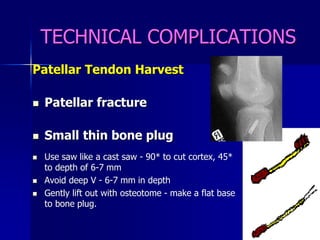
TECHNICAL COMPLICATIONS
Patellar Tendon Harvest
 Patellar fracture
 Small thin bone plug
 Use saw like a cast saw - 90* to cut cortex, 45*
to depth of 6-7 mm
 Avoid deep V - 6-7 mm in depth
 Gently lift out with osteotome - make a flat base
to bone plug.
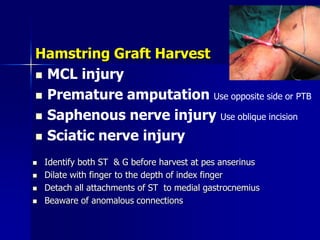
Hamstring Graft Harvest
 MCL injury
 Premature amputation Use opposite side or PTB
 Saphenous nerve injury Use oblique incision
 Sciatic nerve injury
 Identify both ST & G before harvest at pes anserinus
 Dilate with finger to the depth of index finger
 Detach all attachments of ST to medial gastrocnemius
 Beaware of anomalous connections
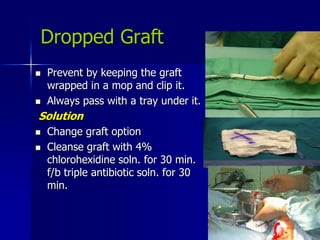
Dropped Graft
 Prevent by keeping the graft
wrapped in a mop and clip it.
 Always pass with a tray under it.
Solution
 Change graft option
 Cleanse graft with 4%
chlorohexidine soln. for 30 min.
f/b triple antibiotic soln. for 30
min.
Tibial Tunnel Preparation
 Transportal (AM or Accesory AM)
 Injury to cartilage of MFC
 Short tunnel length
 Limited visualization
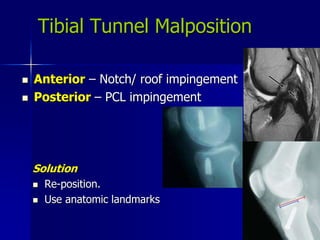
Tibial Tunnel Malposition
 Anterior – Notch/ roof impingement
 Posterior – PCL impingement
Solution
 Re-position.
 Use anatomic landmarks
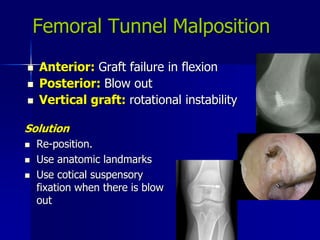
Femoral Tunnel Malposition
 Anterior: Graft failure in flexion
 Posterior: Blow out
 Vertical graft: rotational instability
Solution
 Re-position.
 Use anatomic landmarks
 Use cotical suspensory
fixation when there is blow
out
GRAFT PASSAGE COMPLICATIONS
 Knot failure: use continuous loop
(Endobutton CL)
 Graft laceration: mismatch betn.
graft & tunnel
 Loose graft in tunnel
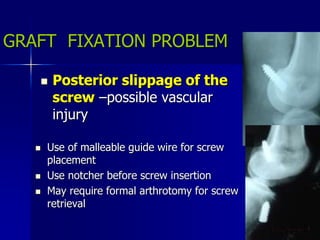
GRAFT FIXATION PROBLEM
 Posterior slippage of the
screw –possible vascular
injury
 Use of malleable guide wire for screw
placement
 Use notcher before screw insertion
 May require formal arthrotomy for screw
retrieval
Screw protrusion into Joint:
 Can cause cartilage injury
 Bioscrew may break in joint
Prevention
 Always verify screw protrusion by
probing after fixation while using screw
longer than 30 mm.
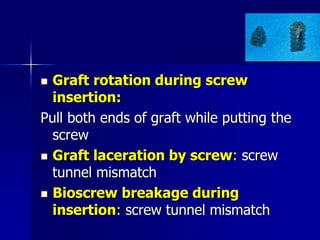
 Graft rotation during screw
insertion:
Pull both ends of graft while putting the
screw
 Graft laceration by screw: screw
tunnel mismatch
 Bioscrew breakage during
insertion: screw tunnel mismatch
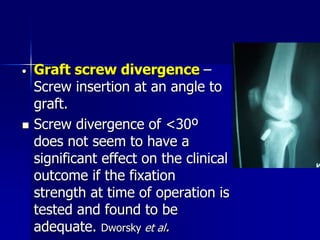
• Graft screw divergence –
Screw insertion at an angle to
graft.
 Screw divergence of <30º
does not seem to have a
significant effect on the clinical
outcome if the fixation
strength at time of operation is
tested and found to be
adequate. Dworsky et al.
Loose tibial side fixation
 Use cortical fixation
- with suture disc / suture post
or direct cortical fixation
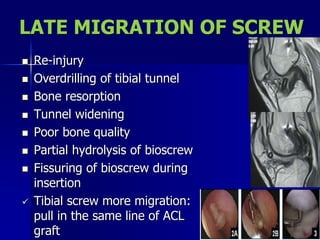
LATE MIGRATION OF SCREW
 Re-injury
 Overdrilling of tibial tunnel
 Bone resorption
 Tunnel widening
 Poor bone quality
 Partial hydrolysis of bioscrew
 Fissuring of bioscrew during
insertion
 Tibial screw more migration:
pull in the same line of ACL
graft
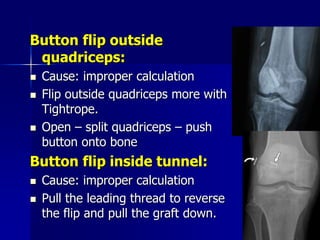
Button flip outside
quadriceps:
 Cause: improper calculation
 Flip outside quadriceps more with
Tightrope.
 Open – split quadriceps – push
button onto bone
Button flip inside tunnel:
 Cause: improper calculation
 Pull the leading thread to reverse
the flip and pull the graft down.
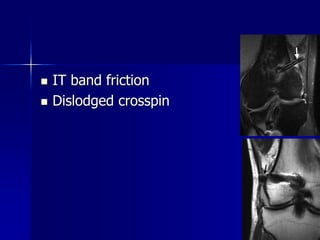
 IT band friction
 Dislodged crosspin
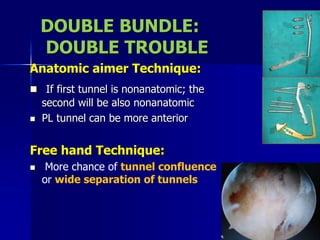
Anatomic aimer Technique:
 If first tunnel is nonanatomic; the
second will be also nonanatomic
 PL tunnel can be more anterior
Free hand Technique:
 More chance of tunnel confluence
or wide separation of tunnels
DOUBLE BUNDLE:
DOUBLE TROUBLE
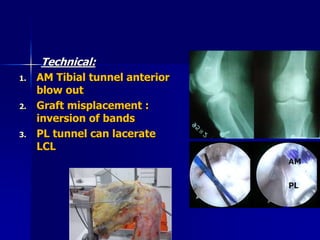
Technical:
1. AM Tibial tunnel anterior
blow out
2. Graft misplacement :
inversion of bands
3. PL tunnel can lacerate
LCL
AM
PL
PL
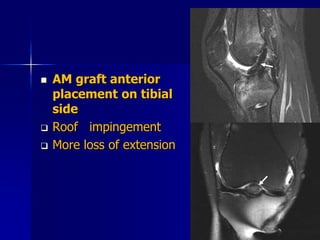
 AM graft anterior
placement on tibial
side
 Roof impingement
 More loss of extension
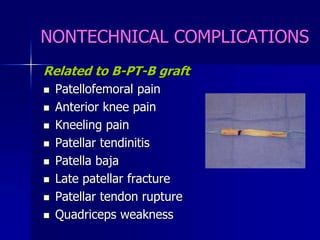
NONTECHNICAL COMPLICATIONS
Related to B-PT-B graft
 Patellofemoral pain
 Anterior knee pain
 Kneeling pain
 Patellar tendinitis
 Patella baja
 Late patellar fracture
 Patellar tendon rupture
 Quadriceps weakness
Related to ST_G graft
 Sensory loss along IPSBN & SBSN:
least with oblique incision
 Hamstring weakness
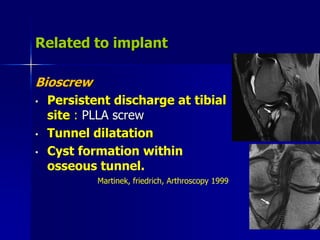
Related to implant
Bioscrew
• Persistent discharge at tibial
site : PLLA screw
• Tunnel dilatation
• Cyst formation within
osseous tunnel.
Martinek, friedrich, Arthroscopy 1999
Not related to graft
 Aseptic Effusion
 Infection
 Thromboembolic disease
 Arthrofibrosis
 Reflex sympathetic dystrophy
 Early osteoarthritic changes
 Fracture through tunnels
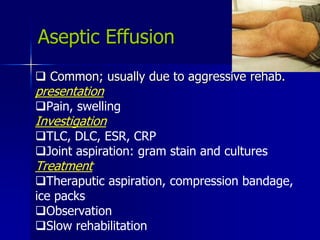
Aseptic Effusion
 Common; usually due to aggressive rehab.
presentation
Pain, swelling
Investigation
TLC, DLC, ESR, CRP
Joint aspiration: gram stain and cultures
Treatment
Theraputic aspiration, compression bandage,
ice packs
Observation
Slow rehabilitation
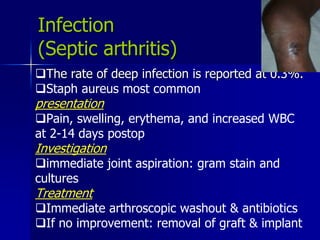
Infection
(Septic arthritis)
The rate of deep infection is reported at 0.3%.
Staph aureus most common
presentation
Pain, swelling, erythema, and increased WBC
at 2-14 days postop
Investigation
immediate joint aspiration: gram stain and
cultures
Treatment
Immediate arthroscopic washout & antibiotics
If no improvement: removal of graft & implant
Arthrofibrosis/ Loss of motion
 More with acute ACLR: ensure full ROM and
subsidence of swelling before surgery
 Proper tunnel placement
 Aggressive cryotherapy in post-op
Treatment
 < 3 mo: Aggressive physiotherapy, CPM
 > 3 mo: arthroscopic arthrolysis, cyclops
excission
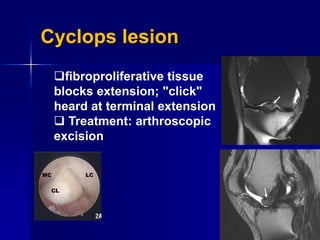
Cyclops lesion
fibroproliferative tissue
blocks extension; "click"
heard at terminal extension
 Treatment: arthroscopic
excision
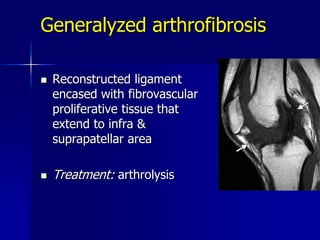
Generalyzed arthrofibrosis
 Reconstructed ligament
encased with fibrovascular
proliferative tissue that
extend to infra &
suprapatellar area
 Treatment: arthrolysis
 Incidence 18%
 Related to status of menisci at the
time of surgery – Kaiser & Dameron
Early osteoarthritic changes
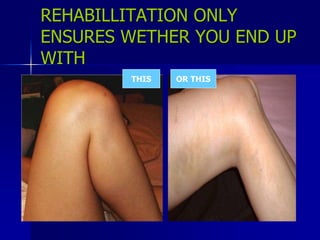
REHABILLITATION ONLY
ENSURES WETHER YOU END UP
WITH
THIS OR THIS
WORK UP FOR A FAILED
ACL
 Clinical: ROM, manual laxity tests,
arthrometer
 Radiographic: Xray, stress view, MRI
 Others: Hematologic, joint aspiration
analysis
 Diagnostic Arthroscopy
Conclusions
 ACL reconstruction is a procedure that
has a long learning curve.
 Various perioperative considerations
determine the final outcome
 Meticulous technique prevents
complications
 Familiarity with use of different grafts &
different modes of fixation might save a lot
of sweat on the operating table.
 Failed cases need to be thoroughly worked
up to find the cause of failure.
Complications in ACL reconstruction 2014

Complications in ACL reconstruction 2014

  • 1.
    DR DHANANJAYA SABATMS, DNB, MNAMS Assistant Professor DEPARTMENT OF ORTHOPAEDICS COMPLICATIONS IN A C L RECONSTRUCTION
  • 2.
    No one likesto experience complications, but the surgeon who is prepared to deal with the potential complications will rise above the rest. Remember: "It's not if, but when, and how bad."
  • 3.
    Presentation of failureof ACLR  Persistent pain (most consistent patient complaint)  Instability  Joint swelling  Infection  Stiff knee
  • 4.
    Five possible causesof reconstruction failure and patient complication  Graft discontinuity (a tear or impingement in the graft)  Inappropriate position of the femoral and/or tibial tunnel (graft will not function properly without proper tunnel positioning)  Hardware failure (screws may not be in the right position)  Infection  Arthrofibrosis (affecting movement of the joint).
  • 5.
    POINTS TO NOTE>>>> Surgical technical error is most common cause  Tunnel placement error is the cause of revision surgery in 70% cases  Missed diagnosis of associated MCL or PLC injury is common.
  • 6.
    COMPLICATIONS TECHNICAL  During graftharvest  During tunnel preparation  During fixation of graft NONTECHNICAL  Implant and instrument breakage  Specific complications - Related to graft
  • 7.
    TECHNICAL COMPLICATIONS Patellar TendonHarvest  Patellar fracture  Small thin bone plug  Use saw like a cast saw - 90* to cut cortex, 45* to depth of 6-7 mm  Avoid deep V - 6-7 mm in depth  Gently lift out with osteotome - make a flat base to bone plug.
  • 8.
    Hamstring Graft Harvest MCL injury  Premature amputation Use opposite side or PTB  Saphenous nerve injury Use oblique incision  Sciatic nerve injury  Identify both ST & G before harvest at pes anserinus  Dilate with finger to the depth of index finger  Detach all attachments of ST to medial gastrocnemius  Beaware of anomalous connections
  • 9.
    Dropped Graft  Preventby keeping the graft wrapped in a mop and clip it.  Always pass with a tray under it. Solution  Change graft option  Cleanse graft with 4% chlorohexidine soln. for 30 min. f/b triple antibiotic soln. for 30 min.
  • 10.
    Tibial Tunnel Preparation Transportal (AM or Accesory AM)  Injury to cartilage of MFC  Short tunnel length  Limited visualization
  • 11.
    Tibial Tunnel Malposition Anterior – Notch/ roof impingement  Posterior – PCL impingement Solution  Re-position.  Use anatomic landmarks
  • 12.
    Femoral Tunnel Malposition Anterior: Graft failure in flexion  Posterior: Blow out  Vertical graft: rotational instability Solution  Re-position.  Use anatomic landmarks  Use cotical suspensory fixation when there is blow out
  • 13.
    GRAFT PASSAGE COMPLICATIONS Knot failure: use continuous loop (Endobutton CL)  Graft laceration: mismatch betn. graft & tunnel  Loose graft in tunnel
  • 14.
    GRAFT FIXATION PROBLEM Posterior slippage of the screw –possible vascular injury  Use of malleable guide wire for screw placement  Use notcher before screw insertion  May require formal arthrotomy for screw retrieval
  • 15.
    Screw protrusion intoJoint:  Can cause cartilage injury  Bioscrew may break in joint Prevention  Always verify screw protrusion by probing after fixation while using screw longer than 30 mm.
  • 16.
     Graft rotationduring screw insertion: Pull both ends of graft while putting the screw  Graft laceration by screw: screw tunnel mismatch  Bioscrew breakage during insertion: screw tunnel mismatch
  • 17.
    • Graft screwdivergence – Screw insertion at an angle to graft.  Screw divergence of <30º does not seem to have a significant effect on the clinical outcome if the fixation strength at time of operation is tested and found to be adequate. Dworsky et al.
  • 18.
    Loose tibial sidefixation  Use cortical fixation - with suture disc / suture post or direct cortical fixation
  • 19.
    LATE MIGRATION OFSCREW  Re-injury  Overdrilling of tibial tunnel  Bone resorption  Tunnel widening  Poor bone quality  Partial hydrolysis of bioscrew  Fissuring of bioscrew during insertion  Tibial screw more migration: pull in the same line of ACL graft
  • 20.
    Button flip outside quadriceps: Cause: improper calculation  Flip outside quadriceps more with Tightrope.  Open – split quadriceps – push button onto bone Button flip inside tunnel:  Cause: improper calculation  Pull the leading thread to reverse the flip and pull the graft down.
  • 21.
     IT bandfriction  Dislodged crosspin
  • 22.
    Anatomic aimer Technique: If first tunnel is nonanatomic; the second will be also nonanatomic  PL tunnel can be more anterior Free hand Technique:  More chance of tunnel confluence or wide separation of tunnels DOUBLE BUNDLE: DOUBLE TROUBLE
  • 23.
    Technical: 1. AM Tibialtunnel anterior blow out 2. Graft misplacement : inversion of bands 3. PL tunnel can lacerate LCL AM PL PL
  • 24.
     AM graftanterior placement on tibial side  Roof impingement  More loss of extension
  • 25.
    NONTECHNICAL COMPLICATIONS Related toB-PT-B graft  Patellofemoral pain  Anterior knee pain  Kneeling pain  Patellar tendinitis  Patella baja  Late patellar fracture  Patellar tendon rupture  Quadriceps weakness
  • 26.
    Related to ST_Ggraft  Sensory loss along IPSBN & SBSN: least with oblique incision  Hamstring weakness
  • 27.
    Related to implant Bioscrew •Persistent discharge at tibial site : PLLA screw • Tunnel dilatation • Cyst formation within osseous tunnel. Martinek, friedrich, Arthroscopy 1999
  • 28.
    Not related tograft  Aseptic Effusion  Infection  Thromboembolic disease  Arthrofibrosis  Reflex sympathetic dystrophy  Early osteoarthritic changes  Fracture through tunnels
  • 29.
    Aseptic Effusion  Common;usually due to aggressive rehab. presentation Pain, swelling Investigation TLC, DLC, ESR, CRP Joint aspiration: gram stain and cultures Treatment Theraputic aspiration, compression bandage, ice packs Observation Slow rehabilitation
  • 30.
    Infection (Septic arthritis) The rateof deep infection is reported at 0.3%. Staph aureus most common presentation Pain, swelling, erythema, and increased WBC at 2-14 days postop Investigation immediate joint aspiration: gram stain and cultures Treatment Immediate arthroscopic washout & antibiotics If no improvement: removal of graft & implant
  • 31.
    Arthrofibrosis/ Loss ofmotion  More with acute ACLR: ensure full ROM and subsidence of swelling before surgery  Proper tunnel placement  Aggressive cryotherapy in post-op Treatment  < 3 mo: Aggressive physiotherapy, CPM  > 3 mo: arthroscopic arthrolysis, cyclops excission
  • 32.
    Cyclops lesion fibroproliferative tissue blocksextension; "click" heard at terminal extension  Treatment: arthroscopic excision
  • 33.
    Generalyzed arthrofibrosis  Reconstructedligament encased with fibrovascular proliferative tissue that extend to infra & suprapatellar area  Treatment: arthrolysis
  • 34.
     Incidence 18% Related to status of menisci at the time of surgery – Kaiser & Dameron Early osteoarthritic changes
  • 35.
    REHABILLITATION ONLY ENSURES WETHERYOU END UP WITH THIS OR THIS
  • 36.
    WORK UP FORA FAILED ACL  Clinical: ROM, manual laxity tests, arthrometer  Radiographic: Xray, stress view, MRI  Others: Hematologic, joint aspiration analysis  Diagnostic Arthroscopy
  • 37.
    Conclusions  ACL reconstructionis a procedure that has a long learning curve.  Various perioperative considerations determine the final outcome  Meticulous technique prevents complications
  • 38.
     Familiarity withuse of different grafts & different modes of fixation might save a lot of sweat on the operating table.  Failed cases need to be thoroughly worked up to find the cause of failure.