LATERAL CONDYLE
FRACTURES IN CHILDREN


            Dr.MADHUSUDAN
            Assistant professor
            Dept. of orthopaedics
            Osmania General Hospital
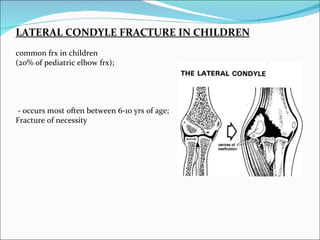
LATERAL CONDYLE FRACTURE IN CHILDREN
common frx in children
(20% of pediatric elbow frx);


- occurs most often between 6-10 yrs of age;
Fracture of necessity
Mechanism of injury:

->When a varus force is applied to
  the extended elbow.

->They tend to be unstable and
  become displaced because of pull of
  the forearm extensors.

->Since these fractures are intra-articular they are
   prone to nonunion because the fracture is bathed
in synovial fluid.
- associated injuries: elbow dislocation;
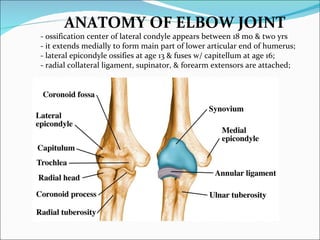
ANATOMY OF ELBOW JOINT
- ossification center of lateral condyle appears between 18 mo & two yrs
- it extends medially to form main part of lower articular end of humerus;
- lateral epicondyle ossifies at age 13 & fuses w/ capitellum at age 16;
- radial collateral ligament, supinator, & forearm extensors are attached;
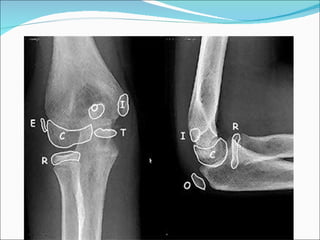
Ossification Centres
Mnemonic CRITOE
๏‚— C - capitellum
๏‚— R - radial head
๏‚— I - Internal Epicondyle
๏‚— T - Trochlea
๏‚— O - Olecranon
๏‚— E - External Epicondyle
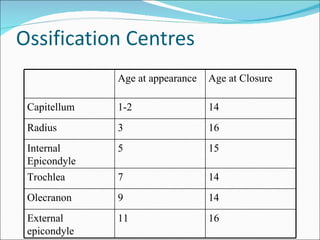
Ossification Centres
              Age at appearance   Age at Closure

 Capitellum   1-2                 14
 Radius       3                   16
 Internal     5                   15
 Epicondyle
 Trochlea     7                   14
 Olecranon    9                   14
 External     11                  16
 epicondyle
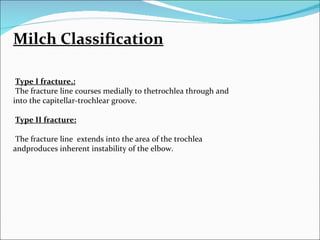
Milch Classification

 Type I fracture,:
 The fracture line courses medially to thetrochlea through and
into the capitellar-trochlear groove.

Type II fracture:

 The fracture line extends into the area of the trochlea
andproduces inherent instability of the elbow.
Figure 2Illustrations of the Milch classification of lateral condylar fracture.
A, In type I, the fracture line courses lateral to the trochlea and exits into the
capitulotrochlear groove.
B, In type II, the fracture line extends into the apex of the trochlea.
(Reproduced from Sullivan JA: Fractures of the lateral condyle of the humerus.
J Am Acad Orthop Surg 2006;14[1]:58-62.)
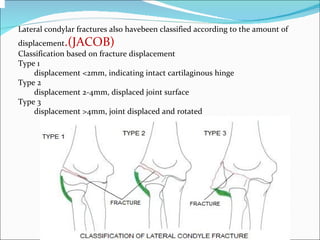
Lateral condylar fractures also havebeen classified according to the amount of
displacement.(JACOB)
Classification based on fracture displacement
Type 1
     displacement <2mm, indicating intact cartilaginous hinge
Type 2
     displacement 2-4mm, displaced joint surface
Type 3
     displacement >4mm, joint displaced and rotated
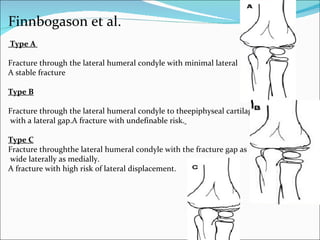
Finnbogason et al.
Type A

Fracture through the lateral humeral condyle with minimal lateral gap .
A stable fracture

Type B

Fracture through the lateral humeral condyle to theepiphyseal cartilage
with a lateral gap.A fracture with undefinable risk.

Type C
Fracture throughthe lateral humeral condyle with the fracture gap as
wide laterally as medially.
A fracture with high risk of lateral displacement.
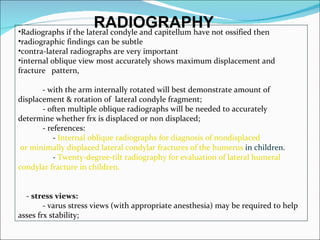
RADIOGRAPHYnot ossified then
โ€ขRadiographs if the lateral condyle and capitellum have
โ€ขradiographic findings can be subtle
โ€ขcontra-lateral radiographs are very important
โ€ขinternal oblique view most accurately shows maximum displacement and
fracture pattern,

       - with the arm internally rotated will best demonstrate amount of
displacement & rotation of lateral condyle fragment;
       - often multiple oblique radiographs will be needed to accurately
determine whether frx is displaced or non displaced;
       - references:
           - Internal oblique radiographs for diagnosis of nondisplaced
 or minimally displaced lateral condylar fractures of the humerus in children.
           - Twenty-degree-tilt radiography for evaluation of lateral humeral
condylar fracture in children.


  - stress views:
        - varus stress views (with appropriate anesthesia) may be required to help
asses frx stability;
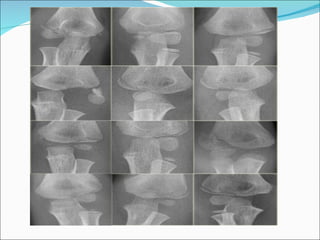
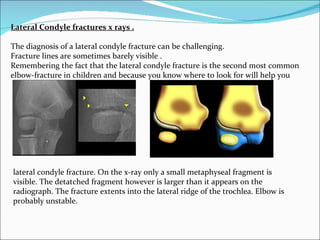
Lateral Condyle fractures x rays .

The diagnosis of a lateral condyle fracture can be challenging.
Fracture lines are sometimes barely visible .
Remembering the fact that the lateral condyle fracture is the second most common
elbow-fracture in children and because you know where to look for will help you


lateral condyle fracture. On the x-ray only a small metaphyseal fragment is
visible. The detatched fragment however is larger than it appears on the
radiograph. The fracture extents into the lateral ridge of the trochlea. Elbow is
probably unstable.
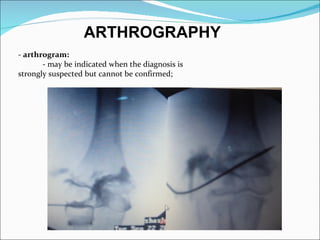
ARTHROGRAPHY
- arthrogram:
       - may be indicated when the diagnosis is
strongly suspected but cannot be confirmed;
CT SCAN
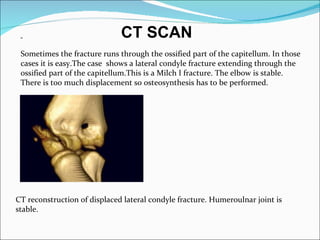
 Sometimes the fracture runs through the ossified part of the capitellum. In those
 cases it is easy.The case shows a lateral condyle fracture extending through the
 ossified part of the capitellum.This is a Milch I fracture. The elbow is stable.
 There is too much displacement so osteosynthesis has to be performed.


CT reconstruction of displaced lateral condyle fracture. Humeroulnar joint is
stable.
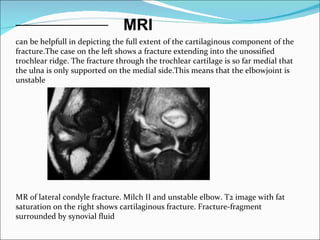
MRI
can be helpfull in depicting the full extent of the cartilaginous component of the
fracture.The case on the left shows a fracture extending into the unossified
trochlear ridge. The fracture through the trochlear cartilage is so far medial that
the ulna is only supported on the medial side.This means that the elbowjoint is
unstable


MR of lateral condyle fracture. Milch II and unstable elbow. T2 image with fat
saturation on the right shows cartilaginous fracture. Fracture-fragment
surrounded by synovial fluid
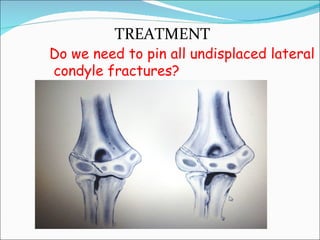
TREATMENT
Do we need to pin all undisplaced lateral
condyle fractures?
THE MESSAGE:
       -WHEN IN DOUBT PIN
   -FOLLOW UNTIL FULLY HEALED
CLINICALLY AND RADIOGRAPHICALLY
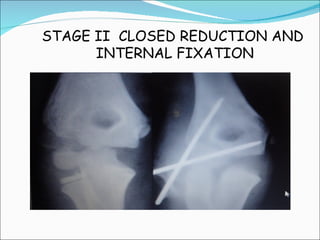
STAGE II CLOSED REDUCTION AND
      INTERNAL FIXATION
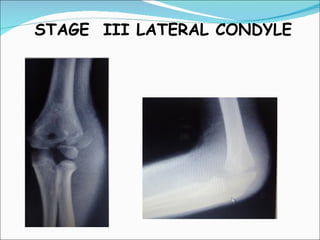
STAGE III LATERAL CONDYLE
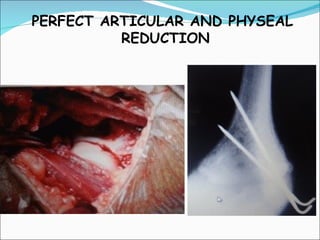
PERFECT ARTICULAR AND PHYSEAL
          REDUCTION
LATE
PRESENTATION
LATERAL
CONDYLE
FRACTURES IN
CHILDREN
What do
 late
presenters
present with?
COMPLICATIONS
Physeal arrest โ€“ cubitus valgus
Physeal stimulation โ€“ cubitus varus
Osteonecrosis.
Nonunion with resultant cubitus valgus
@ย tardy ulnar nerve palsy
If you can not fix the non union
What do we treat?


    Problem oriented solutions
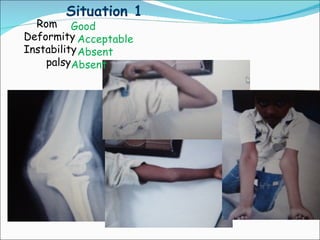
Situation 1
  Rom Good
Deformity Acceptable
Instability Absent
    palsyAbsent
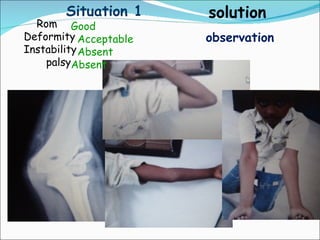
Situation 1     solution
  Rom Good
Deformity Acceptable   observation
Instability Absent
    palsyAbsent
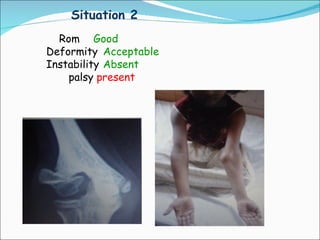
Situation 2
  Rom Good
Deformity Acceptable
Instability Absent
    palsy present
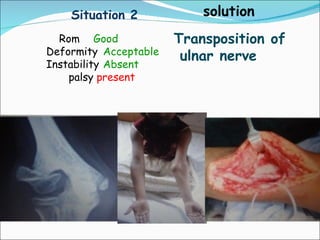
Situation 2            solution
  Rom Good             Transposition of
Deformity Acceptable    ulnar nerve
Instability Absent
    palsy present
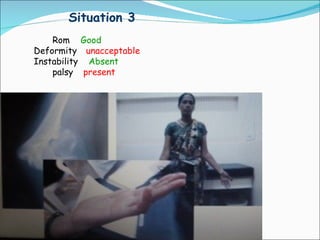
Situation 3
    Rom Good
Deformity unacceptable
Instability Absent
    palsy present
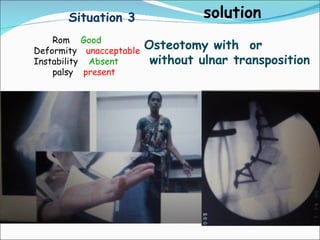
Situation 3                 solution
    Rom Good
Deformity unacceptable
                         Osteotomy with or
Instability Absent        without ulnar transposition
    palsy present
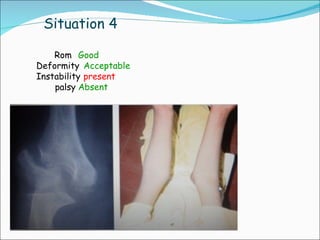
Situation 4

    Rom Good
Deformity Acceptable
Instability present
    palsy Absent
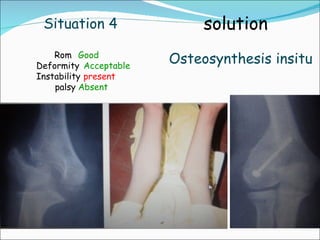
Situation 4                solution
    Rom Good
Deformity Acceptable
                       Osteosynthesis insitu
Instability present
    palsy Absent
COMPLICATIONS
-
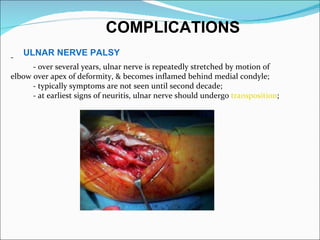
    ULNAR NERVE PALSY
      - over several years, ulnar nerve is repeatedly stretched by motion of
elbow over apex of deformity, & becomes inflamed behind medial condyle;
      - typically symptoms are not seen until second decade;
      - at earliest signs of neuritis, ulnar nerve should undergo transposition;
AVN of capitellum:
      - will cause growth distrubance & deformity of capitellum & radial
head;
      - during exposure, posterior aspect of frx fragment is left
undisturbed because it is source of blood supply to the capitellum;
      - in children, vascular supply of trochlea is vulnerable to injury;

           - risk of AVN with late open reduction of LCF at >3 weeks is
reduced if no tissue is stripped off the fracture fragment
posteriorly; - cubitus varus:
      - a more common complication than cubitus valgus;
      - may be due to over-stimulation of the lateral condylar condylar
physis;
Final final  madhu sir

Final final madhu sir

  • 1.
    LATERAL CONDYLE FRACTURES INCHILDREN Dr.MADHUSUDAN Assistant professor Dept. of orthopaedics Osmania General Hospital
  • 2.
    LATERAL CONDYLE FRACTUREIN CHILDREN common frx in children (20% of pediatric elbow frx); - occurs most often between 6-10 yrs of age; Fracture of necessity
  • 3.
    Mechanism of injury: ->Whena varus force is applied to the extended elbow. ->They tend to be unstable and become displaced because of pull of the forearm extensors. ->Since these fractures are intra-articular they are prone to nonunion because the fracture is bathed in synovial fluid. - associated injuries: elbow dislocation;
  • 4.
    ANATOMY OF ELBOWJOINT - ossification center of lateral condyle appears between 18 mo & two yrs - it extends medially to form main part of lower articular end of humerus; - lateral epicondyle ossifies at age 13 & fuses w/ capitellum at age 16; - radial collateral ligament, supinator, & forearm extensors are attached;
  • 5.
    Ossification Centres Mnemonic CRITOE ๏‚—C - capitellum ๏‚— R - radial head ๏‚— I - Internal Epicondyle ๏‚— T - Trochlea ๏‚— O - Olecranon ๏‚— E - External Epicondyle
  • 6.
    Ossification Centres Age at appearance Age at Closure Capitellum 1-2 14 Radius 3 16 Internal 5 15 Epicondyle Trochlea 7 14 Olecranon 9 14 External 11 16 epicondyle
  • 8.
    Milch Classification TypeI fracture,: The fracture line courses medially to thetrochlea through and into the capitellar-trochlear groove. Type II fracture: The fracture line extends into the area of the trochlea andproduces inherent instability of the elbow.
  • 9.
    Figure 2Illustrations ofthe Milch classification of lateral condylar fracture. A, In type I, the fracture line courses lateral to the trochlea and exits into the capitulotrochlear groove. B, In type II, the fracture line extends into the apex of the trochlea. (Reproduced from Sullivan JA: Fractures of the lateral condyle of the humerus. J Am Acad Orthop Surg 2006;14[1]:58-62.)
  • 10.
    Lateral condylar fracturesalso havebeen classified according to the amount of displacement.(JACOB) Classification based on fracture displacement Type 1 displacement <2mm, indicating intact cartilaginous hinge Type 2 displacement 2-4mm, displaced joint surface Type 3 displacement >4mm, joint displaced and rotated
  • 11.
    Finnbogason et al. TypeA Fracture through the lateral humeral condyle with minimal lateral gap . A stable fracture Type B Fracture through the lateral humeral condyle to theepiphyseal cartilage with a lateral gap.A fracture with undefinable risk. Type C Fracture throughthe lateral humeral condyle with the fracture gap as wide laterally as medially. A fracture with high risk of lateral displacement.
  • 13.
    RADIOGRAPHYnot ossified then โ€ขRadiographsif the lateral condyle and capitellum have โ€ขradiographic findings can be subtle โ€ขcontra-lateral radiographs are very important โ€ขinternal oblique view most accurately shows maximum displacement and fracture pattern, - with the arm internally rotated will best demonstrate amount of displacement & rotation of lateral condyle fragment; - often multiple oblique radiographs will be needed to accurately determine whether frx is displaced or non displaced; - references: - Internal oblique radiographs for diagnosis of nondisplaced or minimally displaced lateral condylar fractures of the humerus in children. - Twenty-degree-tilt radiography for evaluation of lateral humeral condylar fracture in children. - stress views: - varus stress views (with appropriate anesthesia) may be required to help asses frx stability;
  • 14.
    Lateral Condyle fracturesx rays . The diagnosis of a lateral condyle fracture can be challenging. Fracture lines are sometimes barely visible . Remembering the fact that the lateral condyle fracture is the second most common elbow-fracture in children and because you know where to look for will help you lateral condyle fracture. On the x-ray only a small metaphyseal fragment is visible. The detatched fragment however is larger than it appears on the radiograph. The fracture extents into the lateral ridge of the trochlea. Elbow is probably unstable.
  • 15.
    ARTHROGRAPHY - arthrogram: - may be indicated when the diagnosis is strongly suspected but cannot be confirmed;
  • 16.
    CT SCAN Sometimesthe fracture runs through the ossified part of the capitellum. In those cases it is easy.The case shows a lateral condyle fracture extending through the ossified part of the capitellum.This is a Milch I fracture. The elbow is stable. There is too much displacement so osteosynthesis has to be performed. CT reconstruction of displaced lateral condyle fracture. Humeroulnar joint is stable.
  • 17.
    MRI can be helpfullin depicting the full extent of the cartilaginous component of the fracture.The case on the left shows a fracture extending into the unossified trochlear ridge. The fracture through the trochlear cartilage is so far medial that the ulna is only supported on the medial side.This means that the elbowjoint is unstable MR of lateral condyle fracture. Milch II and unstable elbow. T2 image with fat saturation on the right shows cartilaginous fracture. Fracture-fragment surrounded by synovial fluid
  • 18.
    TREATMENT Do we needto pin all undisplaced lateral condyle fractures?
  • 19.
    THE MESSAGE: -WHEN IN DOUBT PIN -FOLLOW UNTIL FULLY HEALED CLINICALLY AND RADIOGRAPHICALLY
  • 20.
    STAGE II CLOSEDREDUCTION AND INTERNAL FIXATION
  • 21.
  • 22.
    PERFECT ARTICULAR ANDPHYSEAL REDUCTION
  • 24.
  • 25.
  • 26.
    COMPLICATIONS Physeal arrest โ€“cubitus valgus Physeal stimulation โ€“ cubitus varus Osteonecrosis. Nonunion with resultant cubitus valgus @ย tardy ulnar nerve palsy
  • 27.
    If you cannot fix the non union What do we treat? Problem oriented solutions
  • 28.
    Situation 1 Rom Good Deformity Acceptable Instability Absent palsyAbsent
  • 29.
    Situation 1 solution Rom Good Deformity Acceptable observation Instability Absent palsyAbsent
  • 30.
    Situation 2 Rom Good Deformity Acceptable Instability Absent palsy present
  • 31.
    Situation 2 solution Rom Good Transposition of Deformity Acceptable ulnar nerve Instability Absent palsy present
  • 32.
    Situation 3 Rom Good Deformity unacceptable Instability Absent palsy present
  • 33.
    Situation 3 solution Rom Good Deformity unacceptable Osteotomy with or Instability Absent without ulnar transposition palsy present
  • 34.
    Situation 4 Rom Good Deformity Acceptable Instability present palsy Absent
  • 35.
    Situation 4 solution Rom Good Deformity Acceptable Osteosynthesis insitu Instability present palsy Absent
  • 36.
    COMPLICATIONS - ULNAR NERVE PALSY - over several years, ulnar nerve is repeatedly stretched by motion of elbow over apex of deformity, & becomes inflamed behind medial condyle; - typically symptoms are not seen until second decade; - at earliest signs of neuritis, ulnar nerve should undergo transposition;
  • 37.
    AVN of capitellum: - will cause growth distrubance & deformity of capitellum & radial head; - during exposure, posterior aspect of frx fragment is left undisturbed because it is source of blood supply to the capitellum; - in children, vascular supply of trochlea is vulnerable to injury; - risk of AVN with late open reduction of LCF at >3 weeks is reduced if no tissue is stripped off the fracture fragment posteriorly; - cubitus varus: - a more common complication than cubitus valgus; - may be due to over-stimulation of the lateral condylar condylar physis;