Meniscus Repair   Kevin R. Stone, M.D. Ann W. Walgenbach, RNNP,  Abhi Freyer, Thomas J. Turek  Stone Research Foundation San Francisco XXIV Congress of the Spanish Arthroscopy Association
Meniscal Tears Cutting Sports: Tennis, Soccer Impact sports: Running, Skiing High Risk activities One million annual meniscus operations in the United States 1 85% meniscectomy 61 acute tears per 100,000 persons 2 2.5:1 (Male:Female) Incidence 1,2 American   Academy of Orthopaedic Surgeons
A young patient with a  lateral  meniscus-deficient knee is doomed to the development of osteoarthritis, pain, and reduced knee function. What happens in a  medial  meniscus-deficient knee?   It varies. Implications of Tears:
Biomechanical Considerations Resection of the medial posterior horn increased tibiofemoral forces up to 68%  1 Ahmed AM, Burke DL. In-vitro measurement of static pressure distribution in synovial joints. Part I. Tibial surface of the knee.  J Biomech Eng  1983;105:216–25.
Biomechanical Considerations Lateral meniscus covers 84% of the lateral tibial plateau versus 64% for the medial 1 More circular than the medial meniscus  More uniform in width (average, 12 to 13 mm)  Meniscal Excursion 2 : Lateral meniscal motion after 5 to 10 degrees flexion Medial meniscal displacement after 17 to 20 degrees of flexion.  Medial meniscus has limited displacement and rotation due to the posterior oblique ligament.  Increased mobility of the lateral meniscus can be responsible for the more frequent medial injuries  1 Ferrer-Roca O, Vilalta C. Lesions of the meniscus. Part I: Macroscopic and histologic findings. Clin Orthop. 1980;146:289-300. 2 DePalma AF.  Diseases of Knee: Management in Medicine and Surgery . Philadelphia: Lippincott; 1954
Diagnosing Tears Medical history 85-98% accurate in diagnosing tears 1 MRI 90-98% accurate 2,3  Using 3 criteria: abnormal signal, abnormal pathology, truncated or cleft. Knee palpation: 34-58% with ACL injury, 77% without 4,5 1 Johnson 1996  2 Brindle 2001  3 Andrish 1996  4 Boeree 1991  5 Anderson 1986 Clicking, popping, or locking Soreness Swelling Symptoms Clinical Examination
Complex Meniscal Tears Radial Parrot Beak Bucket handle Flap Peripheral Horizontal Vertical Capsular Separation 1 2 3 4 Courtesy of John Crues, MD
Meniscal Tears Abnormal signal with chronic ACL with Vertical Meniscal Tear
Meniscal Tears Abnormal meniscus morphology by MRI
Meniscal Tears Truncated abnormal triangle T1 Sagittal T2 Sagittal
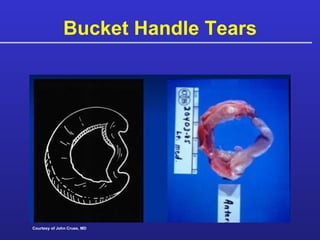
Bucket Handle Tears Courtesy of John Crues, MD
Meniscal Tears Bucket handle T1 Sagittal T2 Sagittal
Meniscal Tears Locked Knee
Meniscal Tears Unstable Fragment
Meniscal Tears Displaced Fragment
Meniscal Cysts Parameniscal Cyst with Meniscal Tear
Popliteal (Baker’s) Cyst Causes Torn Meniscus (~80% of all cysts) Knee instability Arthritis Infection Acute trauma Symptoms  Posterior knee lump with pain, aching, swelling Pronounced when standing Sensation of pressure from the lump Loss of range of motion from swelling Clinical Considerations 30% recurrence rate
Patient GC: Baker’s Cysts 73 YO Female Posterior Fluid accumulation Swelling, pain, stiffness, instability  No  crepitus No ROM loss Aspiration and  cortisone (2003) Cyst excision (2005)
Intrameniscal Ossicle
Repair versus Meniscectomy:  the Reason to Repair Joint Stability  Balanced position of Femur and Tibia Force transmission  Average stress reduced by 2-3x Joint lubricity Coefficient of friction 5x lower than ice/ice Shock Absorption Chondral Protection Preserve the Meniscus whenever possible
Fairbank’s Changes: Meniscus Excision Radiographic Changes Ridge Formation Narrowing of joint space Flattening of femoral condyle Formation of bone spurs
Degenerative Radiographic Changes Patient Example: MP1  5-Yr Post medial meniscectomy PA Flexion
Meniscectomy: What Not to Do Movie
Degenerative MR Changes Patient Example: MP 5 Months Post medial meniscectomy
Degenerative MR Changes Patient Example: MB 10 Months Post medial meniscectomy
Dogma of Meniscus Biology I: Vascular “Red Zone” Excellent healing Fibroblast-like II. “Red and White Zone” Good healing Periphery of vascularized region II: Avascular “White Zone” Poor healing Fibrochondrocytes, Type VI collagen 1  Mc Devitt CA, Webber RJ. The ultrastructure and biochemistry of meniscal cartilage. Clin Orthop. 1990;252:8-18.  2  Arnoczky SP, Warren RF. Microvasculature of the human meniscus. Am J Sports Med. 1982 Mar-Apr;10(2):90-5.  I  II  III
Success rate Inverse Correlation Rim width Tear Length  Patient age Knee instability/ACL deficiency BMI Success Rates Johnson (1999) 76% Cannon (1992) 82% Jakob (1998) 78% Ryu (1988) 87% Stone (1986) 56% Complete, 25% Partial Rosenberg (1986) 83% Complete, 17% Partial Long term healing rate? Re-tears? Restore normal function?
Patient Example: SA 16 year old female LaCrosse: Twisted knee Audible “Pop” Pain, Stiffness, Instablility Torn ACL Torn medial meniscus T1 MRI
SA: Preoperative Images STIR MRI: acute trauma PD MRI T1 MRI: Torn ACL
SA: Meniscoresis Movie
SA: Postoperative X-Ray
Patient Example: VT 30 year old male 1.5 month volleyball injury Knee giving way Pain, swelling, instability Torn ACL Torn lateral meniscus
VT: Tear Identification Medial compartment: probing the meniscus
VT: Tear Identification Lateral compartment: identification of the tear
VT: Meniscal Repair “ Hay Bale” Suture Technique (“Bala de Heno”)
Patient example: CD 20 y.o. male Twisted knee on wet stairs Pain, swelling, weakness, instability Torn ACL Bucket handle Tear (lateral) Peripheral tear (medial) T1 MRI
CD: Preoperative Images AP X-ray Lateral X-ray MRI: Torn ACL
CD: Stable Peripheral Tear Healing already initiated
CD: Bucket Handle Tear: Excise or Repair? Movie
CD: Postoperative X-Ray
Surgical Technique: Suture Repair Inside-Out through mini incisions Movie
Bucket Handle Tears repair young – fail old
Bucket Handle repair: Suture Technique Movie
Bucket Handle Repair
Fixation Devices Suture success rate 78% versus 56% for arrow or T Fix (Venkatachalam 2001) Problems: Migration Failure/Re-tear Patient discomfort
Bionix Arrow Bionix Implants, Inc.
Fixation Devices Biostinger   Barber et. al, Arthroscopy 2005
Acufex T-Fix Sutures Smith and Nephew Endoscopy
Meniscus Reconstruction Collagen Meniscus Implant (CMI)
CMI: Pre Op Versus Post Op Preoperative MRI: Meniscal Tear Arthroscopic view of tear Regenerated meniscus 6.6 Months Post-CMI Histology of regenerated meniscus 6.6 Months Post-CMI MRI 3 years post CMI
Meniscus Replacement Meniscus Allograft in the Arthritic Knee
Meniscus Repair: Rehabilitation General Considerations Daily Icing and elevation. Weight-bearing as tolerated. Walk with crutches. Hinged rehab brace (full extension): 4 weeks. Gait assessment to avoid compensatory patterns.  No resisted leg extension machines No high impact or cutting / twisting activities: 4 months post-op.
Meniscal Tears: Prevention Muscular conditioning  muscles absorb force Prevent abnormal rotations Ability to accept an eccentric load (elongation)  Minimize impact: Non-impact training: bicycling Sorbothane shoe/boot inserts  training on soft surfaces Flexibility, agility and strength workouts.  Focus on Core. The conditioning program must be continued throughout the year. Decreasing the impact loading the knee joint:
Conclusions Save the meniscus if the tissue is healthy.
Thank You

Meniscus repair

  • 1.
    Meniscus Repair Kevin R. Stone, M.D. Ann W. Walgenbach, RNNP, Abhi Freyer, Thomas J. Turek Stone Research Foundation San Francisco XXIV Congress of the Spanish Arthroscopy Association
  • 2.
    Meniscal Tears CuttingSports: Tennis, Soccer Impact sports: Running, Skiing High Risk activities One million annual meniscus operations in the United States 1 85% meniscectomy 61 acute tears per 100,000 persons 2 2.5:1 (Male:Female) Incidence 1,2 American Academy of Orthopaedic Surgeons
  • 3.
    A young patientwith a lateral meniscus-deficient knee is doomed to the development of osteoarthritis, pain, and reduced knee function. What happens in a medial meniscus-deficient knee? It varies. Implications of Tears:
  • 4.
    Biomechanical Considerations Resectionof the medial posterior horn increased tibiofemoral forces up to 68% 1 Ahmed AM, Burke DL. In-vitro measurement of static pressure distribution in synovial joints. Part I. Tibial surface of the knee. J Biomech Eng 1983;105:216–25.
  • 5.
    Biomechanical Considerations Lateralmeniscus covers 84% of the lateral tibial plateau versus 64% for the medial 1 More circular than the medial meniscus More uniform in width (average, 12 to 13 mm) Meniscal Excursion 2 : Lateral meniscal motion after 5 to 10 degrees flexion Medial meniscal displacement after 17 to 20 degrees of flexion. Medial meniscus has limited displacement and rotation due to the posterior oblique ligament. Increased mobility of the lateral meniscus can be responsible for the more frequent medial injuries 1 Ferrer-Roca O, Vilalta C. Lesions of the meniscus. Part I: Macroscopic and histologic findings. Clin Orthop. 1980;146:289-300. 2 DePalma AF. Diseases of Knee: Management in Medicine and Surgery . Philadelphia: Lippincott; 1954
  • 6.
    Diagnosing Tears Medicalhistory 85-98% accurate in diagnosing tears 1 MRI 90-98% accurate 2,3 Using 3 criteria: abnormal signal, abnormal pathology, truncated or cleft. Knee palpation: 34-58% with ACL injury, 77% without 4,5 1 Johnson 1996 2 Brindle 2001 3 Andrish 1996 4 Boeree 1991 5 Anderson 1986 Clicking, popping, or locking Soreness Swelling Symptoms Clinical Examination
  • 7.
    Complex Meniscal TearsRadial Parrot Beak Bucket handle Flap Peripheral Horizontal Vertical Capsular Separation 1 2 3 4 Courtesy of John Crues, MD
  • 8.
    Meniscal Tears Abnormalsignal with chronic ACL with Vertical Meniscal Tear
  • 9.
    Meniscal Tears Abnormalmeniscus morphology by MRI
  • 10.
    Meniscal Tears Truncatedabnormal triangle T1 Sagittal T2 Sagittal
  • 11.
    Bucket Handle TearsCourtesy of John Crues, MD
  • 12.
    Meniscal Tears Buckethandle T1 Sagittal T2 Sagittal
  • 13.
  • 14.
  • 15.
  • 16.
    Meniscal Cysts ParameniscalCyst with Meniscal Tear
  • 17.
    Popliteal (Baker’s) CystCauses Torn Meniscus (~80% of all cysts) Knee instability Arthritis Infection Acute trauma Symptoms Posterior knee lump with pain, aching, swelling Pronounced when standing Sensation of pressure from the lump Loss of range of motion from swelling Clinical Considerations 30% recurrence rate
  • 18.
    Patient GC: Baker’sCysts 73 YO Female Posterior Fluid accumulation Swelling, pain, stiffness, instability No crepitus No ROM loss Aspiration and cortisone (2003) Cyst excision (2005)
  • 19.
  • 20.
    Repair versus Meniscectomy: the Reason to Repair Joint Stability Balanced position of Femur and Tibia Force transmission Average stress reduced by 2-3x Joint lubricity Coefficient of friction 5x lower than ice/ice Shock Absorption Chondral Protection Preserve the Meniscus whenever possible
  • 21.
    Fairbank’s Changes: MeniscusExcision Radiographic Changes Ridge Formation Narrowing of joint space Flattening of femoral condyle Formation of bone spurs
  • 22.
    Degenerative Radiographic ChangesPatient Example: MP1 5-Yr Post medial meniscectomy PA Flexion
  • 23.
  • 24.
    Degenerative MR ChangesPatient Example: MP 5 Months Post medial meniscectomy
  • 25.
    Degenerative MR ChangesPatient Example: MB 10 Months Post medial meniscectomy
  • 26.
    Dogma of MeniscusBiology I: Vascular “Red Zone” Excellent healing Fibroblast-like II. “Red and White Zone” Good healing Periphery of vascularized region II: Avascular “White Zone” Poor healing Fibrochondrocytes, Type VI collagen 1 Mc Devitt CA, Webber RJ. The ultrastructure and biochemistry of meniscal cartilage. Clin Orthop. 1990;252:8-18. 2 Arnoczky SP, Warren RF. Microvasculature of the human meniscus. Am J Sports Med. 1982 Mar-Apr;10(2):90-5. I II III
  • 27.
    Success rate InverseCorrelation Rim width Tear Length Patient age Knee instability/ACL deficiency BMI Success Rates Johnson (1999) 76% Cannon (1992) 82% Jakob (1998) 78% Ryu (1988) 87% Stone (1986) 56% Complete, 25% Partial Rosenberg (1986) 83% Complete, 17% Partial Long term healing rate? Re-tears? Restore normal function?
  • 28.
    Patient Example: SA16 year old female LaCrosse: Twisted knee Audible “Pop” Pain, Stiffness, Instablility Torn ACL Torn medial meniscus T1 MRI
  • 29.
    SA: Preoperative ImagesSTIR MRI: acute trauma PD MRI T1 MRI: Torn ACL
  • 30.
  • 31.
  • 32.
    Patient Example: VT30 year old male 1.5 month volleyball injury Knee giving way Pain, swelling, instability Torn ACL Torn lateral meniscus
  • 33.
    VT: Tear IdentificationMedial compartment: probing the meniscus
  • 34.
    VT: Tear IdentificationLateral compartment: identification of the tear
  • 35.
    VT: Meniscal Repair“ Hay Bale” Suture Technique (“Bala de Heno”)
  • 36.
    Patient example: CD20 y.o. male Twisted knee on wet stairs Pain, swelling, weakness, instability Torn ACL Bucket handle Tear (lateral) Peripheral tear (medial) T1 MRI
  • 37.
    CD: Preoperative ImagesAP X-ray Lateral X-ray MRI: Torn ACL
  • 38.
    CD: Stable PeripheralTear Healing already initiated
  • 39.
    CD: Bucket HandleTear: Excise or Repair? Movie
  • 40.
  • 41.
    Surgical Technique: SutureRepair Inside-Out through mini incisions Movie
  • 42.
    Bucket Handle Tearsrepair young – fail old
  • 43.
    Bucket Handle repair:Suture Technique Movie
  • 44.
  • 45.
    Fixation Devices Suturesuccess rate 78% versus 56% for arrow or T Fix (Venkatachalam 2001) Problems: Migration Failure/Re-tear Patient discomfort
  • 46.
    Bionix Arrow BionixImplants, Inc.
  • 47.
    Fixation Devices Biostinger Barber et. al, Arthroscopy 2005
  • 48.
    Acufex T-Fix SuturesSmith and Nephew Endoscopy
  • 49.
    Meniscus Reconstruction CollagenMeniscus Implant (CMI)
  • 50.
    CMI: Pre OpVersus Post Op Preoperative MRI: Meniscal Tear Arthroscopic view of tear Regenerated meniscus 6.6 Months Post-CMI Histology of regenerated meniscus 6.6 Months Post-CMI MRI 3 years post CMI
  • 51.
    Meniscus Replacement MeniscusAllograft in the Arthritic Knee
  • 52.
    Meniscus Repair: RehabilitationGeneral Considerations Daily Icing and elevation. Weight-bearing as tolerated. Walk with crutches. Hinged rehab brace (full extension): 4 weeks. Gait assessment to avoid compensatory patterns. No resisted leg extension machines No high impact or cutting / twisting activities: 4 months post-op.
  • 53.
    Meniscal Tears: PreventionMuscular conditioning muscles absorb force Prevent abnormal rotations Ability to accept an eccentric load (elongation) Minimize impact: Non-impact training: bicycling Sorbothane shoe/boot inserts training on soft surfaces Flexibility, agility and strength workouts. Focus on Core. The conditioning program must be continued throughout the year. Decreasing the impact loading the knee joint:
  • 54.
    Conclusions Save themeniscus if the tissue is healthy.
  • 55.