AOTrauma Principles Course
AO principles and philosophy 1957–2003
Evolution or revolution?
Piet de Boer, UK
2
Learning outcomes
• Outline the AO principles and relate them to fracture
surgery today
• Describe the importance of the soft tissues in fracture
surgery
• Discuss the role of surgery in diaphyseal, metaphyseal,
and articular fractures
3
AO principles and philosophy—aims and
objectives
• Problem of fracture disease
• Development and evolution of AO principles
• Role of fixation in management of fractures
• Importance of soft-tissue care
4
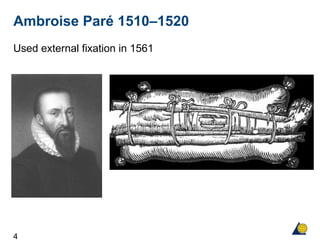
Ambroise Paré 1510–1520
Used external fixation in 1561
5
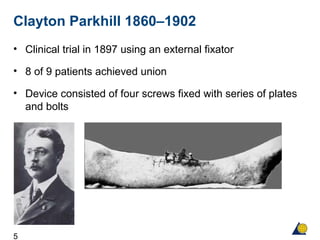
Clayton Parkhill 1860–1902
• Clinical trial in 1897 using an external fixator
• 8 of 9 patients achieved union
• Device consisted of four screws fixed with series of plates
and bolts
6
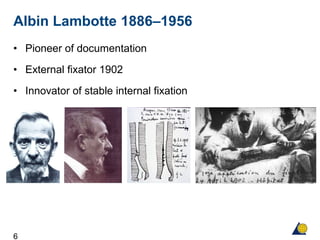
Albin Lambotte 1886–1956
• Pioneer of documentation
• External fixator 1902
• Innovator of stable internal fixation
7
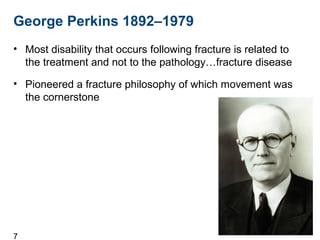
George Perkins 1892–1979
• Most disability that occurs following fracture is related to
the treatment and not to the pathology…fracture disease
• Pioneered a fracture philosophy of which movement was
the cornerstone
8
Fracture disease
Prolonged immobilization and nonweight-bearing resulted in:
• Stiffness
• Muscle atrophy
• Skin atrophy
• Circulatory dysfunction
9
Fracture disease
• To prevent fracture disease you must mobilize the affected
limb
• How do you move the limb but hold the fracture?
• Internal fixation of course!
10
Prevention of fracture disease
• Before the AO, results of internal and external fixation
were usually worse than nonoperative treatment
• Internal fixation was usually accompanied by prolonged
immobilization
11
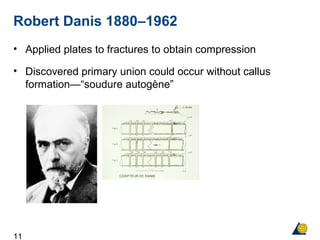
Robert Danis 1880–1962
• Applied plates to fractures to obtain compression
• Discovered primary union could occur without callus
formation—“soudure autogène”
12
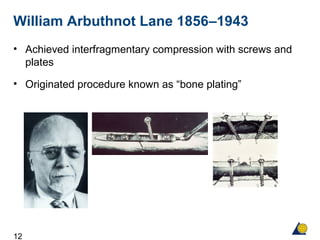
William Arbuthnot Lane 1856–1943
• Achieved interfragmentary compression with screws and
plates
• Originated procedure known as “bone plating”
13
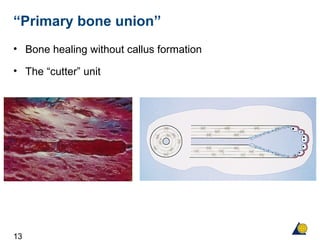
“Primary bone union”
• Bone healing without callus formation
• The “cutter” unit
14
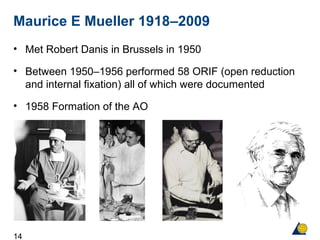
Maurice E Mueller 1918–2009
• Met Robert Danis in Brussels in 1950
• Between 1950–1956 performed 58 ORIF (open reduction
and internal fixation) all of which were documented
• 1958 Formation of the AO
15
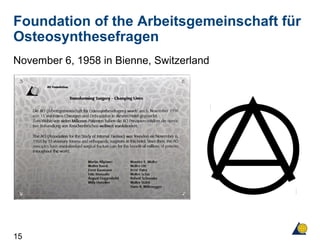
November 6, 1958 in Bienne, Switzerland
Foundation of the Arbeitsgemeinschaft für
Osteosynthesefragen
16
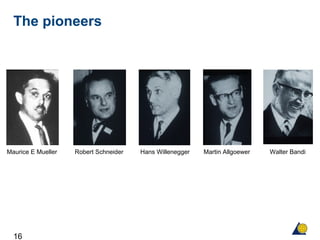
Walter Bandi
The pioneers
Robert Schneider Hans Willenegger Martin AllgoewerMaurice E Mueller
17
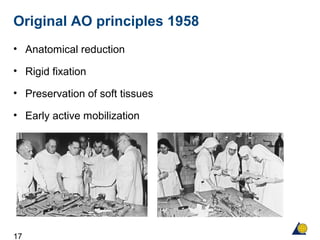
Original AO principles 1958
• Anatomical reduction
• Rigid fixation
• Preservation of soft tissues
• Early active mobilization
18
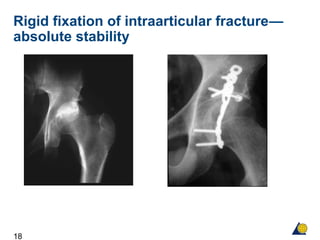
Rigid fixation of intraarticular fracture—
absolute stability
19
Documentation
• Rueedi and Allgoewer documented 487 consecutive tibial
shaft fractures treated by plating
• 98% union
• 3% sepsis
• Superb functional outcomes
20
What went wrong?
• AO techniques were adopted by the world in the 1970s
• Glasgow 30% sepsis, 20% nonunion, treating tibial shaft
fractures by plating
• St Thomas’ 20% sepsis, 20% nonunion
21
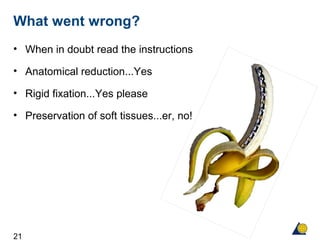
What went wrong?
• When in doubt read the instructions
• Anatomical reduction...Yes
• Rigid fixation...Yes please
• Preservation of soft tissues...er, no!
22
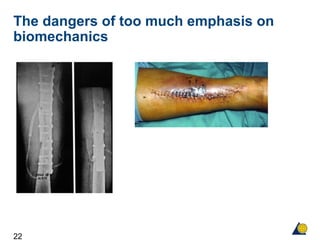
The dangers of too much emphasis on
biomechanics
23
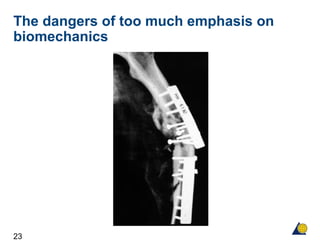
The dangers of too much emphasis on
biomechanics
24
Evolution of AO principles—biology,
preservation of blood supply
• Redesign the plates
• Plates devitalize bone by pressure on the periosteum and
underlying bone
• If you reduce the footprint of the plate you will kill less
bone
25
Improve the biology―redesign the plate
• Plates devitalize bone by pressure on the periosteum and
underlying bone
• If you reduce the footprint of the plate you will kill less
bone
• New concepts favor biological healing (eg; LC-DCP)
26
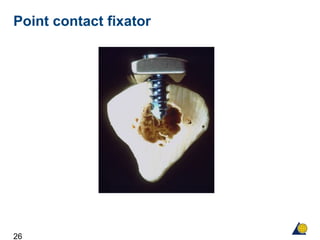
Point contact fixator
27
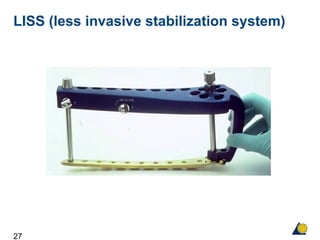
LISS (less invasive stabilization system)
28
Improve the biology—change the surgical
technique
• Open reduction devitalizes the bone
• Indirect reduction is more soft-tissue friendly
29
Do you need to anatomically reduce the
fracture?
• Intraarticular fractures need anatomical reduction
• Shaft fractures need restoration of length, axis, and
rotation for normal function to be restored
30
Improve the biology—change the
mechanics
“Callus is like sex— it’s natural, it joins two things
together and it requires a bit of movement”
[A Apley]
31
Improve the biology―change the
mechanics
If callus is a good way for bones to heal (and it is)
then maybe a bit of movement at the fracture site
would be a good idea after fixation
32
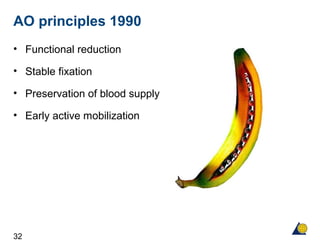
AO principles 1990
• Functional reduction
• Stable fixation
• Preservation of blood supply
• Early active mobilization
33
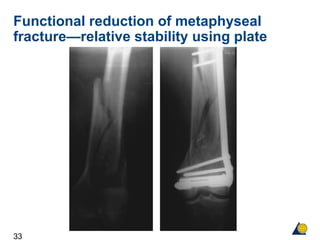
Functional reduction of metaphyseal
fracture—relative stability using plate
34
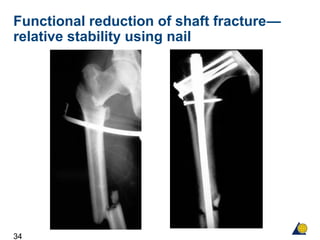
Functional reduction of shaft fracture—
relative stability using nail
35
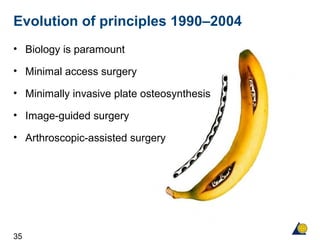
Evolution of principles 1990–2004
• Biology is paramount
• Minimal access surgery
• Minimally invasive plate osteosynthesis
• Image-guided surgery
• Arthroscopic-assisted surgery
36
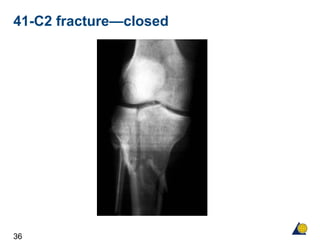
41-C2 fracture—closed
37
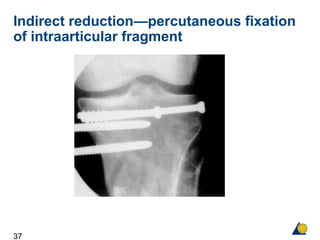
Indirect reduction—percutaneous fixation
of intraarticular fragment
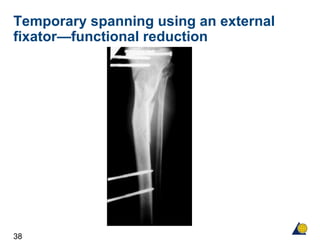
38
Temporary spanning using an external
fixator—functional reduction
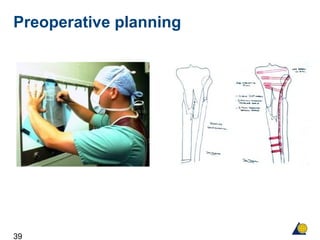
39
Preoperative planning
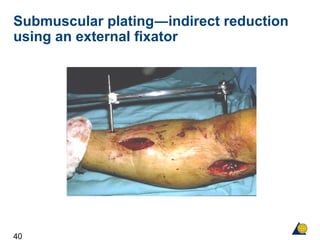
40
Submuscular plating―indirect reduction
using an external fixator
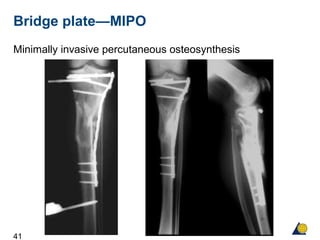
41
Bridge plate—MIPO
Minimally invasive percutaneous osteosynthesis
42
AO principles 2004
• Preservation of blood supply
• Functional reduction
• Stable fixation
• Early active mobilization
43
AO treatment 2004—a spectrum of
possibilities
• Anatomical reduction with rigid fixation
• Functional reduction with stable fixation
• Open reduction
• Closed reduction
• Minimal access surgery
All have their roles. This course will teach you them.
44
AO principles and philosophy; aims and objectives:
• Problem of fracture disease
• Development and evolution of AO principles
• Role of fixation in management of fractures
• Importance of soft-tissue care
Time changes philosophies and treatment techniques but the
philosophy of improving patient care will last forever
Summary

Ao philosophy

  • 1.
    AOTrauma Principles Course AOprinciples and philosophy 1957–2003 Evolution or revolution? Piet de Boer, UK
  • 2.
    2 Learning outcomes • Outlinethe AO principles and relate them to fracture surgery today • Describe the importance of the soft tissues in fracture surgery • Discuss the role of surgery in diaphyseal, metaphyseal, and articular fractures
  • 3.
    3 AO principles andphilosophy—aims and objectives • Problem of fracture disease • Development and evolution of AO principles • Role of fixation in management of fractures • Importance of soft-tissue care
  • 4.
    4 Ambroise Paré 1510–1520 Usedexternal fixation in 1561
  • 5.
    5 Clayton Parkhill 1860–1902 •Clinical trial in 1897 using an external fixator • 8 of 9 patients achieved union • Device consisted of four screws fixed with series of plates and bolts
  • 6.
    6 Albin Lambotte 1886–1956 •Pioneer of documentation • External fixator 1902 • Innovator of stable internal fixation
  • 7.
    7 George Perkins 1892–1979 •Most disability that occurs following fracture is related to the treatment and not to the pathology…fracture disease • Pioneered a fracture philosophy of which movement was the cornerstone
  • 8.
    8 Fracture disease Prolonged immobilizationand nonweight-bearing resulted in: • Stiffness • Muscle atrophy • Skin atrophy • Circulatory dysfunction
  • 9.
    9 Fracture disease • Toprevent fracture disease you must mobilize the affected limb • How do you move the limb but hold the fracture? • Internal fixation of course!
  • 10.
    10 Prevention of fracturedisease • Before the AO, results of internal and external fixation were usually worse than nonoperative treatment • Internal fixation was usually accompanied by prolonged immobilization
  • 11.
    11 Robert Danis 1880–1962 •Applied plates to fractures to obtain compression • Discovered primary union could occur without callus formation—“soudure autogène”
  • 12.
    12 William Arbuthnot Lane1856–1943 • Achieved interfragmentary compression with screws and plates • Originated procedure known as “bone plating”
  • 13.
    13 “Primary bone union” •Bone healing without callus formation • The “cutter” unit
  • 14.
    14 Maurice E Mueller1918–2009 • Met Robert Danis in Brussels in 1950 • Between 1950–1956 performed 58 ORIF (open reduction and internal fixation) all of which were documented • 1958 Formation of the AO
  • 15.
    15 November 6, 1958in Bienne, Switzerland Foundation of the Arbeitsgemeinschaft für Osteosynthesefragen
  • 16.
    16 Walter Bandi The pioneers RobertSchneider Hans Willenegger Martin AllgoewerMaurice E Mueller
  • 17.
    17 Original AO principles1958 • Anatomical reduction • Rigid fixation • Preservation of soft tissues • Early active mobilization
  • 18.
    18 Rigid fixation ofintraarticular fracture— absolute stability
  • 19.
    19 Documentation • Rueedi andAllgoewer documented 487 consecutive tibial shaft fractures treated by plating • 98% union • 3% sepsis • Superb functional outcomes
  • 20.
    20 What went wrong? •AO techniques were adopted by the world in the 1970s • Glasgow 30% sepsis, 20% nonunion, treating tibial shaft fractures by plating • St Thomas’ 20% sepsis, 20% nonunion
  • 21.
    21 What went wrong? •When in doubt read the instructions • Anatomical reduction...Yes • Rigid fixation...Yes please • Preservation of soft tissues...er, no!
  • 22.
    22 The dangers oftoo much emphasis on biomechanics
  • 23.
    23 The dangers oftoo much emphasis on biomechanics
  • 24.
    24 Evolution of AOprinciples—biology, preservation of blood supply • Redesign the plates • Plates devitalize bone by pressure on the periosteum and underlying bone • If you reduce the footprint of the plate you will kill less bone
  • 25.
    25 Improve the biology―redesignthe plate • Plates devitalize bone by pressure on the periosteum and underlying bone • If you reduce the footprint of the plate you will kill less bone • New concepts favor biological healing (eg; LC-DCP)
  • 26.
  • 27.
    27 LISS (less invasivestabilization system)
  • 28.
    28 Improve the biology—changethe surgical technique • Open reduction devitalizes the bone • Indirect reduction is more soft-tissue friendly
  • 29.
    29 Do you needto anatomically reduce the fracture? • Intraarticular fractures need anatomical reduction • Shaft fractures need restoration of length, axis, and rotation for normal function to be restored
  • 30.
    30 Improve the biology—changethe mechanics “Callus is like sex— it’s natural, it joins two things together and it requires a bit of movement” [A Apley]
  • 31.
    31 Improve the biology―changethe mechanics If callus is a good way for bones to heal (and it is) then maybe a bit of movement at the fracture site would be a good idea after fixation
  • 32.
    32 AO principles 1990 •Functional reduction • Stable fixation • Preservation of blood supply • Early active mobilization
  • 33.
    33 Functional reduction ofmetaphyseal fracture—relative stability using plate
  • 34.
    34 Functional reduction ofshaft fracture— relative stability using nail
  • 35.
    35 Evolution of principles1990–2004 • Biology is paramount • Minimal access surgery • Minimally invasive plate osteosynthesis • Image-guided surgery • Arthroscopic-assisted surgery
  • 36.
  • 37.
  • 38.
    38 Temporary spanning usingan external fixator—functional reduction
  • 39.
  • 40.
  • 41.
    41 Bridge plate—MIPO Minimally invasivepercutaneous osteosynthesis
  • 42.
    42 AO principles 2004 •Preservation of blood supply • Functional reduction • Stable fixation • Early active mobilization
  • 43.
    43 AO treatment 2004—aspectrum of possibilities • Anatomical reduction with rigid fixation • Functional reduction with stable fixation • Open reduction • Closed reduction • Minimal access surgery All have their roles. This course will teach you them.
  • 44.
    44 AO principles andphilosophy; aims and objectives: • Problem of fracture disease • Development and evolution of AO principles • Role of fixation in management of fractures • Importance of soft-tissue care Time changes philosophies and treatment techniques but the philosophy of improving patient care will last forever Summary