In the name of God
MENINGITIS
 Meningitis


Master:
Dr.Kermani

By:
Shaghayegh Noorani
Faezeh Sheikolvaezin
?…… What is meningitis
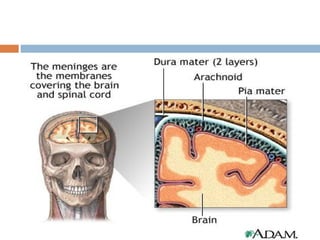
o   The brain and spinal cord are covered by connective
    tissue layers collectively called the meninges which
    form the blood-brain barrier.
(the pia mater (closest to the CNS-1
the arachnoid mater-2
(.the dura mater (farthest from the CNS-3
The meninges contain cerebrospinal fluid (CSF).
Meningitis is an inflammation of the meninges, which, if
severe, may become encephalitis, an inflammation
. of the brain
? W is Meningitis
   hat
   Meningitis can be caused by many different
    organisms including viruses and bacteria.
   Meningitis, caused by a bacteria, is life
    threatening and requires urgent medical attention
    and treatment with antibiotics.
   Meningitis caused by a virus is very rarely life
    threatening but can cause the body to become
    very weak.
   When bacteria invade the body they can cause
    meningitis, septicaemia or meningitis and
    septicaemia together
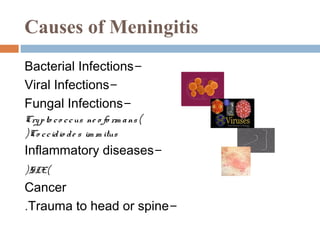
Causes of Meningitis
Bacterial Infections-
Viral Infections-
Fungal Infections-
Cry p to c o c c us ne o fo rm a ns )
(Co c c id io d e s im m itus
Inflammatory diseases-
(SLE)
Cancer
.Trauma to head or spine-
Bacterial meningitis…..
: Etiological Agents
   Pneumococcal, Stre p to c o c c us p ne um o nia e    

                                             ((3 8 %

 (Meningococcal, N is s e ria m e ning itid is (1 4%
                  e                                      


                   (Ha e m o p hilus influe nz a e (4%   


 (Staphylococcal, Sta p hy lo c o c c us a ure us (5 %   


     Tuberculous, M c o ba c te rium tube rc ulo s is
                   y                                     
Bacterial Meningitis
.Potentially life threatening disease
.One million cases per year world wide. 200,000 die annually
. Can affect all age groups but some are at higher risk
Treatment available : antibiotics as per causative organism
 .Humans are the reservoir
Pneumococcal meningitis is the most common type. Approximately
6,000 cases/yr
Haemophilus meningitis: Since 1985 Incidence has declined by
.95% due to the introduction of Ha e m o p hilus influe nz a b vaccine
Other bacterial meningitis caused by E-Co li K-1, Kle bs ie lla species
and Ente ro ba c te r species are less common overall, but may be
more prevalent in newborns, pregnant women, the elderly and
.immunocompromised hosts
? W is Meningococcal disease
      hat
Etiological Agent: N is s e ria m e ning itid is
                    e
Clinical Features: sudden onset. F,H,N,V
Reservoir: Humans only. 5-15% healthy carriers
Mode of transmission: direct contact with patients oral or nasal
.secretions. Saliva
Incubation period: 1-10 days. Usually 2-4 days
Infectious period: as long as meningococci are present in oral secretions
 or until 24 hrs of effective antibiotic therapy
: Epidemiology
. Sporadic cases worldwide
.Meningitis belt” –sub-Saharan Africa into India/Nepal“
.In US most cases seen during late winter and early spring
Children under five and adolescent most susceptible. Overcrowding e.g.
dormitories and military training camps predispose to spread of
Aseptic Meningitis
Definition: A syndrome characterized by acute onset of meningeal
symptoms, fever, and cerebrospinal fluid pleocytosis, with
. bacteriologically sterile cultures

:Laboratory criteria for diagnosis
 CSF showing ≥ 5 W cu mm
                     BC/
. No evidence of bacterial or fungal meningitis

Case classification
Confirm a clinically compatible illness diagnosed by a physician as
        ed:
aseptic meningitis, with no laboratory evidence of bacterial or fungal
meningitis

Comment
Aseptic meningitis is a syndrome of multiple etiologies, but most cases
are caused by a viral agent
Viral Meningitis
 : Etiological Agents
. Enteroviruses (Coxsackie's and echovirus): most common
Adenovirus-
Arbovirus-
Measles virus-
Herpes Simplex Virus-
Varicella-
: Reservoirs
Humans for Enteroviruses, Adenovirus, Measles, Herpes Simplex, and-
Varicella
. Natural reservoir for arbovirus birds, rodents etc-
:Modes of transmission
Primarily person to person and arthopod vectors for Arboviruses-
: Incubation Period
  Variable. For enteroviruses 3-6 days, for arboviruses 2-15 days-
. Treatment: N s p e c ific tre a tm e nt a v a ila ble
                 o
.Most patients recover completely on their own
Non Polio Enteroviruses
: Types:62 different types known

, Coxsackie A viruses 23 -
, Coxsackie B viruses 6 -
  echoviruses, and 5 other 28 -

 ? H com on
    ow  m
of all viral meningitis is caused by Enteroviruses 90% -
. Second only to "common cold" viruses, the rhinoviruses-
Estimated 10-15 million/more symptomatic infections/ in US-
                                                        yr

. W is at risk? Everyone
   ho

H does infection spread?
 ow
. Virus present in the respiratory secretions & stool of a patient
. Direct contact with secretions from an infected person
Parents, teachers, and child care center workers may also become infected by
. contamination of the hands with stool
The difference between Meningitis
and Septicaemia
When bacteria cause disease i.e.
meningococcal disease the body can be
:affected in different ways
 Meningitis - bacteria enter the blood stream

  and travel to the meninges and cause
  inflammation.
 Septicaemia - when bacteria are present in the

  blood stream they can multiply rapidly and
  release toxins that poison the blood. (The rash
  associated with meningitis is due to
  septicaemia.)
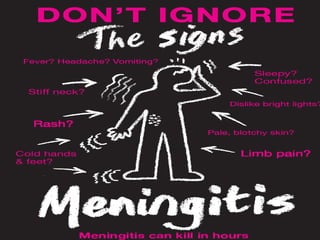
Symptoms of Meningitis and
Septicemia
Meningitis and meningococcal septicaemia may
not always be easy to detect, in early stages
the symptoms can be similar to flu.  They may
develop over one or two days, but sometimes
develop in a matter of hours.

It is important to remember that symptoms do
not appear in any particular order and some
.may not appear at all
Symptoms for meningitis and
meningococcal septicaemia:
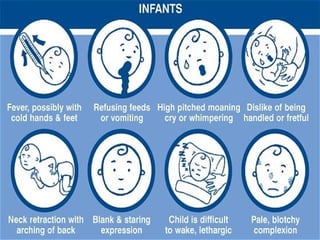
Babies and Young Children:
-High temperature, fever, possibly with cold hands and feet
Vomiting or refusing feeds-
High pitched moaning, whimpering cry-
Blank, staring expression-
Pale, blotchy complexion-
Stiff neck-
Arched back-
Baby may be floppy, may dislike being handled, be fretful-
Difficult to wake or lethargic-
The fontanelle (soft spot on babies heads) may be tense or-
.bulging
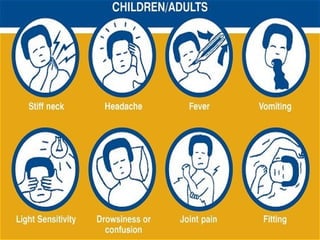
Older Children and Adults

High temperature, fever, possibly with cold hands and-
.feet
.Vomiting, sometimes diarrhoea-
.Severe headache-
.Joint or muscle pains, sometimes stomach cramps-
(Neck stiffness (unable to touch the chin to the chest -
.Dislike of bright lights-
.Drowsiness-
The patient may be confused or disorientated. Fitting may
.also be seen
.A rash may develop
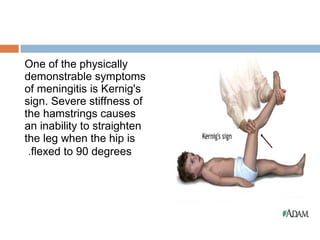
One of the physically
demonstrable symptoms
of meningitis is Kernig's
sign. Severe stiffness of
the hamstrings causes
an inability to straighten
the leg when the hip is
 .flexed to 90 degrees
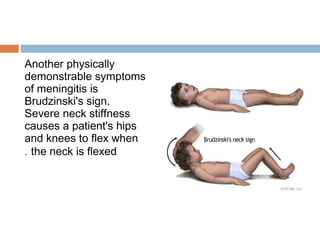
Another physically
demonstrable symptoms
of meningitis is
Brudzinski's sign.
Severe neck stiffness
causes a patient's hips
and knees to flex when
. the neck is flexed
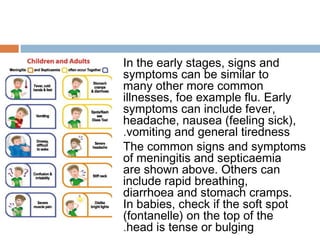
In the early stages, signs and
symptoms can be similar to
many other more common
illnesses, foe example flu. Early
symptoms can include fever,
headache, nausea (feeling sick),
.vomiting and general tiredness
The common signs and symptoms
of meningitis and septicaemia
are shown above. Others can
include rapid breathing,
diarrhoea and stomach cramps.
In babies, check if the soft spot
(fontanelle) on the top of the
.head is tense or bulging
One sign of meningococcal septicaemia is a
rash that does not fade under pressure
’((see ‘Glass test
This rash is caused by blood leaking -
under the skin. It starts anywhere on the
body. It can spread quickly to look like
. fresh bruises
This rash is more difficult to see on darker -
skin. Look on the paler areas of the skin
.and under the eyelids
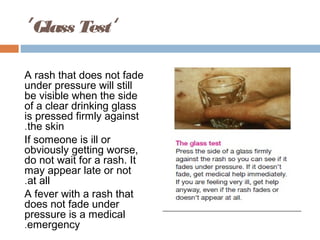
’ Glass Test‘

A rash that does not fade
under pressure will still
be visible when the side
of a clear drinking glass
is pressed firmly against
.the skin
If someone is ill or
obviously getting worse,
do not wait for a rash. It
may appear late or not
.at all
A fever with a rash that
does not fade under
pressure is a medical
.emergency
What to do if you suspect meningitis or
:septicaemia
 Contact your GP immediately. If you GP is not
  available, go straight to your nearest accident
  and emergency department.
 Describe the symptoms carefully and say that

  you think it could be meningitis or septicaemia
Early diagnosis can be difficult. If you have seen
a doctor and are still worried, don’t be afraid to
ask for medical help again
Be aware, be prepared


Meningitis and meningococcal septicaemia (blood
poisoning) are serious diseases that can affect
anyone at any time. Teenagers and studentsin
particular, are at increased risk.Most young
people in the UK have already had the MenC
vaccine. If you haven’t or can’t remember,
gettingvaccinated now is a good way to protect
yourself.
 But remember, vaccines can’t preventall forms of
meningitis and septicaemia.So it is very important
that you are aware of the signs and symptoms so
that you can get medical help urgently if you
Public Health Importance
: Challenges
Educating public-
Timely reporting and records keeping-
.Updating information daily-
Alleviating public anxiety and concerns-
Collaborating with health partners-
: Opportunities
Educating public-
Communication-
Strengthening partnerships-
The End

Meningitis

  • 1.
  • 2.
  • 4.
    ?…… What ismeningitis o The brain and spinal cord are covered by connective tissue layers collectively called the meninges which form the blood-brain barrier. (the pia mater (closest to the CNS-1 the arachnoid mater-2 (.the dura mater (farthest from the CNS-3 The meninges contain cerebrospinal fluid (CSF). Meningitis is an inflammation of the meninges, which, if severe, may become encephalitis, an inflammation . of the brain
  • 6.
    ? W isMeningitis hat  Meningitis can be caused by many different organisms including viruses and bacteria.  Meningitis, caused by a bacteria, is life threatening and requires urgent medical attention and treatment with antibiotics.  Meningitis caused by a virus is very rarely life threatening but can cause the body to become very weak.  When bacteria invade the body they can cause meningitis, septicaemia or meningitis and septicaemia together
  • 7.
    Causes of Meningitis BacterialInfections- Viral Infections- Fungal Infections- Cry p to c o c c us ne o fo rm a ns ) (Co c c id io d e s im m itus Inflammatory diseases- (SLE) Cancer .Trauma to head or spine-
  • 8.
    Bacterial meningitis….. : EtiologicalAgents Pneumococcal, Stre p to c o c c us p ne um o nia e  ((3 8 % (Meningococcal, N is s e ria m e ning itid is (1 4% e  (Ha e m o p hilus influe nz a e (4%  (Staphylococcal, Sta p hy lo c o c c us a ure us (5 %  Tuberculous, M c o ba c te rium tube rc ulo s is y 
  • 9.
    Bacterial Meningitis .Potentially lifethreatening disease .One million cases per year world wide. 200,000 die annually . Can affect all age groups but some are at higher risk Treatment available : antibiotics as per causative organism .Humans are the reservoir Pneumococcal meningitis is the most common type. Approximately 6,000 cases/yr Haemophilus meningitis: Since 1985 Incidence has declined by .95% due to the introduction of Ha e m o p hilus influe nz a b vaccine Other bacterial meningitis caused by E-Co li K-1, Kle bs ie lla species and Ente ro ba c te r species are less common overall, but may be more prevalent in newborns, pregnant women, the elderly and .immunocompromised hosts
  • 10.
    ? W isMeningococcal disease hat Etiological Agent: N is s e ria m e ning itid is e Clinical Features: sudden onset. F,H,N,V Reservoir: Humans only. 5-15% healthy carriers Mode of transmission: direct contact with patients oral or nasal .secretions. Saliva Incubation period: 1-10 days. Usually 2-4 days Infectious period: as long as meningococci are present in oral secretions or until 24 hrs of effective antibiotic therapy : Epidemiology . Sporadic cases worldwide .Meningitis belt” –sub-Saharan Africa into India/Nepal“ .In US most cases seen during late winter and early spring Children under five and adolescent most susceptible. Overcrowding e.g. dormitories and military training camps predispose to spread of
  • 11.
    Aseptic Meningitis Definition: Asyndrome characterized by acute onset of meningeal symptoms, fever, and cerebrospinal fluid pleocytosis, with . bacteriologically sterile cultures :Laboratory criteria for diagnosis CSF showing ≥ 5 W cu mm BC/ . No evidence of bacterial or fungal meningitis Case classification Confirm a clinically compatible illness diagnosed by a physician as ed: aseptic meningitis, with no laboratory evidence of bacterial or fungal meningitis Comment Aseptic meningitis is a syndrome of multiple etiologies, but most cases are caused by a viral agent
  • 12.
    Viral Meningitis :Etiological Agents . Enteroviruses (Coxsackie's and echovirus): most common Adenovirus- Arbovirus- Measles virus- Herpes Simplex Virus- Varicella- : Reservoirs Humans for Enteroviruses, Adenovirus, Measles, Herpes Simplex, and- Varicella . Natural reservoir for arbovirus birds, rodents etc- :Modes of transmission Primarily person to person and arthopod vectors for Arboviruses- : Incubation Period Variable. For enteroviruses 3-6 days, for arboviruses 2-15 days- . Treatment: N s p e c ific tre a tm e nt a v a ila ble o .Most patients recover completely on their own
  • 13.
    Non Polio Enteroviruses :Types:62 different types known , Coxsackie A viruses 23 - , Coxsackie B viruses 6 - echoviruses, and 5 other 28 - ? H com on ow m of all viral meningitis is caused by Enteroviruses 90% - . Second only to "common cold" viruses, the rhinoviruses- Estimated 10-15 million/more symptomatic infections/ in US- yr . W is at risk? Everyone ho H does infection spread? ow . Virus present in the respiratory secretions & stool of a patient . Direct contact with secretions from an infected person Parents, teachers, and child care center workers may also become infected by . contamination of the hands with stool
  • 14.
    The difference betweenMeningitis and Septicaemia When bacteria cause disease i.e. meningococcal disease the body can be :affected in different ways  Meningitis - bacteria enter the blood stream and travel to the meninges and cause inflammation.  Septicaemia - when bacteria are present in the blood stream they can multiply rapidly and release toxins that poison the blood. (The rash associated with meningitis is due to septicaemia.)
  • 15.
    Symptoms of Meningitisand Septicemia Meningitis and meningococcal septicaemia may not always be easy to detect, in early stages the symptoms can be similar to flu.  They may develop over one or two days, but sometimes develop in a matter of hours. It is important to remember that symptoms do not appear in any particular order and some .may not appear at all
  • 16.
    Symptoms for meningitisand meningococcal septicaemia: Babies and Young Children: -High temperature, fever, possibly with cold hands and feet Vomiting or refusing feeds- High pitched moaning, whimpering cry- Blank, staring expression- Pale, blotchy complexion- Stiff neck- Arched back- Baby may be floppy, may dislike being handled, be fretful- Difficult to wake or lethargic- The fontanelle (soft spot on babies heads) may be tense or- .bulging
  • 18.
    Older Children andAdults High temperature, fever, possibly with cold hands and- .feet .Vomiting, sometimes diarrhoea- .Severe headache- .Joint or muscle pains, sometimes stomach cramps- (Neck stiffness (unable to touch the chin to the chest - .Dislike of bright lights- .Drowsiness- The patient may be confused or disorientated. Fitting may .also be seen .A rash may develop
  • 20.
    One of thephysically demonstrable symptoms of meningitis is Kernig's sign. Severe stiffness of the hamstrings causes an inability to straighten the leg when the hip is .flexed to 90 degrees
  • 21.
    Another physically demonstrable symptoms ofmeningitis is Brudzinski's sign. Severe neck stiffness causes a patient's hips and knees to flex when . the neck is flexed
  • 22.
    In the earlystages, signs and symptoms can be similar to many other more common illnesses, foe example flu. Early symptoms can include fever, headache, nausea (feeling sick), .vomiting and general tiredness The common signs and symptoms of meningitis and septicaemia are shown above. Others can include rapid breathing, diarrhoea and stomach cramps. In babies, check if the soft spot (fontanelle) on the top of the .head is tense or bulging
  • 23.
    One sign ofmeningococcal septicaemia is a rash that does not fade under pressure ’((see ‘Glass test This rash is caused by blood leaking - under the skin. It starts anywhere on the body. It can spread quickly to look like . fresh bruises This rash is more difficult to see on darker - skin. Look on the paler areas of the skin .and under the eyelids
  • 24.
    ’ Glass Test‘ Arash that does not fade under pressure will still be visible when the side of a clear drinking glass is pressed firmly against .the skin If someone is ill or obviously getting worse, do not wait for a rash. It may appear late or not .at all A fever with a rash that does not fade under pressure is a medical .emergency
  • 25.
    What to doif you suspect meningitis or :septicaemia  Contact your GP immediately. If you GP is not available, go straight to your nearest accident and emergency department.  Describe the symptoms carefully and say that you think it could be meningitis or septicaemia Early diagnosis can be difficult. If you have seen a doctor and are still worried, don’t be afraid to ask for medical help again
  • 26.
    Be aware, beprepared Meningitis and meningococcal septicaemia (blood poisoning) are serious diseases that can affect anyone at any time. Teenagers and studentsin particular, are at increased risk.Most young people in the UK have already had the MenC vaccine. If you haven’t or can’t remember, gettingvaccinated now is a good way to protect yourself. But remember, vaccines can’t preventall forms of meningitis and septicaemia.So it is very important that you are aware of the signs and symptoms so that you can get medical help urgently if you
  • 27.
    Public Health Importance :Challenges Educating public- Timely reporting and records keeping- .Updating information daily- Alleviating public anxiety and concerns- Collaborating with health partners- : Opportunities Educating public- Communication- Strengthening partnerships-
  • 28.