A.DARSHANAA
II year PG
WHAT IS GENETICS?????
The branch of biology that deals with heredity,
especially the mechanisms of hereditary transmission
and the variation of inherited characteristics among
similar or related organisms
Important Terminology
Genotype is the genetic constitution of an organism
or a cell.
Phenotype is the observable physical or biochemical
characteristics of an organism.
GENE
Biological unit of heredity.
Gene hold the information to build and maintain
their cells and pass genetic traits to offsprings
In cells, a gene is portion of
DNA
Genome
Genome – a term used to refer to all the
genes carried by an individual or cell.
Human genome contains 25000 to 35000
genes.
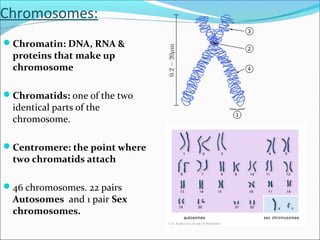
Chromosomes:
Chromatin: DNA, RNA &
proteins that make up
chromosome
Chromatids: one of the two
identical parts of the
chromosome.
Centromere: the point where
two chromatids attach
46 chromosomes. 22 pairs
Autosomes and 1 pair Sex
chromosomes.
NUCLEOTIDE: group of molecules that when linked
together, form the building blocks of DNA and RNA;
composed of phosphate group, the bases:
adenosine,cytosine,guanine and thymine and a
pentose sugar. In case of RNA,thymine base is
replaced by uracil.
CODON: series of three adjacent bases in one
polynucleotide chain of a DNA or RNA molecule
which codes for a specific amino acid.
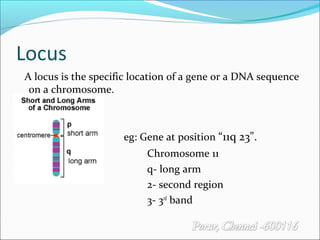
Locus
A locus is the specific location of a gene or a DNA sequence
on a chromosome.
eg: Gene at position “11q 23".
Chromosome 11
q- long arm
2- second region
3- 3rd
band
Examples:
TNF alpha -308 : (-) Upstream/ Promoter region
IL-1 beta: + 3954 : (+) Downstream/ Coding region
Gene is transcribed to RNA
Poly(A) tail added and splicing away intron sequences
RNA transcription product is processed inron functional mRNA
mRNA is transported to cytoplasm
Ribosomes associate with mRNA, mRNA is read and translated into amino acid
sequence of encoded protein which is added to a growing polypeptide chain
The newly synthesized polypeptide chain undergoes posttranslational
modification(folds into a 3d structure and sugar residues or other chemical
groups are added as needed)
Completed protein molecules are then transported to destination sites by specific
targetting amino acid sequences
DNA, RNA and protein
synthesis
The process by which DNA is copied to RNA is
called transcription, and that by which RNA is used to
produce proteins is called translation.
DNA replication
Each time a cell divides, each of its double strands of
DNA splits into two single strands.
Each of these single strands acts as a template for a
new strand of complementary DNA.
As a result, each new cell has its own complete
genome. This process is known as DNA replication.
Replication is controlled by the Watson-Crick pairing
of the bases in the template strand with incoming
deoxynucleotide triphosphates, and is directed by
DNA polymerase enzymes
DNA biosynthesis proceeds in the 5 - to 3 -direction.′ ′
This makes it impossible for DNA polymerases to
synthesize both strands simultaneously. A portion of
the double helix must first unwind, and this is
mediated by helicase enzymes
TRANSCRIPTION
Transcription is the process by which DNA is copied
(transcribed) to mRNA, which carries the information
needed for protein synthesis.
Transcription takes place in two broad steps. First, pre-
messenger RNA is formed, with the involvement of RNA
polymerase enzymes.
The process relies on Watson-Crick base pairing, and the
resultant single strand of RNA is the reverse-complement
of the original DNA sequence.
The pre-messenger RNA is then "edited" to produce the
desired mRNA molecule in a process calledRNA splicing
Formation of pre-messenger RNA
partial unwinding of the double helix must occur
before transcription can take place, and it is the RNA
polymerase enzymes that catalyze this process
only one strand is transcribed.
The strand that contains the gene is called
the sense strand, while the complementary strand is
the antisense strand.
The mRNA produced in transcription is a copy of the
sense strand
Ribonucleotide triphosphates (NTPs) align along the antisense DNA
strand, with Watson-Crick base pairing (A pairs with U). RNA
polymerase joins the ribonucleotides together to form a pre-
messenger RNA molecule that is complementary to a region of the
antisense DNA strand. Transcription ends when the RNA polymerase
enzyme reaches a triplet of bases that is read as a "stop" signal. The
DNA molecule re-winds to re-form the double helix
RNA splicing
The pre-messenger RNA thus formed contains
introns which are not required for protein synthesis.
The pre-messenger RNA is chopped up to remove the
introns and create messenger RNA (mRNA) in a
process called RNA splicing
Alternative splicing
In alternative splicing, individual exons are either
spliced or included, giving rise to several different
possible mRNA products.
Each mRNA product codes for a different protein
isoform; these protein isoforms differ in their peptide
sequence and therefore their biological activity
Alternative splicing contributes to protein diversity −
a single gene transcript (RNA) can have thousands of
different splicing patterns, and will therefore code for
thousands of different proteins: a diverse proteome is
generated from a relatively limited genome.
Reverse transcription
In reverse transcription, RNA is "reverse transcribed"
into DNA.
This process, catalyzed by reverse transcriptase
enzymes, allows retroviruses, including the human
immunodeficiency virus (HIV), to use RNA as their
genetic material.
Reverse transcriptase enzymes have also found
applications in biotechnology, allowing scientists to
convert RNA to DNA for techniques such as PCR.
TRANSLATION
The mRNA formed in transcription is transported out
of the nucleus, into the cytoplasm, to the ribosome
(the cell's protein synthesis factory). Here, it directs
protein synthesis
The process by which mRNA directs protein synthesis
with the assistance of tRNA is called translation.
The ribosome is a very large complex of RNA and
protein molecules.
Each three-base stretch of mRNA (triplet) is known
as a codon, and one codon contains the information
for a specific amino acid.
As the mRNA passes through the ribosome, each codon
interacts with the anticodon of a specific transfer RNA
(tRNA) molecule by Watson-Crick base pairing.
This tRNA molecule carries an amino acid at its 3 -′
terminus, which is incorporated into the growing protein
chain. The tRNA is then expelled from the ribosome
TRANSFER RNA
Each amino acid has its own special tRNA (or set of
tRNAs).
Each amino acid is attached to its tRNA through the 3 -′
OH group to form an ester which reacts with the α-amino
group of the terminal amino-acid of the growing protein
chain to form a new amide bond (peptide bond) during
protein synthesis
The reaction of esters with amines is generally favourable
but the rate of reaction is increased greatly in the
ribosome.
Each transfer RNA molecule has a well defined tertiary
structure that is recognized by the enzyme aminoacyl
tRNA synthetase, which adds the correct amino acid to the
3 -end of the uncharged tRNA. The presence of modified′
nucleosides is important in stabilizing the tRNA structure
THE GENETIC CODE
It is the basis of the transmission of hereditary
information by nucleic acids in all organisms.
There are four bases in RNA (A,G,C and U), so there are
64 possible triplet codes (43
= 64).
In theory only 22 codes are required: one for each of the
20 naturally occurring amino acids, with the addition of a
start codon and a stop codon (to indicate the beginning
and end of a protein sequence).
Many amino acids have several codes (degeneracy), so that
all 64 possible triplet codes are used
No two amino acids have the same code but amino acids
whose side-chains have similar physical or chemical
properties tend to have similar codon sequences
ALLELE
A variant of the DNA sequence at a given locus is
called an allele
Homozygous-an organism in which 2 copies of genes are
identical i.e. have same alleles [AA/ aa]
Heterozygous-an organism which has different alleles of
the gene [Aa]
Do minant alleles are represented with a capitalcapital letter
Recessive alleles are represented with a lo wer caselo wer case letter
Mutation can cause variation in alleles.
Definition:
Permanent changes in the
DNA. Those that affect germ cells are
transmitted to the progeny. Mutations
in the somatic cells are not transferred
to the progeny but are important in
the causation of cancer and some
congenital diseases.
CAUSES OF MUTATIONS
Chemicals
Nitrous acid
Alkylating agents
5- bromouracil
Antiviral drug iododeoxy uridine
Benzpyrene in tobacco smoke
X – rays & ultraviolet light
Certain viruses such as bacterial virus
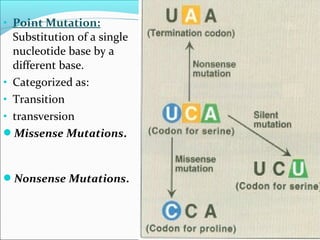
• Point Mutation:
Substitution of a single
nucleotide base by a
different base.
• Categorized as:
• Transition
• transversion
Missense Mutations.
Nonsense Mutations.
• Frameshift
Mutations:
Insertion or
deletion of one or
two base pairs alters
the reading frame of
the DNA strand.
Trinucleotide
Repeat Mutations:
set of genetic
disorder caused by
trinucleotide repeat
in certain genes
exceeding
normal,stable
threshold e.g.
Fragile X Syndrome.
Classification Of Genetic Diseases:
Single Gene Defects/Mendelian Disorders.
Disorders with Multifactorial or Polygenic
inheritance.
Cytogenetic Disorders.
Disorders showing atypical patterns of inheritance.
Mendelian Disorders
A genetic disease caused by a single mutation in the
structure of DNA, which causes a single basic defect
with pathologic consequences
Patterns Of Inheritance:
Autosomal Dominant.
Autosomal Recessive.
X-Linked Recessive.
X-Linked Dominant.
Autosomal
Dominant
Disorders.
 Manifested in heterozygous states.
Individuals with these diseases usually have one affected
parent .*
Variable to late onset.
These disorders usually involve non-enzymatic proteins;
• Proteins involved in metabolic pathway regulation.
• Structural Proteins.
Inheritance Pattern:
• Typical mating pattern is a
heterozygous affected
individual with a
homozygous unaffected
individual.
•Every child has one chance
in two of having the disease
• Both sexes are affected
equally..
Disorders:
Structural Protein Defects:
 Marfan’s Syndrome.
 Ehler-Danlos Syndrome.
Marfan’s Syndrome:
Mutation in the fibrillin gene.
 Fibrillin important
component of microfibrils in
Elastin.
Tissues affected are Skeleton,
Eyes and the CVS.
 C/F include tall stature, long
fingers, pigeon breast
deformity, hyper-extensible
joints,high arched palate, BL
subluxation of lens, floppy
Mitral valve, Aortic aneurysm
and dissection, defects in
skin,lungs.
Ehler-Danlos Syndrome(Cutis Hyperelastica):
Characterized by defects in collagen synthesis.
.Clinical Features include fragile, hyper-extensible skin,
hyper-mobile joints, grotesque contortions, rupture of
internal organs like the colon, cornea and large arteries,
poor wound healing.
Defects in metabolic pathway proteins:
Familial Hypercholesterolemia:
• One of the most common mendelian disorders.
• Mutation in the LDL receptor gene.
• Hypercholesterolemia due to impaired LDL transport
into cells.
• Increased risk of atherosclerosis and coronary artery
disease.
• Increases Cholesterol leads to formation of Xanthomas.
Largest group of Mendelian Disorders
Affected individuals usually have unaffected (carrier)
parents.
Uniform, early age of onset.
These disorders usually involve Enzymatic Proteins.
Pattern Of
Inheritance:
 Typical mating pattern is two
heterozygous unaffected (carrier)
individuals.
The trait doesnot usually affect the
parent, but siblings may show the
disease
Siblings have one chance in four of
being affected
 Both sexes affected equally.
Disorders:
Glycogen Storage Diseases.
Category Disease Enzyme
Hepatic Type. Von Gierke’s
Disease type 1.
Glucose-6-
phosphotase.
Myopathic Type. McArdle Syndrome. Muscle
Phosphorylase.
Miscellaneous Type. Pompe’s Disease
type II
Lysosomal
Glucosidase.
Most common X-linked disorders.
Usually expressed only in males.
Rarely, due to random X-inactivation, a female will express
disease, called manifesting heterozygotes.
Pattern Of Inheritance:
• Disease usually passed on from
carrier mother.
• Expressed in male offspring,
females are carriers.
• Skipped generations are
commonly seen.
• In this case, Recurrence risk is
half of sons are affected, half of
the daughters are carriers.
• Recurrence risk:
• All the daughters
are heterozygous
carriers and all the
sons are homozygous
normal.
Disorders:
DISORDERS WITH
MULTIFACTORIAL
(POLYGENIC)INHERITANCE
Involved in many physiologic characteristics of
humans e.g. height, weight, hair color
Defined as one governed by additive effect of two or
more genes of small effect but conditioned by
environmental, non genetic influences
The disorder becomes manifested only when a certain
number of effector genes, as well as conditioning
environmental influences are involved
Rate of recurrence is 2 to 7%
COMMON DISEASES ASSOCIATED:
Diabetes mellitus
Hypertension
Gout
Cleft lip and palate
Schizophrenia
Bipolar disorder
Congenital heart disease
Skeletal abnormalities
Neural tube defects
Coronary artery disease
KARYOTYPING
Basic tool of cytogeneticist
Karyotype is a photographic representation in which
chromosomes are arranged in order of decreasing
length
Giemsa stain (G banding) technique—each
chromosome can be seen to possess a distinctive
pattern of alternating light and dark bands of variable
widths
Shorthand of Cytogenetics:
Short arm denoted as p,
long arm denoted q.
Each arm divided into
numbered regions from the
centromere onwards.
 Each region numerically
arranged into bands.
For e.g., 5p24 would denote
chromosome 5, short arm,
region 2 and band 4.
Cytogenetic disorders may result from
structural or numeric abnormalities of
chromosomes
It may affect autosomes or sex
chromosomes
Numeric Abnormalities:
Normal Chromosomal number is 46. (2n=46).
This is called euploid state. (Exact multiple of
haploid number).
Polyploidy: posession of more than two sets of
homologous chromosomes. Chromosomal
numbers like 3n or 4n. (Incompatible with life);
generally results in spontaneous abortion
Aneuploidy: Any Chromosomal number that is
not an exact multiple of haploid number . E.g 47
or 45.
Aneuploidy:
Most common cause is nondisjunction of
either a pair of homologous chromosomes
during meiosis I or failure of sister
chromatids to separate during meiosis II.
The resultant gamete will have either one
less chromosome or one extra
chromosome.
Fertilization of such gamete will result in
zygote being either trisomic ( 2n+1 ) or
monosomic ( 2n-1 ).
Monosomy in autosomes is incompatible
with life. Trisomy of certain autosomes and
monosomy of sex chromosomes is
compatible with life.
Mosaicism:
The presence of two or more types of cell populations in the
same individual.
Postzygotic mitotic nondisjunction will result in one
trisomic and one monosomic daughter cell.
The descendants of these cells will produce a mosaic.
Structural Abnormalities:
Usually result from chromosomal breakage, resulting in loss
or rearrangement of genetic material.
Patterns of breakage:
• Translocation.
• Isochromosomes.
• Deletion.
• Inversions.
• Ring Chromosomes.
TRANSLOCATION
Transfer of a part of one chromosome to another
chromosome
Translocations are indicated by t
E.g. 46,XX,t(2;5)(q31;p14)
Balanced reciprocal translocation is not harmful to
the carrier, however during gametogenesis, abnormal
gametes are formed, resulting in abnormal zygotes
Centric fusion type or robertsonian translocation:
The breaks occur close to the centromere, affecting
the short arms of both choromosomes
Transfer of the chromosome leads to one very large
and one extremely small chromosome
The short fragments are lost, and the carrier has 45
chromosomes
Such loss is compatible with survival
However, during gametogenesis difficulties arise
ISOCHROMOSOMES
Result when one arm of a chromosome is lost and the
remaining arm is duplicated, resulting in a
chromosome consisting of two short arms only or of
two long arms.
DELETION
Loss of a portion of chromosome
This can be terminal (close to the end of the
chromosome on the long arm or the short arm), or it
can be interstitial (within the long arm or the short
arm).
A ring chromosome is a variant of deletion.It occurs
when break occurs at both the ends of chromosome
with fusion of the damaged ends.
INVERSIONS
Occur when there are two breaks within a single
chromosome with inverted reincorporation of the
segment.
Since there is no loss or gain of chromosomal
material, inversion carriers are normal.
An inversion is paracentric if the inverted segment is
on the long arm or the short arm .
 The inversion is pericentric if breaks occur on both
the short arm and the long arm .
General Features of Cytogenetic Disorders:
Associated with absence, excess, or
abnormal rearrangements of chromosomes.
Loss of genetic material produces more
severe defects than does gain.
Abormalities of sex chromosomes
generally tolerated better than those of
autosomes.
Sex chromosomal abnormalities are
usually subtle and are not detected at
birth.
Most cases are due to de novo
changes (i.e. parents are normal and
recurrence in siblings is low).
Trisomy 21/Down’s Syndrome:
Most common chromosomal disorder.
Down syndrome is a chromosomal
abnormality characterized by the
presence of an extra copy of genetic
material on the 21st
chromosome
Trisomy 21 is caused by a meiotic
nondisjunction event.
With nondisjunction, a gamete (i.e., a sperm or egg
cell) is produced with an extra copy of chromosome 21;
the gamete thus has 24 chromosomes
When combined with a normal gamete from the other
parent, the embyo now has 47 chromosomes, with
three copies of chromosome 21.
About 4% of cases are due to Robertsonian
translocations.
Maternal age has a strong influence
                              
  
Karyotype for trisomy Down syndrome. Notice the three copies of
chromosome 21
Other Trisomy Syndromes:
Trisomy 18 :Edwards Syndrome.
Trisomy 13 :Patau Syndrome.
Extreme karyotypic variations seen
frequently with Sex Chromosomes, with
females having 4-5 extra X Chromosomes.
Males with two to three Y chromosomes
have also been identified.
Klinefelter’s Syndrome:
Defined as Male Hypogonadism, develops
when there are at least two X
chromosomes and one or more Y
chromosomes.
Usual karyotype is 47,XXY. The extra X
may be maternal or paternal.
Results from nondisjunction of sex
chromosome during meiosis.
Risk factors include advanced
maternal age and a history of exposure
to radiation in either parent.
Clinical Manifestations:
Increase in body length between soles and pubis.
 Reduced facial, body and pubic hair. Gynecomastia.
Testicular atrophy.
Infertility.
Mild mental retardation.
Turner Syndrome:
Primary hypogonadism in phenotypic
females.
Results from partial or complete
monosomy of the X chromosome.
Most common cause is absence of
one X chromosome.
Less commonly, mosaicism, or
deletions on the short arm of the X
chromosome.
DIAGNOSIS OF GENETIC DISEASE
Conventional Cytogenetic Analysis
FISH
Molecular Analysis
REFERENCES
Biology of the Periodontal connective tissues – P.
Mark Bartold A. Sampath Narayanan
Emery’s textbook of genetics
Genetics and molecular biology – Dr. Rober Scliff

Genetics

  • 1.
  • 2.
    WHAT IS GENETICS????? Thebranch of biology that deals with heredity, especially the mechanisms of hereditary transmission and the variation of inherited characteristics among similar or related organisms
  • 3.
    Important Terminology Genotype isthe genetic constitution of an organism or a cell. Phenotype is the observable physical or biochemical characteristics of an organism.
  • 4.
    GENE Biological unit ofheredity. Gene hold the information to build and maintain their cells and pass genetic traits to offsprings In cells, a gene is portion of DNA
  • 5.
    Genome Genome – aterm used to refer to all the genes carried by an individual or cell. Human genome contains 25000 to 35000 genes.
  • 6.
    Chromosomes: Chromatin: DNA, RNA& proteins that make up chromosome Chromatids: one of the two identical parts of the chromosome. Centromere: the point where two chromatids attach 46 chromosomes. 22 pairs Autosomes and 1 pair Sex chromosomes.
  • 7.
    NUCLEOTIDE: group ofmolecules that when linked together, form the building blocks of DNA and RNA; composed of phosphate group, the bases: adenosine,cytosine,guanine and thymine and a pentose sugar. In case of RNA,thymine base is replaced by uracil. CODON: series of three adjacent bases in one polynucleotide chain of a DNA or RNA molecule which codes for a specific amino acid.
  • 8.
    Locus A locus isthe specific location of a gene or a DNA sequence on a chromosome. eg: Gene at position “11q 23". Chromosome 11 q- long arm 2- second region 3- 3rd band
  • 9.
    Examples: TNF alpha -308: (-) Upstream/ Promoter region IL-1 beta: + 3954 : (+) Downstream/ Coding region
  • 10.
    Gene is transcribedto RNA Poly(A) tail added and splicing away intron sequences RNA transcription product is processed inron functional mRNA mRNA is transported to cytoplasm Ribosomes associate with mRNA, mRNA is read and translated into amino acid sequence of encoded protein which is added to a growing polypeptide chain The newly synthesized polypeptide chain undergoes posttranslational modification(folds into a 3d structure and sugar residues or other chemical groups are added as needed) Completed protein molecules are then transported to destination sites by specific targetting amino acid sequences
  • 12.
    DNA, RNA andprotein synthesis The process by which DNA is copied to RNA is called transcription, and that by which RNA is used to produce proteins is called translation.
  • 13.
    DNA replication Each timea cell divides, each of its double strands of DNA splits into two single strands. Each of these single strands acts as a template for a new strand of complementary DNA. As a result, each new cell has its own complete genome. This process is known as DNA replication. Replication is controlled by the Watson-Crick pairing of the bases in the template strand with incoming deoxynucleotide triphosphates, and is directed by DNA polymerase enzymes
  • 14.
    DNA biosynthesis proceedsin the 5 - to 3 -direction.′ ′ This makes it impossible for DNA polymerases to synthesize both strands simultaneously. A portion of the double helix must first unwind, and this is mediated by helicase enzymes
  • 15.
    TRANSCRIPTION Transcription is theprocess by which DNA is copied (transcribed) to mRNA, which carries the information needed for protein synthesis. Transcription takes place in two broad steps. First, pre- messenger RNA is formed, with the involvement of RNA polymerase enzymes. The process relies on Watson-Crick base pairing, and the resultant single strand of RNA is the reverse-complement of the original DNA sequence. The pre-messenger RNA is then "edited" to produce the desired mRNA molecule in a process calledRNA splicing
  • 16.
    Formation of pre-messengerRNA partial unwinding of the double helix must occur before transcription can take place, and it is the RNA polymerase enzymes that catalyze this process only one strand is transcribed. The strand that contains the gene is called the sense strand, while the complementary strand is the antisense strand. The mRNA produced in transcription is a copy of the sense strand
  • 17.
    Ribonucleotide triphosphates (NTPs)align along the antisense DNA strand, with Watson-Crick base pairing (A pairs with U). RNA polymerase joins the ribonucleotides together to form a pre- messenger RNA molecule that is complementary to a region of the antisense DNA strand. Transcription ends when the RNA polymerase enzyme reaches a triplet of bases that is read as a "stop" signal. The DNA molecule re-winds to re-form the double helix
  • 18.
    RNA splicing The pre-messengerRNA thus formed contains introns which are not required for protein synthesis. The pre-messenger RNA is chopped up to remove the introns and create messenger RNA (mRNA) in a process called RNA splicing
  • 19.
    Alternative splicing In alternativesplicing, individual exons are either spliced or included, giving rise to several different possible mRNA products. Each mRNA product codes for a different protein isoform; these protein isoforms differ in their peptide sequence and therefore their biological activity Alternative splicing contributes to protein diversity − a single gene transcript (RNA) can have thousands of different splicing patterns, and will therefore code for thousands of different proteins: a diverse proteome is generated from a relatively limited genome.
  • 21.
    Reverse transcription In reversetranscription, RNA is "reverse transcribed" into DNA. This process, catalyzed by reverse transcriptase enzymes, allows retroviruses, including the human immunodeficiency virus (HIV), to use RNA as their genetic material. Reverse transcriptase enzymes have also found applications in biotechnology, allowing scientists to convert RNA to DNA for techniques such as PCR.
  • 22.
    TRANSLATION The mRNA formedin transcription is transported out of the nucleus, into the cytoplasm, to the ribosome (the cell's protein synthesis factory). Here, it directs protein synthesis The process by which mRNA directs protein synthesis with the assistance of tRNA is called translation. The ribosome is a very large complex of RNA and protein molecules. Each three-base stretch of mRNA (triplet) is known as a codon, and one codon contains the information for a specific amino acid.
  • 23.
    As the mRNApasses through the ribosome, each codon interacts with the anticodon of a specific transfer RNA (tRNA) molecule by Watson-Crick base pairing. This tRNA molecule carries an amino acid at its 3 -′ terminus, which is incorporated into the growing protein chain. The tRNA is then expelled from the ribosome
  • 24.
  • 25.
    Each amino acidhas its own special tRNA (or set of tRNAs). Each amino acid is attached to its tRNA through the 3 -′ OH group to form an ester which reacts with the α-amino group of the terminal amino-acid of the growing protein chain to form a new amide bond (peptide bond) during protein synthesis The reaction of esters with amines is generally favourable but the rate of reaction is increased greatly in the ribosome. Each transfer RNA molecule has a well defined tertiary structure that is recognized by the enzyme aminoacyl tRNA synthetase, which adds the correct amino acid to the 3 -end of the uncharged tRNA. The presence of modified′ nucleosides is important in stabilizing the tRNA structure
  • 26.
    THE GENETIC CODE Itis the basis of the transmission of hereditary information by nucleic acids in all organisms. There are four bases in RNA (A,G,C and U), so there are 64 possible triplet codes (43 = 64). In theory only 22 codes are required: one for each of the 20 naturally occurring amino acids, with the addition of a start codon and a stop codon (to indicate the beginning and end of a protein sequence). Many amino acids have several codes (degeneracy), so that all 64 possible triplet codes are used No two amino acids have the same code but amino acids whose side-chains have similar physical or chemical properties tend to have similar codon sequences
  • 28.
    ALLELE A variant ofthe DNA sequence at a given locus is called an allele Homozygous-an organism in which 2 copies of genes are identical i.e. have same alleles [AA/ aa] Heterozygous-an organism which has different alleles of the gene [Aa] Do minant alleles are represented with a capitalcapital letter Recessive alleles are represented with a lo wer caselo wer case letter Mutation can cause variation in alleles.
  • 31.
    Definition: Permanent changes inthe DNA. Those that affect germ cells are transmitted to the progeny. Mutations in the somatic cells are not transferred to the progeny but are important in the causation of cancer and some congenital diseases.
  • 32.
    CAUSES OF MUTATIONS Chemicals Nitrousacid Alkylating agents 5- bromouracil Antiviral drug iododeoxy uridine Benzpyrene in tobacco smoke
  • 33.
    X – rays& ultraviolet light Certain viruses such as bacterial virus
  • 35.
    • Point Mutation: Substitutionof a single nucleotide base by a different base. • Categorized as: • Transition • transversion Missense Mutations. Nonsense Mutations.
  • 36.
    • Frameshift Mutations: Insertion or deletionof one or two base pairs alters the reading frame of the DNA strand.
  • 37.
    Trinucleotide Repeat Mutations: set ofgenetic disorder caused by trinucleotide repeat in certain genes exceeding normal,stable threshold e.g. Fragile X Syndrome.
  • 38.
    Classification Of GeneticDiseases: Single Gene Defects/Mendelian Disorders. Disorders with Multifactorial or Polygenic inheritance. Cytogenetic Disorders. Disorders showing atypical patterns of inheritance.
  • 39.
    Mendelian Disorders A geneticdisease caused by a single mutation in the structure of DNA, which causes a single basic defect with pathologic consequences
  • 40.
    Patterns Of Inheritance: AutosomalDominant. Autosomal Recessive. X-Linked Recessive. X-Linked Dominant.
  • 41.
  • 42.
     Manifested inheterozygous states. Individuals with these diseases usually have one affected parent .* Variable to late onset. These disorders usually involve non-enzymatic proteins; • Proteins involved in metabolic pathway regulation. • Structural Proteins.
  • 43.
    Inheritance Pattern: • Typicalmating pattern is a heterozygous affected individual with a homozygous unaffected individual. •Every child has one chance in two of having the disease • Both sexes are affected equally..
  • 44.
  • 45.
    Structural Protein Defects: Marfan’s Syndrome.  Ehler-Danlos Syndrome.
  • 46.
    Marfan’s Syndrome: Mutation inthe fibrillin gene.  Fibrillin important component of microfibrils in Elastin. Tissues affected are Skeleton, Eyes and the CVS.  C/F include tall stature, long fingers, pigeon breast deformity, hyper-extensible joints,high arched palate, BL subluxation of lens, floppy Mitral valve, Aortic aneurysm and dissection, defects in skin,lungs.
  • 47.
    Ehler-Danlos Syndrome(Cutis Hyperelastica): Characterizedby defects in collagen synthesis. .Clinical Features include fragile, hyper-extensible skin, hyper-mobile joints, grotesque contortions, rupture of internal organs like the colon, cornea and large arteries, poor wound healing.
  • 49.
    Defects in metabolicpathway proteins: Familial Hypercholesterolemia: • One of the most common mendelian disorders. • Mutation in the LDL receptor gene. • Hypercholesterolemia due to impaired LDL transport into cells. • Increased risk of atherosclerosis and coronary artery disease. • Increases Cholesterol leads to formation of Xanthomas.
  • 51.
    Largest group ofMendelian Disorders Affected individuals usually have unaffected (carrier) parents. Uniform, early age of onset. These disorders usually involve Enzymatic Proteins.
  • 52.
    Pattern Of Inheritance:  Typicalmating pattern is two heterozygous unaffected (carrier) individuals. The trait doesnot usually affect the parent, but siblings may show the disease Siblings have one chance in four of being affected  Both sexes affected equally.
  • 53.
  • 54.
    Glycogen Storage Diseases. CategoryDisease Enzyme Hepatic Type. Von Gierke’s Disease type 1. Glucose-6- phosphotase. Myopathic Type. McArdle Syndrome. Muscle Phosphorylase. Miscellaneous Type. Pompe’s Disease type II Lysosomal Glucosidase.
  • 56.
    Most common X-linkeddisorders. Usually expressed only in males. Rarely, due to random X-inactivation, a female will express disease, called manifesting heterozygotes.
  • 57.
    Pattern Of Inheritance: •Disease usually passed on from carrier mother. • Expressed in male offspring, females are carriers. • Skipped generations are commonly seen. • In this case, Recurrence risk is half of sons are affected, half of the daughters are carriers.
  • 58.
    • Recurrence risk: •All the daughters are heterozygous carriers and all the sons are homozygous normal.
  • 59.
  • 60.
    DISORDERS WITH MULTIFACTORIAL (POLYGENIC)INHERITANCE Involved inmany physiologic characteristics of humans e.g. height, weight, hair color Defined as one governed by additive effect of two or more genes of small effect but conditioned by environmental, non genetic influences
  • 61.
    The disorder becomesmanifested only when a certain number of effector genes, as well as conditioning environmental influences are involved Rate of recurrence is 2 to 7%
  • 62.
    COMMON DISEASES ASSOCIATED: Diabetesmellitus Hypertension Gout Cleft lip and palate Schizophrenia Bipolar disorder Congenital heart disease Skeletal abnormalities Neural tube defects Coronary artery disease
  • 65.
    KARYOTYPING Basic tool ofcytogeneticist Karyotype is a photographic representation in which chromosomes are arranged in order of decreasing length Giemsa stain (G banding) technique—each chromosome can be seen to possess a distinctive pattern of alternating light and dark bands of variable widths
  • 66.
    Shorthand of Cytogenetics: Shortarm denoted as p, long arm denoted q. Each arm divided into numbered regions from the centromere onwards.  Each region numerically arranged into bands. For e.g., 5p24 would denote chromosome 5, short arm, region 2 and band 4.
  • 67.
    Cytogenetic disorders mayresult from structural or numeric abnormalities of chromosomes It may affect autosomes or sex chromosomes
  • 68.
    Numeric Abnormalities: Normal Chromosomalnumber is 46. (2n=46). This is called euploid state. (Exact multiple of haploid number). Polyploidy: posession of more than two sets of homologous chromosomes. Chromosomal numbers like 3n or 4n. (Incompatible with life); generally results in spontaneous abortion Aneuploidy: Any Chromosomal number that is not an exact multiple of haploid number . E.g 47 or 45.
  • 69.
    Aneuploidy: Most common causeis nondisjunction of either a pair of homologous chromosomes during meiosis I or failure of sister chromatids to separate during meiosis II. The resultant gamete will have either one less chromosome or one extra chromosome.
  • 70.
    Fertilization of suchgamete will result in zygote being either trisomic ( 2n+1 ) or monosomic ( 2n-1 ). Monosomy in autosomes is incompatible with life. Trisomy of certain autosomes and monosomy of sex chromosomes is compatible with life.
  • 71.
    Mosaicism: The presence oftwo or more types of cell populations in the same individual. Postzygotic mitotic nondisjunction will result in one trisomic and one monosomic daughter cell. The descendants of these cells will produce a mosaic.
  • 72.
    Structural Abnormalities: Usually resultfrom chromosomal breakage, resulting in loss or rearrangement of genetic material. Patterns of breakage: • Translocation. • Isochromosomes. • Deletion. • Inversions. • Ring Chromosomes.
  • 73.
    TRANSLOCATION Transfer of apart of one chromosome to another chromosome Translocations are indicated by t E.g. 46,XX,t(2;5)(q31;p14) Balanced reciprocal translocation is not harmful to the carrier, however during gametogenesis, abnormal gametes are formed, resulting in abnormal zygotes
  • 74.
    Centric fusion typeor robertsonian translocation: The breaks occur close to the centromere, affecting the short arms of both choromosomes Transfer of the chromosome leads to one very large and one extremely small chromosome The short fragments are lost, and the carrier has 45 chromosomes Such loss is compatible with survival However, during gametogenesis difficulties arise
  • 76.
    ISOCHROMOSOMES Result when onearm of a chromosome is lost and the remaining arm is duplicated, resulting in a chromosome consisting of two short arms only or of two long arms. DELETION Loss of a portion of chromosome This can be terminal (close to the end of the chromosome on the long arm or the short arm), or it can be interstitial (within the long arm or the short arm). A ring chromosome is a variant of deletion.It occurs when break occurs at both the ends of chromosome with fusion of the damaged ends.
  • 77.
    INVERSIONS Occur when thereare two breaks within a single chromosome with inverted reincorporation of the segment. Since there is no loss or gain of chromosomal material, inversion carriers are normal. An inversion is paracentric if the inverted segment is on the long arm or the short arm .  The inversion is pericentric if breaks occur on both the short arm and the long arm .
  • 79.
    General Features ofCytogenetic Disorders: Associated with absence, excess, or abnormal rearrangements of chromosomes. Loss of genetic material produces more severe defects than does gain. Abormalities of sex chromosomes generally tolerated better than those of autosomes.
  • 80.
    Sex chromosomal abnormalitiesare usually subtle and are not detected at birth. Most cases are due to de novo changes (i.e. parents are normal and recurrence in siblings is low).
  • 82.
    Trisomy 21/Down’s Syndrome: Mostcommon chromosomal disorder. Down syndrome is a chromosomal abnormality characterized by the presence of an extra copy of genetic material on the 21st chromosome Trisomy 21 is caused by a meiotic nondisjunction event.
  • 83.
    With nondisjunction, agamete (i.e., a sperm or egg cell) is produced with an extra copy of chromosome 21; the gamete thus has 24 chromosomes When combined with a normal gamete from the other parent, the embyo now has 47 chromosomes, with three copies of chromosome 21. About 4% of cases are due to Robertsonian translocations. Maternal age has a strong influence
  • 84.
  • 85.
    Other Trisomy Syndromes: Trisomy18 :Edwards Syndrome. Trisomy 13 :Patau Syndrome.
  • 87.
    Extreme karyotypic variationsseen frequently with Sex Chromosomes, with females having 4-5 extra X Chromosomes. Males with two to three Y chromosomes have also been identified.
  • 88.
    Klinefelter’s Syndrome: Defined asMale Hypogonadism, develops when there are at least two X chromosomes and one or more Y chromosomes. Usual karyotype is 47,XXY. The extra X may be maternal or paternal.
  • 89.
    Results from nondisjunctionof sex chromosome during meiosis. Risk factors include advanced maternal age and a history of exposure to radiation in either parent.
  • 90.
    Clinical Manifestations: Increase inbody length between soles and pubis.  Reduced facial, body and pubic hair. Gynecomastia. Testicular atrophy. Infertility. Mild mental retardation.
  • 91.
    Turner Syndrome: Primary hypogonadismin phenotypic females. Results from partial or complete monosomy of the X chromosome.
  • 92.
    Most common causeis absence of one X chromosome. Less commonly, mosaicism, or deletions on the short arm of the X chromosome.
  • 94.
    DIAGNOSIS OF GENETICDISEASE Conventional Cytogenetic Analysis FISH Molecular Analysis
  • 95.
    REFERENCES Biology of thePeriodontal connective tissues – P. Mark Bartold A. Sampath Narayanan Emery’s textbook of genetics Genetics and molecular biology – Dr. Rober Scliff