7.1 Alleles and Appearance Today’s Learning Objectives: Explain what is meant by ‘ dominant’  and ‘ recessive’  alleles and write symbols for these. Explain the term ‘ genotype’ . Explain the term ‘ phenotype ’. Explain what is meant by  homozygous  and  heterozygous  organisms. Identify homozygous and heterozygous organisms from their genotypes. Predict phenotypes from genotypes.
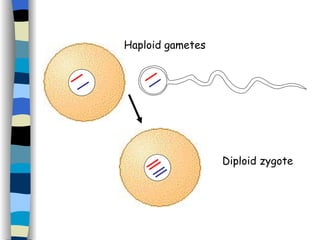
Diploid zygote Haploid gametes
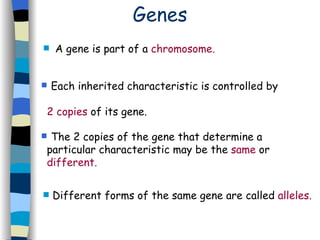
Genes A gene is part of a  chromosome. Each inherited characteristic is controlled by  2 copies   of its gene. The 2 copies of the gene that determine a  particular characteristic may be the  same  or  different. Different forms of the same gene are called  alleles.
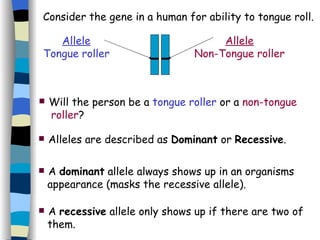
Will the person be a  tongue roller  or a  non-tongue  roller ? Alleles are described as  Dominant  or  Recessive . A  dominant  allele always shows up in an organisms  appearance (masks the recessive allele). A  recessive  allele only shows up if there are two of  them. Consider the gene in a human for ability to tongue roll. Allele Tongue roller Allele Non-Tongue roller
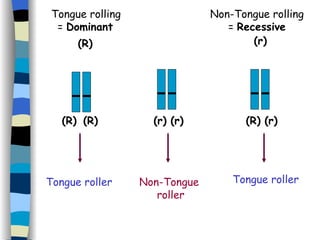
Tongue rolling =  Dominant Non-Tongue rolling =  Recessive (R) (r) (R) (R) (R) (r) (r) (r) Tongue roller Tongue roller Non-Tongue  roller
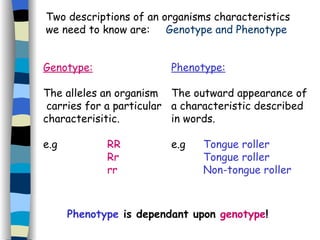
Two descriptions of an organisms characteristics we need to know are:  Genotype and Phenotype Genotype: The alleles an organism carries for a particular  characterisitic. e.g RR Rr rr Phenotype: The outward appearance of a characteristic described in words. e.g Tongue roller Tongue roller Non-tongue roller Phenotype  is dependant upon  genotype !
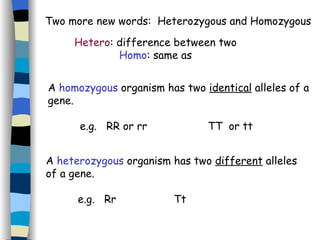
Two more new words:  Heterozygous and Homozygous Hetero : difference between two Homo : same as A  homozygous  organism has two  identical  alleles of a gene.  e.g.  RR or rr TT  or tt A  heterozygous  organism has two  different  alleles of a gene.  e.g.  Rr Tt
7.2 The Monohybrid Cross Today’s Learning Objectives: Define the term  ‘monohybrid cross’. Define the term  ‘true-breeding’. State the   genotype of a true-breeding organism. Explain why true-breeding organisms are useful in breeding experiments. Say whether a generation is P 1 , F 1,  F 2, Outline a monohybrid cross from two contrasting true-breeding parents through to the F 2  generation. Use a Punnett square to show possible genotypes in the F 2  generation for a monohybrid cross. Work out expected genotype and phenotype ratios in the F 2  generation of a monohybrid cross.
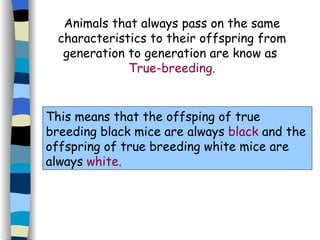
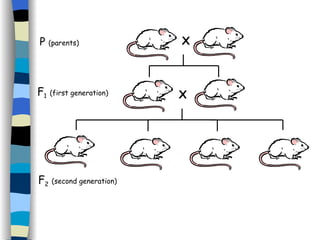
Animals that always pass on the same characteristics to their offspring from generation to generation are know as  True-breeding. This means that the offsping of true breeding black mice are always   black  and the offspring of true breeding white mice are always   white.
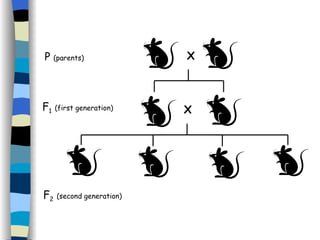
X P  (parents) X F 1   (first generation) F 2   (second generation)
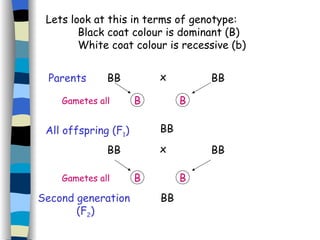
Lets look at this in terms of genotype:  Black coat colour is dominant (B) White coat colour is recessive (b) All offspring (F 1 ) BB BB BB Parents x BB BB x Second generation  (F 2 ) BB Gametes all B B Gametes all B B
X P  (parents) X F 1   (first generation) F 2   (second generation)
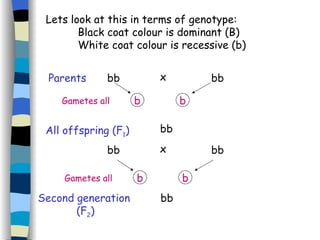
Lets look at this in terms of genotype:  Black coat colour is dominant (B) White coat colour is recessive (b) All offspring (F 1 ) bb bb bb Parents x bb bb x Second generation  (F 2 ) bb Gametes all b b Gametes all b b
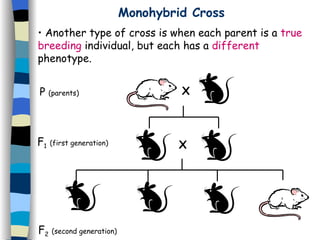
Another type of cross is when each parent is a  true breeding  individual, but each has a  different  phenotype. Monohybrid Cross X P  (parents) F 2   (second generation) X F 1   (first generation)
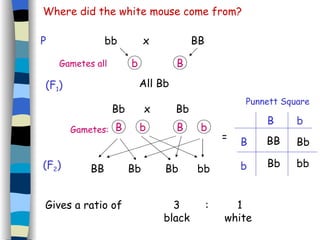
Where did the white mouse come from? P bb   x    BB Bb x Bb Gametes: (F 2 ) Bb BB Bb Bb bb Punnett Square = Gives a ratio of  3 : 1   black   white (F 1 ) All Bb BB Bb bb B b B b Gametes all b B B b B b
Practice Crosses: Pea plants can be tall (T) or dwarf (t). If a true breeding tall plant was crossed with a true breeding tall plant what would the phenotype and genotyope of the F1 and F2 generations be.
Practice Crosses: Pea plants can be tall (T) or dwarf (t). If a true breeding tall plant was crossed with a true breeding dwarf plant what would the phenotype and genotyope of the F1 and F2 generations be.
Practice Crosses: 3. R = red flower  r = yellow flower A plant homozygous for red flowers is crossed with a plant that has yellow flowers.  - Work through the cross to the F 2  generation. What is the phenotye and genotype of the F 1 . What is the phenotye and genotype ratios of the F 2
Practice Crosses: 4. R = red flower  r = yellow flower A plant heterozygous for red flowers is crossed with a plant that has yellow flowers.  - Work through the cross to the F 1  generation. What is the phenotye and genotype ratios of the F 1
7.3 Types of Monohybrid Cross Today’s Learning Objectives: Explain how a phenotype showing a dominant characteristic can have different genotypes. Explain what is meant by a test-cross. Determine genotypes from the results of a test cross. Outline any possible monohybrid cross, from the parents through to the F 1  generation. Interpret a family tree diagram. Use a family tree to work out the genotypes of an individual.
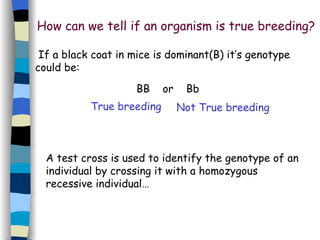
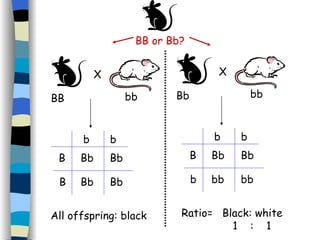
How can we tell if an organism is true breeding? If a black coat in mice is dominant(B) it’s genotype could be: BB  or  Bb True breeding Not True breeding A test cross is used to identify the genotype of an individual by crossing it with a homozygous recessive individual…
All offspring: black Ratio=  Black: white   1  :  1 BB or Bb? B B b b Bb Bb Bb Bb B b b b Bb bb Bb bb X BB bb X Bb bb
Practice Crosses: SG Text book page 201 Q’s 2, 3 and 4.
7.4 CODOMINANCE Today’s Learning Objectives: Define the term ‘ codominance’  and give examples of codominant alleles. Describe the phenotype of an individual that is heterozygous for a codominant characterisitic. Describe the possible genotypes of individuals with codominant characteristics. Be able to work out codominance crosses of all combinations.
It is possible for two different pairs of alleles to be equal in dominance. Offspring from a cross between two true-breeding parents have a phenotype in between each parent. This is known as  codominance. This is seen in animal coat colours and feathers, and in flowers.
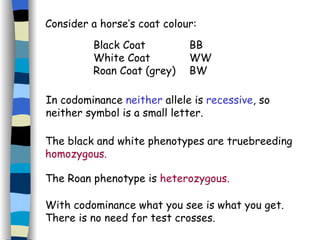
Consider a horse’s coat colour: Black Coat BB White Coat WW Roan Coat (grey) BW In codominance  neither  allele is  recessive , so neither symbol is a small letter. The black and white phenotypes are truebreeding  homozygous. The Roan phenotype is  heterozygous. With codominance what you see is what you get. There is no need for test crosses.
7.5 Polygenic Inheritance Today’s Learning Objectives: Define the term ‘discontinuous variation’ and give some examples. Define the term ‘continuous variation’ and give some examples. State what is meant by single gene inheritance. State what is meant by polygenic inheritance. Describe the relationship between the number of genes controlling a characteristic and the number of phenotypes. Give some examples of polygenic inheritance in plants and animals. Compare polygenic and single-gene inheritance.
Variations between individuals fall into two categories: 1)  Discontinuous variation: -Characteristics fall into distinct categories -Controlled by alleles of a single gene. -Single gene inheritance Discontinuous   or  Continuous
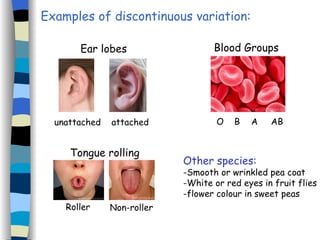
Examples of discontinuous variation: Other species: -Smooth or wrinkled pea coat -White or red eyes in fruit flies -flower colour in sweet peas Ear lobes unattached attached Blood Groups O  B  A  AB Tongue rolling Roller Non-roller
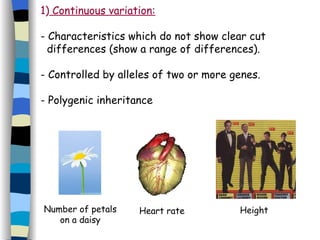
1)  Continuous variation: - Characteristics which do not show clear cut  differences (show a range of differences). - Controlled by alleles of two or more genes. - Polygenic inheritance Number of petals on a daisy Heart rate Height
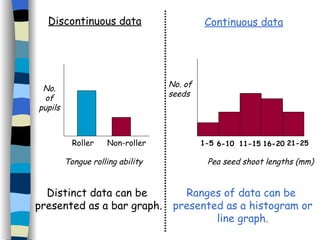
Discontinuous data Continuous data Distinct data can be  presented as a bar graph. Ranges of data can be  presented as a histogram or line graph. No. of pupils Tongue rolling ability Roller Non-roller Pea seed shoot lengths (mm) No. of seeds 1-5 6-10 11-15 16-20 21-25
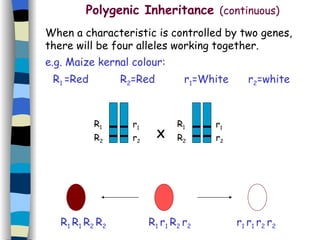
Polygenic Inheritance  (continuous) When a characteristic is controlled by two genes, there will be four alleles working together. e.g. Maize kernal colour: R 1  =Red  R 2 =Red   r 1 =White  r 2 =white R 1  R 1  R 2  R 2 r 1  r 1  r 2  r 2 R 1  r 1  R 2  r 2 R 1 r 1 R 2 r 2 R 1 r 1 R 2 r 2 X

7. Genetics And Inheritance

  • 1.
    7.1 Alleles andAppearance Today’s Learning Objectives: Explain what is meant by ‘ dominant’ and ‘ recessive’ alleles and write symbols for these. Explain the term ‘ genotype’ . Explain the term ‘ phenotype ’. Explain what is meant by homozygous and heterozygous organisms. Identify homozygous and heterozygous organisms from their genotypes. Predict phenotypes from genotypes.
  • 2.
  • 3.
    Genes A geneis part of a chromosome. Each inherited characteristic is controlled by 2 copies of its gene. The 2 copies of the gene that determine a particular characteristic may be the same or different. Different forms of the same gene are called alleles.
  • 4.
    Will the personbe a tongue roller or a non-tongue roller ? Alleles are described as Dominant or Recessive . A dominant allele always shows up in an organisms appearance (masks the recessive allele). A recessive allele only shows up if there are two of them. Consider the gene in a human for ability to tongue roll. Allele Tongue roller Allele Non-Tongue roller
  • 5.
    Tongue rolling = Dominant Non-Tongue rolling = Recessive (R) (r) (R) (R) (R) (r) (r) (r) Tongue roller Tongue roller Non-Tongue roller
  • 6.
    Two descriptions ofan organisms characteristics we need to know are: Genotype and Phenotype Genotype: The alleles an organism carries for a particular characterisitic. e.g RR Rr rr Phenotype: The outward appearance of a characteristic described in words. e.g Tongue roller Tongue roller Non-tongue roller Phenotype is dependant upon genotype !
  • 7.
    Two more newwords: Heterozygous and Homozygous Hetero : difference between two Homo : same as A homozygous organism has two identical alleles of a gene. e.g. RR or rr TT or tt A heterozygous organism has two different alleles of a gene. e.g. Rr Tt
  • 8.
    7.2 The MonohybridCross Today’s Learning Objectives: Define the term ‘monohybrid cross’. Define the term ‘true-breeding’. State the genotype of a true-breeding organism. Explain why true-breeding organisms are useful in breeding experiments. Say whether a generation is P 1 , F 1, F 2, Outline a monohybrid cross from two contrasting true-breeding parents through to the F 2 generation. Use a Punnett square to show possible genotypes in the F 2 generation for a monohybrid cross. Work out expected genotype and phenotype ratios in the F 2 generation of a monohybrid cross.
  • 9.
    Animals that alwayspass on the same characteristics to their offspring from generation to generation are know as True-breeding. This means that the offsping of true breeding black mice are always black and the offspring of true breeding white mice are always white.
  • 10.
    X P (parents) X F 1 (first generation) F 2 (second generation)
  • 11.
    Lets look atthis in terms of genotype: Black coat colour is dominant (B) White coat colour is recessive (b) All offspring (F 1 ) BB BB BB Parents x BB BB x Second generation (F 2 ) BB Gametes all B B Gametes all B B
  • 12.
    X P (parents) X F 1 (first generation) F 2 (second generation)
  • 13.
    Lets look atthis in terms of genotype: Black coat colour is dominant (B) White coat colour is recessive (b) All offspring (F 1 ) bb bb bb Parents x bb bb x Second generation (F 2 ) bb Gametes all b b Gametes all b b
  • 14.
    Another type ofcross is when each parent is a true breeding individual, but each has a different phenotype. Monohybrid Cross X P (parents) F 2 (second generation) X F 1 (first generation)
  • 15.
    Where did thewhite mouse come from? P bb x BB Bb x Bb Gametes: (F 2 ) Bb BB Bb Bb bb Punnett Square = Gives a ratio of 3 : 1 black white (F 1 ) All Bb BB Bb bb B b B b Gametes all b B B b B b
  • 16.
    Practice Crosses: Peaplants can be tall (T) or dwarf (t). If a true breeding tall plant was crossed with a true breeding tall plant what would the phenotype and genotyope of the F1 and F2 generations be.
  • 17.
    Practice Crosses: Peaplants can be tall (T) or dwarf (t). If a true breeding tall plant was crossed with a true breeding dwarf plant what would the phenotype and genotyope of the F1 and F2 generations be.
  • 18.
    Practice Crosses: 3.R = red flower r = yellow flower A plant homozygous for red flowers is crossed with a plant that has yellow flowers. - Work through the cross to the F 2 generation. What is the phenotye and genotype of the F 1 . What is the phenotye and genotype ratios of the F 2
  • 19.
    Practice Crosses: 4.R = red flower r = yellow flower A plant heterozygous for red flowers is crossed with a plant that has yellow flowers. - Work through the cross to the F 1 generation. What is the phenotye and genotype ratios of the F 1
  • 20.
    7.3 Types ofMonohybrid Cross Today’s Learning Objectives: Explain how a phenotype showing a dominant characteristic can have different genotypes. Explain what is meant by a test-cross. Determine genotypes from the results of a test cross. Outline any possible monohybrid cross, from the parents through to the F 1 generation. Interpret a family tree diagram. Use a family tree to work out the genotypes of an individual.
  • 21.
    How can wetell if an organism is true breeding? If a black coat in mice is dominant(B) it’s genotype could be: BB or Bb True breeding Not True breeding A test cross is used to identify the genotype of an individual by crossing it with a homozygous recessive individual…
  • 22.
    All offspring: blackRatio= Black: white 1 : 1 BB or Bb? B B b b Bb Bb Bb Bb B b b b Bb bb Bb bb X BB bb X Bb bb
  • 23.
    Practice Crosses: SGText book page 201 Q’s 2, 3 and 4.
  • 24.
    7.4 CODOMINANCE Today’sLearning Objectives: Define the term ‘ codominance’ and give examples of codominant alleles. Describe the phenotype of an individual that is heterozygous for a codominant characterisitic. Describe the possible genotypes of individuals with codominant characteristics. Be able to work out codominance crosses of all combinations.
  • 25.
    It is possiblefor two different pairs of alleles to be equal in dominance. Offspring from a cross between two true-breeding parents have a phenotype in between each parent. This is known as codominance. This is seen in animal coat colours and feathers, and in flowers.
  • 26.
    Consider a horse’scoat colour: Black Coat BB White Coat WW Roan Coat (grey) BW In codominance neither allele is recessive , so neither symbol is a small letter. The black and white phenotypes are truebreeding homozygous. The Roan phenotype is heterozygous. With codominance what you see is what you get. There is no need for test crosses.
  • 27.
    7.5 Polygenic InheritanceToday’s Learning Objectives: Define the term ‘discontinuous variation’ and give some examples. Define the term ‘continuous variation’ and give some examples. State what is meant by single gene inheritance. State what is meant by polygenic inheritance. Describe the relationship between the number of genes controlling a characteristic and the number of phenotypes. Give some examples of polygenic inheritance in plants and animals. Compare polygenic and single-gene inheritance.
  • 28.
    Variations between individualsfall into two categories: 1) Discontinuous variation: -Characteristics fall into distinct categories -Controlled by alleles of a single gene. -Single gene inheritance Discontinuous or Continuous
  • 29.
    Examples of discontinuousvariation: Other species: -Smooth or wrinkled pea coat -White or red eyes in fruit flies -flower colour in sweet peas Ear lobes unattached attached Blood Groups O B A AB Tongue rolling Roller Non-roller
  • 30.
    1) Continuousvariation: - Characteristics which do not show clear cut differences (show a range of differences). - Controlled by alleles of two or more genes. - Polygenic inheritance Number of petals on a daisy Heart rate Height
  • 31.
    Discontinuous data Continuousdata Distinct data can be presented as a bar graph. Ranges of data can be presented as a histogram or line graph. No. of pupils Tongue rolling ability Roller Non-roller Pea seed shoot lengths (mm) No. of seeds 1-5 6-10 11-15 16-20 21-25
  • 32.
    Polygenic Inheritance (continuous) When a characteristic is controlled by two genes, there will be four alleles working together. e.g. Maize kernal colour: R 1 =Red R 2 =Red r 1 =White r 2 =white R 1 R 1 R 2 R 2 r 1 r 1 r 2 r 2 R 1 r 1 R 2 r 2 R 1 r 1 R 2 r 2 R 1 r 1 R 2 r 2 X