Memory
• What type of memory loss is most
common during the initial stage of
Alzheimer’s disease?
• A. Short term memory loss
• B. Semantic memory loss
• C. Episodic memory loss
• D. Procedural memory loss
• Ans: A) Short term memory loss
• The simplest way to maintain information
in short-term memory is to repeat the
information in a process called
• a. Chunking.
b. Rehearsal.
c. Revision.
d. Recall.
• Ans: B) Rehearsal
Long term memory is processed in:
• a) Hypothalamus
• b) Thalamus
• c) Amygdale
• d) Hippocampus
• e) Parietal Lobe
• Ans: d) Hippocampus
Memory
Memory is the most extraordinary
phenomenon in the natural world. Our
sensory experiences, perceptions and
actions change us continuously and
determine what we are later able to
percivebrains are modified and reorganized
by our experiences.
Our interactions with the physical world, our
sensory experience, our perceptions, our
actions, change us continuously and
determine what we are later able to
perceive, remember, understand, and
become.
The most amazing aspect of human
memory, is the characteristic that it stores
events as video recordings, along with the
associated emotions and feelings.
A subsequent recall therefore also includes,
the reliving of the associated emotions. It is
this phenomena that makes our memories
pleasant and unpleasant.
Higher mental functions such as speech,
thinking, perceptions, moods, psychomotor
skills and consciousness of surroundings are
based is based on memory. Indeed, without
memory there can be no mind..
a. Stages of Memory
Human memory resembles a computer in
that it consists of an information processing
system that has three separate stages:
Encoding :
Sensory information is received and coded
or transformed into neural impulses that can
be processed further or stored for later use.
Just as computer changes keyboard entries
into usable electronic symbols that can be
stored on a disk, sensory information is
transduced, so that it can be used and stored
by the brain.
Apart from transduction a great deal of
encoding process appears to be devoted to
rehearsing or repeating the input.
ii. Storage:
Like a computer program, the encoded
information must be stored in the memory
system. Although some bits of information
are stored briefly or used only once, and
then discarded, others, like certain
telephone numbers, are used frequently, and
are therefore stored on a more permanent
basis.
iii. Retrieval:
Once a computer program has been named
and stored, we can call it up by its name and
use it again. Human memory works in
much the same way. When we recall or
bring a memory into consciousness, we
have retrieved it. This recall process is
known as memory retrieval.
b. Types of Memory:
i. Sensory Memory:
Sensory memory is a memory or storage of
sensory events such as sight, sounds and
taste with no further processing or
interpretation. Sensory memory provides us
with a very brief image of all the stimuli
that present at a particular moment and
therefore has the potential to be quiet large.
Because many are received all the time,
sensory memory appears to last only briefly,
about one half to one second, depending on
which sensory system is involved.
For instance if you see an object, an image
persists for about one-half second
afterwards. Similarly information you hear
is held as a brief echo is sensory memory
for up to two seconds.
ii. Short-term Memory (STM) :
Not everything seen or heard is kept is memory.
Let’s say a TV commercial is running in the
background as your friend reads you notes on
pharmacology. Do you remember the words of the
TV ad? Probably not, because selective attention
determines what information moves on to short-
term memory. Short term memories are also brief,
but longer than sensory memories.
Attending to your friend’s narration will
place his technical jargon in your short-term
memory ( while allowing you to ignore the
voice on TV saying “ talk shawk” ).
Short-term memories can be stored as
images, but more often they are stored as
sounds, especially in recalling words and
letters. Short-term memory acts as a
temporary storehouse for small amount of
information.
Unless the information is important, it is
quickly dumped from STM and is lost
forever. Short-term memory prevents our
minds from collecting useless names, dates,
telephone numbers and other trivia.
At the same time it provides a working
memory where we do much of our thinking,
dialing a phone number, doing mental
arithmetic and remembering a shopping list.
iii. Long-term Memory (LTM):
Information that is meaningful and important is
transferred to the third memory system called
long-term memory. In contrast to STM, long-term
memory (LTM) acts as permanent storehouse for
information. LTM contains everything you know
about the world and yet there appears to be no
danger of running out of room LTM, which is
considered to have a limitless storage capacity.
Information in the LTM is stored on the basis of
meaning and importance and not by sound or
images. When new information enters STM, it is
related to knowledge stored in LTM . This gives
the new information meaning and makes it easier
to store it in LTM.
It is therefore important to built new
information on what you already know
( stored in your LTM) areas of the brain are
responsible for memory, but the
hippocampus is of particular importance.
Recent research in human memory has
revealed that there is more than one type of
LTM. The type of information being
processed influence the nature of the stored
memory.
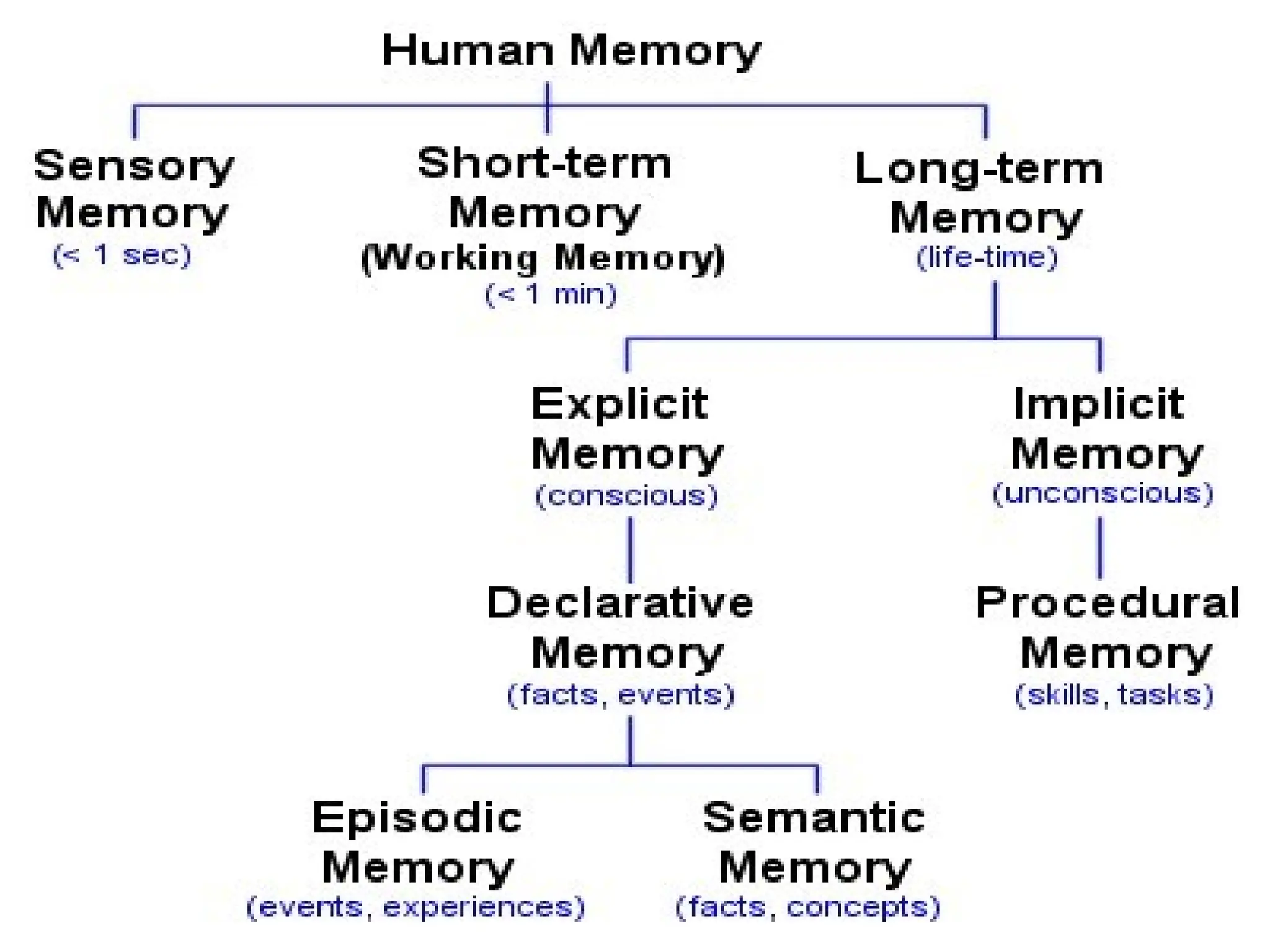
Three major categories of LTM have been
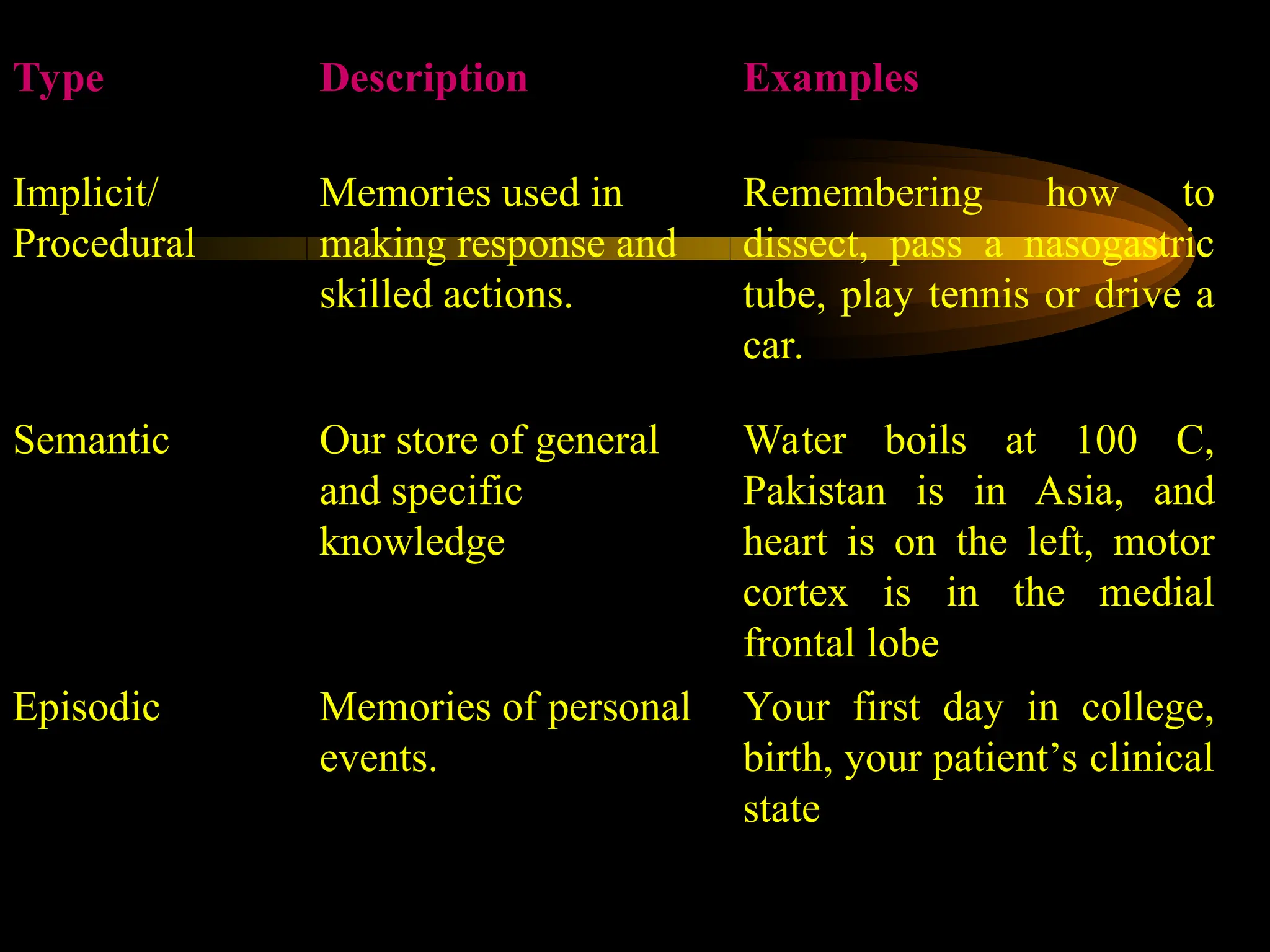
proposed s illustrated in the following table:
Sensory
Memory
Selective
Attention
Short-Term
Memory
Successfully
Coded for
storage in LTM
Long
Term
Memory
Not
Attended
to
Not
Coded
While
In
STM
Forgotten Forgotten
Incoming
information
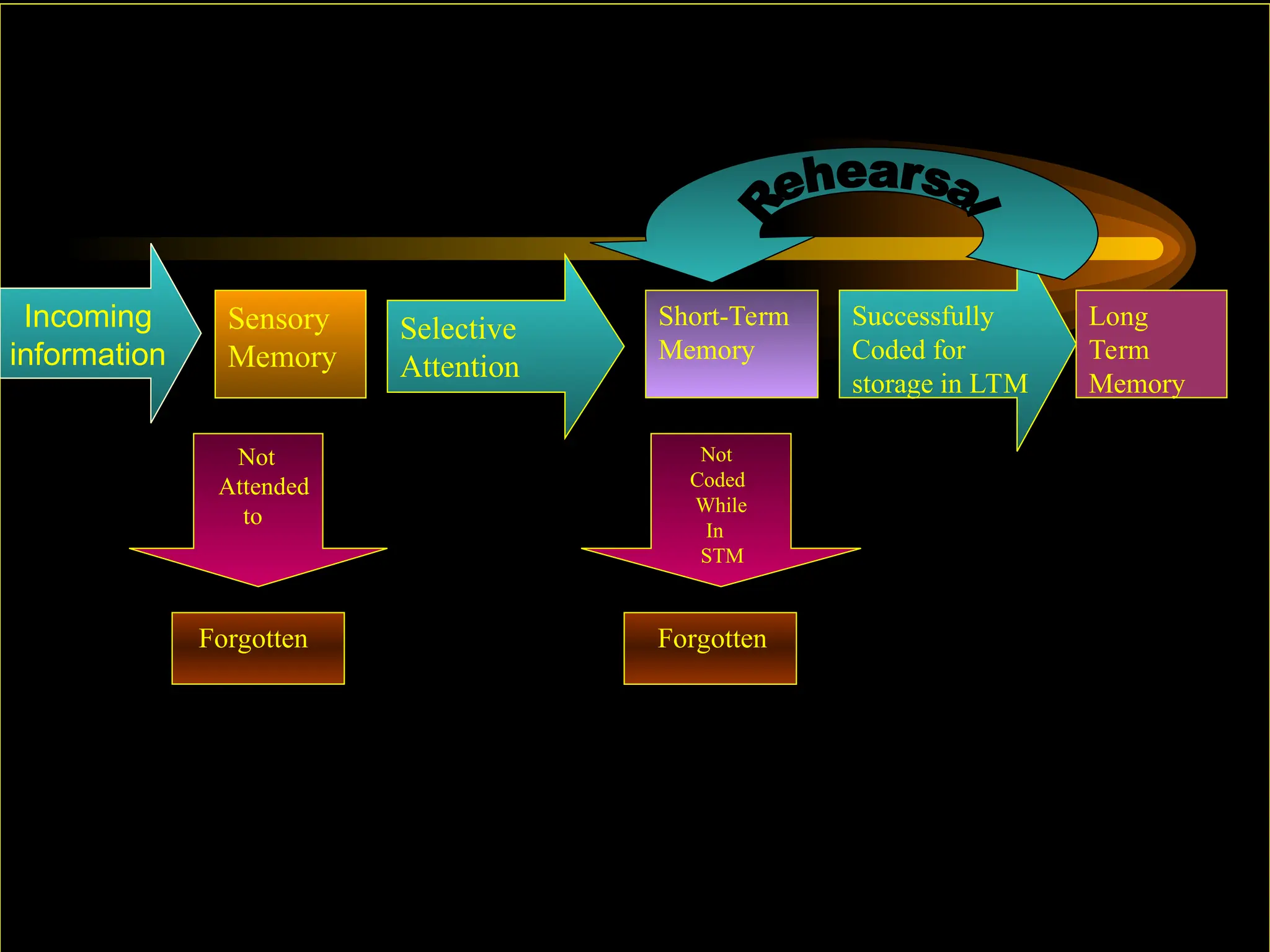
Memory is thought to involve at least three
steps. Incoming information is first held for a
second or two by sensory memory.
Information selected by attention is then
transferred to short term memory. If new
information is not rapidly encoded, or
rehearsed, it is forgotten. If it is transferred to
long term memory, it becomes relatively
permanent, although retrieving it may be a
problem.
Type Description Examples
Implicit/
Procedural
Memories used in
making response and
skilled actions.
Remembering how to
dissect, pass a nasogastric
tube, play tennis or drive a
car.
Semantic Our store of general
and specific
knowledge
Water boils at 100 C,
Pakistan is in Asia, and
heart is on the left, motor
cortex is in the medial
frontal lobe
Episodic Memories of personal
events.
Your first day in college,
birth, your patient’s clinical
state
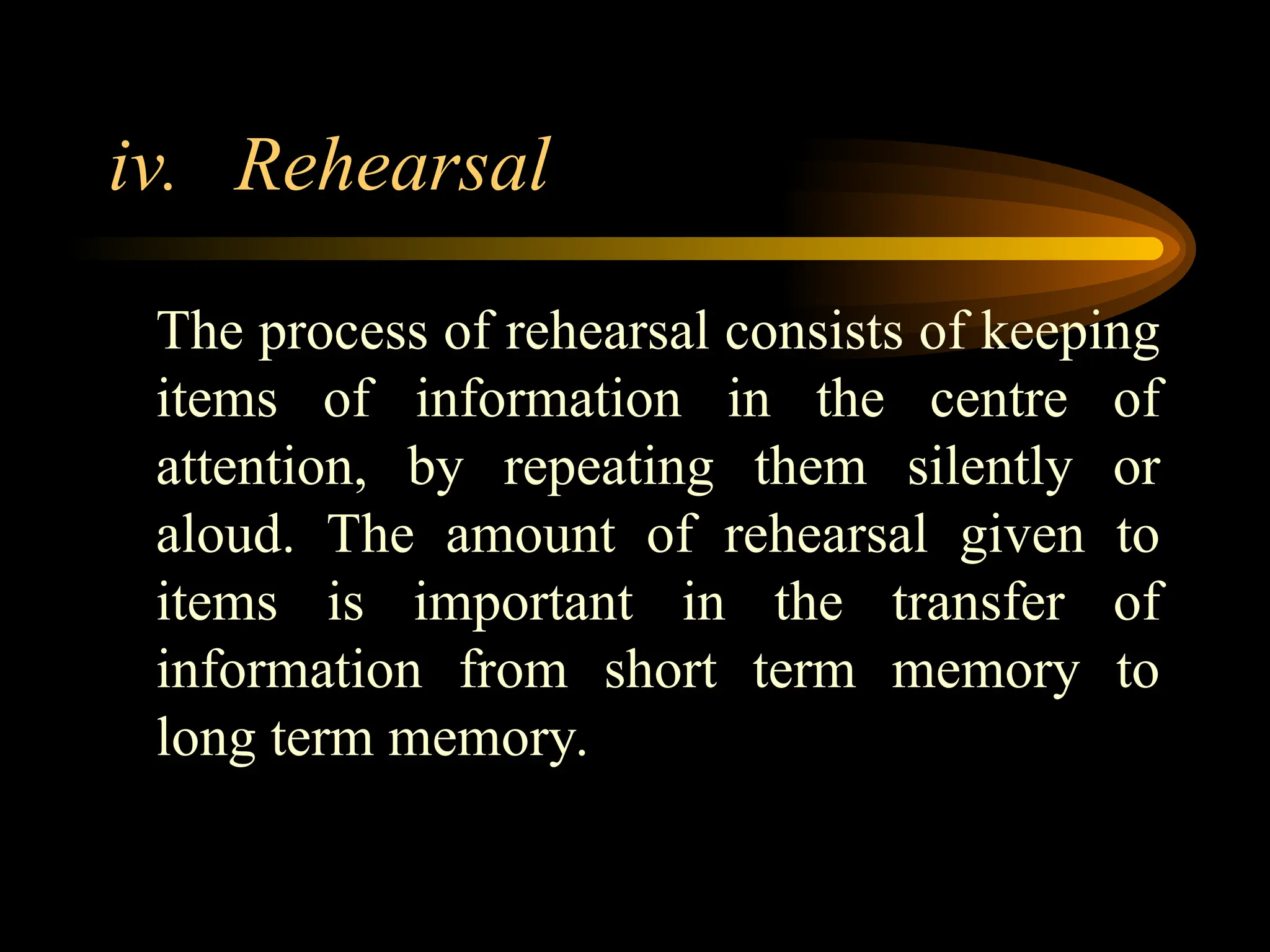
iv. Rehearsal
The process of rehearsal consists of keeping
items of information in the centre of
attention, by repeating them silently or
aloud. The amount of rehearsal given to
items is important in the transfer of
information from short term memory to
long term memory.
Experiments have indicated that the sheer amount
of rehearsal may be less important than the ways
in which information is rehearsed. Just going over
and over what is to remembered (maintenance
rehearsal) does not necessarily succeed in
transferring it to long term memory. What really
works is elaborative rehearsal which is an active
process involving giving the material organization
and meaning as it is being rehearsed.
Forgetting:
Forgetting is the apparent loss of
information already encoded and stored in
long term memory. This means that much
of what we think as forgotten in not really
forgotten because it was never encoded and
stored in the first place.
This usually because some information, due
to lack of attention, may not have reached
short term memory form the sensory
register or due inadequate encoding and
rehearsal, the information may not have
been transferred from the short term
memory to the long term memory. How
much of the information is forgotten
depends on the following factors.
Interference:
Experimental evidence as well as everyday
experience indicates that learning new
things interferes with our memories of what
we learned earlier and prior learning
interferes with memory of things learned
later.
Retrieval problems:
Finding information in the organization
long term memory store is aided by
retrieval cues, or reminders which direct the
memory search to the appropriate part of
the long term memory library. Without the
retrieval cues, the sought for item stored in
LTM may not be found and one forgets.
While we often cannot recall something
while actively searching for it, we may later
recall the sought for information, when we
have given up the search and doing
something else. The new activity in which
we are engaged gives us another set of
appropriate reminders or retrieval cues.
And perhaps the new situation leads us to
search through portions of our LTM store
not examined before. It is therefore a good
idea to ask the examiner to go the next
question in viva vocem, rather than
continuing to retrieve an answer. It will
come to you in a while, when you are
answering another question.
Motivated forgetting:
The theory of motivated forgetting was introduced
by Sigmund Freud when he described a key
concept of psychoanalysis viz. repression.
Repression refers to the tendency of people to
have difficulty in retrieving anxiety provoking or
threatening information. This helps to explain why
people generally remember pleasant events more
often than they do unpleasant ones; the
unpleasant memories have been repressed.
This aspect should encourage to make one’s
learning ‘a lot of fun’, enjoying your studies
and clinical work rather than making it
painful and a burden. This will happen if
you will leave your exam preparation to the
few days try to the exams only.
c. The Anatomy and Biochemistry
of Memory:
The study of organic memory disorders has
led researchers to identify brain that appear
to mediate short term and long term
memory processes. Two of the sky parts of
the limbic system, the hippocampus and the
amygdala embedded under the temporal
lobes are essential in receiving new
information and storing it.
The diencephalons also contains a number of
structures, the most important for memory being
the mammillary bodies, thalamus and
hypothalamus. Lesions to these structures
generally result in problems with encoding of new
information. Although no-one has yet found the
exact physical change in a call that accounts for
memory, many new discoveries have been made
about the physiological basis of learning and
memory.
One of these findings is the role that long
term potentiation (LTP) may play in
memory formation. Studies reveal that
repeated electrical stimulation of nerve cells
in the brain can lead to a significant
increase in the likelihood that a cell will
respond strongly to a future stimulation.
This effect can last for a long time and may be a
key mechanism in the formation of memories.
Studies also indicate that a specific type of
receptor viz. NMDA receptor is extremely active
in long term potentiation as is the role of calcium.
An important part of memory formation is an
increase in the sensitivity of certain nerve cells to
acetylcholine. All these changes suggest that.
d. Methods to improve memory:
In the beginning of the section clearly
indicates that some individuals have
specific techniques through which they
facilitate there memory and learning of new
information. Some of these are as follows:
Knowledge of results:
Learning occurs most effectively when
feedback or knowledge of results allows
you to check and see if you are learning.
Feedback also helps you identify material
that needs extra practice, and it can be
rewarding to know that you have answered
or remembered correctly.
Attention :
A setting that enhance your focus while
studying, and ensures minimal distraction
will turn your attention to the memory job
at hand.
Recitation and rehearsal:
This means repeating to yourself what you
have learned. If you are going re remember
something, eventually you will have to
retrieve it. Recitation forces you to practice
retrieving information as you are learning.
When you are reading a textbook, you
should stop frequently and try to remember
what you have just read by summarizing it
aloud. Your room mate who is sometimes
seen talking to himself, while studying, may
not be “crazy, he may instead be rehearing
what he has just read.
Organize:
Assume that you must memorize the
following list if words; north, man, red
spring, woman, east, autumn, yellow,
summer, boy, blue west, winter, girl, green,
south. The rather difficult list could be
organized into chunks as follow; north-east-
south-west, spring –summer-autumn-boy-
girl.
Similarly by making up stories using long
list of words to be memorized makes
remembering the list much easier.
Selection:
The Dutch scholar Erasmus said that a good
memory is like a fisherman’s net. It should
keep all the big fish and let the little ones
escape. If you boil down the paragraphs in
your textbooks to one or two important
terms or ideas, you will find memorizing
more manageable.
Practice careful and selective marking in
your textbooks and marginal notes to
further summarize ideas. Most students
mark their texts too much instead of too
little. If everything is underlined, you
haven’t been selective.
Serial position:
Whenever you must learn something, be aware of
the serial position effect. This is the tendency to
make most errors is remembering the middle of a
list. If you are introduced to a long line of people,
the names you likely to forget will be those in the
middle, so you should make an extra effort to
attend to them. The middle of a list, poem or
speech should therefore be given special attention
and extra practice.
Mnemonics:
A mnemonic is any kind of memory system or aid.
People demonstrating extraordinary feats with
their memories are actually using mnemonics to
perform this. Mnemonic techniques rely on the
linking or association of to-be-remembered
material with a systematic and organized set of
images or words that are already firmly
established in long term memory and can therefore
serve as retrieval cues.
An example of this happens when we are
trying to remember how many days there
are in a month and recite “ Thirty day halt
September…” Similarly medical students
often invent mnemonics for memorizing the
names of cranial nerves; amino acids etc
and can remember these lists for lengthy
periods.
The basic principles in the formation of
mnemonics are :
• Use mental pictures
• Make things meaningful
• Make information familiar
• Form bizarre, unusual or exaggerated
mental associations.
Attach emotions, feelings:
Or link up with an event, We hardly ever
forget what is emotionally significant in our
lives. Senior citizens continue to recall
events of emotional significance even when
their short term memory is grossly impaired
Using Mental Pictures or Visual
Imagery
• Using mental pictures or visual imagery to
enhance retention. One way is to simply
imagine an unusual scene that includes the
various elements you want to remember. F
• For intance in your way home, you have to
shop for a newspaper, notebook, pen and
shaving cream. To remember this list of
items, you have to make up a mental image
of something funny and bizarre such as you.
• Opening up the front page of a newspaper
to find a picture of a person reading a
notebook with one hand and using a pen to
wipe off the shaving cream on his face with
the other hand.
Over learning:
Many studies indicate that memory is
greatly improved when study is continued
beyond bare mastery. In other words after
you have learned material well enough to
remember it without error, you should
continue to study the material. Over
learning is your best insurance against
going blank on a test because of anxiety.
Spaced practice:
Spaced practice generally is superior to
massed practice. By improving
concentration, three 20 minutes study
sessions can produce more learning than
one hour of continuous study.
Whole versus part learning:
Generally it is better to practice learning
whole packages of information rather than
smaller parts. Try to study the largest
meaningful amount of information possible
at one time. This means, reading a textbook
is better than reading condensed notes. The
only notes that will benefit you will be the
ones that you make yourself based on steps
listed above.
Sleep:
Sleeping after study is helpful and reduces
the interference. Similarly breaks and free
times in a schedule are as important as the
study periods. Staying awake the whole
night before your exams is after all not the
smart thing to do.
Review:
Reviewing shortly before an examination is
helpful, though one should avoid the
tendency to memorize new information at
that point. This review should however over
an hour or so rather than spending the
whole night prior to the exam.
e. Pathological Changes in
Memory
Before considering the pathological basis of
memory loss, it is important to run simple
tests of a person’s cognitive functions such
as attention, concentration, registration and
motivation. In case of an impairment of one
or more of these higher mental functions,
the function of memory does not come into
play.
Pathological Changes in Memory
People with low mood, poor motivation and
consequent lack of attention and
concentration my therefore complain of “
loss of memory “ this state is called
pseuododementia.
Another situation, in which people
sometimes experience a significant
alteration in their memory or identity, occur
on account of loss of integrative function of
the brain due to an emotional challenge or a
stress that could be social, psychological or
structural.
Such stress can interrupt in learning new
information or recalling old information, or
by changes in the ability to think and
process information, result in disruption of
memory and identity.
These alterations in memory ( and or of
identify, or consciousness) sometimes lack
a clear physical cause and are called
dissociative disorders. The principal
symptom in such situations in an inability to
recall important personal events and
information of personal significance.
Disturbances in memory and identity that
have clear physical cause include amnestic
disorders and dementias. Amnestic
disorders affect a person’s memory
exclusively, either for events before an
amnesia inducing trauma or for information
learned after it or both.
They are caused by medical conditions,
such as thiamine deficiency,
hypothyroidism, hypoglycemia, chronic
alcohol or substance abuse, head injury or
other problems that can adversely effect the
physical functioning of the brain.
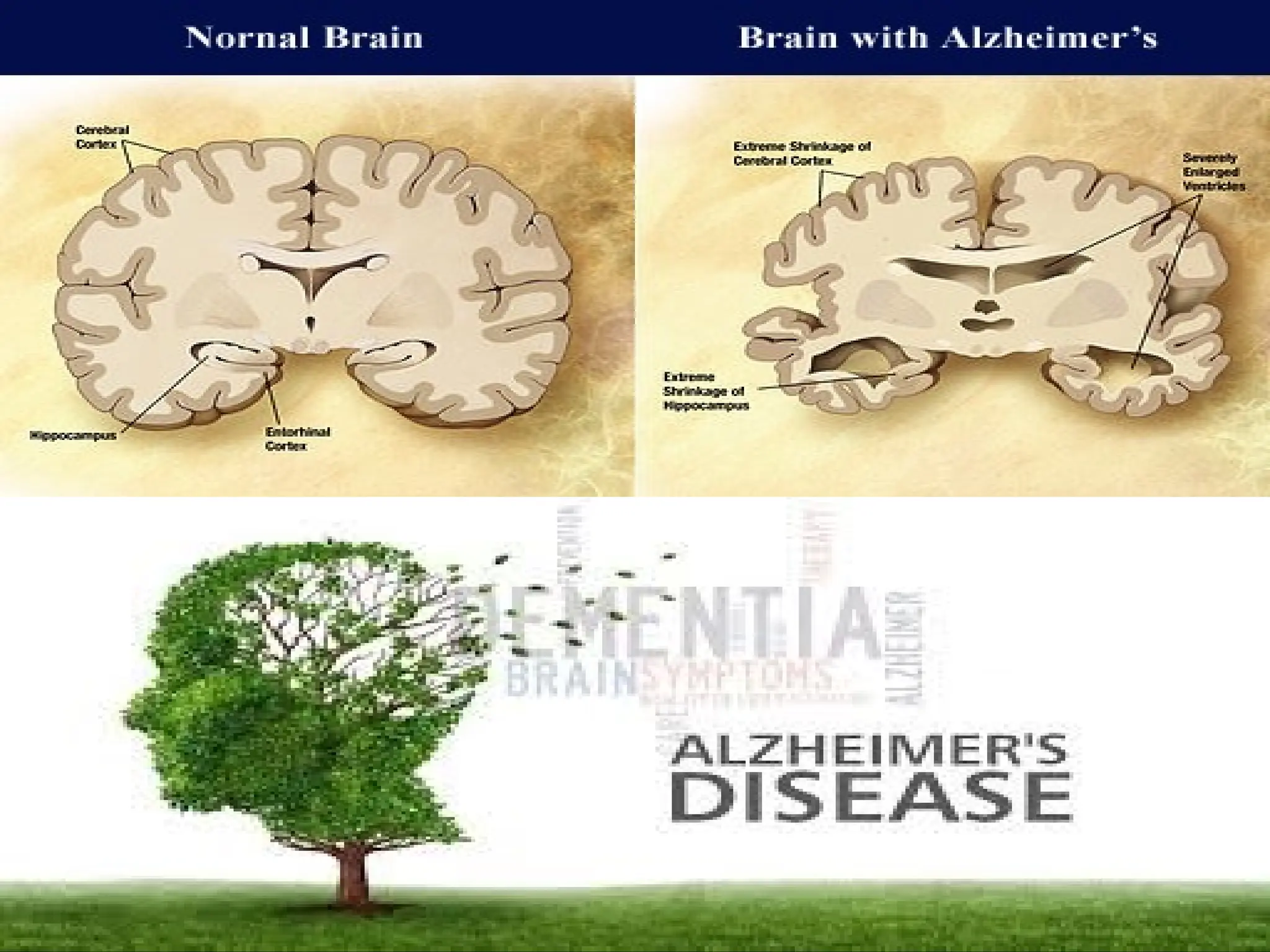
Dementias involve more then just memory
and are characterized by deficits in other
areas of cognitive functioning as well such
as reasoning and problem solving. They are
caused primarily by degeneration disease
that affect specific area of the brain. The
most common amongst them is Alzheimer’s
disease.
Q. The Anatomy of memory is
mainly linked to :
• a) Cerecaral Cortex
• b) Basal Ganglia
• c) Cerebellum
• d) Mammilary Bodies
• e) Substantia Nigra
Key
D. (Mammilary Bodies )
Q. Which of the following can lighten
the load on memory and enhances our
ability to communicate in the best way?
• a) Problem solving
• b) Making Decision
• c) Concepts
• d) Creative thinking
• e) Emotions
Key
c) Concepts
04. MEMORY - Its basic components, types

04. MEMORY - Its basic components, types

  • 2.
  • 3.
    • What typeof memory loss is most common during the initial stage of Alzheimer’s disease? • A. Short term memory loss • B. Semantic memory loss • C. Episodic memory loss • D. Procedural memory loss
  • 4.
    • Ans: A)Short term memory loss
  • 5.
    • The simplestway to maintain information in short-term memory is to repeat the information in a process called • a. Chunking. b. Rehearsal. c. Revision. d. Recall.
  • 6.
    • Ans: B)Rehearsal
  • 7.
    Long term memoryis processed in: • a) Hypothalamus • b) Thalamus • c) Amygdale • d) Hippocampus • e) Parietal Lobe
  • 8.
    • Ans: d)Hippocampus
  • 9.
    Memory Memory is themost extraordinary phenomenon in the natural world. Our sensory experiences, perceptions and actions change us continuously and determine what we are later able to percivebrains are modified and reorganized by our experiences.
  • 10.
    Our interactions withthe physical world, our sensory experience, our perceptions, our actions, change us continuously and determine what we are later able to perceive, remember, understand, and become.
  • 11.
    The most amazingaspect of human memory, is the characteristic that it stores events as video recordings, along with the associated emotions and feelings.
  • 12.
    A subsequent recalltherefore also includes, the reliving of the associated emotions. It is this phenomena that makes our memories pleasant and unpleasant.
  • 13.
    Higher mental functionssuch as speech, thinking, perceptions, moods, psychomotor skills and consciousness of surroundings are based is based on memory. Indeed, without memory there can be no mind..
  • 14.
    a. Stages ofMemory Human memory resembles a computer in that it consists of an information processing system that has three separate stages:
  • 15.
    Encoding : Sensory informationis received and coded or transformed into neural impulses that can be processed further or stored for later use. Just as computer changes keyboard entries into usable electronic symbols that can be stored on a disk, sensory information is transduced, so that it can be used and stored by the brain.
  • 16.
    Apart from transductiona great deal of encoding process appears to be devoted to rehearsing or repeating the input.
  • 17.
    ii. Storage: Like acomputer program, the encoded information must be stored in the memory system. Although some bits of information are stored briefly or used only once, and then discarded, others, like certain telephone numbers, are used frequently, and are therefore stored on a more permanent basis.
  • 18.
    iii. Retrieval: Once acomputer program has been named and stored, we can call it up by its name and use it again. Human memory works in much the same way. When we recall or bring a memory into consciousness, we have retrieved it. This recall process is known as memory retrieval.
  • 20.
    b. Types ofMemory: i. Sensory Memory: Sensory memory is a memory or storage of sensory events such as sight, sounds and taste with no further processing or interpretation. Sensory memory provides us with a very brief image of all the stimuli that present at a particular moment and therefore has the potential to be quiet large.
  • 21.
    Because many arereceived all the time, sensory memory appears to last only briefly, about one half to one second, depending on which sensory system is involved.
  • 22.
    For instance ifyou see an object, an image persists for about one-half second afterwards. Similarly information you hear is held as a brief echo is sensory memory for up to two seconds.
  • 23.
    ii. Short-term Memory(STM) : Not everything seen or heard is kept is memory. Let’s say a TV commercial is running in the background as your friend reads you notes on pharmacology. Do you remember the words of the TV ad? Probably not, because selective attention determines what information moves on to short- term memory. Short term memories are also brief, but longer than sensory memories.
  • 24.
    Attending to yourfriend’s narration will place his technical jargon in your short-term memory ( while allowing you to ignore the voice on TV saying “ talk shawk” ).
  • 25.
    Short-term memories canbe stored as images, but more often they are stored as sounds, especially in recalling words and letters. Short-term memory acts as a temporary storehouse for small amount of information.
  • 26.
    Unless the informationis important, it is quickly dumped from STM and is lost forever. Short-term memory prevents our minds from collecting useless names, dates, telephone numbers and other trivia.
  • 27.
    At the sametime it provides a working memory where we do much of our thinking, dialing a phone number, doing mental arithmetic and remembering a shopping list.
  • 28.
    iii. Long-term Memory(LTM): Information that is meaningful and important is transferred to the third memory system called long-term memory. In contrast to STM, long-term memory (LTM) acts as permanent storehouse for information. LTM contains everything you know about the world and yet there appears to be no danger of running out of room LTM, which is considered to have a limitless storage capacity.
  • 29.
    Information in theLTM is stored on the basis of meaning and importance and not by sound or images. When new information enters STM, it is related to knowledge stored in LTM . This gives the new information meaning and makes it easier to store it in LTM.
  • 30.
    It is thereforeimportant to built new information on what you already know ( stored in your LTM) areas of the brain are responsible for memory, but the hippocampus is of particular importance.
  • 31.
    Recent research inhuman memory has revealed that there is more than one type of LTM. The type of information being processed influence the nature of the stored memory.
  • 32.
    Three major categoriesof LTM have been proposed s illustrated in the following table:
  • 33.
    Sensory Memory Selective Attention Short-Term Memory Successfully Coded for storage inLTM Long Term Memory Not Attended to Not Coded While In STM Forgotten Forgotten Incoming information
  • 34.
    Memory is thoughtto involve at least three steps. Incoming information is first held for a second or two by sensory memory. Information selected by attention is then transferred to short term memory. If new information is not rapidly encoded, or rehearsed, it is forgotten. If it is transferred to long term memory, it becomes relatively permanent, although retrieving it may be a problem.
  • 35.
    Type Description Examples Implicit/ Procedural Memoriesused in making response and skilled actions. Remembering how to dissect, pass a nasogastric tube, play tennis or drive a car. Semantic Our store of general and specific knowledge Water boils at 100 C, Pakistan is in Asia, and heart is on the left, motor cortex is in the medial frontal lobe Episodic Memories of personal events. Your first day in college, birth, your patient’s clinical state
  • 36.
    iv. Rehearsal The processof rehearsal consists of keeping items of information in the centre of attention, by repeating them silently or aloud. The amount of rehearsal given to items is important in the transfer of information from short term memory to long term memory.
  • 37.
    Experiments have indicatedthat the sheer amount of rehearsal may be less important than the ways in which information is rehearsed. Just going over and over what is to remembered (maintenance rehearsal) does not necessarily succeed in transferring it to long term memory. What really works is elaborative rehearsal which is an active process involving giving the material organization and meaning as it is being rehearsed.
  • 38.
    Forgetting: Forgetting is theapparent loss of information already encoded and stored in long term memory. This means that much of what we think as forgotten in not really forgotten because it was never encoded and stored in the first place.
  • 39.
    This usually becausesome information, due to lack of attention, may not have reached short term memory form the sensory register or due inadequate encoding and rehearsal, the information may not have been transferred from the short term memory to the long term memory. How much of the information is forgotten depends on the following factors.
  • 40.
    Interference: Experimental evidence aswell as everyday experience indicates that learning new things interferes with our memories of what we learned earlier and prior learning interferes with memory of things learned later.
  • 41.
    Retrieval problems: Finding informationin the organization long term memory store is aided by retrieval cues, or reminders which direct the memory search to the appropriate part of the long term memory library. Without the retrieval cues, the sought for item stored in LTM may not be found and one forgets.
  • 42.
    While we oftencannot recall something while actively searching for it, we may later recall the sought for information, when we have given up the search and doing something else. The new activity in which we are engaged gives us another set of appropriate reminders or retrieval cues.
  • 43.
    And perhaps thenew situation leads us to search through portions of our LTM store not examined before. It is therefore a good idea to ask the examiner to go the next question in viva vocem, rather than continuing to retrieve an answer. It will come to you in a while, when you are answering another question.
  • 44.
    Motivated forgetting: The theoryof motivated forgetting was introduced by Sigmund Freud when he described a key concept of psychoanalysis viz. repression. Repression refers to the tendency of people to have difficulty in retrieving anxiety provoking or threatening information. This helps to explain why people generally remember pleasant events more often than they do unpleasant ones; the unpleasant memories have been repressed.
  • 45.
    This aspect shouldencourage to make one’s learning ‘a lot of fun’, enjoying your studies and clinical work rather than making it painful and a burden. This will happen if you will leave your exam preparation to the few days try to the exams only.
  • 46.
    c. The Anatomyand Biochemistry of Memory: The study of organic memory disorders has led researchers to identify brain that appear to mediate short term and long term memory processes. Two of the sky parts of the limbic system, the hippocampus and the amygdala embedded under the temporal lobes are essential in receiving new information and storing it.
  • 47.
    The diencephalons alsocontains a number of structures, the most important for memory being the mammillary bodies, thalamus and hypothalamus. Lesions to these structures generally result in problems with encoding of new information. Although no-one has yet found the exact physical change in a call that accounts for memory, many new discoveries have been made about the physiological basis of learning and memory.
  • 48.
    One of thesefindings is the role that long term potentiation (LTP) may play in memory formation. Studies reveal that repeated electrical stimulation of nerve cells in the brain can lead to a significant increase in the likelihood that a cell will respond strongly to a future stimulation.
  • 49.
    This effect canlast for a long time and may be a key mechanism in the formation of memories. Studies also indicate that a specific type of receptor viz. NMDA receptor is extremely active in long term potentiation as is the role of calcium. An important part of memory formation is an increase in the sensitivity of certain nerve cells to acetylcholine. All these changes suggest that.
  • 50.
    d. Methods toimprove memory: In the beginning of the section clearly indicates that some individuals have specific techniques through which they facilitate there memory and learning of new information. Some of these are as follows:
  • 51.
    Knowledge of results: Learningoccurs most effectively when feedback or knowledge of results allows you to check and see if you are learning. Feedback also helps you identify material that needs extra practice, and it can be rewarding to know that you have answered or remembered correctly.
  • 52.
    Attention : A settingthat enhance your focus while studying, and ensures minimal distraction will turn your attention to the memory job at hand.
  • 53.
    Recitation and rehearsal: Thismeans repeating to yourself what you have learned. If you are going re remember something, eventually you will have to retrieve it. Recitation forces you to practice retrieving information as you are learning.
  • 54.
    When you arereading a textbook, you should stop frequently and try to remember what you have just read by summarizing it aloud. Your room mate who is sometimes seen talking to himself, while studying, may not be “crazy, he may instead be rehearing what he has just read.
  • 55.
    Organize: Assume that youmust memorize the following list if words; north, man, red spring, woman, east, autumn, yellow, summer, boy, blue west, winter, girl, green, south. The rather difficult list could be organized into chunks as follow; north-east- south-west, spring –summer-autumn-boy- girl.
  • 56.
    Similarly by makingup stories using long list of words to be memorized makes remembering the list much easier.
  • 57.
    Selection: The Dutch scholarErasmus said that a good memory is like a fisherman’s net. It should keep all the big fish and let the little ones escape. If you boil down the paragraphs in your textbooks to one or two important terms or ideas, you will find memorizing more manageable.
  • 58.
    Practice careful andselective marking in your textbooks and marginal notes to further summarize ideas. Most students mark their texts too much instead of too little. If everything is underlined, you haven’t been selective.
  • 59.
    Serial position: Whenever youmust learn something, be aware of the serial position effect. This is the tendency to make most errors is remembering the middle of a list. If you are introduced to a long line of people, the names you likely to forget will be those in the middle, so you should make an extra effort to attend to them. The middle of a list, poem or speech should therefore be given special attention and extra practice.
  • 60.
    Mnemonics: A mnemonic isany kind of memory system or aid. People demonstrating extraordinary feats with their memories are actually using mnemonics to perform this. Mnemonic techniques rely on the linking or association of to-be-remembered material with a systematic and organized set of images or words that are already firmly established in long term memory and can therefore serve as retrieval cues.
  • 61.
    An example ofthis happens when we are trying to remember how many days there are in a month and recite “ Thirty day halt September…” Similarly medical students often invent mnemonics for memorizing the names of cranial nerves; amino acids etc and can remember these lists for lengthy periods.
  • 62.
    The basic principlesin the formation of mnemonics are : • Use mental pictures • Make things meaningful • Make information familiar • Form bizarre, unusual or exaggerated mental associations.
  • 63.
    Attach emotions, feelings: Orlink up with an event, We hardly ever forget what is emotionally significant in our lives. Senior citizens continue to recall events of emotional significance even when their short term memory is grossly impaired
  • 64.
    Using Mental Picturesor Visual Imagery • Using mental pictures or visual imagery to enhance retention. One way is to simply imagine an unusual scene that includes the various elements you want to remember. F
  • 65.
    • For intancein your way home, you have to shop for a newspaper, notebook, pen and shaving cream. To remember this list of items, you have to make up a mental image of something funny and bizarre such as you.
  • 66.
    • Opening upthe front page of a newspaper to find a picture of a person reading a notebook with one hand and using a pen to wipe off the shaving cream on his face with the other hand.
  • 67.
    Over learning: Many studiesindicate that memory is greatly improved when study is continued beyond bare mastery. In other words after you have learned material well enough to remember it without error, you should continue to study the material. Over learning is your best insurance against going blank on a test because of anxiety.
  • 68.
    Spaced practice: Spaced practicegenerally is superior to massed practice. By improving concentration, three 20 minutes study sessions can produce more learning than one hour of continuous study.
  • 69.
    Whole versus partlearning: Generally it is better to practice learning whole packages of information rather than smaller parts. Try to study the largest meaningful amount of information possible at one time. This means, reading a textbook is better than reading condensed notes. The only notes that will benefit you will be the ones that you make yourself based on steps listed above.
  • 70.
    Sleep: Sleeping after studyis helpful and reduces the interference. Similarly breaks and free times in a schedule are as important as the study periods. Staying awake the whole night before your exams is after all not the smart thing to do.
  • 71.
    Review: Reviewing shortly beforean examination is helpful, though one should avoid the tendency to memorize new information at that point. This review should however over an hour or so rather than spending the whole night prior to the exam.
  • 72.
    e. Pathological Changesin Memory Before considering the pathological basis of memory loss, it is important to run simple tests of a person’s cognitive functions such as attention, concentration, registration and motivation. In case of an impairment of one or more of these higher mental functions, the function of memory does not come into play.
  • 73.
  • 74.
    People with lowmood, poor motivation and consequent lack of attention and concentration my therefore complain of “ loss of memory “ this state is called pseuododementia.
  • 75.
    Another situation, inwhich people sometimes experience a significant alteration in their memory or identity, occur on account of loss of integrative function of the brain due to an emotional challenge or a stress that could be social, psychological or structural.
  • 76.
    Such stress caninterrupt in learning new information or recalling old information, or by changes in the ability to think and process information, result in disruption of memory and identity.
  • 77.
    These alterations inmemory ( and or of identify, or consciousness) sometimes lack a clear physical cause and are called dissociative disorders. The principal symptom in such situations in an inability to recall important personal events and information of personal significance.
  • 78.
    Disturbances in memoryand identity that have clear physical cause include amnestic disorders and dementias. Amnestic disorders affect a person’s memory exclusively, either for events before an amnesia inducing trauma or for information learned after it or both.
  • 79.
    They are causedby medical conditions, such as thiamine deficiency, hypothyroidism, hypoglycemia, chronic alcohol or substance abuse, head injury or other problems that can adversely effect the physical functioning of the brain.
  • 80.
    Dementias involve morethen just memory and are characterized by deficits in other areas of cognitive functioning as well such as reasoning and problem solving. They are caused primarily by degeneration disease that affect specific area of the brain. The most common amongst them is Alzheimer’s disease.
  • 81.
    Q. The Anatomyof memory is mainly linked to : • a) Cerecaral Cortex • b) Basal Ganglia • c) Cerebellum • d) Mammilary Bodies • e) Substantia Nigra
  • 82.
  • 83.
    Q. Which ofthe following can lighten the load on memory and enhances our ability to communicate in the best way? • a) Problem solving • b) Making Decision • c) Concepts • d) Creative thinking • e) Emotions
  • 84.