INTELLIGENT
PRESENTED BY
Sakuntala Giri
M.Sc. Tutor
SUM Nursing College
Siksha ‘O’ Anusandhan
(Deemed to be)University
INTELLIGENCE
• Intelligence is the general capacity for
comprehension and reasoning that manifest
in various ways. It consists of an individual
mental /cognitive ability which helps the
person in solving his actual life problems and
leading a happy and well contended life.
DEFINITION
Intelligence is the aggregate or global capacity of
the individual to think rationally, to act
purposefully and to deal effectively with the
environment.(Weschler-1944)
CLASSIFICATION OF INTELLIGENCE
It can be divided into 3 kinds:
1. Concrete intelligence
2. Social intelligence
3. Abstract /general intelligence
1. Concrete intelligence:
• It is related to concrete materials.
• This type of intelligence is applicable when the
individual is handling concrete objects
/machines.
• The person uses this intelligence in operation
of tools and instruments.
• Examples:Engineers,mechanics genarally have
this type of intelligence.
Concrete intelligence
Social intelligence
2. Social intelligence: it is the ability of an
individual to react to social situations in daily
life.
• It includes the ability to understand people
and act wisely in human relationship
• Person having this type of intelligence, know
the art of winning friends and influence them.
• Examples:leaders, minister,sales man.
Abstract/general intelligence
3. Abstract/general intelligence: It is the ability
to respond to words,numbers and letters.
• This type of intelligrnce is acquired by study of
books & related literature.
• Example: teachers,lawers,doctors etc.
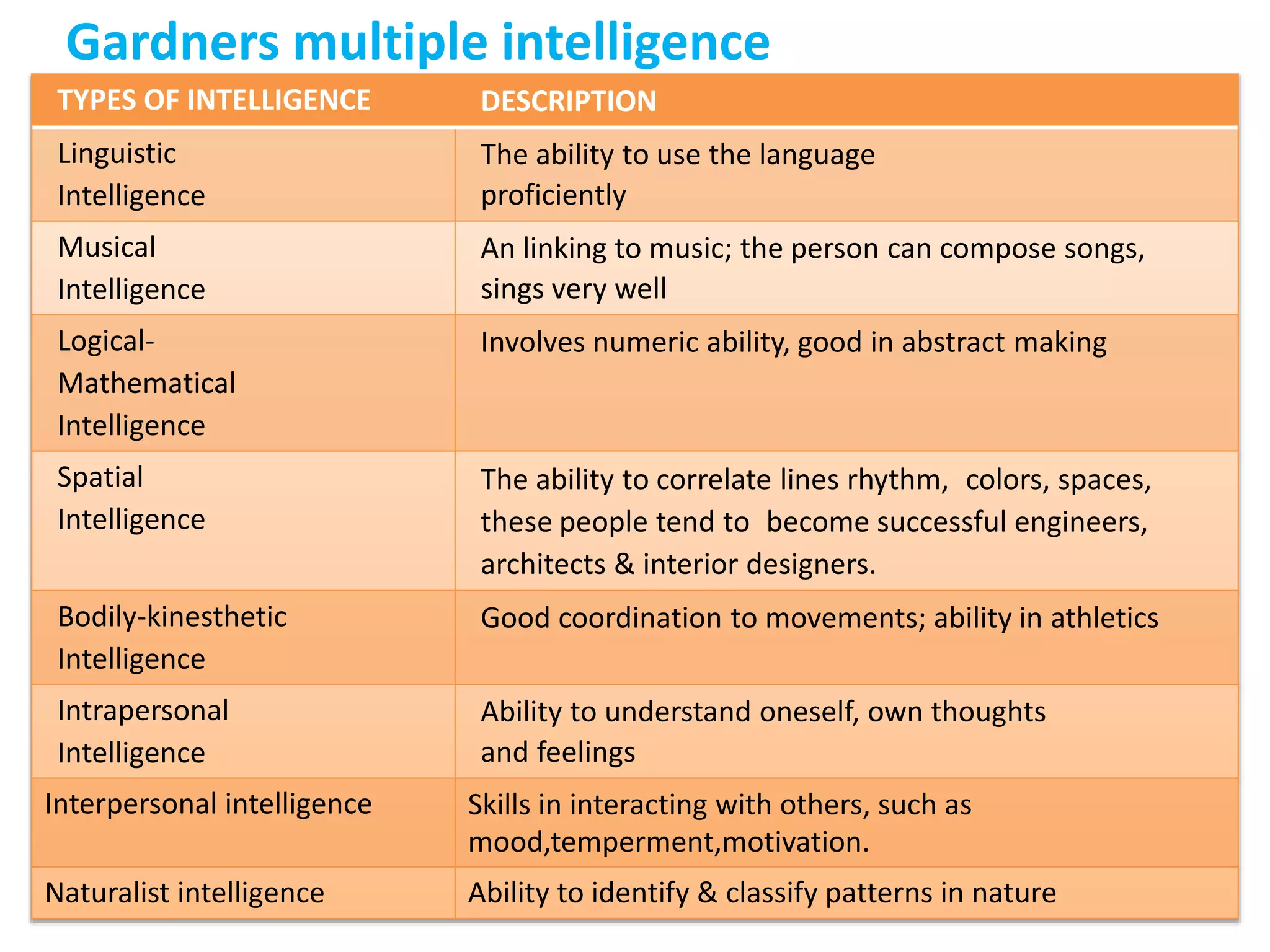
Gardners multiple intelligence
TYPES OF INTELLIGENCE DESCRIPTION
Linguistic
Intelligence
The ability to use the language
proficiently
Musical
Intelligence
An linking to music; the person can compose songs,
sings very well
Logical-
Mathematical
Intelligence
Involves numeric ability, good in abstract making
Spatial
Intelligence
The ability to correlate lines rhythm, colors, spaces,
these people tend to become successful engineers,
architects & interior designers.
Bodily-kinesthetic
Intelligence
Good coordination to movements; ability in athletics
Intrapersonal
Intelligence
Ability to understand oneself, own thoughts
and feelings
Interpersonal intelligence Skills in interacting with others, such as
mood,temperment,motivation.
Naturalist intelligence Ability to identify & classify patterns in nature
• Emotional intelligence:
• Intelligence that provides an understandings of
what other people are feeling and experiencing
and permit us to respond appropriately to others
need.
• It is the basis of empathy for others, self
awareness,& social skills.
• High emotional intelligence enable the individual
to tune into others feelings, permitting a high
degree of responsiveness to others.
Emotional intelligence
• The first ideas of intelligence quotient was utilized first
in 1916 by Stanford-Binet Tests.
• Intelligent quotient(IQ) is the ratio between mental
age(MA) and chronological age(CA).
• While chronological age is determined from the date of
birth, mental age is determined by the Intelligence
tests.
• IQ= MA/CA*100
EXAMPLE: A10 yr old boy scores a mental age of
12.His IQ will be IQ=MA/CA*100=12/10*100=120
Intelligent quotient(IQ)
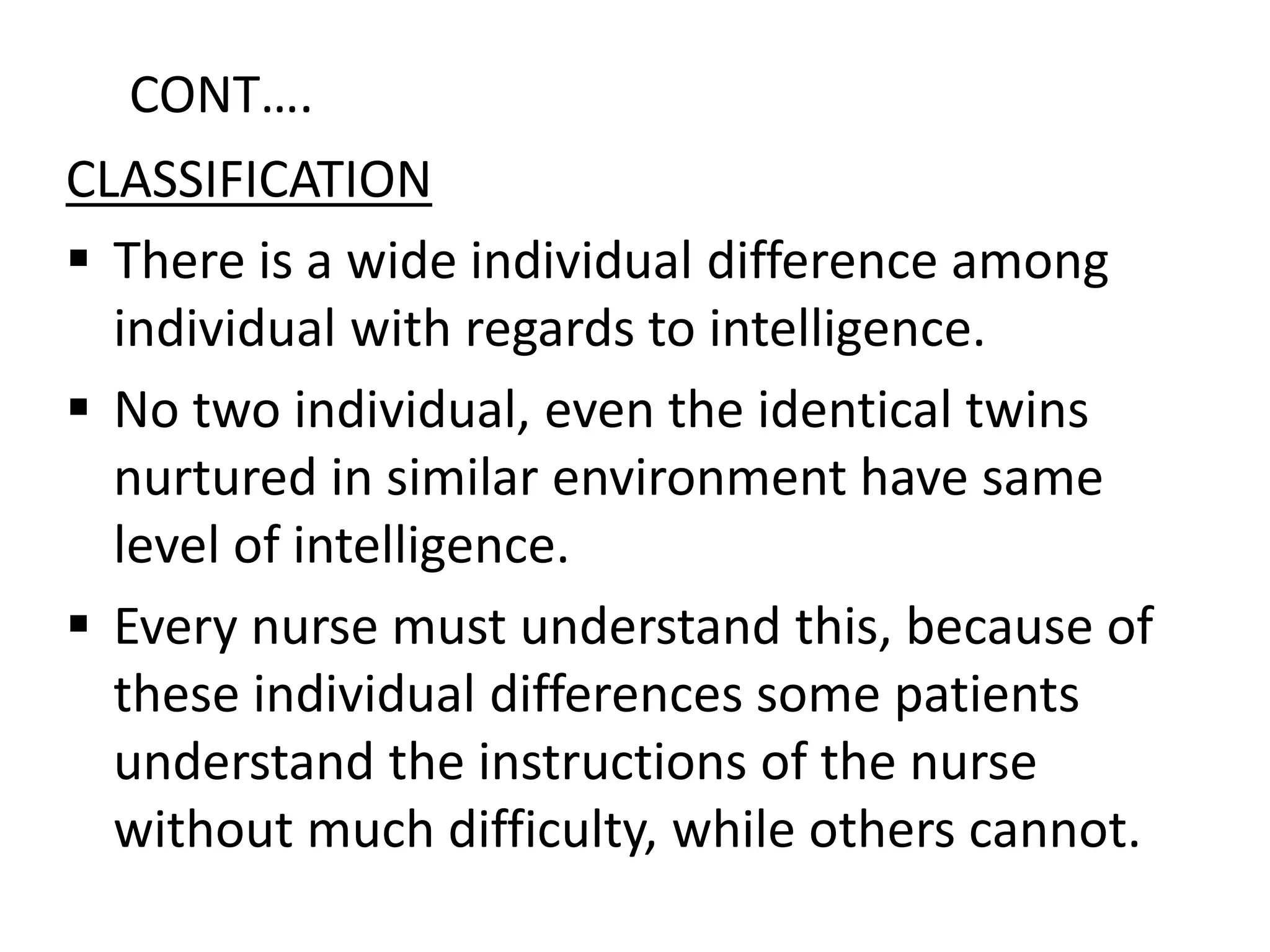
CLASSIFICATION
 There is a wide individual difference among
individual with regards to intelligence.
 No two individual, even the identical twins
nurtured in similar environment have same
level of intelligence.
 Every nurse must understand this, because of
these individual differences some patients
understand the instructions of the nurse
without much difficulty, while others cannot.
CONT….
GENIOUS 140 & ABOVE
VERY SUPERIOR 130 --140
SUPERIOR 120--130
ABOVE AVERAGE 110--120
AVERAGE 90--110
DULL AVERAGE 80--90
BORDERLINE 70--80
MILD MENTAL RETARDATION 50--70
MODERATE MENTAL RETARDATION 35--50
SEVERE MENTAL RETARDATION 20--35
PROFOUND MENTAL RETARDATION 0--20
CONT…
USES OF INTELLIGENCE
It helps the individual to adjust to changing
situations quickly & correctly.
It helps to carry on the higher mental processes
such as reasoning,judging& criticizing.
Helps to learn difficult tasks & solve problems.
Helps the individual to improve performance in
any situation.
It helps in quick understanding of things.
It help the individual to apply the knowledge
gained in various subjects/situations in dealing
with present situation.
Theories of intelligence
Factor Theories of Intelligence
 Two –factor theory or general intelligence(G-factor)
theory: It was advocated by Charles Spearman(1927)
 Spearman proposed a broad general intelligence
factor(G).
 Every individual posses general intelligence factor (G)
in varying amount, this determines the individuals
overall ability.
 ‘G’ is a universal inborn ability.
 Higher the ‘G’ in an individual, higher is the success in
life.
 In addition to the ‘G’ factor there are specific abilities,
which allow an individual to deal with particular kind of
problems.
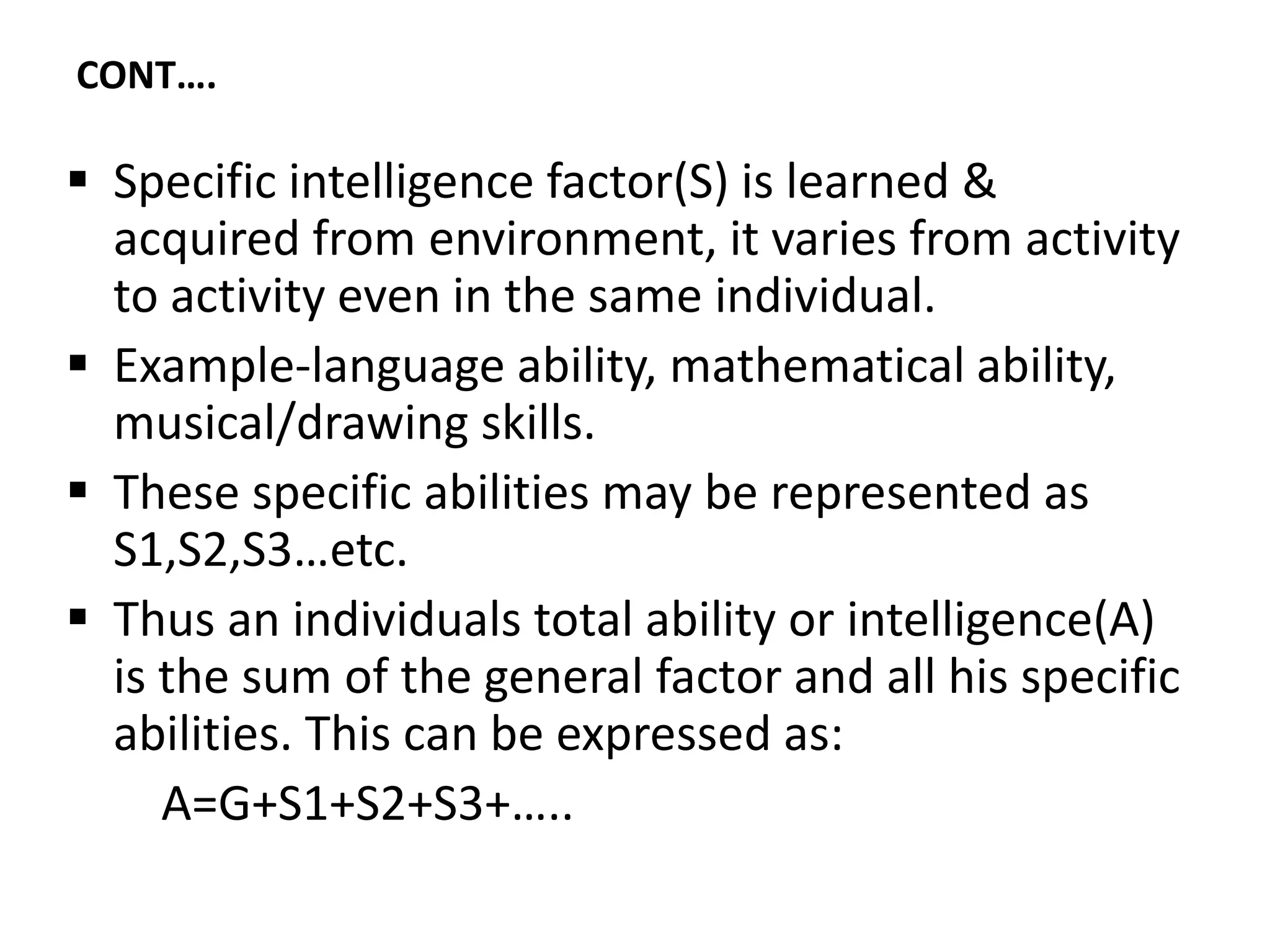
 Specific intelligence factor(S) is learned &
acquired from environment, it varies from activity
to activity even in the same individual.
 Example-language ability, mathematical ability,
musical/drawing skills.
 These specific abilities may be represented as
S1,S2,S3…etc.
 Thus an individuals total ability or intelligence(A)
is the sum of the general factor and all his specific
abilities. This can be expressed as:
A=G+S1+S2+S3+…..
CONT….
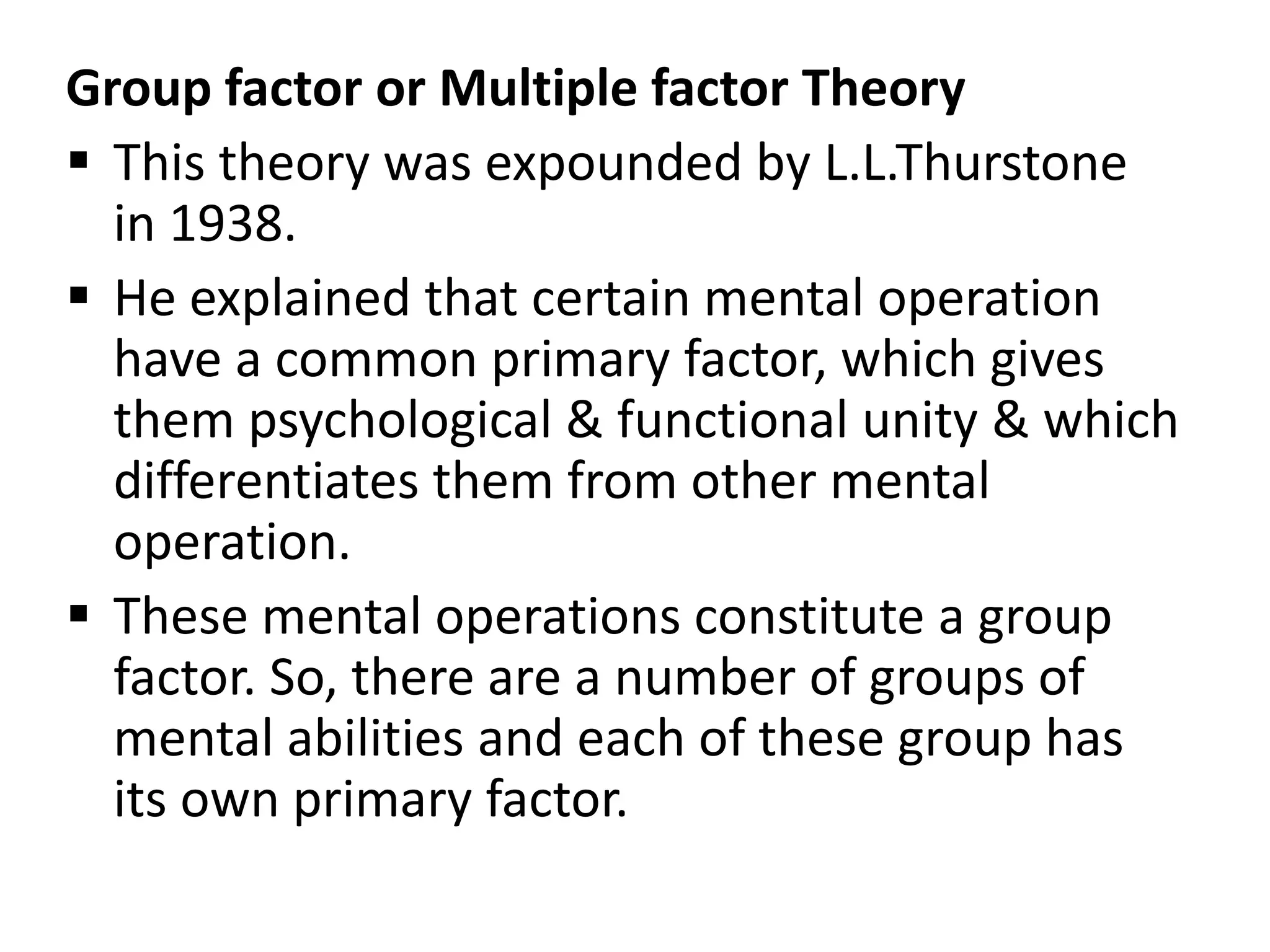
Group factor or Multiple factor Theory
 This theory was expounded by L.L.Thurstone
in 1938.
 He explained that certain mental operation
have a common primary factor, which gives
them psychological & functional unity & which
differentiates them from other mental
operation.
 These mental operations constitute a group
factor. So, there are a number of groups of
mental abilities and each of these group has
its own primary factor.
He identifies following seven factors:
Verbal factor(V): Comprehension of verbal
ideas or words.
Spatial factor (S): Ability to imagine an object
in space.
Numerical factor (N): Ability to perform
mathematical calculations,rapidly and
accurately.
CONT…
CONT…
Memory factor(M): Ability to memorize
quickly.
Reasoning factor (R): Ability to reason & think
things out.
Perceptual factor(P): Ability to perceive
objects accurately.
Problem solving factor(PS): Ability to solve
problems independently.
PROCESS ORIENTED THEORIES OF INTELLIGENCE
 These theories have focused on intellectual
process- the pattern of thinking that people
use when they reason and solve problems.
 These theorist prefer to use the term cognitive
process in place of intelligence.
 They are more interested in how people solve
problem and how many get the right solution.
 They focused on the development of cognitive
abilities
Piaget’s theory(1970) : According to
Piagets,intelligence is an adaptive process
involving interplay of biological maturation
and interaction with the environment.
 He viewed intelligence is an evolution of
cognitive process such as understanding the
laws of nature, principles of grammar and
mathematical rules.
CONT…
Bruner’s theory(1973): Intelligence is an growing
dependence on internal representation of
objects/situation.
 These growing abilities are influenced by
environment, especially the reward and
punishment people receive for using
particular intellectual skills in particular ways.
CONT…
Information processing theory (Robert Stenberg,1984)
• The most recent acceptable theory of intelligence, by
adopting an information processing approach to
cognition or problem solving.
• The information processing approach is the manner in
which one proceed to perform a mental task or solve a
problem from the time one comes across it, gathers
information and makes use of this information for
completing the task or solving the problem in hand.
CONT…
Stenberg identified the following steps in the way one
processes information:
1. Encoding (Identifying the relevant available
information in the mind)
2. Inferring (Drawing the necessary inference)
3. Mapping (Establishing the the relationship between
a previous situation and the present one)
4. Application(Applying the inferred relationship)
5. Justification(Justifying the analyzed solution of the
problem)
6. Responding(Providing the best possible solution)
CONT….
APPLICATION OF INTELLIGENCE IN NURSING
• Children at preoperational stage able to
know more what will be done on any
specific procedure, in role play than in
verbal description.
• Eg;IV therapy is done by acting out the
procedure with a toy IV set.
• Knowledge about the nature of intelligence
& its measurement is useful to the nurse in
understanding herself as well as her patient.
• Nurses explanation or guidance to the patient
would be according to the patients intellectual
level.
• Intelligence helps the nurse in diagnosing a
patient and provide care accordingly.
• Assessment of intelligence is of great
assistance in their management
• Knowledge about abnormalities in newborn &
development of their intelligence help the
nurse in providing suitable care.
CONT…
Intelligence

Intelligence

  • 1.
    INTELLIGENT PRESENTED BY Sakuntala Giri M.Sc.Tutor SUM Nursing College Siksha ‘O’ Anusandhan (Deemed to be)University
  • 2.
    INTELLIGENCE • Intelligence isthe general capacity for comprehension and reasoning that manifest in various ways. It consists of an individual mental /cognitive ability which helps the person in solving his actual life problems and leading a happy and well contended life.
  • 3.
    DEFINITION Intelligence is theaggregate or global capacity of the individual to think rationally, to act purposefully and to deal effectively with the environment.(Weschler-1944)
  • 4.
    CLASSIFICATION OF INTELLIGENCE Itcan be divided into 3 kinds: 1. Concrete intelligence 2. Social intelligence 3. Abstract /general intelligence
  • 5.
    1. Concrete intelligence: •It is related to concrete materials. • This type of intelligence is applicable when the individual is handling concrete objects /machines. • The person uses this intelligence in operation of tools and instruments. • Examples:Engineers,mechanics genarally have this type of intelligence. Concrete intelligence
  • 6.
    Social intelligence 2. Socialintelligence: it is the ability of an individual to react to social situations in daily life. • It includes the ability to understand people and act wisely in human relationship • Person having this type of intelligence, know the art of winning friends and influence them. • Examples:leaders, minister,sales man.
  • 7.
    Abstract/general intelligence 3. Abstract/generalintelligence: It is the ability to respond to words,numbers and letters. • This type of intelligrnce is acquired by study of books & related literature. • Example: teachers,lawers,doctors etc.
  • 8.
    Gardners multiple intelligence TYPESOF INTELLIGENCE DESCRIPTION Linguistic Intelligence The ability to use the language proficiently Musical Intelligence An linking to music; the person can compose songs, sings very well Logical- Mathematical Intelligence Involves numeric ability, good in abstract making Spatial Intelligence The ability to correlate lines rhythm, colors, spaces, these people tend to become successful engineers, architects & interior designers. Bodily-kinesthetic Intelligence Good coordination to movements; ability in athletics Intrapersonal Intelligence Ability to understand oneself, own thoughts and feelings Interpersonal intelligence Skills in interacting with others, such as mood,temperment,motivation. Naturalist intelligence Ability to identify & classify patterns in nature
  • 9.
    • Emotional intelligence: •Intelligence that provides an understandings of what other people are feeling and experiencing and permit us to respond appropriately to others need. • It is the basis of empathy for others, self awareness,& social skills. • High emotional intelligence enable the individual to tune into others feelings, permitting a high degree of responsiveness to others. Emotional intelligence
  • 10.
    • The firstideas of intelligence quotient was utilized first in 1916 by Stanford-Binet Tests. • Intelligent quotient(IQ) is the ratio between mental age(MA) and chronological age(CA). • While chronological age is determined from the date of birth, mental age is determined by the Intelligence tests. • IQ= MA/CA*100 EXAMPLE: A10 yr old boy scores a mental age of 12.His IQ will be IQ=MA/CA*100=12/10*100=120 Intelligent quotient(IQ)
  • 11.
    CLASSIFICATION  There isa wide individual difference among individual with regards to intelligence.  No two individual, even the identical twins nurtured in similar environment have same level of intelligence.  Every nurse must understand this, because of these individual differences some patients understand the instructions of the nurse without much difficulty, while others cannot. CONT….
  • 12.
    GENIOUS 140 &ABOVE VERY SUPERIOR 130 --140 SUPERIOR 120--130 ABOVE AVERAGE 110--120 AVERAGE 90--110 DULL AVERAGE 80--90 BORDERLINE 70--80 MILD MENTAL RETARDATION 50--70 MODERATE MENTAL RETARDATION 35--50 SEVERE MENTAL RETARDATION 20--35 PROFOUND MENTAL RETARDATION 0--20 CONT…
  • 13.
    USES OF INTELLIGENCE Ithelps the individual to adjust to changing situations quickly & correctly. It helps to carry on the higher mental processes such as reasoning,judging& criticizing. Helps to learn difficult tasks & solve problems. Helps the individual to improve performance in any situation. It helps in quick understanding of things. It help the individual to apply the knowledge gained in various subjects/situations in dealing with present situation.
  • 14.
    Theories of intelligence FactorTheories of Intelligence  Two –factor theory or general intelligence(G-factor) theory: It was advocated by Charles Spearman(1927)  Spearman proposed a broad general intelligence factor(G).  Every individual posses general intelligence factor (G) in varying amount, this determines the individuals overall ability.  ‘G’ is a universal inborn ability.  Higher the ‘G’ in an individual, higher is the success in life.  In addition to the ‘G’ factor there are specific abilities, which allow an individual to deal with particular kind of problems.
  • 15.
     Specific intelligencefactor(S) is learned & acquired from environment, it varies from activity to activity even in the same individual.  Example-language ability, mathematical ability, musical/drawing skills.  These specific abilities may be represented as S1,S2,S3…etc.  Thus an individuals total ability or intelligence(A) is the sum of the general factor and all his specific abilities. This can be expressed as: A=G+S1+S2+S3+….. CONT….
  • 16.
    Group factor orMultiple factor Theory  This theory was expounded by L.L.Thurstone in 1938.  He explained that certain mental operation have a common primary factor, which gives them psychological & functional unity & which differentiates them from other mental operation.  These mental operations constitute a group factor. So, there are a number of groups of mental abilities and each of these group has its own primary factor.
  • 17.
    He identifies followingseven factors: Verbal factor(V): Comprehension of verbal ideas or words. Spatial factor (S): Ability to imagine an object in space. Numerical factor (N): Ability to perform mathematical calculations,rapidly and accurately. CONT…
  • 18.
    CONT… Memory factor(M): Abilityto memorize quickly. Reasoning factor (R): Ability to reason & think things out. Perceptual factor(P): Ability to perceive objects accurately. Problem solving factor(PS): Ability to solve problems independently.
  • 19.
    PROCESS ORIENTED THEORIESOF INTELLIGENCE  These theories have focused on intellectual process- the pattern of thinking that people use when they reason and solve problems.  These theorist prefer to use the term cognitive process in place of intelligence.  They are more interested in how people solve problem and how many get the right solution.  They focused on the development of cognitive abilities
  • 20.
    Piaget’s theory(1970) :According to Piagets,intelligence is an adaptive process involving interplay of biological maturation and interaction with the environment.  He viewed intelligence is an evolution of cognitive process such as understanding the laws of nature, principles of grammar and mathematical rules. CONT…
  • 21.
    Bruner’s theory(1973): Intelligenceis an growing dependence on internal representation of objects/situation.  These growing abilities are influenced by environment, especially the reward and punishment people receive for using particular intellectual skills in particular ways. CONT…
  • 22.
    Information processing theory(Robert Stenberg,1984) • The most recent acceptable theory of intelligence, by adopting an information processing approach to cognition or problem solving. • The information processing approach is the manner in which one proceed to perform a mental task or solve a problem from the time one comes across it, gathers information and makes use of this information for completing the task or solving the problem in hand. CONT…
  • 23.
    Stenberg identified thefollowing steps in the way one processes information: 1. Encoding (Identifying the relevant available information in the mind) 2. Inferring (Drawing the necessary inference) 3. Mapping (Establishing the the relationship between a previous situation and the present one) 4. Application(Applying the inferred relationship) 5. Justification(Justifying the analyzed solution of the problem) 6. Responding(Providing the best possible solution) CONT….
  • 24.
    APPLICATION OF INTELLIGENCEIN NURSING • Children at preoperational stage able to know more what will be done on any specific procedure, in role play than in verbal description. • Eg;IV therapy is done by acting out the procedure with a toy IV set. • Knowledge about the nature of intelligence & its measurement is useful to the nurse in understanding herself as well as her patient.
  • 25.
    • Nurses explanationor guidance to the patient would be according to the patients intellectual level. • Intelligence helps the nurse in diagnosing a patient and provide care accordingly. • Assessment of intelligence is of great assistance in their management • Knowledge about abnormalities in newborn & development of their intelligence help the nurse in providing suitable care. CONT…