MEMORY
G R O U P P R E S E N TAT I O N
PSYCHOLOGY
AKASH AMREEM
INTRODUCTION TO
MEMORY
Roll No. 16
DEFINITION
“Memory is the mental capacity to store, recall or
recognize the events that were previously
experienced.”
Remembring
Retaining experiences or recalling them.
ACCORDING TO COGNITIVE
PSYCHOLOGISTS
• Mental system that receives, encodes, modifies or retrieves
information.
According to BEHAVIOURISTS:
• We should be unaware of our own likes and dislikes.
(Vorauel and Ross’1993)
• We would have no idea of who we are in any
meaningful sense.
(Khilstrom, 1993)
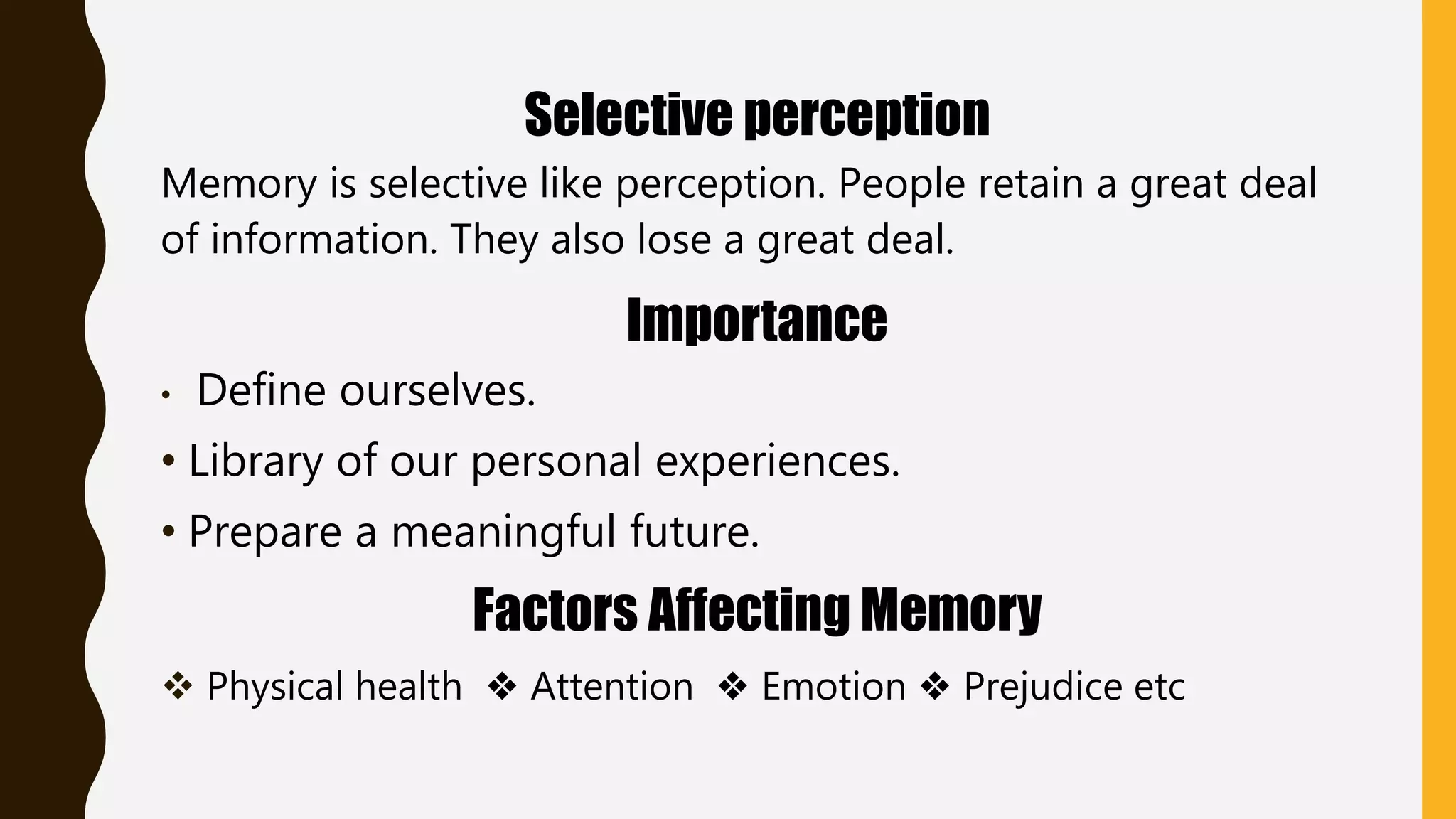
Selective perception
Memory is selective like perception. People retain a great deal
of information. They also lose a great deal.
Importance
• Define ourselves.
• Library of our personal experiences.
• Prepare a meaningful future.
Factors Affecting Memory
 Physical health ❖ Attention ❖ Emotion ❖ Prejudice etc
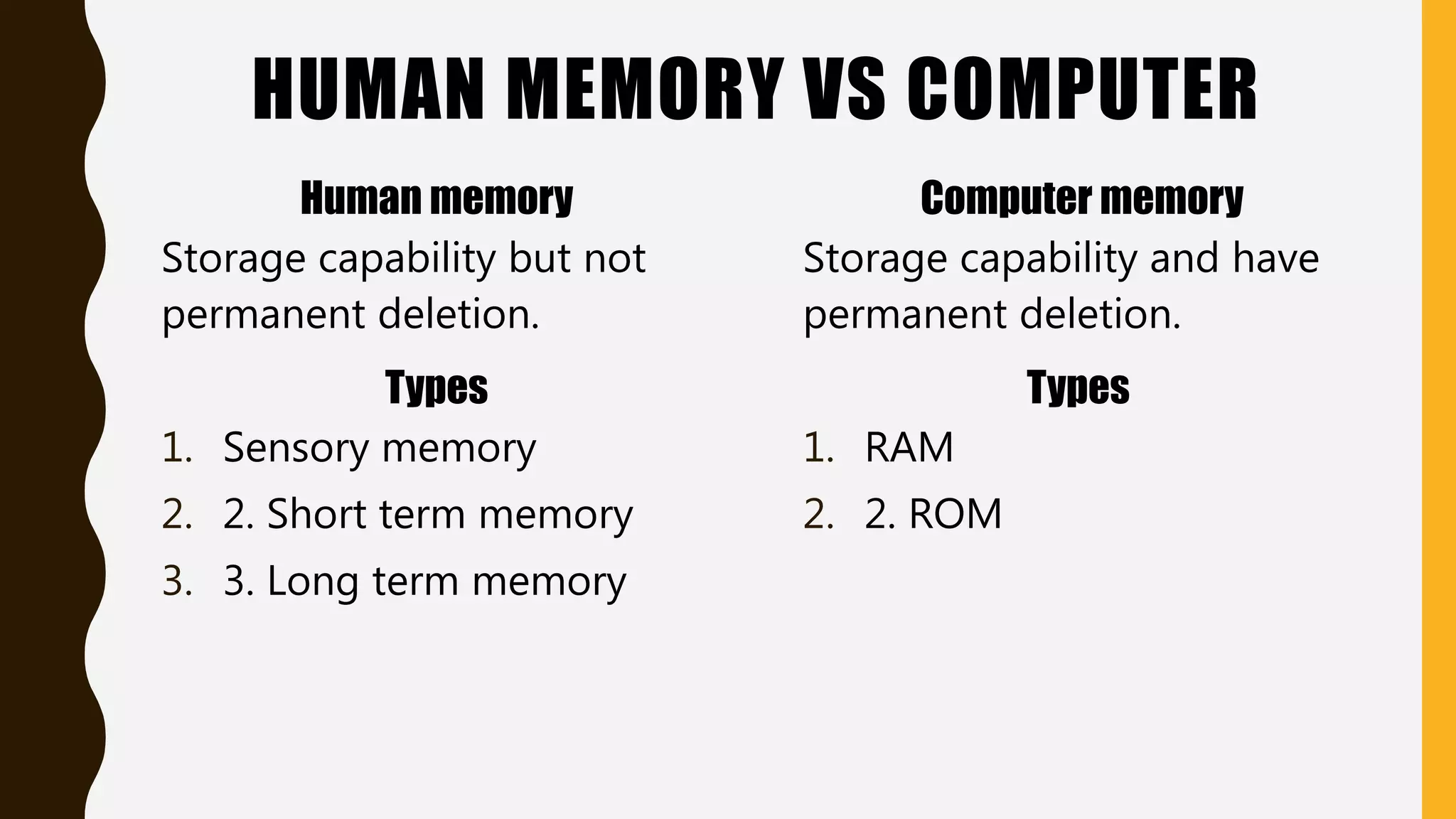
HUMAN MEMORY VS COMPUTER
Human memory
Storage capability but not
permanent deletion.
Types
1. Sensory memory
2. 2. Short term memory
3. 3. Long term memory
Computer memory
Storage capability and have
permanent deletion.
Types
1. RAM
2. 2. ROM
HASSAN RAZA
STAGES OF MEMORY
Roll No. 30
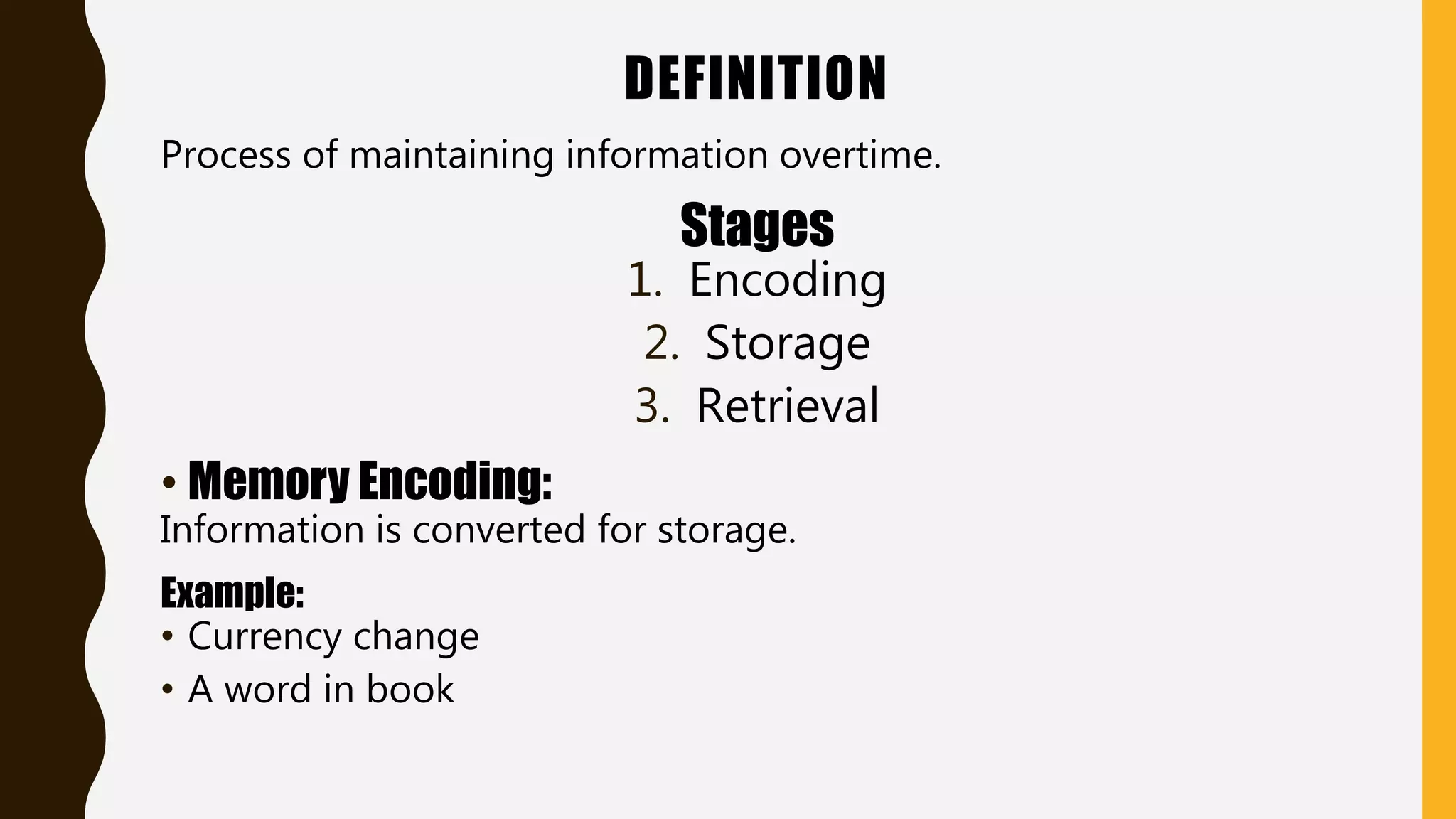
DEFINITION
Process of maintaining information overtime.
Stages
1. Encoding
2. Storage
3. Retrieval
• Memory Encoding:
Information is converted for storage.
Example:
• Currency change
• A word in book
Ways in which info. Is stored:
1. Visual (picture)
2. Acoustic (sound)
3. Semantic (meaning)
Memory Storage:
Information Is retained in memory.
3. Memory Retrieval:
Information is retrieved from memory.
SONIA SADAF
TYPES OF MEMORY
Roll No. 22
DEFINITION
Memory is the faculty of the brain by which information is
encoded, stored, and retrieved when needed.
Types of Memory
• Sensory Memory
• Short-Term Memory
• Long-Term Memory
SENSORY MEMORY
The part of memory where any information is first
registered is called Sensory Memory.
Example:
Looking at an item and remembering it.
Types:
 Iconic memory
▪ Echoic Memory
▪ Haptic Memory
Short-Term Memory
It’s a primary or active memory that is capable of holding small
amount of information for a brief period of time.
Example:
Memorizing a phone number.
Long-Term memory
This form of memory is a memory store capable of storing large quantities
of information for potentially unlimited duration.
Example:
What happened last week, Where and how?
Types
Long-term memory is usually divided into two types:
1. Explicit or Declarative Memory
▪ Episodic Memory
▪ Semantic Memory
▪ Autobiographical Memory
▪ Visual Memory
2. Implicit or Non-Declarative Memory
▪ Procedural Memory
▪ Priming Memory
USMARA ASHRAF
SENSORY MEMORY
Roll No. 15
DEFINITION
Sensory memory is the shortest-term element of memory. Part of memory
where any information is first registered. Has large capacity.
Example:
Trying to remember an object with just a second of observation or
memorization.
Characteristics
• Storage of information is irrelevant of attention to the
stimulus.
• Information in SM is stored in specific modality.
• Info. is detail oriented.
• Different SM store might have different durations
HOW DOES SENSORY MEMORY WORKS:
During every moment of your existence, your senses are constantly
taking in an enormous amount of information about what you see,
feel, hear, and taste.
sensory memory creates something of a quick "snapshot" of the
world around you, allowing you to briefly focus your attention on
relevant details.
Types
1. Iconic memory
2. Echoic memory
3. Haptic memory
ICONIC MEMORY
Sensory input to the visual system goes into iconic memory.
Echoic memory:
Echoic memory is the branch of sensory memory used by the
auditory system.
Haptic memory:
Haptic memory is the branch of sensory memory used by the
sense of touch.
AATIKA SHAIKH
SHORT-TERM MEMORY
Roll No. 14
DEFINITION:
Short term memory takes over when the information in our
sensory memory is transferred to our consciousness or our
awareness.
This is the information that is current active such as reading this
page, talking to a friend or writing a paper.
Example:
It used to remember a phone number that has just been
recited.
• Ghajini
Characteristics:
• Short term memory can definitely last longer than sensory
memory (up to 30 seconds or so).
• Also known as working memory.
• Intermediate memory.
Displacement:
Means that new information will push out part of the old
information.
FUNCTIONS:
It has two major functions:
• It allows us to construct a continually updated working model of the
world.
• Second it makes possible to think and solve problems.
Theories and applications:
• Primary Effect
• Receny Effect
• Distinctiveness
• Frequency Effect
• Association
• Reconstruction
MAIRA RAZA
LONG-TERM MEMORY
Roll No. 21
DEFINITION
The long-term memory refers to unlimited capacity memory
store that hold information over lengthy periods of time.
By saying “lengthy period of time” we mean that it is possible
for memories in LTM to remain there for an entire lifetime.
Example:
Like we can recall some specific past events very easily such as
how many marks I got in 1st grade class or how I first rode my
bike.
SIGNIFICANCE
Imagine how difficult it would be to forget the day you
graduated. Now think about how easy it is to forget
information that has no significance, the color of the car you
parked next to at the store or which shirt you wore last
Thursday.
Types
• Declarative Memory
• Non-Declarative Memory
Declarative memory
Declarative memory consists of facts and events that can be
consciously recalled or "declared." Also known as Explicit
memory.
Example:
let's say that you know that your favorite restaurant is only
open until 6 PM on Sundays.
Types:
• Episodic memory
• Semantic memory.
NON-DECLARATIVE MEMORY
• Implicit memory (also called "non declarative" memory) is a
type of long-term memory that stands in contrast to explicit
memory in that it doesn't require conscious thought.
Example:
When a skilled typist is typing on a keyboard, she does not
need to look at each key. Instead, she is able to type without
recalling the placement of each key.
M. HASSAAN MASOOD
EXPLICIT MEMORY
Roll No. 27
DEFINITION
• It is the conscious, intentional recollection of factual information,
previous experiences, and concepts.
• Requires conscious thought, unlike Implicit memory
Example:
you might hear an annoying pop song, Days later, you find yourself
still humming that same tune.
How are Explicit memories made?
Step 1: Encoding
Step 2: Storage
Step 3: Retrieval
EXPLICIT MEMORY VS IMPLICIT MEMORY
Implicit memory, sometimes called non-declarative memory,
involves the way experiences affect our behaviors. Unlike
explicit memory, which requires making a conscious effort to
recall information, implicit memory operates unconsciously.
Example:
Driving a car, you just do it. You can’t teach them hoe much
pressure to put on gas por break pedal.
Types:
❖ Episodic memory
❖ Semantic memory
Further Division:
▪ Autobiographical memory
▪ Spatial memory
EPISODIC MEMORY
• Episodic memory consists of the storage and recollection of
observational information attached to specific life-events.
Example:
• Remember the trip to London
• Recall a great dinner you had at your favorite restaurant
• Think about your high school graduation ceremony
SEMANTIC MEMORY
Semantic memory refers to general world knowledge (facts, ideas,
meaning and concepts) that can be articulated and is independent
of personal experience.
Example:
• Know that the word “boat” refers to a watercraft of varying sizes
• Recall that Washington, D.C., is the capital of the U.S.
• Recognize the distinguishing features that classify an animal as a
dog
Autobiographical memory
Spatial memory
Disorders
•Amnesia
•Alzheimer’s Disease
•Dementia
NIGHAT SHAFQAT
IMPLICIT MEMORY
Roll No. 32
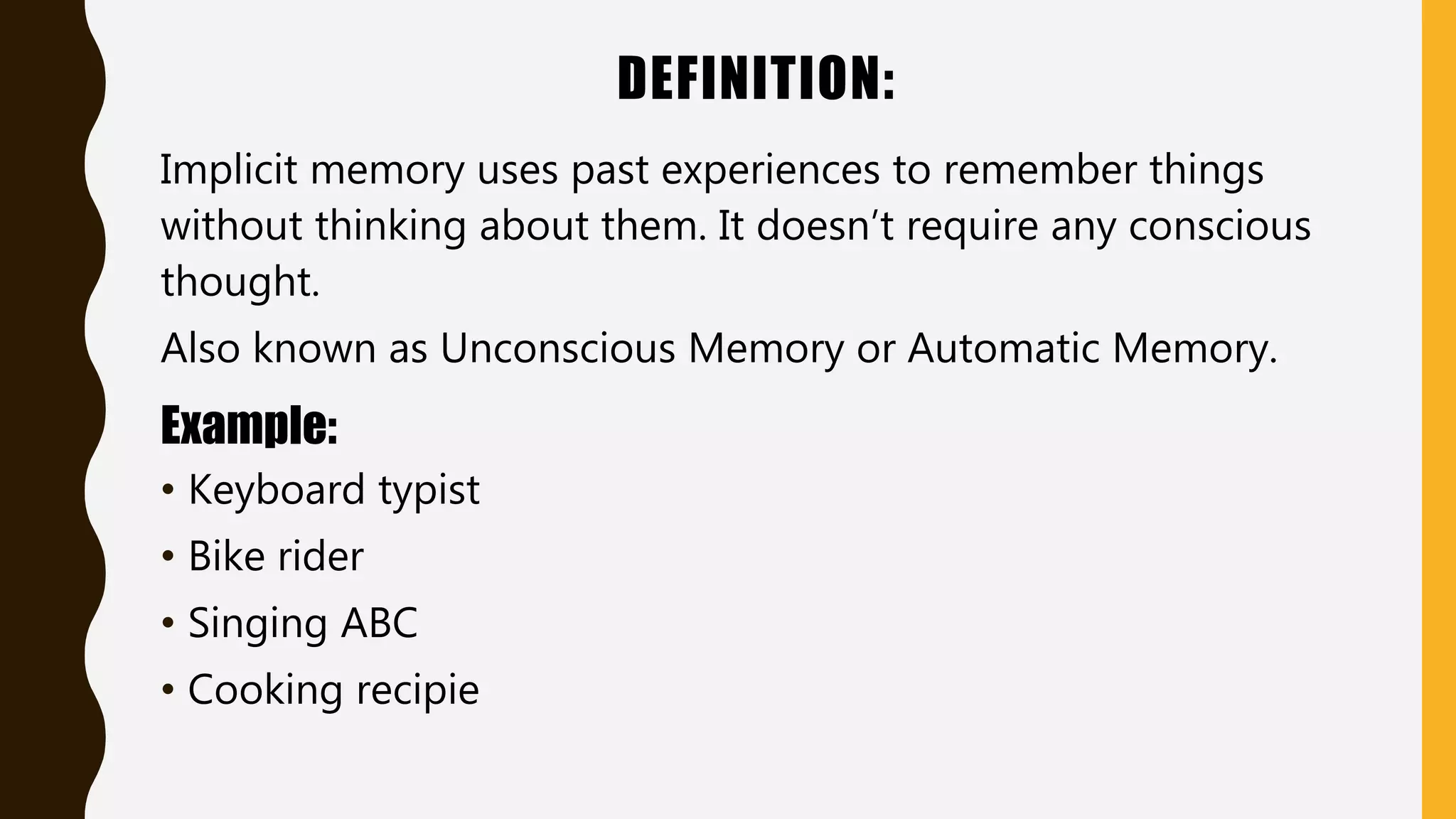
DEFINITION:
Implicit memory uses past experiences to remember things
without thinking about them. It doesn’t require any conscious
thought.
Also known as Unconscious Memory or Automatic Memory.
Example:
• Keyboard typist
• Bike rider
• Singing ABC
• Cooking recipie
Types:
• Procedural memory
• Priming
PROCEDURAL MEMORY
Procedural memory is a type of implicit memory and long
memory which aids the performance of particular type of
without conscious awareness of these previous experiences,
such as walking, talking and riding a bike.
Example:
1: Playing piano
2: skiing
3: Ice skating
4: Playing baseball
5: Swimming
Etc.
PRIMING MEMORY
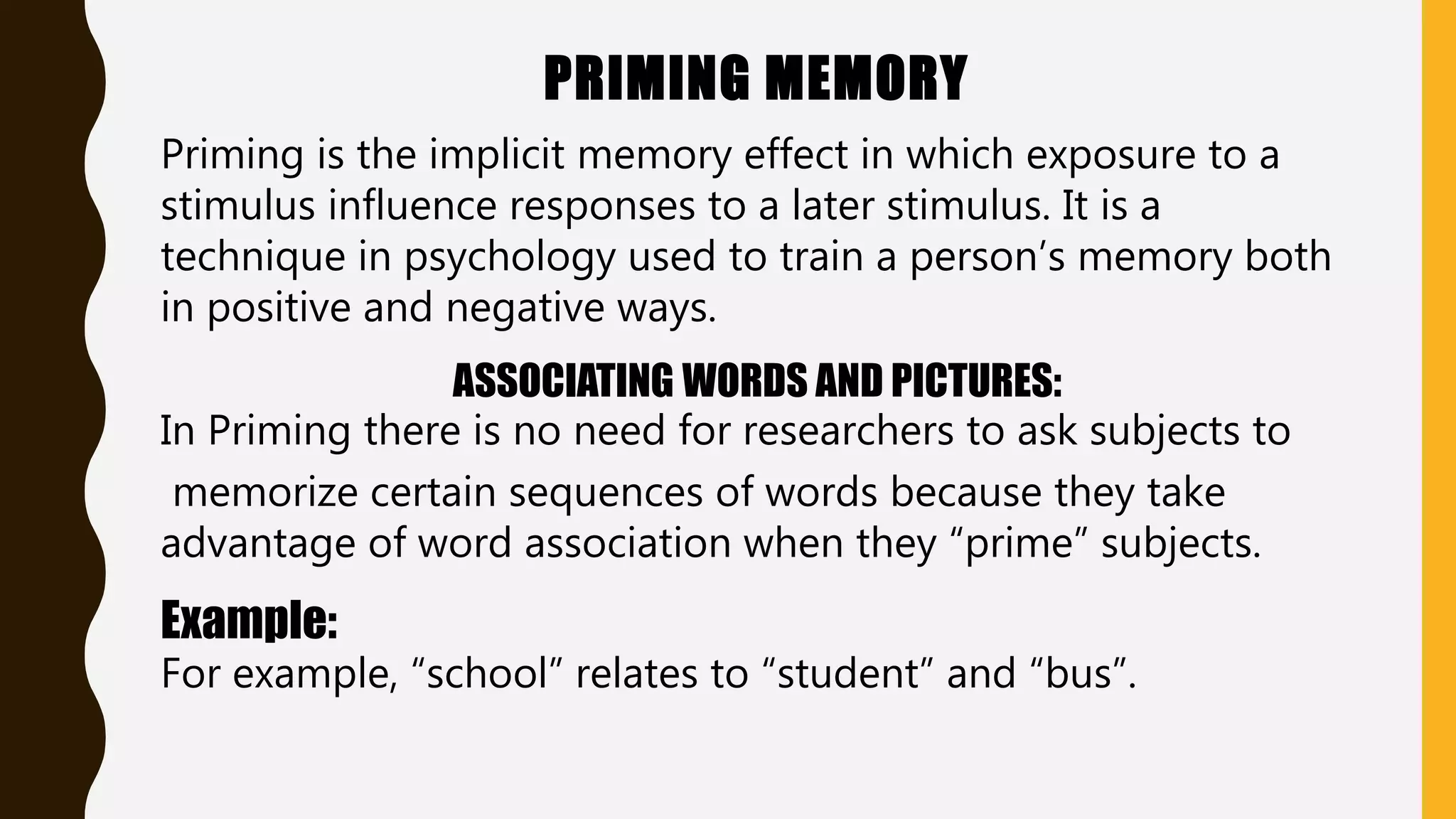
Priming is the implicit memory effect in which exposure to a
stimulus influence responses to a later stimulus. It is a
technique in psychology used to train a person’s memory both
in positive and negative ways.
ASSOCIATING WORDS AND PICTURES:
In Priming there is no need for researchers to ask subjects to
memorize certain sequences of words because they take
advantage of word association when they “prime” subjects.
Example:
For example, “school” relates to “student” and “bus”.
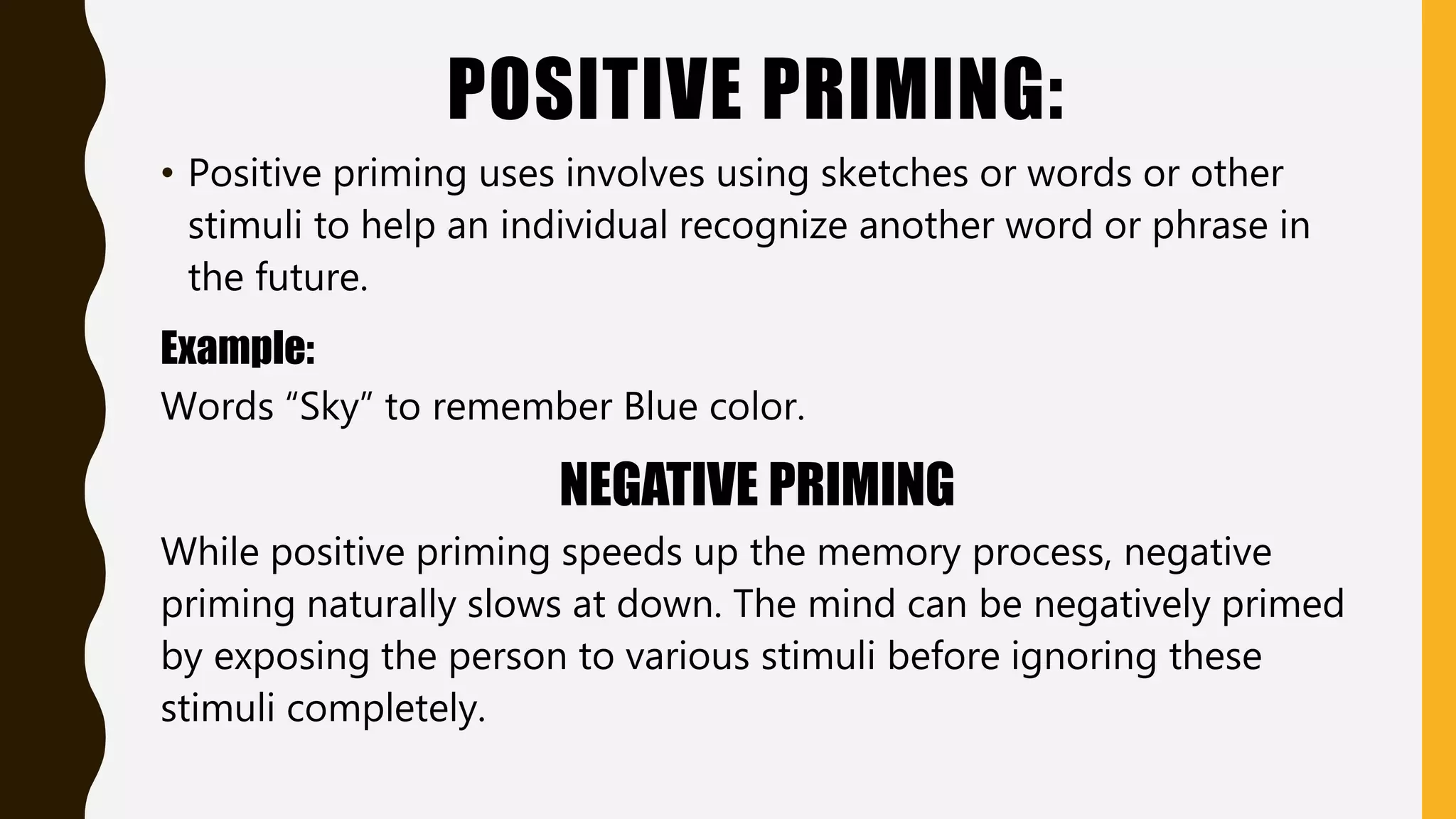
POSITIVE PRIMING:
• Positive priming uses involves using sketches or words or other
stimuli to help an individual recognize another word or phrase in
the future.
Example:
Words “Sky” to remember Blue color.
NEGATIVE PRIMING
While positive priming speeds up the memory process, negative
priming naturally slows at down. The mind can be negatively primed
by exposing the person to various stimuli before ignoring these
stimuli completely.
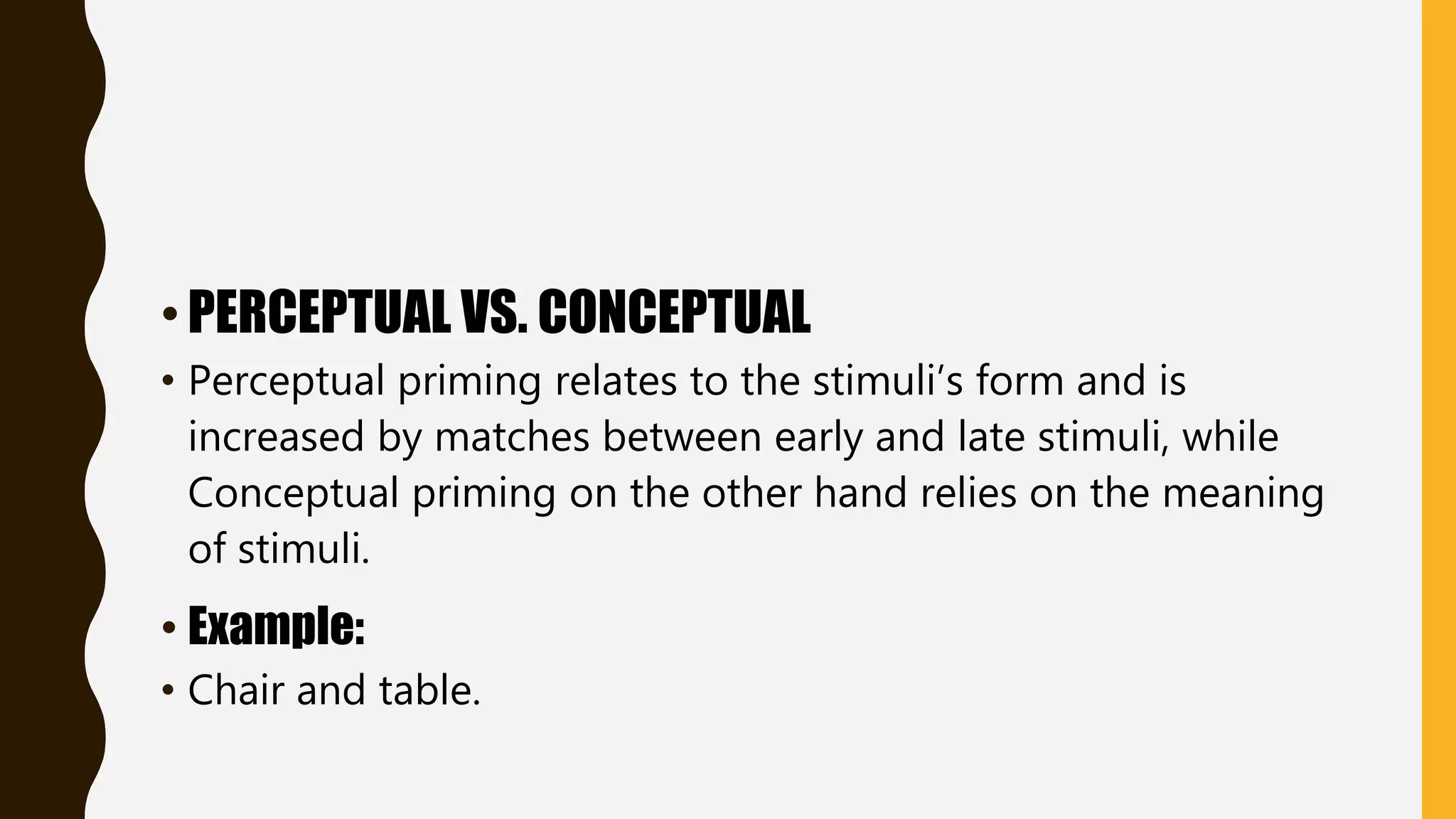
•PERCEPTUAL VS. CONCEPTUAL
• Perceptual priming relates to the stimuli’s form and is
increased by matches between early and late stimuli, while
Conceptual priming on the other hand relies on the meaning
of stimuli.
• Example:
• Chair and table.
ISHRAT PARVEEN
FOGETTING AND
INTELLIGENCE
Roll No. 17
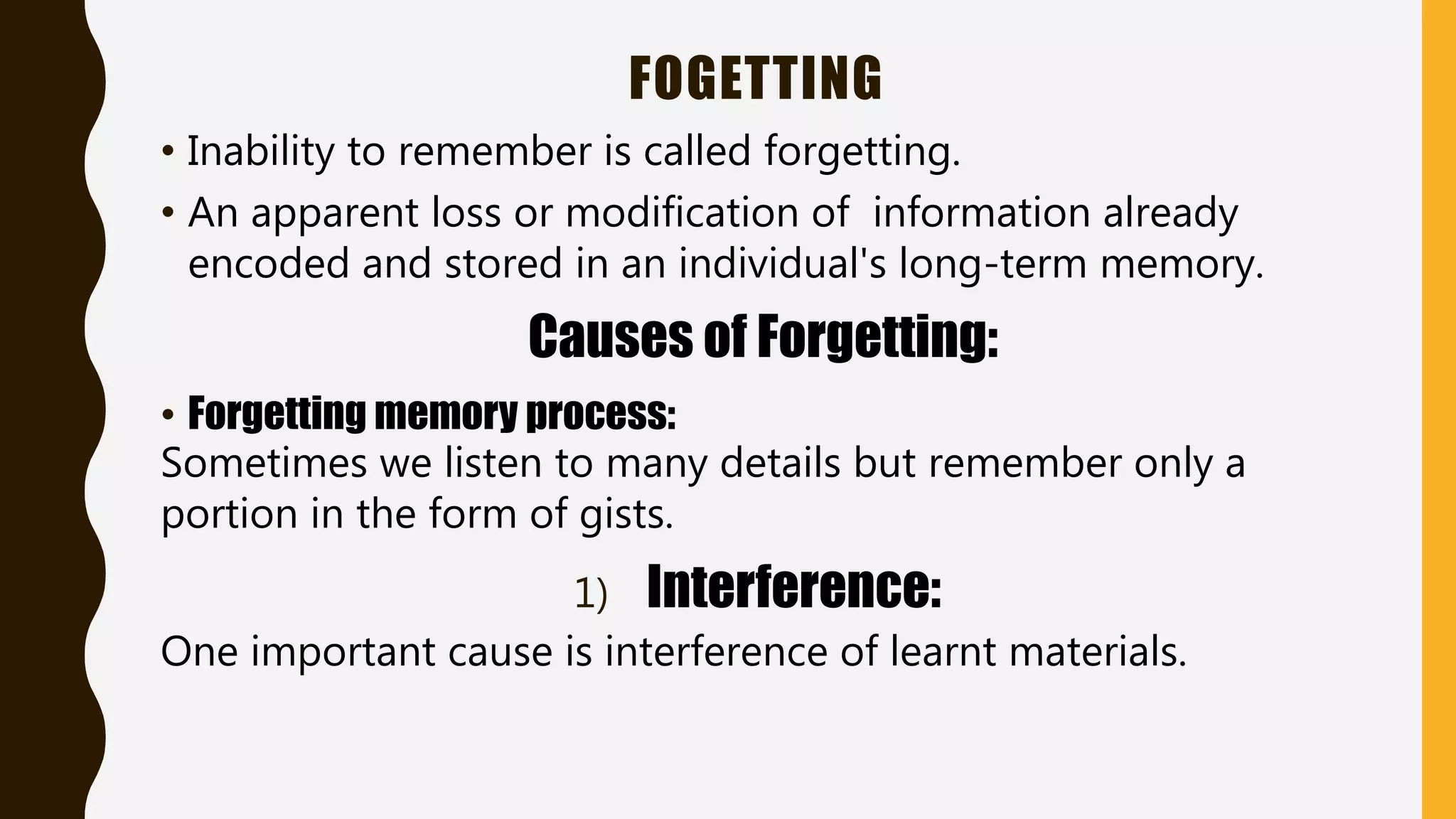
FOGETTING
• Inability to remember is called forgetting.
• An apparent loss or modification of information already
encoded and stored in an individual's long-term memory.
Causes of Forgetting:
• Forgetting memory process:
Sometimes we listen to many details but remember only a
portion in the form of gists.
1) Interference:
One important cause is interference of learnt materials.
Types of Interference
(a) Proactive interference:
(b) Retroactive interference:
Proactive interference:
• Earlier learning interferes with later learning and
inhibits recall of new material.
Retroactive interference:
• Inhibition of earlier learning and recall of later
learning.
1. Retrieval problems.
2. Motivational forgetting
3. Amnesia
Loss of memory.
Types:
• Psychological amnesia
• Childhood dream defense
• Biological amnesia
INTELLIGENCE
“the capacity to acquire and apply knowledge.
Human intelligence
Mental quality that consists of the abilities to learn from
experience, adapt to new situations, understand and handle
abstract concepts, and use knowledge to manipulate one’s
environment.
Cognitive processes:
Effective adaptation draws upon a number of cognitive
processes, such as perception, learning, memory, reasoning,
and problem solving.
Theories Of Intelligence:
•Psychometric theories:
•Biological theories
•Hemispheric studies
KHADIJA SHEHZADI
REL A X ATION AND
HYPNOSIS
Roll No. 05
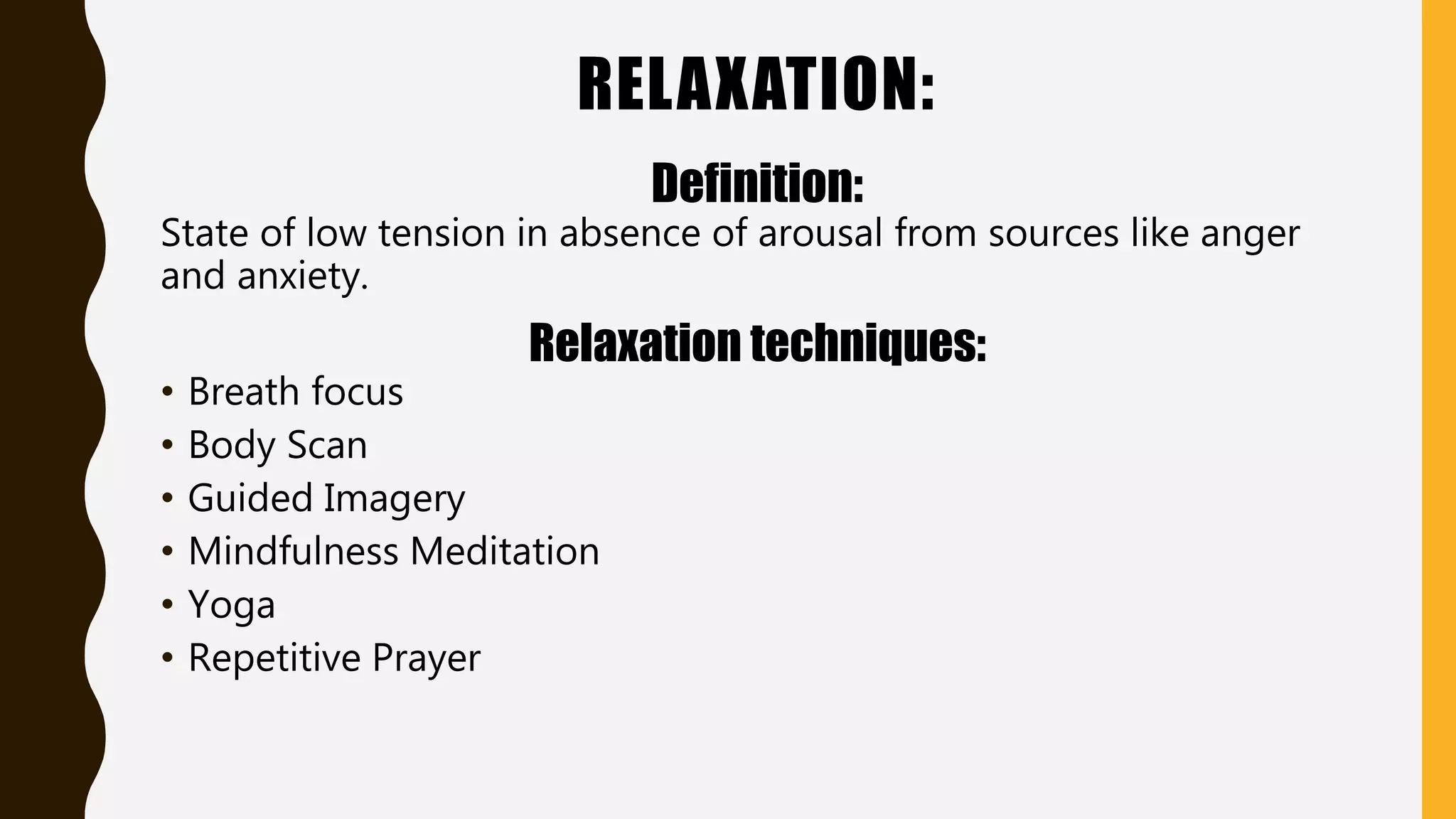
RELAXATION:
Definition:
State of low tension in absence of arousal from sources like anger
and anxiety.
Relaxation techniques:
• Breath focus
• Body Scan
• Guided Imagery
• Mindfulness Meditation
• Yoga
• Repetitive Prayer
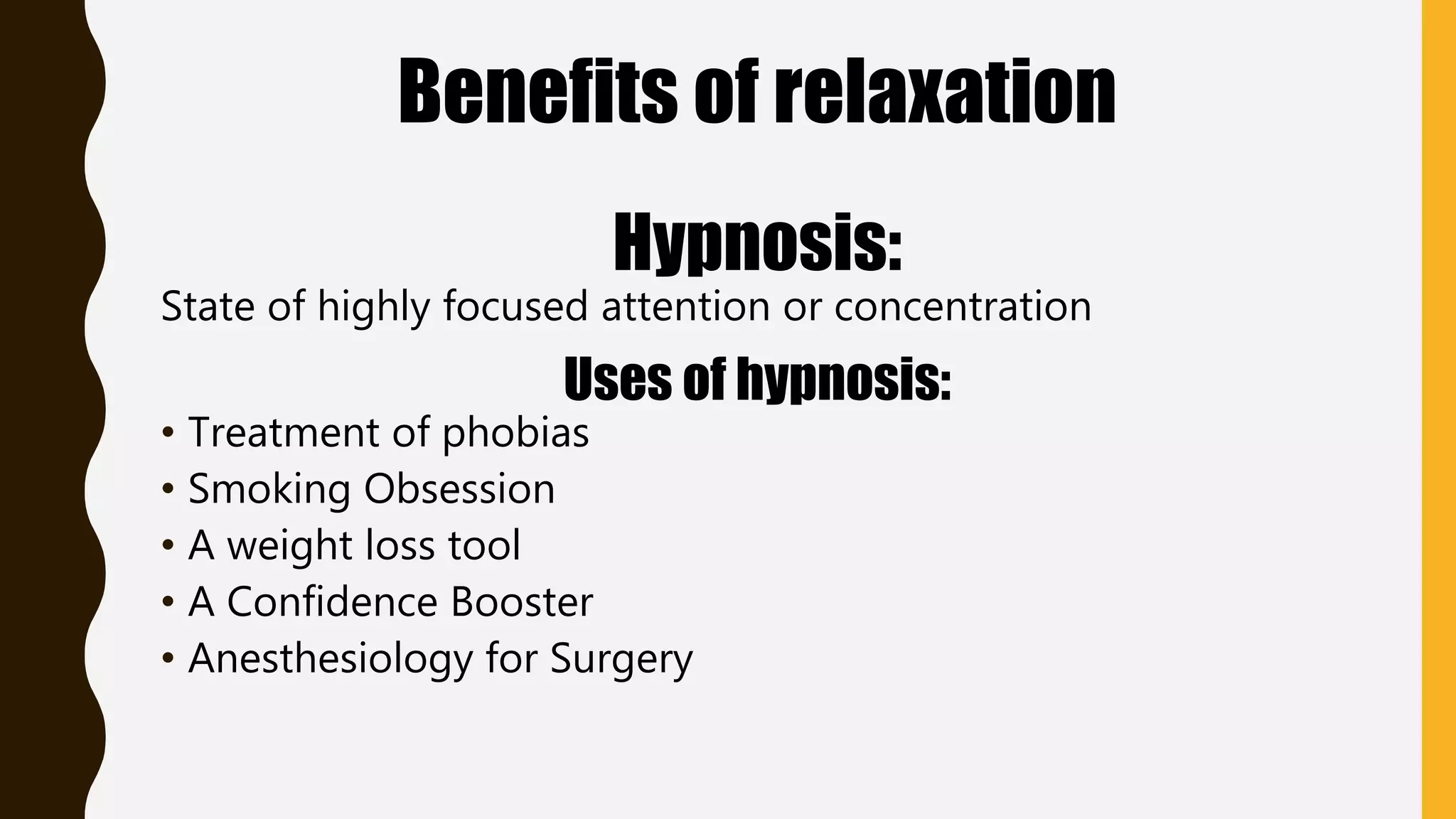
Benefits of relaxation
Hypnosis:
State of highly focused attention or concentration
Uses of hypnosis:
• Treatment of phobias
• Smoking Obsession
• A weight loss tool
• A Confidence Booster
• Anesthesiology for Surgery
•Advantages and disadvantages:
•Limitations
Memory and Types - Psychology

Memory and Types - Psychology

  • 2.
    MEMORY G R OU P P R E S E N TAT I O N PSYCHOLOGY
  • 3.
  • 4.
    DEFINITION “Memory is themental capacity to store, recall or recognize the events that were previously experienced.” Remembring Retaining experiences or recalling them.
  • 5.
    ACCORDING TO COGNITIVE PSYCHOLOGISTS •Mental system that receives, encodes, modifies or retrieves information. According to BEHAVIOURISTS: • We should be unaware of our own likes and dislikes. (Vorauel and Ross’1993) • We would have no idea of who we are in any meaningful sense. (Khilstrom, 1993)
  • 6.
    Selective perception Memory isselective like perception. People retain a great deal of information. They also lose a great deal. Importance • Define ourselves. • Library of our personal experiences. • Prepare a meaningful future. Factors Affecting Memory  Physical health ❖ Attention ❖ Emotion ❖ Prejudice etc
  • 7.
    HUMAN MEMORY VSCOMPUTER Human memory Storage capability but not permanent deletion. Types 1. Sensory memory 2. 2. Short term memory 3. 3. Long term memory Computer memory Storage capability and have permanent deletion. Types 1. RAM 2. 2. ROM
  • 8.
    HASSAN RAZA STAGES OFMEMORY Roll No. 30
  • 9.
    DEFINITION Process of maintaininginformation overtime. Stages 1. Encoding 2. Storage 3. Retrieval • Memory Encoding: Information is converted for storage. Example: • Currency change • A word in book
  • 10.
    Ways in whichinfo. Is stored: 1. Visual (picture) 2. Acoustic (sound) 3. Semantic (meaning) Memory Storage: Information Is retained in memory. 3. Memory Retrieval: Information is retrieved from memory.
  • 11.
    SONIA SADAF TYPES OFMEMORY Roll No. 22
  • 12.
    DEFINITION Memory is thefaculty of the brain by which information is encoded, stored, and retrieved when needed. Types of Memory • Sensory Memory • Short-Term Memory • Long-Term Memory
  • 13.
    SENSORY MEMORY The partof memory where any information is first registered is called Sensory Memory. Example: Looking at an item and remembering it. Types:  Iconic memory ▪ Echoic Memory ▪ Haptic Memory
  • 14.
    Short-Term Memory It’s aprimary or active memory that is capable of holding small amount of information for a brief period of time. Example: Memorizing a phone number. Long-Term memory This form of memory is a memory store capable of storing large quantities of information for potentially unlimited duration. Example: What happened last week, Where and how?
  • 15.
    Types Long-term memory isusually divided into two types: 1. Explicit or Declarative Memory ▪ Episodic Memory ▪ Semantic Memory ▪ Autobiographical Memory ▪ Visual Memory 2. Implicit or Non-Declarative Memory ▪ Procedural Memory ▪ Priming Memory
  • 16.
  • 17.
    DEFINITION Sensory memory isthe shortest-term element of memory. Part of memory where any information is first registered. Has large capacity. Example: Trying to remember an object with just a second of observation or memorization. Characteristics • Storage of information is irrelevant of attention to the stimulus. • Information in SM is stored in specific modality. • Info. is detail oriented. • Different SM store might have different durations
  • 18.
    HOW DOES SENSORYMEMORY WORKS: During every moment of your existence, your senses are constantly taking in an enormous amount of information about what you see, feel, hear, and taste. sensory memory creates something of a quick "snapshot" of the world around you, allowing you to briefly focus your attention on relevant details. Types 1. Iconic memory 2. Echoic memory 3. Haptic memory
  • 19.
    ICONIC MEMORY Sensory inputto the visual system goes into iconic memory. Echoic memory: Echoic memory is the branch of sensory memory used by the auditory system. Haptic memory: Haptic memory is the branch of sensory memory used by the sense of touch.
  • 20.
  • 21.
    DEFINITION: Short term memorytakes over when the information in our sensory memory is transferred to our consciousness or our awareness. This is the information that is current active such as reading this page, talking to a friend or writing a paper. Example: It used to remember a phone number that has just been recited. • Ghajini
  • 22.
    Characteristics: • Short termmemory can definitely last longer than sensory memory (up to 30 seconds or so). • Also known as working memory. • Intermediate memory. Displacement: Means that new information will push out part of the old information.
  • 23.
    FUNCTIONS: It has twomajor functions: • It allows us to construct a continually updated working model of the world. • Second it makes possible to think and solve problems. Theories and applications: • Primary Effect • Receny Effect • Distinctiveness • Frequency Effect • Association • Reconstruction
  • 24.
  • 25.
    DEFINITION The long-term memoryrefers to unlimited capacity memory store that hold information over lengthy periods of time. By saying “lengthy period of time” we mean that it is possible for memories in LTM to remain there for an entire lifetime. Example: Like we can recall some specific past events very easily such as how many marks I got in 1st grade class or how I first rode my bike.
  • 26.
    SIGNIFICANCE Imagine how difficultit would be to forget the day you graduated. Now think about how easy it is to forget information that has no significance, the color of the car you parked next to at the store or which shirt you wore last Thursday. Types • Declarative Memory • Non-Declarative Memory
  • 27.
    Declarative memory Declarative memoryconsists of facts and events that can be consciously recalled or "declared." Also known as Explicit memory. Example: let's say that you know that your favorite restaurant is only open until 6 PM on Sundays. Types: • Episodic memory • Semantic memory.
  • 28.
    NON-DECLARATIVE MEMORY • Implicitmemory (also called "non declarative" memory) is a type of long-term memory that stands in contrast to explicit memory in that it doesn't require conscious thought. Example: When a skilled typist is typing on a keyboard, she does not need to look at each key. Instead, she is able to type without recalling the placement of each key.
  • 29.
    M. HASSAAN MASOOD EXPLICITMEMORY Roll No. 27
  • 30.
    DEFINITION • It isthe conscious, intentional recollection of factual information, previous experiences, and concepts. • Requires conscious thought, unlike Implicit memory Example: you might hear an annoying pop song, Days later, you find yourself still humming that same tune. How are Explicit memories made? Step 1: Encoding Step 2: Storage Step 3: Retrieval
  • 31.
    EXPLICIT MEMORY VSIMPLICIT MEMORY Implicit memory, sometimes called non-declarative memory, involves the way experiences affect our behaviors. Unlike explicit memory, which requires making a conscious effort to recall information, implicit memory operates unconsciously. Example: Driving a car, you just do it. You can’t teach them hoe much pressure to put on gas por break pedal.
  • 32.
    Types: ❖ Episodic memory ❖Semantic memory Further Division: ▪ Autobiographical memory ▪ Spatial memory
  • 33.
    EPISODIC MEMORY • Episodicmemory consists of the storage and recollection of observational information attached to specific life-events. Example: • Remember the trip to London • Recall a great dinner you had at your favorite restaurant • Think about your high school graduation ceremony
  • 34.
    SEMANTIC MEMORY Semantic memoryrefers to general world knowledge (facts, ideas, meaning and concepts) that can be articulated and is independent of personal experience. Example: • Know that the word “boat” refers to a watercraft of varying sizes • Recall that Washington, D.C., is the capital of the U.S. • Recognize the distinguishing features that classify an animal as a dog
  • 35.
  • 36.
  • 37.
    DEFINITION: Implicit memory usespast experiences to remember things without thinking about them. It doesn’t require any conscious thought. Also known as Unconscious Memory or Automatic Memory. Example: • Keyboard typist • Bike rider • Singing ABC • Cooking recipie
  • 38.
    Types: • Procedural memory •Priming PROCEDURAL MEMORY Procedural memory is a type of implicit memory and long memory which aids the performance of particular type of without conscious awareness of these previous experiences, such as walking, talking and riding a bike.
  • 39.
    Example: 1: Playing piano 2:skiing 3: Ice skating 4: Playing baseball 5: Swimming Etc.
  • 40.
    PRIMING MEMORY Priming isthe implicit memory effect in which exposure to a stimulus influence responses to a later stimulus. It is a technique in psychology used to train a person’s memory both in positive and negative ways. ASSOCIATING WORDS AND PICTURES: In Priming there is no need for researchers to ask subjects to memorize certain sequences of words because they take advantage of word association when they “prime” subjects. Example: For example, “school” relates to “student” and “bus”.
  • 41.
    POSITIVE PRIMING: • Positivepriming uses involves using sketches or words or other stimuli to help an individual recognize another word or phrase in the future. Example: Words “Sky” to remember Blue color. NEGATIVE PRIMING While positive priming speeds up the memory process, negative priming naturally slows at down. The mind can be negatively primed by exposing the person to various stimuli before ignoring these stimuli completely.
  • 42.
    •PERCEPTUAL VS. CONCEPTUAL •Perceptual priming relates to the stimuli’s form and is increased by matches between early and late stimuli, while Conceptual priming on the other hand relies on the meaning of stimuli. • Example: • Chair and table.
  • 43.
  • 44.
    FOGETTING • Inability toremember is called forgetting. • An apparent loss or modification of information already encoded and stored in an individual's long-term memory. Causes of Forgetting: • Forgetting memory process: Sometimes we listen to many details but remember only a portion in the form of gists. 1) Interference: One important cause is interference of learnt materials.
  • 45.
    Types of Interference (a)Proactive interference: (b) Retroactive interference: Proactive interference: • Earlier learning interferes with later learning and inhibits recall of new material. Retroactive interference: • Inhibition of earlier learning and recall of later learning.
  • 46.
    1. Retrieval problems. 2.Motivational forgetting 3. Amnesia Loss of memory. Types: • Psychological amnesia • Childhood dream defense • Biological amnesia
  • 47.
    INTELLIGENCE “the capacity toacquire and apply knowledge. Human intelligence Mental quality that consists of the abilities to learn from experience, adapt to new situations, understand and handle abstract concepts, and use knowledge to manipulate one’s environment. Cognitive processes: Effective adaptation draws upon a number of cognitive processes, such as perception, learning, memory, reasoning, and problem solving.
  • 48.
    Theories Of Intelligence: •Psychometrictheories: •Biological theories •Hemispheric studies
  • 49.
    KHADIJA SHEHZADI REL AX ATION AND HYPNOSIS Roll No. 05
  • 50.
    RELAXATION: Definition: State of lowtension in absence of arousal from sources like anger and anxiety. Relaxation techniques: • Breath focus • Body Scan • Guided Imagery • Mindfulness Meditation • Yoga • Repetitive Prayer
  • 51.
    Benefits of relaxation Hypnosis: Stateof highly focused attention or concentration Uses of hypnosis: • Treatment of phobias • Smoking Obsession • A weight loss tool • A Confidence Booster • Anesthesiology for Surgery
  • 52.