Internal Assessment
and
Formative Assessment
RBC WORKSHOP ON MEDICAL EDUCATION TECHNOLOGIES
Dr Munmun Das(Sarkar)
Professor, Microbiology
CNMC&H
Learning Objectives
1. What are the different types of
assessments?
2. How to formulate a plan for internal
and formative assessment?
RBC WORKSHOP ON MEDICAL EDUCATION TECHNOLOGIES
Why do we assess ?
• To help the teachers decide if the students have acquired the
desired competencies,
• To help the students acquire and improve their competencies.
• We need to assess the medical students because we are to
certify them to deal with human life.
• Quality assurance requires quality assessment.
Types of Assessment, we are used to…..
RBC WORKSHOP ON MEDICAL EDUCATION TECHNOLOGIES
University
Prof Exam
Semester
Exam
Part Completion
Exam
Item
clearance
Ward
Completion
Types
•Summative Assessment
•Formative Assessment
•Internal Assessment(IA)
•Continuous Internal Assessment (CIA)
RBC WORKSHOP ON MEDICAL EDUCATION TECHNOLOGIES
Summative Assessment
•Assessment of learning
•Generally taken by students at the end of
a unit or semester to demonstrate the
"sum" of what they have or have not
learned.
•Summative assessment methods are the
most traditional way of evaluating
student work.
RBC WORKSHOP ON MEDICAL EDUCATION TECHNOLOGIES
Formative Assessment
•Assessment for Learning
•Monitor students’ learning and provides
ongoing feedback
•Feedback applicable to the
Teacher/Student as well as the teaching-
learning process
•No pass/fail system
•No marking/gradation- IDEAL
RBC WORKSHOP ON MEDICAL EDUCATION TECHNOLOGIES
LESS SALT !!!
FORMATIVE
ASSESSMENT
SUMMATIVE
ASSESSMENT
RBC WORKSHOP ON MEDICAL EDUCATION TECHNOLOGIES
• Formative and summative assessment are interconnected.
They seldom stand alone in construction or effect.
• The vast majority of genuine formative assessment is
informal, with interactive and timely feedback and
response.
• Formative assessment has the greatest impact on learning
and achievement.
RBC WORKSHOP ON MEDICAL EDUCATION TECHNOLOGIES
Effective Formative Assessment
•Students should be able to answer three
basic questions:
•Where am I going?
•Where am I now?
•How can I close the gap?
• Sadler (1989)
RBC WORKSHOP ON MEDICAL EDUCATION TECHNOLOGIES
Where am I going?
•Strategy 1: Provide a clear and
understandable learning target.
•Strategy 2: Use examples of strong and
weak work.
RBC WORKSHOP ON MEDICAL EDUCATION TECHNOLOGIES
“Students that can identify what they are learning
significantly outscore those who cannot.” Marzano, 2005
Where am I now?
•Strategy 1: Offer regular descriptive
feedback.
•Strategy 2: Also teach students to
self-assess and set goals.
RBC WORKSHOP ON MEDICAL EDUCATION TECHNOLOGIES
How do I close the gap?
•Strategy 1: Design lessons to focus on one
aspect of quality at a time.
•Strategy 2: Engage students in self-
reflection and let them document and share
their learning.
RBC WORKSHOP ON MEDICAL EDUCATION TECHNOLOGIES
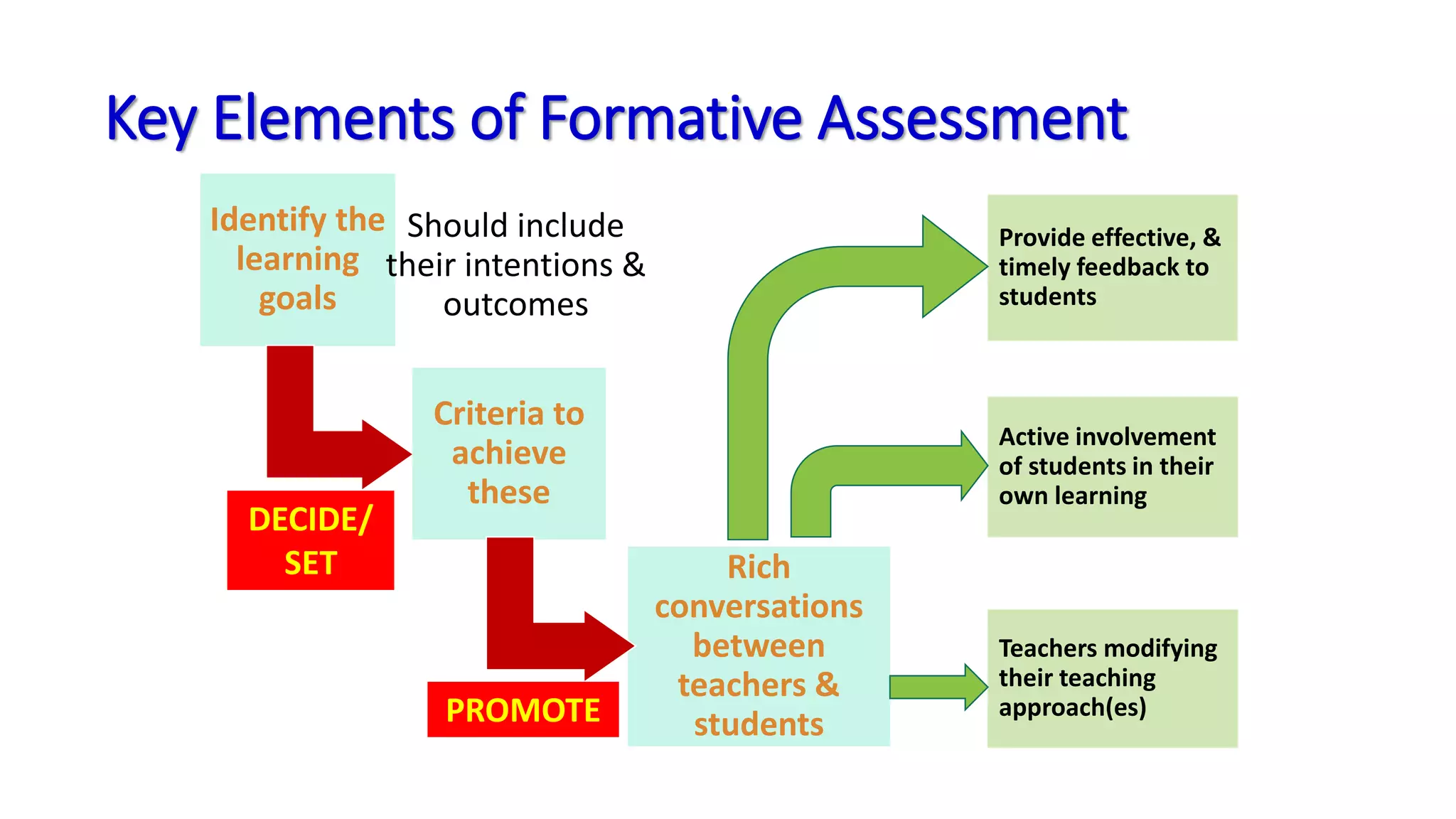
Identify the
learning
goals
Criteria to
achieve
these
Rich
conversations
between
teachers &
students
Should include
their intentions &
outcomes
Provide effective, &
timely feedback to
students
Active involvement
of students in their
own learning
Teachers modifying
their teaching
approach(es)
Key Elements of Formative Assessment
RBC WORKSHOP ON MEDICAL EDUCATION TECHNOLOGIES
DECIDE/
SET
PROMOTE
Formative Assessment Summative Assessment
What FA is
RBC WORKSHOP ON MEDICAL EDUCATION TECHNOLOGIES
 It is a PLANNED process.
 It is used by both teachers & students
 Takes place DURING instruction.
 It provides assessment-based feedback
to both teachers & students.
 It helps teachers & students make
adjustments that will improve student
achievement.
v
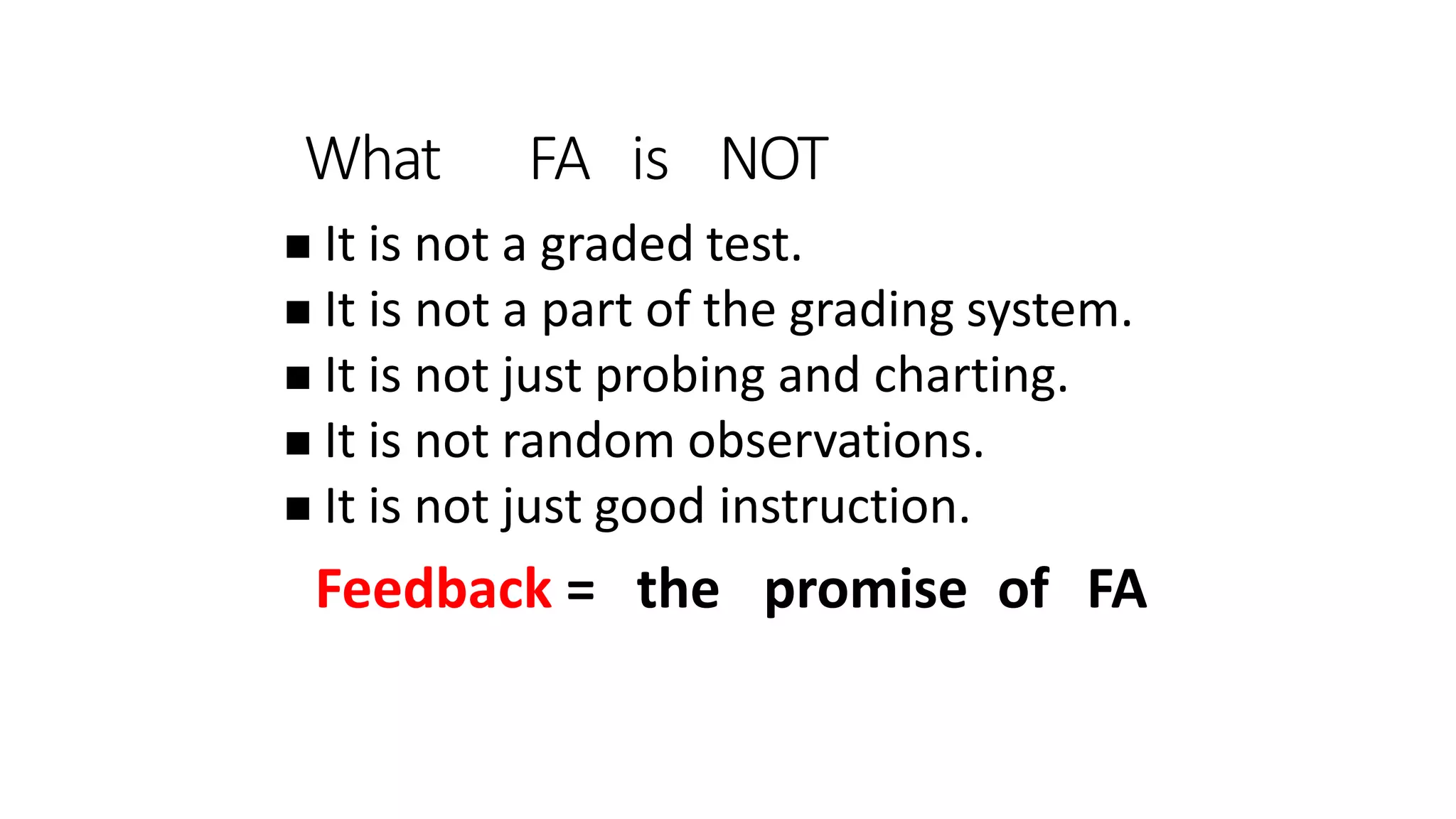
What FA is NOT
 It is not a graded test.
 It is not a part of the grading system.
 It is not just probing and charting.
 It is not random observations.
 It is not just good instruction.
Feedback = the promise of FA
Assessment in our System
RBC WORKSHOP ON MEDICAL EDUCATION TECHNOLOGIES
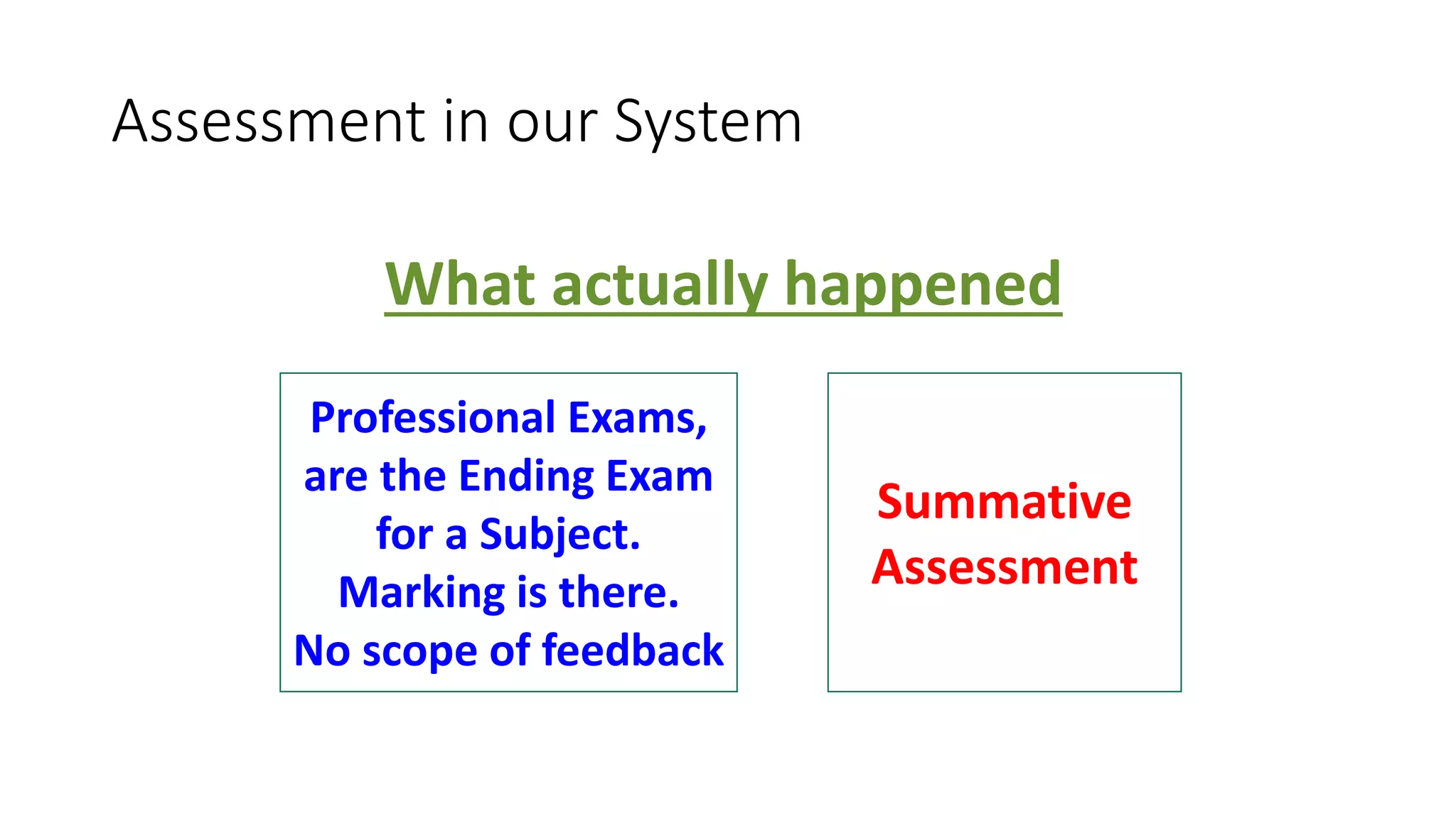
What actually happened
Professional Exams,
are the Ending Exam
for a Subject.
Marking is there.
No scope of feedback
Summative
Assessment
Assessment in our System
RBC WORKSHOP ON MEDICAL EDUCATION TECHNOLOGIES
What actually happened
50% of IA marks
comes from Semester
Exams/(IA Exam).
50% of IA marks
comes from CIA.
Was added in the
final marksheet as
part of university
result under IA
RBC WORKSHOP ON MEDICAL EDUCATION TECHNOLOGIES
What happens after GMER 2019
Internal Assessments to be used for appearing in the
University Exam.
Marks will not be added in the final marks
[IA marks will reflect as a separate head of passing at the University exam.]
***
35% - appearance
50% - result publication
Less than 50% - remedial measures
[In subjects that have two papers - at least 40% marks in each paper with
minimum 50% of marks in aggregate to pass]
RBC WORKSHOP ON MEDICAL EDUCATION TECHNOLOGIES
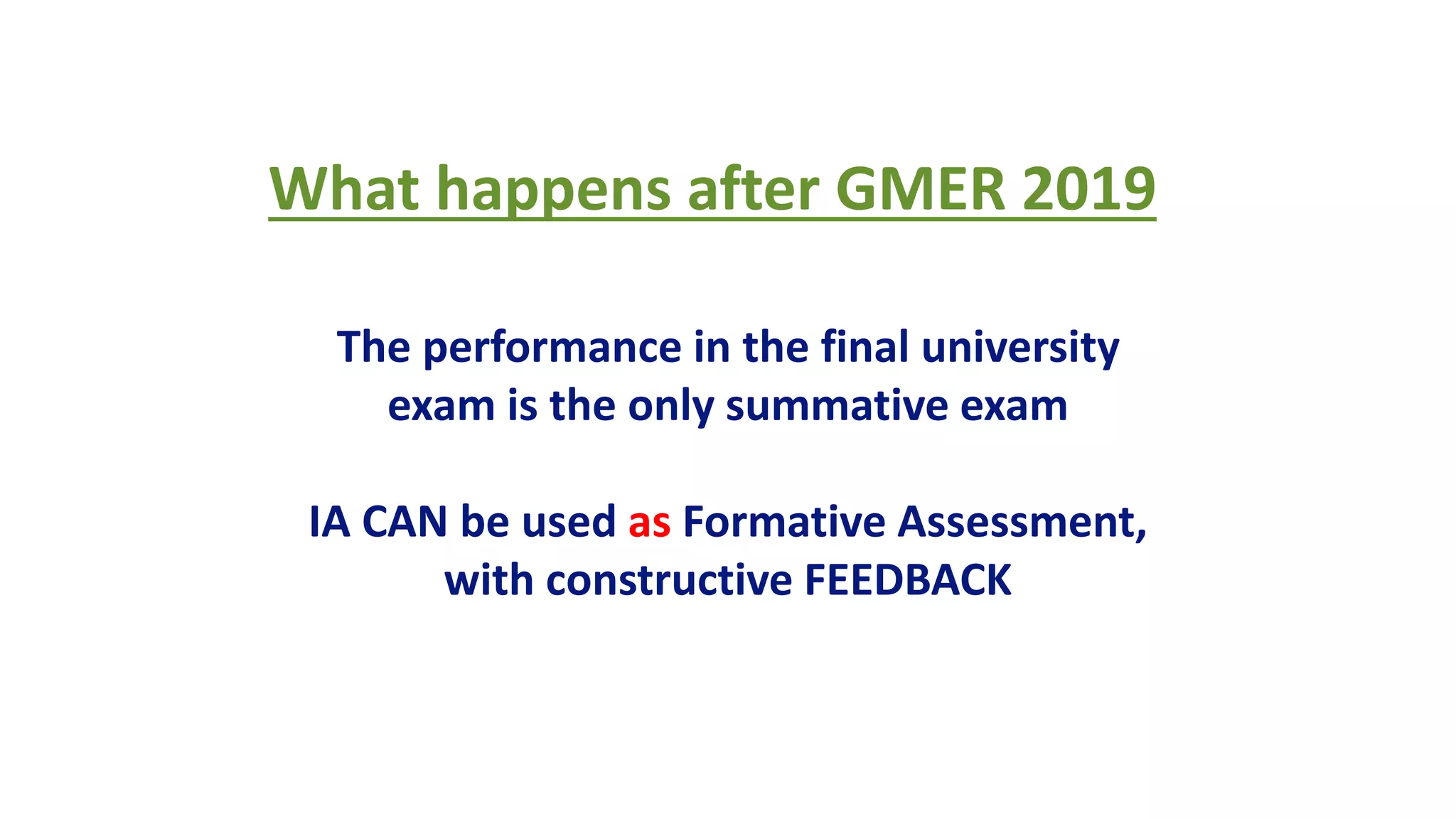
What happens after GMER 2019
The performance in the final university
exam is the only summative exam
IA CAN be used as Formative Assessment,
with constructive FEEDBACK
Internal Assessment
• Assessment is done by the teachers who have taught the subject.
(-all faculty members including Residents can be involved)
• Overcomes the limitations of day-to-day variability and allows larger
sampling of topics, competencies and skills.
• Can provide useful avenues for both formative and summative
assessment.
• Focuses on the content and process of learning i.e. what and how
students have learnt throughout the course.
Internal Assessment
• Priority can be given to psychomotor, communication and
affective domains.[usually not assessed by traditional
assessment methods]
• Can be a very useful tool for assessing the competencies in any
competency based curriculum.
• Multiple tools can be used for a given competency - helps to
improve validity and reliability of the assessment.
Phase – 1
• Human Anatomy - 3, Physiology - 3, Biochemistry - 3,
• Community Medicine – 1
One of the 3 tests in preclinical subjects should be
pre-university examination
Phase – 2
• Pathology 3, Pharmacology 3, Microbiology 3,
One of the 3 tests in para-clinical subjects should be
pre-university examination
General Medicine & allied
General Surgery & allied
Obstetrics& Gynaecology,
Forensic Medicine & Toxicology
Community Medicine
2 IA
+ End of posting (EOP)
examination at each clinical
posting including allied
Phase – 3
• Forensic Medicine &Toxicology -2, Community Medicine -2,
• Ophthalmology- 2, Otorhinolaryngology -2
One of the 2 tests should be pre-university examination
General Medicine & allied
General Surgery & allied
Pediatrics
Obstetrics &Gynaecology
2 IA
+ End of posting (EOP)
examination at each clinical
posting including allied.
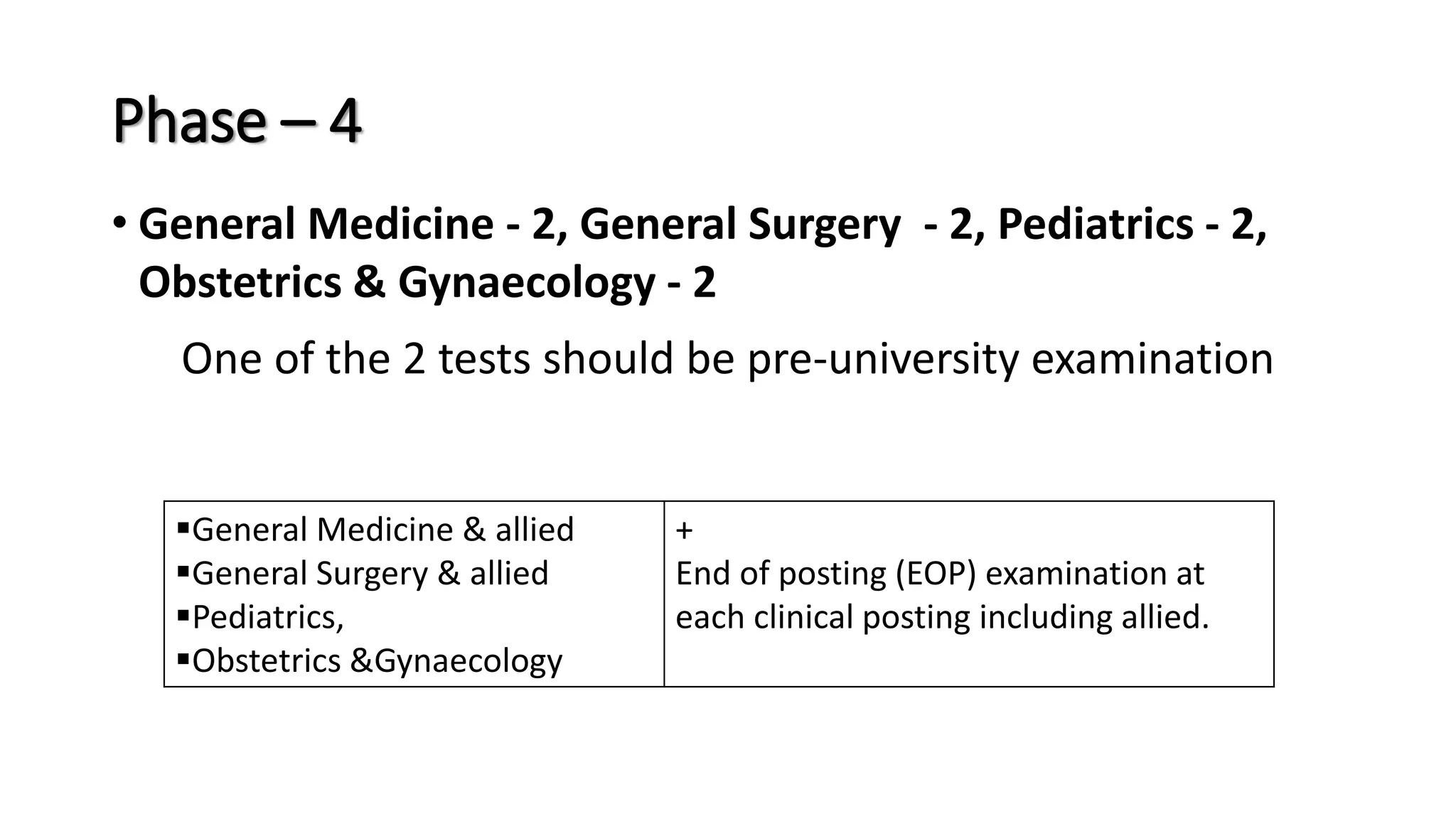
Phase – 4
• General Medicine - 2, General Surgery - 2, Pediatrics - 2,
Obstetrics & Gynaecology - 2
One of the 2 tests should be pre-university examination
General Medicine & allied
General Surgery & allied
Pediatrics,
Obstetrics &Gynaecology
+
End of posting (EOP) examination at
each clinical posting including allied.
Feedback in IA
• Structured Feedback - throughout the course - remedial action in time.
• Sensitization of faculties and students regarding feedback.
• The results of IA - be displayed on notice board within two weeks of the
test.
• Create opportunity for the students to discuss the results and get
feedback (faculty & peer)  better performance.
• Students should sign with date whenever they are shown IA records in
token of having seen and discussed the marks (Recommended).
• Universities should guide Colleges regarding formulating remedial
measures for students - not scored qualifying marks/ missed IA.
Continuous Internal Assessment
• Takes place DURING instruction.
• No marks, no grades.
• Structured Feedback.
• Regular, may be unplanned, unstructured.
• Carried on at any day, any time, any where.
• To assess those abilities, which cannot be evaluated
in term-end exam /(IA).
RBC WORKSHOP ON MEDICAL EDUCATION TECHNOLOGIES
Part of FORMATIVE ASSESSMENT
CIA should be on the process of learning rather than on the product. (MCI)
CIA
•Continuous assessment can take place within
various types of contact moments:-
• Practical.
• Workshops.
• Lectures.
• Placements.
• Projects.
• Cases.
RBC WORKSHOP ON MEDICAL EDUCATION TECHNOLOGIES
In addition -
• Continuous assessment can take various forms,
depending on the final objectives and competencies.
like -
• Regular observation and assessment of different skills or
attitudes (eg: Communication skills, team’s
collaboration skills, verbal language skills)
RBC WORKSHOP ON MEDICAL EDUCATION TECHNOLOGIES
CIA
Continuous assessment often goes hand in hand with
information about (+ descriptive structured feedback on):
• the assessment criteria.
• how the student performed.
• what went smoothly.
• what went less smoothly.
• things the student still has to work on.
RBC WORKSHOP ON MEDICAL EDUCATION TECHNOLOGIES
Why continuous internal assessment ?
• Performing a competency like “Chest compression in CPR” well
does not mean that the student can perform “mouth to mouth
respiration in CPR” as well.
• Assessment in demonstration room may not be the same as
assessment at bedside.
• Communication, team work, ethics, professionalism & many
procedural skills can not be assessed at summative exam..
• Competencies can be assessed multiple times and in different
contexts.
How will you incorporate Formative part in
your existing assessment system ?
RBC WORKSHOP ON MEDICAL EDUCATION
TECHNOLOGIES
Types of Assessment, we are used to…
RBC WORKSHOP ON MEDICAL EDUCATION TECHNOLOGIES
University
Prof Exam
Internal
Assessment
Exam
Part Completion
Exam
Ward
Completion
SUMMATIVE
CONTINUOUS INTERNAL ASSESSMENT
Item
clearance
FORMATIVE
Designing a system of assessment
• All domains of learning should be taken into account &
weightage to be given to all three domains for assessment.
• Miller’s pyramid provides a simple way to select appropriate
tool for assessment.
• Efforts should be made to climb higher in the pyramid.
• Some aspects from competencies of other phases/ other
subjects can be included – help to assess integration of
concepts.
Group Activity –
Plan formative & internal assessment (on the given competency)
• Answer the following questions:-
1. Whom to assess?
2. Identify learning domains to be addressed during assessment.
3. Which level of Miller’s pyramid to be assessed?
4. How to assess (Which tools to be used)?
6. When to provide feedback?
7. Specific subject/learning areas to be addressed during feedback.
Thank You

Internal assessment & formative assessment

  • 1.
    Internal Assessment and Formative Assessment RBCWORKSHOP ON MEDICAL EDUCATION TECHNOLOGIES Dr Munmun Das(Sarkar) Professor, Microbiology CNMC&H
  • 2.
    Learning Objectives 1. Whatare the different types of assessments? 2. How to formulate a plan for internal and formative assessment? RBC WORKSHOP ON MEDICAL EDUCATION TECHNOLOGIES
  • 3.
    Why do weassess ? • To help the teachers decide if the students have acquired the desired competencies, • To help the students acquire and improve their competencies. • We need to assess the medical students because we are to certify them to deal with human life. • Quality assurance requires quality assessment.
  • 4.
    Types of Assessment,we are used to….. RBC WORKSHOP ON MEDICAL EDUCATION TECHNOLOGIES University Prof Exam Semester Exam Part Completion Exam Item clearance Ward Completion
  • 5.
    Types •Summative Assessment •Formative Assessment •InternalAssessment(IA) •Continuous Internal Assessment (CIA) RBC WORKSHOP ON MEDICAL EDUCATION TECHNOLOGIES
  • 6.
    Summative Assessment •Assessment oflearning •Generally taken by students at the end of a unit or semester to demonstrate the "sum" of what they have or have not learned. •Summative assessment methods are the most traditional way of evaluating student work. RBC WORKSHOP ON MEDICAL EDUCATION TECHNOLOGIES
  • 7.
    Formative Assessment •Assessment forLearning •Monitor students’ learning and provides ongoing feedback •Feedback applicable to the Teacher/Student as well as the teaching- learning process •No pass/fail system •No marking/gradation- IDEAL RBC WORKSHOP ON MEDICAL EDUCATION TECHNOLOGIES
  • 8.
    LESS SALT !!! FORMATIVE ASSESSMENT SUMMATIVE ASSESSMENT RBCWORKSHOP ON MEDICAL EDUCATION TECHNOLOGIES
  • 9.
    • Formative andsummative assessment are interconnected. They seldom stand alone in construction or effect. • The vast majority of genuine formative assessment is informal, with interactive and timely feedback and response. • Formative assessment has the greatest impact on learning and achievement. RBC WORKSHOP ON MEDICAL EDUCATION TECHNOLOGIES
  • 10.
    Effective Formative Assessment •Studentsshould be able to answer three basic questions: •Where am I going? •Where am I now? •How can I close the gap? • Sadler (1989) RBC WORKSHOP ON MEDICAL EDUCATION TECHNOLOGIES
  • 11.
    Where am Igoing? •Strategy 1: Provide a clear and understandable learning target. •Strategy 2: Use examples of strong and weak work. RBC WORKSHOP ON MEDICAL EDUCATION TECHNOLOGIES “Students that can identify what they are learning significantly outscore those who cannot.” Marzano, 2005
  • 12.
    Where am Inow? •Strategy 1: Offer regular descriptive feedback. •Strategy 2: Also teach students to self-assess and set goals. RBC WORKSHOP ON MEDICAL EDUCATION TECHNOLOGIES
  • 13.
    How do Iclose the gap? •Strategy 1: Design lessons to focus on one aspect of quality at a time. •Strategy 2: Engage students in self- reflection and let them document and share their learning. RBC WORKSHOP ON MEDICAL EDUCATION TECHNOLOGIES
  • 14.
    Identify the learning goals Criteria to achieve these Rich conversations between teachers& students Should include their intentions & outcomes Provide effective, & timely feedback to students Active involvement of students in their own learning Teachers modifying their teaching approach(es) Key Elements of Formative Assessment RBC WORKSHOP ON MEDICAL EDUCATION TECHNOLOGIES DECIDE/ SET PROMOTE
  • 15.
  • 16.
    What FA is RBCWORKSHOP ON MEDICAL EDUCATION TECHNOLOGIES  It is a PLANNED process.  It is used by both teachers & students  Takes place DURING instruction.  It provides assessment-based feedback to both teachers & students.  It helps teachers & students make adjustments that will improve student achievement. v
  • 17.
    What FA isNOT  It is not a graded test.  It is not a part of the grading system.  It is not just probing and charting.  It is not random observations.  It is not just good instruction. Feedback = the promise of FA
  • 18.
    Assessment in ourSystem RBC WORKSHOP ON MEDICAL EDUCATION TECHNOLOGIES What actually happened Professional Exams, are the Ending Exam for a Subject. Marking is there. No scope of feedback Summative Assessment
  • 19.
    Assessment in ourSystem RBC WORKSHOP ON MEDICAL EDUCATION TECHNOLOGIES What actually happened 50% of IA marks comes from Semester Exams/(IA Exam). 50% of IA marks comes from CIA. Was added in the final marksheet as part of university result under IA
  • 20.
    RBC WORKSHOP ONMEDICAL EDUCATION TECHNOLOGIES What happens after GMER 2019 Internal Assessments to be used for appearing in the University Exam. Marks will not be added in the final marks [IA marks will reflect as a separate head of passing at the University exam.] *** 35% - appearance 50% - result publication Less than 50% - remedial measures [In subjects that have two papers - at least 40% marks in each paper with minimum 50% of marks in aggregate to pass]
  • 21.
    RBC WORKSHOP ONMEDICAL EDUCATION TECHNOLOGIES What happens after GMER 2019 The performance in the final university exam is the only summative exam IA CAN be used as Formative Assessment, with constructive FEEDBACK
  • 22.
    Internal Assessment • Assessmentis done by the teachers who have taught the subject. (-all faculty members including Residents can be involved) • Overcomes the limitations of day-to-day variability and allows larger sampling of topics, competencies and skills. • Can provide useful avenues for both formative and summative assessment. • Focuses on the content and process of learning i.e. what and how students have learnt throughout the course.
  • 23.
    Internal Assessment • Prioritycan be given to psychomotor, communication and affective domains.[usually not assessed by traditional assessment methods] • Can be a very useful tool for assessing the competencies in any competency based curriculum. • Multiple tools can be used for a given competency - helps to improve validity and reliability of the assessment.
  • 24.
    Phase – 1 •Human Anatomy - 3, Physiology - 3, Biochemistry - 3, • Community Medicine – 1 One of the 3 tests in preclinical subjects should be pre-university examination
  • 25.
    Phase – 2 •Pathology 3, Pharmacology 3, Microbiology 3, One of the 3 tests in para-clinical subjects should be pre-university examination General Medicine & allied General Surgery & allied Obstetrics& Gynaecology, Forensic Medicine & Toxicology Community Medicine 2 IA + End of posting (EOP) examination at each clinical posting including allied
  • 26.
    Phase – 3 •Forensic Medicine &Toxicology -2, Community Medicine -2, • Ophthalmology- 2, Otorhinolaryngology -2 One of the 2 tests should be pre-university examination General Medicine & allied General Surgery & allied Pediatrics Obstetrics &Gynaecology 2 IA + End of posting (EOP) examination at each clinical posting including allied.
  • 27.
    Phase – 4 •General Medicine - 2, General Surgery - 2, Pediatrics - 2, Obstetrics & Gynaecology - 2 One of the 2 tests should be pre-university examination General Medicine & allied General Surgery & allied Pediatrics, Obstetrics &Gynaecology + End of posting (EOP) examination at each clinical posting including allied.
  • 28.
    Feedback in IA •Structured Feedback - throughout the course - remedial action in time. • Sensitization of faculties and students regarding feedback. • The results of IA - be displayed on notice board within two weeks of the test. • Create opportunity for the students to discuss the results and get feedback (faculty & peer)  better performance. • Students should sign with date whenever they are shown IA records in token of having seen and discussed the marks (Recommended). • Universities should guide Colleges regarding formulating remedial measures for students - not scored qualifying marks/ missed IA.
  • 29.
    Continuous Internal Assessment •Takes place DURING instruction. • No marks, no grades. • Structured Feedback. • Regular, may be unplanned, unstructured. • Carried on at any day, any time, any where. • To assess those abilities, which cannot be evaluated in term-end exam /(IA). RBC WORKSHOP ON MEDICAL EDUCATION TECHNOLOGIES Part of FORMATIVE ASSESSMENT CIA should be on the process of learning rather than on the product. (MCI)
  • 30.
    CIA •Continuous assessment cantake place within various types of contact moments:- • Practical. • Workshops. • Lectures. • Placements. • Projects. • Cases. RBC WORKSHOP ON MEDICAL EDUCATION TECHNOLOGIES
  • 31.
    In addition - •Continuous assessment can take various forms, depending on the final objectives and competencies. like - • Regular observation and assessment of different skills or attitudes (eg: Communication skills, team’s collaboration skills, verbal language skills) RBC WORKSHOP ON MEDICAL EDUCATION TECHNOLOGIES
  • 32.
    CIA Continuous assessment oftengoes hand in hand with information about (+ descriptive structured feedback on): • the assessment criteria. • how the student performed. • what went smoothly. • what went less smoothly. • things the student still has to work on. RBC WORKSHOP ON MEDICAL EDUCATION TECHNOLOGIES
  • 33.
    Why continuous internalassessment ? • Performing a competency like “Chest compression in CPR” well does not mean that the student can perform “mouth to mouth respiration in CPR” as well. • Assessment in demonstration room may not be the same as assessment at bedside. • Communication, team work, ethics, professionalism & many procedural skills can not be assessed at summative exam.. • Competencies can be assessed multiple times and in different contexts.
  • 34.
    How will youincorporate Formative part in your existing assessment system ? RBC WORKSHOP ON MEDICAL EDUCATION TECHNOLOGIES
  • 35.
    Types of Assessment,we are used to… RBC WORKSHOP ON MEDICAL EDUCATION TECHNOLOGIES University Prof Exam Internal Assessment Exam Part Completion Exam Ward Completion SUMMATIVE CONTINUOUS INTERNAL ASSESSMENT Item clearance FORMATIVE
  • 36.
    Designing a systemof assessment • All domains of learning should be taken into account & weightage to be given to all three domains for assessment. • Miller’s pyramid provides a simple way to select appropriate tool for assessment. • Efforts should be made to climb higher in the pyramid. • Some aspects from competencies of other phases/ other subjects can be included – help to assess integration of concepts.
  • 37.
    Group Activity – Planformative & internal assessment (on the given competency) • Answer the following questions:- 1. Whom to assess? 2. Identify learning domains to be addressed during assessment. 3. Which level of Miller’s pyramid to be assessed? 4. How to assess (Which tools to be used)? 6. When to provide feedback? 7. Specific subject/learning areas to be addressed during feedback.
  • 38.