DR SYED FAHAD ALI ZAIDI
RESIDENT SU II BBH
 Asma, D/O tanveer ,
 12 years
 female
 CR No 7995
 Resident of rawalpindi
 Presented to ER
 On 09-04-2012
 Presented to ER with C/O
 Pain abdomen 3 days
 Constipation; 2 days
 Vomiting 2 days

Pain was initially mild and peri-umblical; later became
generalized and severe. It was associated with nausea,
anorexia and multiple episodes of vomiting.
No associated history of fever, no h/O bleeding PR
 On examination patient had tachycardia, mild fever

and she had generalized abdominal tenderness, and
guarding, suggestive of peritonitis.
 AXR erect showed free gas under diaphragm
 Hb was 14, and TLC was 15900/mm3
 Patient was resuscitated with wide bore IV lines, using

crytalloids.
 NG tube and foley’s catheter was passed.
 After resuscitation she was shifted to COT for

exploration
 SINGLE 2x2 cm perforation in jejunum, in proximity

of a diverticulum at anti-mesenteric border of the
bowel.
 Omentum was sealing the perforation
 150-200 ml free fluid in the abdomen
 Appendix secondarily inflammed.
 Resection of perforated gut, and Primary closure,

followed by appendectomy and abdominal lavage was
done.
 Diverticulum was left in situ as it was broad based
 Abdomen was closed en mass with vicryl 1.
 Patient did not have a smooth post op course, and pain

abdomen , along with signs of toximea were present.
 Wound had sero-sanguinous discharge, with early
features of dehiscence
 On 2nd post op day, an USG abdomen was done to rule
out free fluid. No free fluid was reported.
 On 4th post op day, a decision was made to re-explore

the patient.
 OP FINDINGS showed
 A diverticulum in proximity of the anastomosis
 A new perforation in the jejunum, 6 “ distal to previous

anastomosis.
 The diverticulum was excised, and perforation

exteriorized as tube jejunostomy.
 Post operatively patient remained stable
 A segment of gut was resected in both laparotomies;

histopathology specimen were sent to two different
labs.
 Both specimen reported presence of MECKEL’S
DIVERTICULUM with gastric mucosa, and perforation
 Meckel diverticulum (also referred to as Meckel's

Diverticulum) is the most common congenital
abnormality of the small intestine; it is caused by an
incomplete obliteration of the vitelline duct (ie,
omphalomesenteric duct).
 Although originally described by Fabricius Hildanus
in 1598, it is named after Johann Friedrich Meckel, who
established its embryonic origin in 1809.[1]
 Early in embryonic life, the fetal midgut receives its

nutrition from the yolk sac via the vitelline duct. The
duct then undergoes progressive narrowing and
usually disappears by 7 weeks' gestation.
 When the duct fails to fully obliterate, different types
of vitelline duct anomalies appear.
 Examples of such anomalies include
1) A persistent vitelline duct (appearing as a draining fistula at
2)
3)
4)
5)

the umbilicus);
A fibrous band that connects the ileum to the inner surface of
the umbilicus;
A patent vitelline sinus beneath the umbilicus
A an obliterated bowel portion;
A vitelline duct cyst; and, most commonly (97%)

 Meckel diverticulum, which is a blind-ending true diverticulum

that contains all of the layers normally found in the ileum.
 The tip of the diverticulum is free in 75% of cases and is attached
to the anterior abdominal wall or another structure in the
remainder of cases.
 Meckel diverticulum occurs on the antimesenteric

border of the ileum, usually 40-60 cm proximal to the
ileocecal valve.
 On average, the diverticulum is 3 cm long and 2 cm
wide. Slightly more than one half contain ectopic
mucosa.
 Meckel diverticulum is typically lined by ileal mucosa,
but other tissue types are also found with varying
frequency.
 The heterotopic mucosa is most commonly gastric.

This is important because peptic ulceration of this or
adjacent mucosa can lead to painless bleeding,
perforation, or both.
 Second most common heterotopic mucosa in meckel
diverticulum is pancreatic
 Rarely, colonic, rectal, endometrial, and hepatobiliary
tissues have been noted.
 Found in 2 % of population
 Found at 2 feet proximal to ICJ in most cases
 It is 2 inches long
 Has two types of heterotopic mucosa
 In pediatric group; presentation is common around 2

years of age
 Most patients are asymptomatic. Meckel diverticulum

is most frequently diagnosed as an incidental finding
when a barium study or laparotomy is performed for
other abdominal conditions.
 Symptomatic Meckel diverticulum is virtually
synonymous with a complication.
 Patients can present with various clinical signs,
including peritonitis or hypovolemic shock
 The 3 most common symptomatic presentations are GI
bleeding, intestinal obstruction, and acute
inflammation of the diverticulum.
 In children, hematochezia is the most common

presenting sign. Bleeding in adults is much less
common.
 Acute lower GI bleeding is secondary to hemorrhage
from peptic ulceration. Such ulceration occurs when
acid secreted by heterotopic gastric mucosa damages
contiguous vulnerable tissue, often times resulting in
direct erosion of a vessel.
 Intestinal obstruction is the most common

complication in adults. Obstruction can be the
result of various mechanisms.
Omphalomesenteric band (most frequent cause)
Internal hernia through vitelline duct remnants
Volvulus occurring around vitelline duct remnants
T-shaped prolapse of both efferent and afferent loops of
intestine through a persistent vitelline duct fistula at the
umbilicus in a neonate
 Intussusception (when Meckel diverticulum itself acts
as a lead point for an ileocolic or ileoileal
intussusception)




 Most patients with intestinal obstruction present with

abdominal pain, bilious vomiting, abdominal
tenderness, distension, and hyperactive bowel sounds
upon examination.
 Patients may develop a palpable abdominal mass.
 When patients do not present early or if the diagnosis is

missed, the obstruction can progress to intestinal
ischemia or infarction. The latter manifests with acute
peritoneal signs and lower GI bleeding.
 Like other diverticula in the body, Meckel

diverticulum can become inflamed. Diverticulitis
is usually seen in older patients.
 The clinical presentation includes abdominal pain in

the peri-umbilical area that radiates to the right lower
quadrant. Usually, abdominal tenderness is more
marked in the periumbilical region than the pain of
appendicitis.
 Persistence of peri-umbilical pain or a history of
bleeding per rectum may be helpful in distinguishing
this entity from appendicitis.
 Clinical history resembles that of perforated appendix.
 Patient may present with peritonitis or shock
 History of persistant abdominal pain and bleeding PR

may help differentiate it from perf appendix.
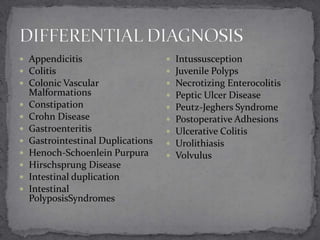
 Appendicitis
 Colitis
 Colonic Vascular









Malformations
Constipation
Crohn Disease
Gastroenteritis
Gastrointestinal Duplications
Henoch-Schoenlein Purpura
Hirschsprung Disease
Intestinal duplication
Intestinal
PolyposisSyndromes











Intussusception
Juvenile Polyps
Necrotizing Enterocolitis
Peptic Ulcer Disease
Peutz-Jeghers Syndrome
Postoperative Adhesions
Ulcerative Colitis
Urolithiasis
Volvulus
 Routine laboratory findings, including CBC count,

electrolyte levels, glucose test results, BUN levels,
creatinine levels, and coagulation screen results,
are not helpful in establishing the diagnosis of
Meckel diverticulum but are necessary to manage a
patient with GI bleeding along with a type and
cross.
 Hemoglobin and hematocrit levels are low in the
setting of anemia or bleeding.
 On BARIUM STUDIES, Meckel diverticulum may appear

as a blind-ending pouch on the antimesenteric side of the
distal ileum. If filling defects are visualized, the
diverticulum may contain a tumor.
 MECKEL SCAN is a more useful and specific

investigation.
 SMA angiogram may help in some patients
 Capsule Endoscopy may be useful in some cases.
 When a patient has GI bleeding suggestive of Meckel

diverticulum, the diagnostic evaluation should focus on
Meckel scanning, a technetium-99m pertechnetate
scintiscan
 The pertechnetate is taken up by gastric mucosa. Because
bleeding from the Meckel diverticulum is related to acid
induced damage of mucosa adjacent to the parietal cell
containing tissue, it is always included early in the workup.
 After intravenous injection of the isotope, the

gamma camera is used to scan the abdomen. This
procedure usually lasts approximately 30 minutes.
 Gastric mucosa secretes the radioactive isotope;
thus, if the diverticulum contains this ectopic
tissue, it is recognized as a hot spot.
 In children the Meckel scan has a reported
sensitivity of 80-90%, a specificity of 95% and an
accuracy of 90%.
 The emergency department evaluation and treatment of

patients depends on the clinical presentation of Meckel
diverticulum.
 Because most symptomatic patients are acutely ill,
establish an intravenous line immediately, start crystalloid
fluids, and keep the patient on nothing by mouth (NPO)
status. Obtain the blood investigations suggested above
with a type and cross match.If significant bleeding occurs,
perform a transfusion of packed red cells.
 Broad spectrum antibiotics should be started
 A patient who presents with intestinal obstruction usually
requires nasogastric decompression; also perform plain
radiography of the abdomen.
 Decision of further management depends on the

patient’s condition and clinical findings.
 If the patient is bleeding but is hemodynamically

stable, a Meckel scan is warranted.
 On the other hand, the presence of peritoneal signs or
hemodynamic instability demands urgent surgical
intervention. Signs of small bowel obstruction also
require surgical intervention.
 Four possible surgical procedures are as follows:
 Diverticulectomy with suture closure of the base
 Wedge resection of the intestinal wall containing the diverticulum

with suture closure
 Segmental resection of the intestine, including the diverticulum,
and end-to-end anastomosis
 Division of the fibrous band with or without diverticulectomy
 Adjacent ileum should be included in the resection because

ulcers frequently develop in the adjacent part of the ileum.

 Successful resection of a Meckel diverticulum, even in children

and infants, can also be accomplished through laparoscopy,
using an endoscopically designed autostapling device.
 Most surgeons prefer to leave a broad based and

asymptomtaic meckel diverticulum in situ as such,
assuming a 6% mortality rate from Meckel
diverticulum complications, 400 asymptomatic
diverticula would have to be excised to save one
patient
 Another faction favors prophylactic removal of a
diverticulum, which is a simple operation. This view is
supported by data that demonstrate that managing a
complication of Meckel diverticulum is associated
with high morbidity and mortality rates.
 Complicated Meckel diverticulum can lead to significant








morbidity and mortality, most often because of a delay in
diagnosis.
Causes of mortality include strangulation, perforation, and
exsanguination because of delay in resuscitation.
Once a complication arises and surgery is required, the
operative mortality and morbidity rates have both been
estimated at 12%.
If the Meckel diverticulum is removed as an incidental
finding, the risk of mortality and morbidity and long-term
complications are much less (1%, 2%, and 2%,
respectively).
As many as 5% of complicated Meckel diverticulum
contain malignant tissue.
Meckel’s diverticulum

Meckel’s diverticulum

  • 1.
    DR SYED FAHADALI ZAIDI RESIDENT SU II BBH
  • 3.
     Asma, D/Otanveer ,  12 years  female  CR No 7995  Resident of rawalpindi  Presented to ER  On 09-04-2012
  • 4.
     Presented toER with C/O  Pain abdomen 3 days  Constipation; 2 days  Vomiting 2 days Pain was initially mild and peri-umblical; later became generalized and severe. It was associated with nausea, anorexia and multiple episodes of vomiting. No associated history of fever, no h/O bleeding PR
  • 5.
     On examinationpatient had tachycardia, mild fever and she had generalized abdominal tenderness, and guarding, suggestive of peritonitis.  AXR erect showed free gas under diaphragm  Hb was 14, and TLC was 15900/mm3
  • 6.
     Patient wasresuscitated with wide bore IV lines, using crytalloids.  NG tube and foley’s catheter was passed.  After resuscitation she was shifted to COT for exploration
  • 7.
     SINGLE 2x2cm perforation in jejunum, in proximity of a diverticulum at anti-mesenteric border of the bowel.  Omentum was sealing the perforation  150-200 ml free fluid in the abdomen  Appendix secondarily inflammed.
  • 8.
     Resection ofperforated gut, and Primary closure, followed by appendectomy and abdominal lavage was done.  Diverticulum was left in situ as it was broad based  Abdomen was closed en mass with vicryl 1.
  • 9.
     Patient didnot have a smooth post op course, and pain abdomen , along with signs of toximea were present.  Wound had sero-sanguinous discharge, with early features of dehiscence  On 2nd post op day, an USG abdomen was done to rule out free fluid. No free fluid was reported.  On 4th post op day, a decision was made to re-explore the patient.
  • 10.
     OP FINDINGSshowed  A diverticulum in proximity of the anastomosis  A new perforation in the jejunum, 6 “ distal to previous anastomosis.  The diverticulum was excised, and perforation exteriorized as tube jejunostomy.  Post operatively patient remained stable
  • 11.
     A segmentof gut was resected in both laparotomies; histopathology specimen were sent to two different labs.  Both specimen reported presence of MECKEL’S DIVERTICULUM with gastric mucosa, and perforation
  • 12.
     Meckel diverticulum(also referred to as Meckel's Diverticulum) is the most common congenital abnormality of the small intestine; it is caused by an incomplete obliteration of the vitelline duct (ie, omphalomesenteric duct).  Although originally described by Fabricius Hildanus in 1598, it is named after Johann Friedrich Meckel, who established its embryonic origin in 1809.[1]
  • 13.
     Early inembryonic life, the fetal midgut receives its nutrition from the yolk sac via the vitelline duct. The duct then undergoes progressive narrowing and usually disappears by 7 weeks' gestation.  When the duct fails to fully obliterate, different types of vitelline duct anomalies appear.
  • 14.
     Examples ofsuch anomalies include 1) A persistent vitelline duct (appearing as a draining fistula at 2) 3) 4) 5) the umbilicus); A fibrous band that connects the ileum to the inner surface of the umbilicus; A patent vitelline sinus beneath the umbilicus A an obliterated bowel portion; A vitelline duct cyst; and, most commonly (97%)  Meckel diverticulum, which is a blind-ending true diverticulum that contains all of the layers normally found in the ileum.  The tip of the diverticulum is free in 75% of cases and is attached to the anterior abdominal wall or another structure in the remainder of cases.
  • 15.
     Meckel diverticulumoccurs on the antimesenteric border of the ileum, usually 40-60 cm proximal to the ileocecal valve.  On average, the diverticulum is 3 cm long and 2 cm wide. Slightly more than one half contain ectopic mucosa.  Meckel diverticulum is typically lined by ileal mucosa, but other tissue types are also found with varying frequency.
  • 16.
     The heterotopicmucosa is most commonly gastric. This is important because peptic ulceration of this or adjacent mucosa can lead to painless bleeding, perforation, or both.  Second most common heterotopic mucosa in meckel diverticulum is pancreatic  Rarely, colonic, rectal, endometrial, and hepatobiliary tissues have been noted.
  • 17.
     Found in2 % of population  Found at 2 feet proximal to ICJ in most cases  It is 2 inches long  Has two types of heterotopic mucosa  In pediatric group; presentation is common around 2 years of age
  • 18.
     Most patientsare asymptomatic. Meckel diverticulum is most frequently diagnosed as an incidental finding when a barium study or laparotomy is performed for other abdominal conditions.  Symptomatic Meckel diverticulum is virtually synonymous with a complication.  Patients can present with various clinical signs, including peritonitis or hypovolemic shock  The 3 most common symptomatic presentations are GI bleeding, intestinal obstruction, and acute inflammation of the diverticulum.
  • 19.
     In children,hematochezia is the most common presenting sign. Bleeding in adults is much less common.  Acute lower GI bleeding is secondary to hemorrhage from peptic ulceration. Such ulceration occurs when acid secreted by heterotopic gastric mucosa damages contiguous vulnerable tissue, often times resulting in direct erosion of a vessel.
  • 20.
     Intestinal obstructionis the most common complication in adults. Obstruction can be the result of various mechanisms. Omphalomesenteric band (most frequent cause) Internal hernia through vitelline duct remnants Volvulus occurring around vitelline duct remnants T-shaped prolapse of both efferent and afferent loops of intestine through a persistent vitelline duct fistula at the umbilicus in a neonate  Intussusception (when Meckel diverticulum itself acts as a lead point for an ileocolic or ileoileal intussusception)    
  • 21.
     Most patientswith intestinal obstruction present with abdominal pain, bilious vomiting, abdominal tenderness, distension, and hyperactive bowel sounds upon examination.  Patients may develop a palpable abdominal mass.  When patients do not present early or if the diagnosis is missed, the obstruction can progress to intestinal ischemia or infarction. The latter manifests with acute peritoneal signs and lower GI bleeding.
  • 22.
     Like otherdiverticula in the body, Meckel diverticulum can become inflamed. Diverticulitis is usually seen in older patients.  The clinical presentation includes abdominal pain in the peri-umbilical area that radiates to the right lower quadrant. Usually, abdominal tenderness is more marked in the periumbilical region than the pain of appendicitis.  Persistence of peri-umbilical pain or a history of bleeding per rectum may be helpful in distinguishing this entity from appendicitis.
  • 23.
     Clinical historyresembles that of perforated appendix.  Patient may present with peritonitis or shock  History of persistant abdominal pain and bleeding PR may help differentiate it from perf appendix.
  • 24.
     Appendicitis  Colitis Colonic Vascular         Malformations Constipation Crohn Disease Gastroenteritis Gastrointestinal Duplications Henoch-Schoenlein Purpura Hirschsprung Disease Intestinal duplication Intestinal PolyposisSyndromes          Intussusception Juvenile Polyps Necrotizing Enterocolitis Peptic Ulcer Disease Peutz-Jeghers Syndrome Postoperative Adhesions Ulcerative Colitis Urolithiasis Volvulus
  • 25.
     Routine laboratoryfindings, including CBC count, electrolyte levels, glucose test results, BUN levels, creatinine levels, and coagulation screen results, are not helpful in establishing the diagnosis of Meckel diverticulum but are necessary to manage a patient with GI bleeding along with a type and cross.  Hemoglobin and hematocrit levels are low in the setting of anemia or bleeding.
  • 26.
     On BARIUMSTUDIES, Meckel diverticulum may appear as a blind-ending pouch on the antimesenteric side of the distal ileum. If filling defects are visualized, the diverticulum may contain a tumor.  MECKEL SCAN is a more useful and specific investigation.  SMA angiogram may help in some patients  Capsule Endoscopy may be useful in some cases.
  • 27.
     When apatient has GI bleeding suggestive of Meckel diverticulum, the diagnostic evaluation should focus on Meckel scanning, a technetium-99m pertechnetate scintiscan  The pertechnetate is taken up by gastric mucosa. Because bleeding from the Meckel diverticulum is related to acid induced damage of mucosa adjacent to the parietal cell containing tissue, it is always included early in the workup.
  • 28.
     After intravenousinjection of the isotope, the gamma camera is used to scan the abdomen. This procedure usually lasts approximately 30 minutes.  Gastric mucosa secretes the radioactive isotope; thus, if the diverticulum contains this ectopic tissue, it is recognized as a hot spot.  In children the Meckel scan has a reported sensitivity of 80-90%, a specificity of 95% and an accuracy of 90%.
  • 29.
     The emergencydepartment evaluation and treatment of patients depends on the clinical presentation of Meckel diverticulum.  Because most symptomatic patients are acutely ill, establish an intravenous line immediately, start crystalloid fluids, and keep the patient on nothing by mouth (NPO) status. Obtain the blood investigations suggested above with a type and cross match.If significant bleeding occurs, perform a transfusion of packed red cells.  Broad spectrum antibiotics should be started  A patient who presents with intestinal obstruction usually requires nasogastric decompression; also perform plain radiography of the abdomen.
  • 30.
     Decision offurther management depends on the patient’s condition and clinical findings.  If the patient is bleeding but is hemodynamically stable, a Meckel scan is warranted.  On the other hand, the presence of peritoneal signs or hemodynamic instability demands urgent surgical intervention. Signs of small bowel obstruction also require surgical intervention.
  • 31.
     Four possiblesurgical procedures are as follows:  Diverticulectomy with suture closure of the base  Wedge resection of the intestinal wall containing the diverticulum with suture closure  Segmental resection of the intestine, including the diverticulum, and end-to-end anastomosis  Division of the fibrous band with or without diverticulectomy  Adjacent ileum should be included in the resection because ulcers frequently develop in the adjacent part of the ileum.  Successful resection of a Meckel diverticulum, even in children and infants, can also be accomplished through laparoscopy, using an endoscopically designed autostapling device.
  • 32.
     Most surgeonsprefer to leave a broad based and asymptomtaic meckel diverticulum in situ as such, assuming a 6% mortality rate from Meckel diverticulum complications, 400 asymptomatic diverticula would have to be excised to save one patient  Another faction favors prophylactic removal of a diverticulum, which is a simple operation. This view is supported by data that demonstrate that managing a complication of Meckel diverticulum is associated with high morbidity and mortality rates.
  • 33.
     Complicated Meckeldiverticulum can lead to significant     morbidity and mortality, most often because of a delay in diagnosis. Causes of mortality include strangulation, perforation, and exsanguination because of delay in resuscitation. Once a complication arises and surgery is required, the operative mortality and morbidity rates have both been estimated at 12%. If the Meckel diverticulum is removed as an incidental finding, the risk of mortality and morbidity and long-term complications are much less (1%, 2%, and 2%, respectively). As many as 5% of complicated Meckel diverticulum contain malignant tissue.