Meckel diverticulum
Basic description
• Congenital abnormality of small intestine
resulting from persistence of
omphalomesenteric duct (vitelline duct)
• It is true diverticulum ( containing al three
layers of bowel wall )
Omphalomesentric duct
anomalies
• Vitelline duct or omphalomesenteric duct
anomalies are secondary to the persistence of
the embryonic vitelline duct, which
normallyobliterates by weeks 5–9 of
intrauterine life
• Meckel’s diverticulum is the most common
vitelline duct anomaly
Embryology
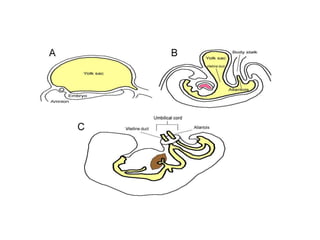
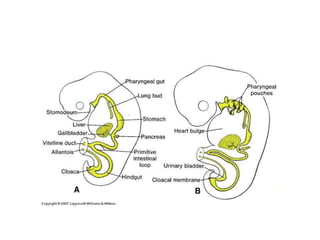
During week 3 of gestation, the midgut is open
into the yolk sac, which does not grow as
rapidly as the rest of the embryo.
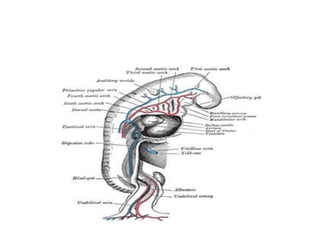
Subsequently, by week 5, the connection with
the yolk sac becomes narrowed and is then
termed a yolk stalk, vitelline duct, or
omphalomesenteric duct. Normally, the
vitelline duct disappears by gestational week
9, just before the midgut returns to the
abdomen
Important point
• Meckel diverticulum ( rule of two)
• Occur in 2% of poulation
• 2 inch long
• 2 feet from ileocecal valve
• In child younger than age2
• 2 type of tissue ( ectopic stomach or
pancerase )
• not attached to the abdominal wall
but it is one of the most unlikely to cause
symptoms. About 4% of children with a
Meckel’s diverticulum develop symptoms, and
more than 60% of those who develop
symptoms are younger than 2 years of age.2–
5 The male-to-female complication rate ratio
is about 3:1
Pathophyisology
• Most complications of these abnormalities are
related to ectopic tissue (gastric, pancreatic,
colonic, endometriosis, or hepatobiliary) . Ectopic
gastric tissue usually causes bleeding from
ulceration of the adjacent ileal mucosa. The ileal
mucosa is not equipped to buffer the acid
produced by the ectopic gastric mucosa and thus
is prone to ulceration. ulceration. The site of the
ulceration is most often at the junction of the
normal ileal mucosa and the ectopic gastric mucosa
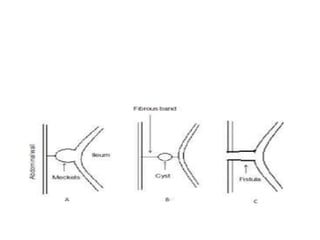
• Intestinal obstruction may be caused by a
Meckel’s diverticulum attached to the
umbilicus by a fibrous cord or by a fibrous
cord betweenthe ileum and the umbilicusand
can also occur by intussusception with the
diverticulum
Complications of Meckel Diverticulum
• Ulceration
• Hemorrhage
• Small bowel obstruction
• Diverticulitis
• Perforation
Clinical Presentation
• The classic presentation is an older infant or
young child with painless rectal bleeding (This
usually consists of a large volume of bright red
bleeding but can occasionally also present as
dark, tarry stools)
• Melena may be episodic and usually ceases
without treatment; sometimes the melena is
insidious and not appreciated by the family. In a
young child with haemoglobin positive stools and
a chronic iron deficiency anaemia, the diagnosis
of Meckel’s diverticulum should be considered
• Intestinal obstruction, usually due to
intussusception, is the most typical
presentation in newborns and infants. The
symptoms include crampy abdominal pain,
bilious vomiting, currant-jelly stools, and
abdominaldistention
• intestinal ischaemia, such as acidosis,
peritonitis, and shock, may occur first, and can
be fatal in infants.
• Patients with Meckel’s diverticulitis often have
symptoms that resemble appendicitis. They
are usually older children. Periumbilical pain is
the first symptom. They usually do not have
the same amount or intensity of vomiting and
nausea
Diagnosis
• Diagnosis of a symptomatic vitelline duct
malformation is dependent on the anatomic
configuration and its presentation, signs, and
symptoms. History and physical examination are
important for the diagnosis
• A complete description of the quality and
frequency of the bloodystools is necessary in
patients with rectal bleeding. Rectal examination
and lower endoscopy is useful to identify other
causes of lower bleeding
• The test of choice for a bleeding Meckel’s
diverticulum is a (Meckelscan), which
concentrates the isotope in ectopic gastric
mucosa
• If obstruction from either intussusception or
volvulus is suspected, plain x-rays may reveal
dilated bowel loops and multiple air-fluid
levels.
Treatment
• Symptomatic children with
omphalomesenteric duct remnants should
be resuscitated before intervention. Those with
significant haemorrhageshould be transfused
• The incision chosen varies with the symptoms
and the age of the patient
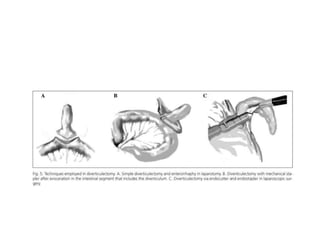
Surgical treatment
• Children with Meckel’s diverticulitis or a
bleeding Meckel’s diverticulum are operated
on by using a transverse appendectomy
incision with medial extension if necessary.
Patients with suspected intestinal obstruction
should be explored through a generous
laparotomy incision.
Meckel diverticulum

Meckel diverticulum

  • 1.
  • 2.
    Basic description • Congenitalabnormality of small intestine resulting from persistence of omphalomesenteric duct (vitelline duct) • It is true diverticulum ( containing al three layers of bowel wall )
  • 3.
    Omphalomesentric duct anomalies • Vitellineduct or omphalomesenteric duct anomalies are secondary to the persistence of the embryonic vitelline duct, which normallyobliterates by weeks 5–9 of intrauterine life • Meckel’s diverticulum is the most common vitelline duct anomaly
  • 4.
    Embryology During week 3of gestation, the midgut is open into the yolk sac, which does not grow as rapidly as the rest of the embryo. Subsequently, by week 5, the connection with the yolk sac becomes narrowed and is then termed a yolk stalk, vitelline duct, or omphalomesenteric duct. Normally, the vitelline duct disappears by gestational week 9, just before the midgut returns to the abdomen
  • 9.
    Important point • Meckeldiverticulum ( rule of two) • Occur in 2% of poulation • 2 inch long • 2 feet from ileocecal valve • In child younger than age2 • 2 type of tissue ( ectopic stomach or pancerase ) • not attached to the abdominal wall
  • 10.
    but it isone of the most unlikely to cause symptoms. About 4% of children with a Meckel’s diverticulum develop symptoms, and more than 60% of those who develop symptoms are younger than 2 years of age.2– 5 The male-to-female complication rate ratio is about 3:1
  • 11.
    Pathophyisology • Most complicationsof these abnormalities are related to ectopic tissue (gastric, pancreatic, colonic, endometriosis, or hepatobiliary) . Ectopic gastric tissue usually causes bleeding from ulceration of the adjacent ileal mucosa. The ileal mucosa is not equipped to buffer the acid produced by the ectopic gastric mucosa and thus is prone to ulceration. ulceration. The site of the ulceration is most often at the junction of the normal ileal mucosa and the ectopic gastric mucosa
  • 12.
    • Intestinal obstructionmay be caused by a Meckel’s diverticulum attached to the umbilicus by a fibrous cord or by a fibrous cord betweenthe ileum and the umbilicusand can also occur by intussusception with the diverticulum
  • 13.
    Complications of MeckelDiverticulum • Ulceration • Hemorrhage • Small bowel obstruction • Diverticulitis • Perforation
  • 14.
    Clinical Presentation • Theclassic presentation is an older infant or young child with painless rectal bleeding (This usually consists of a large volume of bright red bleeding but can occasionally also present as dark, tarry stools) • Melena may be episodic and usually ceases without treatment; sometimes the melena is insidious and not appreciated by the family. In a young child with haemoglobin positive stools and a chronic iron deficiency anaemia, the diagnosis of Meckel’s diverticulum should be considered
  • 15.
    • Intestinal obstruction,usually due to intussusception, is the most typical presentation in newborns and infants. The symptoms include crampy abdominal pain, bilious vomiting, currant-jelly stools, and abdominaldistention
  • 16.
    • intestinal ischaemia,such as acidosis, peritonitis, and shock, may occur first, and can be fatal in infants.
  • 17.
    • Patients withMeckel’s diverticulitis often have symptoms that resemble appendicitis. They are usually older children. Periumbilical pain is the first symptom. They usually do not have the same amount or intensity of vomiting and nausea
  • 18.
    Diagnosis • Diagnosis ofa symptomatic vitelline duct malformation is dependent on the anatomic configuration and its presentation, signs, and symptoms. History and physical examination are important for the diagnosis • A complete description of the quality and frequency of the bloodystools is necessary in patients with rectal bleeding. Rectal examination and lower endoscopy is useful to identify other causes of lower bleeding
  • 19.
    • The testof choice for a bleeding Meckel’s diverticulum is a (Meckelscan), which concentrates the isotope in ectopic gastric mucosa
  • 20.
    • If obstructionfrom either intussusception or volvulus is suspected, plain x-rays may reveal dilated bowel loops and multiple air-fluid levels.
  • 21.
    Treatment • Symptomatic childrenwith omphalomesenteric duct remnants should be resuscitated before intervention. Those with significant haemorrhageshould be transfused • The incision chosen varies with the symptoms and the age of the patient
  • 22.
    Surgical treatment • Childrenwith Meckel’s diverticulitis or a bleeding Meckel’s diverticulum are operated on by using a transverse appendectomy incision with medial extension if necessary. Patients with suspected intestinal obstruction should be explored through a generous laparotomy incision.