Dr. R. T. Patil
Ex-Director CIPHET & Chairman
Benevole Welfare Society for Post Harvest
Technology, Bhopal (MP)
Mechanization of Post Harvest
Operations in Horticultural Crops
Production & Post Harvest Scenario
•Agriculture contributes about 15% of GDP,
employs 57 % workforce and sustains approx
over 65 % of the population
•India produces about 265+million tons of food
grains and more than 280+million tons of fruits
and vegetables and ranks second in world
•Low level of processing of fruits and vegetables
and hence losses range from 6 - 18 %.
•Food processing is employment intensive,
creates 1.8 jobs directly and 6.4 indirectly for
every Rs. 10 lakh investment
Agro Processing in
Production Catchment
1. Can provide processed food of highest quality at
affordable cost to consumers
2. Help environment by processing food in production
catchment with least food miles
3. Ensure traceability of raw materials used for processed
product hence great for export and elite urban market.
4. Help effective backward linkage with farmers for
processing their raw produce
5. Shorten the supply chain, increase the profitability of
farmers and ultimately increase in GDP from agriculture
and reduce poverty
6. Reduce post harvest losses and increased availability of
by products for further processing.
Unit Operations in Post Harvest
Management
• Pre harvest Treatment
• Harvesting at Proper Maturity
• Safe Harvesting
• Sorting/Grading
• Pre cooling and Washing
• Cool/Cold Storage
• Safe Handling/Packaging
• Safe Transport
• Value Addition
Covering Banana
Bunch
• They protect the skin of the
fruit against leaf, insect and
bird damage as the fruit
matures.
• With use of the bunch
covers fruit size is more
uniform and larger
throughout the bunch.
• Bunch covers can increase
yields by 5-25 %.
• Bigger individual bananas
or plantains with less skin
damage means a better
market price and higher
profit.
Harvesting at Maturity - Maturity of
Mango in Tree
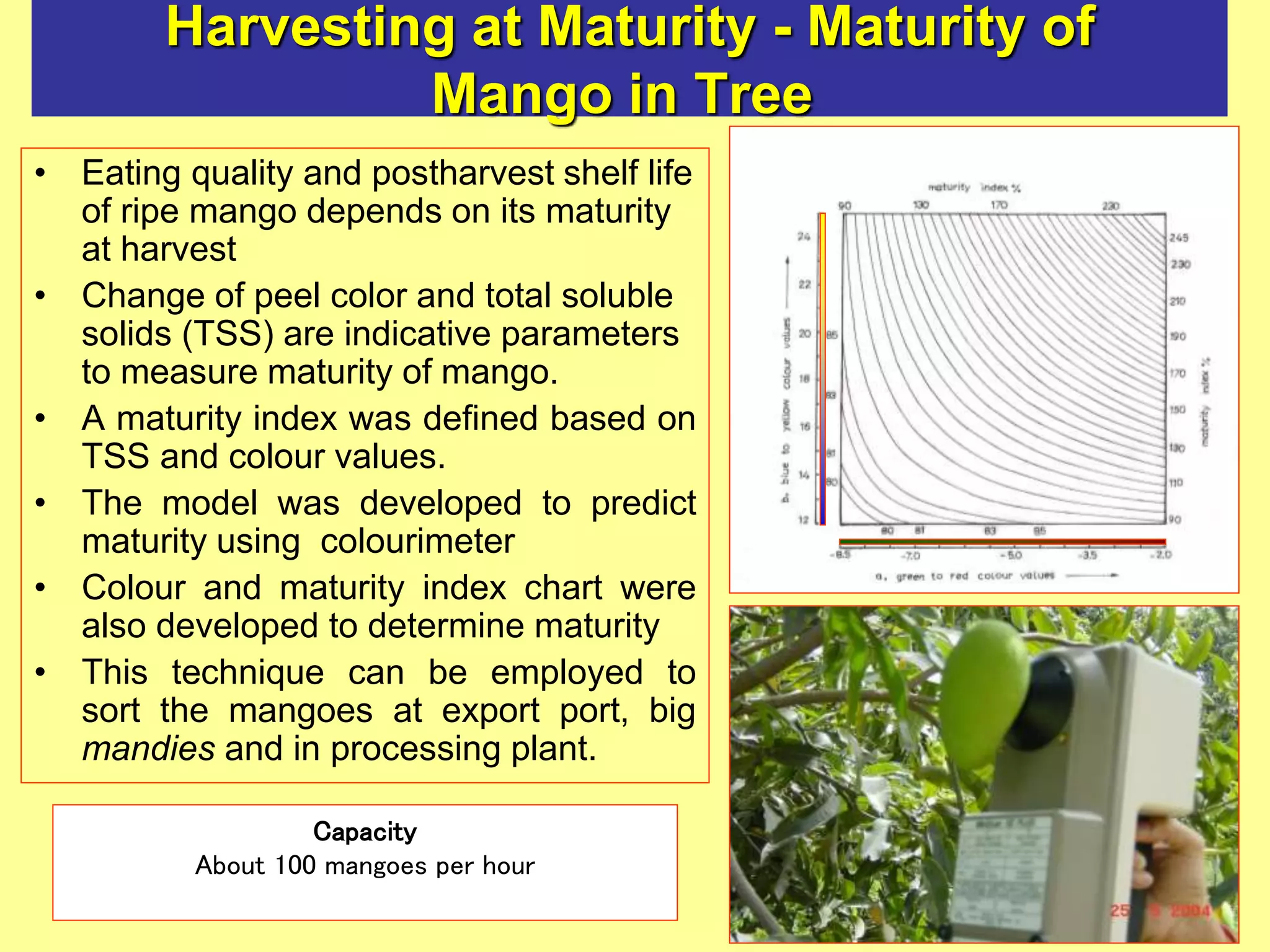
• Eating quality and postharvest shelf life
of ripe mango depends on its maturity
at harvest
• Change of peel color and total soluble
solids (TSS) are indicative parameters
to measure maturity of mango.
• A maturity index was defined based on
TSS and colour values.
• The model was developed to predict
maturity using colourimeter
• Colour and maturity index chart were
also developed to determine maturity
• This technique can be employed to
sort the mangoes at export port, big
mandies and in processing plant.
Capacity
About 100 mangoes per hour
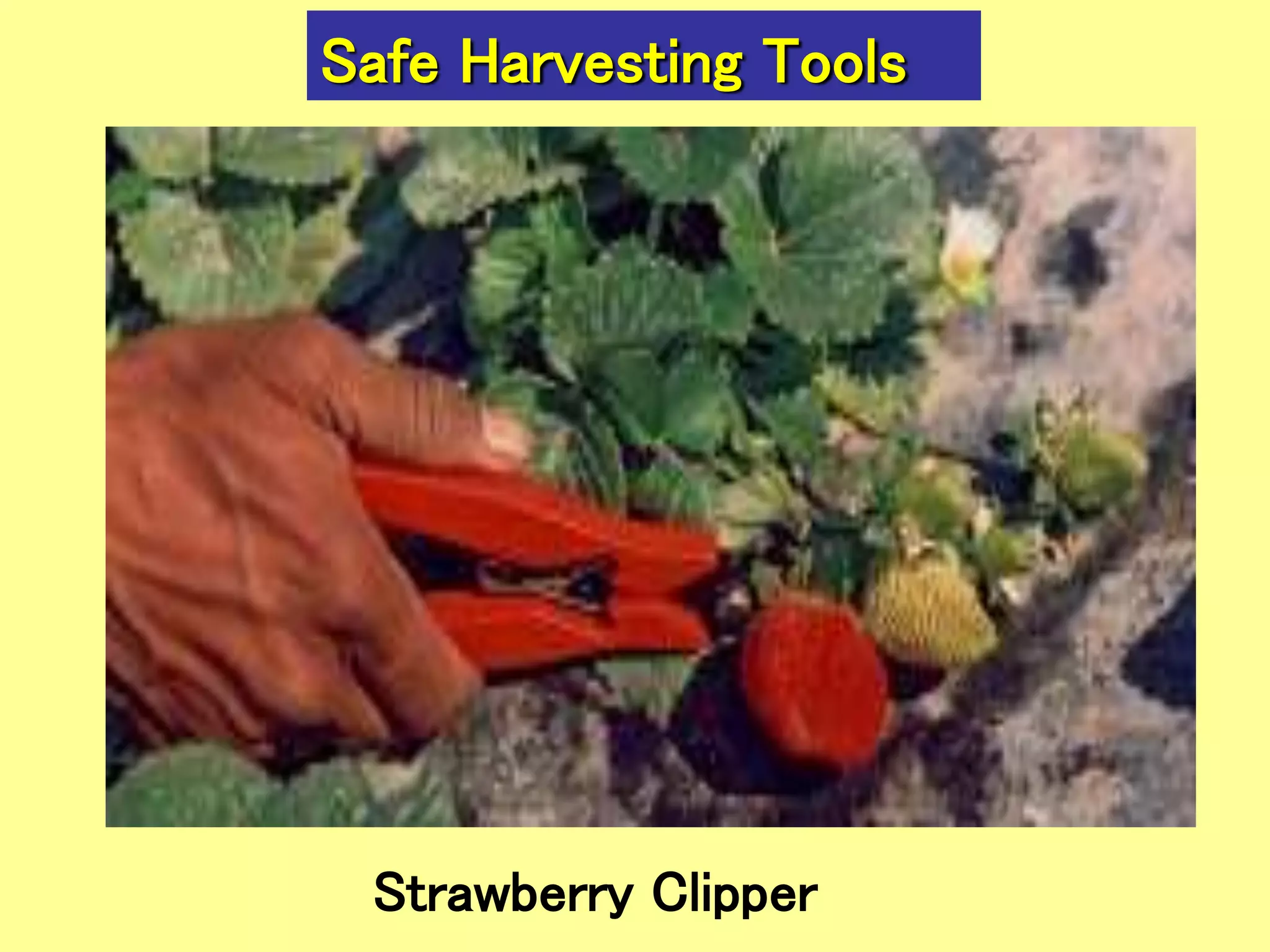
Strawberry Clipper
Safe Harvesting Tools
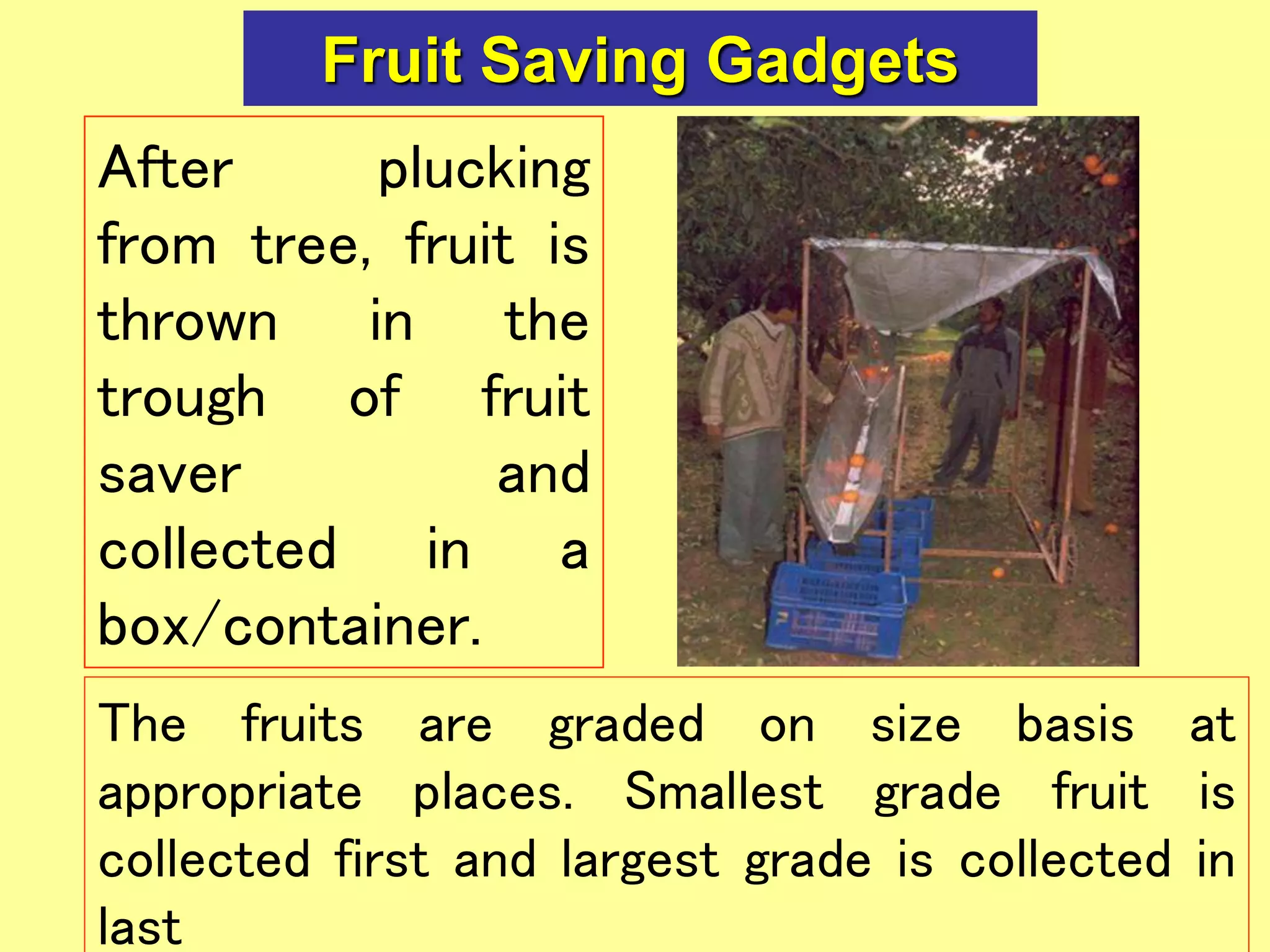
Fruit Saving Gadgets
After plucking
from tree, fruit is
thrown in the
trough of fruit
saver and
collected in a
box/container.
The fruits are graded on size basis at
appropriate places. Smallest grade fruit is
collected first and largest grade is collected in
last
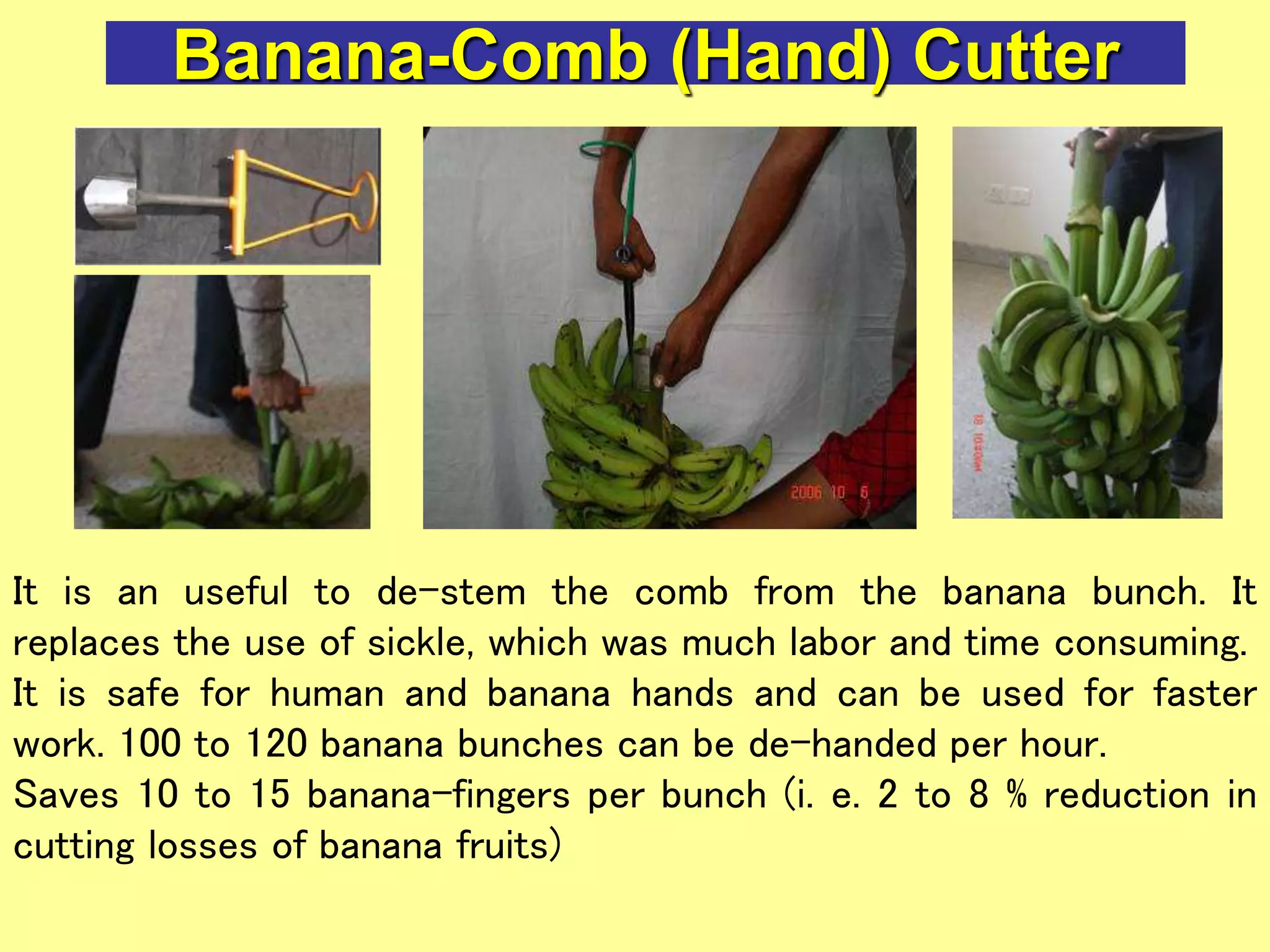
Banana-Comb (Hand) Cutter
It is an useful to de-stem the comb from the banana bunch. It
replaces the use of sickle, which was much labor and time consuming.
It is safe for human and banana hands and can be used for faster
work. 100 to 120 banana bunches can be de-handed per hour.
Saves 10 to 15 banana-fingers per bunch (i. e. 2 to 8 % reduction in
cutting losses of banana fruits)
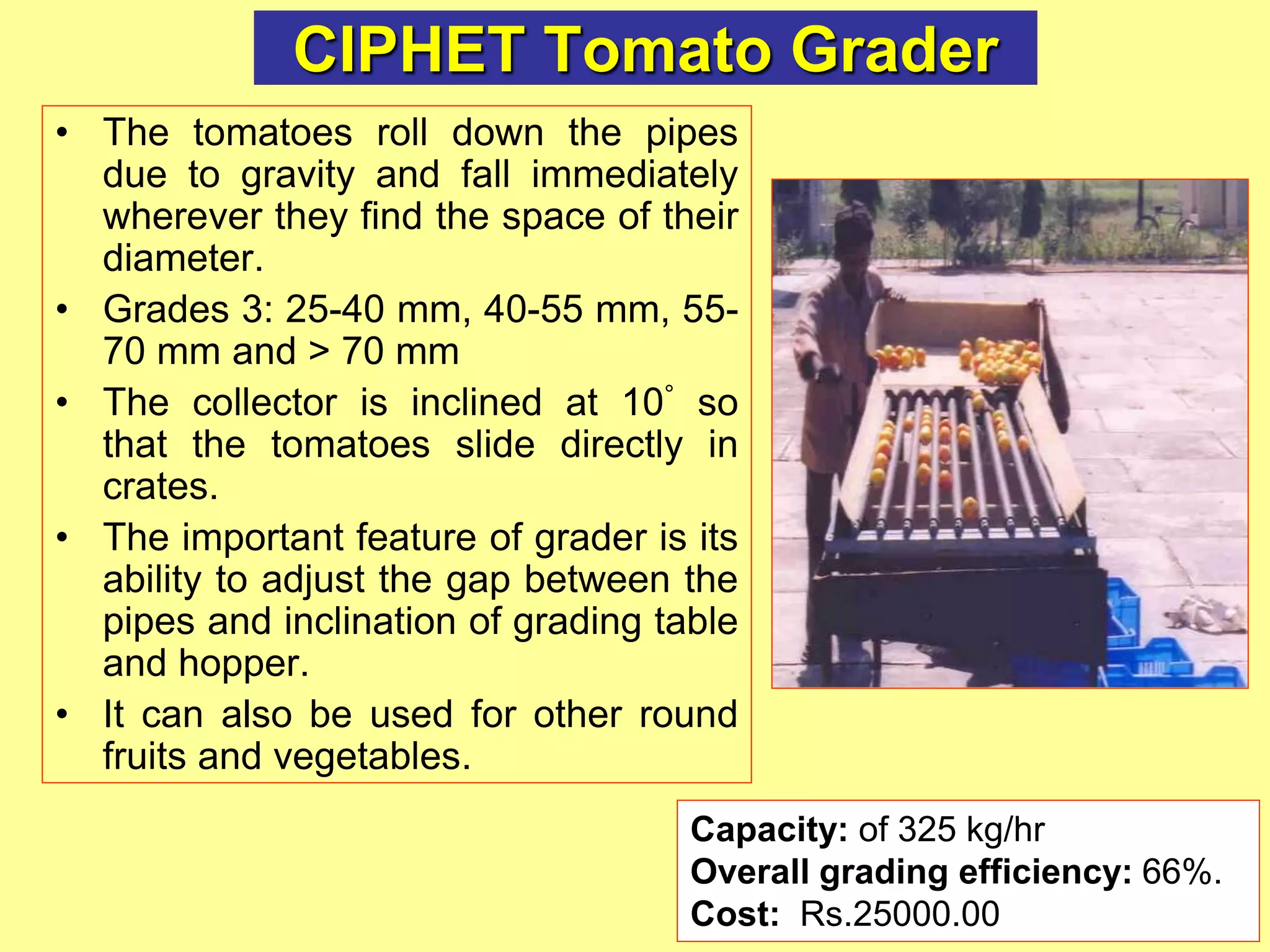
CIPHET Tomato Grader
• The tomatoes roll down the pipes
due to gravity and fall immediately
wherever they find the space of their
diameter.
• Grades 3: 25-40 mm, 40-55 mm, 55-
70 mm and > 70 mm
• The collector is inclined at 10° so
that the tomatoes slide directly in
crates.
• The important feature of grader is its
ability to adjust the gap between the
pipes and inclination of grading table
and hopper.
• It can also be used for other round
fruits and vegetables.
Capacity: of 325 kg/hr
Overall grading efficiency: 66%.
Cost: Rs.25000.00
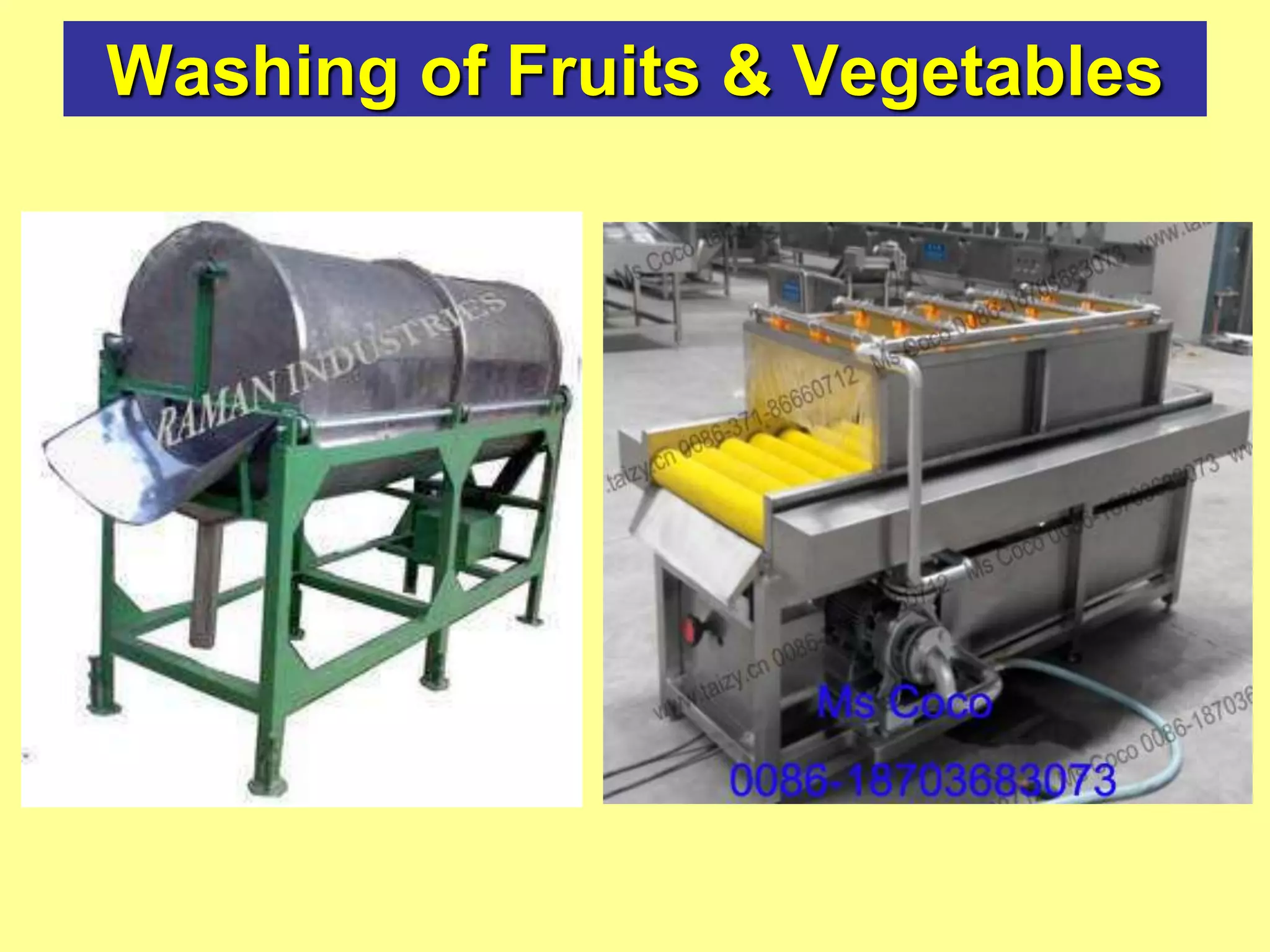
Washing of Fruits & Vegetables
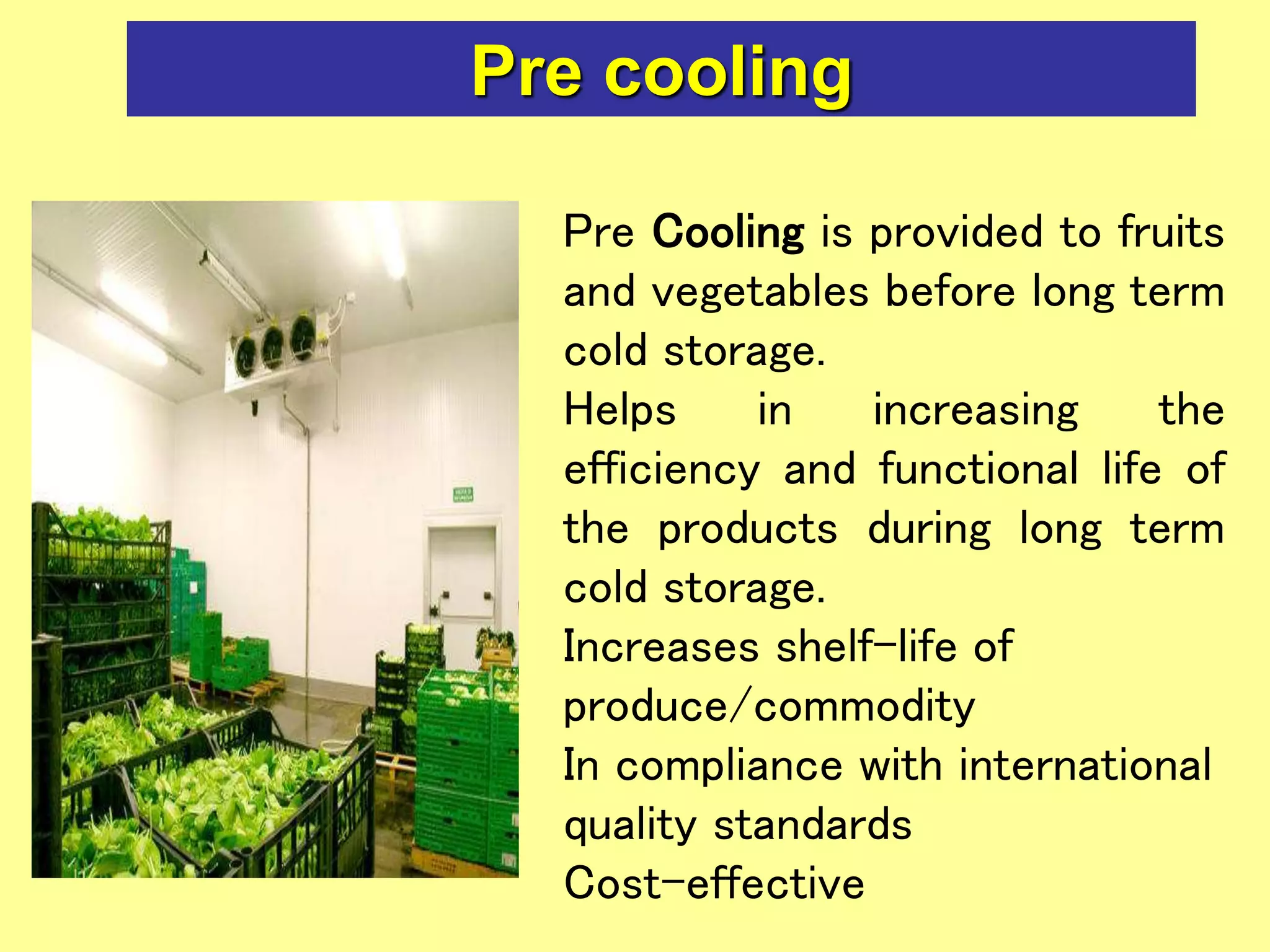
Pre cooling
Pre Cooling is provided to fruits
and vegetables before long term
cold storage.
Helps in increasing the
efficiency and functional life of
the products during long term
cold storage.
Increases shelf-life of
produce/commodity
In compliance with international
quality standards
Cost-effective
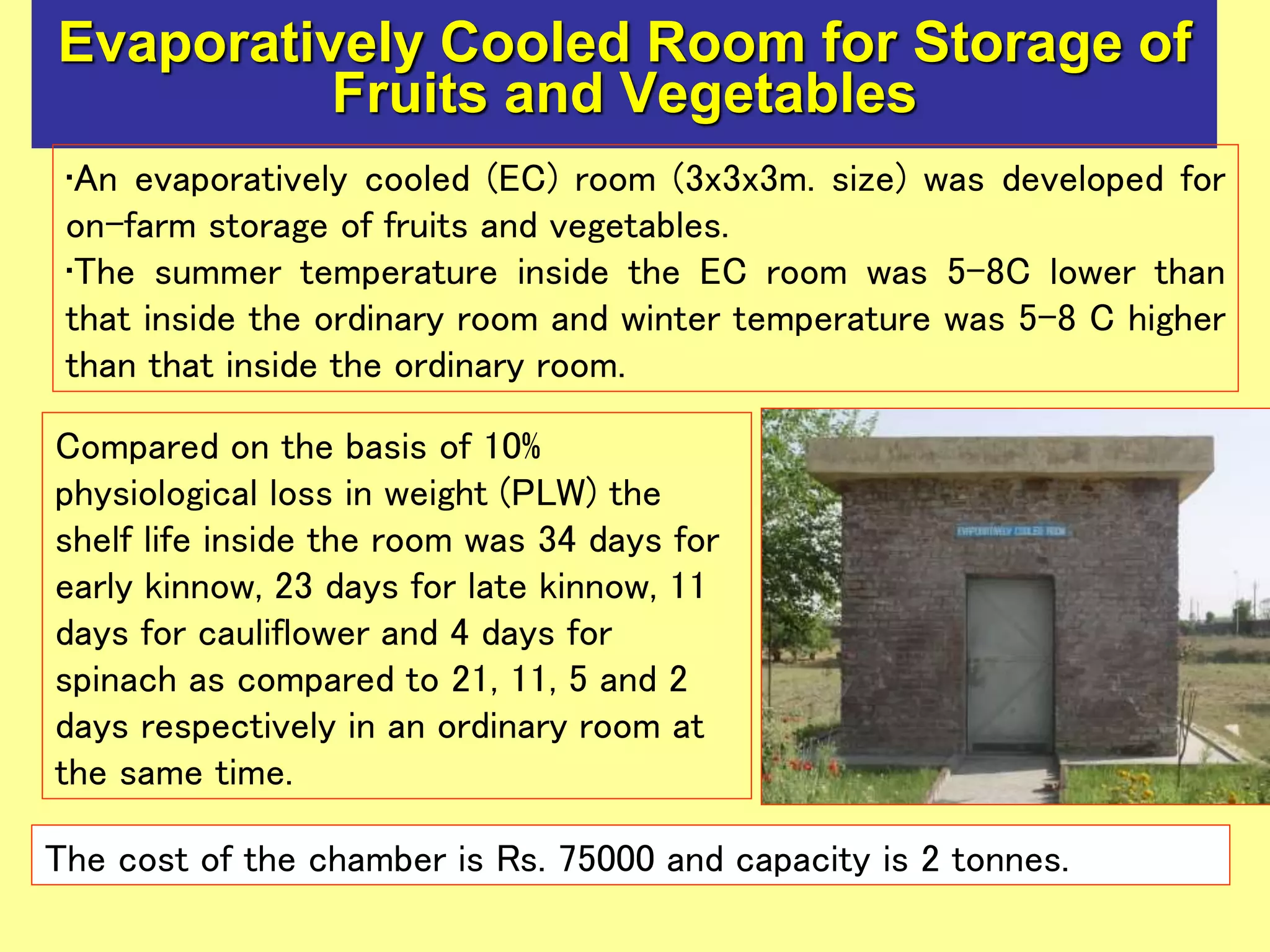
Evaporatively Cooled Room for Storage of
Fruits and Vegetables
Compared on the basis of 10%
physiological loss in weight (PLW) the
shelf life inside the room was 34 days for
early kinnow, 23 days for late kinnow, 11
days for cauliflower and 4 days for
spinach as compared to 21, 11, 5 and 2
days respectively in an ordinary room at
the same time.
The cost of the chamber is Rs. 75000 and capacity is 2 tonnes.
•An evaporatively cooled (EC) room (3x3x3m. size) was developed for
on-farm storage of fruits and vegetables.
•The summer temperature inside the EC room was 5-8C lower than
that inside the ordinary room and winter temperature was 5-8 C higher
than that inside the ordinary room.
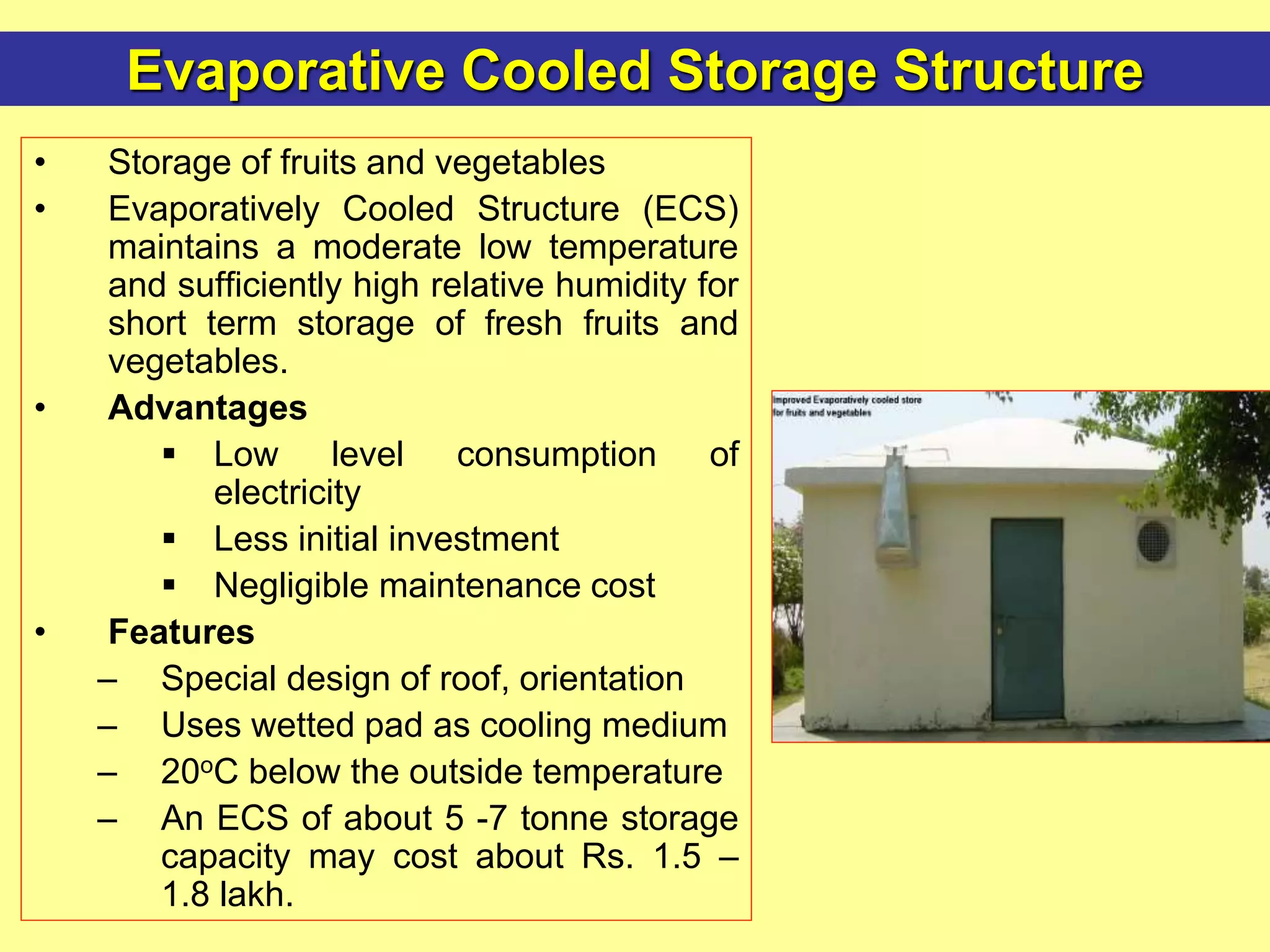
Evaporative Cooled Storage Structure
• Storage of fruits and vegetables
• Evaporatively Cooled Structure (ECS)
maintains a moderate low temperature
and sufficiently high relative humidity for
short term storage of fresh fruits and
vegetables.
• Advantages
 Low level consumption of
electricity
 Less initial investment
 Negligible maintenance cost
• Features
– Special design of roof, orientation
– Uses wetted pad as cooling medium
– 20oC below the outside temperature
– An ECS of about 5 -7 tonne storage
capacity may cost about Rs. 1.5 –
1.8 lakh.
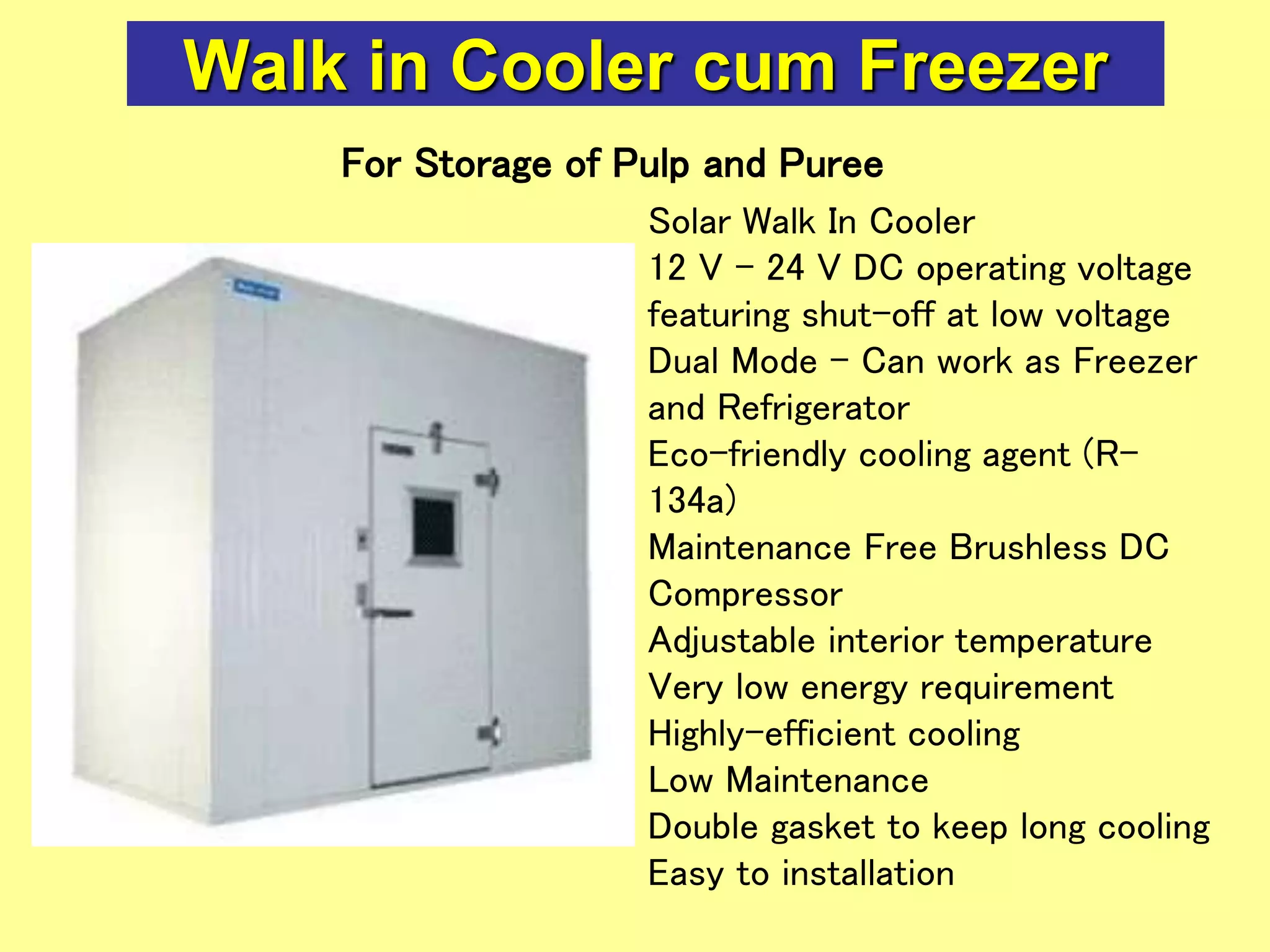
Walk in Cooler cum Freezer
Solar Walk In Cooler
12 V - 24 V DC operating voltage
featuring shut-off at low voltage
Dual Mode - Can work as Freezer
and Refrigerator
Eco-friendly cooling agent (R-
134a)
Maintenance Free Brushless DC
Compressor
Adjustable interior temperature
Very low energy requirement
Highly-efficient cooling
Low Maintenance
Double gasket to keep long cooling
Easy to installation
For Storage of Pulp and Puree
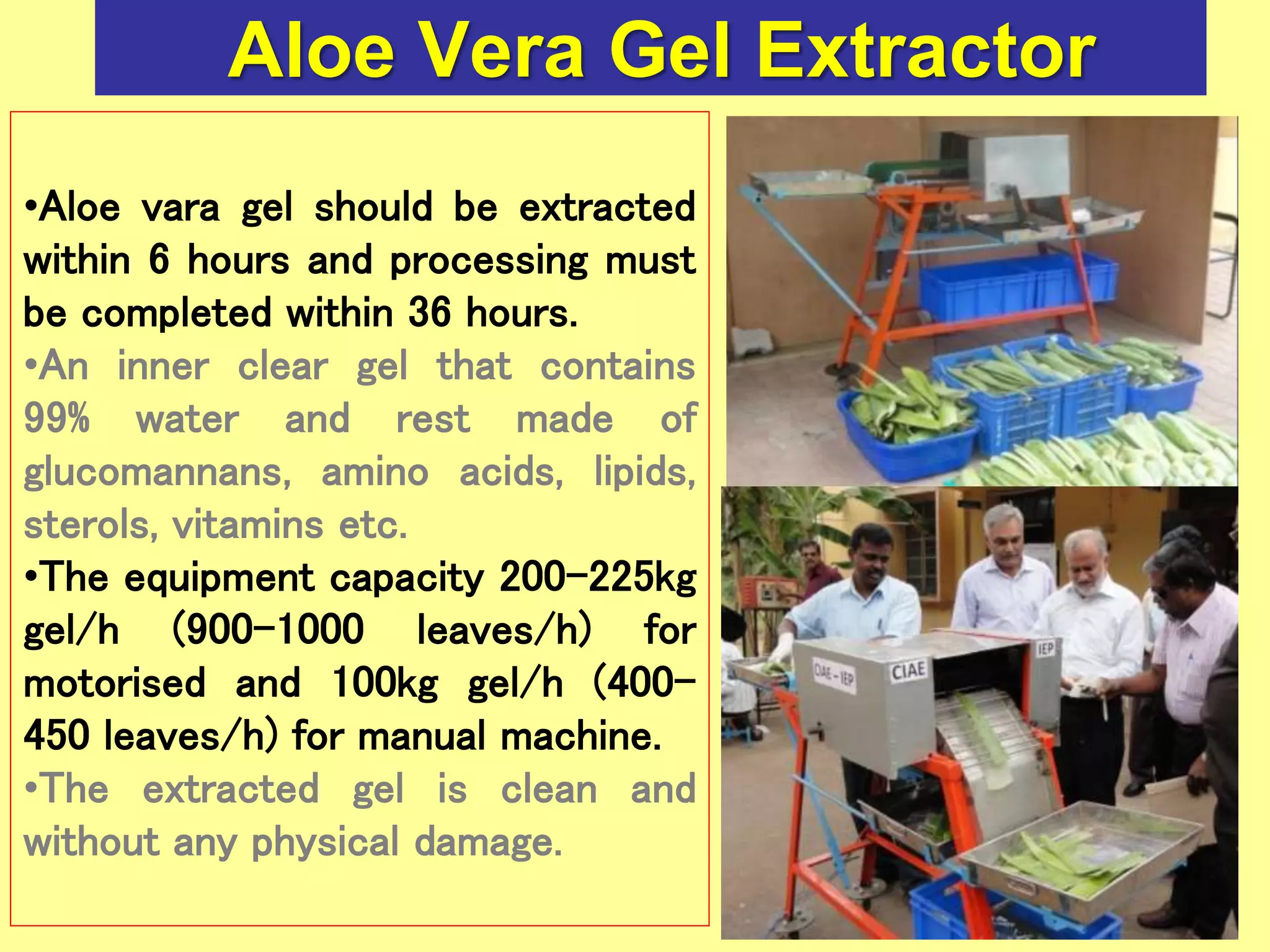
Aloe Vera Gel Extractor
•Aloe vara gel should be extracted
within 6 hours and processing must
be completed within 36 hours.
•An inner clear gel that contains
99% water and rest made of
glucomannans, amino acids, lipids,
sterols, vitamins etc.
•The equipment capacity 200-225kg
gel/h (900-1000 leaves/h) for
motorised and 100kg gel/h (400-
450 leaves/h) for manual machine.
•The extracted gel is clean and
without any physical damage.
Heat Pump Dryer for High Value
Products
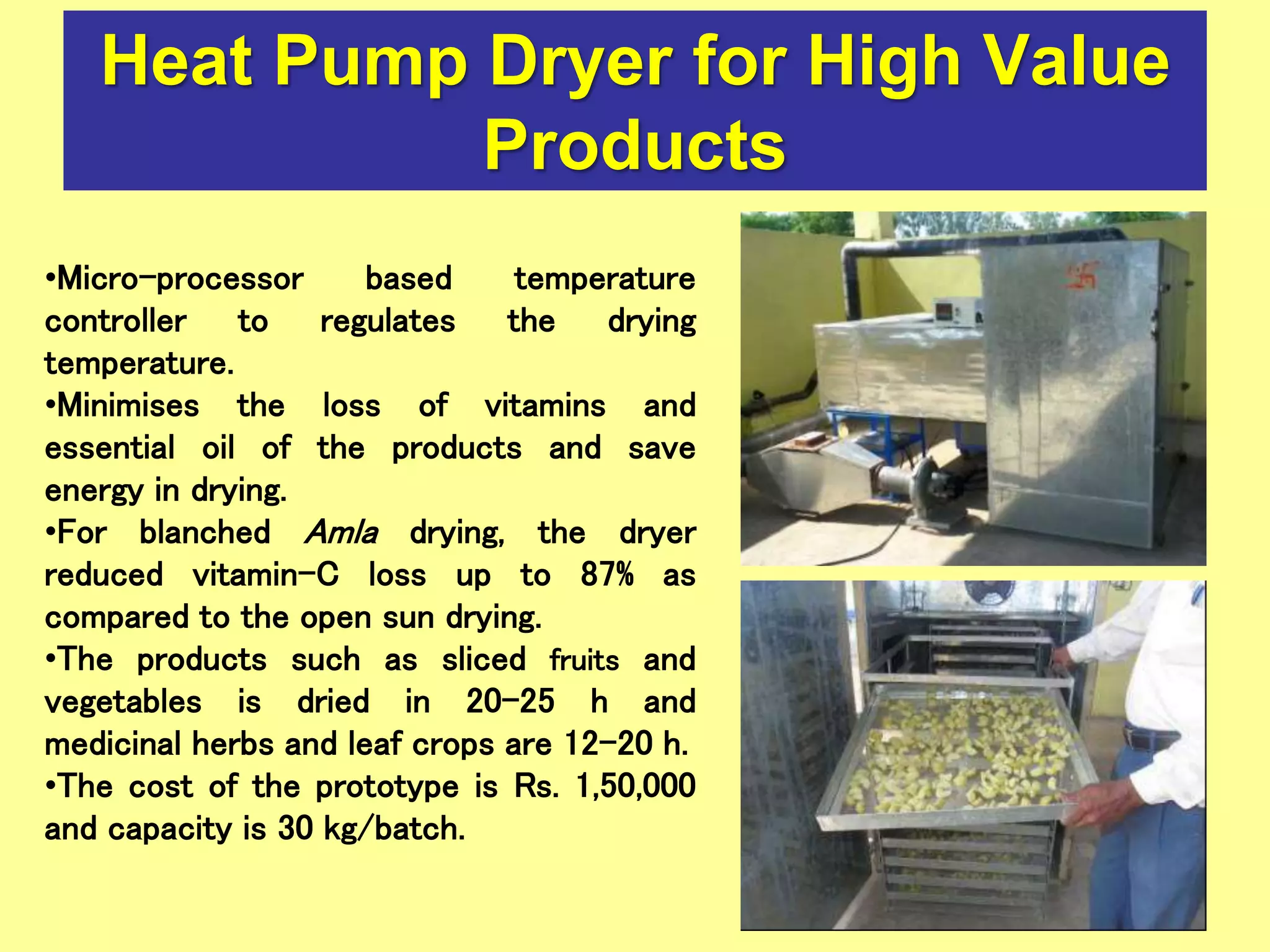
•Micro-processor based temperature
controller to regulates the drying
temperature.
•Minimises the loss of vitamins and
essential oil of the products and save
energy in drying.
•For blanched Amla drying, the dryer
reduced vitamin-C loss up to 87% as
compared to the open sun drying.
•The products such as sliced fruits and
vegetables is dried in 20-25 h and
medicinal herbs and leaf crops are 12-20 h.
•The cost of the prototype is Rs. 1,50,000
and capacity is 30 kg/batch.
Sitaphal Peeling Machine
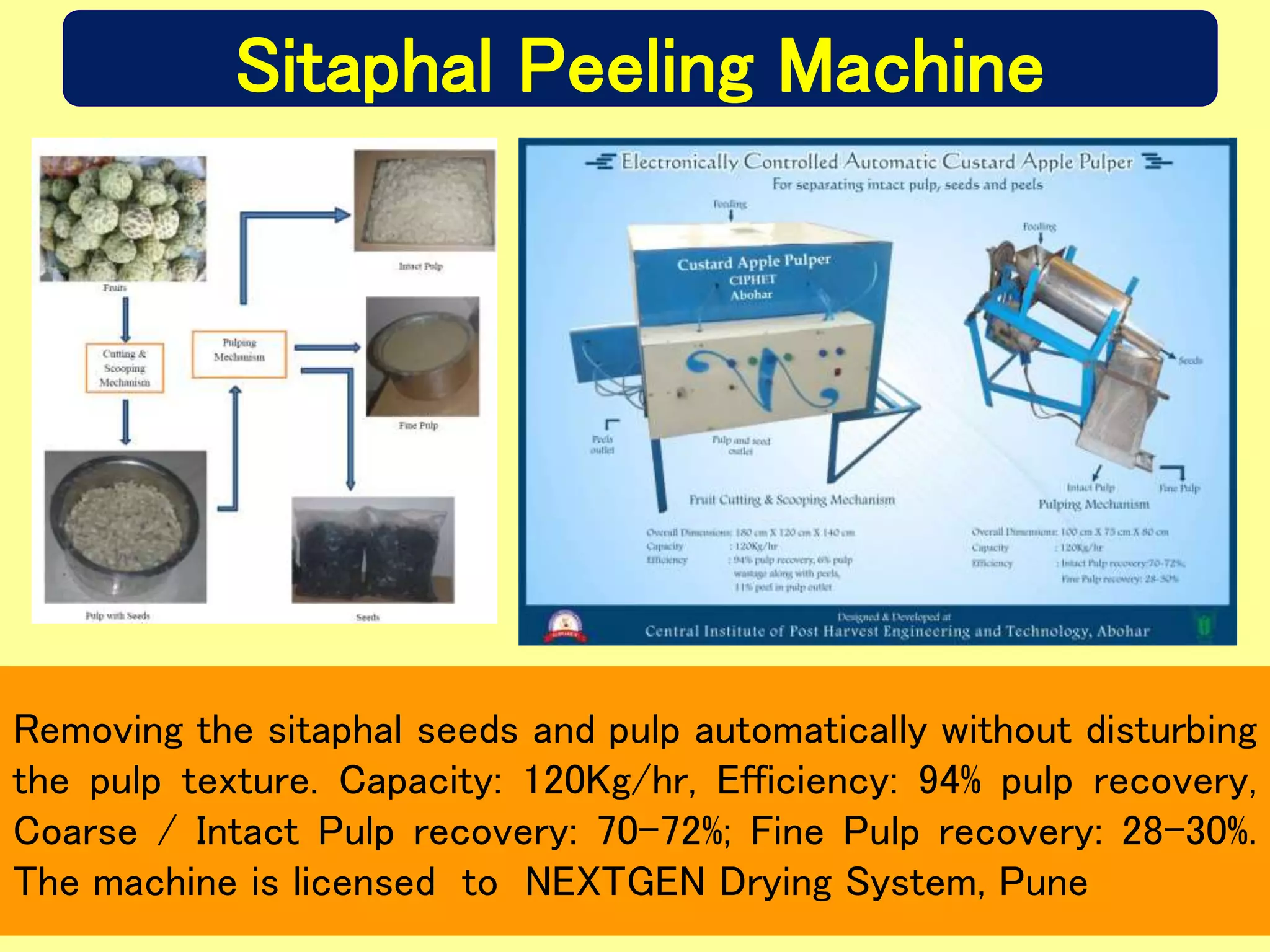
Removing the sitaphal seeds and pulp automatically without disturbing
the pulp texture. Capacity: 120Kg/hr, Efficiency: 94% pulp recovery,
Coarse / Intact Pulp recovery: 70-72%; Fine Pulp recovery: 28-30%.
The machine is licensed to NEXTGEN Drying System, Pune
Small Composite Unit for
Tomato Puree and Fruit Pulp
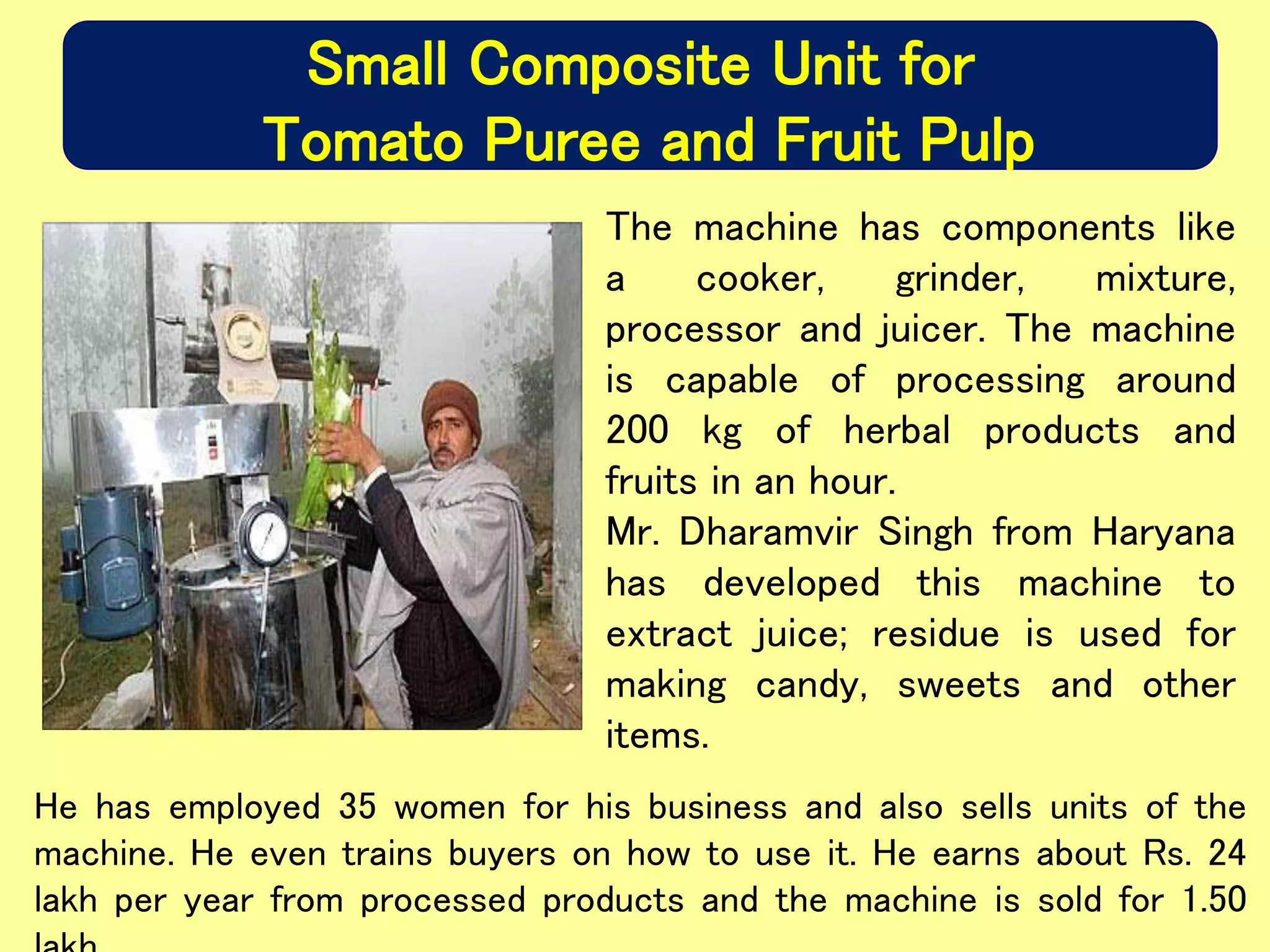
The machine has components like
a cooker, grinder, mixture,
processor and juicer. The machine
is capable of processing around
200 kg of herbal products and
fruits in an hour.
Mr. Dharamvir Singh from Haryana
has developed this machine to
extract juice; residue is used for
making candy, sweets and other
items.
He has employed 35 women for his business and also sells units of the
machine. He even trains buyers on how to use it. He earns about Rs. 24
lakh per year from processed products and the machine is sold for 1.50
Technology
Packages
Minimal Processing of Vegetables
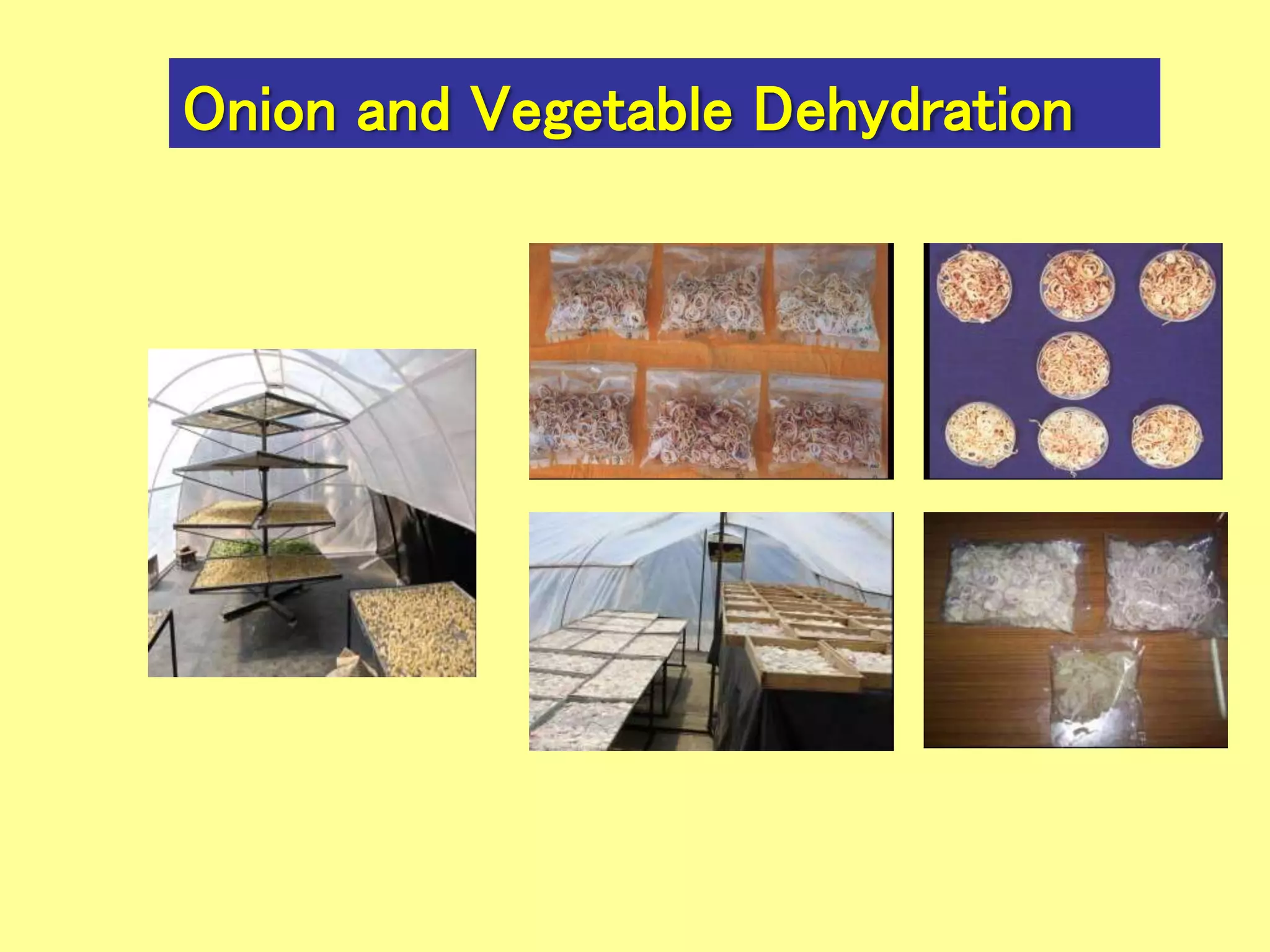
Onion and Vegetable Dehydration
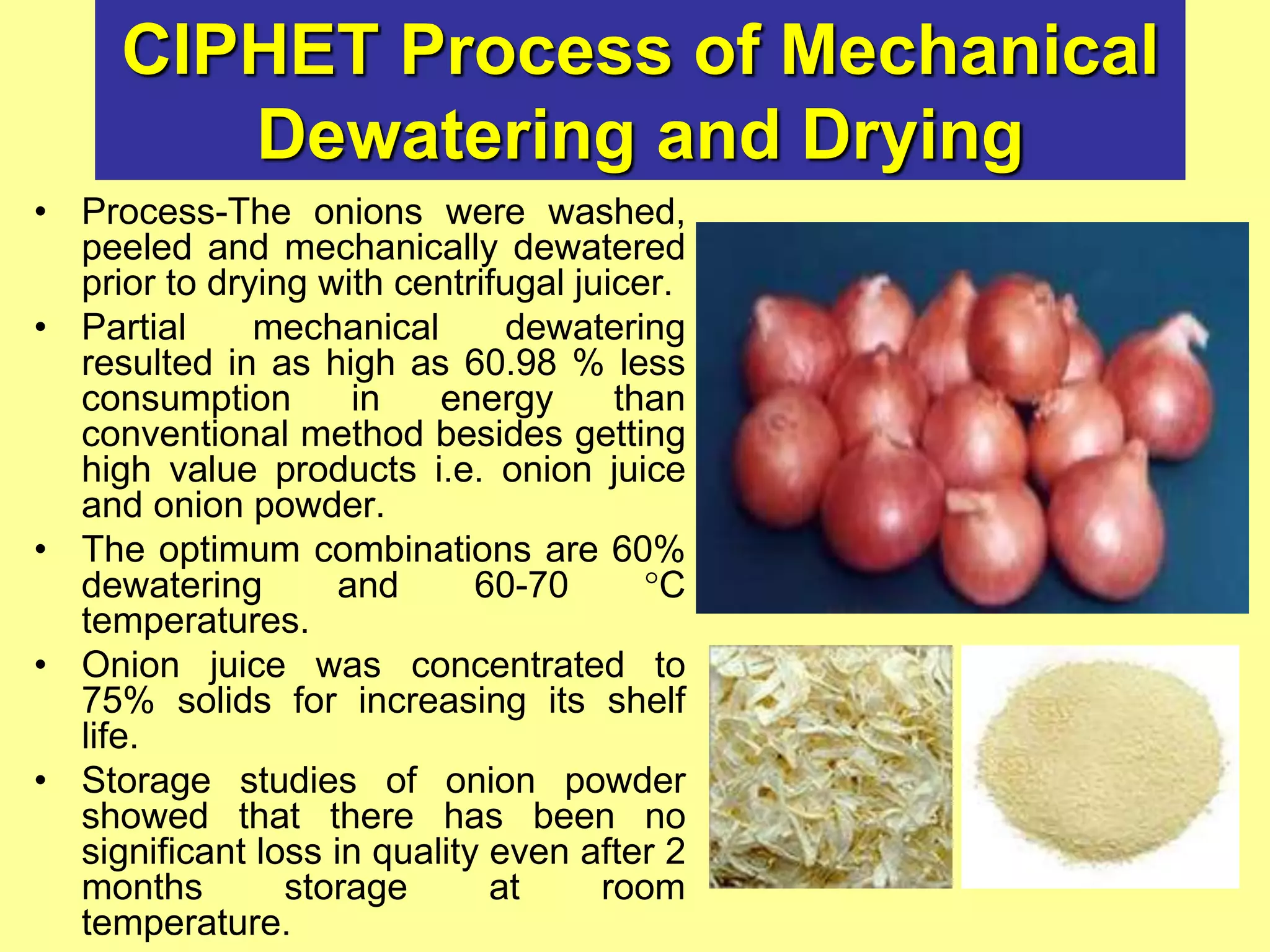
CIPHET Process of Mechanical
Dewatering and Drying
• Process-The onions were washed,
peeled and mechanically dewatered
prior to drying with centrifugal juicer.
• Partial mechanical dewatering
resulted in as high as 60.98 % less
consumption in energy than
conventional method besides getting
high value products i.e. onion juice
and onion powder.
• The optimum combinations are 60%
dewatering and 60-70 C
temperatures.
• Onion juice was concentrated to
75% solids for increasing its shelf
life.
• Storage studies of onion powder
showed that there has been no
significant loss in quality even after 2
months storage at room
temperature.
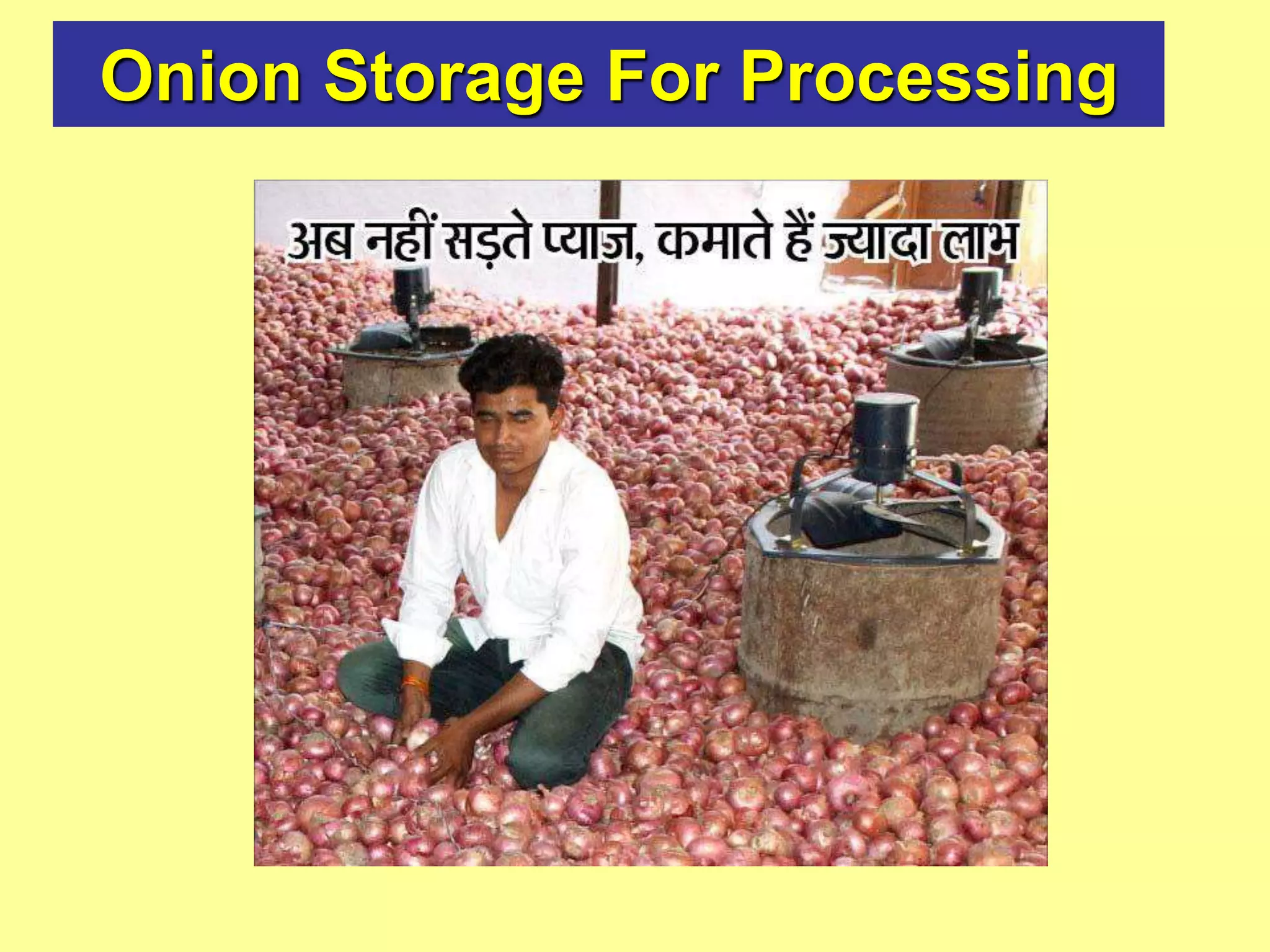
Onion Storage For Processing
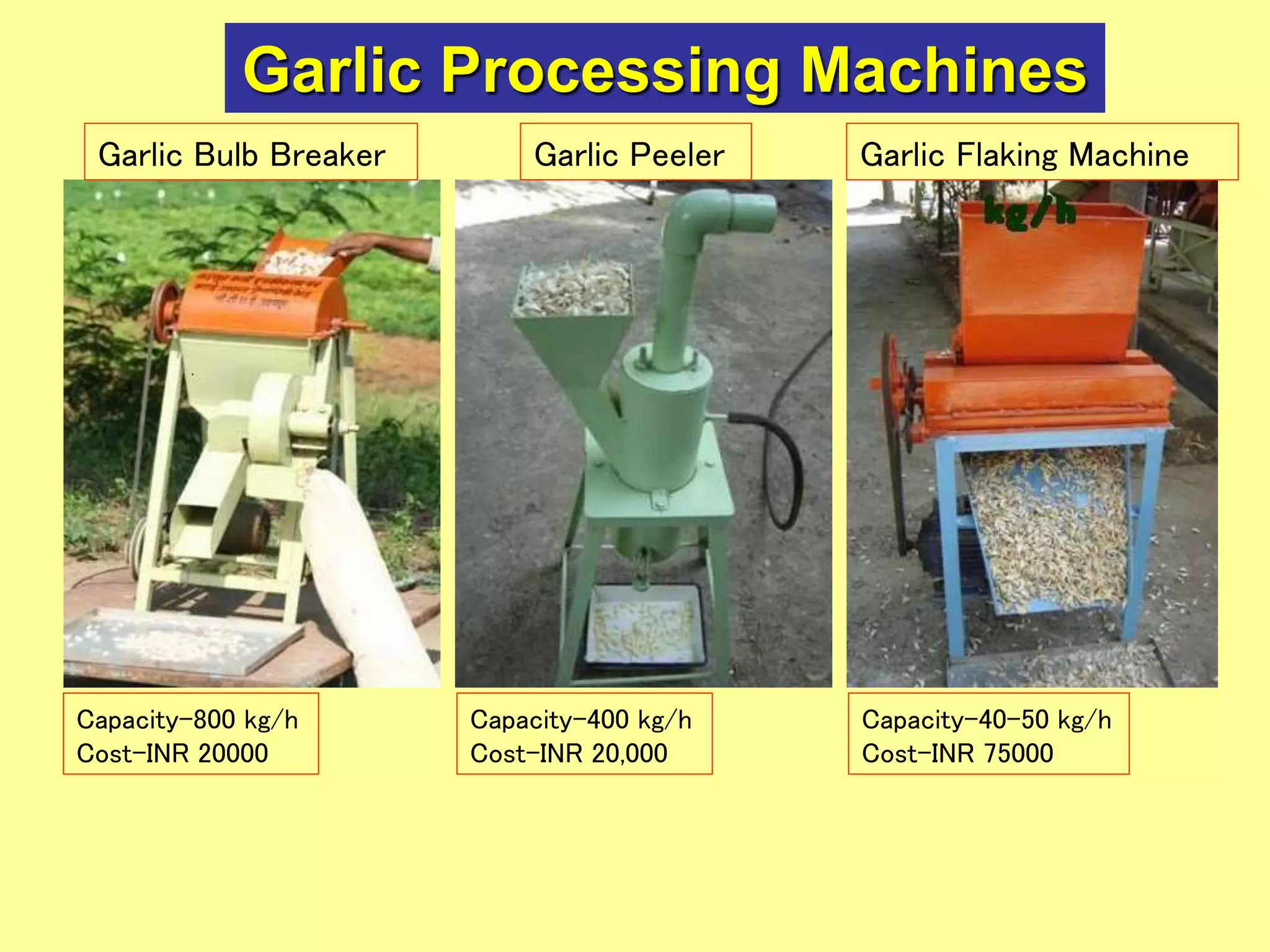
Garlic Processing Machines
Garlic Flaking MachineGarlic PeelerGarlic Bulb Breaker
Capacity-800 kg/h
Cost-INR 20000
Capacity-400 kg/h
Cost-INR 20,000
Capacity-40-50 kg/h
Cost-INR 75000
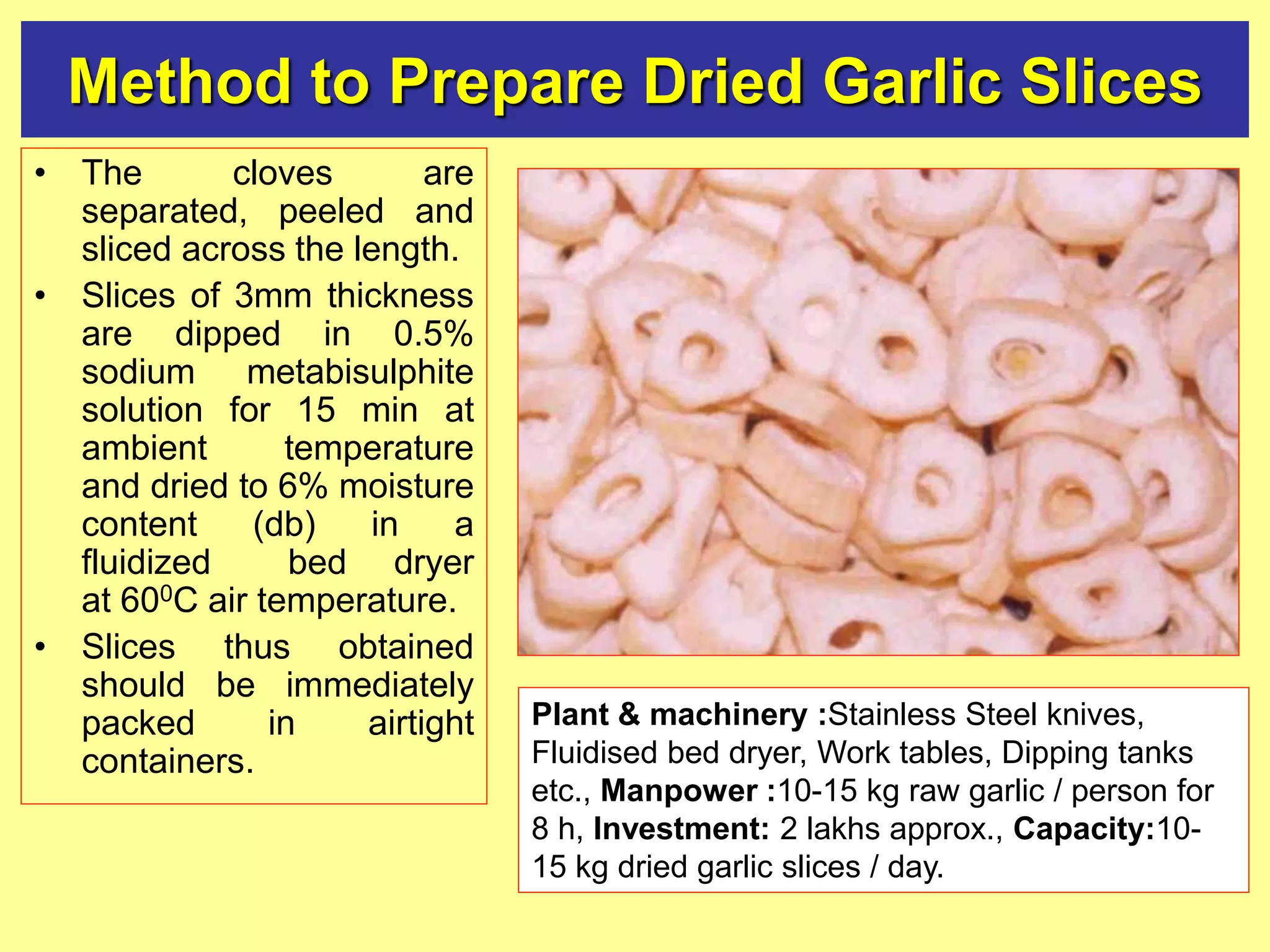
Method to Prepare Dried Garlic Slices
• The cloves are
separated, peeled and
sliced across the length.
• Slices of 3mm thickness
are dipped in 0.5%
sodium metabisulphite
solution for 15 min at
ambient temperature
and dried to 6% moisture
content (db) in a
fluidized bed dryer
at 600C air temperature.
• Slices thus obtained
should be immediately
packed in airtight
containers.
Plant & machinery :Stainless Steel knives,
Fluidised bed dryer, Work tables, Dipping tanks
etc., Manpower :10-15 kg raw garlic / person for
8 h, Investment: 2 lakhs approx., Capacity:10-
15 kg dried garlic slices / day.
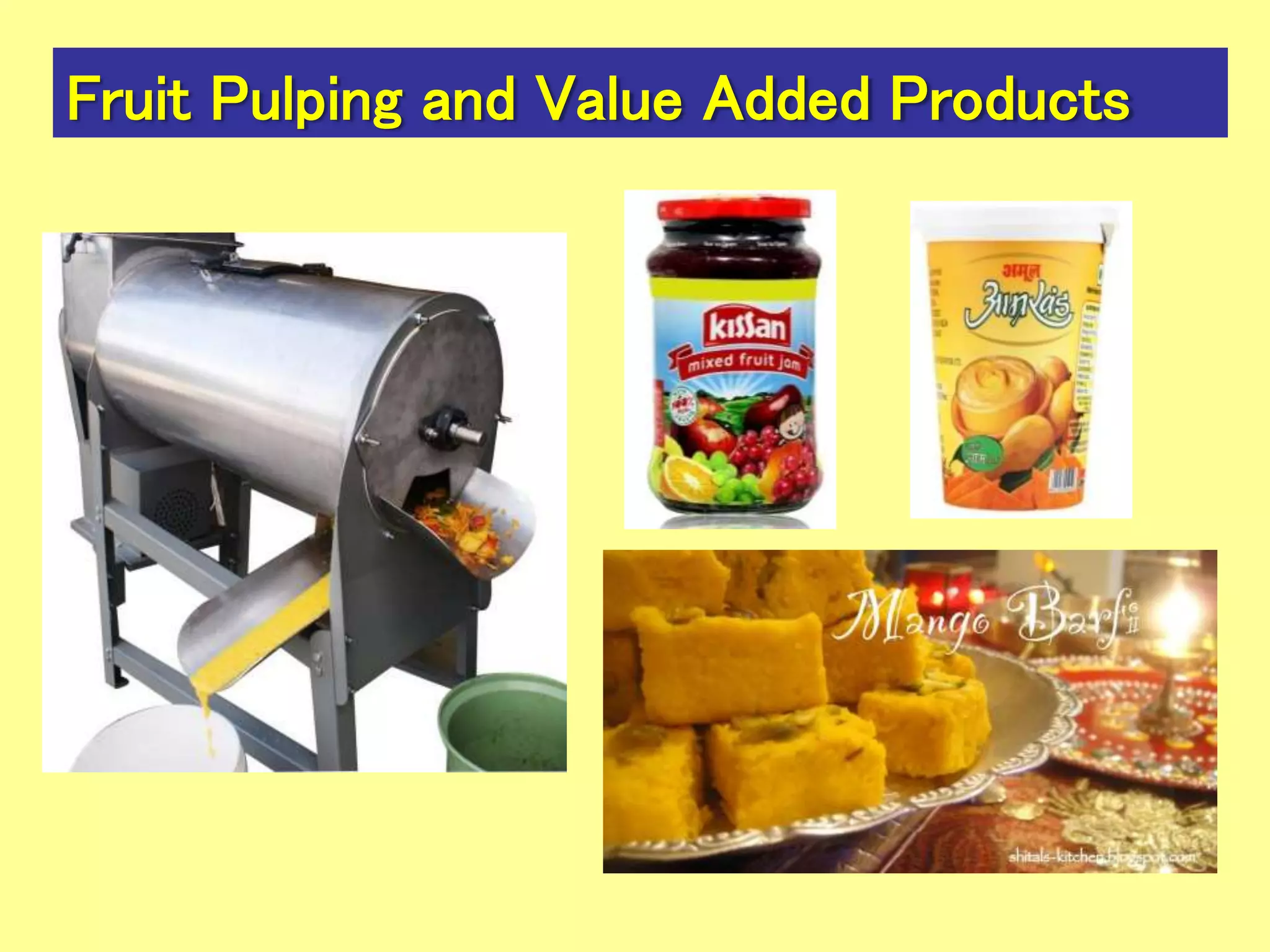
Fruit Pulping and Value Added Products
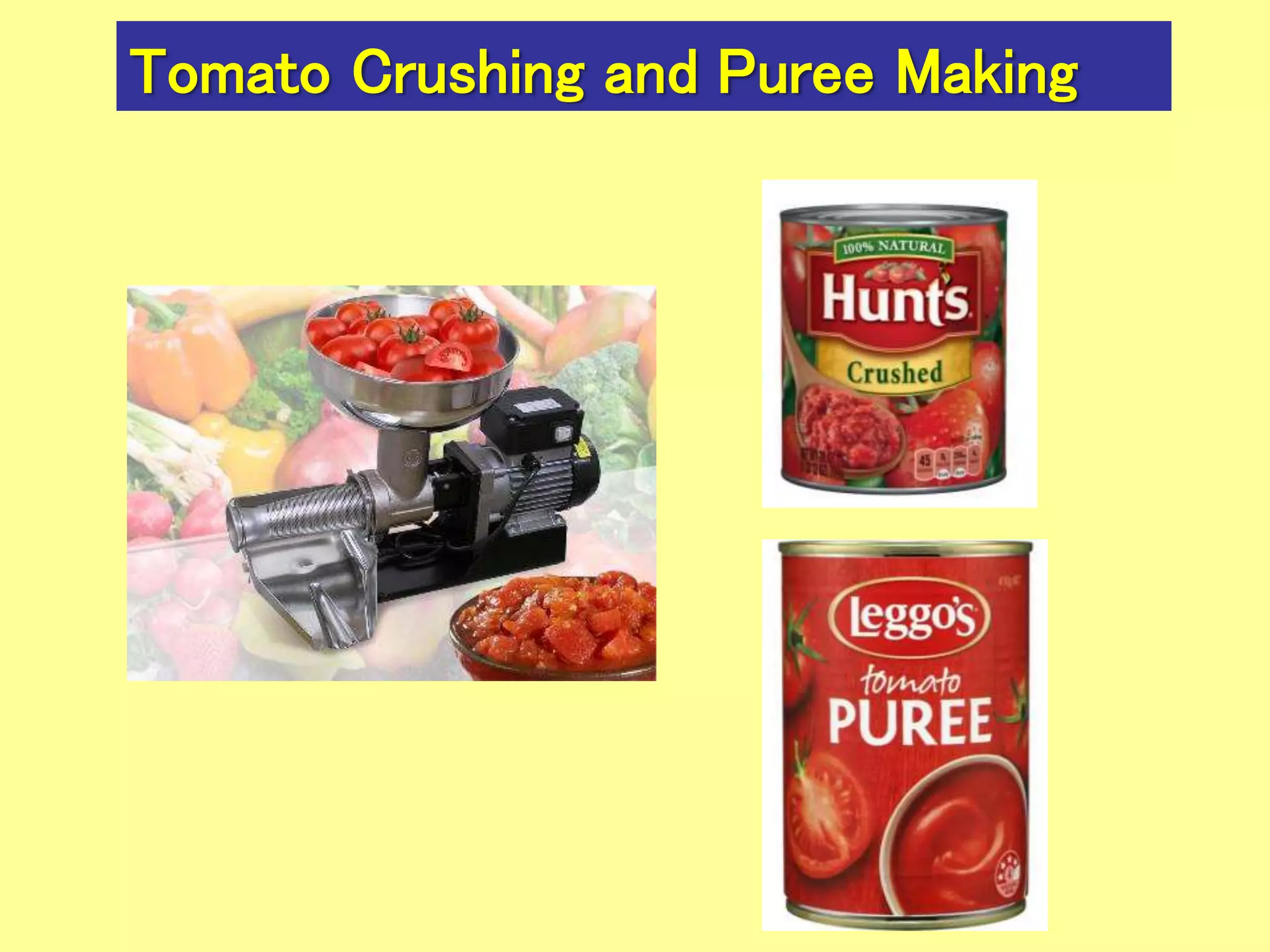
Tomato Crushing and Puree Making
Other Useful Technologies
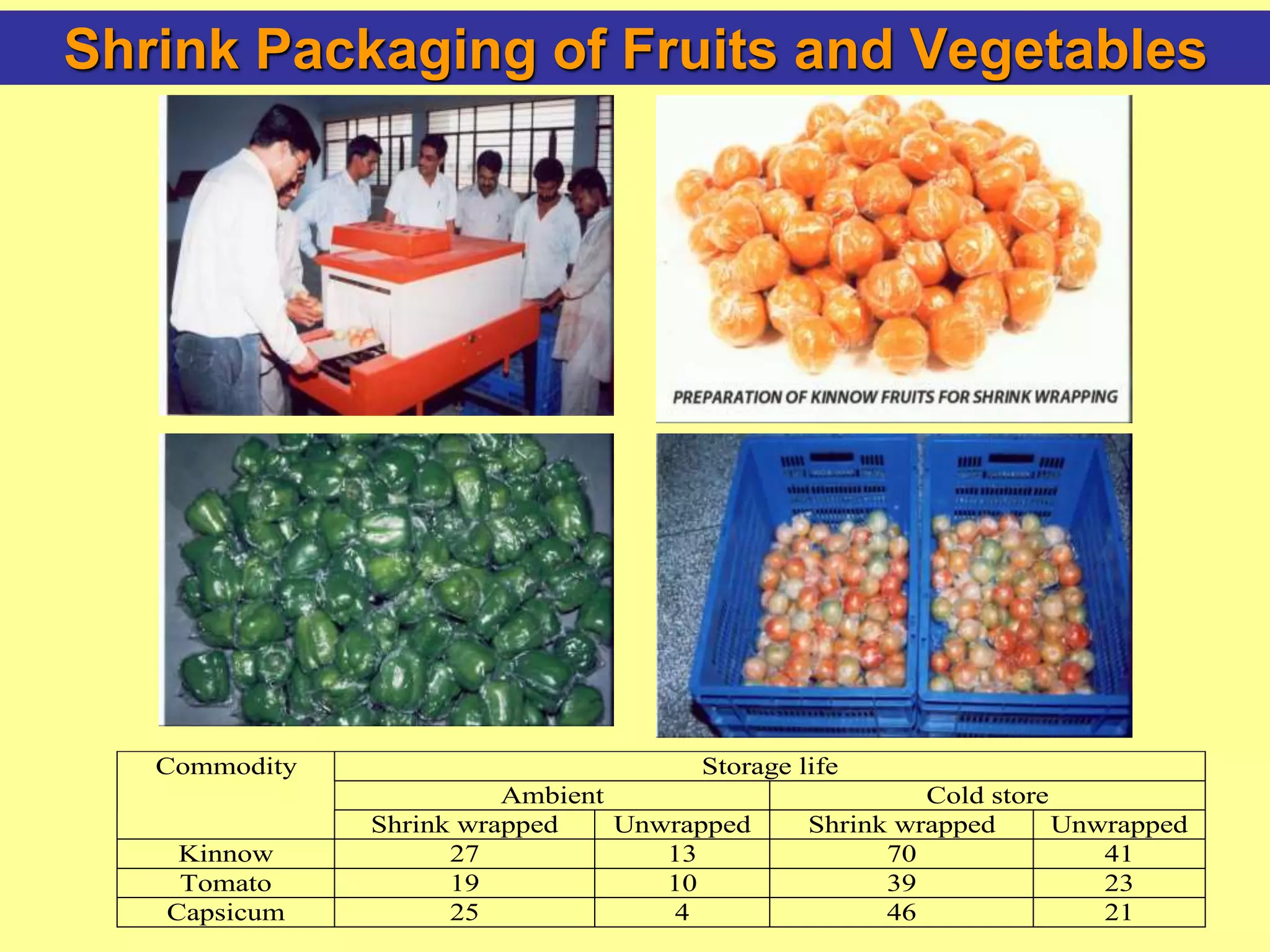
Shrink Packaging of Fruits and Vegetables
Storage life
Ambient Cold store
Commodity
Shrink wrapped Unwrapped Shrink wrapped Unwrapped
Kinnow 27 13 70 41
Tomato 19 10 39 23
Capsicum 25 4 46 21
Minimal Processing of Pomegranate Arils
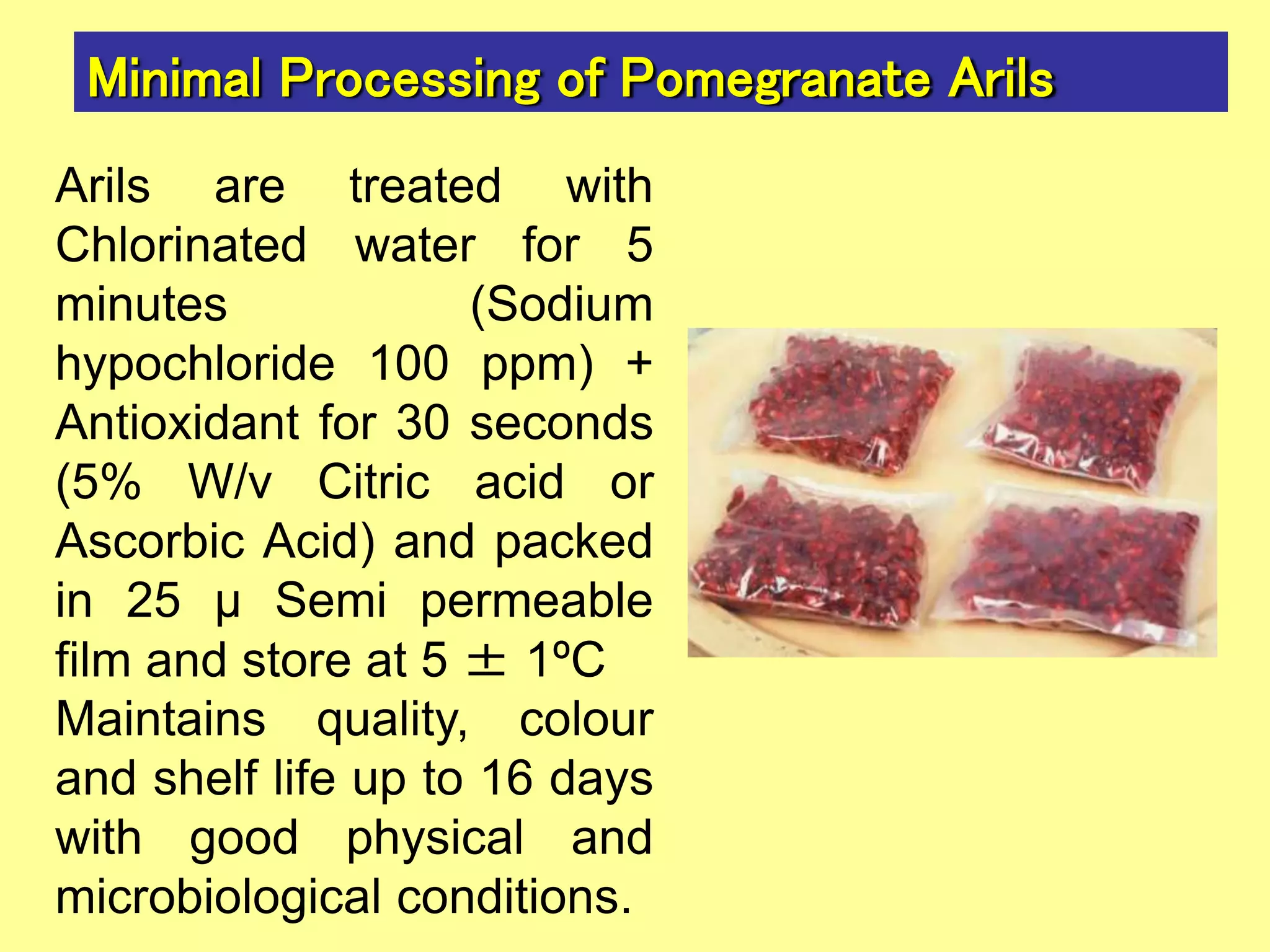
Arils are treated with
Chlorinated water for 5
minutes (Sodium
hypochloride 100 ppm) +
Antioxidant for 30 seconds
(5% W/v Citric acid or
Ascorbic Acid) and packed
in 25 μ Semi permeable
film and store at 5 ± 1ºC
Maintains quality, colour
and shelf life up to 16 days
with good physical and
microbiological conditions.
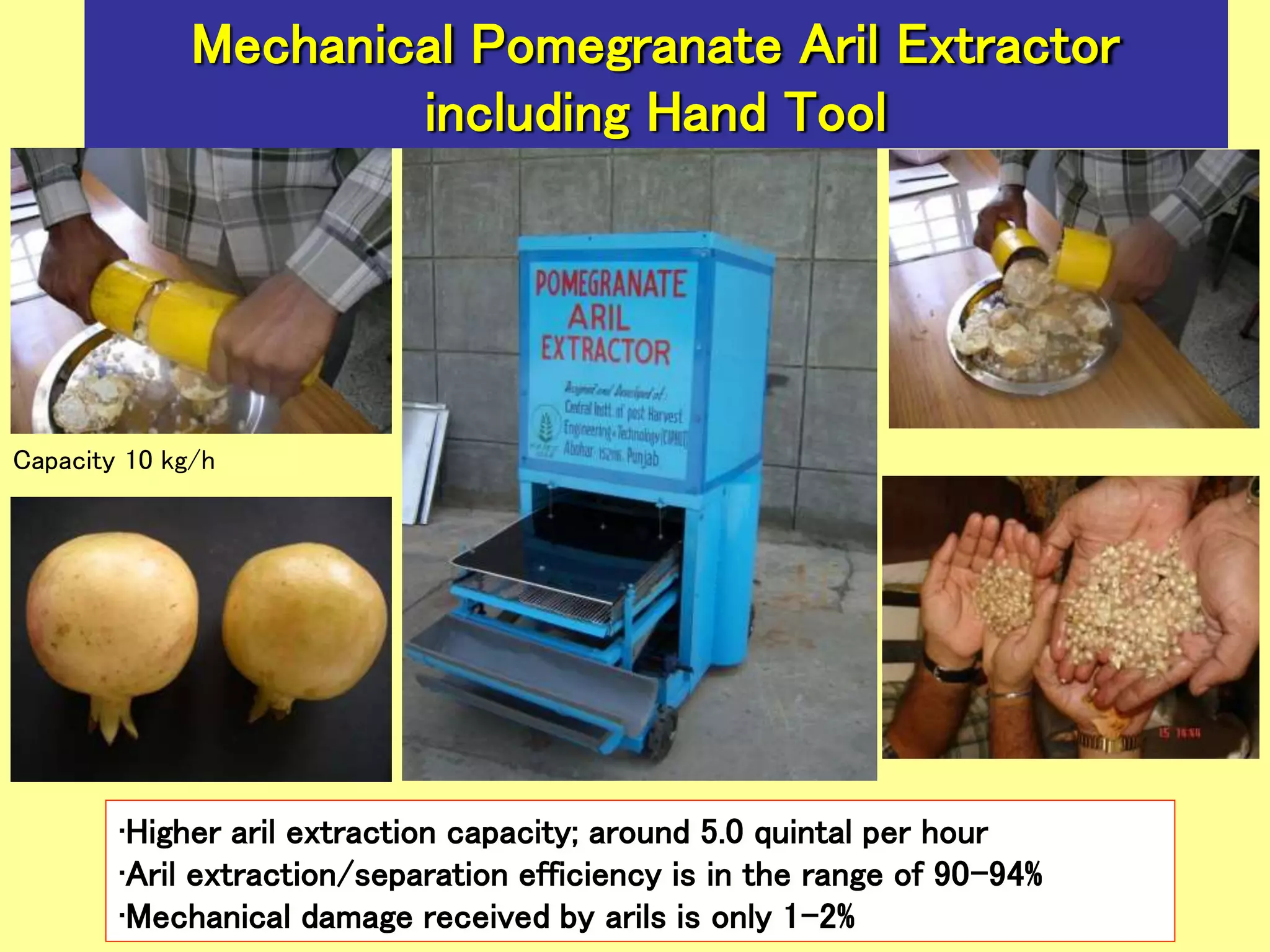
•Higher aril extraction capacity; around 5.0 quintal per hour
•Aril extraction/separation efficiency is in the range of 90-94%
•Mechanical damage received by arils is only 1-2%
Mechanical Pomegranate Aril Extractor
including Hand Tool
Capacity 10 kg/h
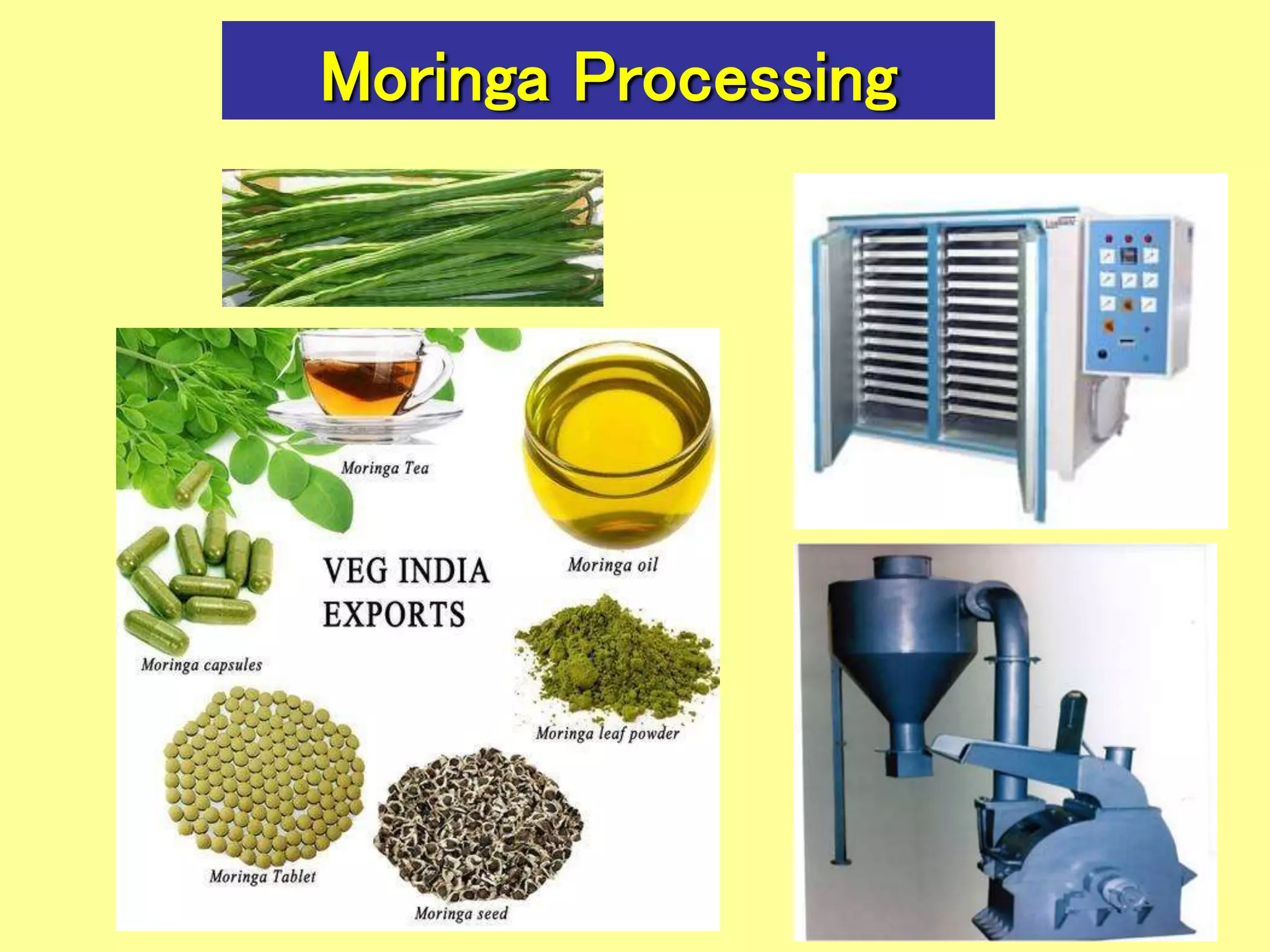
Moringa Processing
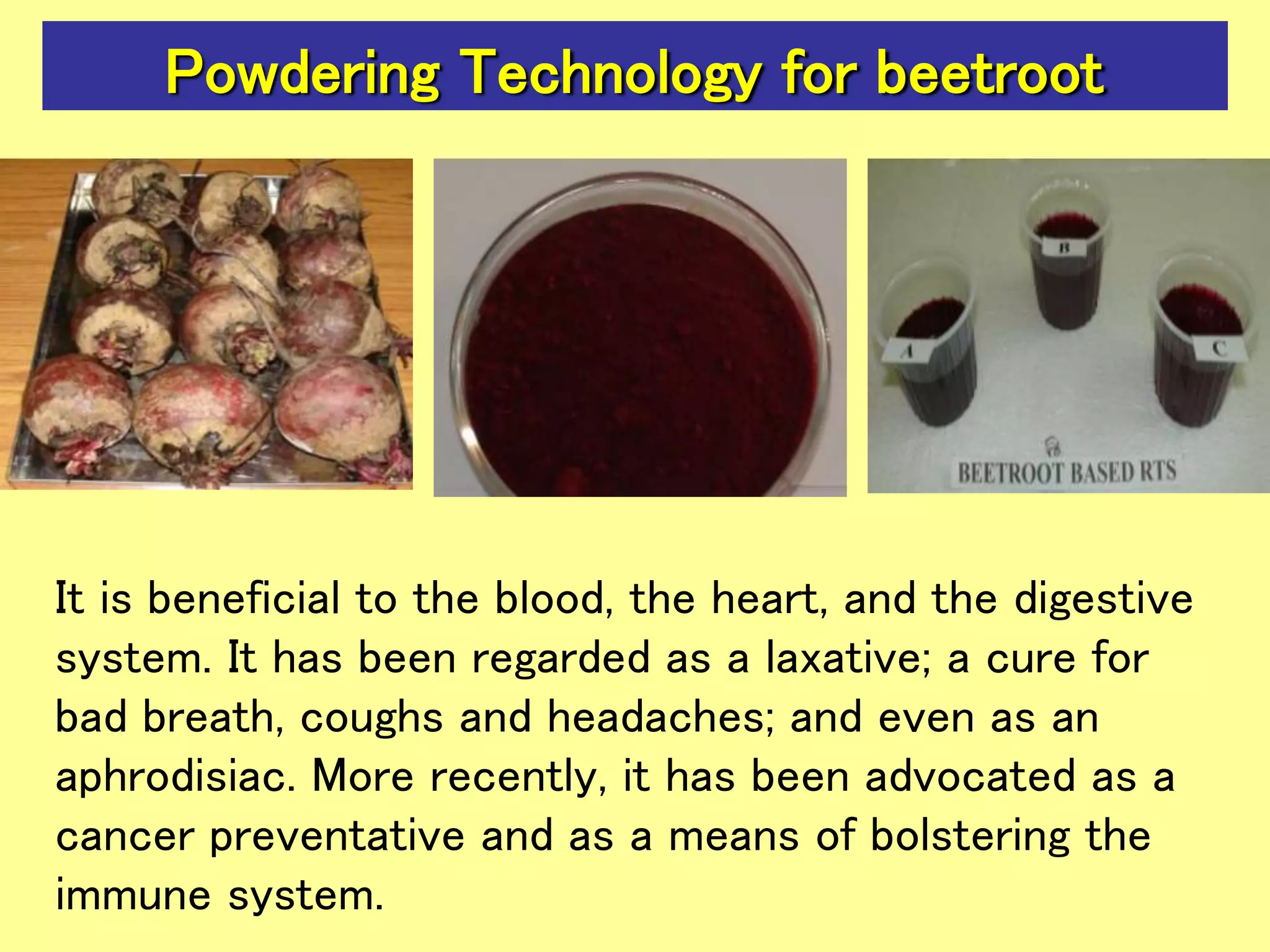
Powdering Technology for beetroot
It is beneficial to the blood, the heart, and the digestive
system. It has been regarded as a laxative; a cure for
bad breath, coughs and headaches; and even as an
aphrodisiac. More recently, it has been advocated as a
cancer preventative and as a means of bolstering the
immune system.
Conclusions
• India produces variety of fruits and vegetables which
require specific machines for small scale pre & post
harvest operations
• The commodity specific machines like pomegranate aril
extractor, custard apple cutter and pulp extractor, ber
deseeder, litchi peeler etc are needed to be developed
for their value addition
• Strengthening the research efforts in developing
machines for production and post harvest operations
suitable for Indian horticultural sector will increase the
farmers income substantially while reducing the post
harvest losses.
Email ID- ramabhau@gmail.com
Mobile. No. 08964030701

Mechanization of post harvest operations in horticultural crops

  • 1.
    Dr. R. T.Patil Ex-Director CIPHET & Chairman Benevole Welfare Society for Post Harvest Technology, Bhopal (MP) Mechanization of Post Harvest Operations in Horticultural Crops
  • 2.
    Production & PostHarvest Scenario •Agriculture contributes about 15% of GDP, employs 57 % workforce and sustains approx over 65 % of the population •India produces about 265+million tons of food grains and more than 280+million tons of fruits and vegetables and ranks second in world •Low level of processing of fruits and vegetables and hence losses range from 6 - 18 %. •Food processing is employment intensive, creates 1.8 jobs directly and 6.4 indirectly for every Rs. 10 lakh investment
  • 3.
    Agro Processing in ProductionCatchment 1. Can provide processed food of highest quality at affordable cost to consumers 2. Help environment by processing food in production catchment with least food miles 3. Ensure traceability of raw materials used for processed product hence great for export and elite urban market. 4. Help effective backward linkage with farmers for processing their raw produce 5. Shorten the supply chain, increase the profitability of farmers and ultimately increase in GDP from agriculture and reduce poverty 6. Reduce post harvest losses and increased availability of by products for further processing.
  • 4.
    Unit Operations inPost Harvest Management • Pre harvest Treatment • Harvesting at Proper Maturity • Safe Harvesting • Sorting/Grading • Pre cooling and Washing • Cool/Cold Storage • Safe Handling/Packaging • Safe Transport • Value Addition
  • 5.
    Covering Banana Bunch • Theyprotect the skin of the fruit against leaf, insect and bird damage as the fruit matures. • With use of the bunch covers fruit size is more uniform and larger throughout the bunch. • Bunch covers can increase yields by 5-25 %. • Bigger individual bananas or plantains with less skin damage means a better market price and higher profit.
  • 6.
    Harvesting at Maturity- Maturity of Mango in Tree • Eating quality and postharvest shelf life of ripe mango depends on its maturity at harvest • Change of peel color and total soluble solids (TSS) are indicative parameters to measure maturity of mango. • A maturity index was defined based on TSS and colour values. • The model was developed to predict maturity using colourimeter • Colour and maturity index chart were also developed to determine maturity • This technique can be employed to sort the mangoes at export port, big mandies and in processing plant. Capacity About 100 mangoes per hour
  • 7.
  • 8.
    Fruit Saving Gadgets Afterplucking from tree, fruit is thrown in the trough of fruit saver and collected in a box/container. The fruits are graded on size basis at appropriate places. Smallest grade fruit is collected first and largest grade is collected in last
  • 9.
    Banana-Comb (Hand) Cutter Itis an useful to de-stem the comb from the banana bunch. It replaces the use of sickle, which was much labor and time consuming. It is safe for human and banana hands and can be used for faster work. 100 to 120 banana bunches can be de-handed per hour. Saves 10 to 15 banana-fingers per bunch (i. e. 2 to 8 % reduction in cutting losses of banana fruits)
  • 10.
    CIPHET Tomato Grader •The tomatoes roll down the pipes due to gravity and fall immediately wherever they find the space of their diameter. • Grades 3: 25-40 mm, 40-55 mm, 55- 70 mm and > 70 mm • The collector is inclined at 10° so that the tomatoes slide directly in crates. • The important feature of grader is its ability to adjust the gap between the pipes and inclination of grading table and hopper. • It can also be used for other round fruits and vegetables. Capacity: of 325 kg/hr Overall grading efficiency: 66%. Cost: Rs.25000.00
  • 11.
    Washing of Fruits& Vegetables
  • 12.
    Pre cooling Pre Coolingis provided to fruits and vegetables before long term cold storage. Helps in increasing the efficiency and functional life of the products during long term cold storage. Increases shelf-life of produce/commodity In compliance with international quality standards Cost-effective
  • 13.
    Evaporatively Cooled Roomfor Storage of Fruits and Vegetables Compared on the basis of 10% physiological loss in weight (PLW) the shelf life inside the room was 34 days for early kinnow, 23 days for late kinnow, 11 days for cauliflower and 4 days for spinach as compared to 21, 11, 5 and 2 days respectively in an ordinary room at the same time. The cost of the chamber is Rs. 75000 and capacity is 2 tonnes. •An evaporatively cooled (EC) room (3x3x3m. size) was developed for on-farm storage of fruits and vegetables. •The summer temperature inside the EC room was 5-8C lower than that inside the ordinary room and winter temperature was 5-8 C higher than that inside the ordinary room.
  • 14.
    Evaporative Cooled StorageStructure • Storage of fruits and vegetables • Evaporatively Cooled Structure (ECS) maintains a moderate low temperature and sufficiently high relative humidity for short term storage of fresh fruits and vegetables. • Advantages  Low level consumption of electricity  Less initial investment  Negligible maintenance cost • Features – Special design of roof, orientation – Uses wetted pad as cooling medium – 20oC below the outside temperature – An ECS of about 5 -7 tonne storage capacity may cost about Rs. 1.5 – 1.8 lakh.
  • 15.
    Walk in Coolercum Freezer Solar Walk In Cooler 12 V - 24 V DC operating voltage featuring shut-off at low voltage Dual Mode - Can work as Freezer and Refrigerator Eco-friendly cooling agent (R- 134a) Maintenance Free Brushless DC Compressor Adjustable interior temperature Very low energy requirement Highly-efficient cooling Low Maintenance Double gasket to keep long cooling Easy to installation For Storage of Pulp and Puree
  • 16.
    Aloe Vera GelExtractor •Aloe vara gel should be extracted within 6 hours and processing must be completed within 36 hours. •An inner clear gel that contains 99% water and rest made of glucomannans, amino acids, lipids, sterols, vitamins etc. •The equipment capacity 200-225kg gel/h (900-1000 leaves/h) for motorised and 100kg gel/h (400- 450 leaves/h) for manual machine. •The extracted gel is clean and without any physical damage.
  • 17.
    Heat Pump Dryerfor High Value Products •Micro-processor based temperature controller to regulates the drying temperature. •Minimises the loss of vitamins and essential oil of the products and save energy in drying. •For blanched Amla drying, the dryer reduced vitamin-C loss up to 87% as compared to the open sun drying. •The products such as sliced fruits and vegetables is dried in 20-25 h and medicinal herbs and leaf crops are 12-20 h. •The cost of the prototype is Rs. 1,50,000 and capacity is 30 kg/batch.
  • 18.
    Sitaphal Peeling Machine Removingthe sitaphal seeds and pulp automatically without disturbing the pulp texture. Capacity: 120Kg/hr, Efficiency: 94% pulp recovery, Coarse / Intact Pulp recovery: 70-72%; Fine Pulp recovery: 28-30%. The machine is licensed to NEXTGEN Drying System, Pune
  • 19.
    Small Composite Unitfor Tomato Puree and Fruit Pulp The machine has components like a cooker, grinder, mixture, processor and juicer. The machine is capable of processing around 200 kg of herbal products and fruits in an hour. Mr. Dharamvir Singh from Haryana has developed this machine to extract juice; residue is used for making candy, sweets and other items. He has employed 35 women for his business and also sells units of the machine. He even trains buyers on how to use it. He earns about Rs. 24 lakh per year from processed products and the machine is sold for 1.50
  • 20.
  • 21.
  • 22.
  • 23.
    CIPHET Process ofMechanical Dewatering and Drying • Process-The onions were washed, peeled and mechanically dewatered prior to drying with centrifugal juicer. • Partial mechanical dewatering resulted in as high as 60.98 % less consumption in energy than conventional method besides getting high value products i.e. onion juice and onion powder. • The optimum combinations are 60% dewatering and 60-70 C temperatures. • Onion juice was concentrated to 75% solids for increasing its shelf life. • Storage studies of onion powder showed that there has been no significant loss in quality even after 2 months storage at room temperature.
  • 24.
  • 25.
    Garlic Processing Machines GarlicFlaking MachineGarlic PeelerGarlic Bulb Breaker Capacity-800 kg/h Cost-INR 20000 Capacity-400 kg/h Cost-INR 20,000 Capacity-40-50 kg/h Cost-INR 75000
  • 26.
    Method to PrepareDried Garlic Slices • The cloves are separated, peeled and sliced across the length. • Slices of 3mm thickness are dipped in 0.5% sodium metabisulphite solution for 15 min at ambient temperature and dried to 6% moisture content (db) in a fluidized bed dryer at 600C air temperature. • Slices thus obtained should be immediately packed in airtight containers. Plant & machinery :Stainless Steel knives, Fluidised bed dryer, Work tables, Dipping tanks etc., Manpower :10-15 kg raw garlic / person for 8 h, Investment: 2 lakhs approx., Capacity:10- 15 kg dried garlic slices / day.
  • 27.
    Fruit Pulping andValue Added Products
  • 28.
    Tomato Crushing andPuree Making
  • 29.
  • 30.
    Shrink Packaging ofFruits and Vegetables Storage life Ambient Cold store Commodity Shrink wrapped Unwrapped Shrink wrapped Unwrapped Kinnow 27 13 70 41 Tomato 19 10 39 23 Capsicum 25 4 46 21
  • 31.
    Minimal Processing ofPomegranate Arils Arils are treated with Chlorinated water for 5 minutes (Sodium hypochloride 100 ppm) + Antioxidant for 30 seconds (5% W/v Citric acid or Ascorbic Acid) and packed in 25 μ Semi permeable film and store at 5 ± 1ºC Maintains quality, colour and shelf life up to 16 days with good physical and microbiological conditions.
  • 32.
    •Higher aril extractioncapacity; around 5.0 quintal per hour •Aril extraction/separation efficiency is in the range of 90-94% •Mechanical damage received by arils is only 1-2% Mechanical Pomegranate Aril Extractor including Hand Tool Capacity 10 kg/h
  • 33.
  • 34.
    Powdering Technology forbeetroot It is beneficial to the blood, the heart, and the digestive system. It has been regarded as a laxative; a cure for bad breath, coughs and headaches; and even as an aphrodisiac. More recently, it has been advocated as a cancer preventative and as a means of bolstering the immune system.
  • 35.
    Conclusions • India producesvariety of fruits and vegetables which require specific machines for small scale pre & post harvest operations • The commodity specific machines like pomegranate aril extractor, custard apple cutter and pulp extractor, ber deseeder, litchi peeler etc are needed to be developed for their value addition • Strengthening the research efforts in developing machines for production and post harvest operations suitable for Indian horticultural sector will increase the farmers income substantially while reducing the post harvest losses.
  • 36.