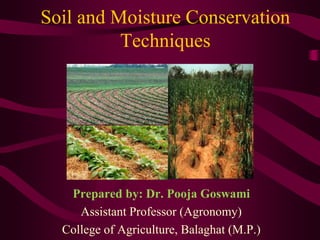
Soil and Moisture Conservation
Techniques
Prepared by: Dr. Pooja Goswami
Assistant Professor (Agronomy)
College of Agriculture, Balaghat (M.P.)
Soil and Moisture Conservation
Techniques
Methods of soil and water conservation
fall into two important classes, viz.
Agronomic measures
Engineering measures.
Agronomical measures are adopted:
where land slope is <2 per cent, which are followings:
1. Conservation Tillage
2. Deep tillage
3. Conservation Farming
4. Contour Farming
5. Mulching
6. Growing of cover crops
7. Strip cropping
8. Mixed cropping
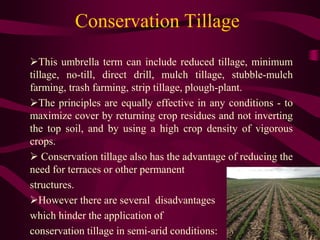
Conservation Tillage
This umbrella term can include reduced tillage, minimum
tillage, no-till, direct drill, mulch tillage, stubble-mulch
farming, trash farming, strip tillage, plough-plant.
The principles are equally effective in any conditions - to
maximize cover by returning crop residues and not inverting
the top soil, and by using a high crop density of vigorous
crops.
 Conservation tillage also has the advantage of reducing the
need for terraces or other permanent
structures.
However there are several disadvantages
which hinder the application of
conservation tillage in semi-arid conditions:
Deep Tillage
One of the reasons for low yields in semi-arid areas is the
limited amount of moisture available to crop roots. The
available moisture will be increased if the rooting depth is
increased and it has been shown that in some cases deep tillage
can help, for example on the dense sandy soils.
Deep tillage is beneficial for some crops but not all, and on
some soils but not all. It requires greater draught power which is
usually in short supply in semi-arid areas.
Ripping or subsoiling can be beneficial, either to increase the
porosity of the soil, or to break a pan which is reducing
permeability.
The deep placement of fertilizer can also be used to encourage
more rooting at depth, but again the application of this technique
to subsistence farming will be difficult.
RESOURSE CONSERVATION FARMING
It includes any farming practice which improves
yield, or reliability, or decreases the inputs of
labour or fertilizer, or anything else leading
towards improved land husbandry, which we have
defined as the foundation of good soil
conservation.
It includes strip cropping, crop rotations,
alternate cropping, mixed cropping and inter
planting, surface and mulching, organic mulches,
deep planting of varieties, dry seeding etc.
STRIP CROPPING
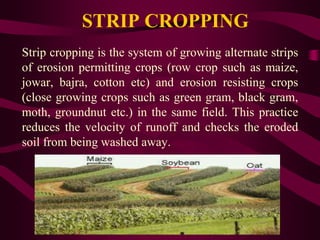
Strip cropping is the system of growing alternate strips
of erosion permitting crops (row crop such as maize,
jowar, bajra, cotton etc) and erosion resisting crops
(close growing crops such as green gram, black gram,
moth, groundnut etc.) in the same field. This practice
reduces the velocity of runoff and checks the eroded
soil from being washed away.
Continued…
Strip cropping is essentially for controlling the run-off
erosion and thereby maintaining the fertility of the soil
is now universally recognized. Strip cropping, in effect,
employs several good farming practices, including crop
rotation, contour cultivation, proper tillage stubble
mulching, cover cropping, etc.
Strip cropping is of the following different forms :
Contour strip cropping
Field strip cropping
Wind strip cropping
Permanent or temporary buffer strip cropping
CONTOUR-FARMING
During intense rain storms, the soil cannot absorb all the
rain as it falls. The excess water flows down the slope under
the influence of gravity.
If farming is done up and down the slope, the flow of water
is accelerated, because each furrow serves as a rill. The major
part of the rain is drained away without infiltrating into the
soil. The top fertile soil, along with plant nutrients and seeds,
is washed off. All this results in a scanty and uneven growth
of a crop.
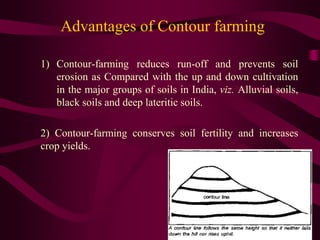
A simple practice of farming across the slope, keeping the
same level, as far as possible is technically called contour-
farming‖.
Advantages of Contour farming
1) Contour-farming reduces run-off and prevents soil
erosion as Compared with the up and down cultivation
in the major groups of soils in India, viz. Alluvial soils,
black soils and deep lateritic soils.
2) Contour-farming conserves soil fertility and increases
crop yields.
MULCHING
Any material used (spread) at surface or
vertically in soil to assist soil and water
conservation and soil productivity is called
mulch. And process of applying mulches to
soil is known as mulching.
Mulching helps in conserving moisture,
lowering soil temperatures around plant roots,
reducing weed growth, etc thus helps crops
during moisture stress conditions.
Types of mulches
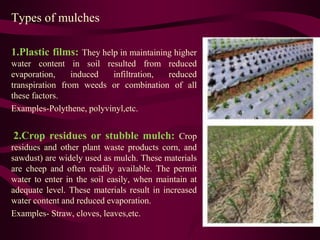
1.Plastic films: They help in maintaining higher
water content in soil resulted from reduced
evaporation, induced infiltration, reduced
transpiration from weeds or combination of all
these factors.
Examples-Polythene, polyvinyl,etc.
2.Crop residues or stubble mulch: Crop
residues and other plant waste products corn, and
sawdust) are widely used as mulch. These materials
are cheep and often readily available. The permit
water to enter in the soil easily, when maintain at
adequate level. These materials result in increased
water content and reduced evaporation.
Examples- Straw, cloves, leaves,etc.
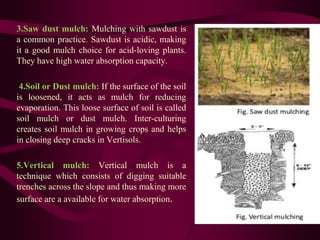
3.Saw dust mulch: Mulching with sawdust is
a common practice. Sawdust is acidic, making
it a good mulch choice for acid-loving plants.
They have high water absorption capacity.
4.Soil or Dust mulch: If the surface of the soil
is loosened, it acts as mulch for reducing
evaporation. This loose surface of soil is called
soil mulch or dust mulch. Inter-culturing
creates soil mulch in growing crops and helps
in closing deep cracks in Vertisols.
5.Vertical mulch: Vertical mulch is a
technique which consists of digging suitable
trenches across the slope and thus making more
surface are a available for water absorption.
ANTI-TRANSPIRANTS
Anti-transpirants are the materials or chemicals that applied to
transpiring plant surfaces for reducing water loss from the plant.
The purpose of ATs is to maintain the growth and productivity
under stress conditions and it is never recommended for high
productivity / unit area.
The severity of intermittent drought of 6-10 days during
critical stages of the crop can reasonably be avoided by the use
of anti transpirants and thus crops can be save
 Mainly four types of anti-transpirants:
1. Stomatal closing type
2. Film forming type
3. Reflectance type
4. Growth retardant
Stomatal closing type: Most of the transpiration occur through the
stomata on the leaf surface. They induce stomatal closing or
decrease size and number of stomata which subsequently reduce
the photosynthesis.
Examples:
Phenyl Mercuric Acetate (PMA) , Atrazine
Film forming type: Plastic and waxy material which form a thin
colourless film over the leaf surface and result in a physical
barrier. These glossy films then reduce water loss on plants while
at the same time allow them to breathe normally.
Examples: Hexadecanol (Higher alcohols), Cetyl alcohol,
Methanol , Paclobutrazol , Brassinolide , Resorcinol
Reflecting type: They are white materials which form a
coating on the leaves and increase the leaf reflectance
(albedo). By reflecting the radiation, vapour pressure
gradient and thus reduce transpiration.
Examples: Kaoline(5%), China Clay, Calcium
bicarbonate , Lime water
Growth retardant: These chemicals reduce shoot
growth and increase root growth and thus enable the
plants to resist drought. They may also induce stomatal
closure.
Examples: cycocel
Engineering measures.
Engineering/Mechanical measures are construction of mechanical
barriers across the direction of the flow of water to retain the
runoff for reducing soil and water loss.
They are generally adopted where land slope is >2 per cent
and to supplement the agronomical practices
When the later alone are not adequately effective. These
measures include:
1. Bunding
2. Terracing
2. Trenching
3. Basin-listing
4. Subsoiling
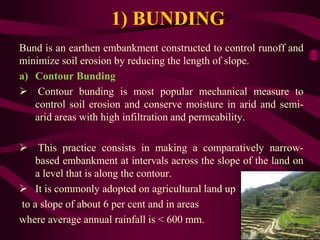
1) BUNDING
Bund is an earthen embankment constructed to control runoff and
minimize soil erosion by reducing the length of slope.
a) Contour Bunding
 Contour bunding is most popular mechanical measure to
control soil erosion and conserve moisture in arid and semi-
arid areas with high infiltration and permeability.
 This practice consists in making a comparatively narrow-
based embankment at intervals across the slope of the land on
a level that is along the contour.
 It is commonly adopted on agricultural land up
to a slope of about 6 per cent and in areas
where average annual rainfall is < 600 mm.
FORMULA IS USED FOR DETERMINING
SPACING OF BUNDS
V.I= S/a + b
where,
V.I.= vertical interval (m) between consecutive builds
S = % slope of land
a' and .b' constants depends on soil and rainfall characteristics
The height of the contour bunds depends on
 slope of land,
spacing of bunds and maximum intensity expected In deep
black soils, contour bonds have been a failure due to cracking of
bunds during dry months and water stagnation above the bunds
for prolonged periods during rainy season.
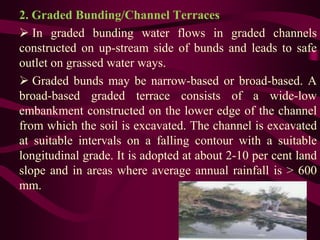
2. Graded Bunding/Channel Terraces
 In graded bunding water flows in graded channels
constructed on up-stream side of bunds and leads to safe
outlet on grassed water ways.
 Graded bunds may be narrow-based or broad-based. A
broad-based graded terrace consists of a wide-low
embankment constructed on the lower edge of the channel
from which the soil is excavated. The channel is excavated
at suitable intervals on a falling contour with a suitable
longitudinal grade. It is adopted at about 2-10 per cent land
slope and in areas where average annual rainfall is > 600
mm.
3. Compartmental bunding:
Small bunds of 15 cm width and 15 cm height are
formed in both directions to divide the field into small
basins or compartments of square or rectangular
shape of 6 x 6 m to 10 x 10 m size using bund former
.
They are useful for temporary impounding of rain
water which facilitates high infiltration resulting in
high moisture storage in the soil. Recommended for
black soils with a slope of 0.5 to 1%.
Maize, sunflower, sorghum perform well in this type
of bunding.
Different types of Bunds
4. Grass waterways
Grass waterways are natural or constructed watercourses
covered with erosion resistant grasses and are used to dispose
surface water from the crop land. They are constructed along the
slope of the land.
 Grassed waterways are associated with channel terraces for the
safe disposal of concentrated runoff, thereby protecting the land
against rills and gullies.
 The suitability of a grass was based on the cover it gave, the
ease with which it was established and the forage yield obtained
from it.
 Panicum repens was the best suited grass, followed by
Brachiara mutica, Cynodon plectostachyus, Cynodon dactylon
and Paspalum notatum.
2) TERRACING
A terracing is a combination of ridge and channels
built across the slope. This is generally practiced in
steep hill slope.
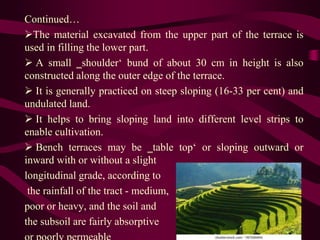
(a) Bench Terracing: Bench terrace consists of
construction of step like fields along the contour
by half cutting and half filling. Original slope of
the land is converted into level fields and thus all
hazards of erosion are eliminated.
(b) The vertical drop may vary from 60 to 180 cm,
depending upon the slope and soil conditions, as
also on the economic width required for easy
cultural operations.
Continued…
The material excavated from the upper part of the terrace is
used in filling the lower part.
 A small ‗shoulder‘ bund of about 30 cm in height is also
constructed along the outer edge of the terrace.
 It is generally practiced on steep sloping (16-33 per cent) and
undulated land.
 It helps to bring sloping land into different level strips to
enable cultivation.
 Bench terraces may be ‗table top‘ or sloping outward or
inward with or without a slight
longitudinal grade, according to
the rainfall of the tract - medium,
poor or heavy, and the soil and
the subsoil are fairly absorptive
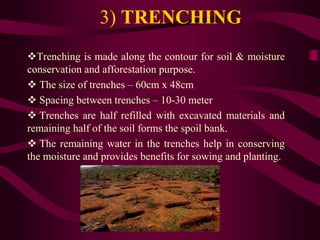
3) TRENCHING
Trenching is made along the contour for soil & moisture
conservation and afforestation purpose.
 The size of trenches – 60cm x 48cm
 Spacing between trenches – 10-30 meter
 Trenches are half refilled with excavated materials and
remaining half of the soil forms the spoil bank.
 The remaining water in the trenches help in conserving
the moisture and provides benefits for sowing and planting.
4) SUBSOILING
This method consists of breaking the hard and impermeable
subsoil with a subsoiler to conserve more rainwater by
improving the physical conditions of a soil.
This operation, which does not involve soil inversion and
promotes greater moisture penetration into the soil, reduces both
run-off and soil erosion.
The subsoiler is worked through the soil at a depth of 30-60 cm
at a spacing of 90-180 cm. Sub soling by tractor drawn chisel
plough at 2 m horizontal interval is the most effective insitu soil
and water conservation practice for early establishment and
improving the pasture.
It will also increase the efficiency of work and a large area can
be covered in a few cost and limited time.
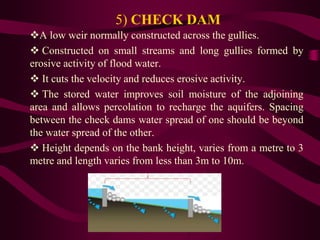
5) CHECK DAM
A low weir normally constructed across the gullies.
 Constructed on small streams and long gullies formed by
erosive activity of flood water.
 It cuts the velocity and reduces erosive activity.
 The stored water improves soil moisture of the adjoining
area and allows percolation to recharge the aquifers. Spacing
between the check dams water spread of one should be beyond
the water spread of the other.
 Height depends on the bank height, varies from a metre to 3
metre and length varies from less than 3m to 10m.
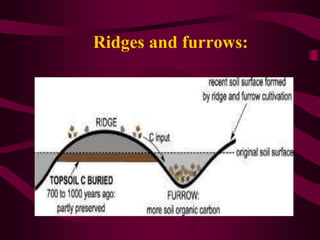
6) Ridges and furrows:
The field must be formed into ridges and furrows. Furrows of
30-45 cm width and 15-20 cm height are formed across the
slope. The furrows guide runoff water safely when rainfall
intensity is high and avoid water stagnation. They collect and
store water when rainfall intensity is less.
It is suitable for medium deep to deep black soils and deep
red soils. It can be practiced in wide row spaced crops like
cotton, maize, chillies, tomato etc.
It is not suitable for shallow red soils, shallow black soils and
sandy/ gravelly soils.
It is not suitable for broadcast sown crops and for crops sown
at closer row spacing less than 30 cm. Since furrows are formed
usually before sowing, sowing by dibbling or planting alone is
possible.
Ridges and furrows:
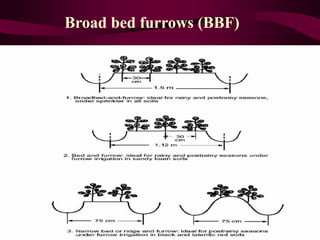
(7) Broad bed furrows (BBF):
This practice has been recommended by ICRISAT for
vertisols or black soils in high rainfall areas (> 750 mm).
Here beds of 90-120cm width, 15 cm height and convenient
length are formed, separated by furrows of 60 cm width and
15 cm depth.
When runoff occurs, its velocity will be reduced by beds
and infiltration opportunity time is increased. The furrows
have a gradient of 0.6%. Crops are sown on the broad beds
and excess water is drained through number of small furrows
which may be connected to farm ponds.
It can be formed by bullock drawn or tractor drawn
implements. Bed former cum seed drill enables BBF
formation and sowing simultaneously, thus reducing the delay
between receipt rainfall and sowing.
Broad bed furrows (BBF)
Advantages of BBF
Broad bed furrow has many advantages over other methods.
• It helps in moisture storage
• Safely dispose off surplus surface runoff without causing
erosion
• Provide better drainage facilities
• Facilitate dry seeding
• It can accommodate a wide range of crop geometry i.e. close as
well as wide row
spacing.
• It is suitable for both sole cropping and intercropping systems.
• Sowing can be done with seed drills.
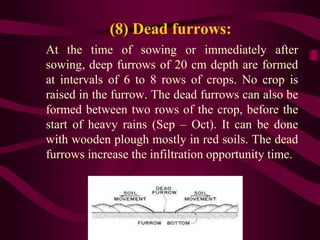
(8) Dead furrows:
At the time of sowing or immediately after
sowing, deep furrows of 20 cm depth are formed
at intervals of 6 to 8 rows of crops. No crop is
raised in the furrow. The dead furrows can also be
formed between two rows of the crop, before the
start of heavy rains (Sep – Oct). It can be done
with wooden plough mostly in red soils. The dead
furrows increase the infiltration opportunity time.

Soil and moisture conservation techniques

  • 1.
    Soil and MoistureConservation Techniques Prepared by: Dr. Pooja Goswami Assistant Professor (Agronomy) College of Agriculture, Balaghat (M.P.)
  • 2.
    Soil and MoistureConservation Techniques Methods of soil and water conservation fall into two important classes, viz. Agronomic measures Engineering measures.
  • 3.
    Agronomical measures areadopted: where land slope is <2 per cent, which are followings: 1. Conservation Tillage 2. Deep tillage 3. Conservation Farming 4. Contour Farming 5. Mulching 6. Growing of cover crops 7. Strip cropping 8. Mixed cropping
  • 4.
    Conservation Tillage This umbrellaterm can include reduced tillage, minimum tillage, no-till, direct drill, mulch tillage, stubble-mulch farming, trash farming, strip tillage, plough-plant. The principles are equally effective in any conditions - to maximize cover by returning crop residues and not inverting the top soil, and by using a high crop density of vigorous crops.  Conservation tillage also has the advantage of reducing the need for terraces or other permanent structures. However there are several disadvantages which hinder the application of conservation tillage in semi-arid conditions:
  • 5.
    Deep Tillage One ofthe reasons for low yields in semi-arid areas is the limited amount of moisture available to crop roots. The available moisture will be increased if the rooting depth is increased and it has been shown that in some cases deep tillage can help, for example on the dense sandy soils. Deep tillage is beneficial for some crops but not all, and on some soils but not all. It requires greater draught power which is usually in short supply in semi-arid areas. Ripping or subsoiling can be beneficial, either to increase the porosity of the soil, or to break a pan which is reducing permeability. The deep placement of fertilizer can also be used to encourage more rooting at depth, but again the application of this technique to subsistence farming will be difficult.
  • 6.
    RESOURSE CONSERVATION FARMING Itincludes any farming practice which improves yield, or reliability, or decreases the inputs of labour or fertilizer, or anything else leading towards improved land husbandry, which we have defined as the foundation of good soil conservation. It includes strip cropping, crop rotations, alternate cropping, mixed cropping and inter planting, surface and mulching, organic mulches, deep planting of varieties, dry seeding etc.
  • 7.
    STRIP CROPPING Strip croppingis the system of growing alternate strips of erosion permitting crops (row crop such as maize, jowar, bajra, cotton etc) and erosion resisting crops (close growing crops such as green gram, black gram, moth, groundnut etc.) in the same field. This practice reduces the velocity of runoff and checks the eroded soil from being washed away.
  • 8.
    Continued… Strip cropping isessentially for controlling the run-off erosion and thereby maintaining the fertility of the soil is now universally recognized. Strip cropping, in effect, employs several good farming practices, including crop rotation, contour cultivation, proper tillage stubble mulching, cover cropping, etc. Strip cropping is of the following different forms : Contour strip cropping Field strip cropping Wind strip cropping Permanent or temporary buffer strip cropping
  • 9.
    CONTOUR-FARMING During intense rainstorms, the soil cannot absorb all the rain as it falls. The excess water flows down the slope under the influence of gravity. If farming is done up and down the slope, the flow of water is accelerated, because each furrow serves as a rill. The major part of the rain is drained away without infiltrating into the soil. The top fertile soil, along with plant nutrients and seeds, is washed off. All this results in a scanty and uneven growth of a crop. A simple practice of farming across the slope, keeping the same level, as far as possible is technically called contour- farming‖.
  • 10.
    Advantages of Contourfarming 1) Contour-farming reduces run-off and prevents soil erosion as Compared with the up and down cultivation in the major groups of soils in India, viz. Alluvial soils, black soils and deep lateritic soils. 2) Contour-farming conserves soil fertility and increases crop yields.
  • 11.
    MULCHING Any material used(spread) at surface or vertically in soil to assist soil and water conservation and soil productivity is called mulch. And process of applying mulches to soil is known as mulching. Mulching helps in conserving moisture, lowering soil temperatures around plant roots, reducing weed growth, etc thus helps crops during moisture stress conditions.
  • 12.
    Types of mulches 1.Plasticfilms: They help in maintaining higher water content in soil resulted from reduced evaporation, induced infiltration, reduced transpiration from weeds or combination of all these factors. Examples-Polythene, polyvinyl,etc. 2.Crop residues or stubble mulch: Crop residues and other plant waste products corn, and sawdust) are widely used as mulch. These materials are cheep and often readily available. The permit water to enter in the soil easily, when maintain at adequate level. These materials result in increased water content and reduced evaporation. Examples- Straw, cloves, leaves,etc.
  • 13.
    3.Saw dust mulch:Mulching with sawdust is a common practice. Sawdust is acidic, making it a good mulch choice for acid-loving plants. They have high water absorption capacity. 4.Soil or Dust mulch: If the surface of the soil is loosened, it acts as mulch for reducing evaporation. This loose surface of soil is called soil mulch or dust mulch. Inter-culturing creates soil mulch in growing crops and helps in closing deep cracks in Vertisols. 5.Vertical mulch: Vertical mulch is a technique which consists of digging suitable trenches across the slope and thus making more surface are a available for water absorption.
  • 14.
    ANTI-TRANSPIRANTS Anti-transpirants are thematerials or chemicals that applied to transpiring plant surfaces for reducing water loss from the plant. The purpose of ATs is to maintain the growth and productivity under stress conditions and it is never recommended for high productivity / unit area. The severity of intermittent drought of 6-10 days during critical stages of the crop can reasonably be avoided by the use of anti transpirants and thus crops can be save  Mainly four types of anti-transpirants: 1. Stomatal closing type 2. Film forming type 3. Reflectance type 4. Growth retardant
  • 15.
    Stomatal closing type:Most of the transpiration occur through the stomata on the leaf surface. They induce stomatal closing or decrease size and number of stomata which subsequently reduce the photosynthesis. Examples: Phenyl Mercuric Acetate (PMA) , Atrazine Film forming type: Plastic and waxy material which form a thin colourless film over the leaf surface and result in a physical barrier. These glossy films then reduce water loss on plants while at the same time allow them to breathe normally. Examples: Hexadecanol (Higher alcohols), Cetyl alcohol, Methanol , Paclobutrazol , Brassinolide , Resorcinol
  • 16.
    Reflecting type: Theyare white materials which form a coating on the leaves and increase the leaf reflectance (albedo). By reflecting the radiation, vapour pressure gradient and thus reduce transpiration. Examples: Kaoline(5%), China Clay, Calcium bicarbonate , Lime water Growth retardant: These chemicals reduce shoot growth and increase root growth and thus enable the plants to resist drought. They may also induce stomatal closure. Examples: cycocel
  • 17.
    Engineering measures. Engineering/Mechanical measuresare construction of mechanical barriers across the direction of the flow of water to retain the runoff for reducing soil and water loss. They are generally adopted where land slope is >2 per cent and to supplement the agronomical practices When the later alone are not adequately effective. These measures include: 1. Bunding 2. Terracing 2. Trenching 3. Basin-listing 4. Subsoiling
  • 18.
    1) BUNDING Bund isan earthen embankment constructed to control runoff and minimize soil erosion by reducing the length of slope. a) Contour Bunding  Contour bunding is most popular mechanical measure to control soil erosion and conserve moisture in arid and semi- arid areas with high infiltration and permeability.  This practice consists in making a comparatively narrow- based embankment at intervals across the slope of the land on a level that is along the contour.  It is commonly adopted on agricultural land up to a slope of about 6 per cent and in areas where average annual rainfall is < 600 mm.
  • 19.
    FORMULA IS USEDFOR DETERMINING SPACING OF BUNDS V.I= S/a + b where, V.I.= vertical interval (m) between consecutive builds S = % slope of land a' and .b' constants depends on soil and rainfall characteristics The height of the contour bunds depends on  slope of land, spacing of bunds and maximum intensity expected In deep black soils, contour bonds have been a failure due to cracking of bunds during dry months and water stagnation above the bunds for prolonged periods during rainy season.
  • 20.
    2. Graded Bunding/ChannelTerraces  In graded bunding water flows in graded channels constructed on up-stream side of bunds and leads to safe outlet on grassed water ways.  Graded bunds may be narrow-based or broad-based. A broad-based graded terrace consists of a wide-low embankment constructed on the lower edge of the channel from which the soil is excavated. The channel is excavated at suitable intervals on a falling contour with a suitable longitudinal grade. It is adopted at about 2-10 per cent land slope and in areas where average annual rainfall is > 600 mm.
  • 21.
    3. Compartmental bunding: Smallbunds of 15 cm width and 15 cm height are formed in both directions to divide the field into small basins or compartments of square or rectangular shape of 6 x 6 m to 10 x 10 m size using bund former . They are useful for temporary impounding of rain water which facilitates high infiltration resulting in high moisture storage in the soil. Recommended for black soils with a slope of 0.5 to 1%. Maize, sunflower, sorghum perform well in this type of bunding.
  • 22.
  • 23.
    4. Grass waterways Grasswaterways are natural or constructed watercourses covered with erosion resistant grasses and are used to dispose surface water from the crop land. They are constructed along the slope of the land.  Grassed waterways are associated with channel terraces for the safe disposal of concentrated runoff, thereby protecting the land against rills and gullies.  The suitability of a grass was based on the cover it gave, the ease with which it was established and the forage yield obtained from it.  Panicum repens was the best suited grass, followed by Brachiara mutica, Cynodon plectostachyus, Cynodon dactylon and Paspalum notatum.
  • 24.
    2) TERRACING A terracingis a combination of ridge and channels built across the slope. This is generally practiced in steep hill slope. (a) Bench Terracing: Bench terrace consists of construction of step like fields along the contour by half cutting and half filling. Original slope of the land is converted into level fields and thus all hazards of erosion are eliminated. (b) The vertical drop may vary from 60 to 180 cm, depending upon the slope and soil conditions, as also on the economic width required for easy cultural operations.
  • 25.
    Continued… The material excavatedfrom the upper part of the terrace is used in filling the lower part.  A small ‗shoulder‘ bund of about 30 cm in height is also constructed along the outer edge of the terrace.  It is generally practiced on steep sloping (16-33 per cent) and undulated land.  It helps to bring sloping land into different level strips to enable cultivation.  Bench terraces may be ‗table top‘ or sloping outward or inward with or without a slight longitudinal grade, according to the rainfall of the tract - medium, poor or heavy, and the soil and the subsoil are fairly absorptive
  • 26.
    3) TRENCHING Trenching ismade along the contour for soil & moisture conservation and afforestation purpose.  The size of trenches – 60cm x 48cm  Spacing between trenches – 10-30 meter  Trenches are half refilled with excavated materials and remaining half of the soil forms the spoil bank.  The remaining water in the trenches help in conserving the moisture and provides benefits for sowing and planting.
  • 27.
    4) SUBSOILING This methodconsists of breaking the hard and impermeable subsoil with a subsoiler to conserve more rainwater by improving the physical conditions of a soil. This operation, which does not involve soil inversion and promotes greater moisture penetration into the soil, reduces both run-off and soil erosion. The subsoiler is worked through the soil at a depth of 30-60 cm at a spacing of 90-180 cm. Sub soling by tractor drawn chisel plough at 2 m horizontal interval is the most effective insitu soil and water conservation practice for early establishment and improving the pasture. It will also increase the efficiency of work and a large area can be covered in a few cost and limited time.
  • 28.
    5) CHECK DAM Alow weir normally constructed across the gullies.  Constructed on small streams and long gullies formed by erosive activity of flood water.  It cuts the velocity and reduces erosive activity.  The stored water improves soil moisture of the adjoining area and allows percolation to recharge the aquifers. Spacing between the check dams water spread of one should be beyond the water spread of the other.  Height depends on the bank height, varies from a metre to 3 metre and length varies from less than 3m to 10m.
  • 29.
    6) Ridges andfurrows: The field must be formed into ridges and furrows. Furrows of 30-45 cm width and 15-20 cm height are formed across the slope. The furrows guide runoff water safely when rainfall intensity is high and avoid water stagnation. They collect and store water when rainfall intensity is less. It is suitable for medium deep to deep black soils and deep red soils. It can be practiced in wide row spaced crops like cotton, maize, chillies, tomato etc. It is not suitable for shallow red soils, shallow black soils and sandy/ gravelly soils. It is not suitable for broadcast sown crops and for crops sown at closer row spacing less than 30 cm. Since furrows are formed usually before sowing, sowing by dibbling or planting alone is possible.
  • 30.
  • 31.
    (7) Broad bedfurrows (BBF): This practice has been recommended by ICRISAT for vertisols or black soils in high rainfall areas (> 750 mm). Here beds of 90-120cm width, 15 cm height and convenient length are formed, separated by furrows of 60 cm width and 15 cm depth. When runoff occurs, its velocity will be reduced by beds and infiltration opportunity time is increased. The furrows have a gradient of 0.6%. Crops are sown on the broad beds and excess water is drained through number of small furrows which may be connected to farm ponds. It can be formed by bullock drawn or tractor drawn implements. Bed former cum seed drill enables BBF formation and sowing simultaneously, thus reducing the delay between receipt rainfall and sowing.
  • 32.
  • 33.
    Advantages of BBF Broadbed furrow has many advantages over other methods. • It helps in moisture storage • Safely dispose off surplus surface runoff without causing erosion • Provide better drainage facilities • Facilitate dry seeding • It can accommodate a wide range of crop geometry i.e. close as well as wide row spacing. • It is suitable for both sole cropping and intercropping systems. • Sowing can be done with seed drills.
  • 34.
    (8) Dead furrows: Atthe time of sowing or immediately after sowing, deep furrows of 20 cm depth are formed at intervals of 6 to 8 rows of crops. No crop is raised in the furrow. The dead furrows can also be formed between two rows of the crop, before the start of heavy rains (Sep – Oct). It can be done with wooden plough mostly in red soils. The dead furrows increase the infiltration opportunity time.