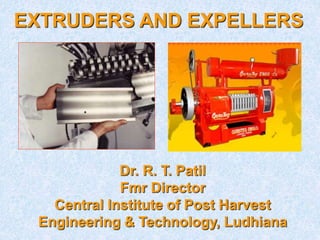
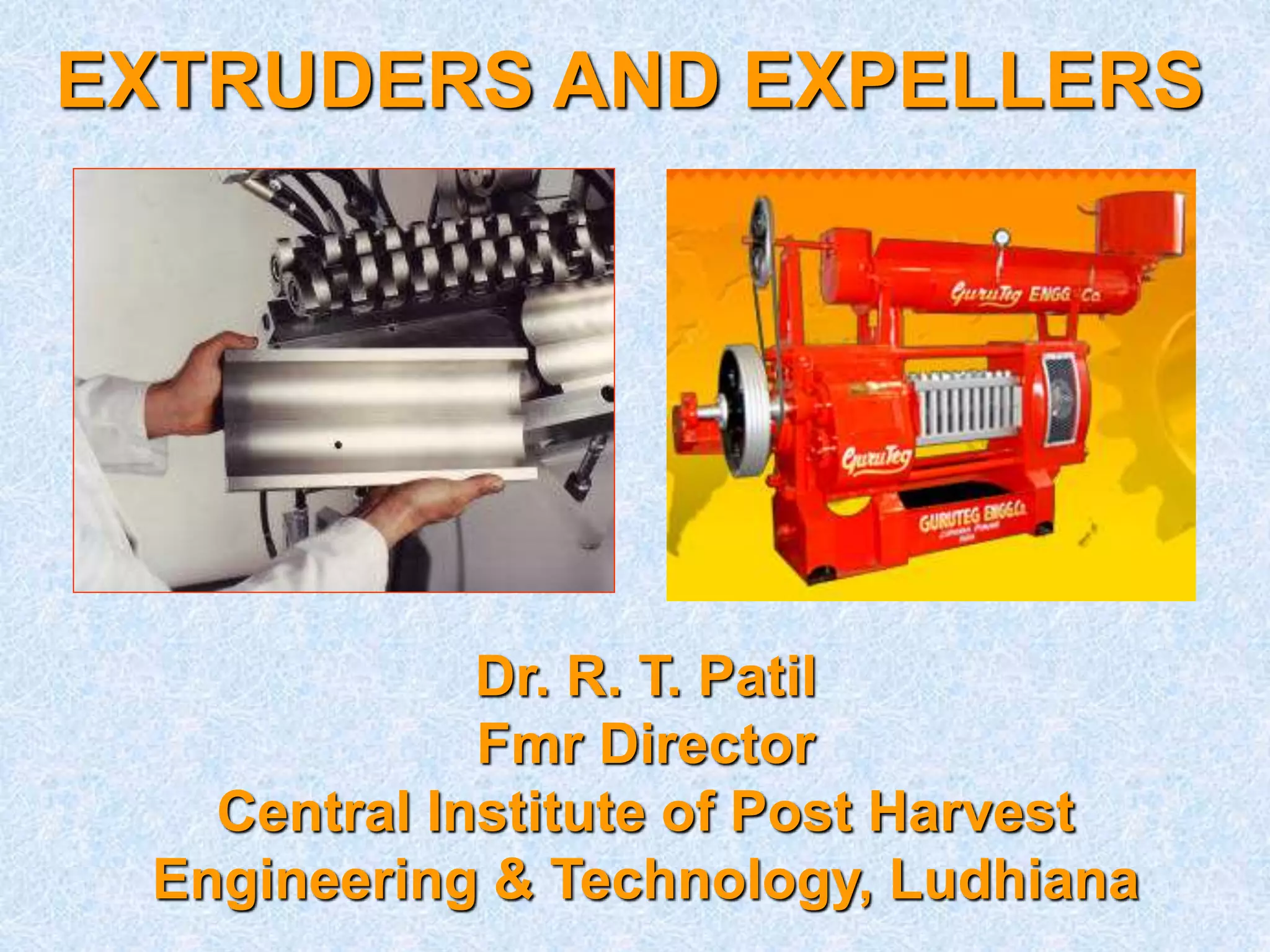
EXTRUDERS AND EXPELLERS
Dr. R. T. Patil
Fmr Director
Central Institute of Post Harvest
Engineering & Technology, Ludhiana
• A single machine conveys, mixes, kneads,
cooks and forms in one continuous
process.
• The energy input comes mainly from the
conversion of mechanical to thermal
energy.
• Extruded food materials undergo various
transformations like starch gelatinization,
fragmentation and protein denaturation
• It is widely used to manufacture breakfast
cereals and snacks and other emerging
application to increase process efficiencies.
Extrusion Processing
• Low-shear (forming) extruders: used to increase
density of material that is generally high in moisture
(e.g. pasta) using low screw speeds.
• Medium-shear stress: used to process raw materials
with lower moisture content with higher energy
inputs (e.g. pet foods, aquatic feeds, texturized
vegetable protein).
• High-shear stress: where extrusion speeds and
energy inputs are high to process low-moisture raw
materials in a short length-to-diameter ratio barrel.
Highly expanded products are obtained (e.g. snacks,
breakfast cereals).
Classification of Extrusion Processes
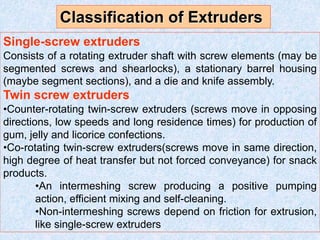
Single-screw extruders
Consists of a rotating extruder shaft with screw elements (may be
segmented screws and shearlocks), a stationary barrel housing
(maybe segment sections), and a die and knife assembly.
Twin screw extruders
•Counter-rotating twin-screw extruders (screws move in opposing
directions, low speeds and long residence times) for production of
gum, jelly and licorice confections.
•Co-rotating twin-screw extruders(screws move in same direction,
high degree of heat transfer but not forced conveyance) for snack
products.
•An intermeshing screw producing a positive pumping
action, efficient mixing and self-cleaning.
•Non-intermeshing screws depend on friction for extrusion,
like single-screw extruders
Classification of Extruders
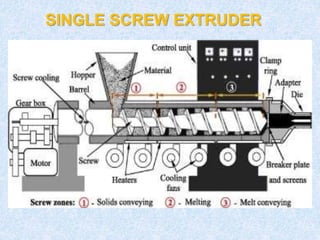
SINGLE SCREW EXTRUDER
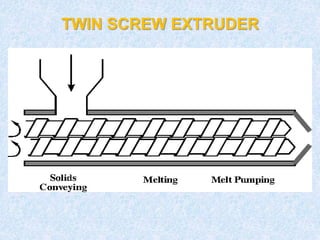
TWIN SCREW EXTRUDER
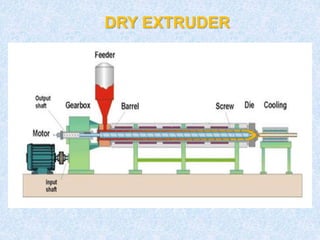
DRY EXTRUDER
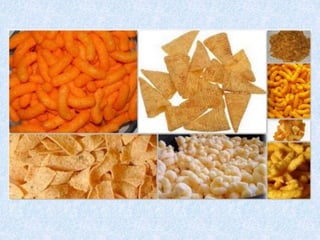
• Second generation snacks: are those that
expand when they come out of the extruder.
This is the most popular type of expanded
snack.
• Third generation snacks: or pellets do not
expand when they come out of the extruder.
After storage, the pellets are puffed by frying,
microwave heating or hot air puffing.
Expanded Snacks Produced
by Extrusion
• Have angled steam injector ports oriented in the
direction of material flow, along with a unique
screw profile that allows steam to be mixed into
the product and can utilize up to four times more
thermal energy than the average twin screw
machine.
• They translate thermal to mechanical energy
ratios of 14:1, lowering energy costs, less wear
and a lower environmental impact.
• Potential to produce specialty foods including up
to 90 percent fresh meat (as a percent of the dry
recipe) and up to 40 percent moisture without
changing the extruder configuration.
Thermal Twin Extrusion Systems
• Supercritical CO2 is injected into mixer and
extruder to provide proofing of the product.
• Rising of the dough is achieved by a
combination of hydrodynamic expansion of air
bubbles and diffusion of CO2 into these bubbles
without the need for yeast.
• The controlled acid hydrolysis of the starches in
the dough helps to produce reducing sugars
that add desirable flavor to the final product.
Super Critical Fluid Extrusion for
Breadlike Products
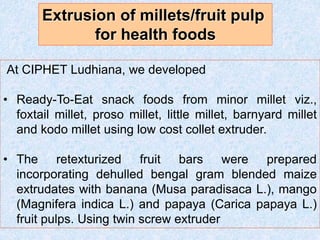
At CIPHET Ludhiana, we developed
• Ready-To-Eat snack foods from minor millet viz.,
foxtail millet, proso millet, little millet, barnyard millet
and kodo millet using low cost collet extruder.
• The retexturized fruit bars were prepared
incorporating dehulled bengal gram blended maize
extrudates with banana (Musa paradisaca L.), mango
(Magnifera indica L.) and papaya (Carica papaya L.)
fruit pulps. Using twin screw extruder
Extrusion of millets/fruit pulp
for health foods
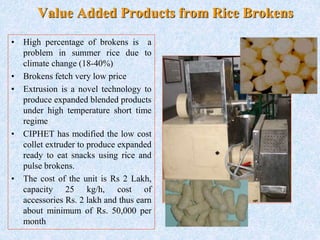
Value Added Products from Rice Brokens
• High percentage of brokens is a
problem in summer rice due to
climate change (18-40%)
• Brokens fetch very low price
• Extrusion is a novel technology to
produce expanded blended products
under high temperature short time
regime
• CIPHET has modified the low cost
collet extruder to produce expanded
ready to eat snacks using rice and
pulse brokens.
• The cost of the unit is Rs 2 Lakh,
capacity 25 kg/h, cost of
accessories Rs. 2 lakh and thus earn
about minimum of Rs. 50,000 per
month
• More homogeneous and consistent cooking
process minimum waste.
• Extrusion is a very efficient and clean process,
since all steps can be done in-line: mixing,
cooking, forming, cooling, and cutting.
• Modular designs allow changing from one
product to another product, color, or shape to
be done within minutes—a significant process
efficiency.
• Twin-screw extruders are largely self-cleaning,
an advantage from the viewpoint of both
sanitation and labor savings.
Conclusion
Extractors
• Oil Seed Production of India is 30 million tonnes, losses are to
about 6%.
• Oil from by products
–Rice Bran
–Maize Germ
–Millet bran
• Oilseed processing is a major segment, an activity largely
concentrated in the cottage industry.
• 2.5 lakh ghanis and kolus which are animal operated oil
expellers (cake has 15% fat)
• 50,000 mechanical oil expellers (Cake 6-8%)
• 15,500 oil mills (Cake 5-6%)
• 725 solvent extraction plants (Cake/Meal <1%)
• 300 oil refineries and
• over 175 hydrogenated vegetable oil plants.
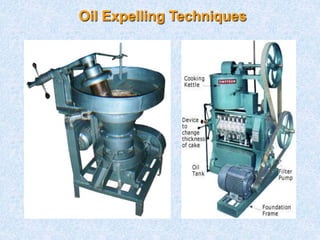
Oil Expelling Techniques
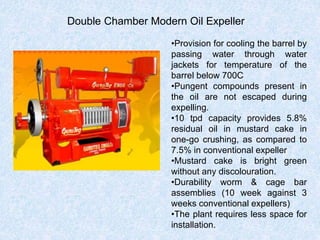
Double Chamber Modern Oil Expeller
•Provision for cooling the barrel by
passing water through water
jackets for temperature of the
barrel below 700C
•Pungent compounds present in
the oil are not escaped during
expelling.
•10 tpd capacity provides 5.8%
residual oil in mustard cake in
one-go crushing, as compared to
7.5% in conventional expeller
•Mustard cake is bright green
without any discolouration.
•Durability worm & cage bar
assemblies (10 week against 3
weeks conventional expellers)
•The plant requires less space for
installation.
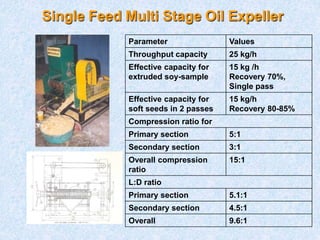
Parameter Values
Throughput capacity 25 kg/h
Effective capacity for
extruded soy-sample
15 kg /h
Recovery 70%,
Single pass
Effective capacity for
soft seeds in 2 passes
15 kg/h
Recovery 80-85%
Compression ratio for
Primary section 5:1
Secondary section 3:1
Overall compression
ratio
15:1
L:D ratio
Primary section 5.1:1
Secondary section 4.5:1
Overall 9.6:1
Single Feed Multi Stage Oil Expeller
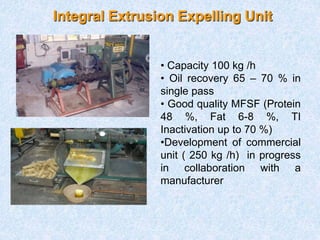
• Capacity 100 kg /h
• Oil recovery 65 – 70 % in
single pass
• Good quality MFSF (Protein
48 %, Fat 6-8 %, TI
Inactivation up to 70 %)
•Development of commercial
unit ( 250 kg /h) in progress
in collaboration with a
manufacturer
Integral Extrusion Expelling Unit
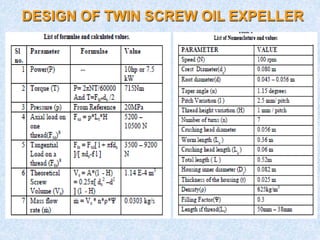
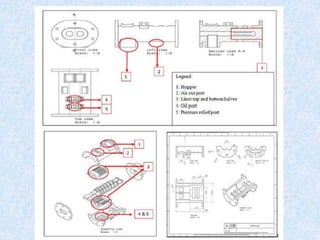
DESIGN OF TWIN SCREW OIL EXPELLER
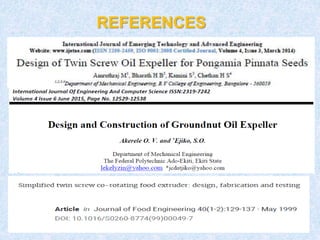
REFERENCES
Thank You
Contact: ramabhau@gmail.com
Mob. No. 8964030701

Extruders and expellers

  • 1.
    EXTRUDERS AND EXPELLERS Dr.R. T. Patil Fmr Director Central Institute of Post Harvest Engineering & Technology, Ludhiana
  • 2.
    • A singlemachine conveys, mixes, kneads, cooks and forms in one continuous process. • The energy input comes mainly from the conversion of mechanical to thermal energy. • Extruded food materials undergo various transformations like starch gelatinization, fragmentation and protein denaturation • It is widely used to manufacture breakfast cereals and snacks and other emerging application to increase process efficiencies. Extrusion Processing
  • 3.
    • Low-shear (forming)extruders: used to increase density of material that is generally high in moisture (e.g. pasta) using low screw speeds. • Medium-shear stress: used to process raw materials with lower moisture content with higher energy inputs (e.g. pet foods, aquatic feeds, texturized vegetable protein). • High-shear stress: where extrusion speeds and energy inputs are high to process low-moisture raw materials in a short length-to-diameter ratio barrel. Highly expanded products are obtained (e.g. snacks, breakfast cereals). Classification of Extrusion Processes
  • 4.
    Single-screw extruders Consists ofa rotating extruder shaft with screw elements (may be segmented screws and shearlocks), a stationary barrel housing (maybe segment sections), and a die and knife assembly. Twin screw extruders •Counter-rotating twin-screw extruders (screws move in opposing directions, low speeds and long residence times) for production of gum, jelly and licorice confections. •Co-rotating twin-screw extruders(screws move in same direction, high degree of heat transfer but not forced conveyance) for snack products. •An intermeshing screw producing a positive pumping action, efficient mixing and self-cleaning. •Non-intermeshing screws depend on friction for extrusion, like single-screw extruders Classification of Extruders
  • 5.
  • 6.
  • 7.
  • 8.
    • Second generationsnacks: are those that expand when they come out of the extruder. This is the most popular type of expanded snack. • Third generation snacks: or pellets do not expand when they come out of the extruder. After storage, the pellets are puffed by frying, microwave heating or hot air puffing. Expanded Snacks Produced by Extrusion
  • 10.
    • Have angledsteam injector ports oriented in the direction of material flow, along with a unique screw profile that allows steam to be mixed into the product and can utilize up to four times more thermal energy than the average twin screw machine. • They translate thermal to mechanical energy ratios of 14:1, lowering energy costs, less wear and a lower environmental impact. • Potential to produce specialty foods including up to 90 percent fresh meat (as a percent of the dry recipe) and up to 40 percent moisture without changing the extruder configuration. Thermal Twin Extrusion Systems
  • 11.
    • Supercritical CO2is injected into mixer and extruder to provide proofing of the product. • Rising of the dough is achieved by a combination of hydrodynamic expansion of air bubbles and diffusion of CO2 into these bubbles without the need for yeast. • The controlled acid hydrolysis of the starches in the dough helps to produce reducing sugars that add desirable flavor to the final product. Super Critical Fluid Extrusion for Breadlike Products
  • 12.
    At CIPHET Ludhiana,we developed • Ready-To-Eat snack foods from minor millet viz., foxtail millet, proso millet, little millet, barnyard millet and kodo millet using low cost collet extruder. • The retexturized fruit bars were prepared incorporating dehulled bengal gram blended maize extrudates with banana (Musa paradisaca L.), mango (Magnifera indica L.) and papaya (Carica papaya L.) fruit pulps. Using twin screw extruder Extrusion of millets/fruit pulp for health foods
  • 13.
    Value Added Productsfrom Rice Brokens • High percentage of brokens is a problem in summer rice due to climate change (18-40%) • Brokens fetch very low price • Extrusion is a novel technology to produce expanded blended products under high temperature short time regime • CIPHET has modified the low cost collet extruder to produce expanded ready to eat snacks using rice and pulse brokens. • The cost of the unit is Rs 2 Lakh, capacity 25 kg/h, cost of accessories Rs. 2 lakh and thus earn about minimum of Rs. 50,000 per month
  • 14.
    • More homogeneousand consistent cooking process minimum waste. • Extrusion is a very efficient and clean process, since all steps can be done in-line: mixing, cooking, forming, cooling, and cutting. • Modular designs allow changing from one product to another product, color, or shape to be done within minutes—a significant process efficiency. • Twin-screw extruders are largely self-cleaning, an advantage from the viewpoint of both sanitation and labor savings. Conclusion
  • 15.
    Extractors • Oil SeedProduction of India is 30 million tonnes, losses are to about 6%. • Oil from by products –Rice Bran –Maize Germ –Millet bran • Oilseed processing is a major segment, an activity largely concentrated in the cottage industry. • 2.5 lakh ghanis and kolus which are animal operated oil expellers (cake has 15% fat) • 50,000 mechanical oil expellers (Cake 6-8%) • 15,500 oil mills (Cake 5-6%) • 725 solvent extraction plants (Cake/Meal <1%) • 300 oil refineries and • over 175 hydrogenated vegetable oil plants.
  • 16.
  • 17.
    Double Chamber ModernOil Expeller •Provision for cooling the barrel by passing water through water jackets for temperature of the barrel below 700C •Pungent compounds present in the oil are not escaped during expelling. •10 tpd capacity provides 5.8% residual oil in mustard cake in one-go crushing, as compared to 7.5% in conventional expeller •Mustard cake is bright green without any discolouration. •Durability worm & cage bar assemblies (10 week against 3 weeks conventional expellers) •The plant requires less space for installation.
  • 18.
    Parameter Values Throughput capacity25 kg/h Effective capacity for extruded soy-sample 15 kg /h Recovery 70%, Single pass Effective capacity for soft seeds in 2 passes 15 kg/h Recovery 80-85% Compression ratio for Primary section 5:1 Secondary section 3:1 Overall compression ratio 15:1 L:D ratio Primary section 5.1:1 Secondary section 4.5:1 Overall 9.6:1 Single Feed Multi Stage Oil Expeller
  • 19.
    • Capacity 100kg /h • Oil recovery 65 – 70 % in single pass • Good quality MFSF (Protein 48 %, Fat 6-8 %, TI Inactivation up to 70 %) •Development of commercial unit ( 250 kg /h) in progress in collaboration with a manufacturer Integral Extrusion Expelling Unit
  • 20.
    DESIGN OF TWINSCREW OIL EXPELLER
  • 22.
  • 23.