Advances in Oil Seed
Processing Technologies
Dr. R.T. Patil
Former Director, CIPHET, Ludhiana
Chairman, Benevole Welfare Society for Post
Harvest Technology, Bhopal
Availability of Oils
•The current demand for vegetable oil in India is
around 235 million tonnes.
•Primary sources include Groundnut, Rapeseed
(Mustard), Soyabean, Sunflower, Sesamum,
Niger seeds, Safflower, Castor and Linseed
(60MT)
•Secondary sources include Coconut, Cottonseed,
Ricebran, Solvent Extracted Oils and oils from
Tree and forest origin (29MT)
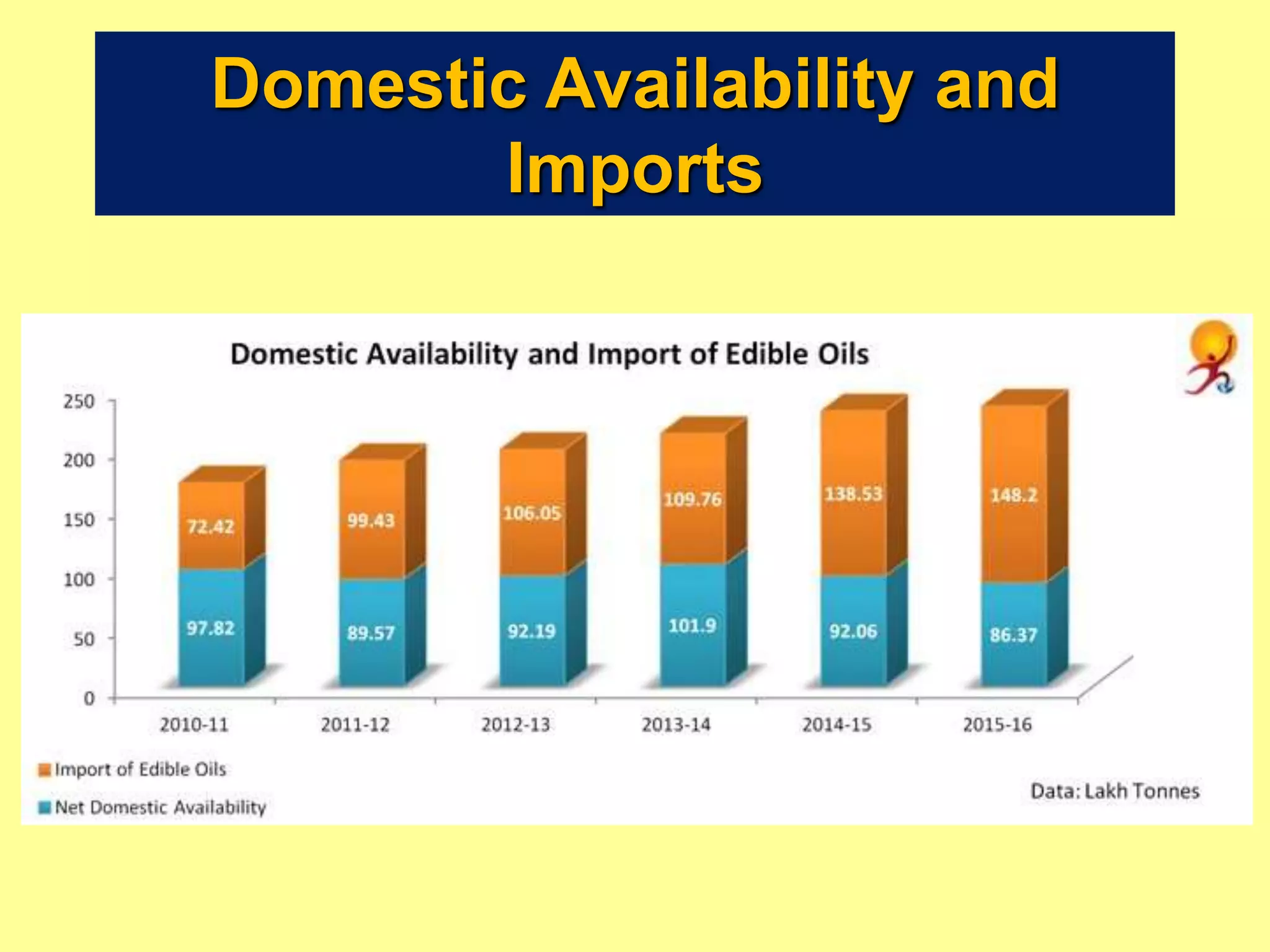
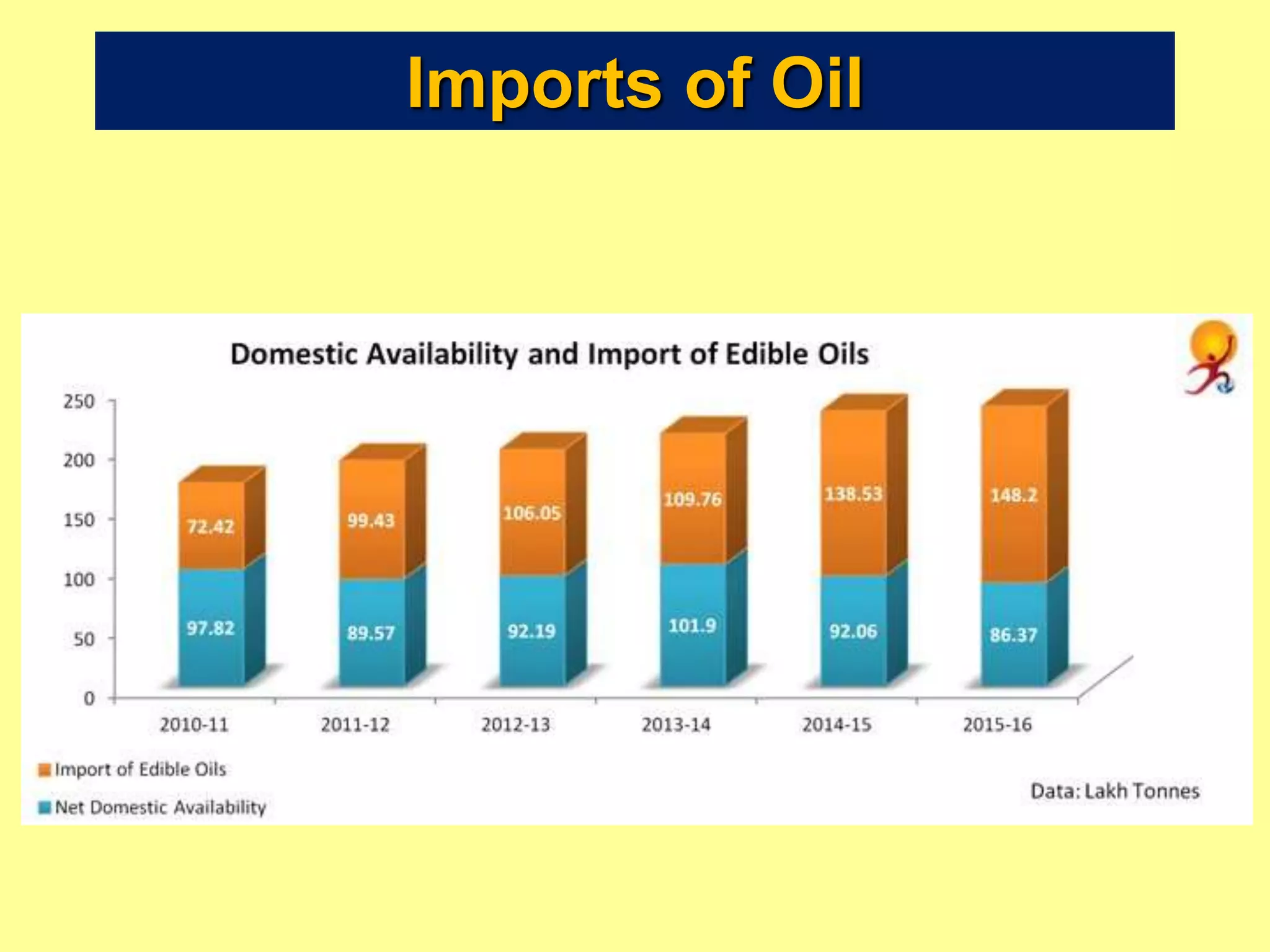
•In 2015-16, India imported 148.20 million tonnes
of edible oils. Thus, India has an alarming
level of import dependency on oil.
Domestic Availability and
Imports
Imports of Oil
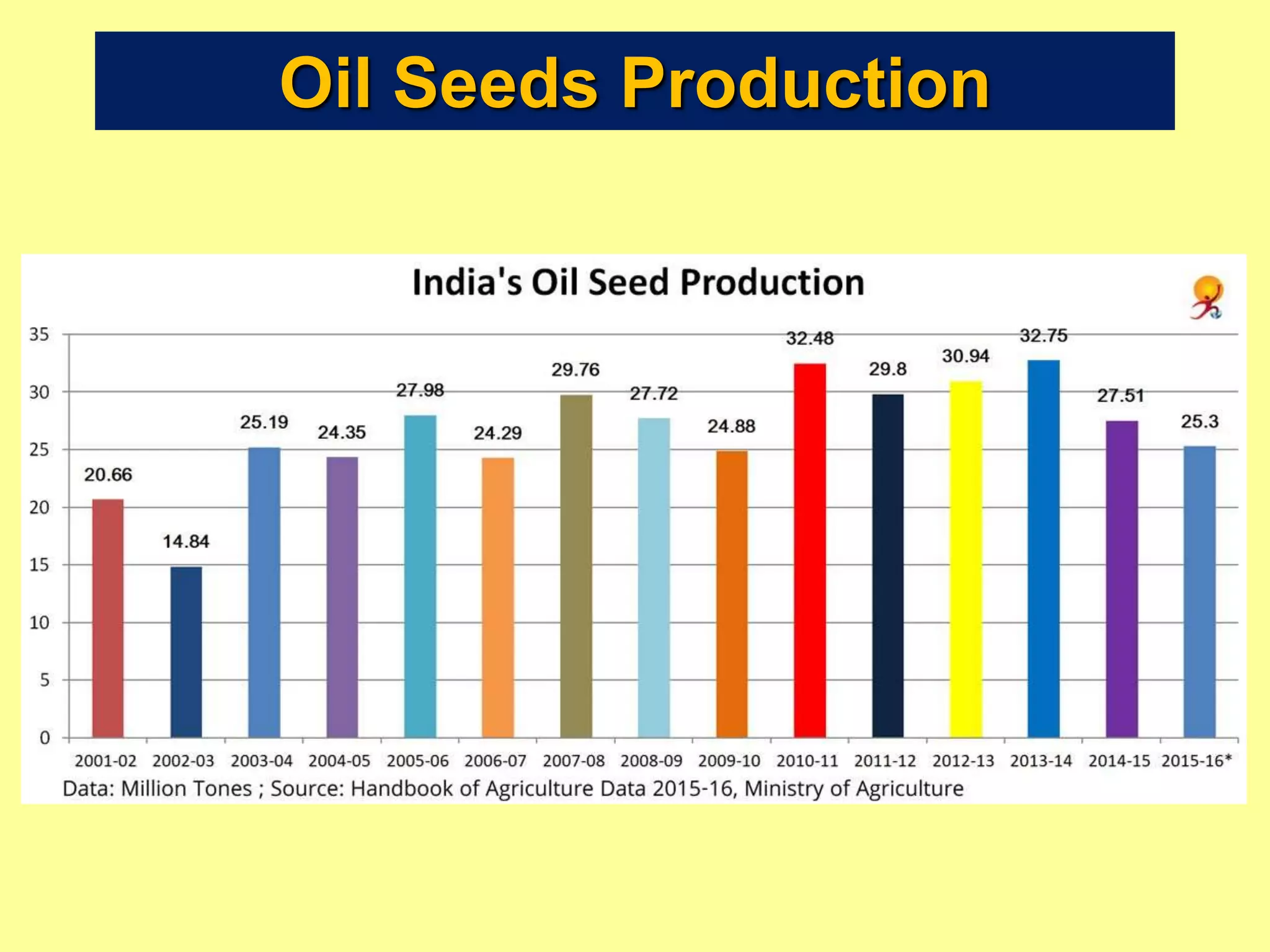
Oil Seeds Production
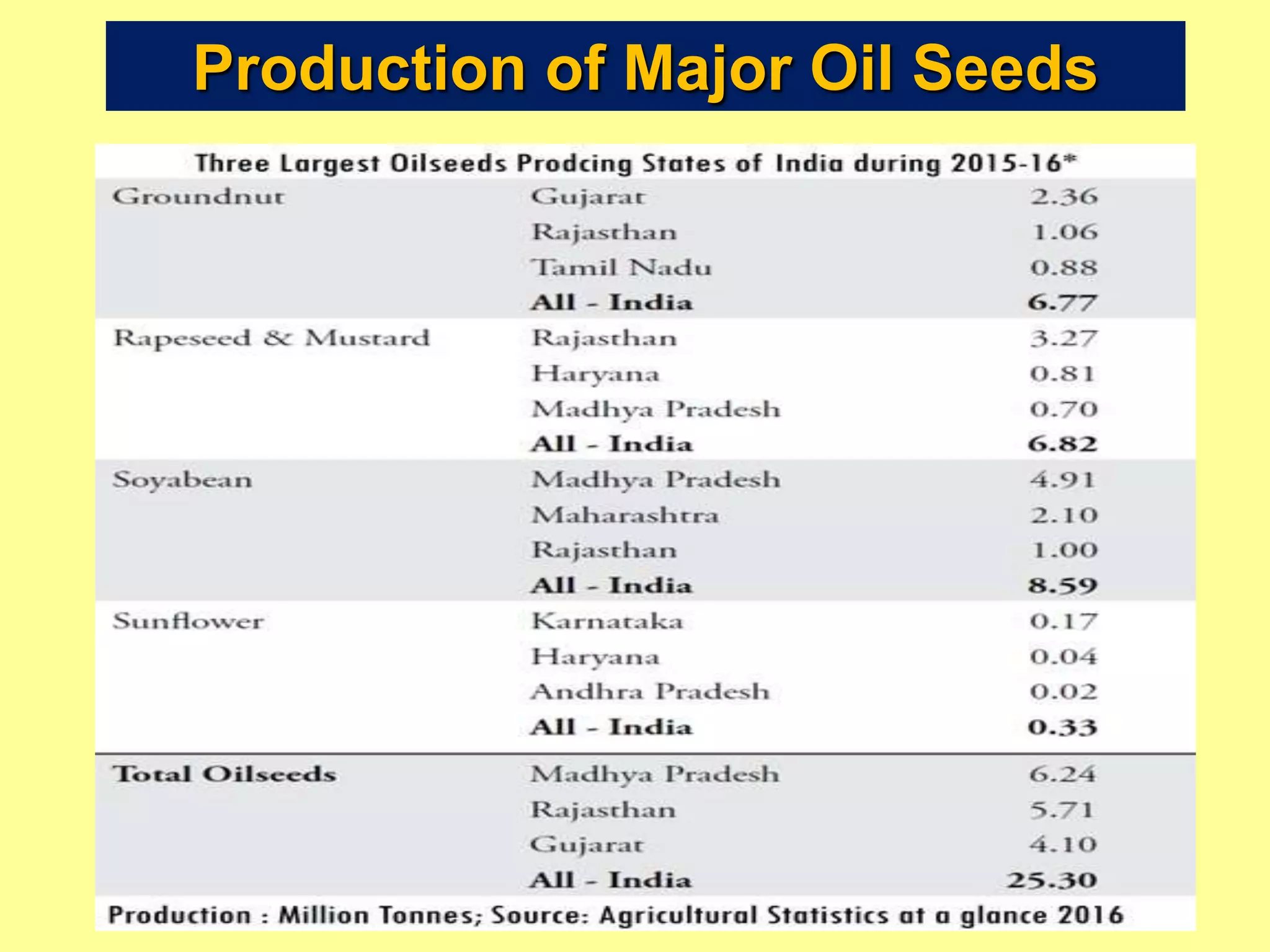
Production of Major Oil Seeds
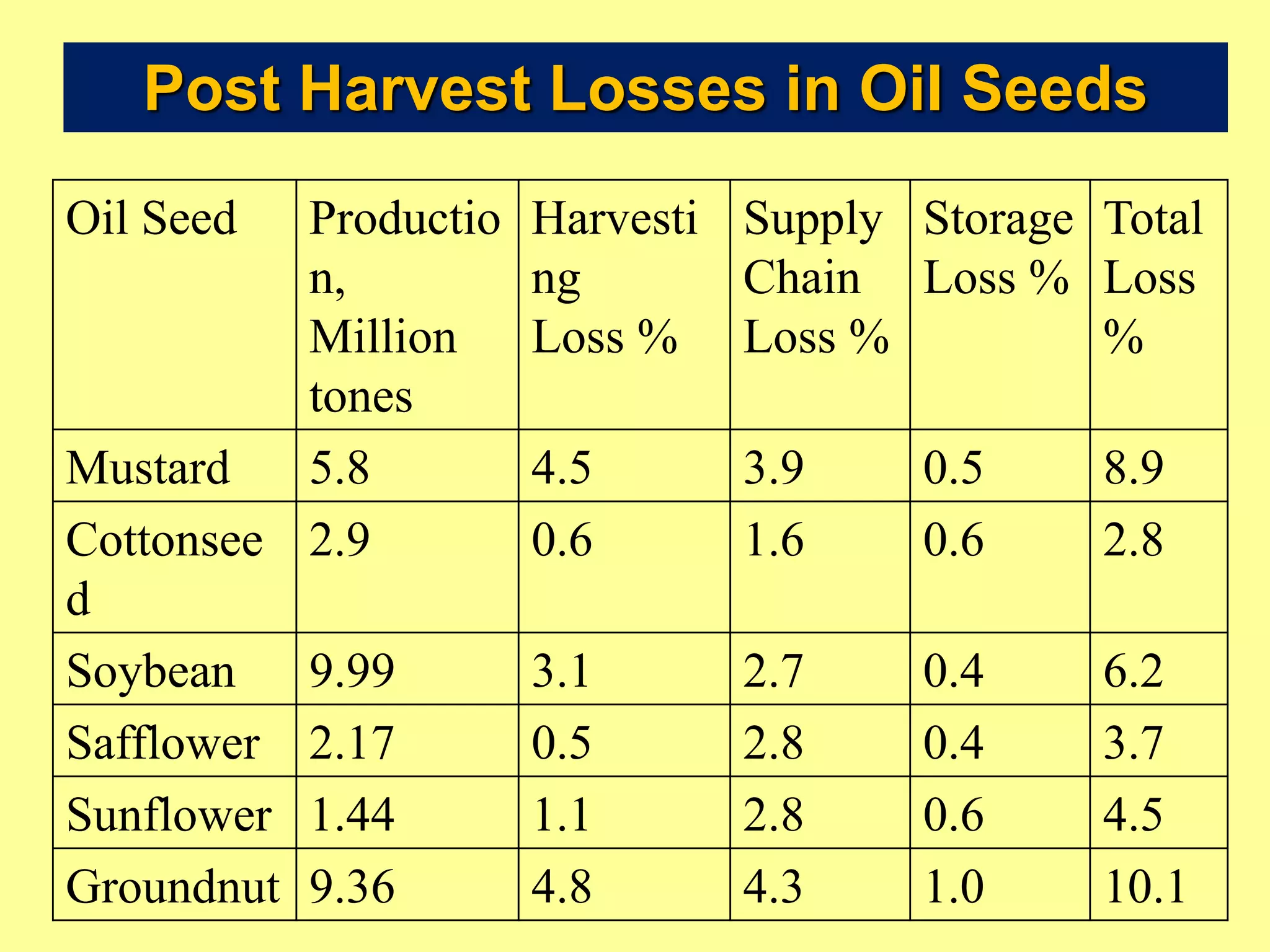
Post Harvest Losses in Oil Seeds
Oil Seed Productio
n,
Million
tones
Harvesti
ng
Loss %
Supply
Chain
Loss %
Storage
Loss %
Total
Loss
%
Mustard 5.8 4.5 3.9 0.5 8.9
Cottonsee
d
2.9 0.6 1.6 0.6 2.8
Soybean 9.99 3.1 2.7 0.4 6.2
Safflower 2.17 0.5 2.8 0.4 3.7
Sunflower 1.44 1.1 2.8 0.6 4.5
Groundnut 9.36 4.8 4.3 1.0 10.1
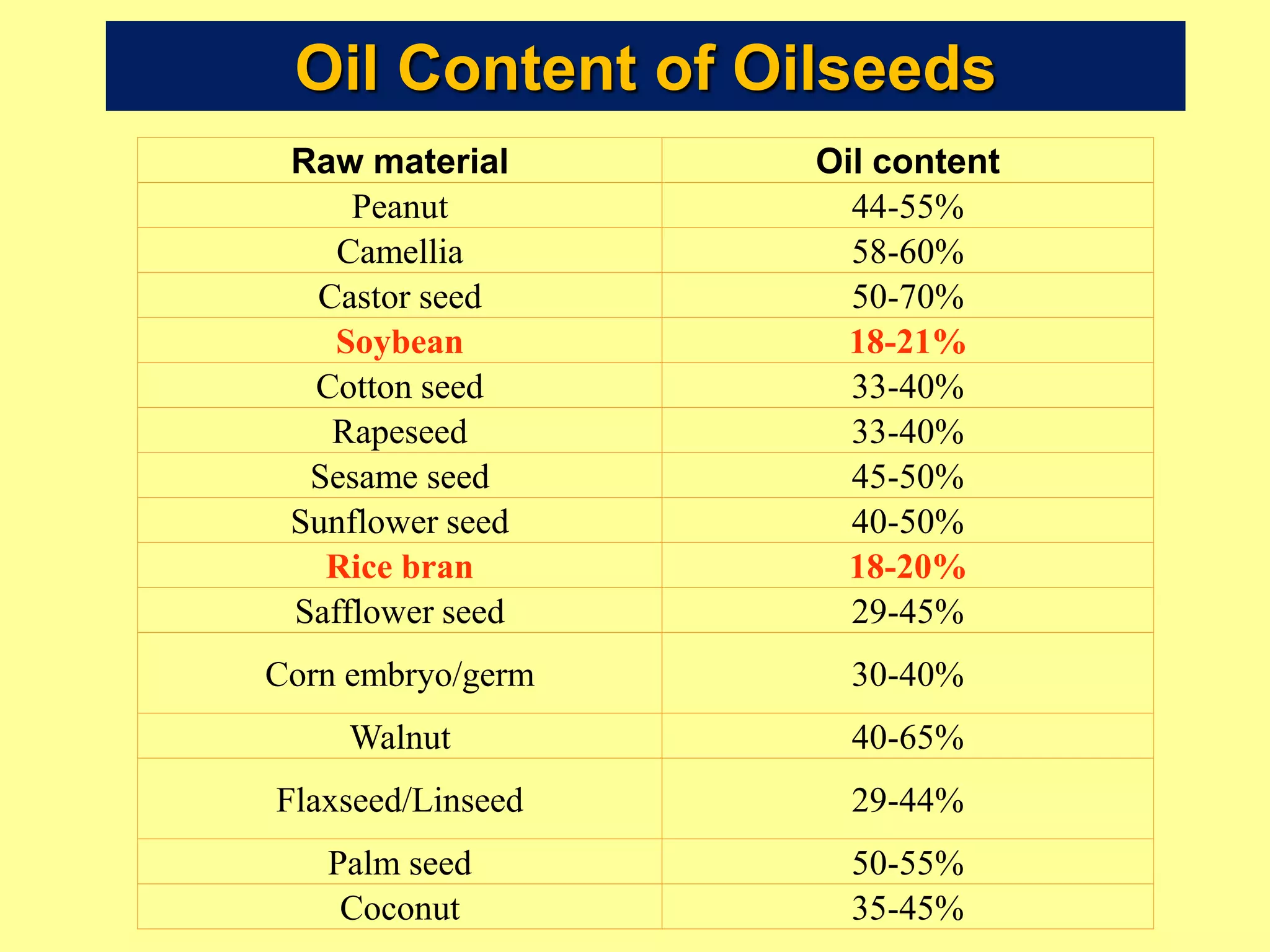
Oil Content of Oilseeds
Raw material Oil content
Peanut 44-55%
Camellia 58-60%
Castor seed 50-70%
Soybean 18-21%
Cotton seed 33-40%
Rapeseed 33-40%
Sesame seed 45-50%
Sunflower seed 40-50%
Rice bran 18-20%
Safflower seed 29-45%
Corn embryo/germ 30-40%
Walnut 40-65%
Flaxseed/Linseed 29-44%
Palm seed 50-55%
Coconut 35-45%
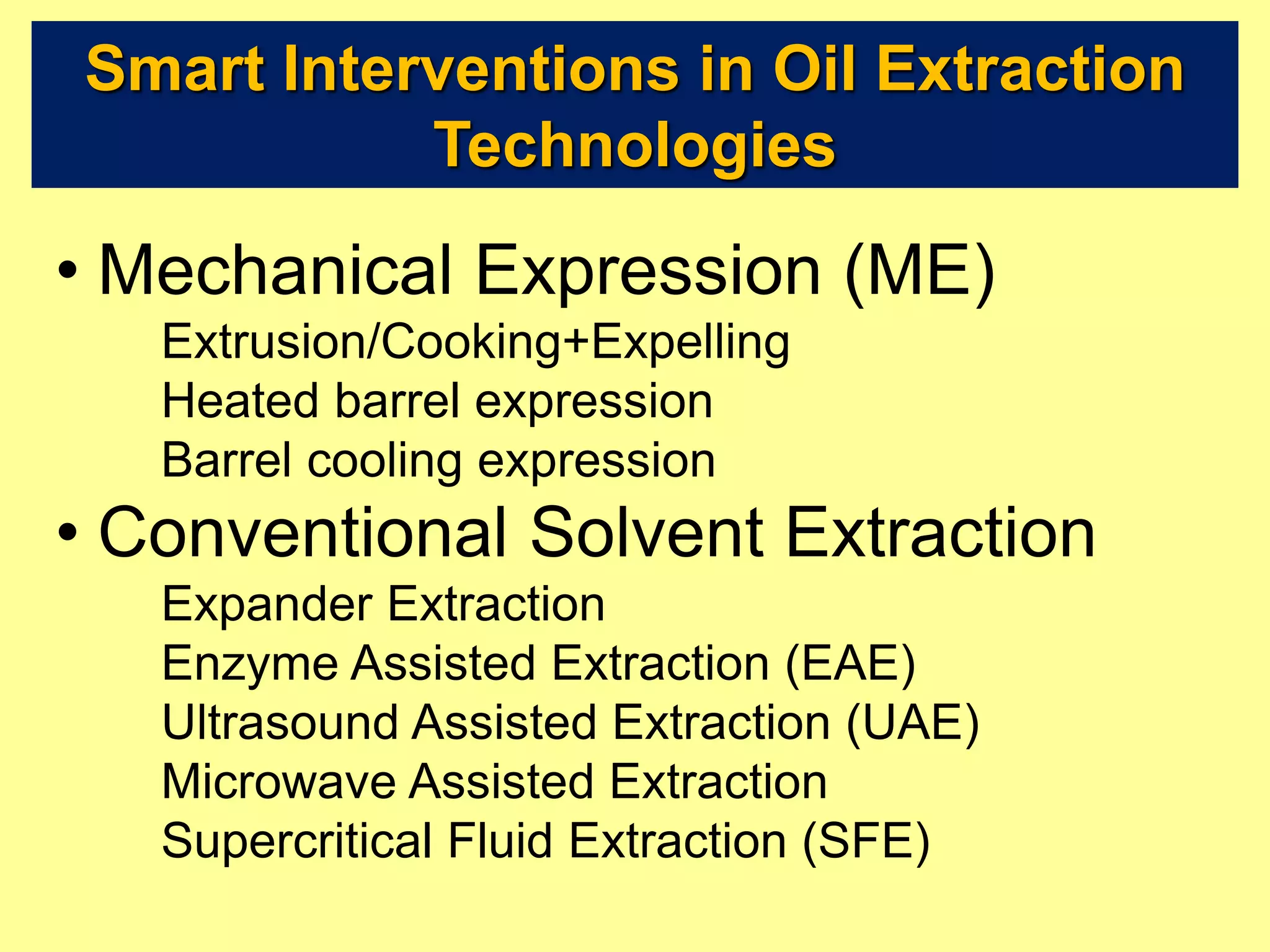
Smart Interventions in Oil Extraction
Technologies
• Mechanical Expression (ME)
Extrusion/Cooking+Expelling
Heated barrel expression
Barrel cooling expression
• Conventional Solvent Extraction
Expander Extraction
Enzyme Assisted Extraction (EAE)
Ultrasound Assisted Extraction (UAE)
Microwave Assisted Extraction
Supercritical Fluid Extraction (SFE)
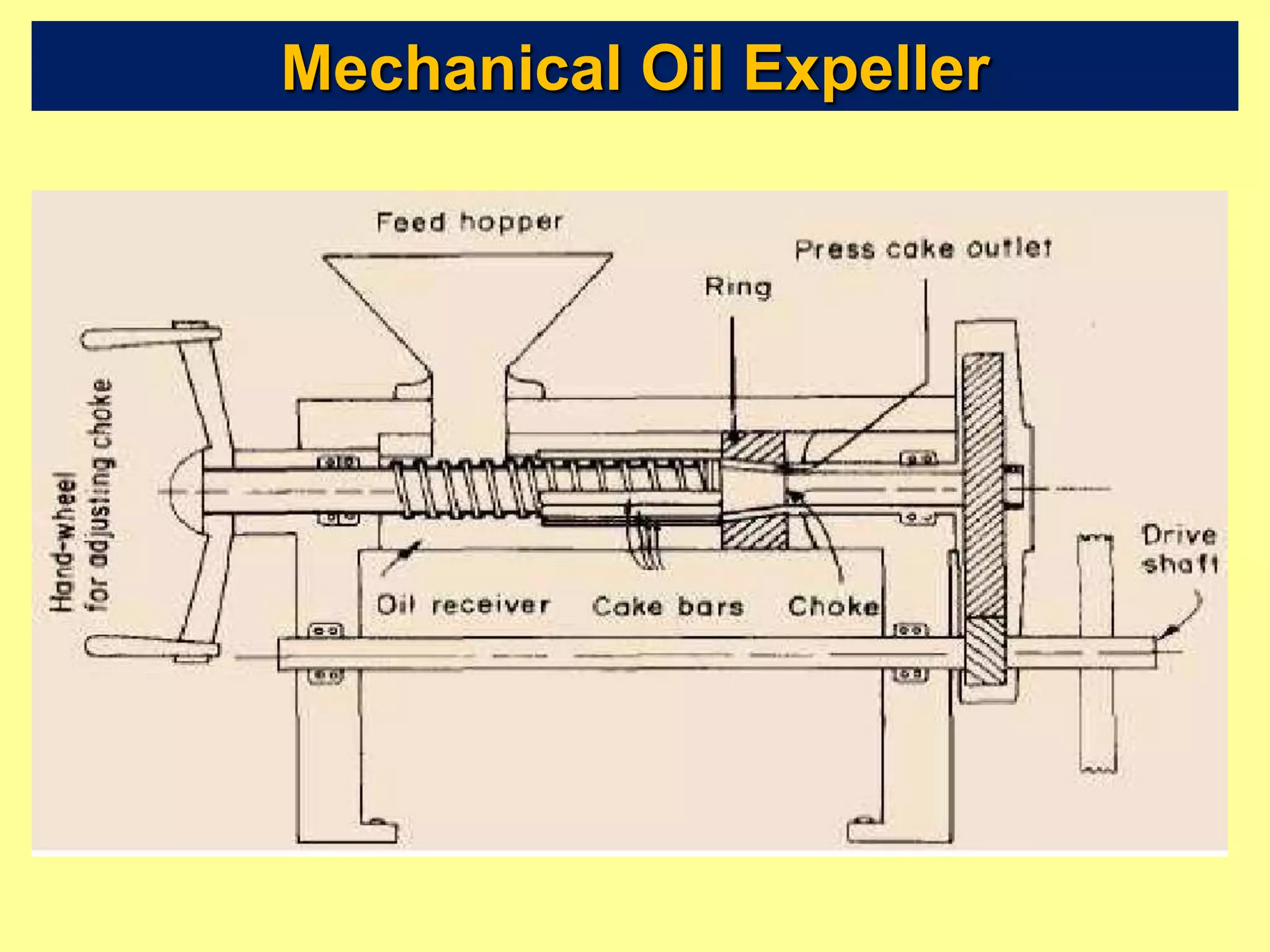
Mechanical Oil Expeller
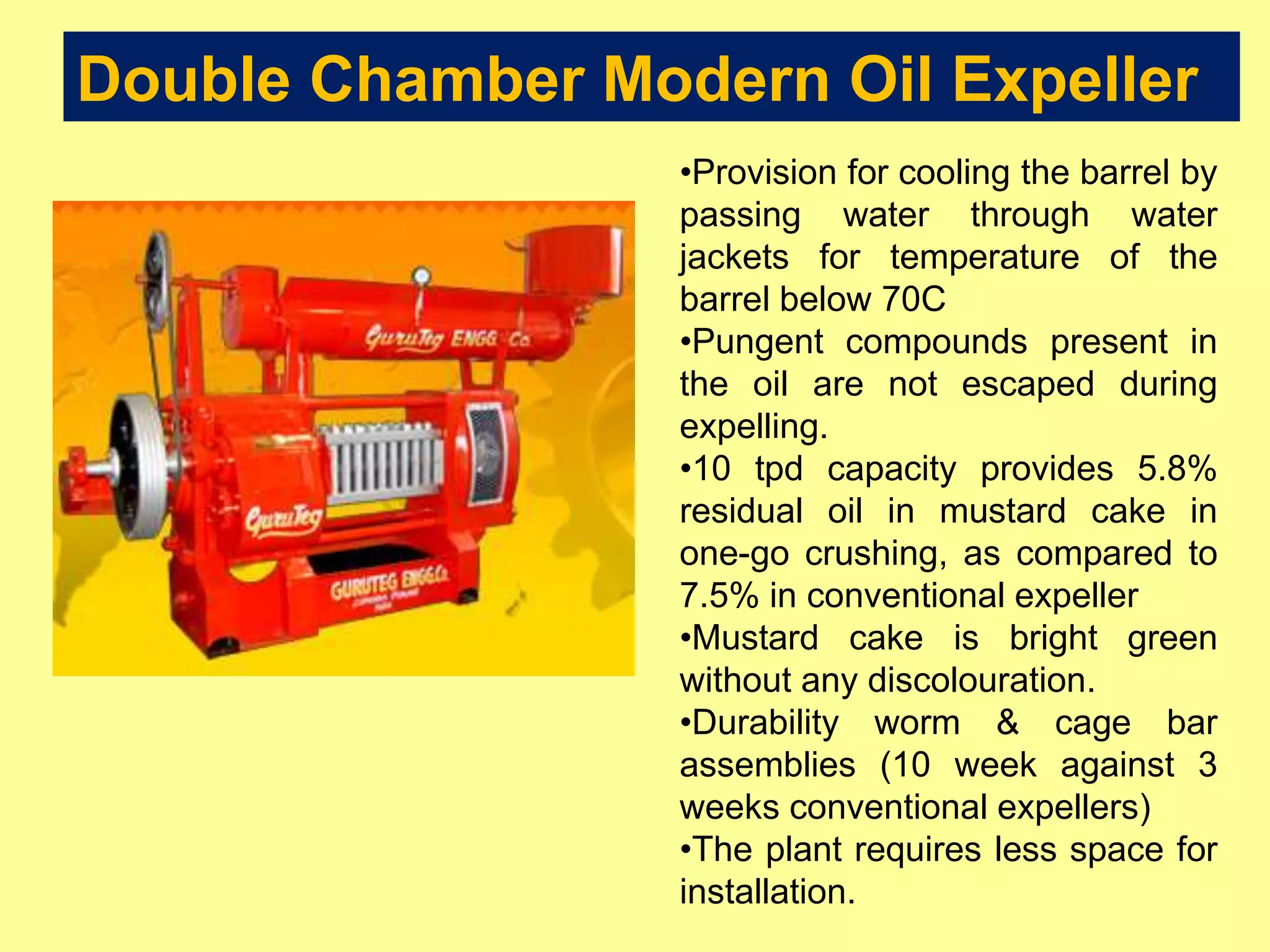
Double Chamber Modern Oil Expeller
•Provision for cooling the barrel by
passing water through water
jackets for temperature of the
barrel below 70C
•Pungent compounds present in
the oil are not escaped during
expelling.
•10 tpd capacity provides 5.8%
residual oil in mustard cake in
one-go crushing, as compared to
7.5% in conventional expeller
•Mustard cake is bright green
without any discolouration.
•Durability worm & cage bar
assemblies (10 week against 3
weeks conventional expellers)
•The plant requires less space for
installation.
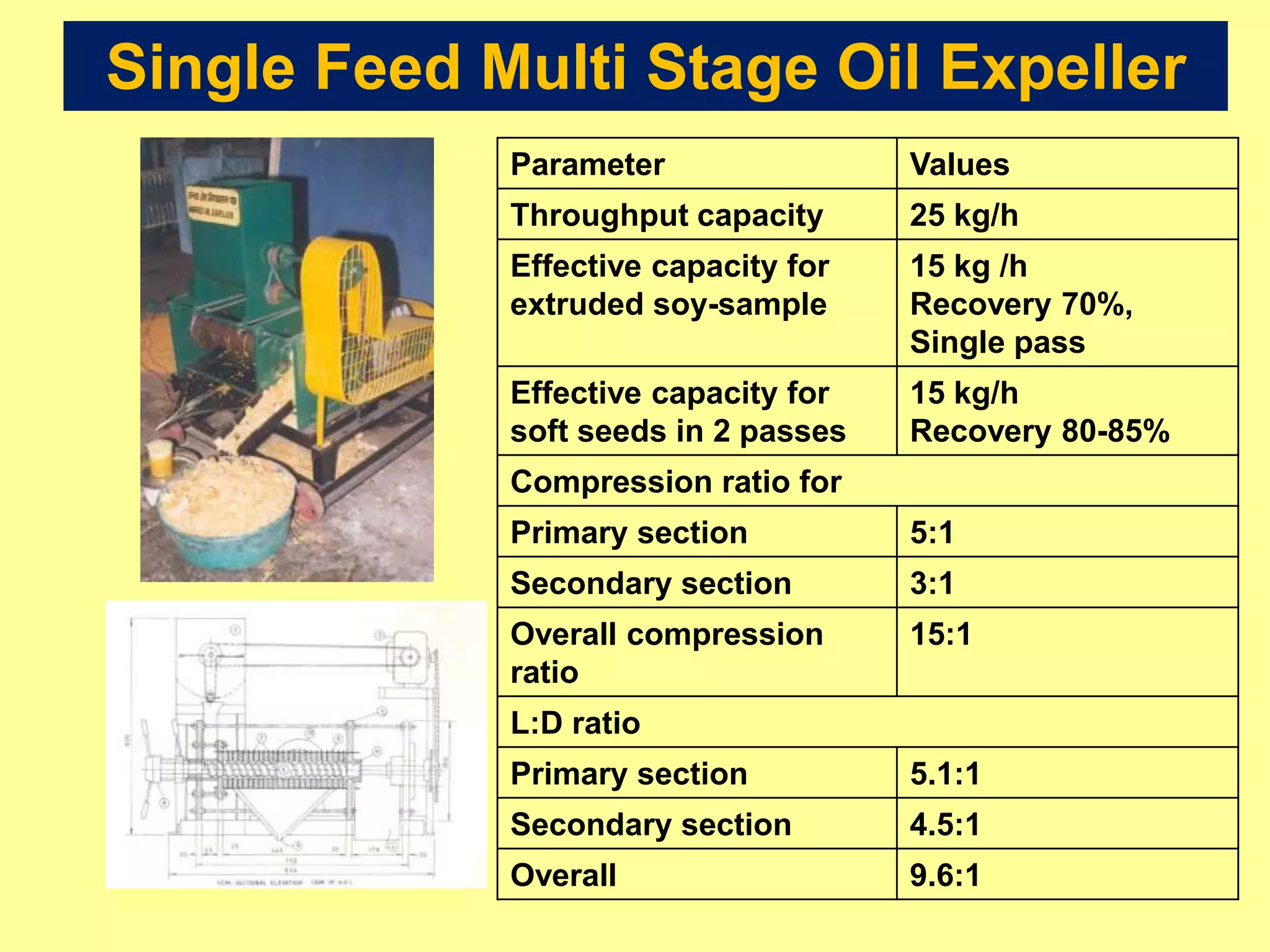
Parameter Values
Throughput capacity 25 kg/h
Effective capacity for
extruded soy-sample
15 kg /h
Recovery 70%,
Single pass
Effective capacity for
soft seeds in 2 passes
15 kg/h
Recovery 80-85%
Compression ratio for
Primary section 5:1
Secondary section 3:1
Overall compression
ratio
15:1
L:D ratio
Primary section 5.1:1
Secondary section 4.5:1
Overall 9.6:1
Single Feed Multi Stage Oil Expeller
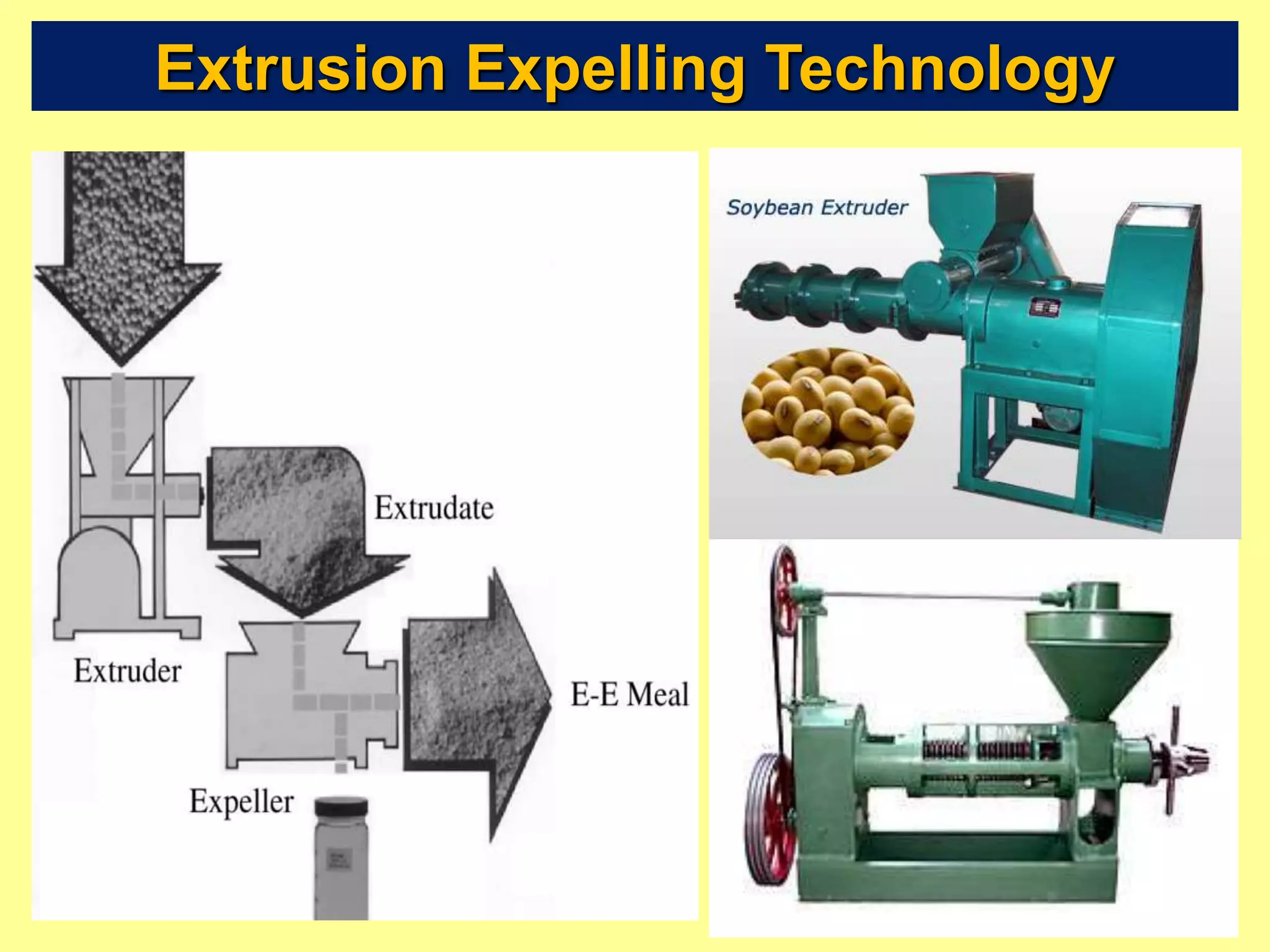
Extrusion Expelling Technology
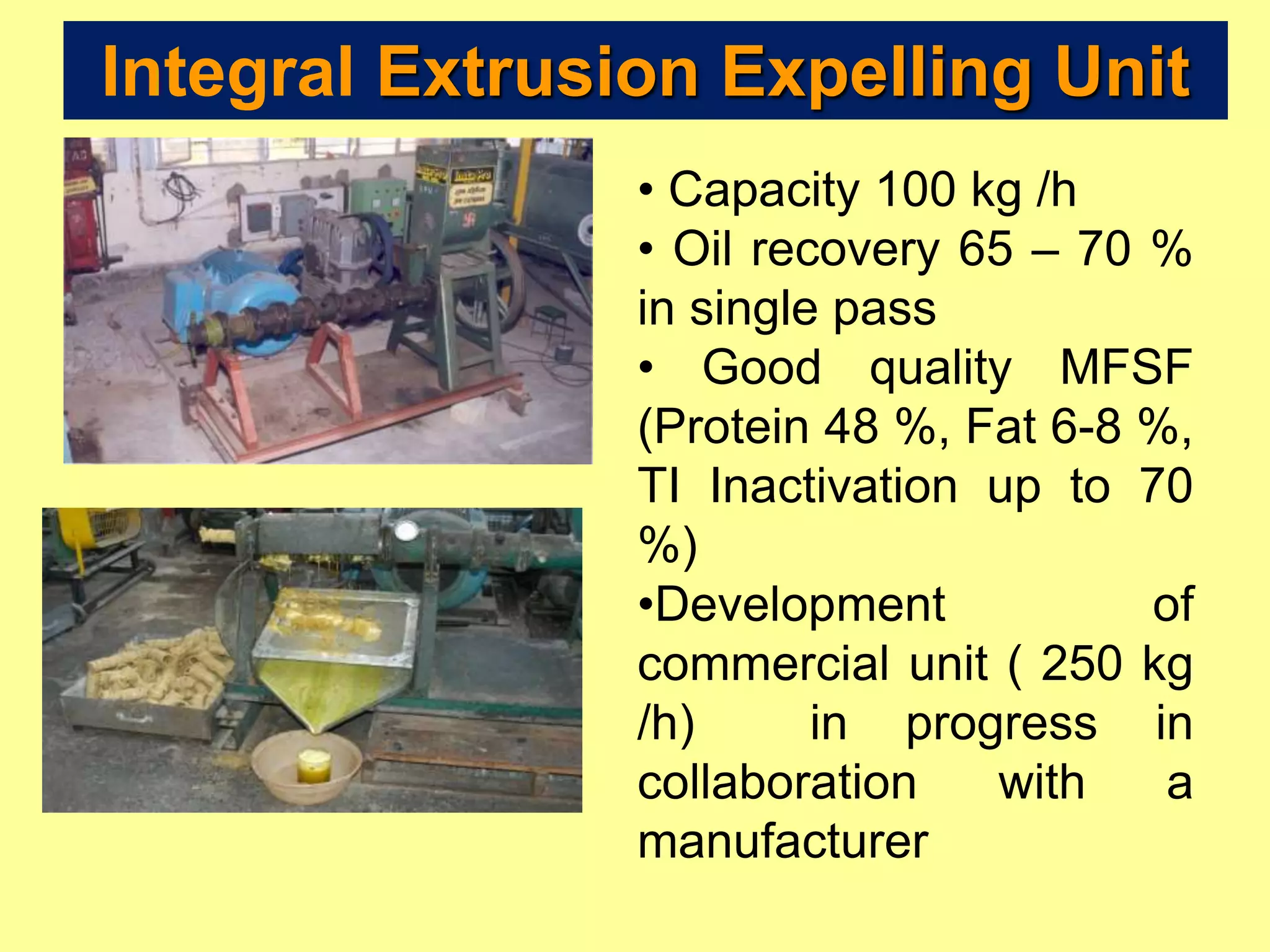
• Capacity 100 kg /h
• Oil recovery 65 – 70 %
in single pass
• Good quality MFSF
(Protein 48 %, Fat 6-8 %,
TI Inactivation up to 70
%)
•Development of
commercial unit ( 250 kg
/h) in progress in
collaboration with a
manufacturer
Integral Extrusion Expelling Unit
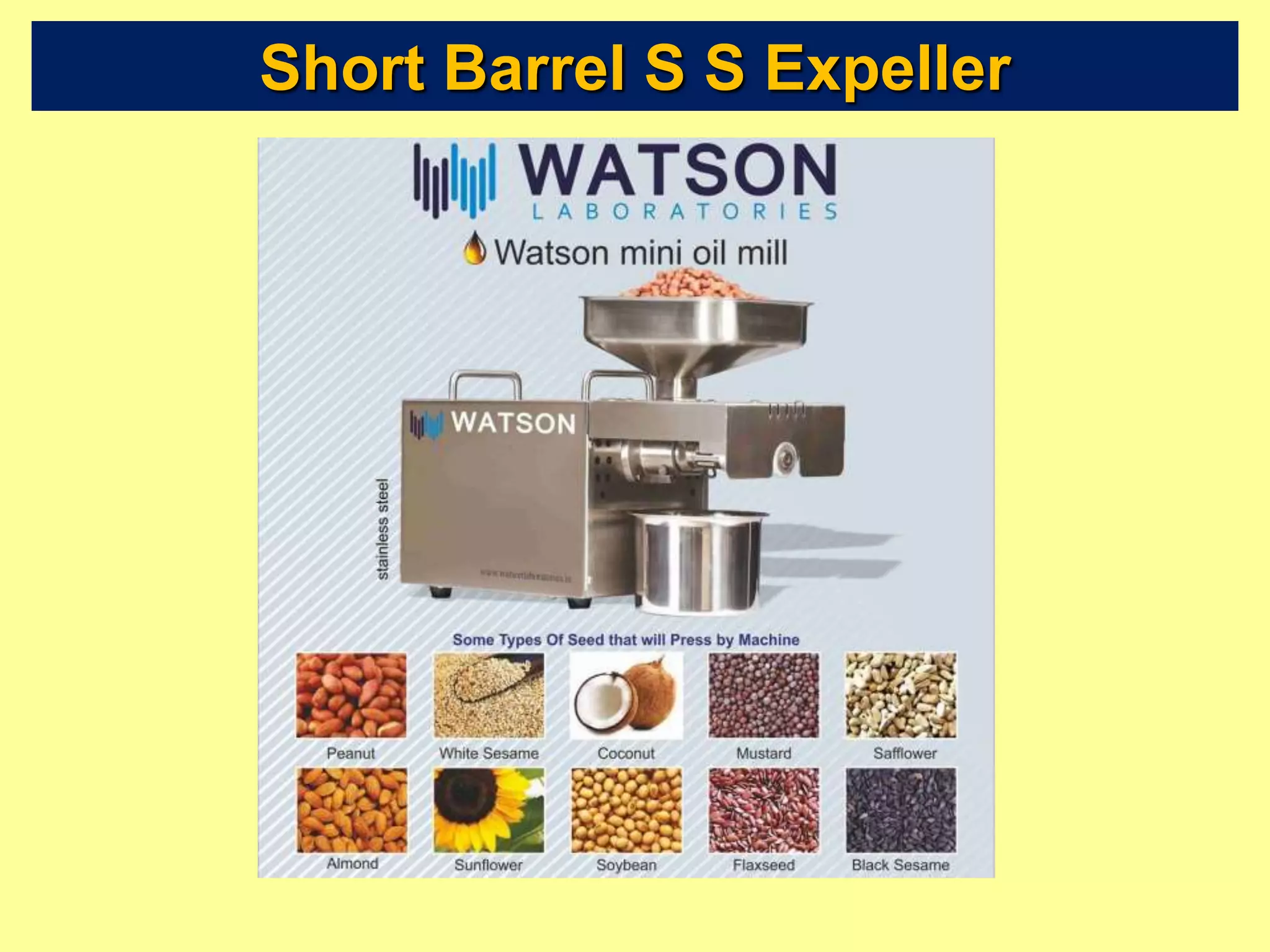
Short Barrel S S Expeller
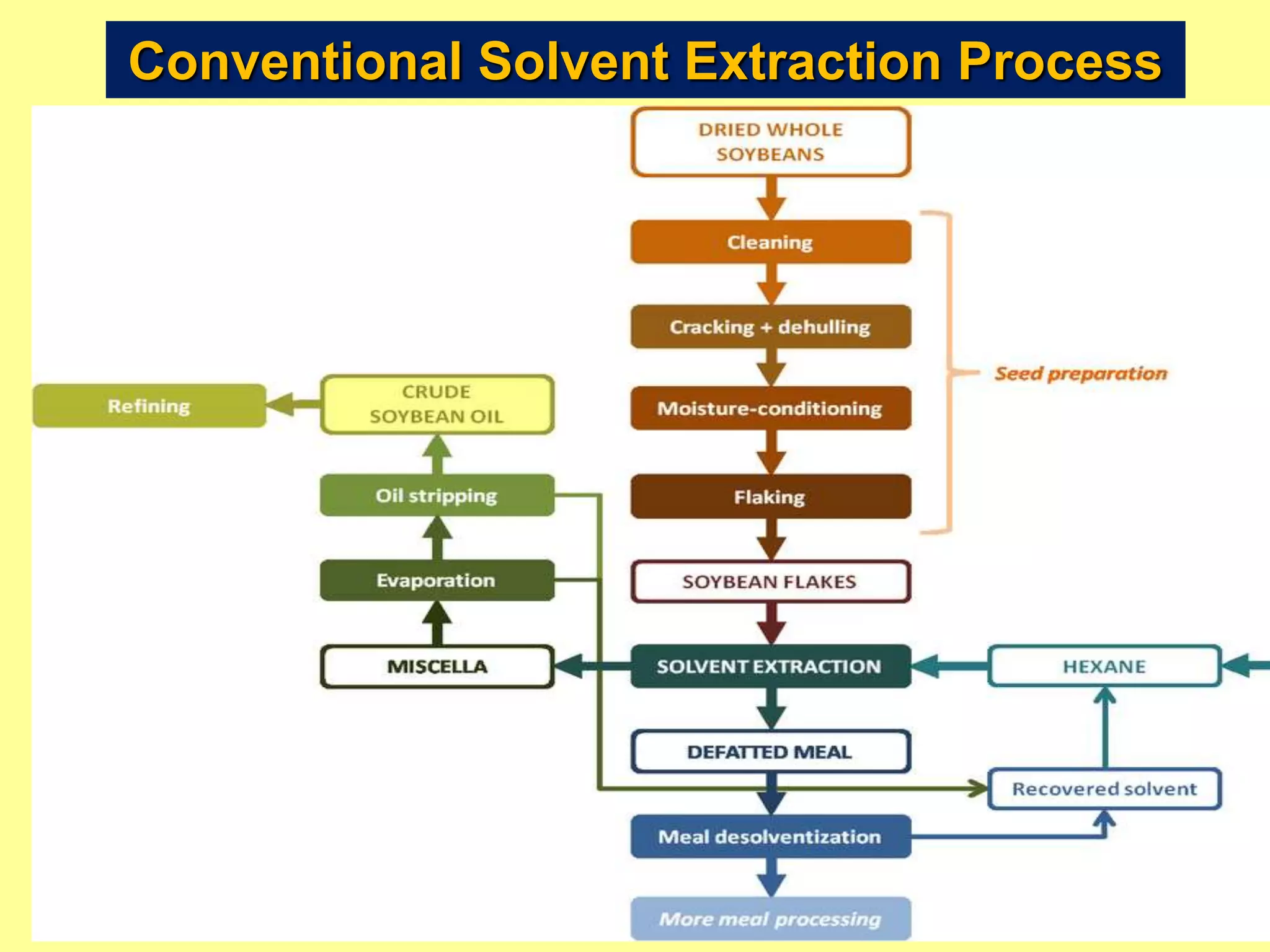
Conventional Solvent Extraction Process
Smart Intervention in Solvent
Extraction
• Enzyme Assisted Extraction (EAE)
The most effective enzymes used are from the
fungus Trichoderma. Cellulases, hemicellulases, and
pectinases
• Ultrasound Assisted Extraction (UAE)
shorter extraction times, low energy demands, and high
extraction efficiency.
• Microwave Assisted Extraction
The protein material is denatured during microwave
treatment leading to an improved extraction within a short
with less solvent.
• Supercritical Fluid Extraction (SFE)
Nontoxic, nonflammable, with good solvent power, low viscosity,
high diffusivity, easily removable.
Enzyme Assisted Solvent
Extraction
Plant cell walls are made up of lignocellulosic, and other
polymers intertwined with each other, which provide a barrier
to extraction of its components
Enzymes are used for the digestion of these cellular materials
and disruption of pores as a pre-extraction step which eases
the diffusion of the oil into the extraction medium
Some of the most effective enzymes used are from the
fungus Trichoderma. Cellulases, hemicellulases, and
pectinases, are commonly used during EAE to hydrolyze and
degrade the cell wall thus improving the release of
intracellular content.
Ultrasound Assisted Solvent
Extraction
•Ultrasound is a special type of sound wave beyond
human hearing, with frequencies ranging from 20
to 100 MHz.
• Advantages of UAE include shorter extraction times,
low energy demands, and high extraction
efficiency.
•UAE is mainly attributed to the behavior of cavitation
which brings about the formation and growth of
bubbles and its subsequent collapse.
•The result of this collapse are physico-chemical and
mechanical effects which provoke disruption of
material matrix, facilitating release of extractable
compounds into the solvent.
Microwave Assisted Solvent
Extraction
•Microwave assisted extraction (MAE) is one of the most
recent and attractive alternative oil extraction
methods.
•The protein material is denatured during microwave
treatment leading to an improved extraction.
•The rapid heating and destruction of biological cell
structure by the microwave ensures effective
extraction within a short time requiring small
amounts of solvent and produces high quality oil.
•Another important advantage of this process is the
lower energy requirement which decreases
environmental impact and financial costs.
Super Critical Fluid Extraction
•This method is commonly referred to as the
supercritical carbon dioxide extraction method as
compressed carbon dioxide with properties of 10–
50 MPa pressures and 35–80 °C temperatures
is the most frequently used as solvent.
•It has a relatively low critical temperature (31.1 °C), is
nontoxic, nonflammable, with good solvent power,
low viscosity, high diffusivity, can be easily
removed from the product, and is readily available
at low cost.
•Unlike other methods that require thermal treatment
after extraction, the separation of supercritical
carbon dioxide from the extracted oil occurs by
simple depressurization
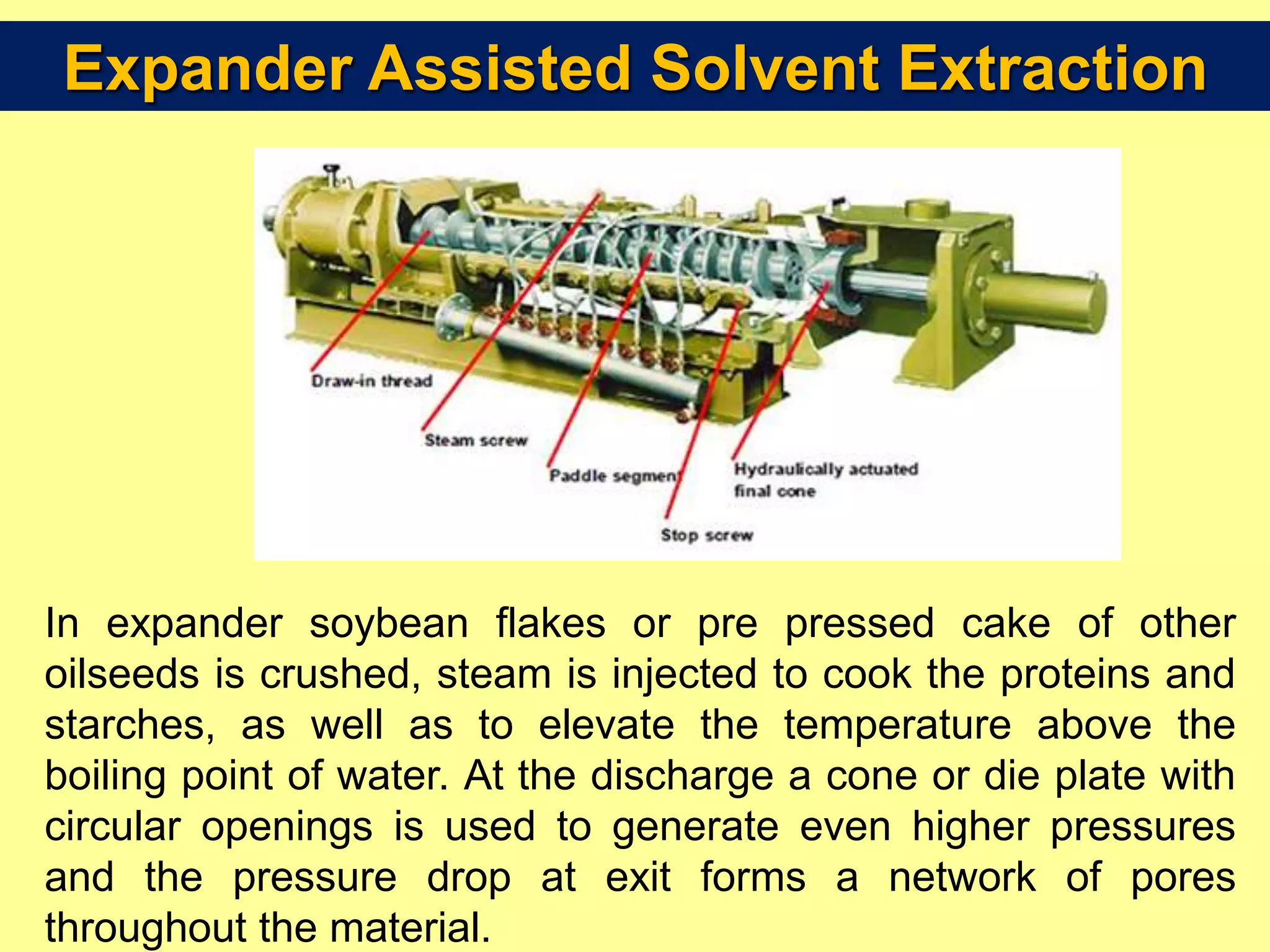
Expander Assisted Solvent Extraction
In expander soybean flakes or pre pressed cake of other
oilseeds is crushed, steam is injected to cook the proteins and
starches, as well as to elevate the temperature above the
boiling point of water. At the discharge a cone or die plate with
circular openings is used to generate even higher pressures
and the pressure drop at exit forms a network of pores
throughout the material.
Expander Assisted Solvent
Extraction
The expanded product is 50% more dense than flakes, can
squeeze 50% more material (increase in capacity).
Porous material allows better drainage of the solvent, lowest
residual oil levels in the meal, and less solvent per ton
Advantages
•Up to 50% increase in extractor capacity
•Residual oil levels as low as 0.6%
•Reduction in fines
•Higher extractor percolation rates
•Lower solvent to meal ratios
•Higher miscella concentration
•Lower steam consumption
•Lower solvent loss
•Reduction in non-hydratable phospholipid content
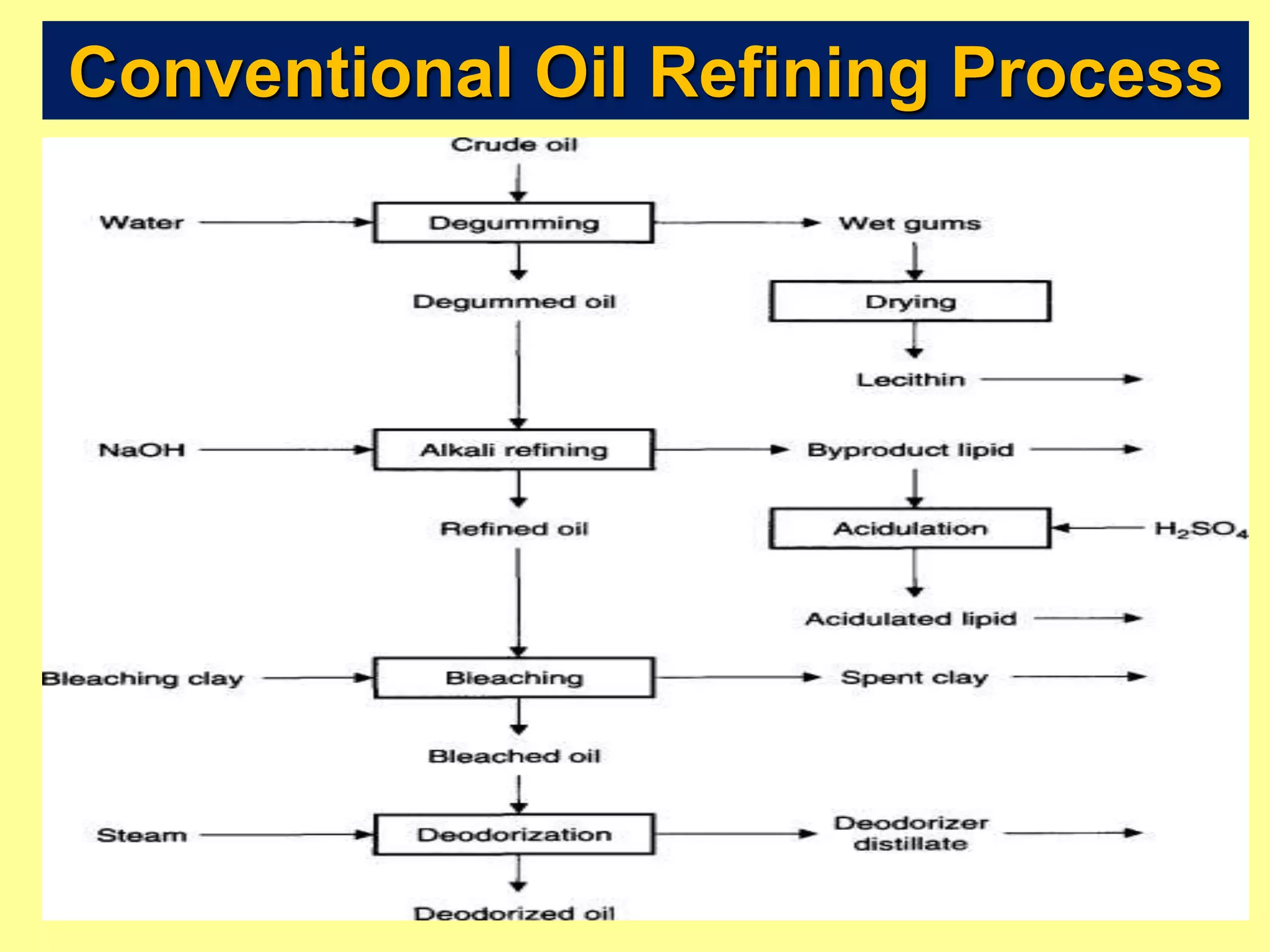
Conventional Oil Refining Process
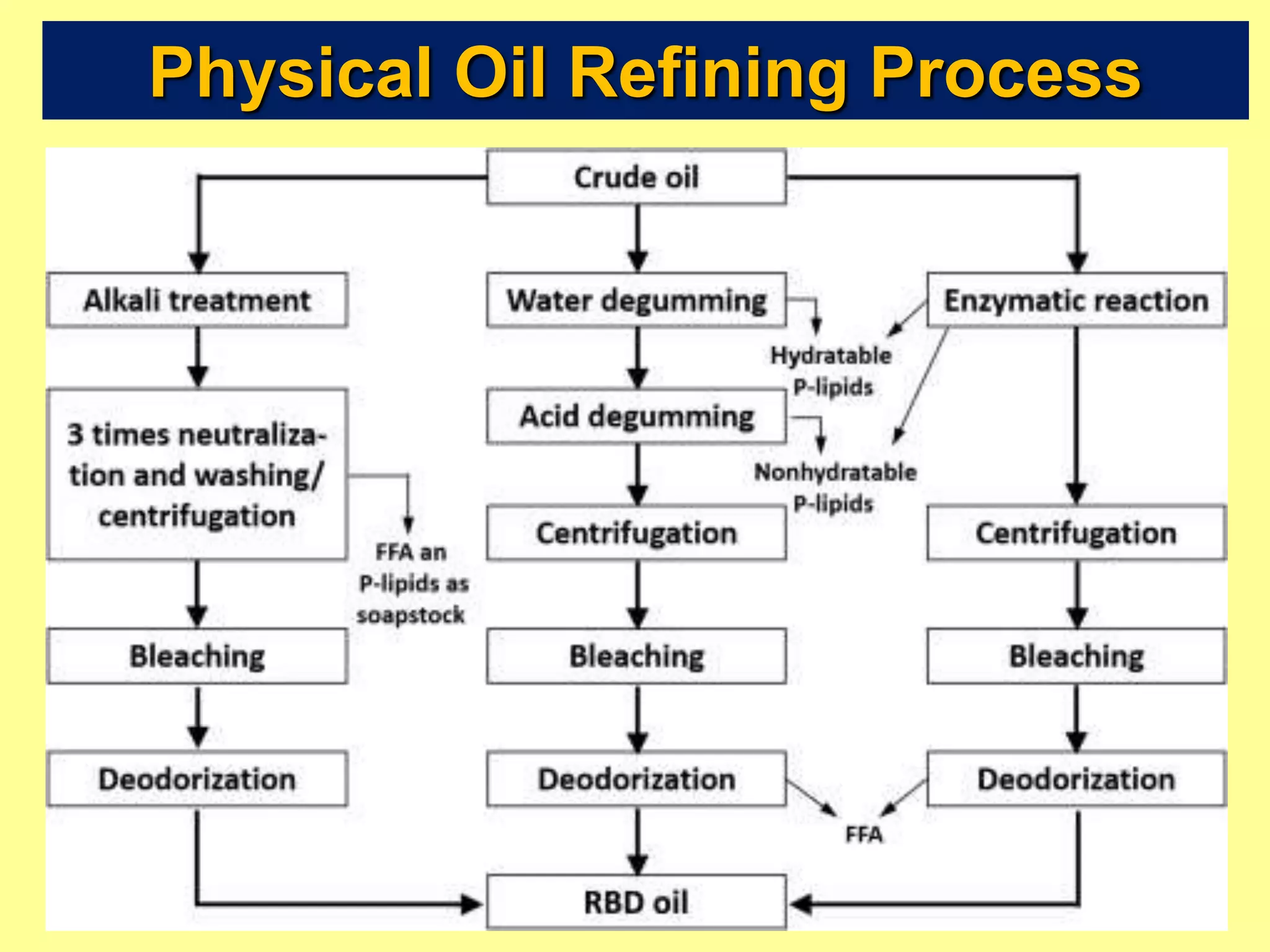
Physical Oil Refining Process
Storage of Oil
•Properly stored, an unopened bottle of vegetable oil
will generally stay at best quality for about 24
months
•Once you'll open the bottle, the oil in it should be
fine for at least a year.
•Antioxidants prevent auto-oxidation of oils and fats
during heat processing. It has been shown that
most of natural additives have more
antioxidants activity and thermal stability than
synthetic ones in different edible oils.
•Sesame oil has a special and strong antioxidant
called sesamol and can be used to extend
shelf life of other oils
Demonstration of Heated Barrel
SS Oil Mill
https://www.youtube.com/watch?v=2_4bjrduOTQ
Conclusions
• Modernization of oil milling sector to
higher oil recovery and better quality
cake
• Develop pre-pressing treatments for
higher recovery and cold pressed quality
oil
• Develop novel and efficient designs of
oil expellers and their promotion
• Use of smart solvent extraction methods
Email ID- ramabhau@gmail.com
https://www.facebook.com/ramabhau

Mpkv lecture 3 advances in oil seed processing technologies

  • 1.
    Advances in OilSeed Processing Technologies Dr. R.T. Patil Former Director, CIPHET, Ludhiana Chairman, Benevole Welfare Society for Post Harvest Technology, Bhopal
  • 2.
    Availability of Oils •Thecurrent demand for vegetable oil in India is around 235 million tonnes. •Primary sources include Groundnut, Rapeseed (Mustard), Soyabean, Sunflower, Sesamum, Niger seeds, Safflower, Castor and Linseed (60MT) •Secondary sources include Coconut, Cottonseed, Ricebran, Solvent Extracted Oils and oils from Tree and forest origin (29MT) •In 2015-16, India imported 148.20 million tonnes of edible oils. Thus, India has an alarming level of import dependency on oil.
  • 3.
  • 4.
  • 5.
  • 6.
  • 7.
    Post Harvest Lossesin Oil Seeds Oil Seed Productio n, Million tones Harvesti ng Loss % Supply Chain Loss % Storage Loss % Total Loss % Mustard 5.8 4.5 3.9 0.5 8.9 Cottonsee d 2.9 0.6 1.6 0.6 2.8 Soybean 9.99 3.1 2.7 0.4 6.2 Safflower 2.17 0.5 2.8 0.4 3.7 Sunflower 1.44 1.1 2.8 0.6 4.5 Groundnut 9.36 4.8 4.3 1.0 10.1
  • 8.
    Oil Content ofOilseeds Raw material Oil content Peanut 44-55% Camellia 58-60% Castor seed 50-70% Soybean 18-21% Cotton seed 33-40% Rapeseed 33-40% Sesame seed 45-50% Sunflower seed 40-50% Rice bran 18-20% Safflower seed 29-45% Corn embryo/germ 30-40% Walnut 40-65% Flaxseed/Linseed 29-44% Palm seed 50-55% Coconut 35-45%
  • 9.
    Smart Interventions inOil Extraction Technologies • Mechanical Expression (ME) Extrusion/Cooking+Expelling Heated barrel expression Barrel cooling expression • Conventional Solvent Extraction Expander Extraction Enzyme Assisted Extraction (EAE) Ultrasound Assisted Extraction (UAE) Microwave Assisted Extraction Supercritical Fluid Extraction (SFE)
  • 10.
  • 11.
    Double Chamber ModernOil Expeller •Provision for cooling the barrel by passing water through water jackets for temperature of the barrel below 70C •Pungent compounds present in the oil are not escaped during expelling. •10 tpd capacity provides 5.8% residual oil in mustard cake in one-go crushing, as compared to 7.5% in conventional expeller •Mustard cake is bright green without any discolouration. •Durability worm & cage bar assemblies (10 week against 3 weeks conventional expellers) •The plant requires less space for installation.
  • 12.
    Parameter Values Throughput capacity25 kg/h Effective capacity for extruded soy-sample 15 kg /h Recovery 70%, Single pass Effective capacity for soft seeds in 2 passes 15 kg/h Recovery 80-85% Compression ratio for Primary section 5:1 Secondary section 3:1 Overall compression ratio 15:1 L:D ratio Primary section 5.1:1 Secondary section 4.5:1 Overall 9.6:1 Single Feed Multi Stage Oil Expeller
  • 13.
  • 14.
    • Capacity 100kg /h • Oil recovery 65 – 70 % in single pass • Good quality MFSF (Protein 48 %, Fat 6-8 %, TI Inactivation up to 70 %) •Development of commercial unit ( 250 kg /h) in progress in collaboration with a manufacturer Integral Extrusion Expelling Unit
  • 15.
    Short Barrel SS Expeller
  • 16.
  • 17.
    Smart Intervention inSolvent Extraction • Enzyme Assisted Extraction (EAE) The most effective enzymes used are from the fungus Trichoderma. Cellulases, hemicellulases, and pectinases • Ultrasound Assisted Extraction (UAE) shorter extraction times, low energy demands, and high extraction efficiency. • Microwave Assisted Extraction The protein material is denatured during microwave treatment leading to an improved extraction within a short with less solvent. • Supercritical Fluid Extraction (SFE) Nontoxic, nonflammable, with good solvent power, low viscosity, high diffusivity, easily removable.
  • 18.
    Enzyme Assisted Solvent Extraction Plantcell walls are made up of lignocellulosic, and other polymers intertwined with each other, which provide a barrier to extraction of its components Enzymes are used for the digestion of these cellular materials and disruption of pores as a pre-extraction step which eases the diffusion of the oil into the extraction medium Some of the most effective enzymes used are from the fungus Trichoderma. Cellulases, hemicellulases, and pectinases, are commonly used during EAE to hydrolyze and degrade the cell wall thus improving the release of intracellular content.
  • 19.
    Ultrasound Assisted Solvent Extraction •Ultrasoundis a special type of sound wave beyond human hearing, with frequencies ranging from 20 to 100 MHz. • Advantages of UAE include shorter extraction times, low energy demands, and high extraction efficiency. •UAE is mainly attributed to the behavior of cavitation which brings about the formation and growth of bubbles and its subsequent collapse. •The result of this collapse are physico-chemical and mechanical effects which provoke disruption of material matrix, facilitating release of extractable compounds into the solvent.
  • 20.
    Microwave Assisted Solvent Extraction •Microwaveassisted extraction (MAE) is one of the most recent and attractive alternative oil extraction methods. •The protein material is denatured during microwave treatment leading to an improved extraction. •The rapid heating and destruction of biological cell structure by the microwave ensures effective extraction within a short time requiring small amounts of solvent and produces high quality oil. •Another important advantage of this process is the lower energy requirement which decreases environmental impact and financial costs.
  • 21.
    Super Critical FluidExtraction •This method is commonly referred to as the supercritical carbon dioxide extraction method as compressed carbon dioxide with properties of 10– 50 MPa pressures and 35–80 °C temperatures is the most frequently used as solvent. •It has a relatively low critical temperature (31.1 °C), is nontoxic, nonflammable, with good solvent power, low viscosity, high diffusivity, can be easily removed from the product, and is readily available at low cost. •Unlike other methods that require thermal treatment after extraction, the separation of supercritical carbon dioxide from the extracted oil occurs by simple depressurization
  • 22.
    Expander Assisted SolventExtraction In expander soybean flakes or pre pressed cake of other oilseeds is crushed, steam is injected to cook the proteins and starches, as well as to elevate the temperature above the boiling point of water. At the discharge a cone or die plate with circular openings is used to generate even higher pressures and the pressure drop at exit forms a network of pores throughout the material.
  • 23.
    Expander Assisted Solvent Extraction Theexpanded product is 50% more dense than flakes, can squeeze 50% more material (increase in capacity). Porous material allows better drainage of the solvent, lowest residual oil levels in the meal, and less solvent per ton Advantages •Up to 50% increase in extractor capacity •Residual oil levels as low as 0.6% •Reduction in fines •Higher extractor percolation rates •Lower solvent to meal ratios •Higher miscella concentration •Lower steam consumption •Lower solvent loss •Reduction in non-hydratable phospholipid content
  • 24.
  • 25.
  • 26.
    Storage of Oil •Properlystored, an unopened bottle of vegetable oil will generally stay at best quality for about 24 months •Once you'll open the bottle, the oil in it should be fine for at least a year. •Antioxidants prevent auto-oxidation of oils and fats during heat processing. It has been shown that most of natural additives have more antioxidants activity and thermal stability than synthetic ones in different edible oils. •Sesame oil has a special and strong antioxidant called sesamol and can be used to extend shelf life of other oils
  • 27.
    Demonstration of HeatedBarrel SS Oil Mill https://www.youtube.com/watch?v=2_4bjrduOTQ
  • 28.
    Conclusions • Modernization ofoil milling sector to higher oil recovery and better quality cake • Develop pre-pressing treatments for higher recovery and cold pressed quality oil • Develop novel and efficient designs of oil expellers and their promotion • Use of smart solvent extraction methods
  • 29.