Food Processing Technologies for
AtmaNirbhar Madhya Pradesh
Dr. R.T. Patil
Former Director, CIPHET, Ludhiana
Chairman, Benevole Welfare Society for
Post Harvest Technology, Bhopal
Indian Perspective
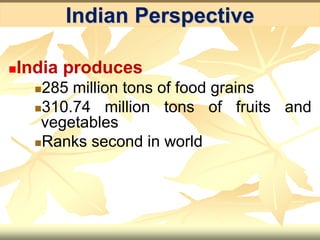
India produces
285 million tons of food grains
310.74 million tons of fruits and
vegetables
Ranks second in world
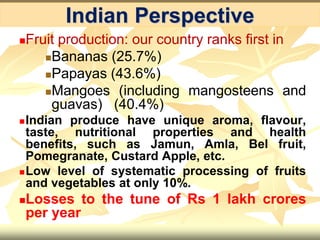
Fruit production: our country ranks first in
Bananas (25.7%)
Papayas (43.6%)
Mangoes (including mangosteens and
guavas) (40.4%)
Indian produce have unique aroma, flavour,
taste, nutritional properties and health
benefits, such as Jamun, Amla, Bel fruit,
Pomegranate, Custard Apple, etc.
Low level of systematic processing of fruits
and vegetables at only 10%.
Losses to the tune of Rs 1 lakh crores
per year
Indian Perspective
Reasons for Losses
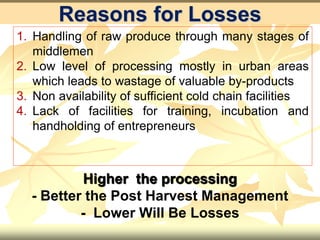
1. Handling of raw produce through many stages of
middlemen
2. Low level of processing mostly in urban areas
which leads to wastage of valuable by-products
3. Non availability of sufficient cold chain facilities
4. Lack of facilities for training, incubation and
handholding of entrepreneurs
Higher the processing
- Better the Post Harvest Management
- Lower Will Be Losses
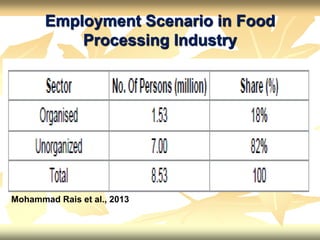
Employment Scenario in Food
Processing Industry
Mohammad Rais et al., 2013
Selected Potential
Technologies
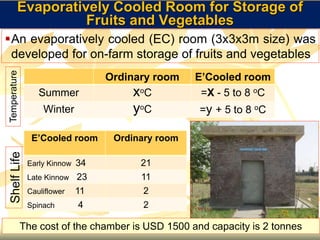
Evaporatively Cooled Room for Storage of
Fruits and Vegetables
The cost of the chamber is USD 1500 and capacity is 2 tonnes
An evaporatively cooled (EC) room (3x3x3m size) was
developed for on-farm storage of fruits and vegetables
Ordinary room E’Cooled room
Summer xoC =X - 5 to 8 oC
Winter yoC =y + 5 to 8 oC
E’Cooled room Ordinary room
Early Kinnow 34 21
Late Kinnow 23 11
Cauliflower 11 2
Spinach 4 2
TemperatureShelfLife
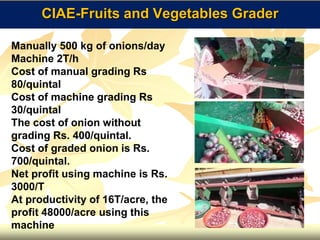
CIAE-Fruits and Vegetables Grader
Manually 500 kg of onions/day
Machine 2T/h
Cost of manual grading Rs
80/quintal
Cost of machine grading Rs
30/quintal
The cost of onion without
grading Rs. 400/quintal.
Cost of graded onion is Rs.
700/quintal.
Net profit using machine is Rs.
3000/T
At productivity of 16T/acre, the
profit 48000/acre using this
machine
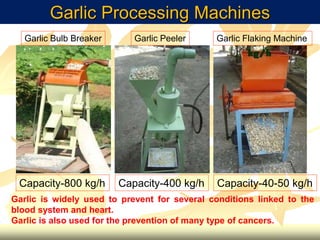
Garlic Processing Machines
Garlic Flaking MachineGarlic PeelerGarlic Bulb Breaker
Capacity-800 kg/h Capacity-400 kg/h Capacity-40-50 kg/h
Garlic is widely used to prevent for several conditions linked to the
blood system and heart.
Garlic is also used for the prevention of many type of cancers.
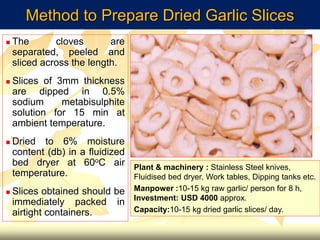
Method to Prepare Dried Garlic Slices
 The cloves are
separated, peeled and
sliced across the length.
 Slices of 3mm thickness
are dipped in 0.5%
sodium metabisulphite
solution for 15 min at
ambient temperature.
 Dried to 6% moisture
content (db) in a fluidized
bed dryer at 60oC air
temperature.
 Slices obtained should be
immediately packed in
airtight containers.
Plant & machinery : Stainless Steel knives,
Fluidised bed dryer, Work tables, Dipping tanks etc.
Manpower :10-15 kg raw garlic/ person for 8 h,
Investment: USD 4000 approx.
Capacity:10-15 kg dried garlic slices/ day.
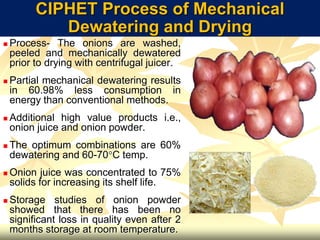
CIPHET Process of Mechanical
Dewatering and Drying
 Process- The onions are washed,
peeled and mechanically dewatered
prior to drying with centrifugal juicer.
 Partial mechanical dewatering results
in 60.98% less consumption in
energy than conventional methods.
 Additional high value products i.e.,
onion juice and onion powder.
 The optimum combinations are 60%
dewatering and 60-70C temp.
 Onion juice was concentrated to 75%
solids for increasing its shelf life.
 Storage studies of onion powder
showed that there has been no
significant loss in quality even after 2
months storage at room temperature.
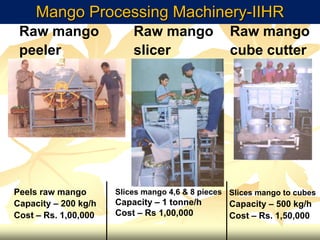
Raw mango
cube cutter
Peels raw mango
Capacity – 200 kg/h
Cost – Rs. 1,00,000
Slices mango 4,6 & 8 pieces
Capacity – 1 tonne/h
Cost – Rs 1,00,000
Slices mango to cubes
Capacity – 500 kg/h
Cost – Rs. 1,50,000
Mango Processing Machinery-IIHR
Raw mango
slicer
Raw mango
peeler
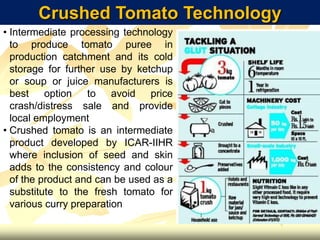
Crushed Tomato Technology
• Intermediate processing technology
to produce tomato puree in
production catchment and its cold
storage for further use by ketchup
or soup or juice manufacturers is
best option to avoid price
crash/distress sale and provide
local employment
• Crushed tomato is an intermediate
product developed by ICAR-IIHR
where inclusion of seed and skin
adds to the consistency and colour
of the product and can be used as a
substitute to the fresh tomato for
various curry preparation
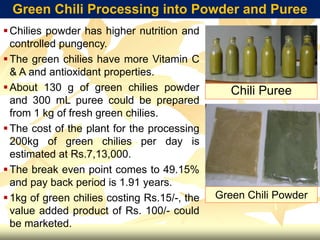
Green Chili Processing into Powder and Puree
Chilies powder has higher nutrition and
controlled pungency.
The green chilies have more Vitamin C
& A and antioxidant properties.
About 130 g of green chilies powder
and 300 mL puree could be prepared
from 1 kg of fresh green chilies.
The cost of the plant for the processing
200kg of green chilies per day is
estimated at Rs.7,13,000.
The break even point comes to 49.15%
and pay back period is 1.91 years.
1kg of green chilies costing Rs.15/-, the
value added product of Rs. 100/- could
be marketed.
Chili Puree
Green Chili Powder
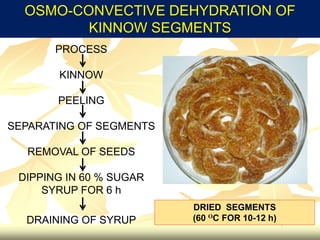
OSMO-CONVECTIVE DEHYDRATION OF
KINNOW SEGMENTS
PROCESS
KINNOW
PEELING
SEPARATING OF SEGMENTS
REMOVAL OF SEEDS
DIPPING IN 60 % SUGAR
SYRUP FOR 6 h
DRAINING OF SYRUP
DRIED SEGMENTS
(60 OC FOR 10-12 h)
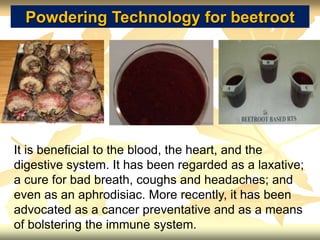
Powdering Technology for beetroot
It is beneficial to the blood, the heart, and the
digestive system. It has been regarded as a laxative;
a cure for bad breath, coughs and headaches; and
even as an aphrodisiac. More recently, it has been
advocated as a cancer preventative and as a means
of bolstering the immune system.
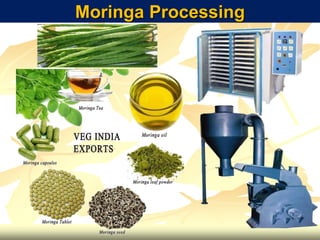
Moringa Processing
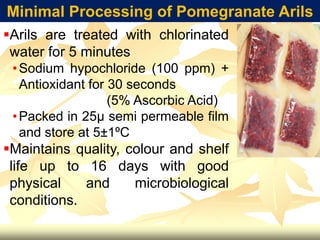
Minimal Processing of Pomegranate Arils
Arils are treated with chlorinated
water for 5 minutes
•Sodium hypochloride (100 ppm) +
Antioxidant for 30 seconds
(5% Ascorbic Acid)
•Packed in 25μ semi permeable film
and store at 5±1ºC
Maintains quality, colour and shelf
life up to 16 days with good
physical and microbiological
conditions.
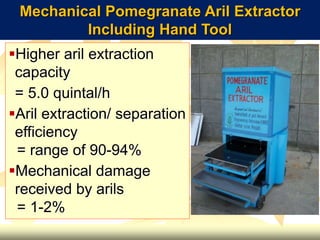
Higher aril extraction
capacity
= 5.0 quintal/h
Aril extraction/ separation
efficiency
= range of 90-94%
Mechanical damage
received by arils
= 1-2%
Mechanical Pomegranate Aril Extractor
Including Hand Tool
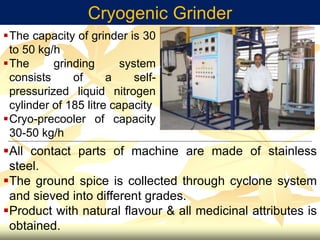
Cryogenic Grinder
All contact parts of machine are made of stainless
steel.
The ground spice is collected through cyclone system
and sieved into different grades.
Product with natural flavour & all medicinal attributes is
obtained.
The capacity of grinder is 30
to 50 kg/h
The grinding system
consists of a self-
pressurized liquid nitrogen
cylinder of 185 litre capacity
Cryo-precooler of capacity
30-50 kg/h
Conclusions/Recommendations
•Tremendous scope for micro food processing enterprises
if aggregation, packaging and distribution support is
provided
• Develop rural infrastructure of agro processing centres
through schemes for custom hiring like yantradoot
•Establish rural infrastructure for sorting, packaging and
cold storages for fruits, vegetables, pulp and purees
and dehydrated vegetables.
• Government may purchase processed foods by MFP
units at MSP and for sale through PDS and used in
school meal programmes
•Facilitate direct marketing by farmers and rural
processors through exhibitions at district places
Email ID- ramabhau@gmail.com
Mobile. No. 08964030701
https://www.facebook.com/ramabhau

Atmanirbhar mp rtp

  • 1.
    Food Processing Technologiesfor AtmaNirbhar Madhya Pradesh Dr. R.T. Patil Former Director, CIPHET, Ludhiana Chairman, Benevole Welfare Society for Post Harvest Technology, Bhopal
  • 2.
    Indian Perspective India produces 285million tons of food grains 310.74 million tons of fruits and vegetables Ranks second in world
  • 3.
    Fruit production: ourcountry ranks first in Bananas (25.7%) Papayas (43.6%) Mangoes (including mangosteens and guavas) (40.4%) Indian produce have unique aroma, flavour, taste, nutritional properties and health benefits, such as Jamun, Amla, Bel fruit, Pomegranate, Custard Apple, etc. Low level of systematic processing of fruits and vegetables at only 10%. Losses to the tune of Rs 1 lakh crores per year Indian Perspective
  • 4.
    Reasons for Losses 1.Handling of raw produce through many stages of middlemen 2. Low level of processing mostly in urban areas which leads to wastage of valuable by-products 3. Non availability of sufficient cold chain facilities 4. Lack of facilities for training, incubation and handholding of entrepreneurs Higher the processing - Better the Post Harvest Management - Lower Will Be Losses
  • 5.
    Employment Scenario inFood Processing Industry Mohammad Rais et al., 2013
  • 6.
  • 7.
    Evaporatively Cooled Roomfor Storage of Fruits and Vegetables The cost of the chamber is USD 1500 and capacity is 2 tonnes An evaporatively cooled (EC) room (3x3x3m size) was developed for on-farm storage of fruits and vegetables Ordinary room E’Cooled room Summer xoC =X - 5 to 8 oC Winter yoC =y + 5 to 8 oC E’Cooled room Ordinary room Early Kinnow 34 21 Late Kinnow 23 11 Cauliflower 11 2 Spinach 4 2 TemperatureShelfLife
  • 8.
    CIAE-Fruits and VegetablesGrader Manually 500 kg of onions/day Machine 2T/h Cost of manual grading Rs 80/quintal Cost of machine grading Rs 30/quintal The cost of onion without grading Rs. 400/quintal. Cost of graded onion is Rs. 700/quintal. Net profit using machine is Rs. 3000/T At productivity of 16T/acre, the profit 48000/acre using this machine
  • 9.
    Garlic Processing Machines GarlicFlaking MachineGarlic PeelerGarlic Bulb Breaker Capacity-800 kg/h Capacity-400 kg/h Capacity-40-50 kg/h Garlic is widely used to prevent for several conditions linked to the blood system and heart. Garlic is also used for the prevention of many type of cancers.
  • 10.
    Method to PrepareDried Garlic Slices  The cloves are separated, peeled and sliced across the length.  Slices of 3mm thickness are dipped in 0.5% sodium metabisulphite solution for 15 min at ambient temperature.  Dried to 6% moisture content (db) in a fluidized bed dryer at 60oC air temperature.  Slices obtained should be immediately packed in airtight containers. Plant & machinery : Stainless Steel knives, Fluidised bed dryer, Work tables, Dipping tanks etc. Manpower :10-15 kg raw garlic/ person for 8 h, Investment: USD 4000 approx. Capacity:10-15 kg dried garlic slices/ day.
  • 11.
    CIPHET Process ofMechanical Dewatering and Drying  Process- The onions are washed, peeled and mechanically dewatered prior to drying with centrifugal juicer.  Partial mechanical dewatering results in 60.98% less consumption in energy than conventional methods.  Additional high value products i.e., onion juice and onion powder.  The optimum combinations are 60% dewatering and 60-70C temp.  Onion juice was concentrated to 75% solids for increasing its shelf life.  Storage studies of onion powder showed that there has been no significant loss in quality even after 2 months storage at room temperature.
  • 12.
    Raw mango cube cutter Peelsraw mango Capacity – 200 kg/h Cost – Rs. 1,00,000 Slices mango 4,6 & 8 pieces Capacity – 1 tonne/h Cost – Rs 1,00,000 Slices mango to cubes Capacity – 500 kg/h Cost – Rs. 1,50,000 Mango Processing Machinery-IIHR Raw mango slicer Raw mango peeler
  • 13.
    Crushed Tomato Technology •Intermediate processing technology to produce tomato puree in production catchment and its cold storage for further use by ketchup or soup or juice manufacturers is best option to avoid price crash/distress sale and provide local employment • Crushed tomato is an intermediate product developed by ICAR-IIHR where inclusion of seed and skin adds to the consistency and colour of the product and can be used as a substitute to the fresh tomato for various curry preparation
  • 14.
    Green Chili Processinginto Powder and Puree Chilies powder has higher nutrition and controlled pungency. The green chilies have more Vitamin C & A and antioxidant properties. About 130 g of green chilies powder and 300 mL puree could be prepared from 1 kg of fresh green chilies. The cost of the plant for the processing 200kg of green chilies per day is estimated at Rs.7,13,000. The break even point comes to 49.15% and pay back period is 1.91 years. 1kg of green chilies costing Rs.15/-, the value added product of Rs. 100/- could be marketed. Chili Puree Green Chili Powder
  • 15.
    OSMO-CONVECTIVE DEHYDRATION OF KINNOWSEGMENTS PROCESS KINNOW PEELING SEPARATING OF SEGMENTS REMOVAL OF SEEDS DIPPING IN 60 % SUGAR SYRUP FOR 6 h DRAINING OF SYRUP DRIED SEGMENTS (60 OC FOR 10-12 h)
  • 16.
    Powdering Technology forbeetroot It is beneficial to the blood, the heart, and the digestive system. It has been regarded as a laxative; a cure for bad breath, coughs and headaches; and even as an aphrodisiac. More recently, it has been advocated as a cancer preventative and as a means of bolstering the immune system.
  • 17.
  • 18.
    Minimal Processing ofPomegranate Arils Arils are treated with chlorinated water for 5 minutes •Sodium hypochloride (100 ppm) + Antioxidant for 30 seconds (5% Ascorbic Acid) •Packed in 25μ semi permeable film and store at 5±1ºC Maintains quality, colour and shelf life up to 16 days with good physical and microbiological conditions.
  • 19.
    Higher aril extraction capacity =5.0 quintal/h Aril extraction/ separation efficiency = range of 90-94% Mechanical damage received by arils = 1-2% Mechanical Pomegranate Aril Extractor Including Hand Tool
  • 20.
    Cryogenic Grinder All contactparts of machine are made of stainless steel. The ground spice is collected through cyclone system and sieved into different grades. Product with natural flavour & all medicinal attributes is obtained. The capacity of grinder is 30 to 50 kg/h The grinding system consists of a self- pressurized liquid nitrogen cylinder of 185 litre capacity Cryo-precooler of capacity 30-50 kg/h
  • 21.
    Conclusions/Recommendations •Tremendous scope formicro food processing enterprises if aggregation, packaging and distribution support is provided • Develop rural infrastructure of agro processing centres through schemes for custom hiring like yantradoot •Establish rural infrastructure for sorting, packaging and cold storages for fruits, vegetables, pulp and purees and dehydrated vegetables. • Government may purchase processed foods by MFP units at MSP and for sale through PDS and used in school meal programmes •Facilitate direct marketing by farmers and rural processors through exhibitions at district places
  • 22.
    Email ID- ramabhau@gmail.com Mobile.No. 08964030701 https://www.facebook.com/ramabhau