Grain quality deterioration
Presented By
Nagarathna S B
Ph. D. Scholar
Department of PFE
CTAE, MPUAT,
Udaipur, Rajasthan 18-03-20191
Content
 Introduction
 Post harvest losses
 Changes in Food Grains during Storage
 Grain Storage Pests, Rodents, Mites, Birds andTheir
Control
 Conclusion
 References
18-03-20192
Introduction
 Storage is an important link in the entire procurement
and distribution system of food grains which are
produced seasonally but are consumed all the year round
 It helps in reducing the seasonal fluctuations in
availability and prices
 To ensures a continuous flow of goods in the market
 It protects the quality of perishable and semi-perishable
products from deterioration
 It helps in the stabilization of prices by adjusting demand
and supply
 It provides employment and income through price
advantages
18-03-20193
 Food grains are living organism, so they are store as
living seeds
 They store in control condition of temperature &
relative humidity
 Prevent from insects, pests & rodents.
18-03-20194
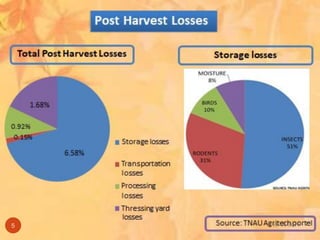
Percentage loss of food grains production
Stages
where loss
is caused
Wheat Rice Sorghum Bajra Maize Gram Millet Pulses
Threshing
Yard
1 2.5 2 0.5 0.5 0.5 1.0 0.5
Transport 0.5 0.5 0.5 0.5 0.5 0.5 0.5 0.5
Processing 2.0 - - - - - - 0.92
Storage
Rodents 2.5 2.5 2.5 2.5 2.5 2.5 2.5 2.5
Birds 0.5 1.0 1.0 1.0 0.5 0.5 2.0 0.5
Insects 3.0 2.0 2.0 1.0 3.0 5.0 0.5 5.0
Moisture 0.5 0.5 2.0 0.5 0.5 0.5 0.5 0.5
18-03-20195
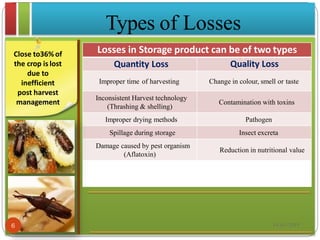
Close to36%of
the crop is lost
due to
inefficient
post harvest
management
Losses in Storage product can be of two types
Quantity Loss Quality Loss
Improper time of harvesting Change in colour, smell or taste
Inconsistent Harvest technology
(Thrashing & shelling)
Contamination with toxins
Improper drying methods Pathogen
Spillage during storage Insect excreta
Damage caused by pest organism
(Aflatoxin)
Reduction in nutritional value
Types of Losses
18-03-20196
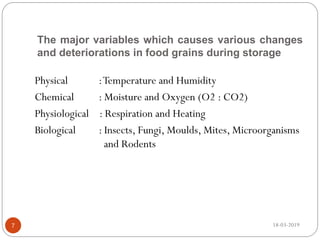
The major variables which causes various changes
and deteriorations in food grains during storage
Physical :Temperature and Humidity
Chemical : Moisture and Oxygen (O2 : CO2)
Physiological : Respiration and Heating
Biological : Insects, Fungi, Moulds, Mites, Microorganisms
and Rodents
18-03-20197
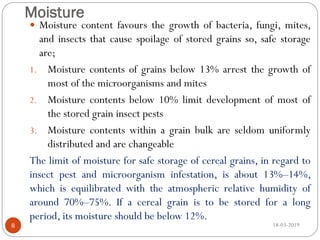
Moisture
 Moisture content favours the growth of bacteria, fungi, mites,
and insects that cause spoilage of stored grains so, safe storage
are;
1. Moisture contents of grains below 13% arrest the growth of
most of the microorganisms and mites
2. Moisture contents below 10% limit development of most of
the stored grain insect pests
3. Moisture contents within a grain bulk are seldom uniformly
distributed and are changeable
The limit of moisture for safe storage of cereal grains, in regard to
insect pest and microorganism infestation, is about 13%–14%,
which is equilibrated with the atmospheric relative humidity of
around 70%–75%. If a cereal grain is to be stored for a long
period, its moisture should be below 12%.
18-03-20198
Temperature
The temperature is another important basic factor to be
considered along with the grain moisture and equilibrium
relative humidity
The relative humidity, which is in equilibrium with the grain
moisture, varies with the temperature
 Example: For the storage of brown rice, low temperature is
generally used in Japan as the rates of chemical and biochemical
reactions are always slow at the low temperatures. The metabolic
heat produced exclusively by dry grain is about 1 × 10⁻⁷ cal/scc
and by wet grain is ∼1.3 × 10⁻⁵ cal/scc. The amount of heat
produced by fungi, insects, and other organisms infesting the
grain is much higher compared to the above mentioned values
18-03-20199
Considering temperature for safe grain storage system
Generally, mites do not develop below 5°C nor insect below
15°C
Most of the storage fungi do not develop below 0°C
The effect of temperature on an organism can be correlated with
the amount of grain moisture
The rate of respiration of grain, the growth of microorganisms,
and the chemical and enzymatic reactions during storage also
accelerate up to a certain temperature
 When the grain temperature rises to around 20°C, it starts
getting easily infested with insects and microorganisms, and, at
the same time, its rate of respiration becomes rapid with the
expense of chemical constituents. The grain temperature is always
to be considered in conjunction with its moisture content
18-03-201910
Changes in Food Grains during Storage
The changes taking place in a food grain during storage are the
chemical changes within itself and the deteriorations caused by
various living organisms. However, these changes and
deteriorations occur almost simultaneously during the storage
Chemical Changes:
o Oxidation, enzymatic reactions, and respiration influence the
chemical changes in cereal grains during storage.
o All cereal grains contain certain enzymes that decompose their
constituents such as starch, proteins, and lipids
o Enzymatic activities are enhanced with the rise in grain
moisture and temperature
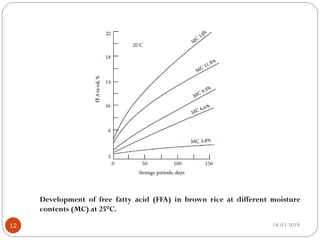
o During storage, the lipase that is inherently present in rice bran
hydrolyzes its fats into free fatty acids and glycerol 18-03-201911
Development of free fatty acid (FFA) in brown rice at different moisture
contents (MC) at 25°C.
18-03-201912
o Starch in rice, is converted into dextrin and maltose by the action
of amylase. It results in an increase in reducing sugars.
o When moisture content of a rice kernel is considerably at a higher
level, the carbohydrates are fermented. As a result, alcohol and
acetic acid are produced with the formation of acid odour.
o During storage of paddy, reducing sugars and acidity increase
whereas non-reducing sugars decrease. The percentage of
germination, non-reducing sugars, and acidity are the three most
sensitive characteristics of grain storage.
o The changes in protein during storage are comparatively small &
slow.
o Besides enzymatic reactions, oxidation by the surrounding air
causes changes in colour and flavour.
o Other constituents of cereal grains, vitamins are gradually
diminished under ordinary storage conditions.
18-03-201913
Physiological Changes
Respiration:
 The life of a food grain is manifested by respiration.
 Aerobic respiration: a complete oxidation of the hexose
yields carbon dioxide, water, and energy
 Anaerobic respiration: hexose is incompletely decomposed
into carbon dioxide, ethyl alcohol, and energy.
 Direct consequences of respiration are the loss of mass and gain
in moisture content of the grain, rise in the level of carbon
dioxide in the intergranular air space, and rise in the
temperature of the grain
 The respiration rates of freshly harvested grains are different
from those of old grains and grains damaged by insects, fungi,
and moulds.
18-03-201914
Other factors involved in grain storage are the amounts of
O2 and CO2 in the air
The respiration of grain under anaerobic condition usually
weakens viability and induces quality deterioration.
Storing cereal grains under vacuum or airtight conditions
appears to be very effective, but anaerobic respiration of
the grain at high moisture content makes it unsuitable
The cracked grains have higher respiratory rates than the
whole grains under the same condition.
18-03-201915
Longevity:
The viability period of a grain during storage can be short or
long.
 The grain dies owing to the degeneration of protein which, in
turn, is influenced by decay of components in the cell nucleus.
Generally, the life of a stored grain is regulated by the grain type,
the seed-borne micro-flora, and by the interaction between
temperature and moisture.
Sprouting:
Sprouting of the grain during storage occurs mainly owing to
generation of heat as a result of infestation.
 A grain sprouts only when its moisture content exceeds certain
limit of moisture content of 30%–35%.
18-03-201916
Heating
 The stored grain is sometimes heated up by itself without any
external cause. This spontaneous heating can be attributed to
the respiration of grain in combination with the respiration of
infested pests.
 Heating usually occurs when grain is stored in bulk. By
respiration alone, however, the temperature may not exceed
above 35°C.
 Under favourable conditions, the growth of microorganisms
is very rapid and the combined effects of respirations become
high, generating more heat.
 The total heating phenomena is about 60%–70% due to the
respiration of pests.
18-03-201917
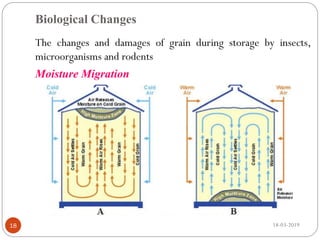
Biological Changes
The changes and damages of grain during storage by insects,
microorganisms and rodents
Moisture Migration
18-03-201918
Grain Storage Pests and Their Control
Deteriorations caused by insects and microorganisms
 Qualitative and quantitative deteriorations of stored cereal
grains.
Deterioration in the quality of grains, caused by
microorganisms
Alteration in chemical constituents of grain owing to its
metabolism
Insects and rodents cause damage by eating and contamination
18-03-201919
Types of grain spoilage
 Reduction in mass:
About 15 mg of rice kernel can be eaten away by a grain weevil
during its growth from egg to adult.
The embryo of wheat kernels making it unfit for germination
 Spoilage of Grains by Heating:
Heating of grain sometimes is brought about by insect and pest
infestation, which ultimately causes serious grain damage
 Reduction in Seed Germination:
A seed grain attacked by a germ eater is not likely to germinate.
In consequence, germination of seed grains will be seriously affected.
 Contamination of Grains by Insects:
Food grains, specially the milled products contaminated with
dead bodies of insects and their excreta and secretions, often lead to a
serious loss of grain quality.
18-03-201920
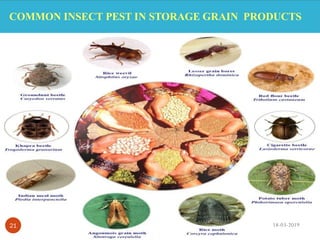
COMMON INSECT PEST IN STORAGE GRAIN PRODUCTS
18-03-201921
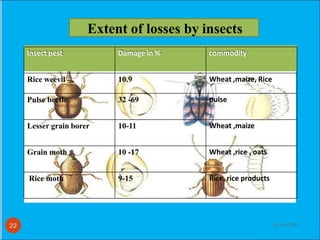
Insect pest Damage in % commodity
Rice weevil 10.9 Wheat ,maize, Rice
Pulse beetle 32 -69 pulse
Lesser grain borer 10-11 Wheat ,maize
Grain moth 10 -17 Wheat ,rice , oats
Rice moth 9-15 Rice, rice products
Extent of losses by insects
18-03-201922
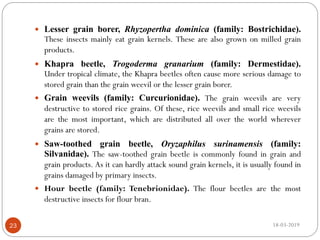
 Lesser grain borer, Rhyzopertha dominica (family: Bostrichidae).
These insects mainly eat grain kernels. These are also grown on milled grain
products.
 Khapra beetle, Trogoderma granarium (family: Dermestidae).
Under tropical climate, the Khapra beetles often cause more serious damage to
stored grain than the grain weevil or the lesser grain borer.
 Grain weevils (family: Curcurionidae). The grain weevils are very
destructive to stored rice grains. Of these, rice weevils and small rice weevils
are the most important, which are distributed all over the world wherever
grains are stored.
 Saw-toothed grain beetle, Oryzaphilus surinamensis (family:
Silvanidae). The saw-toothed grain beetle is commonly found in grain and
grain products. As it can hardly attack sound grain kernels, it is usually found in
grains damaged by primary insects.
 Hour beetle (family: Tenebrionidae). The flour beetles are the most
destructive insects for flour bran.
18-03-201923
 Warehouse moth, tropical warehouse moth (family: Phycitidae).
These are the destructive insects for both stored grains and grain
products.
 Indian meal moth, Plodia interpunctella (family: Phycitidae). It
generally grows and multiplies on grains and grain products,
seeds, nuts, etc. It is especially destructive to wheat and brown
rice. But it seldom occurs on milled rice.
 Angoumois moth, Sitotroga cerealella (family: Gelechiidae). It is the
only moth that develops within the grain kernel. It attacks both
stored and field grains. It grows on barley, oat, rye, corn, and rice.
 Rice moth, Corcyra cephalonica (family: Galleriidae). It attacks
rice, wheat, green gram, cocoa, etc. In India, it grows well on
milled jowar and millets also.
18-03-201924
Rats and Rodents
 Rodents are one of the most destructive vertebrate animals
on earth.
 The rats consume food grain and at the same time spoil it by
nibbling it into brokens and contaminating it with their
droppings of urine.
 Rats eat about 10% of their weight in food each day and
contaminate a great deal, thereby rendering it unfit for
human consumption.
18-03-201925
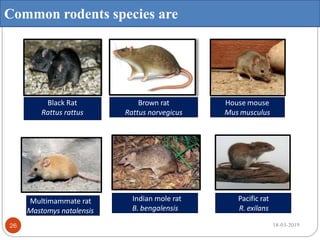
Common rodents species are
Black Rat
Rattus rattus
Brown rat
Rattus norvegicus
House mouse
Mus musculus
Multimammate rat
Mastomys natalensis
Indian mole rat
B. bengalensis
Pacific rat
R. exilans
18-03-201926
Mites
 Mites, the tiny (1-mm size) arthropods, occur in grains both in tropical
and temperate regions. There are about 54 species recorded in stored
grains and flour. Although they are abundant, they have not been
studied in detail. Also, there is a lack of information on the quantitative
losses in stored grains caused by mites (Haines CP).
 The moisture content of the grain is the critical factor for their survival.
They multiply rapidly in damp and moldy grain at low temperatures. In
heavy infestation, mites impart a characteristic odour owing to their
lipid secretions. They eat the germ part of the grains and disseminate
storage fungi and bacteria.
 They cause dermatitis and allergies in humans. Mites in stored grain
may be either saprophytic (e.g., Acarus siro and Typophagus
putrescentiae), parasitic, or predatory (Pyemotes spp., Cheyletus spp).
 The life cycle consists of egg, larva, nymph (one to three instars), and
adult. During the nymphal stage, in some species under certain
environmental conditions, there is a hypopus stage that is tolerant of
adverse conditions.
18-03-201927
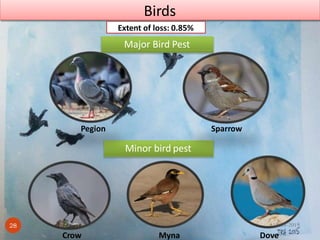
Minor bird pest
Pegion Sparrow
Major Bird Pest
Crow Myna Dove
Birds
Extent of loss: 0.85%
18-03-201928
18-03-201929
Many species are attracted by ripening grain crops and to
drying and threshing floors at harvest time. Some have
developed a close association with the more permanent sources
of grain products and have become a nuisance in food stores and
warehouses.
Grain spilled by careless handling in and around stores attracts
birds and regular spillage may lead to establishment of a
resident population. Accumulations of grain dust and flour
residues around mills and processing plants will also attract
birds as well as heavy insect infestation on the surface of stocks.
Once attracted to a building, birds quickly learn how to enter.
Bird populations inside a store pose some major
problems such as:
18-03-201930
 They may settle on top of stacks and peck holes in wooven sacks in order to reach
the food inside.This can cause spillage and in extreme cases, collapse of the stack.
 They will roost and nest inside large buildings unless access is completely
restricted. In a warehouse, birds, may damage screens in order to gain entry.
 Nests in guttering and downpiping can cause blockages and lead to flooding and
water damage to commodities.
 They become hosts for lice and mites which become occasional pests of man when
birds nest in buildings.
 Nesting materials will provide harbourage and breeding sites for several of the
stored insect pests.
 As a result of their activity, bird droppings, feathers and decaying bodies may
contaminate the foodstuffs, packaging and handling facilities. Droppings are likely
to be infected by food poisoning bacteria Salmonella) and also constitute a major
source of infection for the diseases.
Microorganisms
The principal of microorganisms (fungi and yeast), which
attack grains, are very dangerous as they can not be easily
seen with naked eyes and their harmful influences spreads
very quickly and render whole grains waste.
Microorganisms are omnipresent. They may come from soil,
from growing plant, on the surface of container and in the
air.
At the first stage, the germ of grain is affected by
microorganisms and they develop in stored grains under the
combined effect of RH and Temperature, aeration, storage
period, biochemical composition of grains, types of foreign
material present, insect and mites infestations and grains
protectants used.
18-03-201931
Most of storage fungi grow very quickly at the temperature
of about 20 - 40 o
C and above 90% RH and some are
practically confined to these conditions, but on low oxygen
and high moisture on moist maize, yeasts are more important
than fungi
It is estimated that the annual loss due to microorganisms in
stored commodities runs to million dollars
Storage fungi and bacteria cause the loss to the tune of 1-2 %
of food grains.
18-03-201932
Fungi
 The simple structure of fungus consists of a
thread (hypha) which grows inside the host
material, several hyphae produce a mat known
as mycelium
 The most important fungi in crop storage are the
moulds, whose optimum temperature for
development is above 20 0C
 In order to multiply, fungi require food material
from substrate, water, oxygen and suitable
temperature.
18-03-201933
From ecological point of view fungi may be divided
into field ad storage fungi
Field fungi: such as Alternaria, Fusarium, Cladosporium and
Helminthosporium,invade the seed before harvest.
Field fungi may affect the appearance and quality of seed or
grain. Usually damage caused by field fungi occurs before
harvest, can be detected by routine inspection and does not
continue to increase in storage.
If grain is stored at the proper moisture content and
temperature.
Most field fungi are more prevalent when rainfall is above
normal during grain fill and harvest. Invasion by field fungi
may be more severe is the crop has been damaged by insects,
birds or hail.
18-03-201934
Storage fungi (also called storage moulds): are fungi which
invade grains or seeds during storage.
 Storage fungi are usually not present to any serious extent before
harvest.
 Small quantities of spores of storage fungi may be present on grain
going into storage or may be present on spilled grain present in
harvest, handling and storage equipment or structures.
 Under improper storage conditions this small amount of inoculum
can increase rapidly leading to significant problems.
 The development of storage fungi in stored grain is influenced by
the moisture content of the stored grain, the temperature of the
stored grain, the condition of the grain going into storage, the
length of time the is grain stored and the amount of insect and
mite activity in the grain.
18-03-201935
The most common storage fungi are species
of Aspergillus and Penicillium, develop on seeds with 12-18%
moisture content
a) Aspergillus flavus and Aspergillus Parasiticus, are most
dangerous group of mycotoxins. Commonly found in
cereals and oil seeds, it causes deterioration of protein,
starches and oils in particulars. It reduces the quality of oil.
Some strains produces poisonous toxins i.e., Aflatoxin
(GN)
b) Aspergillus glaucus: commonly grown in substrate with low
moisture and high sugar content. Usually the primary
invaders of stored crops.
18-03-201936
c) Penicillium spp.: Commonly produces ochratoxins, penicillic
acid and citrinin toxins which are mainly found in corn, beans,
wheat and other field crops
d) Fusarium spp: produces Fumonisins. It is mainly present in
corns, cereal grains and sugar cane. May survive in seed and
may continue growing during storage.
Moulds during storage damages the grains as well as reducing
quality and viability of grain.
18-03-201937
Control measures
The following recommendations should help prevent storage fungi
problems or minimize damage from storage fungi in stored grains.
 Harvest as soon as the moisture content allows for minimum grain
damage.
 Adjust the harvesting equipment for minimum kernel or seed
damage and maximum cleaning.
 Clean all grain harvesting and handling equipment thoroughly
before beginning to harvest. Clean bins or storage facilities
thoroughly to remove dirt, dust and other foreign material, crop
debris, chaff and grain debris.
 Clean grain going into storage to remove light weight and broken
kernels or seeds as well as foreign material and fines.
18-03-201938
 Moisture content is by far the most important factor affecting the
growth of fungi in stored grain. After harvest grain should be
dried to safe moisture contents as quickly as possible.
 Aerate grain to safe and equalized temperatures through the grain
mass.
 Protect grain from insect and mite damage.
 Check stored grain on a regular basis and aerate as needed to
maintain low moisture and proper temperature.
 High moisture corn can be protected from storage moulds with
propionic acid or other organic acids sold under various trade
names. It is important to follow label directions on rate and
application methods. Grain treated with propionic acid can only
be used for animal feed and it is not permitted in commercial
grain channels.
18-03-201939
Fumigation
Fumigation is an insect-controlling method of
exposing stored grains to a lethal concentration of
highly toxic gas long enough to kill the insects.
Fumigants are the effective chemicals for killing
stored grain pests.
In the gaseous phase, fumigants can penetrate
through stored grains anywhere in bags on stacks
or in bulk and mill the hiding insects. These do not
have any residual effect.
18-03-201940
Different fumigants
Solid:Aluminum phosphide, Hydrogen phosphide, Phostoxin
Liquid: Ethylene bromide, Carbon tetra chloride
Gaseous: Methyl bromide, Bromomethane, Hydranic acid
Both liquid and gaseous fumigants are common.
18-03-201941
Insecticides
 The insecticides for grain storage pests are also divided into
Preventive and Curative insecticides.
 For control of additional re-infestation from outside sources
after fumigation, a contact insecticide (grain protectant) must
be applied immediately after the fumigation on the surface of
the stored grains.
18-03-201942
Principles of Fumigation
1. Application of fumigant
2. Vaporization:
 Vaporizing(kind of fumigant, method of application, temperature
and air flow rate
3. Diffusion:
• The diffusion of gas takes place owing to convection of air.
• The rate of diffusion depends on
i. Kind of fumigant
ii. Temperature
iii. Method of application.
18-03-201943
4. Sorption:
Reduction in concentration of fumigant gases in any grain storage
system takes place mainly owing to sorption of gases by grain and structural
materials of the same storage system.
It mainly depends on kind of fumigant, kind of stored grain,
temperature, gas concentration, exposure time.
5. Penetration:
The penetration of gas in between individual kernels of the stored
grain mass is accomplished by diffusion. It is gradually done by molecular
diffusion of fumigant gas due to concentration gradient of gas.
6. Lethal effect
The fumigant gas reaches the body of the insect through the
operations to render the insecticidal effect.The lethal effect mainly depends
on toxicity of chemical agent, dosage, exposure period, temperature.
18-03-201944
Applications of Fumigants
 In India, fumigation with ethylene dibromide or aluminum
phosphide is adopted for farm storage
 methyl bromide or ethylene dibromide or aluminum
phosphide is employed in commercial storage of grains
 In addition to fumigation, surface treatment with malathion
or pyrethrum is employed in commercial grain storage. Due
to the low cost of fumigation and convenience,
18-03-201945
Rodent Control
 Sanitation and hygiene (waste should be removed)
 Rat-proof construction
 The metal bins can be tight enough to prevent entry of
rodents.
 Silos made of either steel or concrete are sufficiently rat
proof.
 Rodenticides are usually mixed with baits
 Rat traps
18-03-201946
Birds control
18-03-201947
Preventive measures are very important in reducing
losses by birds.
 Making the premises inaccessible to birds by netting or grills
or hanging plastic strips is necessary.
 All ventilators and windows need wire netting to prevent the
birds from invading, nesting, or roosting.
 Scaring devices based on vision, noise, or recorded alarm
calls will become ineffective after some period.
Conclusion
18-03-201948
 Safe storage temperature and moisture content is reuired
 Preventive measures should b practiced during storage
 R & D efforts are required in area of impact o biotic and
abiotic factors, detection and monitoring of spoilage, safe
fumigants, uniform fumigation is necessary
References
Magan. N and Lacey, J., 1985. Interactions between field and
storage fungi, Transactions of the British Mycological
Society, 85(1):29-37
Gregg et al. 1970. Seed Processing. NSC.
Sahay, K. M & Singh, K.K. 1994. Unit Operation of
Agricultural Processing,Vikas Publ. House.S
Weaver, D.K and Petroff, A.R, 2004. Pest management for
grain storage and fumigation
agebb@missouri.edu.2019. Moisture grain storage
18-03-201949
 Lessard, F. F., 2017. Integrated management of the risks of stored
grain spoilage by seedborne fungi and contamination by storage
mould mycotoxins. Journal of stored products research. 71-22-40
Chakraverty, A., 1981. Post harvest technology of cereals,
pulses and oilseeds, 3rd
Edition, Oxford &IBH publishing Co.
PVT. LTD.
TNAU agritech portal, post harvest technology, 2017.
 Kiaya, V., 2014. Post-harvest losses and strategies to reduce
them, Technical paper on post harvest losses, ACF.
18-03-201950
18-03-201951
Chakraverty,A., Mujumdar,A. S., Raghavan, G.S.V. and
Ramaswamy, H. S., 2003. Handbook of Postharvest
Technology of cereals, fruits, vegetables, tea and spices,
Eastern Hemisphere Distribution, Marcel Dekkar. Inc.

Grain quality deterioration ppt pdf

  • 1.
    Grain quality deterioration PresentedBy Nagarathna S B Ph. D. Scholar Department of PFE CTAE, MPUAT, Udaipur, Rajasthan 18-03-20191
  • 2.
    Content  Introduction  Postharvest losses  Changes in Food Grains during Storage  Grain Storage Pests, Rodents, Mites, Birds andTheir Control  Conclusion  References 18-03-20192
  • 3.
    Introduction  Storage isan important link in the entire procurement and distribution system of food grains which are produced seasonally but are consumed all the year round  It helps in reducing the seasonal fluctuations in availability and prices  To ensures a continuous flow of goods in the market  It protects the quality of perishable and semi-perishable products from deterioration  It helps in the stabilization of prices by adjusting demand and supply  It provides employment and income through price advantages 18-03-20193
  • 4.
     Food grainsare living organism, so they are store as living seeds  They store in control condition of temperature & relative humidity  Prevent from insects, pests & rodents. 18-03-20194
  • 5.
    Percentage loss offood grains production Stages where loss is caused Wheat Rice Sorghum Bajra Maize Gram Millet Pulses Threshing Yard 1 2.5 2 0.5 0.5 0.5 1.0 0.5 Transport 0.5 0.5 0.5 0.5 0.5 0.5 0.5 0.5 Processing 2.0 - - - - - - 0.92 Storage Rodents 2.5 2.5 2.5 2.5 2.5 2.5 2.5 2.5 Birds 0.5 1.0 1.0 1.0 0.5 0.5 2.0 0.5 Insects 3.0 2.0 2.0 1.0 3.0 5.0 0.5 5.0 Moisture 0.5 0.5 2.0 0.5 0.5 0.5 0.5 0.5 18-03-20195
  • 6.
    Close to36%of the cropis lost due to inefficient post harvest management Losses in Storage product can be of two types Quantity Loss Quality Loss Improper time of harvesting Change in colour, smell or taste Inconsistent Harvest technology (Thrashing & shelling) Contamination with toxins Improper drying methods Pathogen Spillage during storage Insect excreta Damage caused by pest organism (Aflatoxin) Reduction in nutritional value Types of Losses 18-03-20196
  • 7.
    The major variableswhich causes various changes and deteriorations in food grains during storage Physical :Temperature and Humidity Chemical : Moisture and Oxygen (O2 : CO2) Physiological : Respiration and Heating Biological : Insects, Fungi, Moulds, Mites, Microorganisms and Rodents 18-03-20197
  • 8.
    Moisture  Moisture contentfavours the growth of bacteria, fungi, mites, and insects that cause spoilage of stored grains so, safe storage are; 1. Moisture contents of grains below 13% arrest the growth of most of the microorganisms and mites 2. Moisture contents below 10% limit development of most of the stored grain insect pests 3. Moisture contents within a grain bulk are seldom uniformly distributed and are changeable The limit of moisture for safe storage of cereal grains, in regard to insect pest and microorganism infestation, is about 13%–14%, which is equilibrated with the atmospheric relative humidity of around 70%–75%. If a cereal grain is to be stored for a long period, its moisture should be below 12%. 18-03-20198
  • 9.
    Temperature The temperature isanother important basic factor to be considered along with the grain moisture and equilibrium relative humidity The relative humidity, which is in equilibrium with the grain moisture, varies with the temperature  Example: For the storage of brown rice, low temperature is generally used in Japan as the rates of chemical and biochemical reactions are always slow at the low temperatures. The metabolic heat produced exclusively by dry grain is about 1 × 10⁻⁷ cal/scc and by wet grain is ∼1.3 × 10⁻⁵ cal/scc. The amount of heat produced by fungi, insects, and other organisms infesting the grain is much higher compared to the above mentioned values 18-03-20199
  • 10.
    Considering temperature forsafe grain storage system Generally, mites do not develop below 5°C nor insect below 15°C Most of the storage fungi do not develop below 0°C The effect of temperature on an organism can be correlated with the amount of grain moisture The rate of respiration of grain, the growth of microorganisms, and the chemical and enzymatic reactions during storage also accelerate up to a certain temperature  When the grain temperature rises to around 20°C, it starts getting easily infested with insects and microorganisms, and, at the same time, its rate of respiration becomes rapid with the expense of chemical constituents. The grain temperature is always to be considered in conjunction with its moisture content 18-03-201910
  • 11.
    Changes in FoodGrains during Storage The changes taking place in a food grain during storage are the chemical changes within itself and the deteriorations caused by various living organisms. However, these changes and deteriorations occur almost simultaneously during the storage Chemical Changes: o Oxidation, enzymatic reactions, and respiration influence the chemical changes in cereal grains during storage. o All cereal grains contain certain enzymes that decompose their constituents such as starch, proteins, and lipids o Enzymatic activities are enhanced with the rise in grain moisture and temperature o During storage, the lipase that is inherently present in rice bran hydrolyzes its fats into free fatty acids and glycerol 18-03-201911
  • 12.
    Development of freefatty acid (FFA) in brown rice at different moisture contents (MC) at 25°C. 18-03-201912
  • 13.
    o Starch inrice, is converted into dextrin and maltose by the action of amylase. It results in an increase in reducing sugars. o When moisture content of a rice kernel is considerably at a higher level, the carbohydrates are fermented. As a result, alcohol and acetic acid are produced with the formation of acid odour. o During storage of paddy, reducing sugars and acidity increase whereas non-reducing sugars decrease. The percentage of germination, non-reducing sugars, and acidity are the three most sensitive characteristics of grain storage. o The changes in protein during storage are comparatively small & slow. o Besides enzymatic reactions, oxidation by the surrounding air causes changes in colour and flavour. o Other constituents of cereal grains, vitamins are gradually diminished under ordinary storage conditions. 18-03-201913
  • 14.
    Physiological Changes Respiration:  Thelife of a food grain is manifested by respiration.  Aerobic respiration: a complete oxidation of the hexose yields carbon dioxide, water, and energy  Anaerobic respiration: hexose is incompletely decomposed into carbon dioxide, ethyl alcohol, and energy.  Direct consequences of respiration are the loss of mass and gain in moisture content of the grain, rise in the level of carbon dioxide in the intergranular air space, and rise in the temperature of the grain  The respiration rates of freshly harvested grains are different from those of old grains and grains damaged by insects, fungi, and moulds. 18-03-201914
  • 15.
    Other factors involvedin grain storage are the amounts of O2 and CO2 in the air The respiration of grain under anaerobic condition usually weakens viability and induces quality deterioration. Storing cereal grains under vacuum or airtight conditions appears to be very effective, but anaerobic respiration of the grain at high moisture content makes it unsuitable The cracked grains have higher respiratory rates than the whole grains under the same condition. 18-03-201915
  • 16.
    Longevity: The viability periodof a grain during storage can be short or long.  The grain dies owing to the degeneration of protein which, in turn, is influenced by decay of components in the cell nucleus. Generally, the life of a stored grain is regulated by the grain type, the seed-borne micro-flora, and by the interaction between temperature and moisture. Sprouting: Sprouting of the grain during storage occurs mainly owing to generation of heat as a result of infestation.  A grain sprouts only when its moisture content exceeds certain limit of moisture content of 30%–35%. 18-03-201916
  • 17.
    Heating  The storedgrain is sometimes heated up by itself without any external cause. This spontaneous heating can be attributed to the respiration of grain in combination with the respiration of infested pests.  Heating usually occurs when grain is stored in bulk. By respiration alone, however, the temperature may not exceed above 35°C.  Under favourable conditions, the growth of microorganisms is very rapid and the combined effects of respirations become high, generating more heat.  The total heating phenomena is about 60%–70% due to the respiration of pests. 18-03-201917
  • 18.
    Biological Changes The changesand damages of grain during storage by insects, microorganisms and rodents Moisture Migration 18-03-201918
  • 19.
    Grain Storage Pestsand Their Control Deteriorations caused by insects and microorganisms  Qualitative and quantitative deteriorations of stored cereal grains. Deterioration in the quality of grains, caused by microorganisms Alteration in chemical constituents of grain owing to its metabolism Insects and rodents cause damage by eating and contamination 18-03-201919
  • 20.
    Types of grainspoilage  Reduction in mass: About 15 mg of rice kernel can be eaten away by a grain weevil during its growth from egg to adult. The embryo of wheat kernels making it unfit for germination  Spoilage of Grains by Heating: Heating of grain sometimes is brought about by insect and pest infestation, which ultimately causes serious grain damage  Reduction in Seed Germination: A seed grain attacked by a germ eater is not likely to germinate. In consequence, germination of seed grains will be seriously affected.  Contamination of Grains by Insects: Food grains, specially the milled products contaminated with dead bodies of insects and their excreta and secretions, often lead to a serious loss of grain quality. 18-03-201920
  • 21.
    COMMON INSECT PESTIN STORAGE GRAIN PRODUCTS 18-03-201921
  • 22.
    Insect pest Damagein % commodity Rice weevil 10.9 Wheat ,maize, Rice Pulse beetle 32 -69 pulse Lesser grain borer 10-11 Wheat ,maize Grain moth 10 -17 Wheat ,rice , oats Rice moth 9-15 Rice, rice products Extent of losses by insects 18-03-201922
  • 23.
     Lesser grainborer, Rhyzopertha dominica (family: Bostrichidae). These insects mainly eat grain kernels. These are also grown on milled grain products.  Khapra beetle, Trogoderma granarium (family: Dermestidae). Under tropical climate, the Khapra beetles often cause more serious damage to stored grain than the grain weevil or the lesser grain borer.  Grain weevils (family: Curcurionidae). The grain weevils are very destructive to stored rice grains. Of these, rice weevils and small rice weevils are the most important, which are distributed all over the world wherever grains are stored.  Saw-toothed grain beetle, Oryzaphilus surinamensis (family: Silvanidae). The saw-toothed grain beetle is commonly found in grain and grain products. As it can hardly attack sound grain kernels, it is usually found in grains damaged by primary insects.  Hour beetle (family: Tenebrionidae). The flour beetles are the most destructive insects for flour bran. 18-03-201923
  • 24.
     Warehouse moth,tropical warehouse moth (family: Phycitidae). These are the destructive insects for both stored grains and grain products.  Indian meal moth, Plodia interpunctella (family: Phycitidae). It generally grows and multiplies on grains and grain products, seeds, nuts, etc. It is especially destructive to wheat and brown rice. But it seldom occurs on milled rice.  Angoumois moth, Sitotroga cerealella (family: Gelechiidae). It is the only moth that develops within the grain kernel. It attacks both stored and field grains. It grows on barley, oat, rye, corn, and rice.  Rice moth, Corcyra cephalonica (family: Galleriidae). It attacks rice, wheat, green gram, cocoa, etc. In India, it grows well on milled jowar and millets also. 18-03-201924
  • 25.
    Rats and Rodents Rodents are one of the most destructive vertebrate animals on earth.  The rats consume food grain and at the same time spoil it by nibbling it into brokens and contaminating it with their droppings of urine.  Rats eat about 10% of their weight in food each day and contaminate a great deal, thereby rendering it unfit for human consumption. 18-03-201925
  • 26.
    Common rodents speciesare Black Rat Rattus rattus Brown rat Rattus norvegicus House mouse Mus musculus Multimammate rat Mastomys natalensis Indian mole rat B. bengalensis Pacific rat R. exilans 18-03-201926
  • 27.
    Mites  Mites, thetiny (1-mm size) arthropods, occur in grains both in tropical and temperate regions. There are about 54 species recorded in stored grains and flour. Although they are abundant, they have not been studied in detail. Also, there is a lack of information on the quantitative losses in stored grains caused by mites (Haines CP).  The moisture content of the grain is the critical factor for their survival. They multiply rapidly in damp and moldy grain at low temperatures. In heavy infestation, mites impart a characteristic odour owing to their lipid secretions. They eat the germ part of the grains and disseminate storage fungi and bacteria.  They cause dermatitis and allergies in humans. Mites in stored grain may be either saprophytic (e.g., Acarus siro and Typophagus putrescentiae), parasitic, or predatory (Pyemotes spp., Cheyletus spp).  The life cycle consists of egg, larva, nymph (one to three instars), and adult. During the nymphal stage, in some species under certain environmental conditions, there is a hypopus stage that is tolerant of adverse conditions. 18-03-201927
  • 28.
    Minor bird pest PegionSparrow Major Bird Pest Crow Myna Dove Birds Extent of loss: 0.85% 18-03-201928
  • 29.
    18-03-201929 Many species areattracted by ripening grain crops and to drying and threshing floors at harvest time. Some have developed a close association with the more permanent sources of grain products and have become a nuisance in food stores and warehouses. Grain spilled by careless handling in and around stores attracts birds and regular spillage may lead to establishment of a resident population. Accumulations of grain dust and flour residues around mills and processing plants will also attract birds as well as heavy insect infestation on the surface of stocks. Once attracted to a building, birds quickly learn how to enter.
  • 30.
    Bird populations insidea store pose some major problems such as: 18-03-201930  They may settle on top of stacks and peck holes in wooven sacks in order to reach the food inside.This can cause spillage and in extreme cases, collapse of the stack.  They will roost and nest inside large buildings unless access is completely restricted. In a warehouse, birds, may damage screens in order to gain entry.  Nests in guttering and downpiping can cause blockages and lead to flooding and water damage to commodities.  They become hosts for lice and mites which become occasional pests of man when birds nest in buildings.  Nesting materials will provide harbourage and breeding sites for several of the stored insect pests.  As a result of their activity, bird droppings, feathers and decaying bodies may contaminate the foodstuffs, packaging and handling facilities. Droppings are likely to be infected by food poisoning bacteria Salmonella) and also constitute a major source of infection for the diseases.
  • 31.
    Microorganisms The principal ofmicroorganisms (fungi and yeast), which attack grains, are very dangerous as they can not be easily seen with naked eyes and their harmful influences spreads very quickly and render whole grains waste. Microorganisms are omnipresent. They may come from soil, from growing plant, on the surface of container and in the air. At the first stage, the germ of grain is affected by microorganisms and they develop in stored grains under the combined effect of RH and Temperature, aeration, storage period, biochemical composition of grains, types of foreign material present, insect and mites infestations and grains protectants used. 18-03-201931
  • 32.
    Most of storagefungi grow very quickly at the temperature of about 20 - 40 o C and above 90% RH and some are practically confined to these conditions, but on low oxygen and high moisture on moist maize, yeasts are more important than fungi It is estimated that the annual loss due to microorganisms in stored commodities runs to million dollars Storage fungi and bacteria cause the loss to the tune of 1-2 % of food grains. 18-03-201932
  • 33.
    Fungi  The simplestructure of fungus consists of a thread (hypha) which grows inside the host material, several hyphae produce a mat known as mycelium  The most important fungi in crop storage are the moulds, whose optimum temperature for development is above 20 0C  In order to multiply, fungi require food material from substrate, water, oxygen and suitable temperature. 18-03-201933
  • 34.
    From ecological pointof view fungi may be divided into field ad storage fungi Field fungi: such as Alternaria, Fusarium, Cladosporium and Helminthosporium,invade the seed before harvest. Field fungi may affect the appearance and quality of seed or grain. Usually damage caused by field fungi occurs before harvest, can be detected by routine inspection and does not continue to increase in storage. If grain is stored at the proper moisture content and temperature. Most field fungi are more prevalent when rainfall is above normal during grain fill and harvest. Invasion by field fungi may be more severe is the crop has been damaged by insects, birds or hail. 18-03-201934
  • 35.
    Storage fungi (alsocalled storage moulds): are fungi which invade grains or seeds during storage.  Storage fungi are usually not present to any serious extent before harvest.  Small quantities of spores of storage fungi may be present on grain going into storage or may be present on spilled grain present in harvest, handling and storage equipment or structures.  Under improper storage conditions this small amount of inoculum can increase rapidly leading to significant problems.  The development of storage fungi in stored grain is influenced by the moisture content of the stored grain, the temperature of the stored grain, the condition of the grain going into storage, the length of time the is grain stored and the amount of insect and mite activity in the grain. 18-03-201935
  • 36.
    The most commonstorage fungi are species of Aspergillus and Penicillium, develop on seeds with 12-18% moisture content a) Aspergillus flavus and Aspergillus Parasiticus, are most dangerous group of mycotoxins. Commonly found in cereals and oil seeds, it causes deterioration of protein, starches and oils in particulars. It reduces the quality of oil. Some strains produces poisonous toxins i.e., Aflatoxin (GN) b) Aspergillus glaucus: commonly grown in substrate with low moisture and high sugar content. Usually the primary invaders of stored crops. 18-03-201936
  • 37.
    c) Penicillium spp.:Commonly produces ochratoxins, penicillic acid and citrinin toxins which are mainly found in corn, beans, wheat and other field crops d) Fusarium spp: produces Fumonisins. It is mainly present in corns, cereal grains and sugar cane. May survive in seed and may continue growing during storage. Moulds during storage damages the grains as well as reducing quality and viability of grain. 18-03-201937
  • 38.
    Control measures The followingrecommendations should help prevent storage fungi problems or minimize damage from storage fungi in stored grains.  Harvest as soon as the moisture content allows for minimum grain damage.  Adjust the harvesting equipment for minimum kernel or seed damage and maximum cleaning.  Clean all grain harvesting and handling equipment thoroughly before beginning to harvest. Clean bins or storage facilities thoroughly to remove dirt, dust and other foreign material, crop debris, chaff and grain debris.  Clean grain going into storage to remove light weight and broken kernels or seeds as well as foreign material and fines. 18-03-201938
  • 39.
     Moisture contentis by far the most important factor affecting the growth of fungi in stored grain. After harvest grain should be dried to safe moisture contents as quickly as possible.  Aerate grain to safe and equalized temperatures through the grain mass.  Protect grain from insect and mite damage.  Check stored grain on a regular basis and aerate as needed to maintain low moisture and proper temperature.  High moisture corn can be protected from storage moulds with propionic acid or other organic acids sold under various trade names. It is important to follow label directions on rate and application methods. Grain treated with propionic acid can only be used for animal feed and it is not permitted in commercial grain channels. 18-03-201939
  • 40.
    Fumigation Fumigation is aninsect-controlling method of exposing stored grains to a lethal concentration of highly toxic gas long enough to kill the insects. Fumigants are the effective chemicals for killing stored grain pests. In the gaseous phase, fumigants can penetrate through stored grains anywhere in bags on stacks or in bulk and mill the hiding insects. These do not have any residual effect. 18-03-201940
  • 41.
    Different fumigants Solid:Aluminum phosphide,Hydrogen phosphide, Phostoxin Liquid: Ethylene bromide, Carbon tetra chloride Gaseous: Methyl bromide, Bromomethane, Hydranic acid Both liquid and gaseous fumigants are common. 18-03-201941
  • 42.
    Insecticides  The insecticidesfor grain storage pests are also divided into Preventive and Curative insecticides.  For control of additional re-infestation from outside sources after fumigation, a contact insecticide (grain protectant) must be applied immediately after the fumigation on the surface of the stored grains. 18-03-201942
  • 43.
    Principles of Fumigation 1.Application of fumigant 2. Vaporization:  Vaporizing(kind of fumigant, method of application, temperature and air flow rate 3. Diffusion: • The diffusion of gas takes place owing to convection of air. • The rate of diffusion depends on i. Kind of fumigant ii. Temperature iii. Method of application. 18-03-201943
  • 44.
    4. Sorption: Reduction inconcentration of fumigant gases in any grain storage system takes place mainly owing to sorption of gases by grain and structural materials of the same storage system. It mainly depends on kind of fumigant, kind of stored grain, temperature, gas concentration, exposure time. 5. Penetration: The penetration of gas in between individual kernels of the stored grain mass is accomplished by diffusion. It is gradually done by molecular diffusion of fumigant gas due to concentration gradient of gas. 6. Lethal effect The fumigant gas reaches the body of the insect through the operations to render the insecticidal effect.The lethal effect mainly depends on toxicity of chemical agent, dosage, exposure period, temperature. 18-03-201944
  • 45.
    Applications of Fumigants In India, fumigation with ethylene dibromide or aluminum phosphide is adopted for farm storage  methyl bromide or ethylene dibromide or aluminum phosphide is employed in commercial storage of grains  In addition to fumigation, surface treatment with malathion or pyrethrum is employed in commercial grain storage. Due to the low cost of fumigation and convenience, 18-03-201945
  • 46.
    Rodent Control  Sanitationand hygiene (waste should be removed)  Rat-proof construction  The metal bins can be tight enough to prevent entry of rodents.  Silos made of either steel or concrete are sufficiently rat proof.  Rodenticides are usually mixed with baits  Rat traps 18-03-201946
  • 47.
    Birds control 18-03-201947 Preventive measuresare very important in reducing losses by birds.  Making the premises inaccessible to birds by netting or grills or hanging plastic strips is necessary.  All ventilators and windows need wire netting to prevent the birds from invading, nesting, or roosting.  Scaring devices based on vision, noise, or recorded alarm calls will become ineffective after some period.
  • 48.
    Conclusion 18-03-201948  Safe storagetemperature and moisture content is reuired  Preventive measures should b practiced during storage  R & D efforts are required in area of impact o biotic and abiotic factors, detection and monitoring of spoilage, safe fumigants, uniform fumigation is necessary
  • 49.
    References Magan. N andLacey, J., 1985. Interactions between field and storage fungi, Transactions of the British Mycological Society, 85(1):29-37 Gregg et al. 1970. Seed Processing. NSC. Sahay, K. M & Singh, K.K. 1994. Unit Operation of Agricultural Processing,Vikas Publ. House.S Weaver, D.K and Petroff, A.R, 2004. Pest management for grain storage and fumigation agebb@missouri.edu.2019. Moisture grain storage 18-03-201949
  • 50.
     Lessard, F.F., 2017. Integrated management of the risks of stored grain spoilage by seedborne fungi and contamination by storage mould mycotoxins. Journal of stored products research. 71-22-40 Chakraverty, A., 1981. Post harvest technology of cereals, pulses and oilseeds, 3rd Edition, Oxford &IBH publishing Co. PVT. LTD. TNAU agritech portal, post harvest technology, 2017.  Kiaya, V., 2014. Post-harvest losses and strategies to reduce them, Technical paper on post harvest losses, ACF. 18-03-201950
  • 51.
    18-03-201951 Chakraverty,A., Mujumdar,A. S.,Raghavan, G.S.V. and Ramaswamy, H. S., 2003. Handbook of Postharvest Technology of cereals, fruits, vegetables, tea and spices, Eastern Hemisphere Distribution, Marcel Dekkar. Inc.