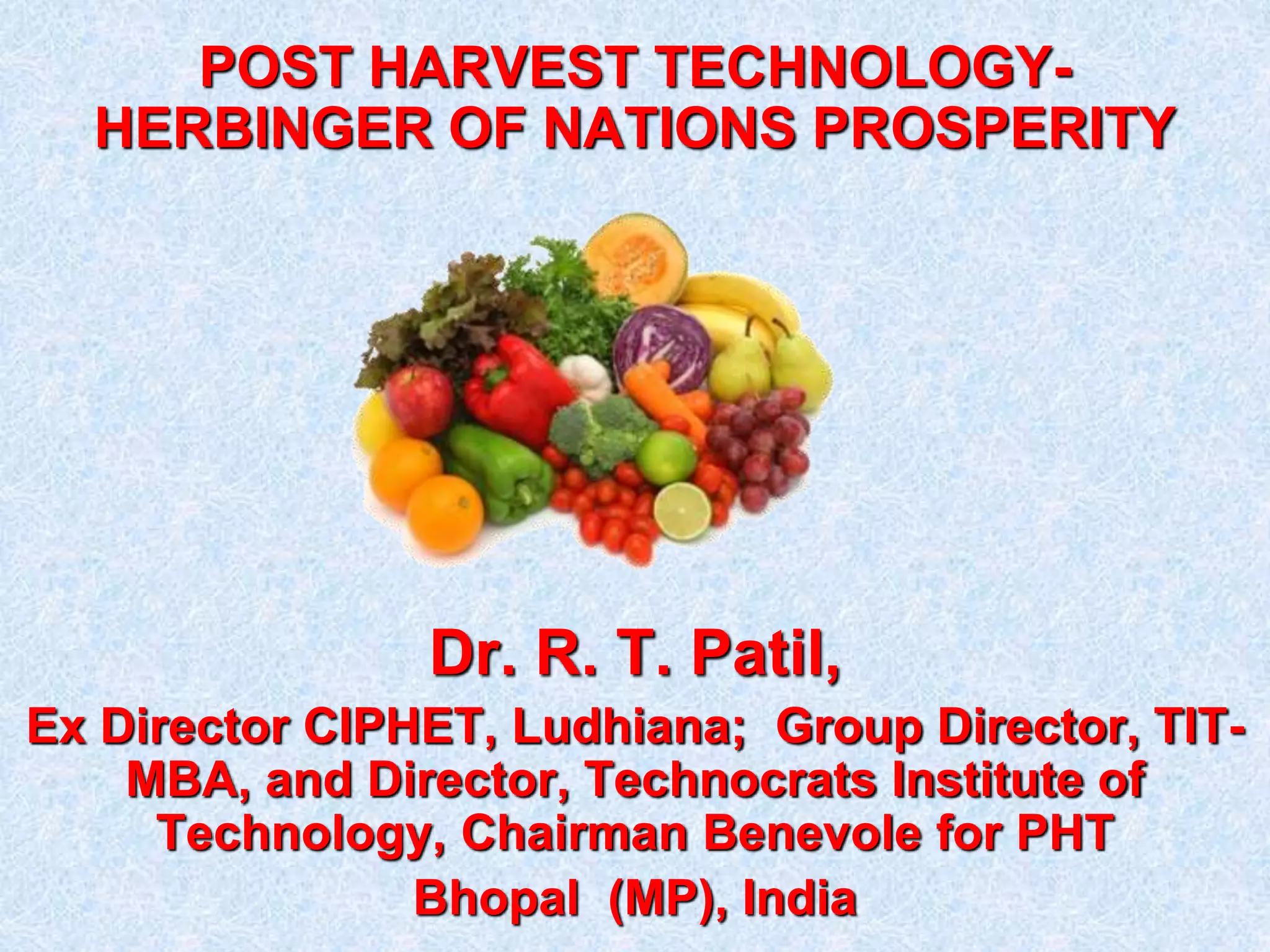


POST HARVEST TECHNOLOGY-HERBINGER 
OF NATIONS PROSPERITY 
Dr. R. T. Patil, 
Ex Director CIPHET, Ludhiana; Group Director, TIT-MBA, 
and Director, Technocrats Institute of 
Technology, Chairman Benevole for PHT 
Bhopal (MP), India
Production & Post Harvest Scenario 
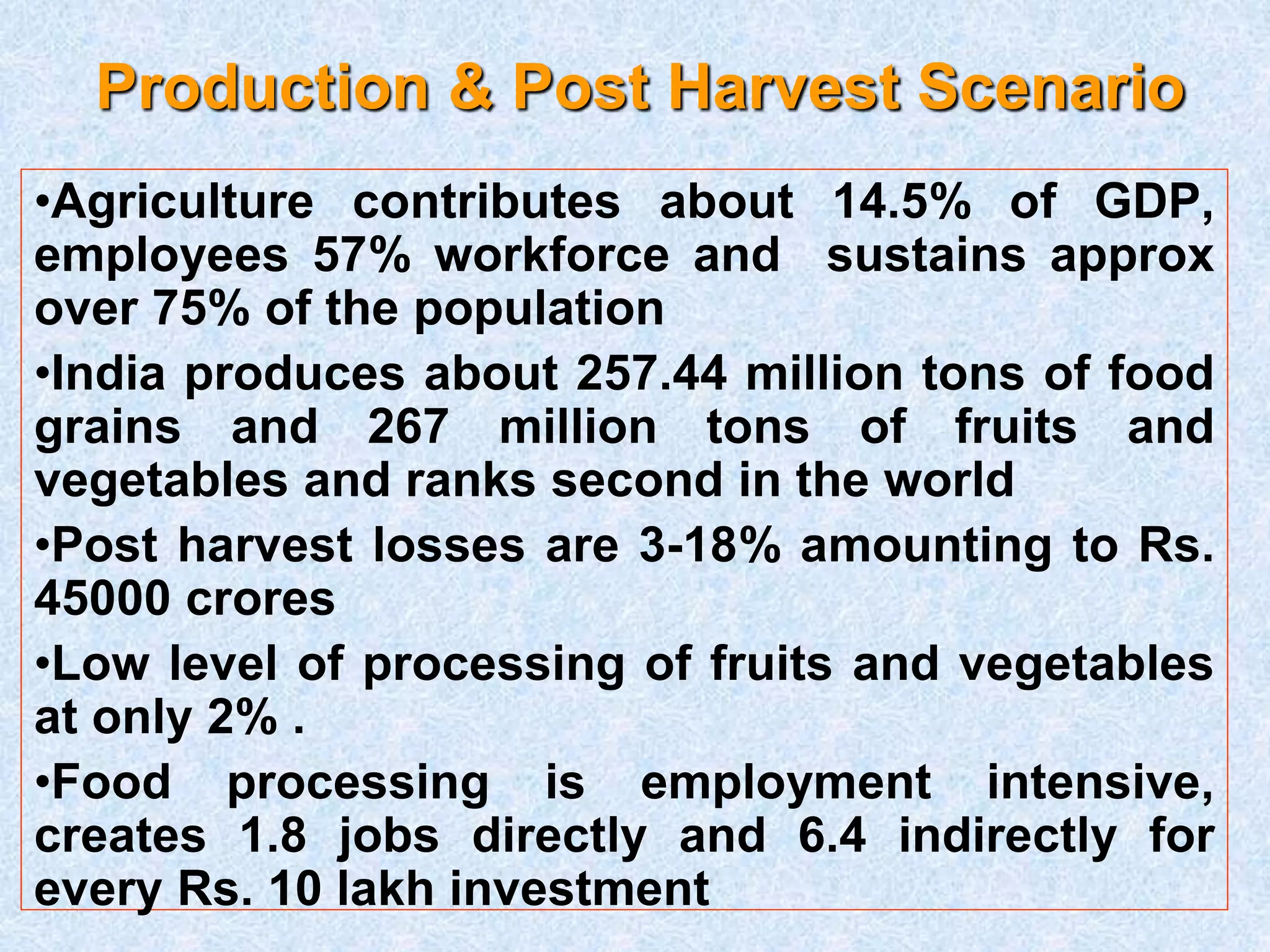
•Agriculture contributes about 14.5% of GDP, 
employees 57% workforce and sustains approx 
over 75% of the population 
•India produces about 257.44 million tons of food 
grains and 267 million tons of fruits and 
vegetables and ranks second in the world 
•Post harvest losses are 3-18% amounting to Rs. 
45000 crores 
•Low level of processing of fruits and vegetables 
at only 2% . 
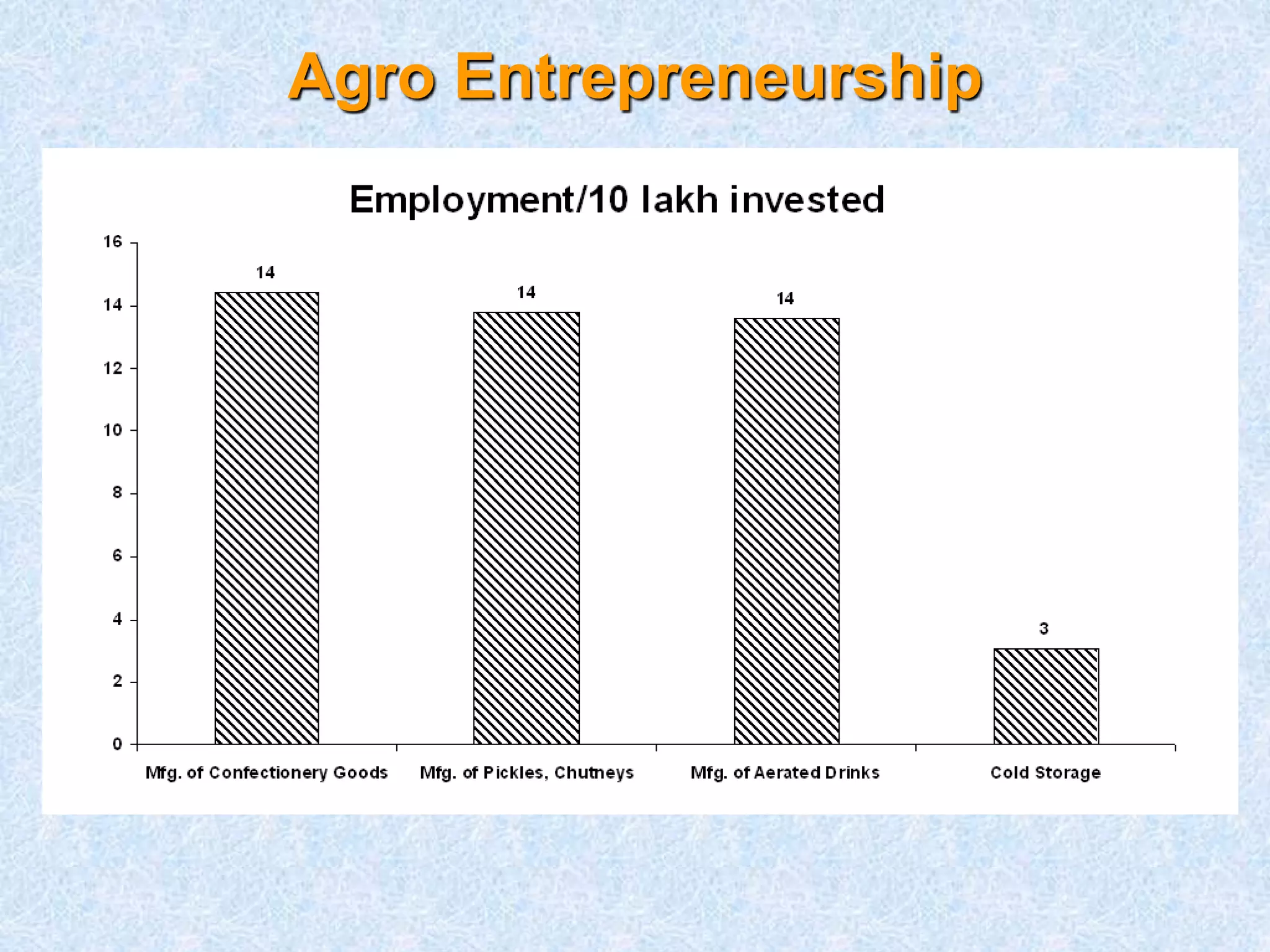
•Food processing is employment intensive, 
creates 1.8 jobs directly and 6.4 indirectly for 
every Rs. 10 lakh investment
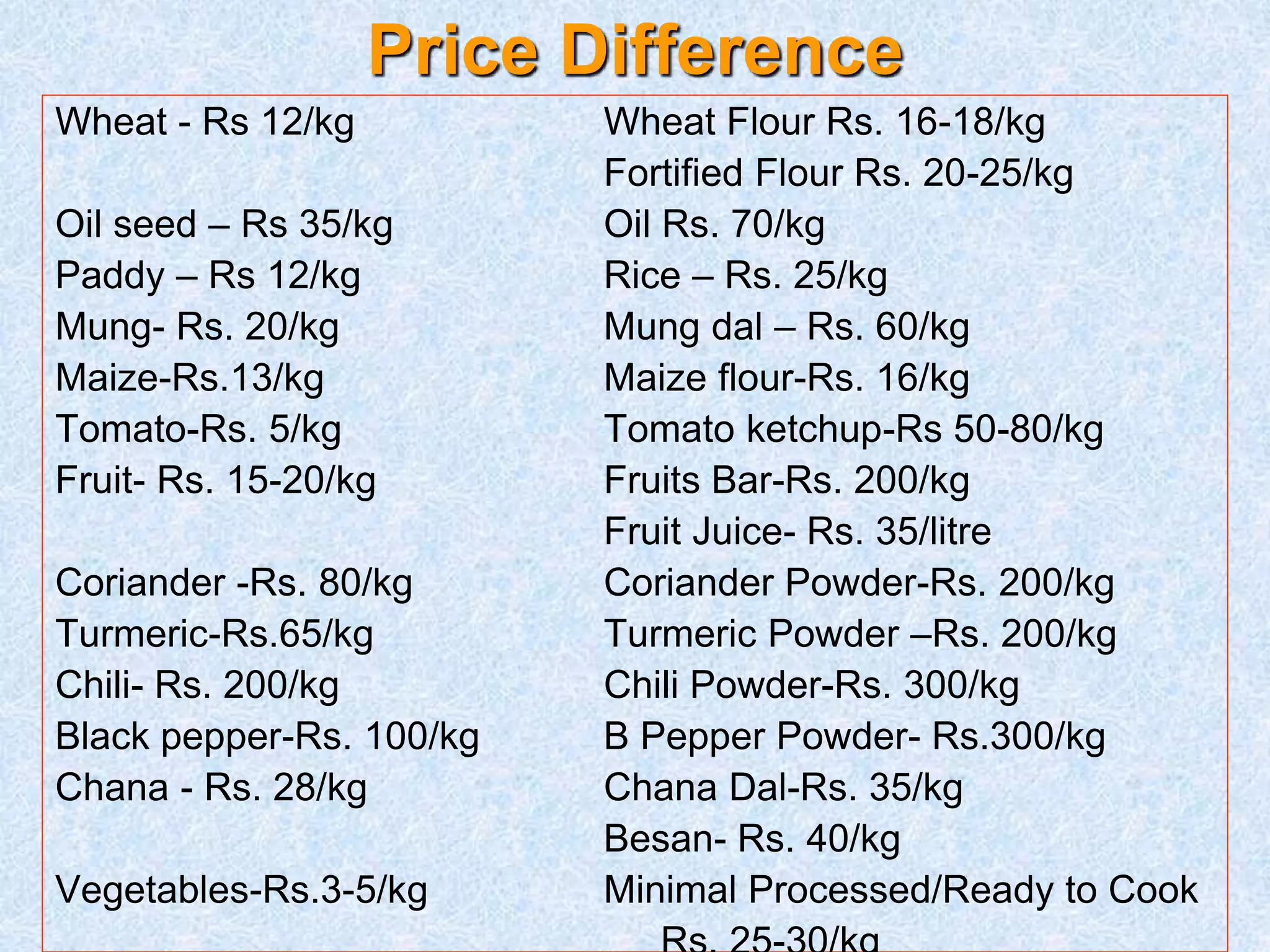
Price Difference 
Wheat - Rs 12/kg Wheat Flour Rs. 16-18/kg 
Fortified Flour Rs. 20-25/kg 
Oil seed – Rs 35/kg Oil Rs. 70/kg 
Paddy – Rs 12/kg Rice – Rs. 25/kg 
Mung- Rs. 20/kg Mung dal – Rs. 60/kg 
Maize-Rs.13/kg Maize flour-Rs. 16/kg 
Tomato-Rs. 5/kg Tomato ketchup-Rs 50-80/kg 
Fruit- Rs. 15-20/kg Fruits Bar-Rs. 200/kg 
Fruit Juice- Rs. 35/litre 
Coriander -Rs. 80/kg Coriander Powder-Rs. 200/kg 
Turmeric-Rs.65/kg Turmeric Powder –Rs. 200/kg 
Chili- Rs. 200/kg Chili Powder-Rs. 300/kg 
Black pepper-Rs. 100/kg B Pepper Powder- Rs.300/kg 
Chana - Rs. 28/kg Chana Dal-Rs. 35/kg 
Besan- Rs. 40/kg 
Vegetables-Rs.3-5/kg Minimal Processed/Ready to Cook 
Rs. 25-30/kg
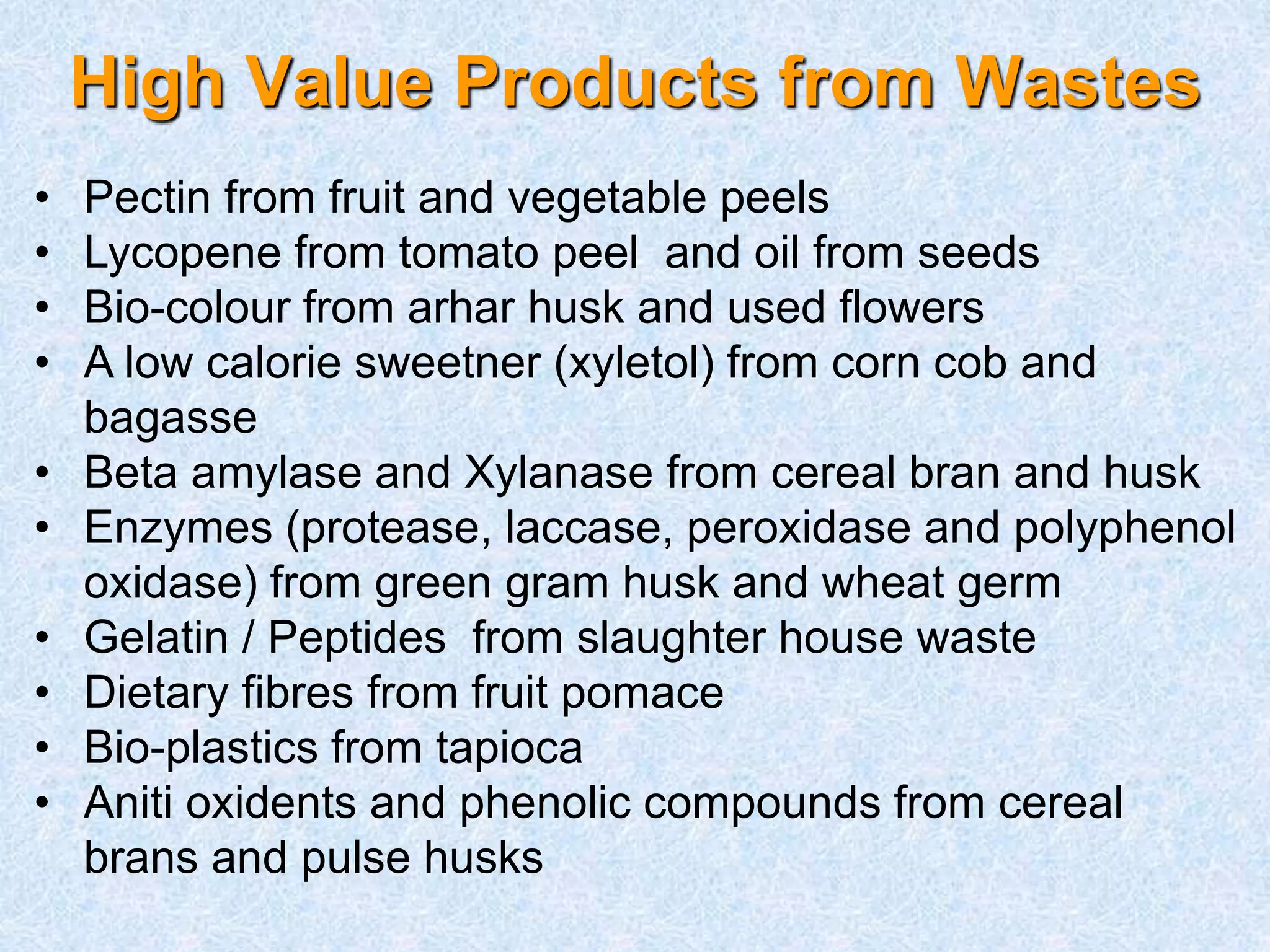
High Value Products from Wastes 
• Pectin from fruit and vegetable peels 
• Lycopene from tomato peel and oil from seeds 
• Bio-colour from arhar husk and used flowers 
• A low calorie sweetner (xyletol) from corn cob and 
bagasse 
• Beta amylase and Xylanase from cereal bran and husk 
• Enzymes (protease, laccase, peroxidase and polyphenol 
oxidase) from green gram husk and wheat germ 
• Gelatin / Peptides from slaughter house waste 
• Dietary fibres from fruit pomace 
• Bio-plastics from tapioca 
• Aniti oxidents and phenolic compounds from cereal 
brans and pulse husks
Reasons for Losses 
1. Handling of raw produce through many stages of 
middlemen. 
2. Processing is mostly controlled by urban rather than rural 
entrepreneurs which leads to losses in valuable by 
products. 
3. Non availability of adequate and efficient equipment and 
machinery to be used in catchment areas. 
4. Low level of entrepreneurial urge in rural areas due to 
constraints of finance, assured market and proper training 
on technology 
5. On the whole, there exists a fragmented and inefficient 
value chain 
Higher the processing- - Better the Post Harvest 
Management - - Lower Will Be Losses
Post Harvest Activities in SITU 
1. Can provide processed food of highest quality at 
affordable cost to consumers 
2. Help environment by processing food in production 
catchment with least food miles 
3. Ensure traceability of raw materials used for 
processed product hence great for export and elite 
urban market. 
4. Help effective backward linkage with farmers for 
processing their raw produce 
5. Shorten the supply chain, increase the profitability of 
farmers and ultimately increase in GDP from 
agriculture and reduce poverty 
6. Reduce post harvest losses and increased 
availability of by products for further processing.
Unit Operations in Post Harvest 
Management 
Food Grains 
•Harvesting at Maturity 
•Proper threshing 
•Post thresh cleaning 
•Proper drying 
•Safe storage 
Fruits and Vegetables 
•Preharvest treatment 
•Harvesting at Maturity 
•Safe harvesting 
•Pre cooling & washing 
•Surface drying 
•Cool/cold storage 
•Safe transport 
•Safe handling 
•Value Addition to Main 
& Byproducts
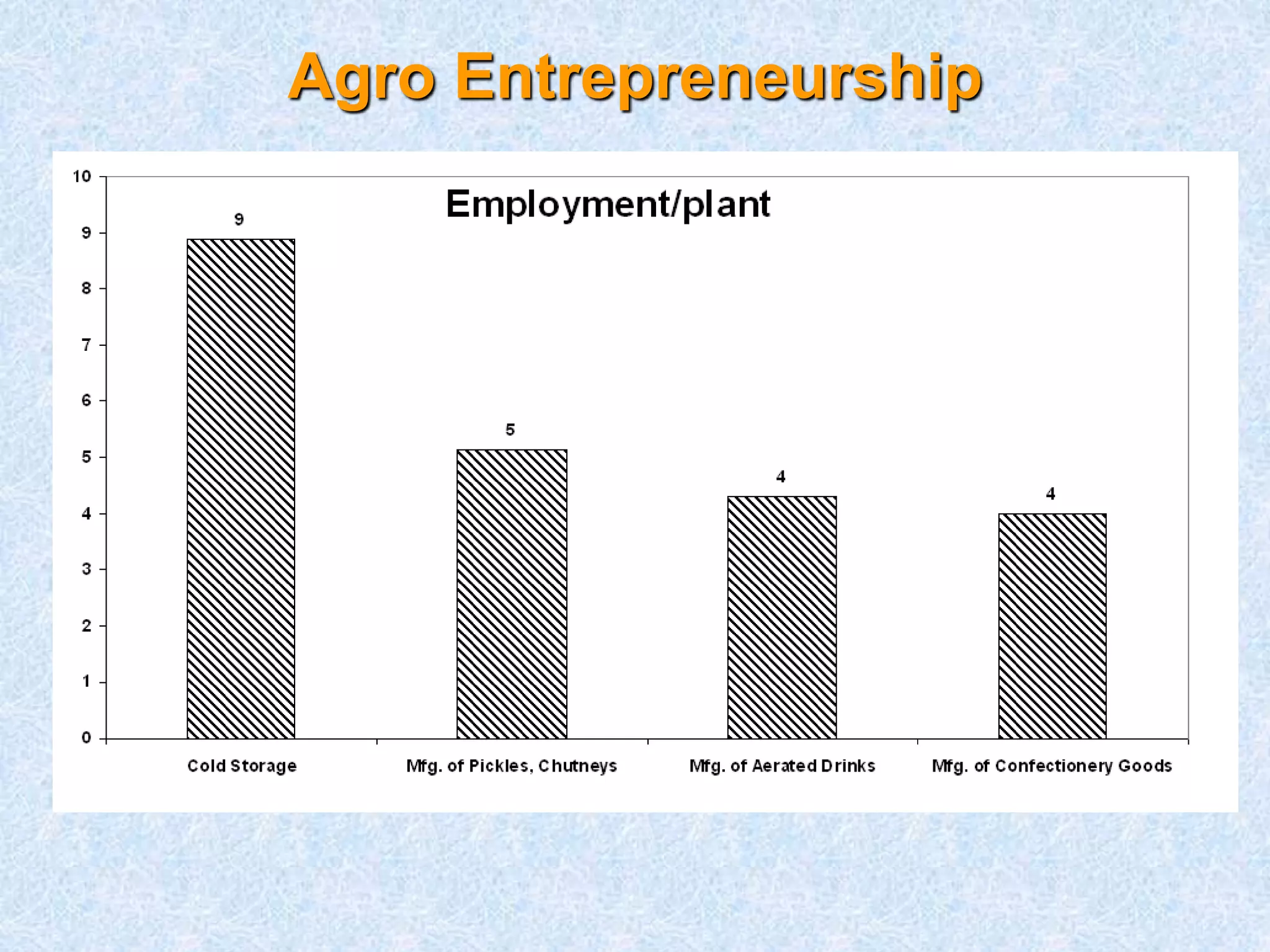
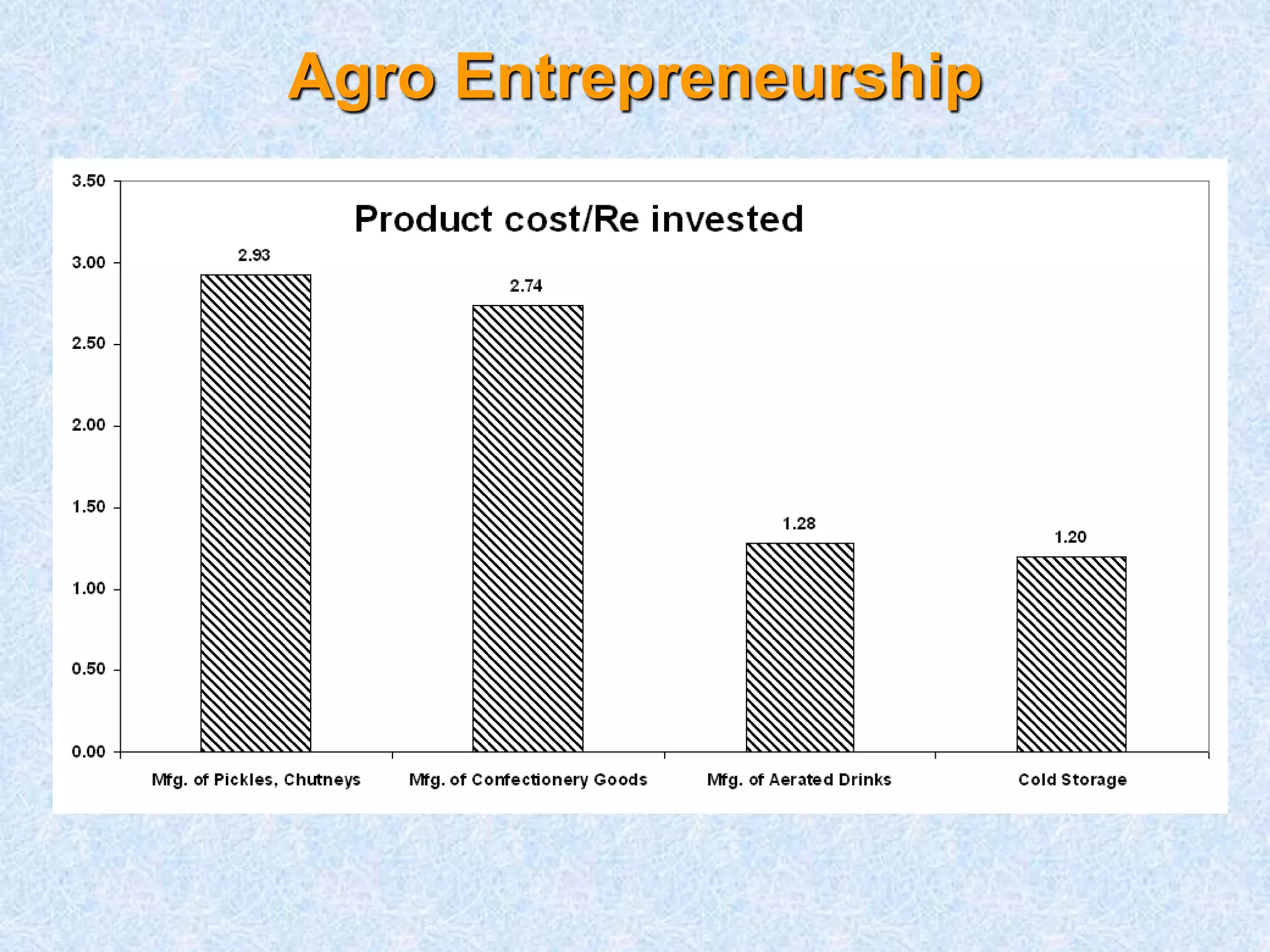
Agro Entrepreneurship
Equipment and 
Gadgets
Method of Determining Maturity of 
Mango in Tree 
• Eating quality and postharvest shelf life 
of ripe mango depends on its maturity 
at harvest 
• Change of peel color and total soluble 
solids (TSS) are indicative parameters 
to measure maturity of mango. 
• A maturity index was defined based on 
TSS and colour values. 
• The model was developed to predict 
maturity using colourimeter 
• Colour and maturity index chart were 
also developed to determine maturity 
• This technique can be employed to 
sort the mangoes at export port, big 
mandies and in processing plant. 
Capacity 
About 100 mangoes per hour
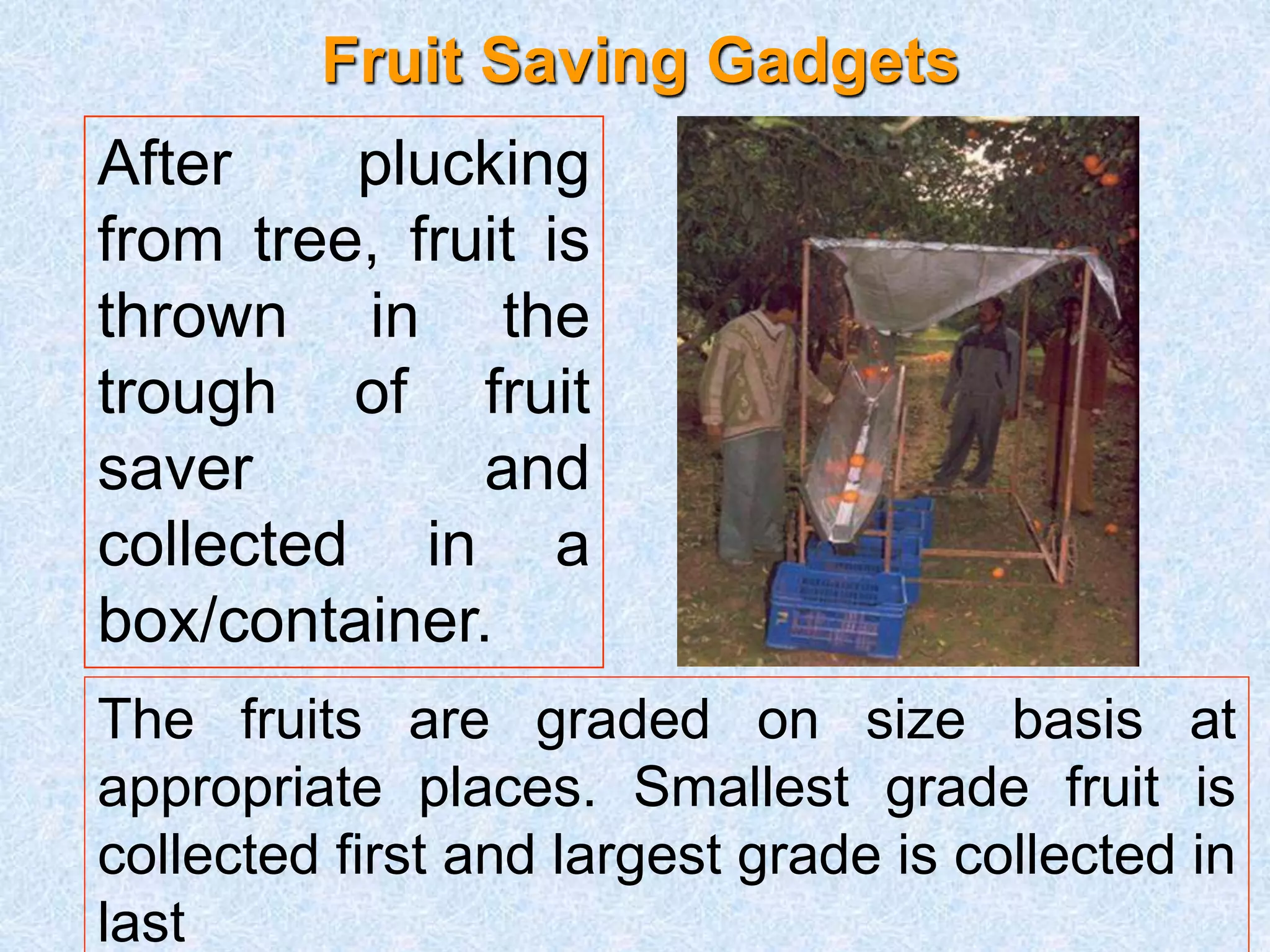
Fruit Saving Gadgets 
After plucking 
from tree, fruit is 
thrown in the 
trough of fruit 
saver and 
collected in a 
box/container. 
The fruits are graded on size basis at 
appropriate places. Smallest grade fruit is 
collected first and largest grade is collected in 
last
Banana-Comb (Hand) Cutter 
It is an useful to de-stem the comb from the banana bunch. It 
replaces the use of sickle, which was much labor and time 
consuming. 
It is safe for human and banana hands and can be used for faster 
work. 100 to 120 banana bunches can be de-handed per hour. 
Saves 10 to 15 banana-fingers per bunch (i. e. 2 to 8 % reduction 
in cutting losses of banana fruits)
CIPHET Tomato Grader 
• The tomatoes roll down the pipes 
due to gravity and fall immediately 
wherever they find the space of their 
diameter. 
• Grades 3: 25-40 mm, 40-55 mm, 55- 
70 mm and > 70 mm 
• The collector is inclined at 10° so 
that the tomatoes slide directly in 
crates. 
• The important feature of grader is its 
ability to adjust the gap between the 
pipes and inclination of grading table 
and hopper. 
• It can also be used for other round 
fruits and vegetables. 
Capacity: of 325 kg/hr 
Overall grading efficiency: 66%. 
Cost: Rs.25000.00
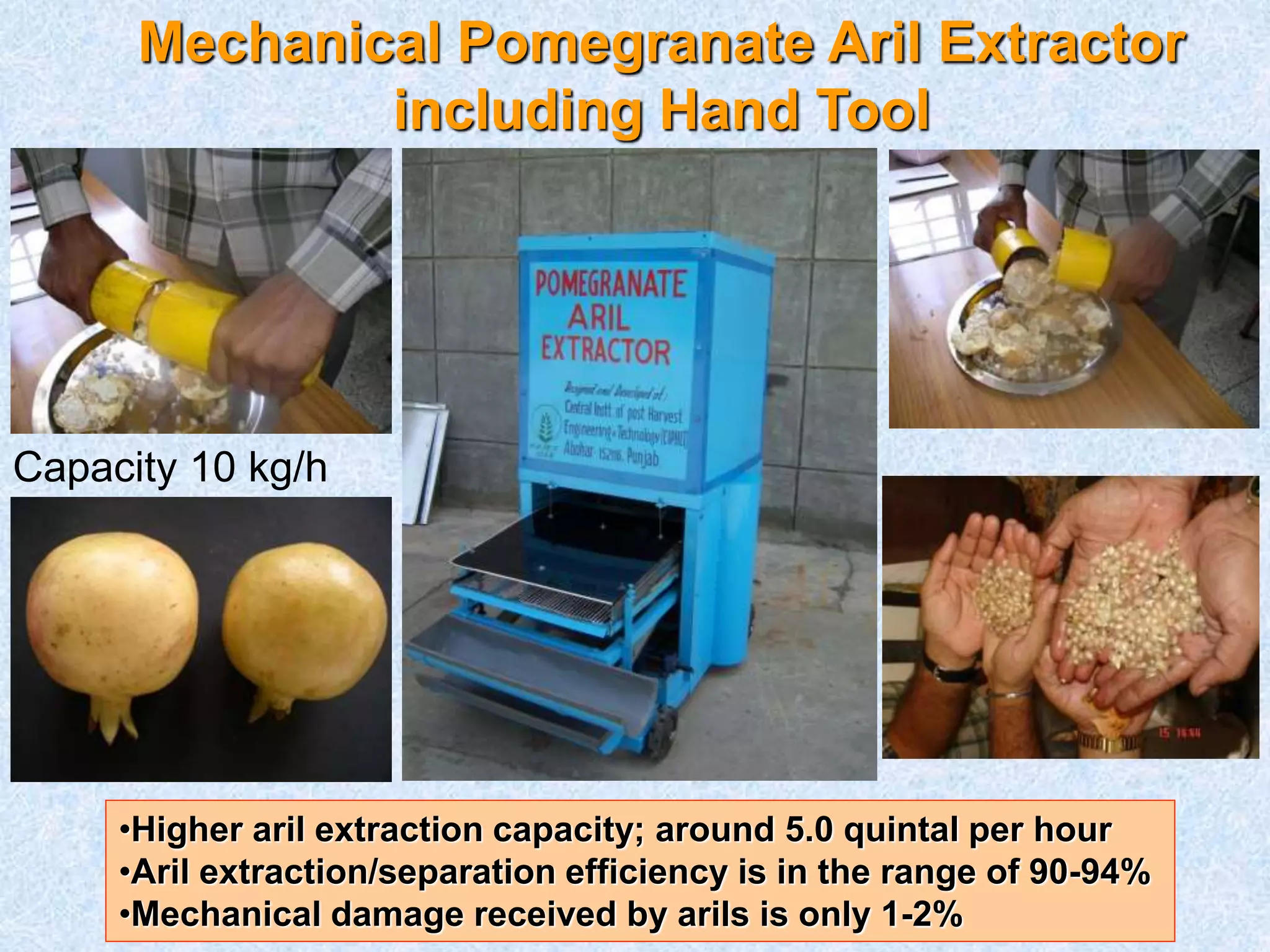
Mechanical Pomegranate Aril Extractor 
including Hand Tool 
Capacity 10 kg/h 
•Higher aril extraction capacity; around 5.0 quintal per hour 
•Aril extraction/separation efficiency is in the range of 90-94% 
•Mechanical damage received by arils is only 1-2%
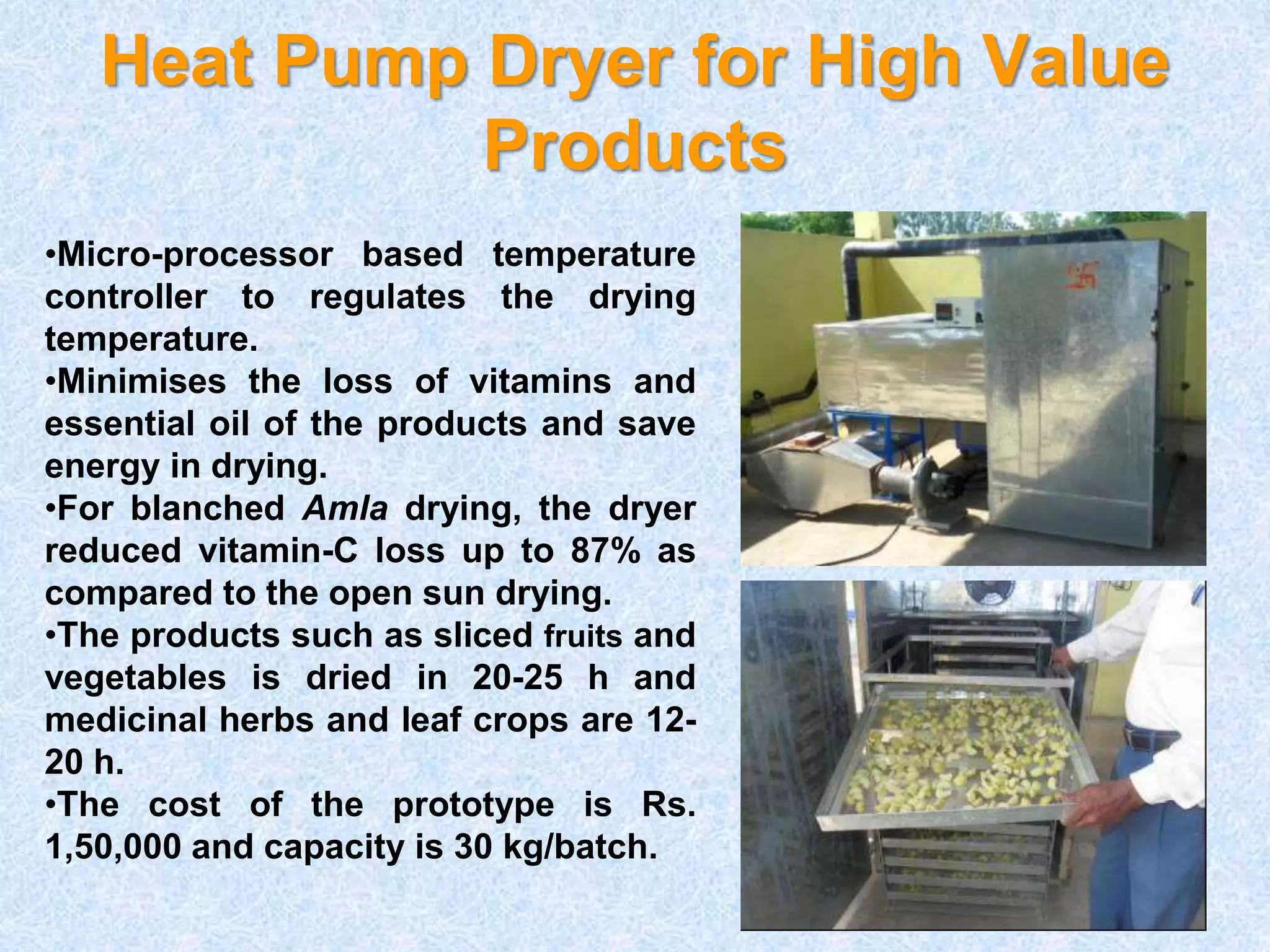
Heat Pump Dryer for High Value 
Products 
•Micro-processor based temperature 
controller to regulates the drying 
temperature. 
•Minimises the loss of vitamins and 
essential oil of the products and save 
energy in drying. 
•For blanched Amla drying, the dryer 
reduced vitamin-C loss up to 87% as 
compared to the open sun drying. 
•The products such as sliced fruits and 
vegetables is dried in 20-25 h and 
medicinal herbs and leaf crops are 12- 
20 h. 
•The cost of the prototype is Rs. 
1,50,000 and capacity is 30 kg/batch.
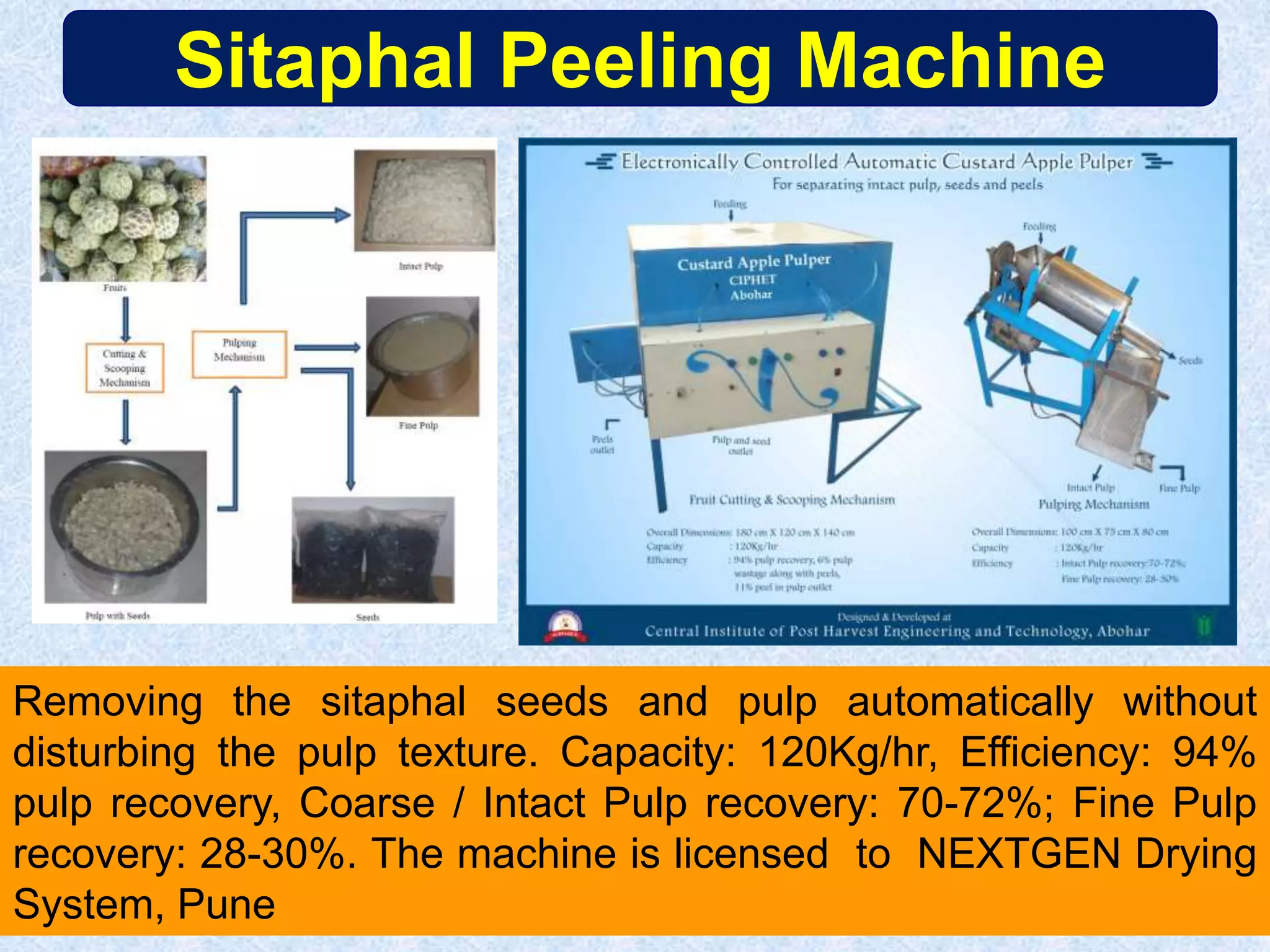
Sitaphal Peeling Machine 
Removing the sitaphal seeds and pulp automatically without 
disturbing the pulp texture. Capacity: 120Kg/hr, Efficiency: 94% 
pulp recovery, Coarse / Intact Pulp recovery: 70-72%; Fine Pulp 
recovery: 28-30%. The machine is licensed to NEXTGEN Drying 
System, Pune
Emerging 
Technologies
Emerging Technologies in Food 
Processing 
•High Pressure Processing 
•Microwave heat processing 
•Ohmic heat processing 
•Micronisation 
•Irradiation 
•Extrusion Processing 
•Biotechnology
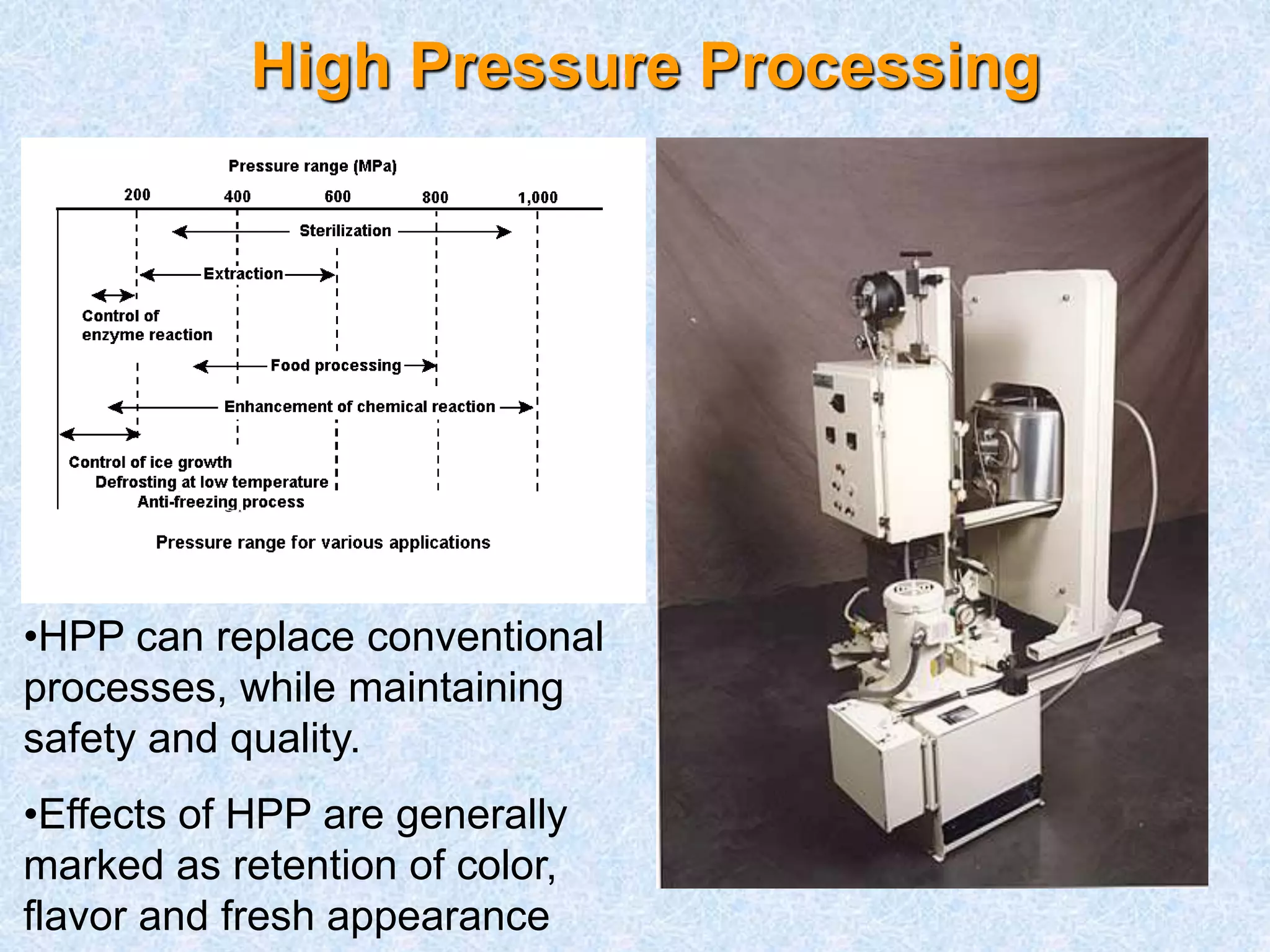
High Pressure Processing 
•HPP can replace conventional 
processes, while maintaining 
safety and quality. 
•Effects of HPP are generally 
marked as retention of color, 
flavor and fresh appearance
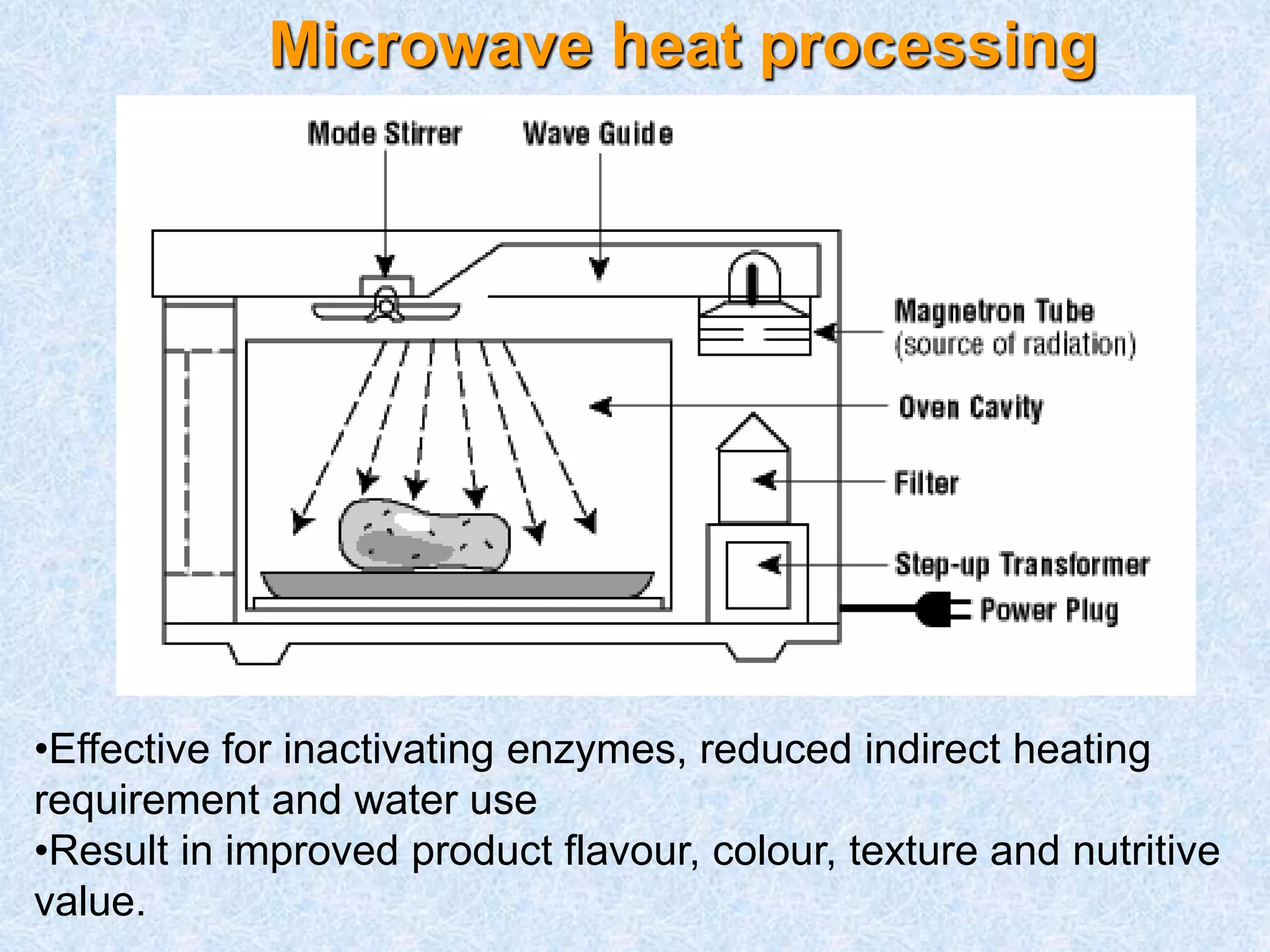
Microwave heat processing 
•Effective for inactivating enzymes, reduced indirect heating 
requirement and water use 
•Result in improved product flavour, colour, texture and nutritive 
value.
Ohmic heat processing 
•Alternating electrical current is passed through a food sample. 
•Internal energy generation in foods. 
•Produces an inside-out heating pattern at different 
frequencies than MW. 
•Uniformly heats foods with different densities.
Micronisation 
•Short time exposure of electromagnetic radiation at a wavelength 
of 1.8-3.4 mm, 
•Promotes internal heating and increased digestibility 
•Instantized product due to increased ability to uptake of water. 
•Starch is gelatinized, seed microstructure becomes more 
penetrable and thus short cooking times.
Irradiation 
•Gamma - irradiation reduces antinutritional factors 
•Reduces the phytic acid content and flatulence causing 
oligosaccharides in leguminous crops 
•Helps improved keeping quality of food grains and flours
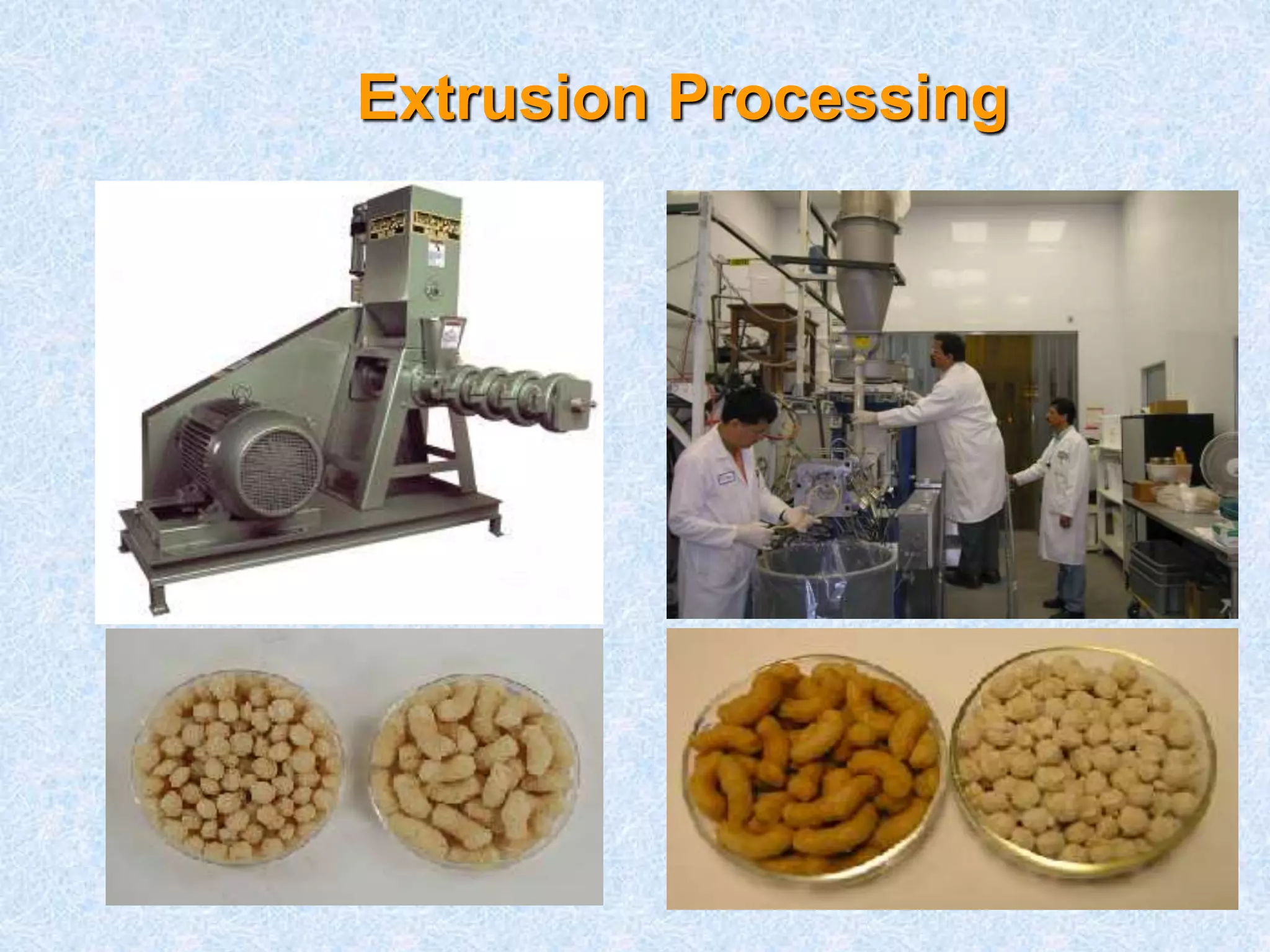
Extrusion Processing
Extruded Products from Coarse Cereals 
• Extrusion is a high 
temperature short time 
processed to produce 
expanded & textured 
products 
• CIPHET has modified the low 
cost collet extruder to 
produce expanded ready to 
eat snacks using rice and 
pulse brokens. 
• The cost of the unit is Rs 2 
Lakh, capacity 25 kg/h, cost 
of accessories Rs. 2 lakh and 
thus earn about minimum of 
Rs. 50,000 per month
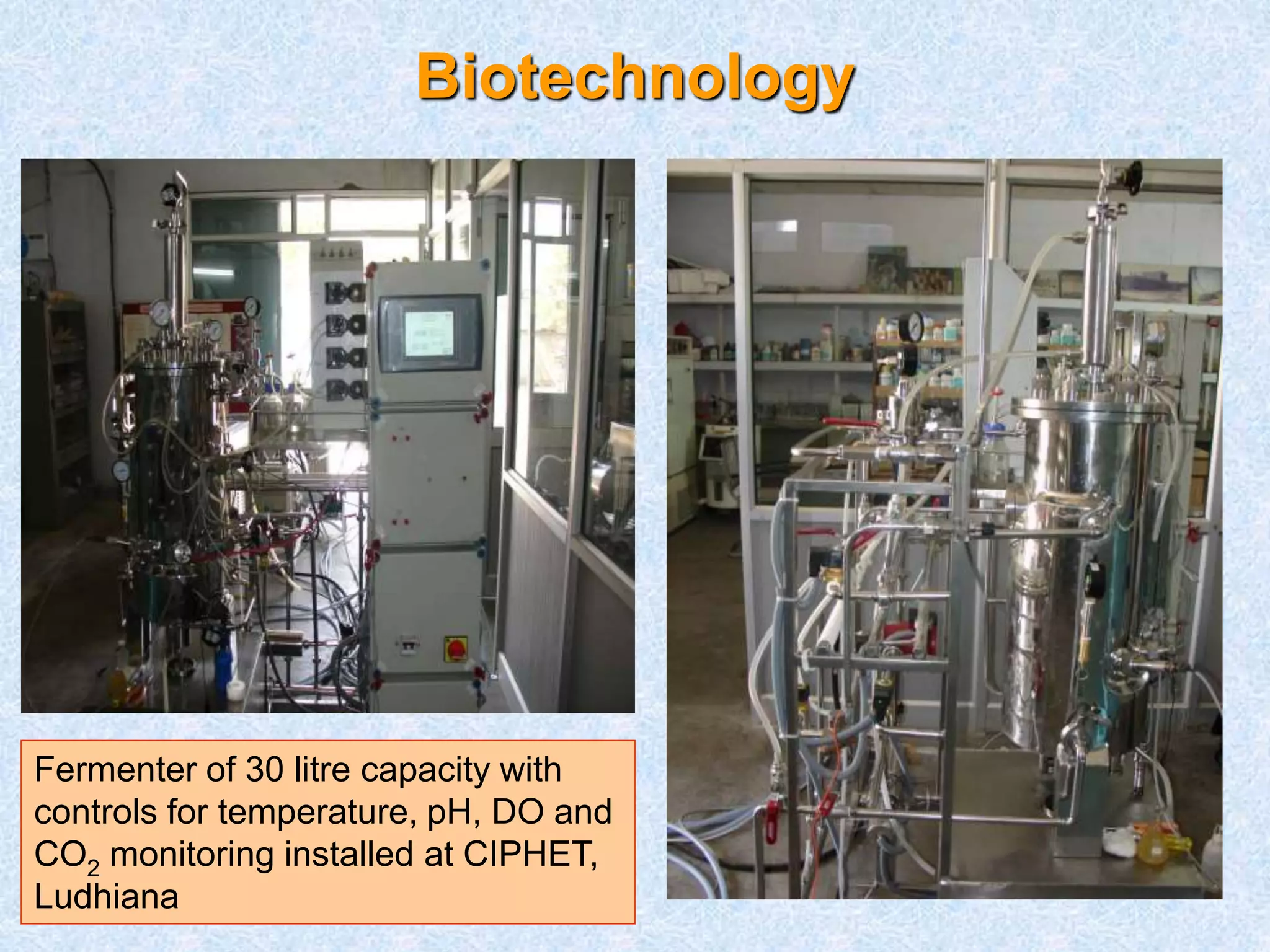
Biotechnology 
Fermenter of 30 litre capacity with 
controls for temperature, pH, DO and 
CO2 monitoring installed at CIPHET, 
Ludhiana
Bioprocessing Technologies 
for Crop Residues 
• Efficient process for production of 
ethanol 
• Production of enzymes such as 
cellulase, xylanase, pectinase and 
protease 
• Production of industrially important 
products such as citric acid 
• Single Cell Protein (SCP) production
Safe Transport 
and Storage
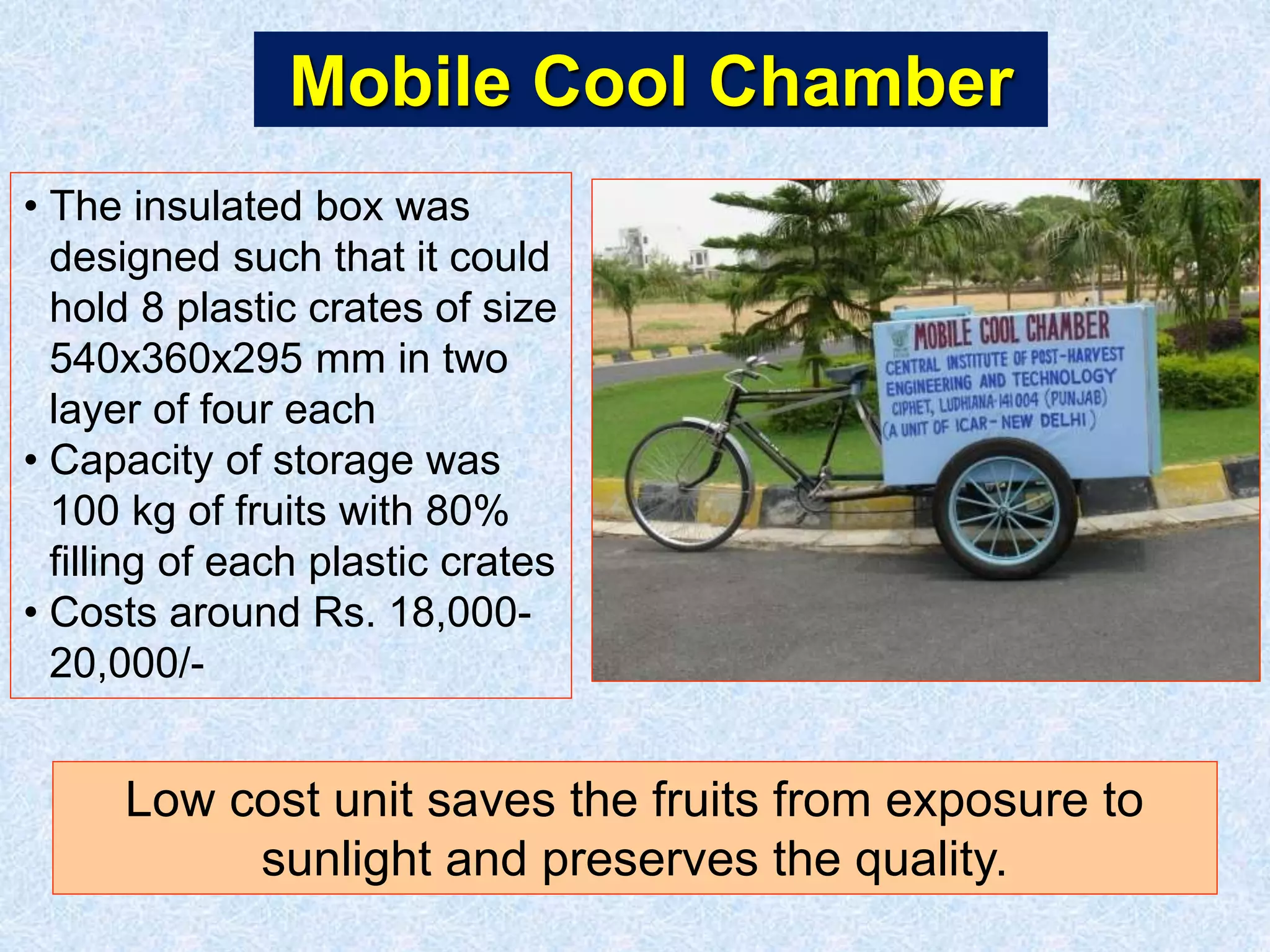
Mobile Cool Chamber 
• The insulated box was 
designed such that it could 
hold 8 plastic crates of size 
540x360x295 mm in two 
layer of four each 
• Capacity of storage was 
100 kg of fruits with 80% 
filling of each plastic crates 
• Costs around Rs. 18,000- 
20,000/- 
Low cost unit saves the fruits from exposure to 
sunlight and preserves the quality.
Ventilated Rail Transport 
• Ventilated rail cars have been 
developed by NHB where the 
slotted holes were provided on 
front bottom, front and rear ends 
to accommodate vertical forced 
air and natural convection due to 
holes at the bottom. 
• At least 15% of total floor area 
was perforated and labyrinths 
provided for the protection from 
rain where ever essential. 
• The design provides 5% area at 
the bottom and 10% area on the 
top at both from and rear ends. 
• The rail trasnports the material as 
fresh over very long distances
Evaporatively Cooled Room for Storage of 
Fruits and Vegetables 
•An evaporatively cooled (EC) room (3x3x3m. size) was developed 
for on-farm storage of fruits and vegetables. 
•The summer temperature inside the EC room was 5-8C lower than 
that inside the ordinary room and winter temperature was 5-8 C 
higher than that inside the ordinary room. 
Compared on the basis of 10% 
physiological loss in weight (PLW) the 
shelf life inside the room was 34 days 
for early kinnow, 23 days for late 
kinnow, 11 days for cauliflower and 4 
days for spinach as compared to 21, 
11, 5 and 2 days respectively in an 
ordinary room at the same time. 
The cost of the chamber is Rs. 75000 and capacity is 2 tonnes.
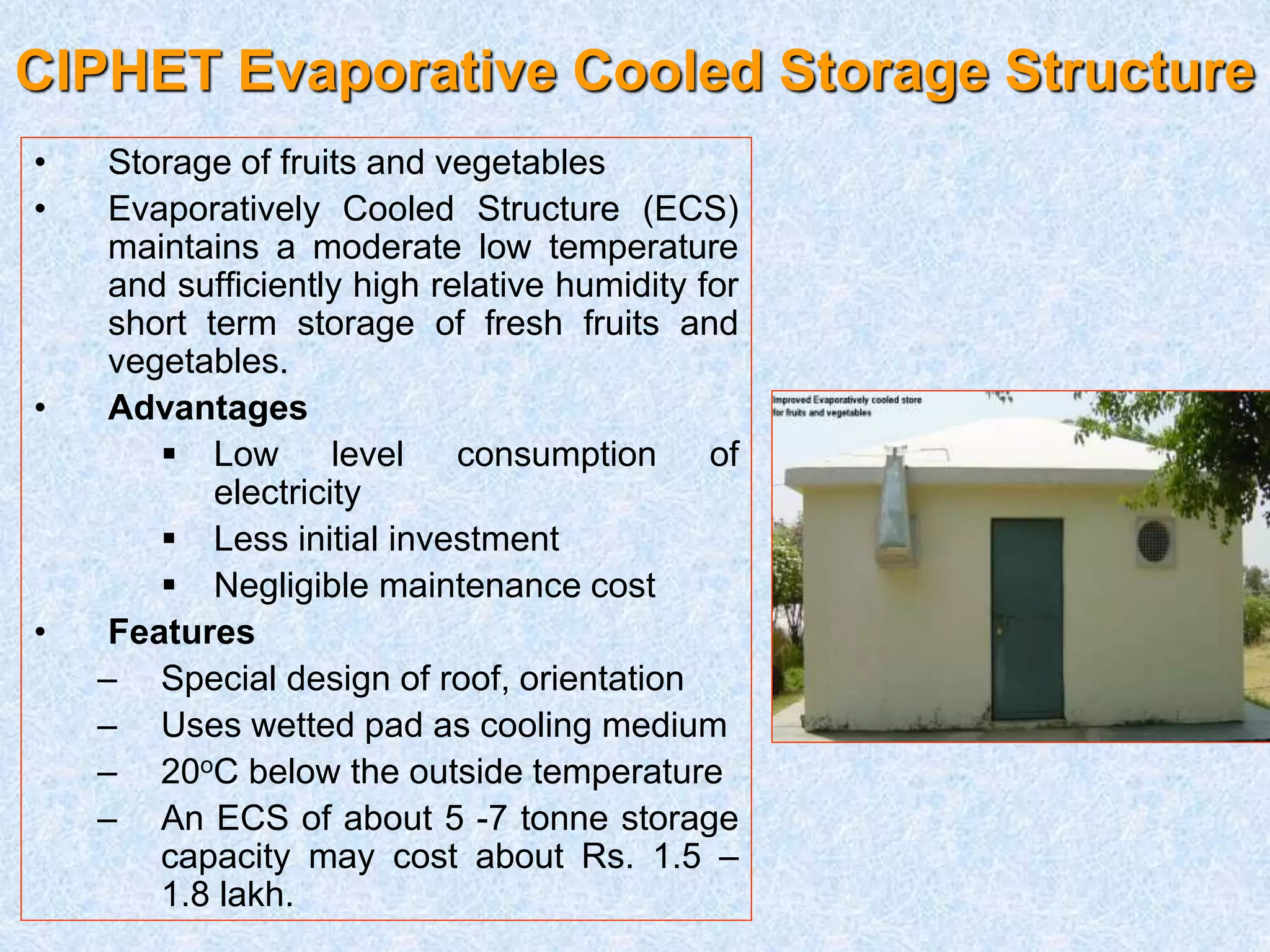
CIPHET Evaporative Cooled Storage Structure 
• Storage of fruits and vegetables 
• Evaporatively Cooled Structure (ECS) 
maintains a moderate low temperature 
and sufficiently high relative humidity for 
short term storage of fresh fruits and 
vegetables. 
• Advantages 
 Low level consumption of 
electricity 
 Less initial investment 
 Negligible maintenance cost 
• Features 
– Special design of roof, orientation 
– Uses wetted pad as cooling medium 
– 20oC below the outside temperature 
– An ECS of about 5 -7 tonne storage 
capacity may cost about Rs. 1.5 – 
1.8 lakh.
Technology 
Packages
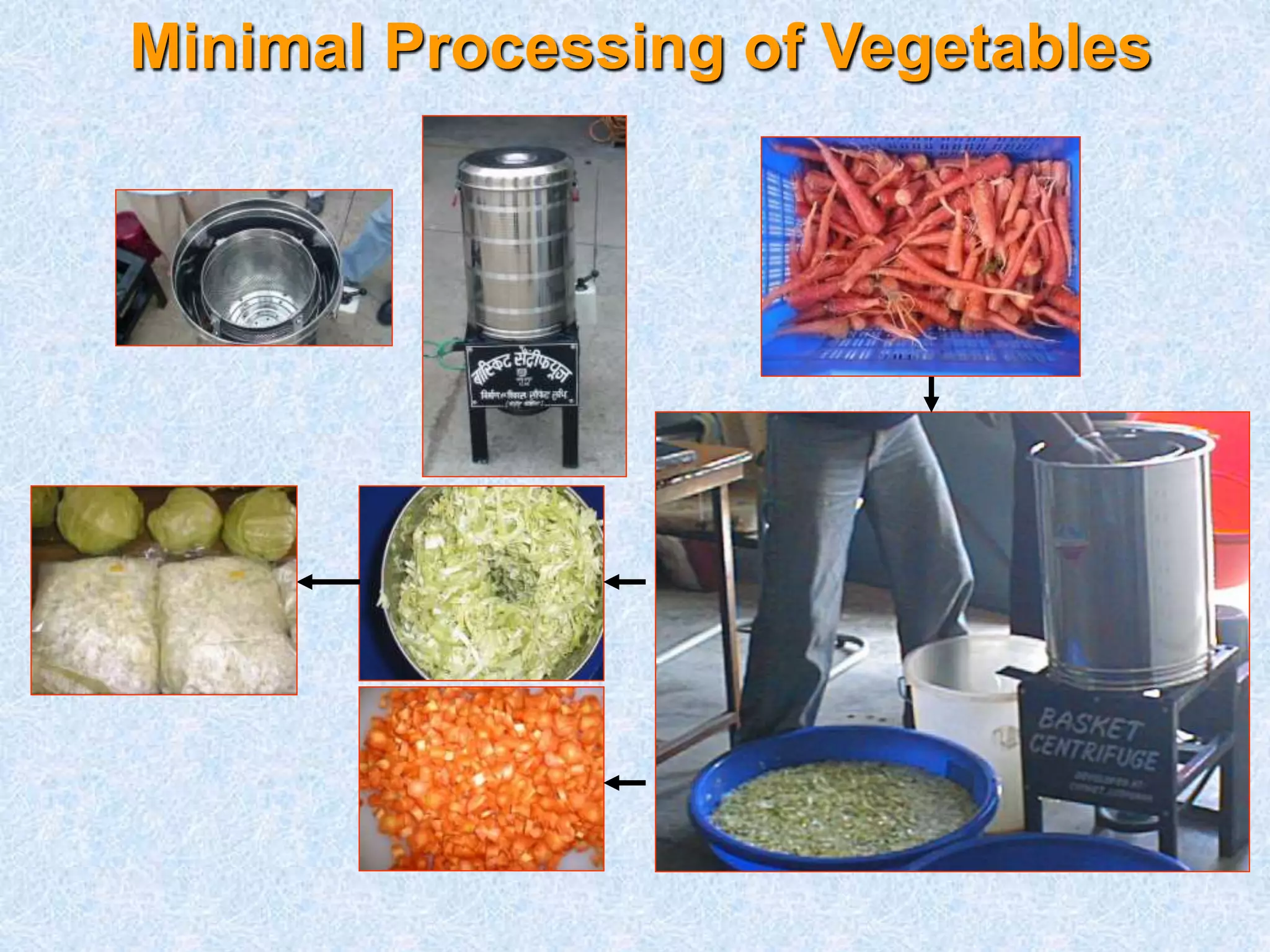
Minimal Processing of Vegetables
Shrink Packaging of Fruits and Vegetables 
Storage life 
Ambient Cold store 
Commodity 
Shrink wrapped Unwrapped Shrink wrapped Unwrapped 
Kinnow 27 13 70 41 
Tomato 19 10 39 23 
Capsicum 25 4 46 21
Process Technology for Guava Bar 
• Guava is perishable in nature 
and cannot be stored for 
more than two days during 
peak season. 
• Guava can be processed into 
a number of products like 
fruits bar and beverage 
• Fruits, which are rich in 
nutrients can be blended to 
improve its acceptability and 
flavor 
• Guava bar acceptable even 
after 6 month of storage 
Composition: Moisture: 15%, Vitamin C: 120 mg/100g, Acidity: 
1.08%, Reducing sugar: 14%, Non-reducing sugar: 46%, Weight 
of each bar: 5-10 g, KSM: 0.2%
OSMO-CONVECTIVE DEHYDRATION OF KINNOW 
SEGMENTS 
PROCESS 
KINNOW 
PEELING 
SEPARATING OF SEGMENTS 
REMOVAL OF SEEDS 
DIPPING IN 60 % SUGAR 
SYRUP FOR 6 h 
DRAINING OF SYRUP 
DRIED SEGMENTS 
(60 OC FOR 10-12 h)
Ready to Constitute Mustard Saag 
•The green leaves are washed, drained 
and cut. The cut leaves are taken in the 
known proportion. 
•The mixture of cut leaves and spices is 
cooked and then mashed to get smooth 
curry. The curry is then processed 
through various steps involving 
crushing, cooking, pulping, addition of 
edible flour, cold extrusion, drying, size 
reduction and packaging to attain 
mustard saag powder. 
•The dried powder on mixing with 
lukewarm / hot water yield the inherent 
taste and odor of staple ingredients.
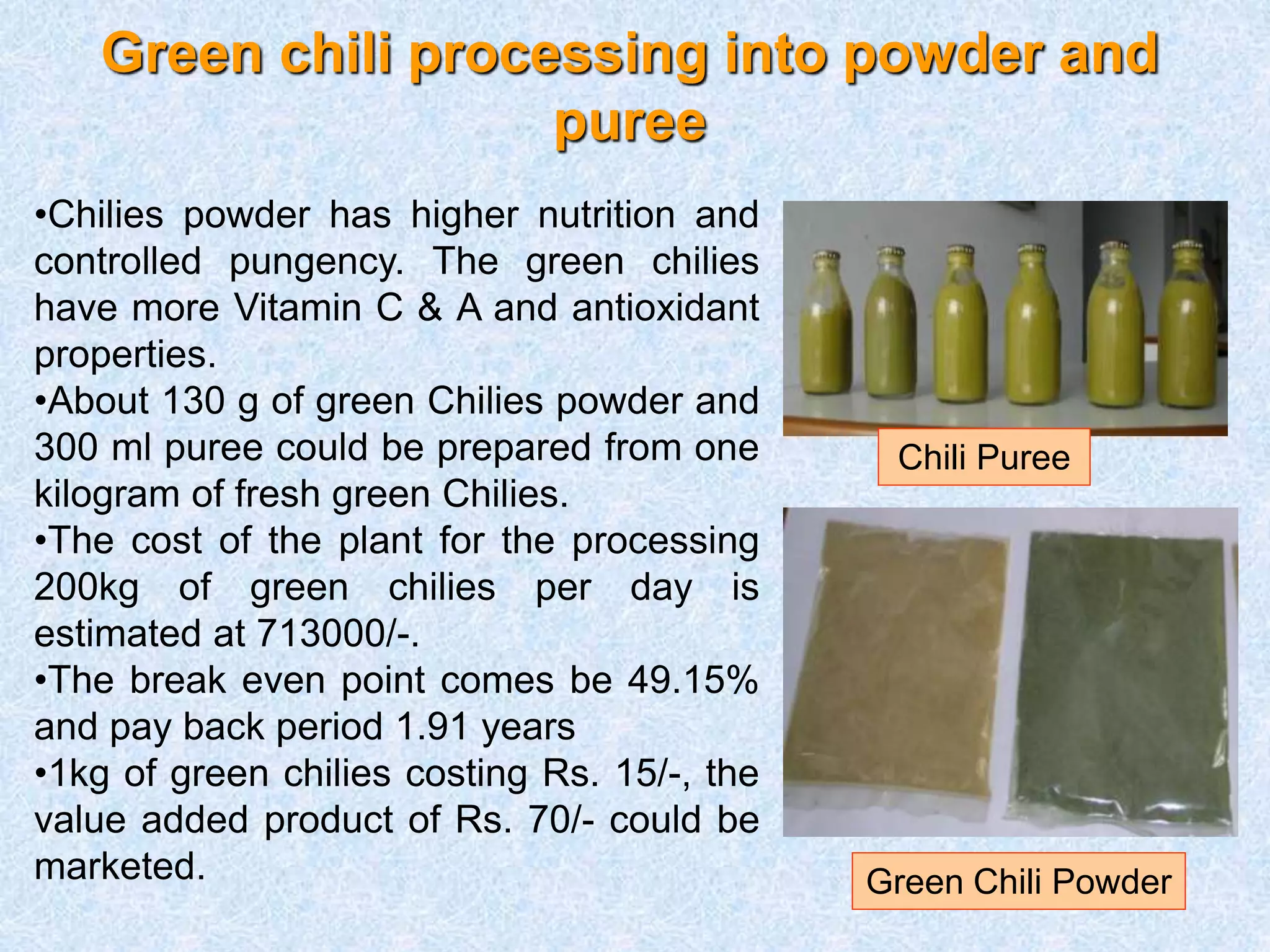
Green chili processing into powder and 
puree 
•Chilies powder has higher nutrition and 
controlled pungency. The green chilies 
have more Vitamin C & A and antioxidant 
properties. 
•About 130 g of green Chilies powder and 
300 ml puree could be prepared from one 
kilogram of fresh green Chilies. 
•The cost of the plant for the processing 
200kg of green chilies per day is 
estimated at 713000/-. 
•The break even point comes be 49.15% 
and pay back period 1.91 years 
•1kg of green chilies costing Rs. 15/-, the 
value added product of Rs. 70/- could be 
marketed. 
Chili Puree 
Green Chili Powder
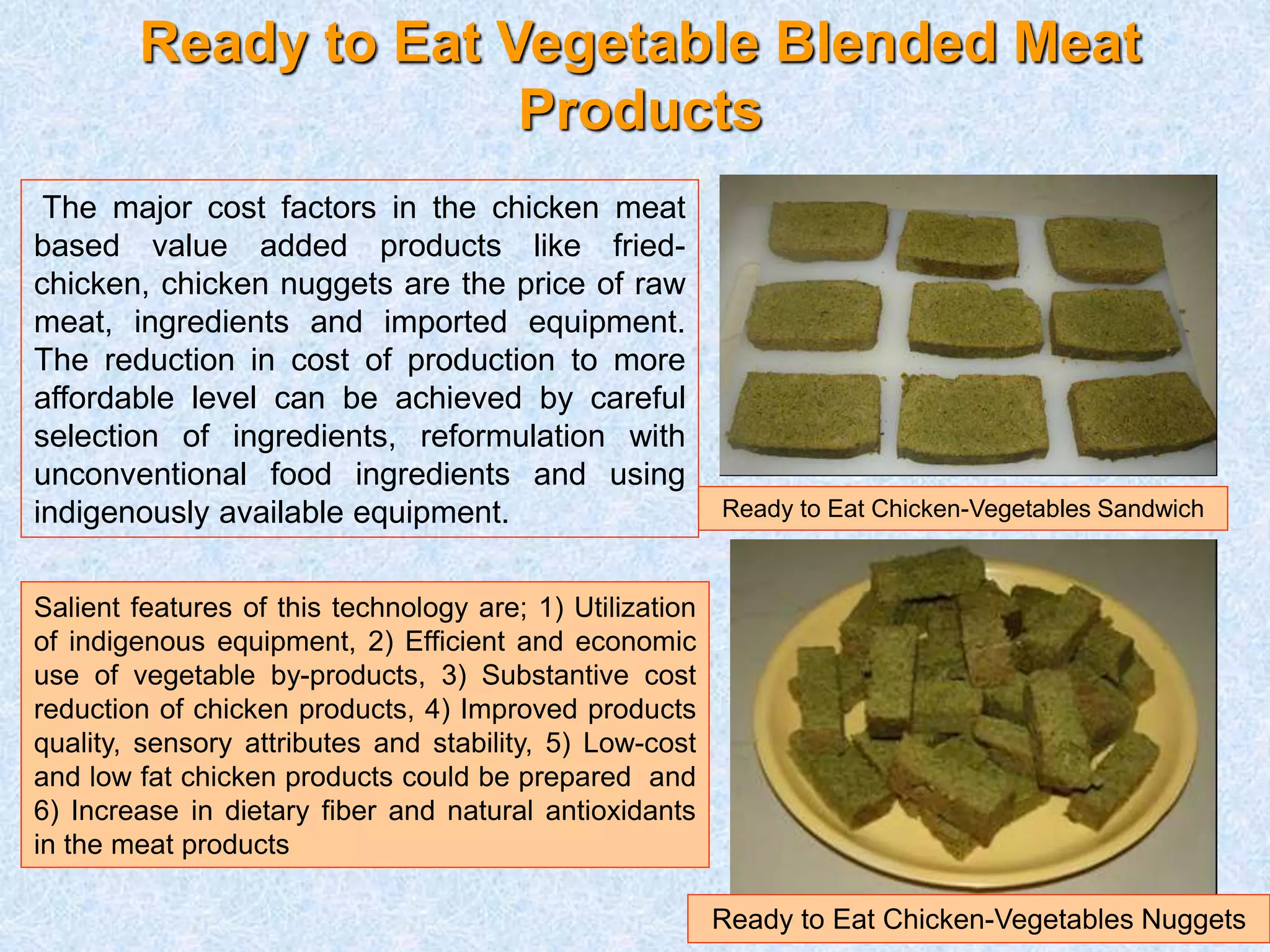
Ready to Eat Vegetable Blended Meat 
Products 
Ready to Eat Chicken-Vegetables Sandwich 
Ready to Eat Chicken-Vegetables Nuggets 
The major cost factors in the chicken meat 
based value added products like fried-chicken, 
chicken nuggets are the price of raw 
meat, ingredients and imported equipment. 
The reduction in cost of production to more 
affordable level can be achieved by careful 
selection of ingredients, reformulation with 
unconventional food ingredients and using 
indigenously available equipment. 
Salient features of this technology are; 1) Utilization 
of indigenous equipment, 2) Efficient and economic 
use of vegetable by-products, 3) Substantive cost 
reduction of chicken products, 4) Improved products 
quality, sensory attributes and stability, 5) Low-cost 
and low fat chicken products could be prepared and 
6) Increase in dietary fiber and natural antioxidants 
in the meat products
Use of Kinnow Peels for Face 
Care Products 
Kinnow Peel Face Toner 
Kinnow Peel Face Pack 
Kinnow peel is a major (30- 34 %) 
processing waste generated during 
Kinnow processing into juices. 
Rich source of Vitamin C, Carotenoids, 
limonene, antioxidants, micronutrients 
and antibacterial limonoids. 
The face mask/pack and face toner are a 
rich blend of major concentration of 
Kinnow peel extracts and other minor 
components as preservatives and 
sticking agents. 
The products possess very effective 
deep cleansing properties along with 
stringent, disinfectant and antiseptic 
action to protect facial skin from 
unwanted blemishes
Examples
Chowdhary Made Agriculture Profitable 
with Value Addition in Rajasthan 
Kailash Chaudhary, Age 60 years 
Products: Aamla juice, amla 
powder, aloe vera juice, candies, 
squashes, pickles, sweets 
Exports to many countries 
Employment: Direct 30;Indirect 40 
Established: 2004 
Training and Technologies by 
CIPHET 
Turnover: > 1 crore 
Web: www.ksbiofoods.com
Evaporative Cooled Room 
Surinder Singh 
Vill Jalalabad, Moga Punjab 
Profession: Vegetable Farmer 
Cold Room used for on-farm 
short term storage of fruits 
and vegetables 
Cost of structure: Rs 75,000
Recommendations 
• Formulate National Post Harvest Management 
Policy with incentives for small scale units in rural 
areas. 
• Unleash the vast entrepreneurial talent of our rural 
population by providing training and credit. 
• Forge Public Private partnerships in this sector to 
develop infrastructure including food parks, cold 
storage, rural godowns, warehouses etc. 
• Facilitate direct marketing by rural entrepreneurs & 
processors to consumers though modern Haats 
• Reach international standards of food packaging, 
safety and quality and by compulsory appointment 
of food engg/tech in each food business.
The Post Harvest Industries in Production 
Catchment has potential to Provide Urban-amenities 
in Rural Areas (PURA) through 
employment and income generation for the 
youth.

Pht niftem

  • 1.
    POST HARVEST TECHNOLOGY-HERBINGER OF NATIONS PROSPERITY Dr. R. T. Patil, Ex Director CIPHET, Ludhiana; Group Director, TIT-MBA, and Director, Technocrats Institute of Technology, Chairman Benevole for PHT Bhopal (MP), India
  • 2.
    Production & PostHarvest Scenario •Agriculture contributes about 14.5% of GDP, employees 57% workforce and sustains approx over 75% of the population •India produces about 257.44 million tons of food grains and 267 million tons of fruits and vegetables and ranks second in the world •Post harvest losses are 3-18% amounting to Rs. 45000 crores •Low level of processing of fruits and vegetables at only 2% . •Food processing is employment intensive, creates 1.8 jobs directly and 6.4 indirectly for every Rs. 10 lakh investment
  • 3.
    Price Difference Wheat- Rs 12/kg Wheat Flour Rs. 16-18/kg Fortified Flour Rs. 20-25/kg Oil seed – Rs 35/kg Oil Rs. 70/kg Paddy – Rs 12/kg Rice – Rs. 25/kg Mung- Rs. 20/kg Mung dal – Rs. 60/kg Maize-Rs.13/kg Maize flour-Rs. 16/kg Tomato-Rs. 5/kg Tomato ketchup-Rs 50-80/kg Fruit- Rs. 15-20/kg Fruits Bar-Rs. 200/kg Fruit Juice- Rs. 35/litre Coriander -Rs. 80/kg Coriander Powder-Rs. 200/kg Turmeric-Rs.65/kg Turmeric Powder –Rs. 200/kg Chili- Rs. 200/kg Chili Powder-Rs. 300/kg Black pepper-Rs. 100/kg B Pepper Powder- Rs.300/kg Chana - Rs. 28/kg Chana Dal-Rs. 35/kg Besan- Rs. 40/kg Vegetables-Rs.3-5/kg Minimal Processed/Ready to Cook Rs. 25-30/kg
  • 4.
    High Value Productsfrom Wastes • Pectin from fruit and vegetable peels • Lycopene from tomato peel and oil from seeds • Bio-colour from arhar husk and used flowers • A low calorie sweetner (xyletol) from corn cob and bagasse • Beta amylase and Xylanase from cereal bran and husk • Enzymes (protease, laccase, peroxidase and polyphenol oxidase) from green gram husk and wheat germ • Gelatin / Peptides from slaughter house waste • Dietary fibres from fruit pomace • Bio-plastics from tapioca • Aniti oxidents and phenolic compounds from cereal brans and pulse husks
  • 5.
    Reasons for Losses 1. Handling of raw produce through many stages of middlemen. 2. Processing is mostly controlled by urban rather than rural entrepreneurs which leads to losses in valuable by products. 3. Non availability of adequate and efficient equipment and machinery to be used in catchment areas. 4. Low level of entrepreneurial urge in rural areas due to constraints of finance, assured market and proper training on technology 5. On the whole, there exists a fragmented and inefficient value chain Higher the processing- - Better the Post Harvest Management - - Lower Will Be Losses
  • 6.
    Post Harvest Activitiesin SITU 1. Can provide processed food of highest quality at affordable cost to consumers 2. Help environment by processing food in production catchment with least food miles 3. Ensure traceability of raw materials used for processed product hence great for export and elite urban market. 4. Help effective backward linkage with farmers for processing their raw produce 5. Shorten the supply chain, increase the profitability of farmers and ultimately increase in GDP from agriculture and reduce poverty 6. Reduce post harvest losses and increased availability of by products for further processing.
  • 7.
    Unit Operations inPost Harvest Management Food Grains •Harvesting at Maturity •Proper threshing •Post thresh cleaning •Proper drying •Safe storage Fruits and Vegetables •Preharvest treatment •Harvesting at Maturity •Safe harvesting •Pre cooling & washing •Surface drying •Cool/cold storage •Safe transport •Safe handling •Value Addition to Main & Byproducts
  • 8.
  • 9.
  • 10.
  • 11.
  • 12.
    Method of DeterminingMaturity of Mango in Tree • Eating quality and postharvest shelf life of ripe mango depends on its maturity at harvest • Change of peel color and total soluble solids (TSS) are indicative parameters to measure maturity of mango. • A maturity index was defined based on TSS and colour values. • The model was developed to predict maturity using colourimeter • Colour and maturity index chart were also developed to determine maturity • This technique can be employed to sort the mangoes at export port, big mandies and in processing plant. Capacity About 100 mangoes per hour
  • 13.
    Fruit Saving Gadgets After plucking from tree, fruit is thrown in the trough of fruit saver and collected in a box/container. The fruits are graded on size basis at appropriate places. Smallest grade fruit is collected first and largest grade is collected in last
  • 14.
    Banana-Comb (Hand) Cutter It is an useful to de-stem the comb from the banana bunch. It replaces the use of sickle, which was much labor and time consuming. It is safe for human and banana hands and can be used for faster work. 100 to 120 banana bunches can be de-handed per hour. Saves 10 to 15 banana-fingers per bunch (i. e. 2 to 8 % reduction in cutting losses of banana fruits)
  • 15.
    CIPHET Tomato Grader • The tomatoes roll down the pipes due to gravity and fall immediately wherever they find the space of their diameter. • Grades 3: 25-40 mm, 40-55 mm, 55- 70 mm and > 70 mm • The collector is inclined at 10° so that the tomatoes slide directly in crates. • The important feature of grader is its ability to adjust the gap between the pipes and inclination of grading table and hopper. • It can also be used for other round fruits and vegetables. Capacity: of 325 kg/hr Overall grading efficiency: 66%. Cost: Rs.25000.00
  • 16.
    Mechanical Pomegranate ArilExtractor including Hand Tool Capacity 10 kg/h •Higher aril extraction capacity; around 5.0 quintal per hour •Aril extraction/separation efficiency is in the range of 90-94% •Mechanical damage received by arils is only 1-2%
  • 17.
    Heat Pump Dryerfor High Value Products •Micro-processor based temperature controller to regulates the drying temperature. •Minimises the loss of vitamins and essential oil of the products and save energy in drying. •For blanched Amla drying, the dryer reduced vitamin-C loss up to 87% as compared to the open sun drying. •The products such as sliced fruits and vegetables is dried in 20-25 h and medicinal herbs and leaf crops are 12- 20 h. •The cost of the prototype is Rs. 1,50,000 and capacity is 30 kg/batch.
  • 18.
    Sitaphal Peeling Machine Removing the sitaphal seeds and pulp automatically without disturbing the pulp texture. Capacity: 120Kg/hr, Efficiency: 94% pulp recovery, Coarse / Intact Pulp recovery: 70-72%; Fine Pulp recovery: 28-30%. The machine is licensed to NEXTGEN Drying System, Pune
  • 19.
  • 20.
    Emerging Technologies inFood Processing •High Pressure Processing •Microwave heat processing •Ohmic heat processing •Micronisation •Irradiation •Extrusion Processing •Biotechnology
  • 21.
    High Pressure Processing •HPP can replace conventional processes, while maintaining safety and quality. •Effects of HPP are generally marked as retention of color, flavor and fresh appearance
  • 22.
    Microwave heat processing •Effective for inactivating enzymes, reduced indirect heating requirement and water use •Result in improved product flavour, colour, texture and nutritive value.
  • 23.
    Ohmic heat processing •Alternating electrical current is passed through a food sample. •Internal energy generation in foods. •Produces an inside-out heating pattern at different frequencies than MW. •Uniformly heats foods with different densities.
  • 24.
    Micronisation •Short timeexposure of electromagnetic radiation at a wavelength of 1.8-3.4 mm, •Promotes internal heating and increased digestibility •Instantized product due to increased ability to uptake of water. •Starch is gelatinized, seed microstructure becomes more penetrable and thus short cooking times.
  • 25.
    Irradiation •Gamma -irradiation reduces antinutritional factors •Reduces the phytic acid content and flatulence causing oligosaccharides in leguminous crops •Helps improved keeping quality of food grains and flours
  • 26.
  • 27.
    Extruded Products fromCoarse Cereals • Extrusion is a high temperature short time processed to produce expanded & textured products • CIPHET has modified the low cost collet extruder to produce expanded ready to eat snacks using rice and pulse brokens. • The cost of the unit is Rs 2 Lakh, capacity 25 kg/h, cost of accessories Rs. 2 lakh and thus earn about minimum of Rs. 50,000 per month
  • 28.
    Biotechnology Fermenter of30 litre capacity with controls for temperature, pH, DO and CO2 monitoring installed at CIPHET, Ludhiana
  • 29.
    Bioprocessing Technologies forCrop Residues • Efficient process for production of ethanol • Production of enzymes such as cellulase, xylanase, pectinase and protease • Production of industrially important products such as citric acid • Single Cell Protein (SCP) production
  • 30.
  • 31.
    Mobile Cool Chamber • The insulated box was designed such that it could hold 8 plastic crates of size 540x360x295 mm in two layer of four each • Capacity of storage was 100 kg of fruits with 80% filling of each plastic crates • Costs around Rs. 18,000- 20,000/- Low cost unit saves the fruits from exposure to sunlight and preserves the quality.
  • 32.
    Ventilated Rail Transport • Ventilated rail cars have been developed by NHB where the slotted holes were provided on front bottom, front and rear ends to accommodate vertical forced air and natural convection due to holes at the bottom. • At least 15% of total floor area was perforated and labyrinths provided for the protection from rain where ever essential. • The design provides 5% area at the bottom and 10% area on the top at both from and rear ends. • The rail trasnports the material as fresh over very long distances
  • 33.
    Evaporatively Cooled Roomfor Storage of Fruits and Vegetables •An evaporatively cooled (EC) room (3x3x3m. size) was developed for on-farm storage of fruits and vegetables. •The summer temperature inside the EC room was 5-8C lower than that inside the ordinary room and winter temperature was 5-8 C higher than that inside the ordinary room. Compared on the basis of 10% physiological loss in weight (PLW) the shelf life inside the room was 34 days for early kinnow, 23 days for late kinnow, 11 days for cauliflower and 4 days for spinach as compared to 21, 11, 5 and 2 days respectively in an ordinary room at the same time. The cost of the chamber is Rs. 75000 and capacity is 2 tonnes.
  • 34.
    CIPHET Evaporative CooledStorage Structure • Storage of fruits and vegetables • Evaporatively Cooled Structure (ECS) maintains a moderate low temperature and sufficiently high relative humidity for short term storage of fresh fruits and vegetables. • Advantages  Low level consumption of electricity  Less initial investment  Negligible maintenance cost • Features – Special design of roof, orientation – Uses wetted pad as cooling medium – 20oC below the outside temperature – An ECS of about 5 -7 tonne storage capacity may cost about Rs. 1.5 – 1.8 lakh.
  • 35.
  • 36.
  • 37.
    Shrink Packaging ofFruits and Vegetables Storage life Ambient Cold store Commodity Shrink wrapped Unwrapped Shrink wrapped Unwrapped Kinnow 27 13 70 41 Tomato 19 10 39 23 Capsicum 25 4 46 21
  • 38.
    Process Technology forGuava Bar • Guava is perishable in nature and cannot be stored for more than two days during peak season. • Guava can be processed into a number of products like fruits bar and beverage • Fruits, which are rich in nutrients can be blended to improve its acceptability and flavor • Guava bar acceptable even after 6 month of storage Composition: Moisture: 15%, Vitamin C: 120 mg/100g, Acidity: 1.08%, Reducing sugar: 14%, Non-reducing sugar: 46%, Weight of each bar: 5-10 g, KSM: 0.2%
  • 39.
    OSMO-CONVECTIVE DEHYDRATION OFKINNOW SEGMENTS PROCESS KINNOW PEELING SEPARATING OF SEGMENTS REMOVAL OF SEEDS DIPPING IN 60 % SUGAR SYRUP FOR 6 h DRAINING OF SYRUP DRIED SEGMENTS (60 OC FOR 10-12 h)
  • 40.
    Ready to ConstituteMustard Saag •The green leaves are washed, drained and cut. The cut leaves are taken in the known proportion. •The mixture of cut leaves and spices is cooked and then mashed to get smooth curry. The curry is then processed through various steps involving crushing, cooking, pulping, addition of edible flour, cold extrusion, drying, size reduction and packaging to attain mustard saag powder. •The dried powder on mixing with lukewarm / hot water yield the inherent taste and odor of staple ingredients.
  • 41.
    Green chili processinginto powder and puree •Chilies powder has higher nutrition and controlled pungency. The green chilies have more Vitamin C & A and antioxidant properties. •About 130 g of green Chilies powder and 300 ml puree could be prepared from one kilogram of fresh green Chilies. •The cost of the plant for the processing 200kg of green chilies per day is estimated at 713000/-. •The break even point comes be 49.15% and pay back period 1.91 years •1kg of green chilies costing Rs. 15/-, the value added product of Rs. 70/- could be marketed. Chili Puree Green Chili Powder
  • 42.
    Ready to EatVegetable Blended Meat Products Ready to Eat Chicken-Vegetables Sandwich Ready to Eat Chicken-Vegetables Nuggets The major cost factors in the chicken meat based value added products like fried-chicken, chicken nuggets are the price of raw meat, ingredients and imported equipment. The reduction in cost of production to more affordable level can be achieved by careful selection of ingredients, reformulation with unconventional food ingredients and using indigenously available equipment. Salient features of this technology are; 1) Utilization of indigenous equipment, 2) Efficient and economic use of vegetable by-products, 3) Substantive cost reduction of chicken products, 4) Improved products quality, sensory attributes and stability, 5) Low-cost and low fat chicken products could be prepared and 6) Increase in dietary fiber and natural antioxidants in the meat products
  • 43.
    Use of KinnowPeels for Face Care Products Kinnow Peel Face Toner Kinnow Peel Face Pack Kinnow peel is a major (30- 34 %) processing waste generated during Kinnow processing into juices. Rich source of Vitamin C, Carotenoids, limonene, antioxidants, micronutrients and antibacterial limonoids. The face mask/pack and face toner are a rich blend of major concentration of Kinnow peel extracts and other minor components as preservatives and sticking agents. The products possess very effective deep cleansing properties along with stringent, disinfectant and antiseptic action to protect facial skin from unwanted blemishes
  • 44.
  • 45.
    Chowdhary Made AgricultureProfitable with Value Addition in Rajasthan Kailash Chaudhary, Age 60 years Products: Aamla juice, amla powder, aloe vera juice, candies, squashes, pickles, sweets Exports to many countries Employment: Direct 30;Indirect 40 Established: 2004 Training and Technologies by CIPHET Turnover: > 1 crore Web: www.ksbiofoods.com
  • 46.
    Evaporative Cooled Room Surinder Singh Vill Jalalabad, Moga Punjab Profession: Vegetable Farmer Cold Room used for on-farm short term storage of fruits and vegetables Cost of structure: Rs 75,000
  • 47.
    Recommendations • FormulateNational Post Harvest Management Policy with incentives for small scale units in rural areas. • Unleash the vast entrepreneurial talent of our rural population by providing training and credit. • Forge Public Private partnerships in this sector to develop infrastructure including food parks, cold storage, rural godowns, warehouses etc. • Facilitate direct marketing by rural entrepreneurs & processors to consumers though modern Haats • Reach international standards of food packaging, safety and quality and by compulsory appointment of food engg/tech in each food business.
  • 48.
    The Post HarvestIndustries in Production Catchment has potential to Provide Urban-amenities in Rural Areas (PURA) through employment and income generation for the youth.