Processing and Value Addition
of Medicinal and Herbal Crops
Dr. R.T. Patil
Former Director, CIPHET, Ludhiana
Chairman & ED, Benevole for PHT,
Chief Technical Advisor, Khyati Foods,
Bhopal
Madhya Pradesh in Medicinal
and Herbal Crops
• Madhya Pradesh is known for a wide range of
herbs.
• It caters to about 40 percent of Indian herbal
industry's requirement spread across the country.
• The main herbal centers are Shivpuri, Betul, Katni,
Neemuch and Lalitpur.
• The natural occurrence & mass scale cultivation
has made the state the herbal hub of the country.
• Madhya Pradesh is the raw material bowl of the
herbal industry and can become the main
processing center for several herbal products
Processing of Medicinal Crops
• Isolate pure active compounds for
formulation into drugs (quinine,
reserpine, digoxin, etc.)
• Isolate intermediates for the production
of semi-synthetic drugs
• Prepare standardised galenicals
(extracts, powders, tinctures, etc.)
Raw Material Selection
• Authentication of plant material and
elimination of foreign matter completely
• Use the right plant part, right age of
plant & the time, season and place of
collection.
• Proper drying of plant material
• Low temperature grinding methods
should be followed
• Powdered plant material should be
screened for uniform particle size.
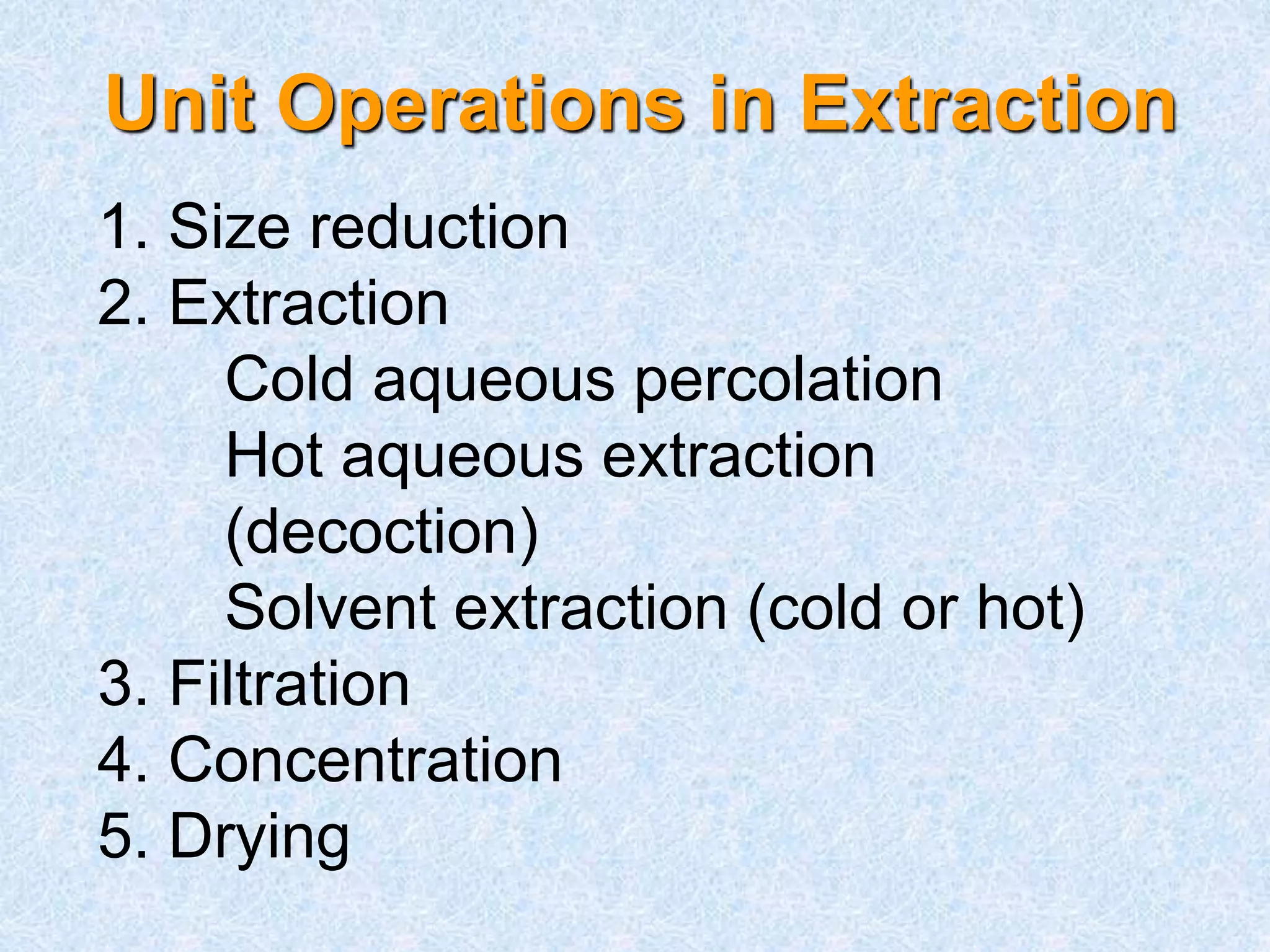
Unit Operations in Extraction
1. Size reduction
2. Extraction
Cold aqueous percolation
Hot aqueous extraction
(decoction)
Solvent extraction (cold or hot)
3. Filtration
4. Concentration
5. Drying
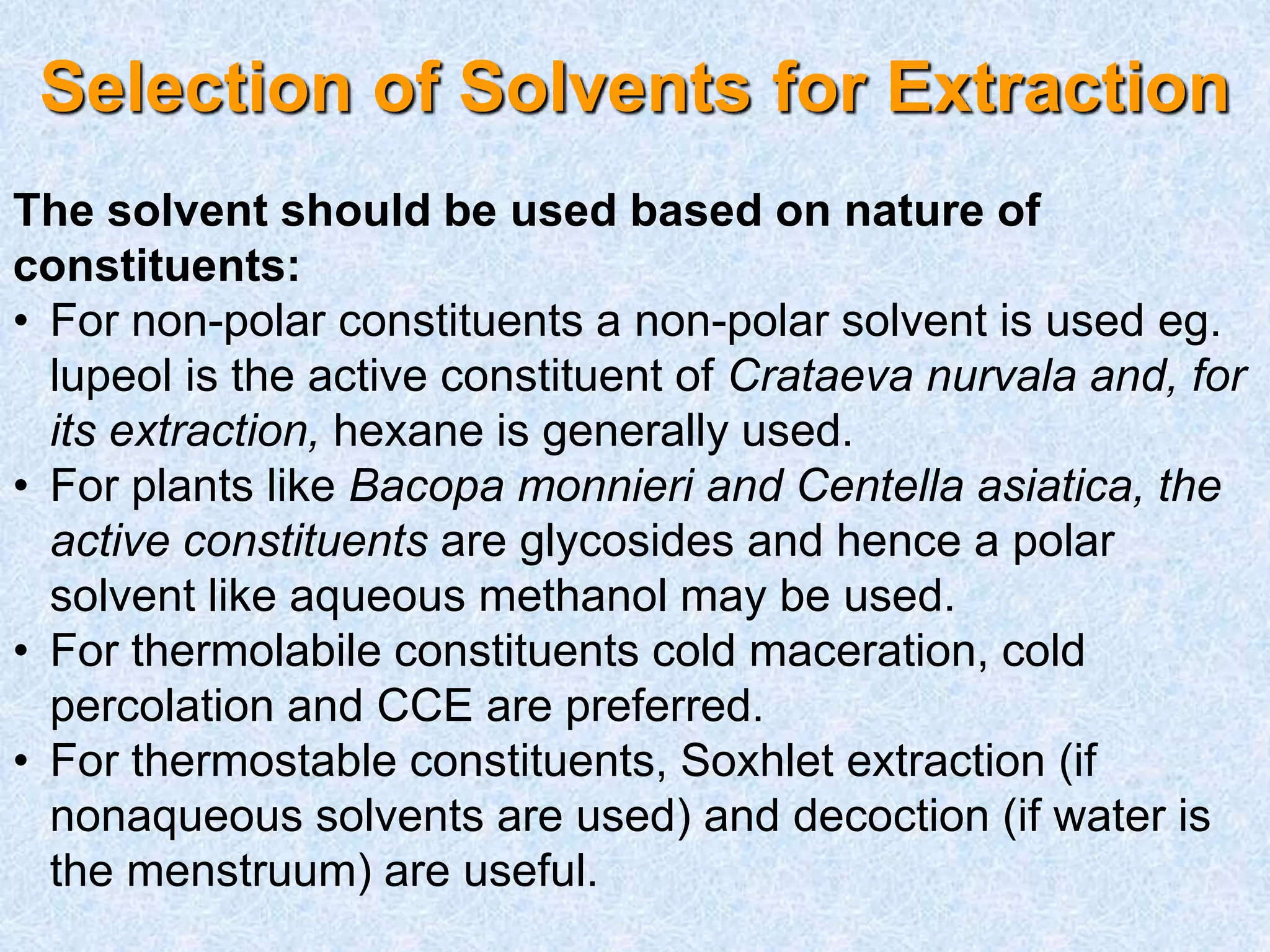
Selection of Solvents for Extraction
The solvent should be used based on nature of
constituents:
• For non-polar constituents a non-polar solvent is used eg.
lupeol is the active constituent of Crataeva nurvala and, for
its extraction, hexane is generally used.
• For plants like Bacopa monnieri and Centella asiatica, the
active constituents are glycosides and hence a polar
solvent like aqueous methanol may be used.
• For thermolabile constituents cold maceration, cold
percolation and CCE are preferred.
• For thermostable constituents, Soxhlet extraction (if
nonaqueous solvents are used) and decoction (if water is
the menstruum) are useful.
Precautions during Extraction
• In hot extraction, avoid higher temperatures than required.
Some glycosides break upon continuous exposure to higher
temperature.
• Standardize time of extraction be done, insufficient time
means incomplete extraction & longer time results in
unwanted constituents.
• The quality of water or medium used should be specified
and controlled.
• Concentration and drying procedures should ensure the
safety and stability of the active constituents.
• Drying under reduced pressure (e.g. using a Rotavapor) &
freeze drying although expensive be employed.
• The design and material of fabrication of the extractor
should be food grade stainless steel
Basket Centrifuge to Remove
Surface Moisture after Washing
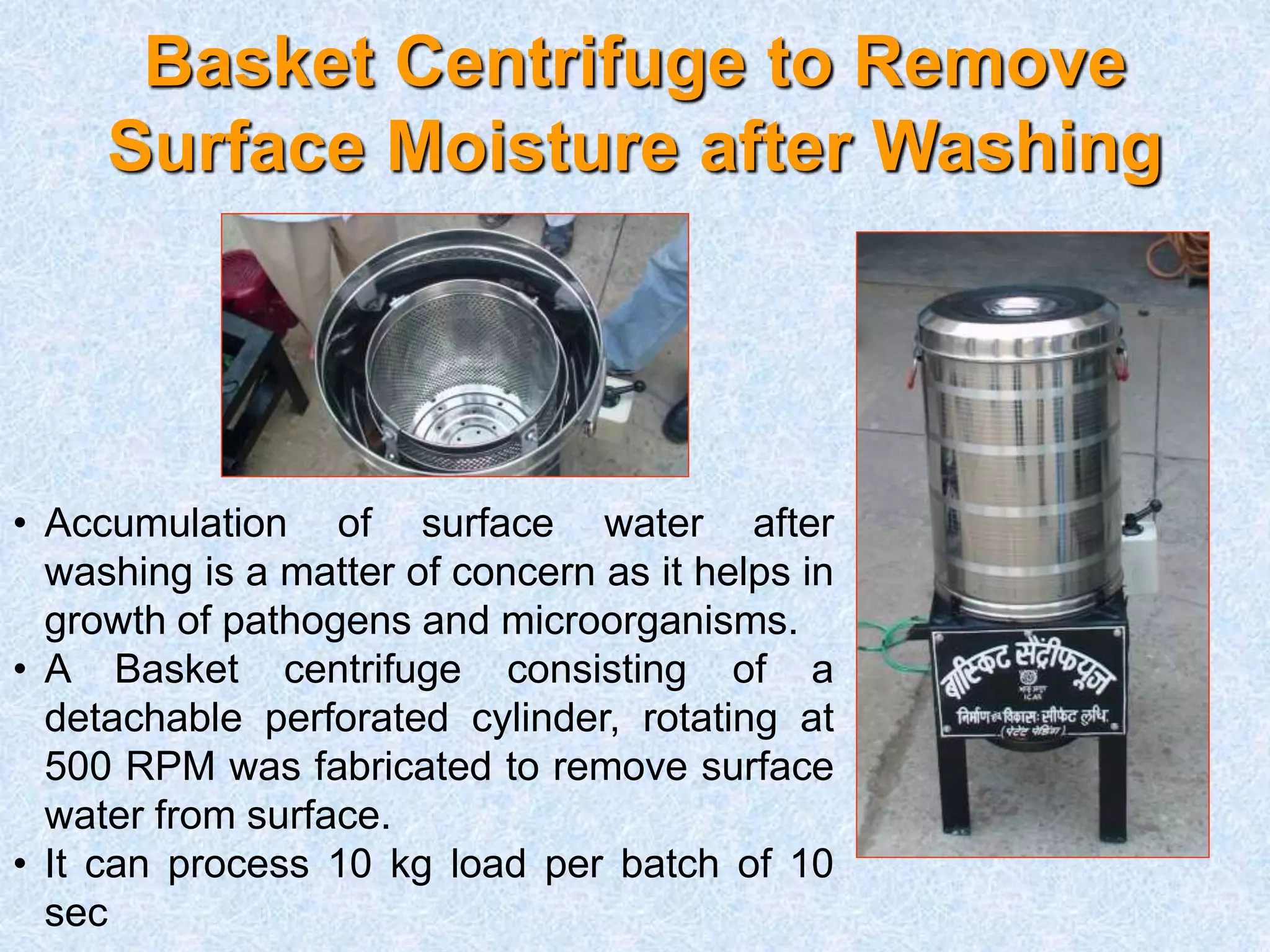
• Accumulation of surface water after
washing is a matter of concern as it helps in
growth of pathogens and microorganisms.
• A Basket centrifuge consisting of a
detachable perforated cylinder, rotating at
500 RPM was fabricated to remove surface
water from surface.
• It can process 10 kg load per batch of 10
sec
Controlled Solar Drying
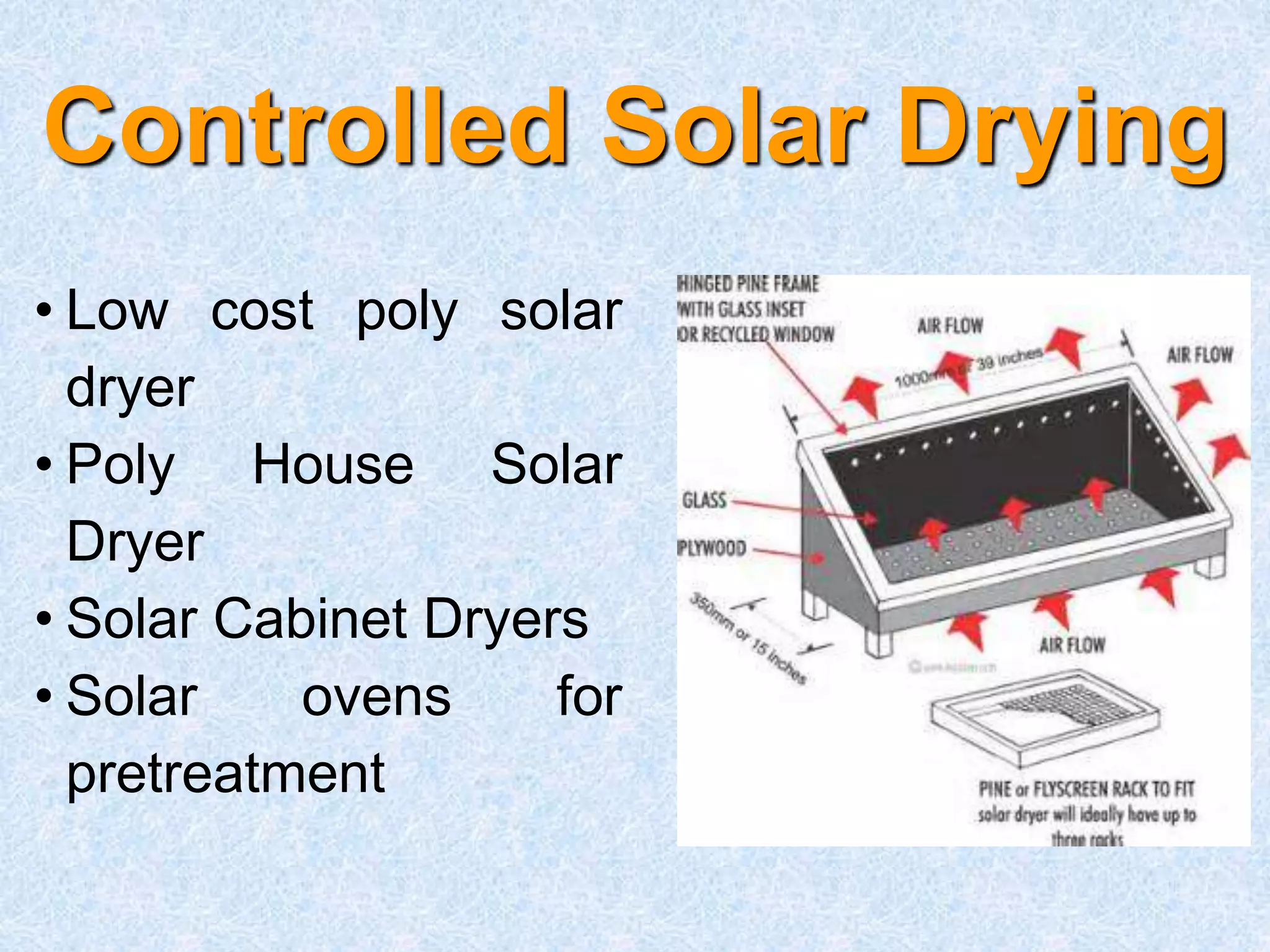
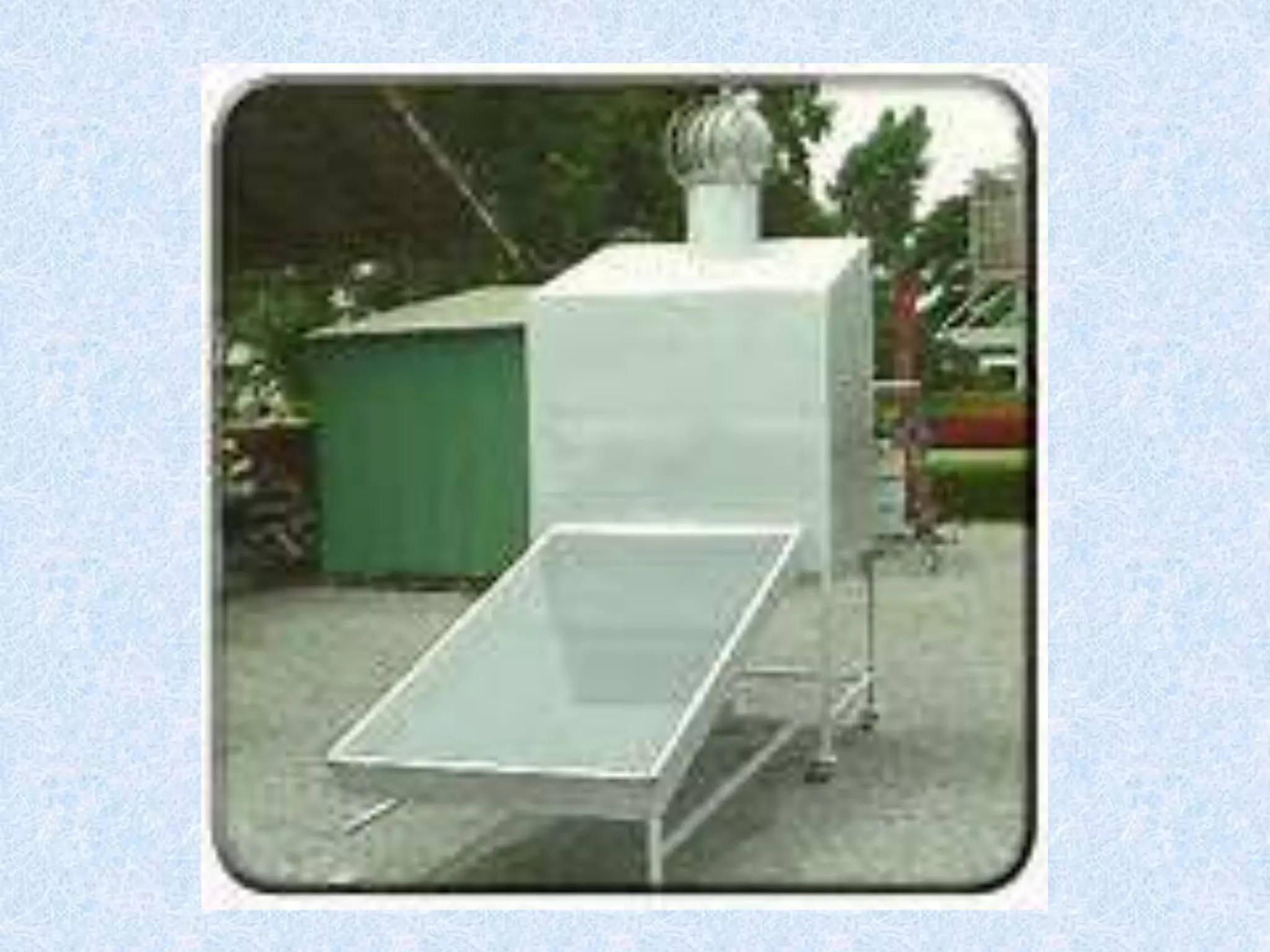
• Low cost poly solar
dryer
• Poly House Solar
Dryer
• Solar Cabinet Dryers
• Solar ovens for
pretreatment
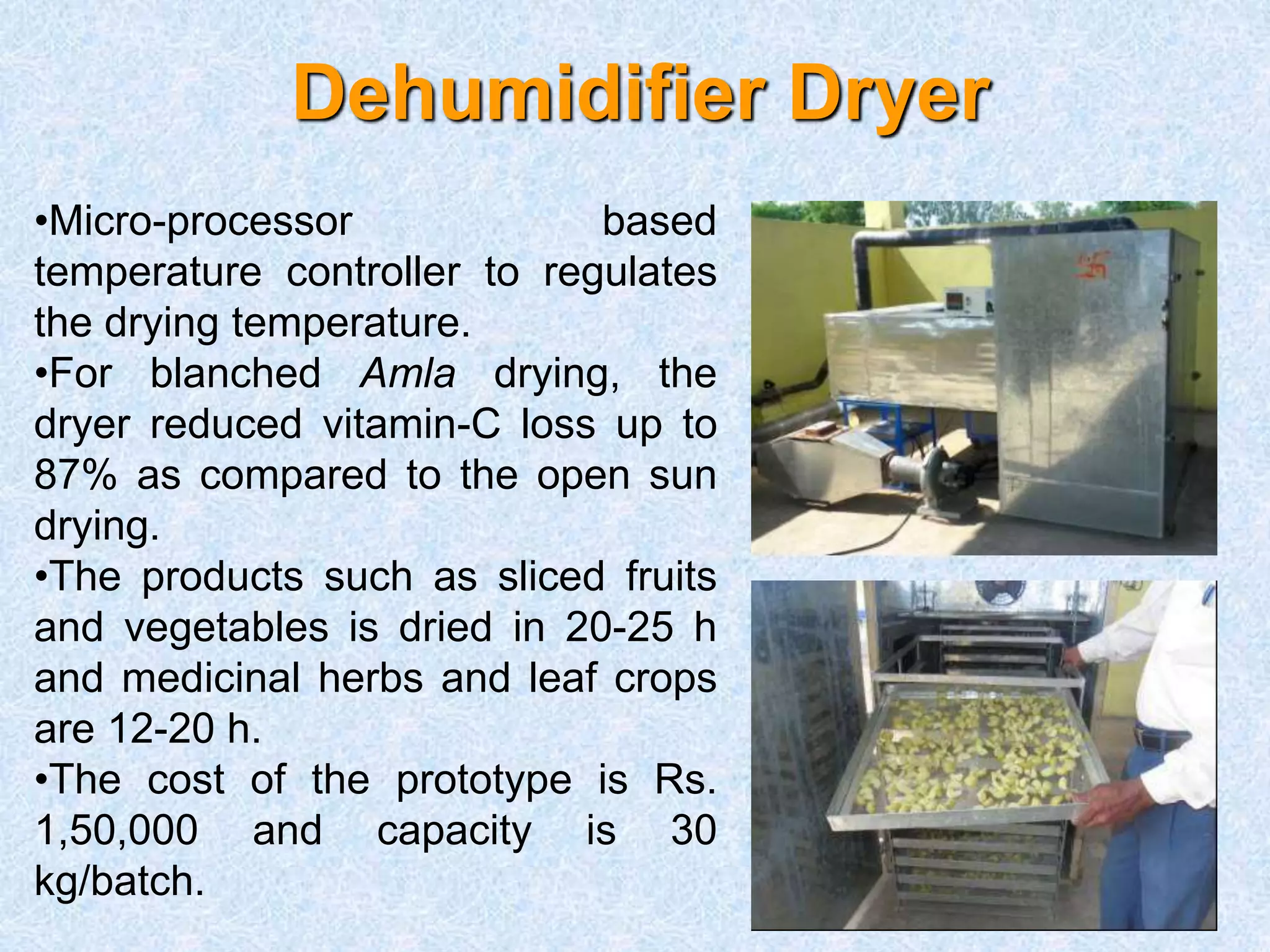
Dehumidifier Dryer
•Micro-processor based
temperature controller to regulates
the drying temperature.
•For blanched Amla drying, the
dryer reduced vitamin-C loss up to
87% as compared to the open sun
drying.
•The products such as sliced fruits
and vegetables is dried in 20-25 h
and medicinal herbs and leaf crops
are 12-20 h.
•The cost of the prototype is Rs.
1,50,000 and capacity is 30
kg/batch.
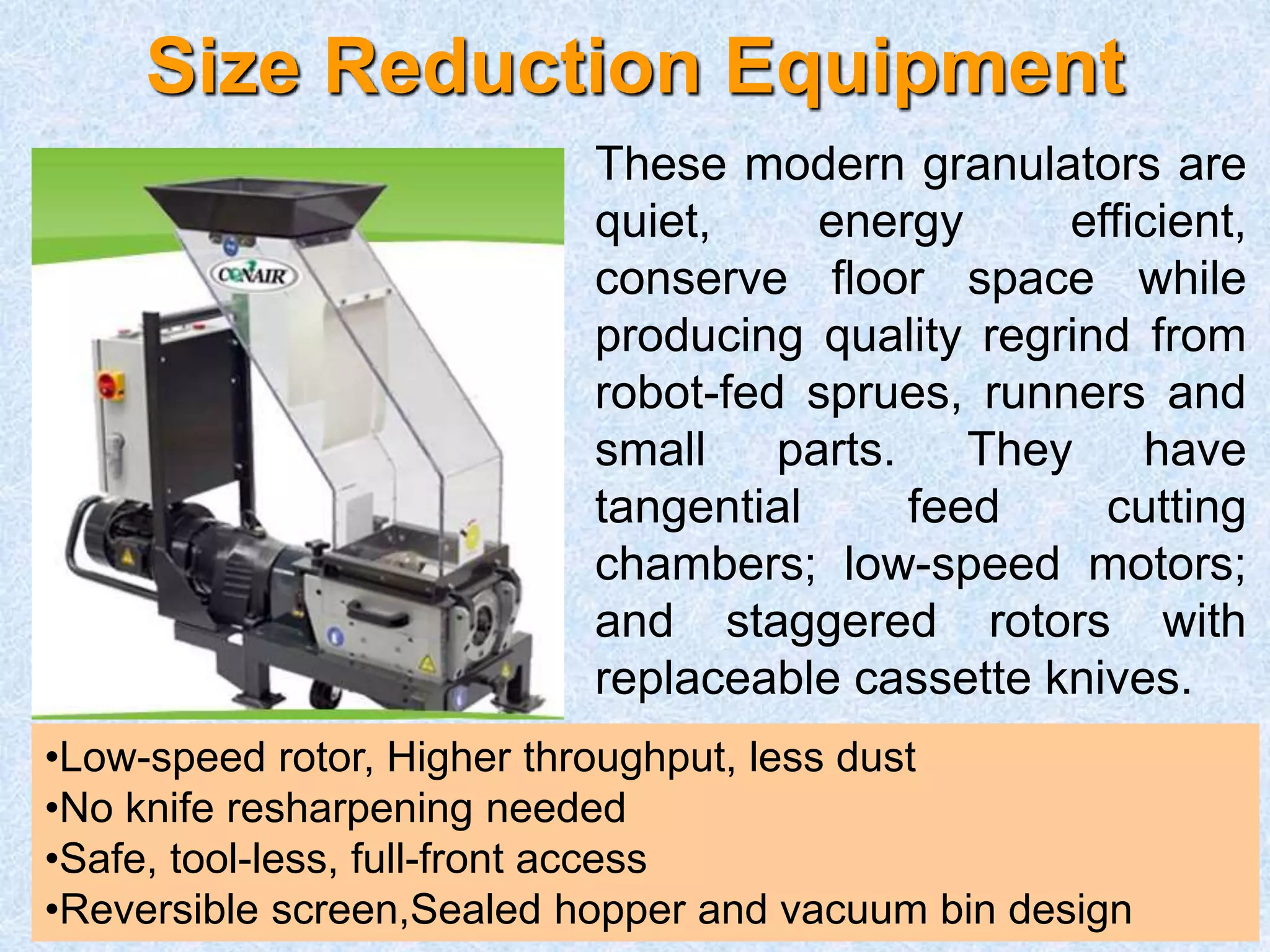
Size Reduction Equipment
These modern granulators are
quiet, energy efficient,
conserve floor space while
producing quality regrind from
robot-fed sprues, runners and
small parts. They have
tangential feed cutting
chambers; low-speed motors;
and staggered rotors with
replaceable cassette knives.
•Low-speed rotor, Higher throughput, less dust
•No knife resharpening needed
•Safe, tool-less, full-front access
•Reversible screen,Sealed hopper and vacuum bin design
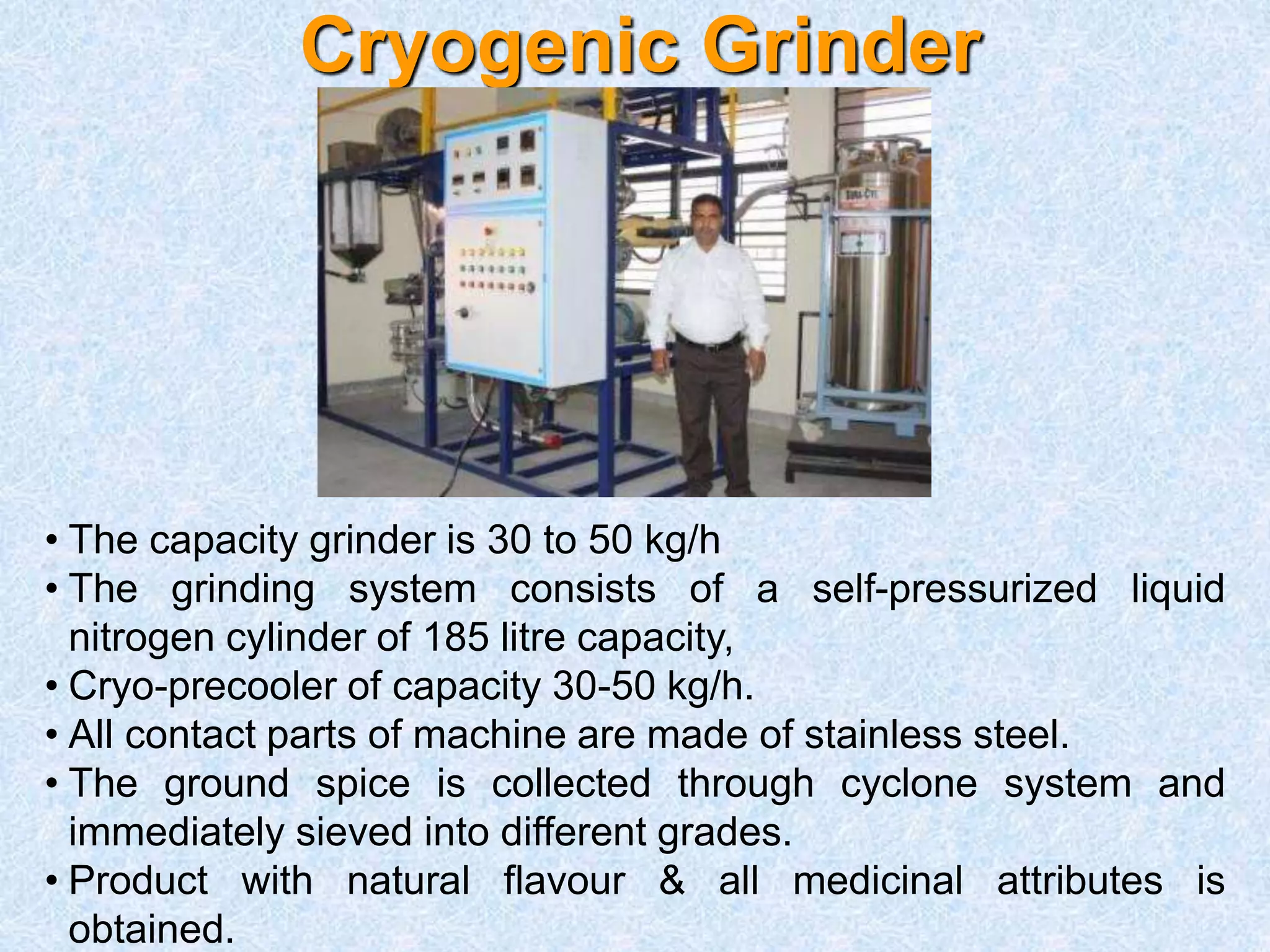
Cryogenic Grinder
• The capacity grinder is 30 to 50 kg/h
• The grinding system consists of a self-pressurized liquid
nitrogen cylinder of 185 litre capacity,
• Cryo-precooler of capacity 30-50 kg/h.
• All contact parts of machine are made of stainless steel.
• The ground spice is collected through cyclone system and
immediately sieved into different grades.
• Product with natural flavour & all medicinal attributes is
obtained.
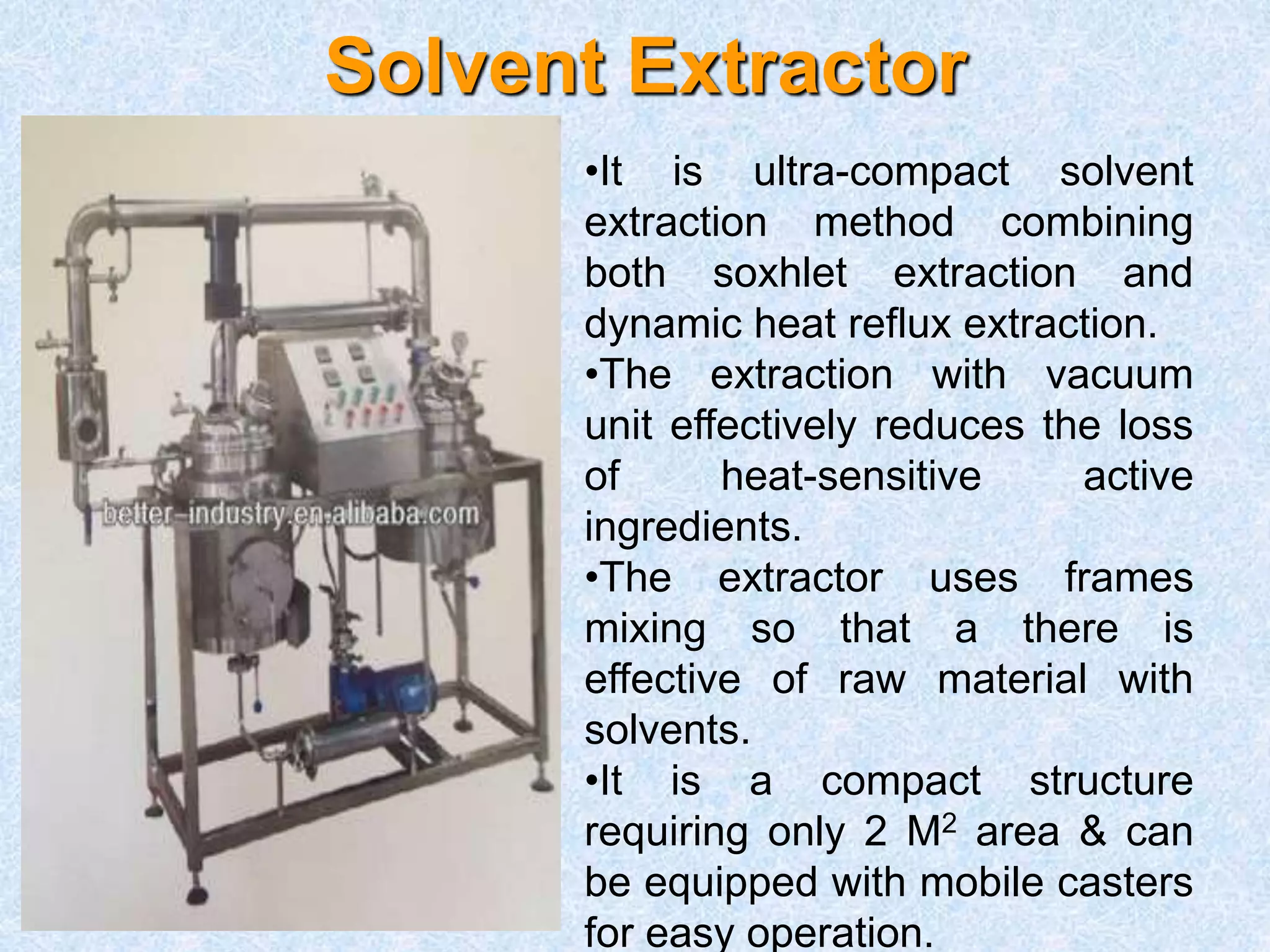
Solvent Extractor
•It is ultra-compact solvent
extraction method combining
both soxhlet extraction and
dynamic heat reflux extraction.
•The extraction with vacuum
unit effectively reduces the loss
of heat-sensitive active
ingredients.
•The extractor uses frames
mixing so that a there is
effective of raw material with
solvents.
•It is a compact structure
requiring only 2 M2 area & can
be equipped with mobile casters
for easy operation.
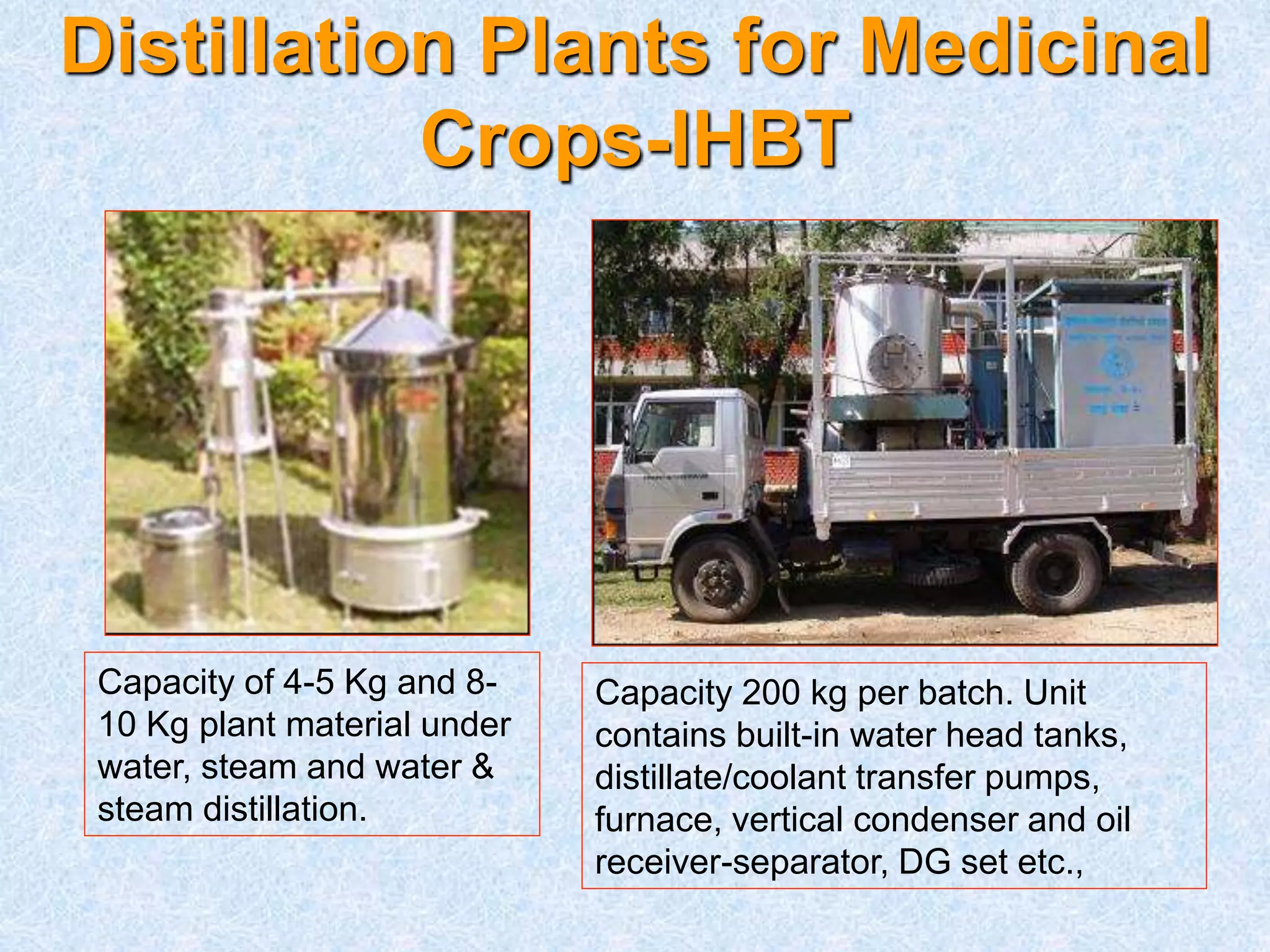
Distillation Plants for Medicinal
Crops-IHBT
Capacity of 4-5 Kg and 8-
10 Kg plant material under
water, steam and water &
steam distillation.
Capacity 200 kg per batch. Unit
contains built-in water head tanks,
distillate/coolant transfer pumps,
furnace, vertical condenser and oil
receiver-separator, DG set etc.,
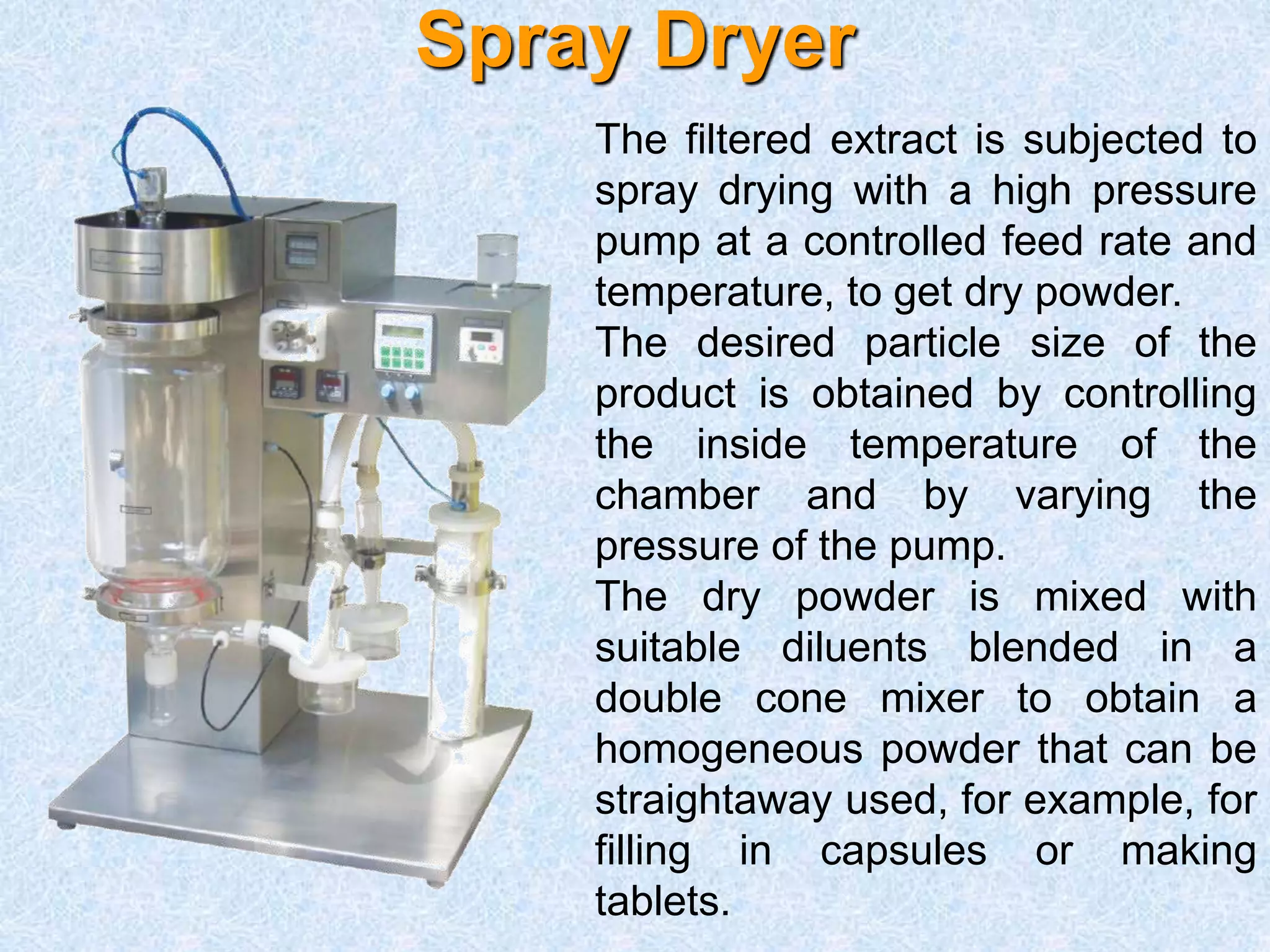
Spray Dryer
The filtered extract is subjected to
spray drying with a high pressure
pump at a controlled feed rate and
temperature, to get dry powder.
The desired particle size of the
product is obtained by controlling
the inside temperature of the
chamber and by varying the
pressure of the pump.
The dry powder is mixed with
suitable diluents blended in a
double cone mixer to obtain a
homogeneous powder that can be
straightaway used, for example, for
filling in capsules or making
tablets.
Commercial Products
Chironji -Mewa for khir & sweets
Amchur -condiments & masala
Vaybidaing -For insecticides & medicines.
Karanji - For soap & medicines
Shikakai -For shampooing the hair
Ghotpal-For ayurvedic medicines
Kosa cocoons-For silk manufacture
Peng seeds-For herbal oil & medicines
Karkatia seeds-For medical uses
Nirmali seeds -For ayurvedic medicines.
Contd…….
Ambadi-Pharma oil
Charota seeds-For soap manufacture
Chirayta -For medicinal uses
Mahua-For brewing liquor
Harra-For tanning industry
Tora –Oil for soap manufactures, cake as
cattle feed
Dhavai phool –Colouring agent in drugs/
medicines
Bhilawan seeds -For inks/paints.
Commercial Products
Major Concerns in Value Addition
Inadequate infrastructure, and post-harvesting facilities and
skills
• The Forest Department, procurement agencies, Gram
sabha/Panchayat or the institutions of primary collectors
should have proper storage facilities.
• Most medicinal and herbal products being seasonal products;
and several being perishable require appropriate storage
facility.
• Inadequate storage facility results in distress sale or sale at a
low price.
• The medicinal and herbal plants require cold storage
• The products like char seeds and kalmegh fail to provide the
potential return without intermediate level value addition.
Recommendations
• Develop appropriate technologies for processing and
intermediate product development adaptable at forest or
rural locations.
• Development of downstream processing to produce value
added products.
• Strengthening of R&D institutes with pilot plant
processing facilities for training, demonstration and
incubation.
• Setting up facilities for design and fabrication of
appropriate process equipment and pilot plants for scale
up operations.
• Establish agro processing centres in production
catchment with custom processing facility
• Create 1 Vanaspati Mitra in each village who can be
facilitator between experts and collectors of these crops
Thank you,
Let us scientifically
preserve & process
Medicinal and Herbal
Plants to bring prosperity
to tribals

Processing and value addition of medicinal and herbal crops

  • 1.
    Processing and ValueAddition of Medicinal and Herbal Crops Dr. R.T. Patil Former Director, CIPHET, Ludhiana Chairman & ED, Benevole for PHT, Chief Technical Advisor, Khyati Foods, Bhopal
  • 2.
    Madhya Pradesh inMedicinal and Herbal Crops • Madhya Pradesh is known for a wide range of herbs. • It caters to about 40 percent of Indian herbal industry's requirement spread across the country. • The main herbal centers are Shivpuri, Betul, Katni, Neemuch and Lalitpur. • The natural occurrence & mass scale cultivation has made the state the herbal hub of the country. • Madhya Pradesh is the raw material bowl of the herbal industry and can become the main processing center for several herbal products
  • 3.
    Processing of MedicinalCrops • Isolate pure active compounds for formulation into drugs (quinine, reserpine, digoxin, etc.) • Isolate intermediates for the production of semi-synthetic drugs • Prepare standardised galenicals (extracts, powders, tinctures, etc.)
  • 4.
    Raw Material Selection •Authentication of plant material and elimination of foreign matter completely • Use the right plant part, right age of plant & the time, season and place of collection. • Proper drying of plant material • Low temperature grinding methods should be followed • Powdered plant material should be screened for uniform particle size.
  • 7.
    Unit Operations inExtraction 1. Size reduction 2. Extraction Cold aqueous percolation Hot aqueous extraction (decoction) Solvent extraction (cold or hot) 3. Filtration 4. Concentration 5. Drying
  • 8.
    Selection of Solventsfor Extraction The solvent should be used based on nature of constituents: • For non-polar constituents a non-polar solvent is used eg. lupeol is the active constituent of Crataeva nurvala and, for its extraction, hexane is generally used. • For plants like Bacopa monnieri and Centella asiatica, the active constituents are glycosides and hence a polar solvent like aqueous methanol may be used. • For thermolabile constituents cold maceration, cold percolation and CCE are preferred. • For thermostable constituents, Soxhlet extraction (if nonaqueous solvents are used) and decoction (if water is the menstruum) are useful.
  • 9.
    Precautions during Extraction •In hot extraction, avoid higher temperatures than required. Some glycosides break upon continuous exposure to higher temperature. • Standardize time of extraction be done, insufficient time means incomplete extraction & longer time results in unwanted constituents. • The quality of water or medium used should be specified and controlled. • Concentration and drying procedures should ensure the safety and stability of the active constituents. • Drying under reduced pressure (e.g. using a Rotavapor) & freeze drying although expensive be employed. • The design and material of fabrication of the extractor should be food grade stainless steel
  • 10.
    Basket Centrifuge toRemove Surface Moisture after Washing • Accumulation of surface water after washing is a matter of concern as it helps in growth of pathogens and microorganisms. • A Basket centrifuge consisting of a detachable perforated cylinder, rotating at 500 RPM was fabricated to remove surface water from surface. • It can process 10 kg load per batch of 10 sec
  • 11.
    Controlled Solar Drying •Low cost poly solar dryer • Poly House Solar Dryer • Solar Cabinet Dryers • Solar ovens for pretreatment
  • 13.
    Dehumidifier Dryer •Micro-processor based temperaturecontroller to regulates the drying temperature. •For blanched Amla drying, the dryer reduced vitamin-C loss up to 87% as compared to the open sun drying. •The products such as sliced fruits and vegetables is dried in 20-25 h and medicinal herbs and leaf crops are 12-20 h. •The cost of the prototype is Rs. 1,50,000 and capacity is 30 kg/batch.
  • 14.
    Size Reduction Equipment Thesemodern granulators are quiet, energy efficient, conserve floor space while producing quality regrind from robot-fed sprues, runners and small parts. They have tangential feed cutting chambers; low-speed motors; and staggered rotors with replaceable cassette knives. •Low-speed rotor, Higher throughput, less dust •No knife resharpening needed •Safe, tool-less, full-front access •Reversible screen,Sealed hopper and vacuum bin design
  • 15.
    Cryogenic Grinder • Thecapacity grinder is 30 to 50 kg/h • The grinding system consists of a self-pressurized liquid nitrogen cylinder of 185 litre capacity, • Cryo-precooler of capacity 30-50 kg/h. • All contact parts of machine are made of stainless steel. • The ground spice is collected through cyclone system and immediately sieved into different grades. • Product with natural flavour & all medicinal attributes is obtained.
  • 16.
    Solvent Extractor •It isultra-compact solvent extraction method combining both soxhlet extraction and dynamic heat reflux extraction. •The extraction with vacuum unit effectively reduces the loss of heat-sensitive active ingredients. •The extractor uses frames mixing so that a there is effective of raw material with solvents. •It is a compact structure requiring only 2 M2 area & can be equipped with mobile casters for easy operation.
  • 17.
    Distillation Plants forMedicinal Crops-IHBT Capacity of 4-5 Kg and 8- 10 Kg plant material under water, steam and water & steam distillation. Capacity 200 kg per batch. Unit contains built-in water head tanks, distillate/coolant transfer pumps, furnace, vertical condenser and oil receiver-separator, DG set etc.,
  • 18.
    Spray Dryer The filteredextract is subjected to spray drying with a high pressure pump at a controlled feed rate and temperature, to get dry powder. The desired particle size of the product is obtained by controlling the inside temperature of the chamber and by varying the pressure of the pump. The dry powder is mixed with suitable diluents blended in a double cone mixer to obtain a homogeneous powder that can be straightaway used, for example, for filling in capsules or making tablets.
  • 19.
    Commercial Products Chironji -Mewafor khir & sweets Amchur -condiments & masala Vaybidaing -For insecticides & medicines. Karanji - For soap & medicines Shikakai -For shampooing the hair Ghotpal-For ayurvedic medicines Kosa cocoons-For silk manufacture Peng seeds-For herbal oil & medicines Karkatia seeds-For medical uses Nirmali seeds -For ayurvedic medicines. Contd…….
  • 20.
    Ambadi-Pharma oil Charota seeds-Forsoap manufacture Chirayta -For medicinal uses Mahua-For brewing liquor Harra-For tanning industry Tora –Oil for soap manufactures, cake as cattle feed Dhavai phool –Colouring agent in drugs/ medicines Bhilawan seeds -For inks/paints. Commercial Products
  • 21.
    Major Concerns inValue Addition Inadequate infrastructure, and post-harvesting facilities and skills • The Forest Department, procurement agencies, Gram sabha/Panchayat or the institutions of primary collectors should have proper storage facilities. • Most medicinal and herbal products being seasonal products; and several being perishable require appropriate storage facility. • Inadequate storage facility results in distress sale or sale at a low price. • The medicinal and herbal plants require cold storage • The products like char seeds and kalmegh fail to provide the potential return without intermediate level value addition.
  • 22.
    Recommendations • Develop appropriatetechnologies for processing and intermediate product development adaptable at forest or rural locations. • Development of downstream processing to produce value added products. • Strengthening of R&D institutes with pilot plant processing facilities for training, demonstration and incubation. • Setting up facilities for design and fabrication of appropriate process equipment and pilot plants for scale up operations. • Establish agro processing centres in production catchment with custom processing facility • Create 1 Vanaspati Mitra in each village who can be facilitator between experts and collectors of these crops
  • 23.
    Thank you, Let usscientifically preserve & process Medicinal and Herbal Plants to bring prosperity to tribals