What is post harvest technology
Dr. Majid Javanmard (Ph.D)
Food Hygiene & Quality Control
Horticulture Production: Global Trends
 The world population would top eight billion by the year 2030(FAO)
 FAO estimated that the world production of fruits and vegetables over a three-
year period was 489 million tons for vegetables and 448 million tons for fruits.
 This trend in production is expected to increase at a rate of 3.2 percent per
year for vegetables and 1.6 percent per year for fruits.
 Asia is the leading producer of vegetables with a 61 percent total volume
output and a yearly growth of 51 percent.
 the U.S. continues to lead in the export of fresh fruits and vegetables
worldwide with orange, grapes, and tomatoes.
 Brazil dominates the international trade of frozen orange juice concentrate,
while Chile has become the major fresh fruit exporter with a production
volume of 45 percent.
 The top six fruit producers, in declining order of importance, are China, India,
Brazil, USA, Italy, and Mexico. China, India, and Brazil account for almost 30
percent of the world's fruit supply
TRADITIONAL CONSUMPTION
 Fruit and vegetable consumption per capita showed an increase of 0.38
percent for fresh fruits and 0.92 percent for vegetables per capita from 1986 to
1995.
 The highest consumption of fresh fruits was registered in China (6.4%), as the
apparent per capita consumption of vegetables in China went from 68.7 kg per
capita in 1986 to 146 kg in 1995 (53.8% growth rate), while African and Near
East Asian countries showed a decrease in fresh fruit consumption.
 The lowest consumption of vegetables per capita was registered in Sub-
Saharan Africa.
post harvest
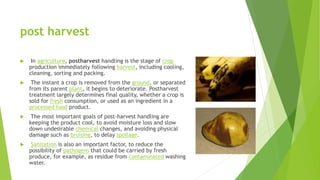
 In agriculture, postharvest handling is the stage of crop
production immediately following harvest, including cooling,
cleaning, sorting and packing.
 The instant a crop is removed from the ground, or separated
from its parent plant, it begins to deteriorate. Postharvest
treatment largely determines final quality, whether a crop is
sold for fresh consumption, or used as an ingredient in a
processed food product.
 The most important goals of post-harvest handling are
keeping the product cool, to avoid moisture loss and slow
down undesirable chemical changes, and avoiding physical
damage such as bruising, to delay spoilage.
 Sanitation is also an important factor, to reduce the
possibility of pathogens that could be carried by fresh
produce, for example, as residue from contaminated washing
water.
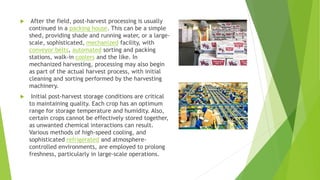
 After the field, post-harvest processing is usually
continued in a packing house. This can be a simple
shed, providing shade and running water, or a large-
scale, sophisticated, mechanized facility, with
conveyor belts, automated sorting and packing
stations, walk-in coolers and the like. In
mechanized harvesting, processing may also begin
as part of the actual harvest process, with initial
cleaning and sorting performed by the harvesting
machinery.
 Initial post-harvest storage conditions are critical
to maintaining quality. Each crop has an optimum
range for storage temperature and humidity. Also,
certain crops cannot be effectively stored together,
as unwanted chemical interactions can result.
Various methods of high-speed cooling, and
sophisticated refrigerated and atmosphere-
controlled environments, are employed to prolong
freshness, particularly in large-scale operations.
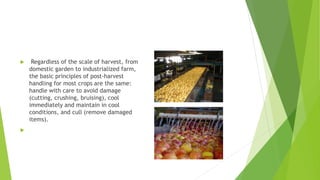
 Regardless of the scale of harvest, from
domestic garden to industrialized farm,
the basic principles of post-harvest
handling for most crops are the same:
handle with care to avoid damage
(cutting, crushing, bruising), cool
immediately and maintain in cool
conditions, and cull (remove damaged
items).

Postharvest Shelf Life
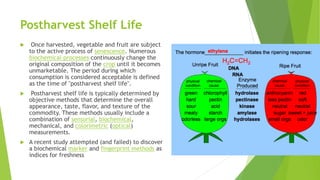
 Once harvested, vegetable and fruit are subject
to the active process of senescence. Numerous
biochemical processes continuously change the
original composition of the crop until it becomes
unmarketable. The period during which
consumption is considered acceptable is defined
as the time of "postharvest shelf life".
 Postharvest shelf life is typically determined by
objective methods that determine the overall
appearance, taste, flavor, and texture of the
commodity. These methods usually include a
combination of sensorial, biochemical,
mechanical, and colorimetric (optical)
measurements.
 A recent study attempted (and failed) to discover
a biochemical marker and fingerprint methods as
indices for freshness
Postharvest Physiology
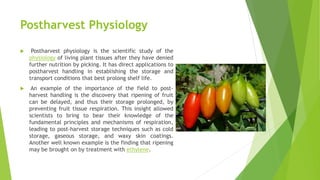
 Postharvest physiology is the scientific study of the
physiology of living plant tissues after they have denied
further nutrition by picking. It has direct applications to
postharvest handling in establishing the storage and
transport conditions that best prolong shelf life.
 An example of the importance of the field to post-
harvest handling is the discovery that ripening of fruit
can be delayed, and thus their storage prolonged, by
preventing fruit tissue respiration. This insight allowed
scientists to bring to bear their knowledge of the
fundamental principles and mechanisms of respiration,
leading to post-harvest storage techniques such as cold
storage, gaseous storage, and waxy skin coatings.
Another well known example is the finding that ripening
may be brought on by treatment with ethylene.
 Post-harvest technology involves all
treatments or processes that occur from
time of harvesting until the foodstuff
reaches the final consumer.
 Efficient techniques for harvesting,
conveying/transportation, handling,
storage, processing/preservation,
packaging, etc are components of the post-
harvest chain.
 Harvesting is normally included as a
component of the although post-harvest
strictly means 'after harvest' because how
produce are harvested have a large bearing
on the post-harvest life of the produce.
 Post harvest technology is inter-disciplinary
"Science and Technique" applied to agricultural
produce after harvest for its protection,
conservation, processing, packaging, distribution,
marketing, and utilization to meet the food and
nutritional requirements of the people in relation
to their needs.
 Importance of Post-harvest technology lies in the
fact that it has capability to meet food
requirement of growing population by eliminating
avoidable losses making more nutritive food items
from low grade raw commodity by proper
processing and fortification, diverting portion of
food material being fed to cattle by way of
processing and fortifying low grade food and
organic wastes and by-products into nutritive
animal feed.
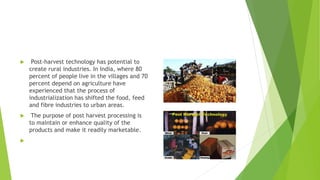
 Post-harvest technology has potential to
create rural industries. In India, where 80
percent of people live in the villages and 70
percent depend on agriculture have
experienced that the process of
industrialization has shifted the food, feed
and fibre industries to urban areas.
 The purpose of post harvest processing is
to maintain or enhance quality of the
products and make it readily marketable.

Post Harvest Industries
The post harvest industry includes the following main components
 Harvesting and threshing
 Drying and storage
 Processing (conservation and / or transformation of the produce)
 Utilization by consumer including home processing.
Other components of the system include.
 Transportation and distribution.
 Marketing.
 Grading and quality control.
 Pest control.
 Packaging.
 Communication among all concerned.
 Information, demonstration and advisory systems.
 Manufacture and supply of essential equipment and machinery.
 Financial control.
 Price stabilization
 Management and integration of the total system.

What is post harvest technology

  • 1.
    What is postharvest technology Dr. Majid Javanmard (Ph.D) Food Hygiene & Quality Control
  • 2.
    Horticulture Production: GlobalTrends  The world population would top eight billion by the year 2030(FAO)  FAO estimated that the world production of fruits and vegetables over a three- year period was 489 million tons for vegetables and 448 million tons for fruits.  This trend in production is expected to increase at a rate of 3.2 percent per year for vegetables and 1.6 percent per year for fruits.  Asia is the leading producer of vegetables with a 61 percent total volume output and a yearly growth of 51 percent.  the U.S. continues to lead in the export of fresh fruits and vegetables worldwide with orange, grapes, and tomatoes.  Brazil dominates the international trade of frozen orange juice concentrate, while Chile has become the major fresh fruit exporter with a production volume of 45 percent.  The top six fruit producers, in declining order of importance, are China, India, Brazil, USA, Italy, and Mexico. China, India, and Brazil account for almost 30 percent of the world's fruit supply
  • 3.
    TRADITIONAL CONSUMPTION  Fruitand vegetable consumption per capita showed an increase of 0.38 percent for fresh fruits and 0.92 percent for vegetables per capita from 1986 to 1995.  The highest consumption of fresh fruits was registered in China (6.4%), as the apparent per capita consumption of vegetables in China went from 68.7 kg per capita in 1986 to 146 kg in 1995 (53.8% growth rate), while African and Near East Asian countries showed a decrease in fresh fruit consumption.  The lowest consumption of vegetables per capita was registered in Sub- Saharan Africa.
  • 4.
    post harvest  Inagriculture, postharvest handling is the stage of crop production immediately following harvest, including cooling, cleaning, sorting and packing.  The instant a crop is removed from the ground, or separated from its parent plant, it begins to deteriorate. Postharvest treatment largely determines final quality, whether a crop is sold for fresh consumption, or used as an ingredient in a processed food product.  The most important goals of post-harvest handling are keeping the product cool, to avoid moisture loss and slow down undesirable chemical changes, and avoiding physical damage such as bruising, to delay spoilage.  Sanitation is also an important factor, to reduce the possibility of pathogens that could be carried by fresh produce, for example, as residue from contaminated washing water.
  • 5.
     After thefield, post-harvest processing is usually continued in a packing house. This can be a simple shed, providing shade and running water, or a large- scale, sophisticated, mechanized facility, with conveyor belts, automated sorting and packing stations, walk-in coolers and the like. In mechanized harvesting, processing may also begin as part of the actual harvest process, with initial cleaning and sorting performed by the harvesting machinery.  Initial post-harvest storage conditions are critical to maintaining quality. Each crop has an optimum range for storage temperature and humidity. Also, certain crops cannot be effectively stored together, as unwanted chemical interactions can result. Various methods of high-speed cooling, and sophisticated refrigerated and atmosphere- controlled environments, are employed to prolong freshness, particularly in large-scale operations.
  • 6.
     Regardless ofthe scale of harvest, from domestic garden to industrialized farm, the basic principles of post-harvest handling for most crops are the same: handle with care to avoid damage (cutting, crushing, bruising), cool immediately and maintain in cool conditions, and cull (remove damaged items). 
  • 7.
    Postharvest Shelf Life Once harvested, vegetable and fruit are subject to the active process of senescence. Numerous biochemical processes continuously change the original composition of the crop until it becomes unmarketable. The period during which consumption is considered acceptable is defined as the time of "postharvest shelf life".  Postharvest shelf life is typically determined by objective methods that determine the overall appearance, taste, flavor, and texture of the commodity. These methods usually include a combination of sensorial, biochemical, mechanical, and colorimetric (optical) measurements.  A recent study attempted (and failed) to discover a biochemical marker and fingerprint methods as indices for freshness
  • 8.
    Postharvest Physiology  Postharvestphysiology is the scientific study of the physiology of living plant tissues after they have denied further nutrition by picking. It has direct applications to postharvest handling in establishing the storage and transport conditions that best prolong shelf life.  An example of the importance of the field to post- harvest handling is the discovery that ripening of fruit can be delayed, and thus their storage prolonged, by preventing fruit tissue respiration. This insight allowed scientists to bring to bear their knowledge of the fundamental principles and mechanisms of respiration, leading to post-harvest storage techniques such as cold storage, gaseous storage, and waxy skin coatings. Another well known example is the finding that ripening may be brought on by treatment with ethylene.
  • 9.
     Post-harvest technologyinvolves all treatments or processes that occur from time of harvesting until the foodstuff reaches the final consumer.  Efficient techniques for harvesting, conveying/transportation, handling, storage, processing/preservation, packaging, etc are components of the post- harvest chain.  Harvesting is normally included as a component of the although post-harvest strictly means 'after harvest' because how produce are harvested have a large bearing on the post-harvest life of the produce.
  • 10.
     Post harvesttechnology is inter-disciplinary "Science and Technique" applied to agricultural produce after harvest for its protection, conservation, processing, packaging, distribution, marketing, and utilization to meet the food and nutritional requirements of the people in relation to their needs.  Importance of Post-harvest technology lies in the fact that it has capability to meet food requirement of growing population by eliminating avoidable losses making more nutritive food items from low grade raw commodity by proper processing and fortification, diverting portion of food material being fed to cattle by way of processing and fortifying low grade food and organic wastes and by-products into nutritive animal feed.
  • 11.
     Post-harvest technologyhas potential to create rural industries. In India, where 80 percent of people live in the villages and 70 percent depend on agriculture have experienced that the process of industrialization has shifted the food, feed and fibre industries to urban areas.  The purpose of post harvest processing is to maintain or enhance quality of the products and make it readily marketable. 
  • 12.
    Post Harvest Industries Thepost harvest industry includes the following main components  Harvesting and threshing  Drying and storage  Processing (conservation and / or transformation of the produce)  Utilization by consumer including home processing.
  • 13.
    Other components ofthe system include.  Transportation and distribution.  Marketing.  Grading and quality control.  Pest control.  Packaging.  Communication among all concerned.  Information, demonstration and advisory systems.  Manufacture and supply of essential equipment and machinery.  Financial control.  Price stabilization  Management and integration of the total system.