Lens Power
 Measurement
   Walter Huang, OD
  Yuanpei University
Department of Optometry
Methods of Lens Power
          Measurement
Trial lens hand neutralization
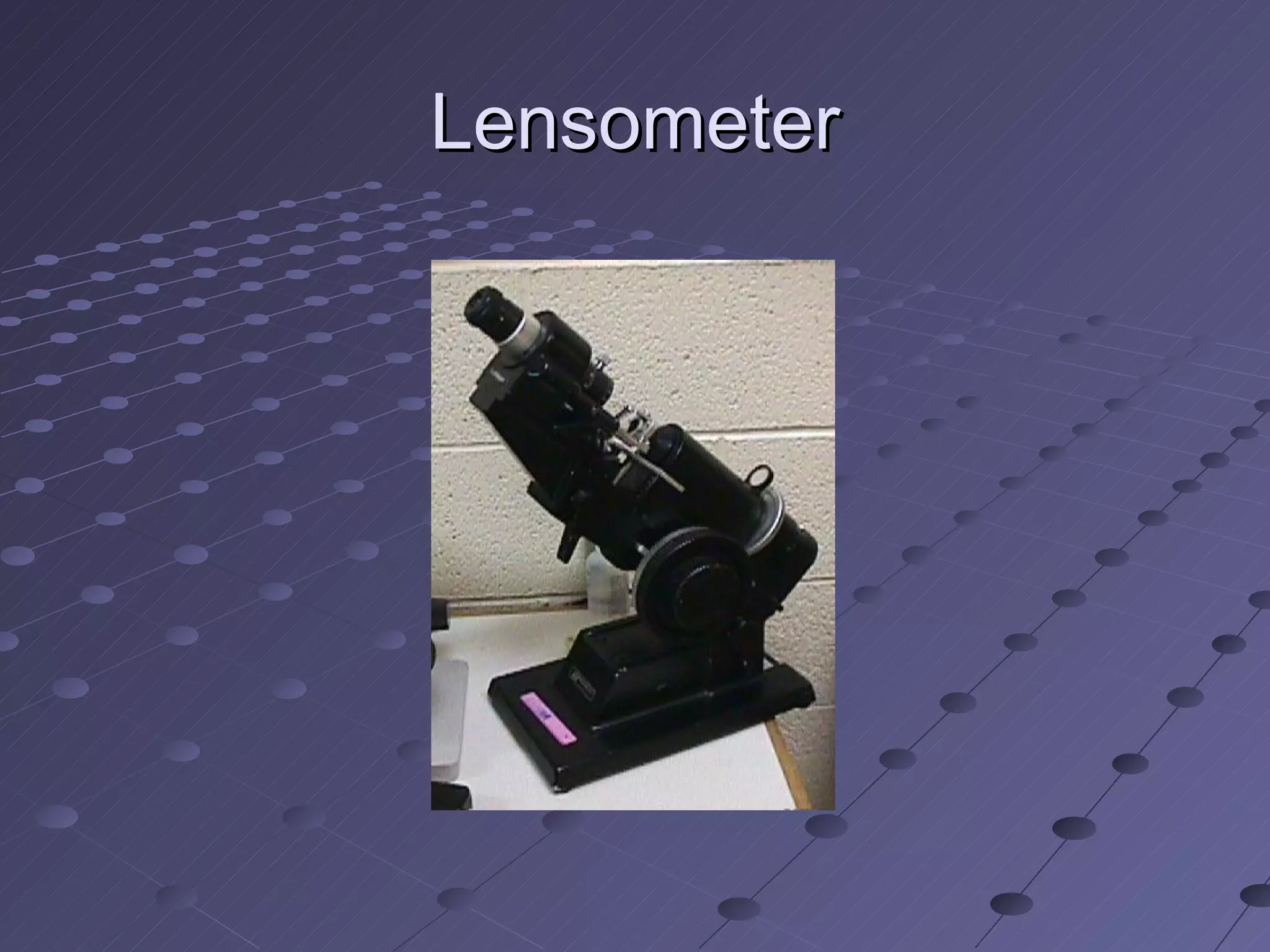
Lensometer
   Much greater accuracy may be obtained with
    the lensometer than with trial lens hand
    neutralization
Trial Lens Hand Neutralization
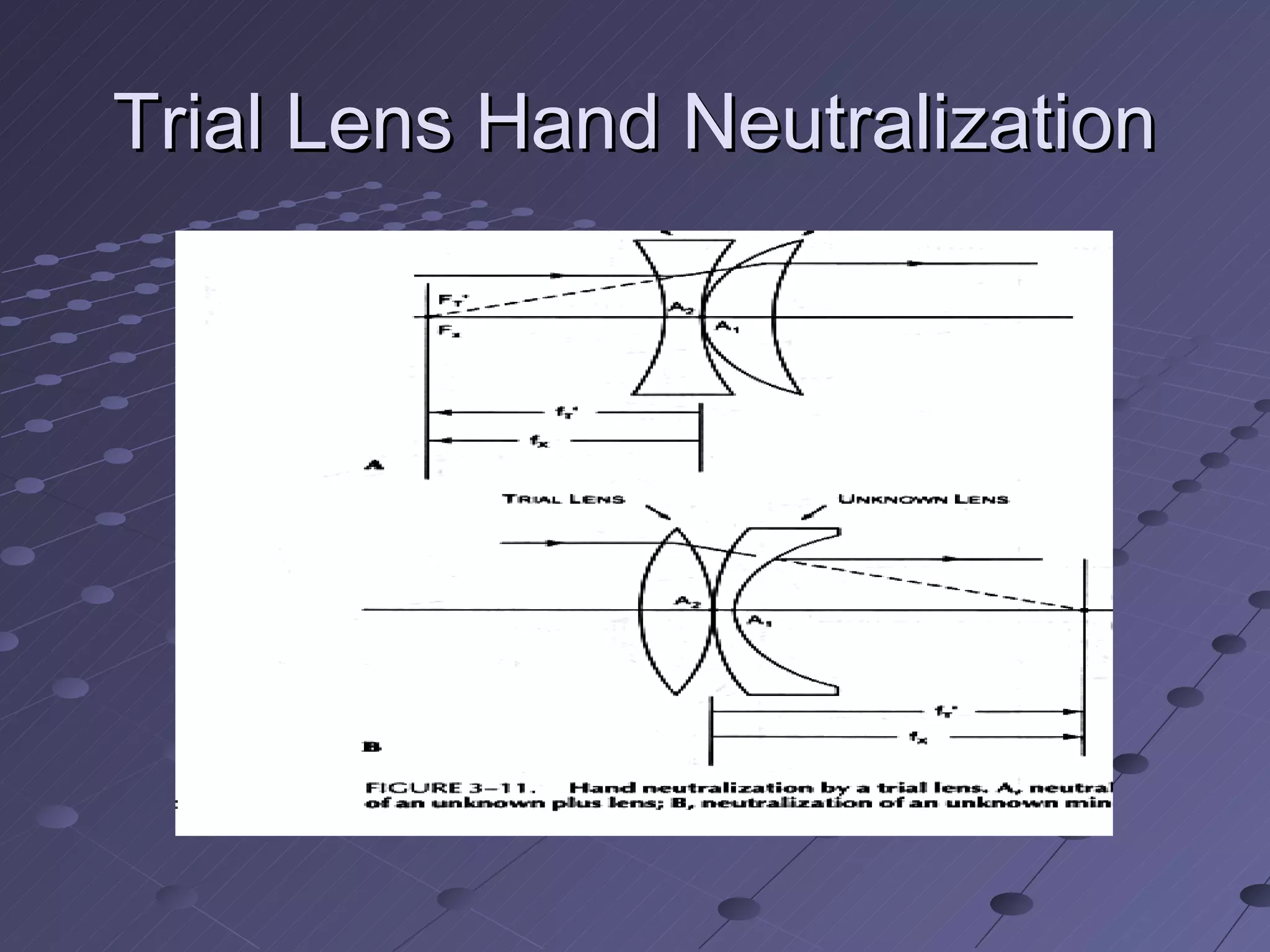
Two lenses neutralize each other when
placed in contact with each other so that
the combined power of the two lenses is
equal to zero
An unknown lens is neutralized by a
known trial lens of equal power but
opposite in sign
Trial Lens Hand Neutralization
This is performed in the absence of a
lensometer
It is used qualitatively as a means for
estimation in many clinical and dispensing
situations
It often involves simply identifying if it is a
plus, a minus, or a toric lens
It more accurately estimates low power
plus and minus lenses than toric lenses
Trial Lens Hand Neutralization
It is used to measure the front vertex
power of the lens
Trial Lens Hand Neutralization
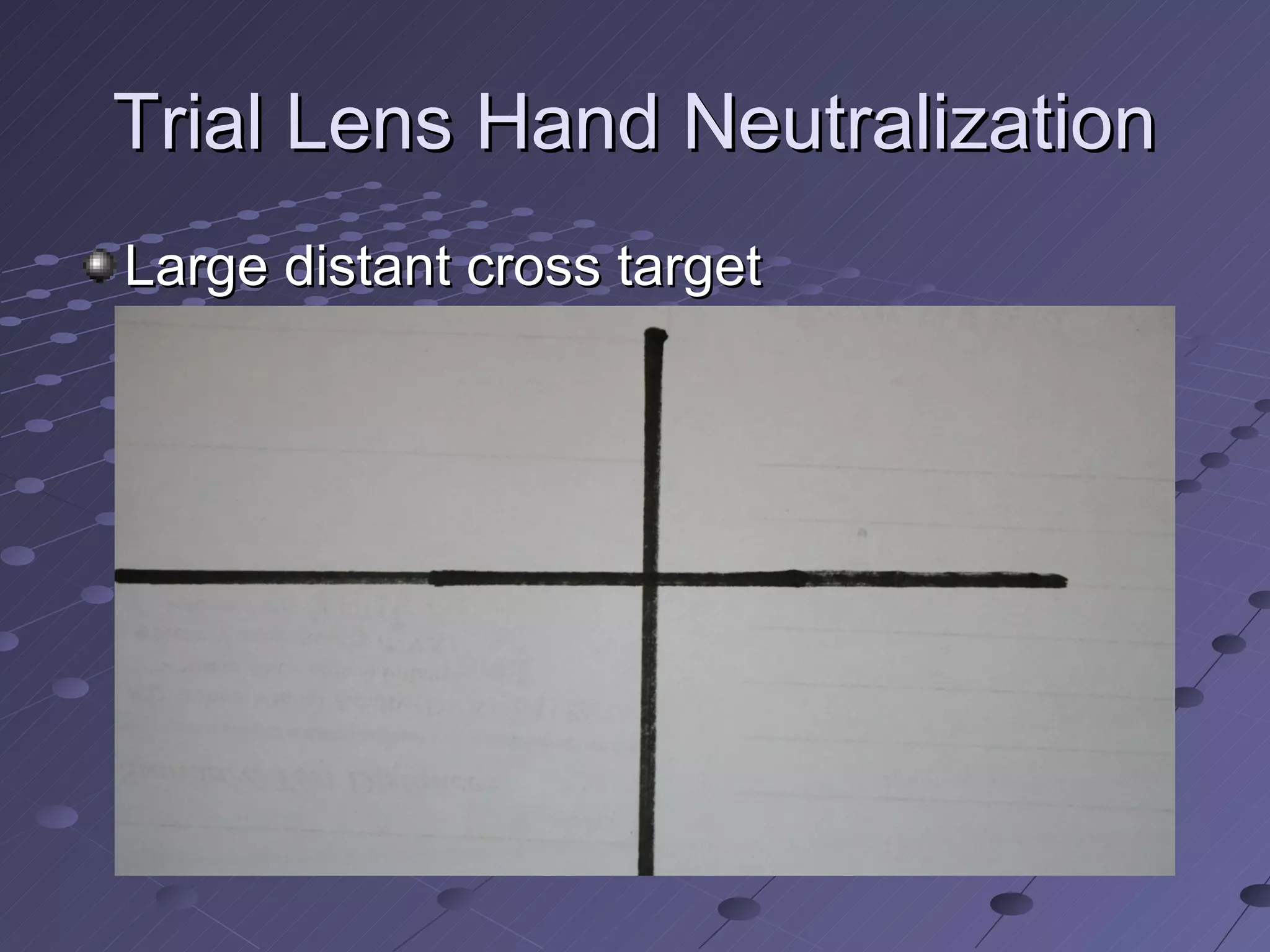
View a large distant cross target through
the lens
Hold lens on visual axis, at arm’s distance
Align lens such that the cross target is
continuous
Move lens vertically, observe motion of
horizontal line
Move lens horizontally, observe motion of
vertical line
Trial Lens Hand Neutralization
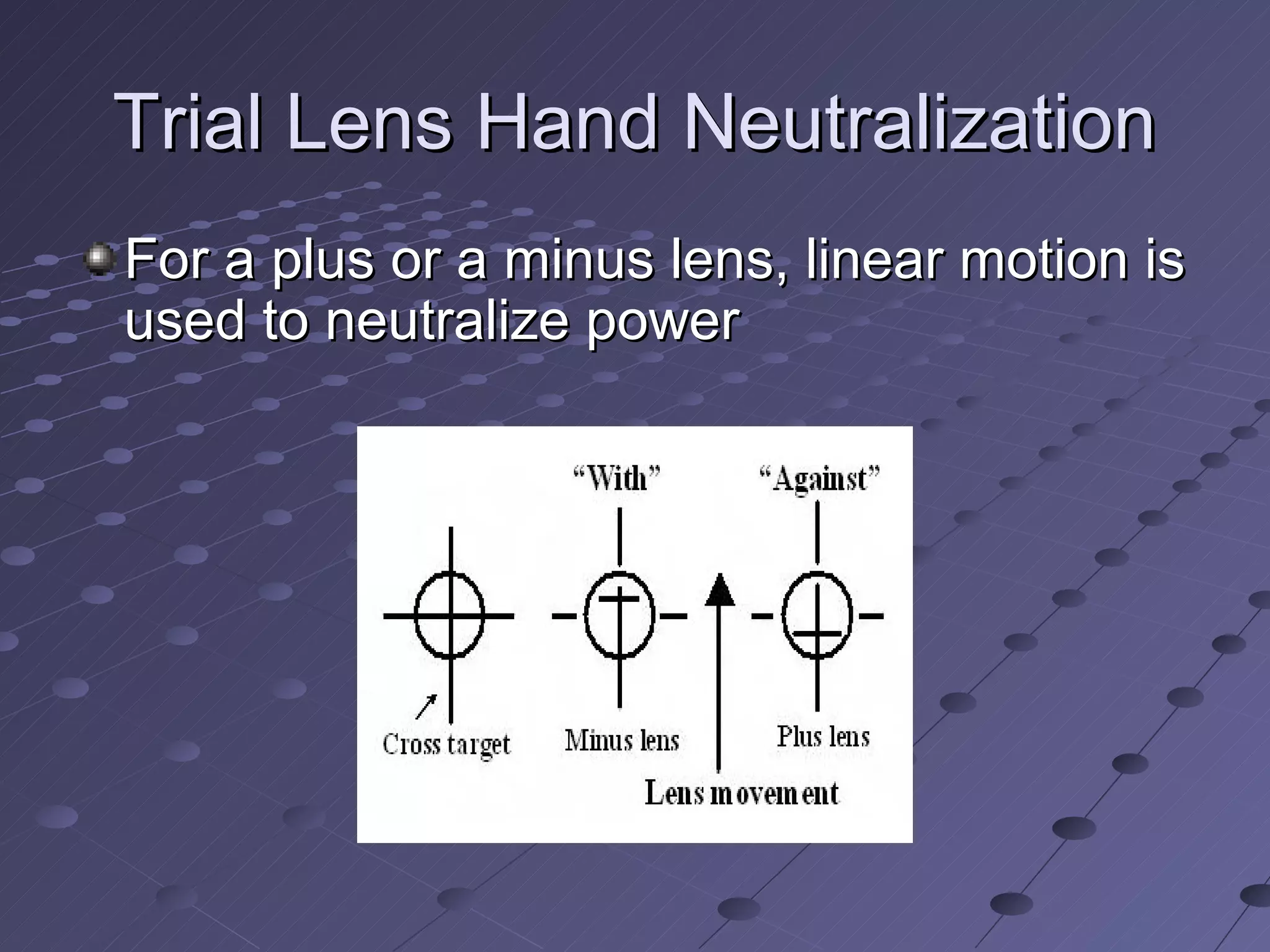
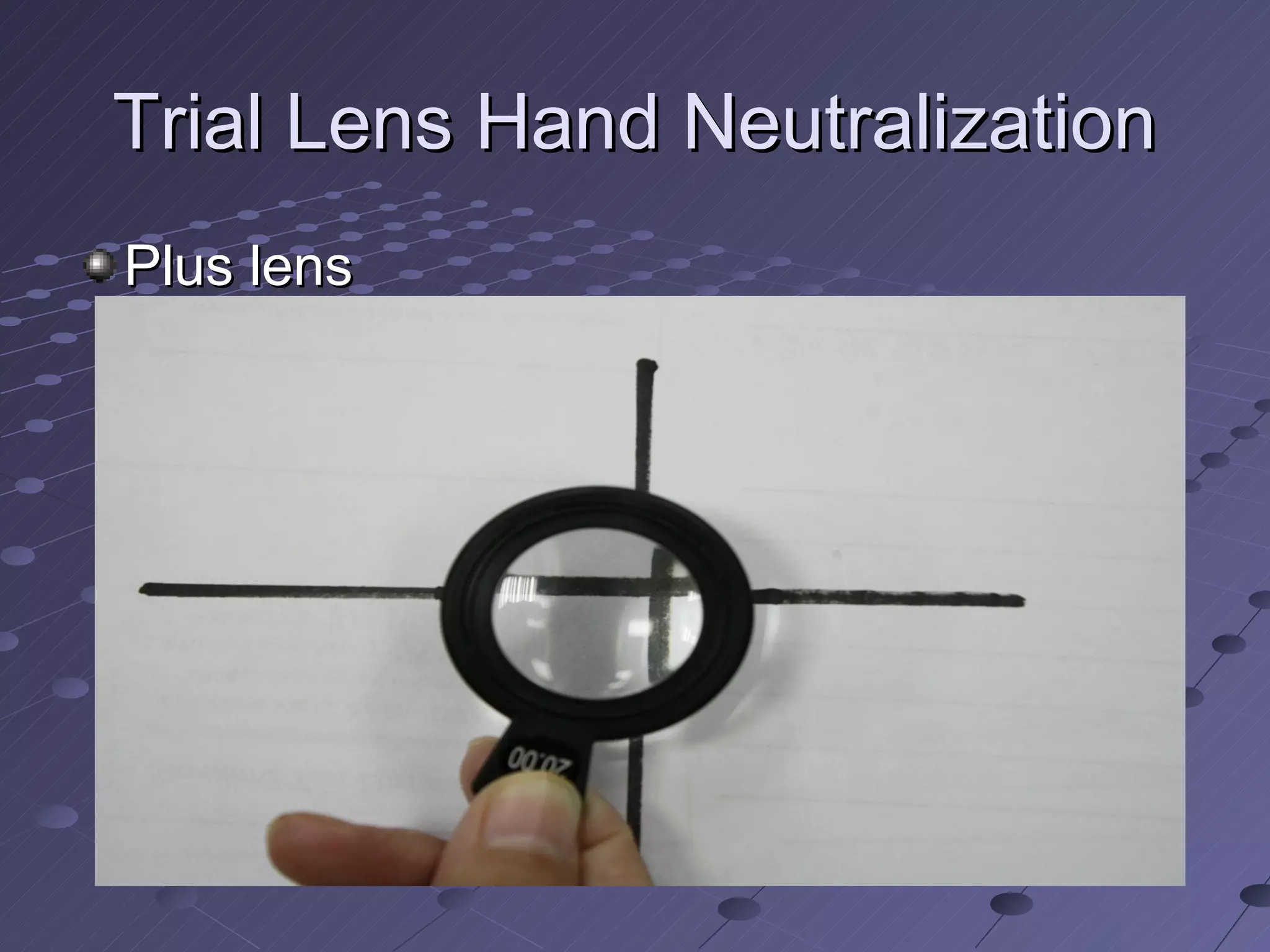
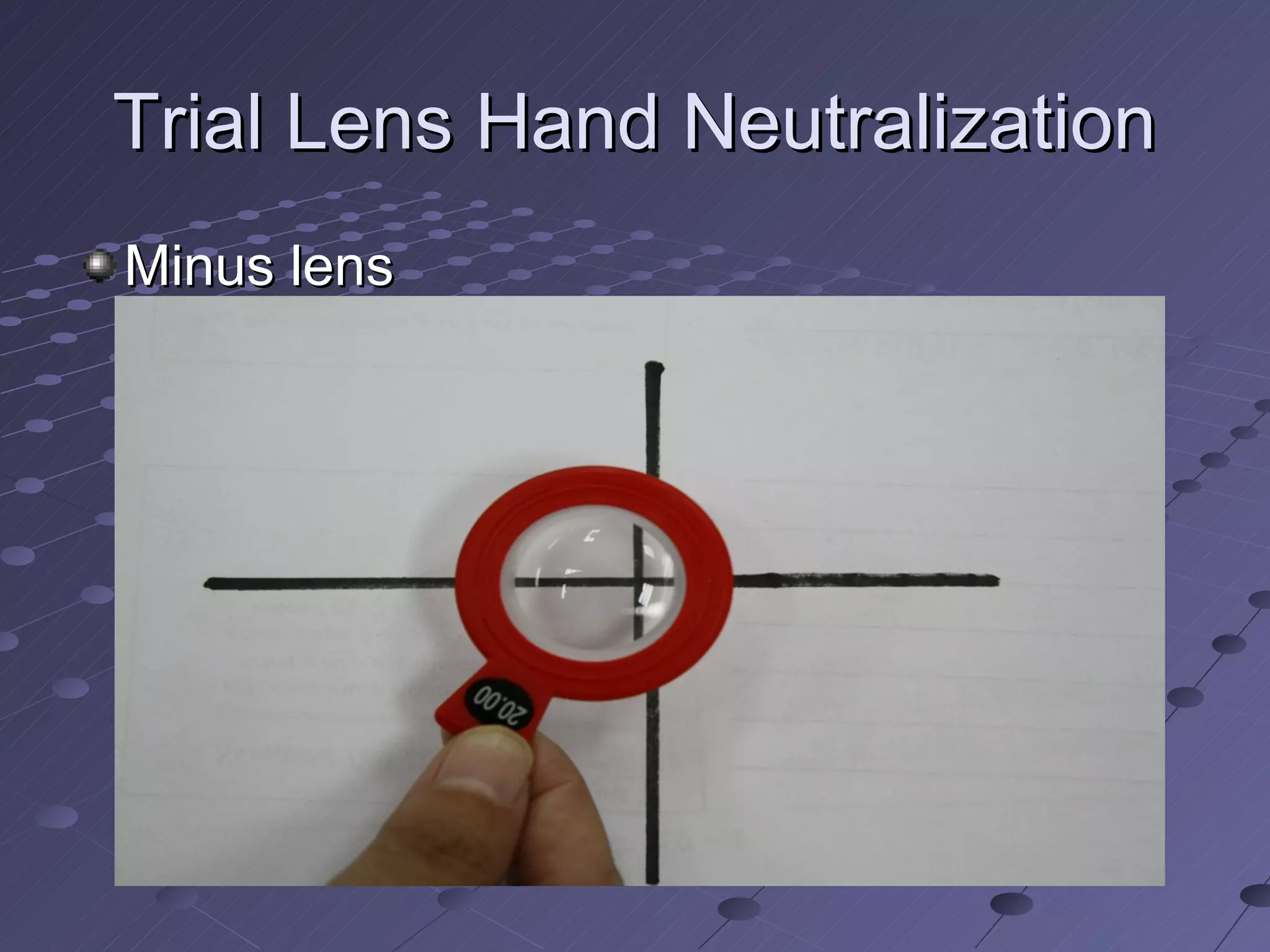
For a plus or a minus lens, linear motion is
used to neutralize power
   If observe “against motion,” use plus lens
   If observe “with motion,” use minus lens
Trial Lens Hand Neutralization
For a plus or a minus lens, linear motion is
used to neutralize power
Trial Lens Hand Neutralization
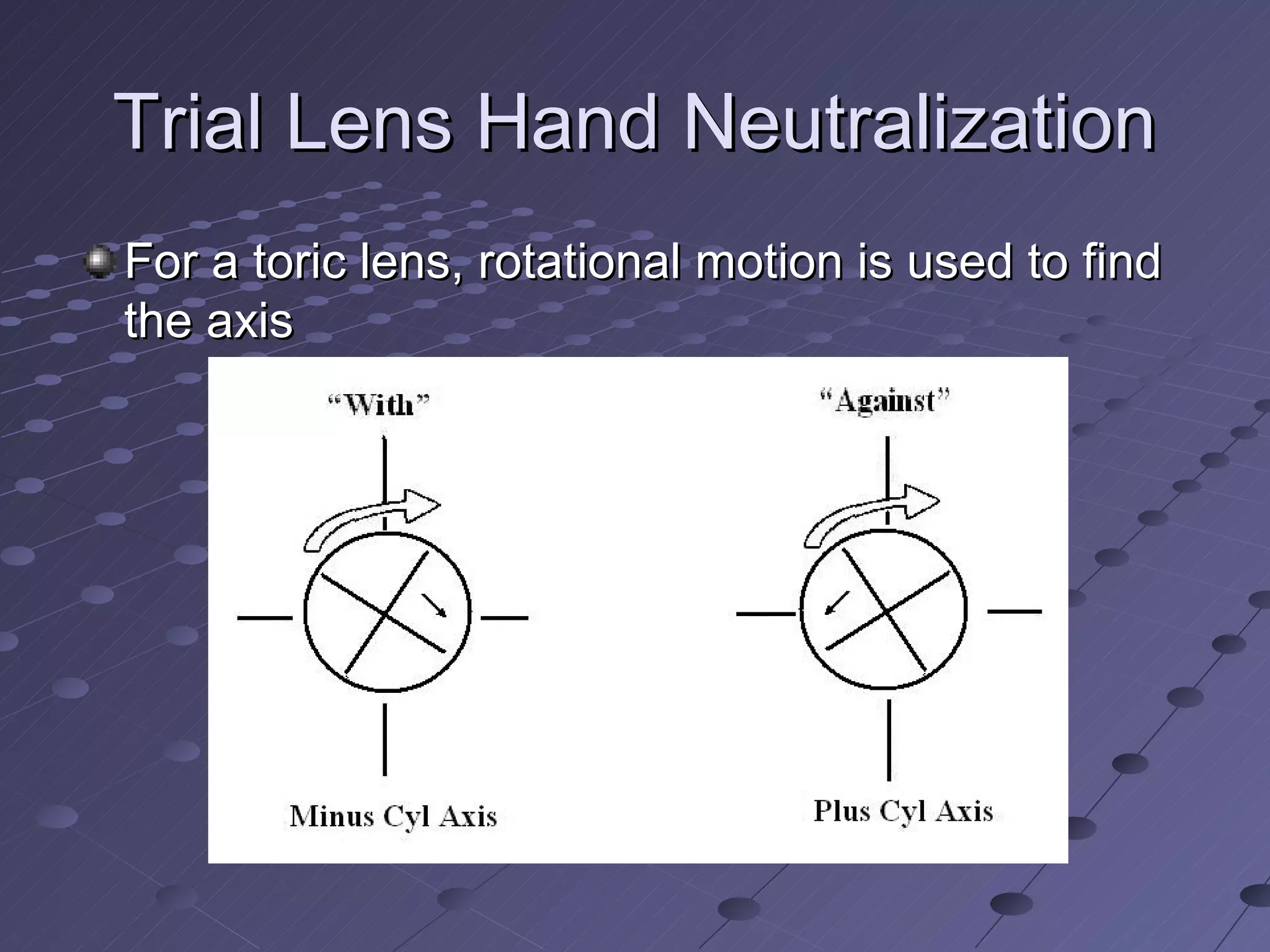
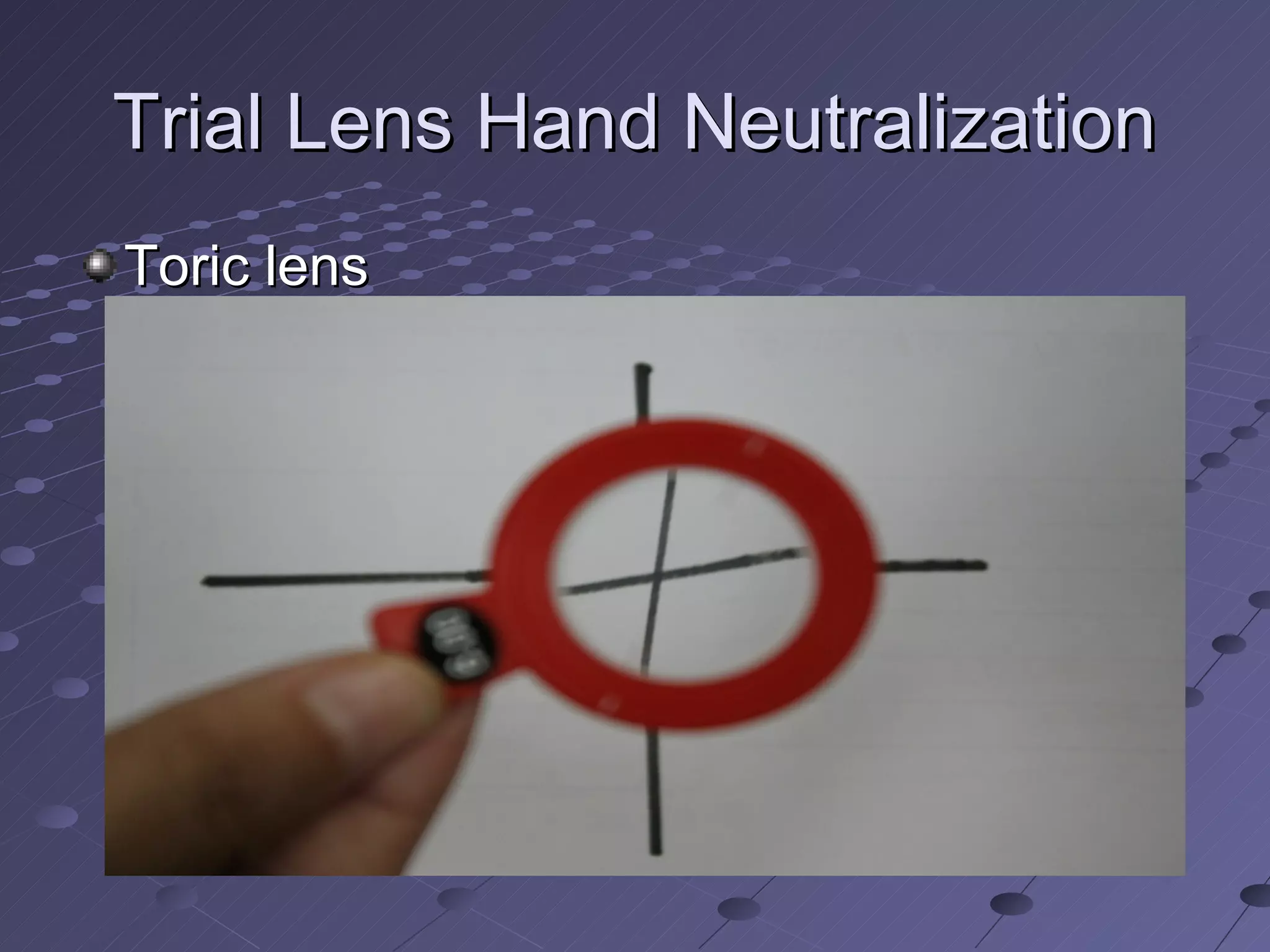
For a toric lens, rotational motion is used
to find the axis
   If observe “against motion,” use plus cylinder
    axis
   If observe “with motion,” use minus cylinder
    axis
Trial Lens Hand Neutralization
For a toric lens, rotational motion is used to find
the axis
Trial Lens Hand Neutralization
Place known trial lens against front surface of
unknown lens
No movement indicates neutrality
A minus or plus lens (i.e., a spherical lens) has
the same speed and direction of motion in both
the vertical and horizontal meridians
In the case of a toric lens (i.e., spherocylindrical
lens), neutralize one limb of the cross target at a
time
Trial Lens Hand Neutralization
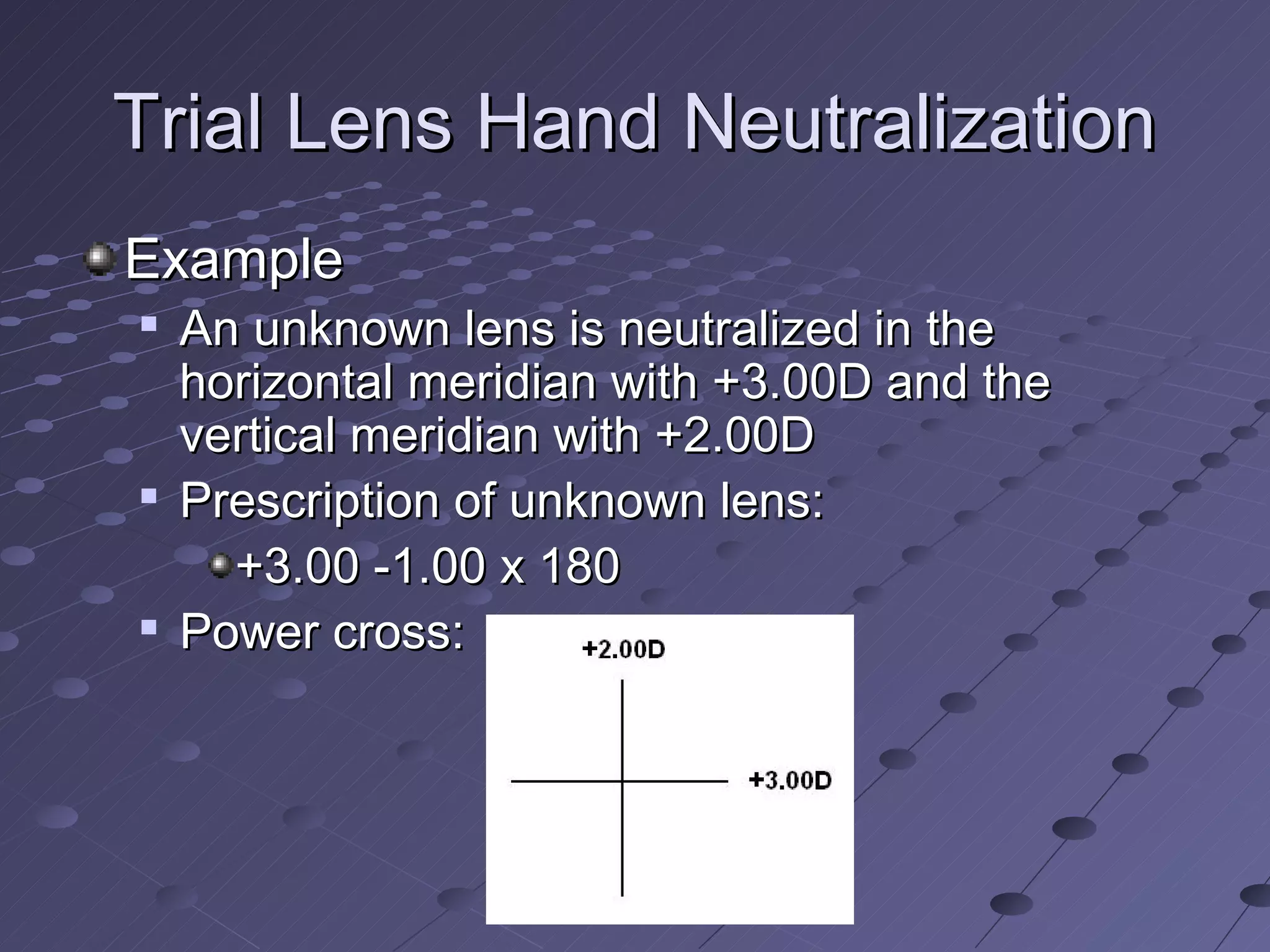
Example
   An unknown lens is neutralized in the
    horizontal meridian with +3.00D and the
    vertical meridian with +2.00D
   Prescription of unknown lens:
      +3.00 -1.00 x 180
   Power cross:
Trial Lens Hand Neutralization
Large distant cross target
Trial Lens Hand Neutralization
Plus lens
Trial Lens Hand Neutralization
Minus lens
Trial Lens Hand Neutralization
Toric lens
Lensometry
Definition

    “Lenso” = lens
   “metry” = measurement of
Lensometer
Lensometer Purpose
Neutralizing a pair of glasses

    To determine the prescription
Verifying a pair of glasses
   To confirm the accuracy of fabricated glasses
Duplicating a pair of glasses
   To determine the prescription, and the lab
    duplicates the exact prescription
Lensometer
It is used to measure the back vertex
power or front vertex power of the lens
Lensometer
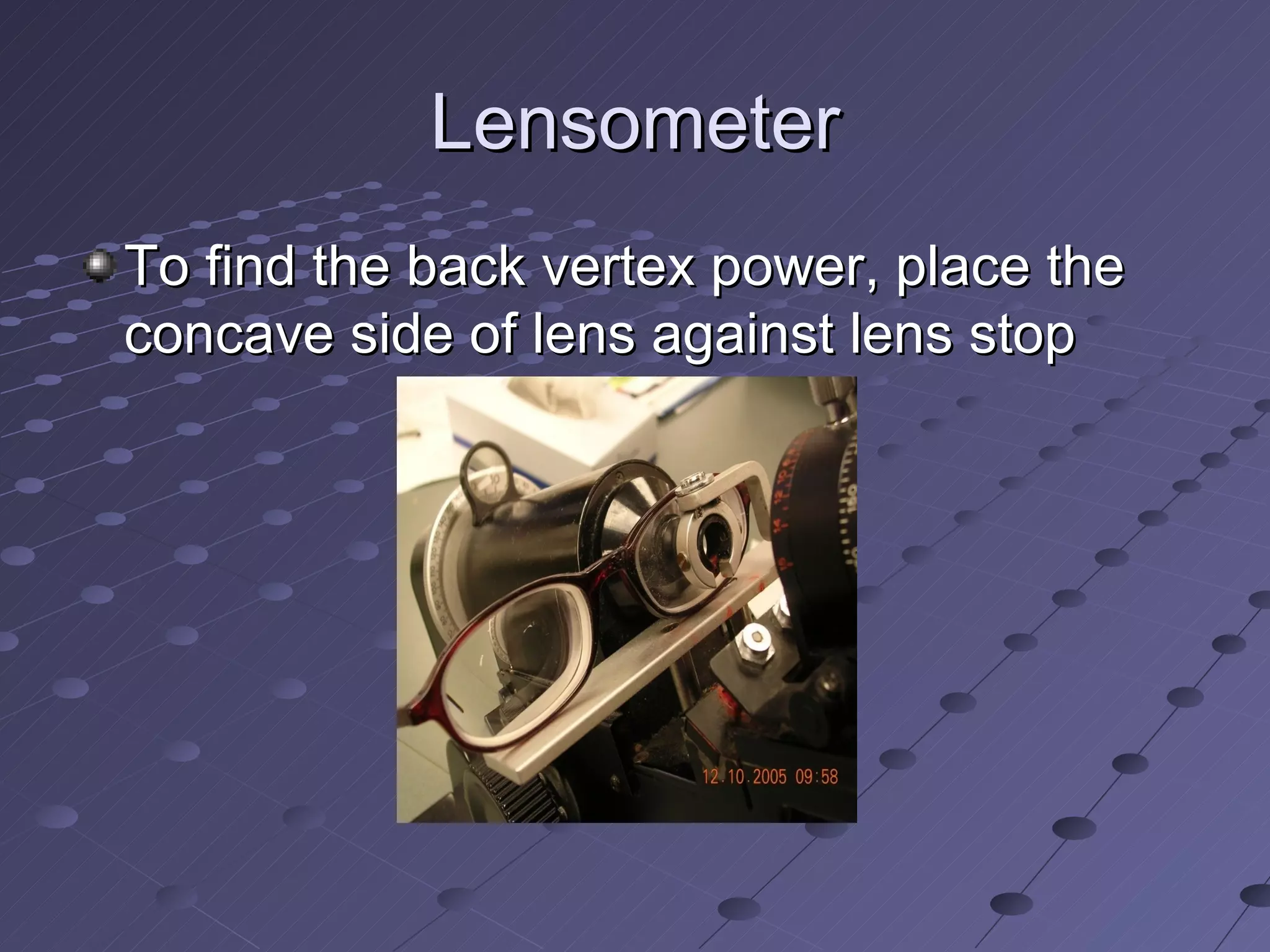
To find the back vertex power, place the
concave side of lens against lens stop
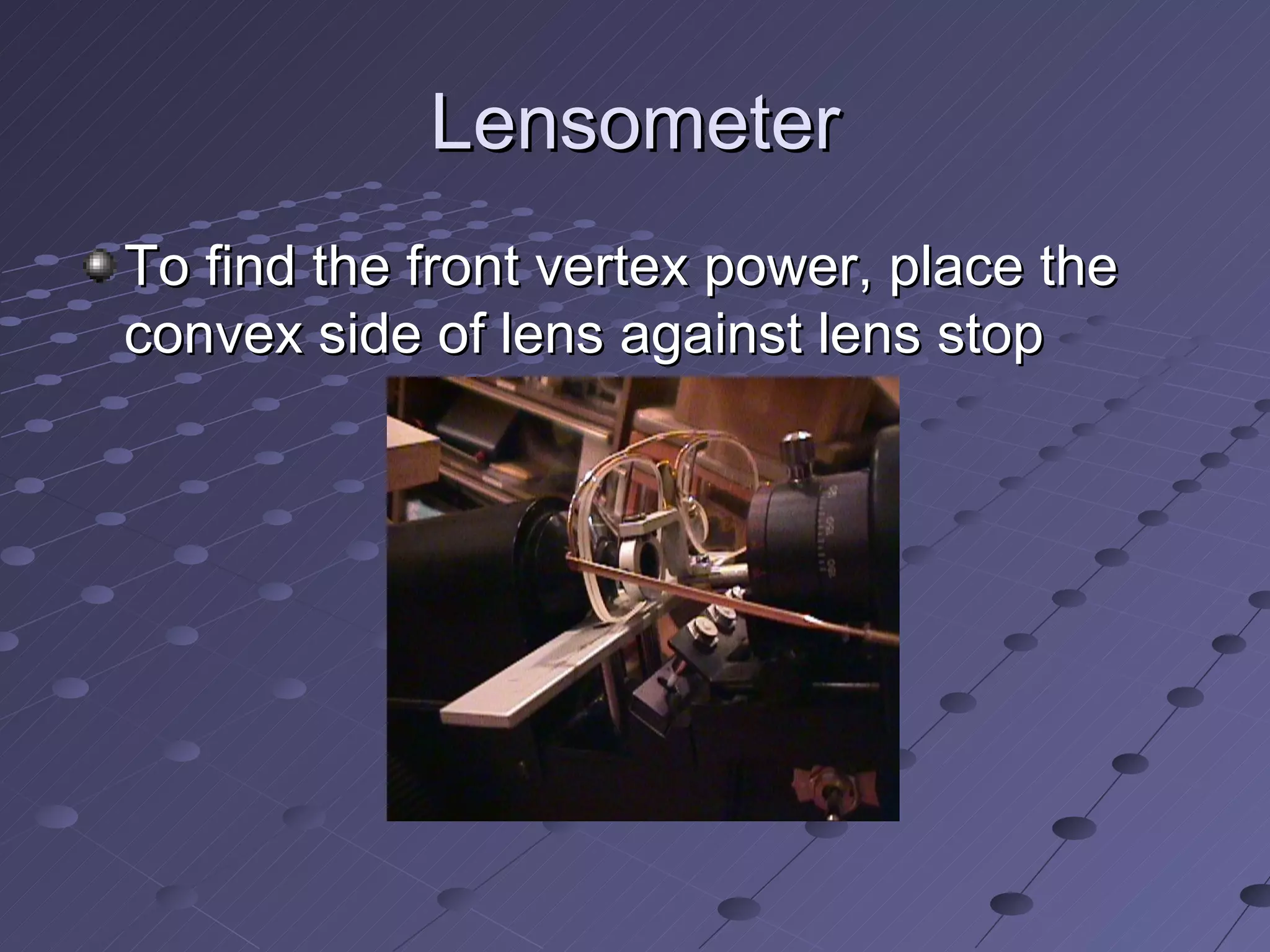
Lensometer
To find the front vertex power, place the
convex side of lens against lens stop
Lensometer
In the case that the lens is a sphero-
cylindrical prescription, the lensometer is
used to determine the cylinder axis
It is used to locate the optical center of the
lens
The lensometer is used to measure the
amount of prism in the lens
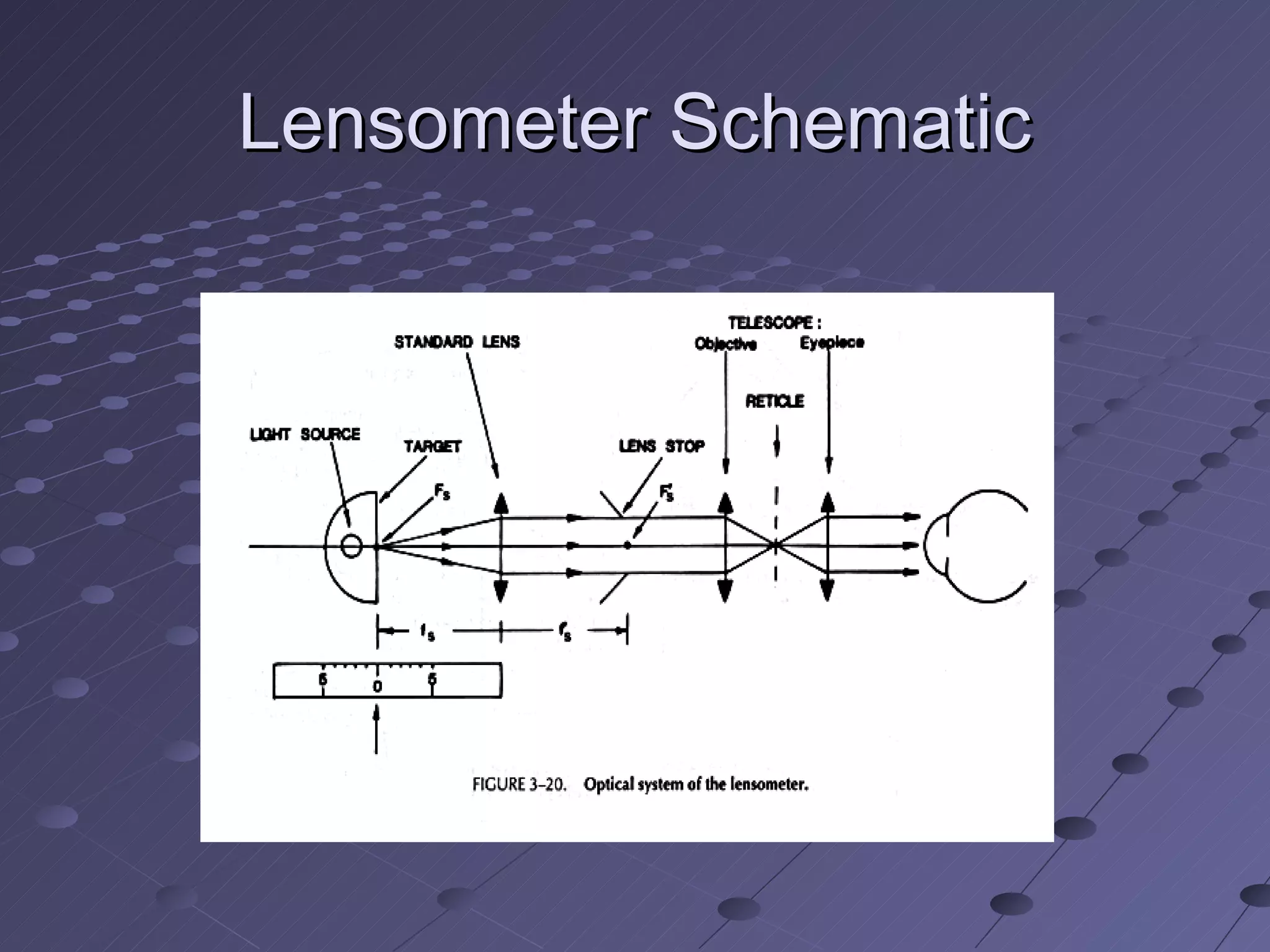
Lensometer Systems
Observation system (Keplerian telescope
with two plus lenses, an inverted target
image)
   Objective lens
   Eyepiece (ocular lens)
   Reticle (concentric circles and cross hairs
    focused by eyepiece)
Lensometer Systems
Focusing system (Badal lens system)
   Light source

    Target (cross hairs)

    Standard lens (+20.00D)

    Lens stop
   Power wheel
Lensometer Schematic
Observation System
The Keplerian telescope consists of an
objective lens, an eyepiece, and a reticle
The two plus lenses are positioned so that
their two focal points coincide with each
other
The unknown lens whose power is to be
measured or neutralized is positioned at
the lens stop (the location of the
secondary focal plane of the standard
lens)
Lensometer Operation
With the instrument set at zero, an
illuminated target (light source) is
positioned at the focal length of a plus lens
(standard lens) usually a +20.00D lens
Diverging rays of light from the illuminated
target are bent by the standard lens and
parallel light emerges from focusing
system into the observation system, which
is viewed through the telescope by the
observer
Lensometer Operation
When the lens of unknown power is
introduced, the image of the illuminated
target is thrown out of focus
Lensometer Operation
The target is movable
By moving the target closer to or farther
from the standard lens, the refractive
power of the unknown lens can be
neutralized

    Closer to standard lens for plus lens
    neutralization
   Farther from standard lens for minus lens
    neutralization
Lensometer Operation
The physical distance forward or
backward that the target moves indicates
the power of unknown lens for the
meridian being measured
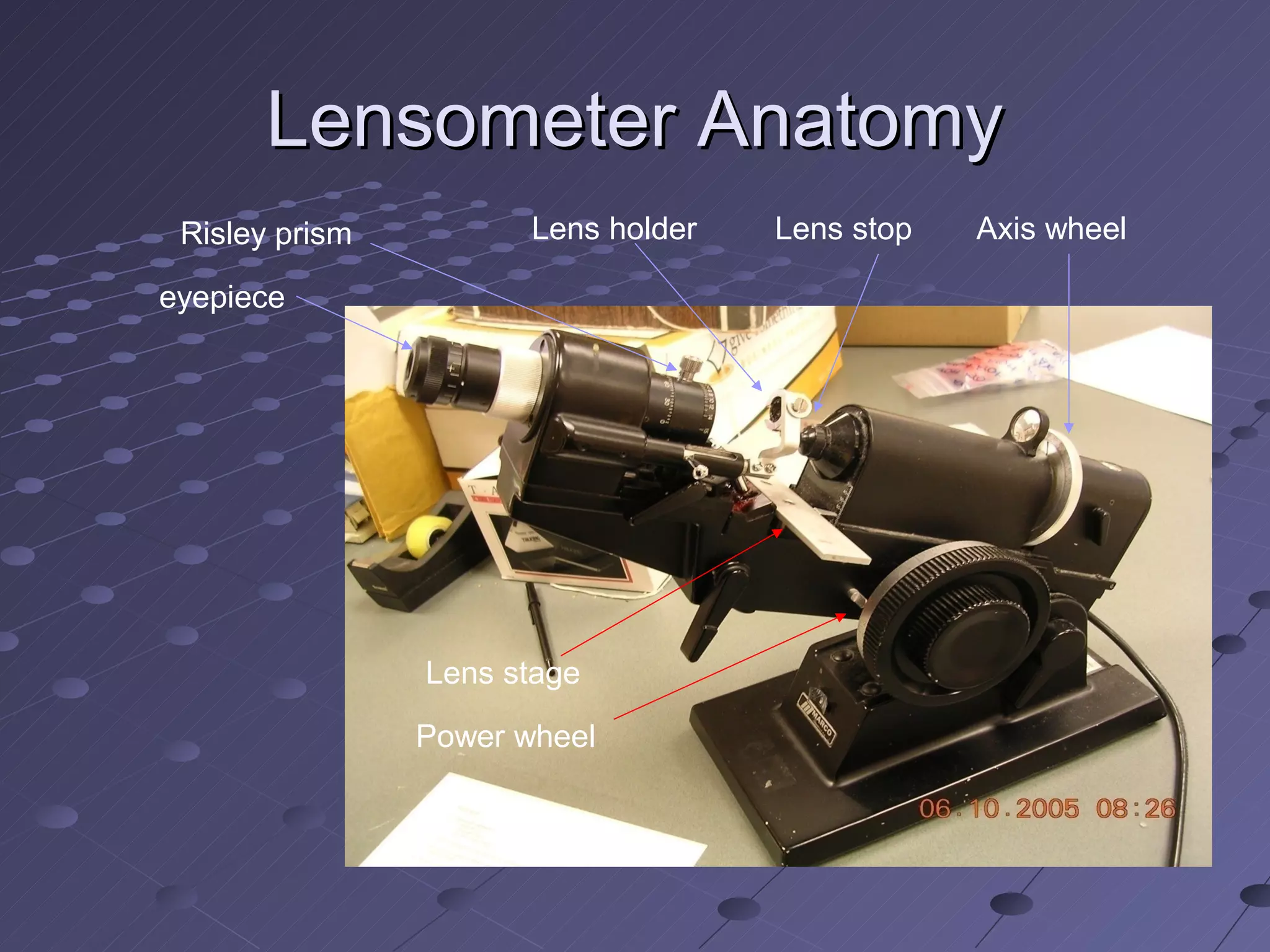
Lensometer Anatomy
 Risley prism          Lens holder   Lens stop   Axis wheel

eyepiece


                Lens stage

                Power wheel
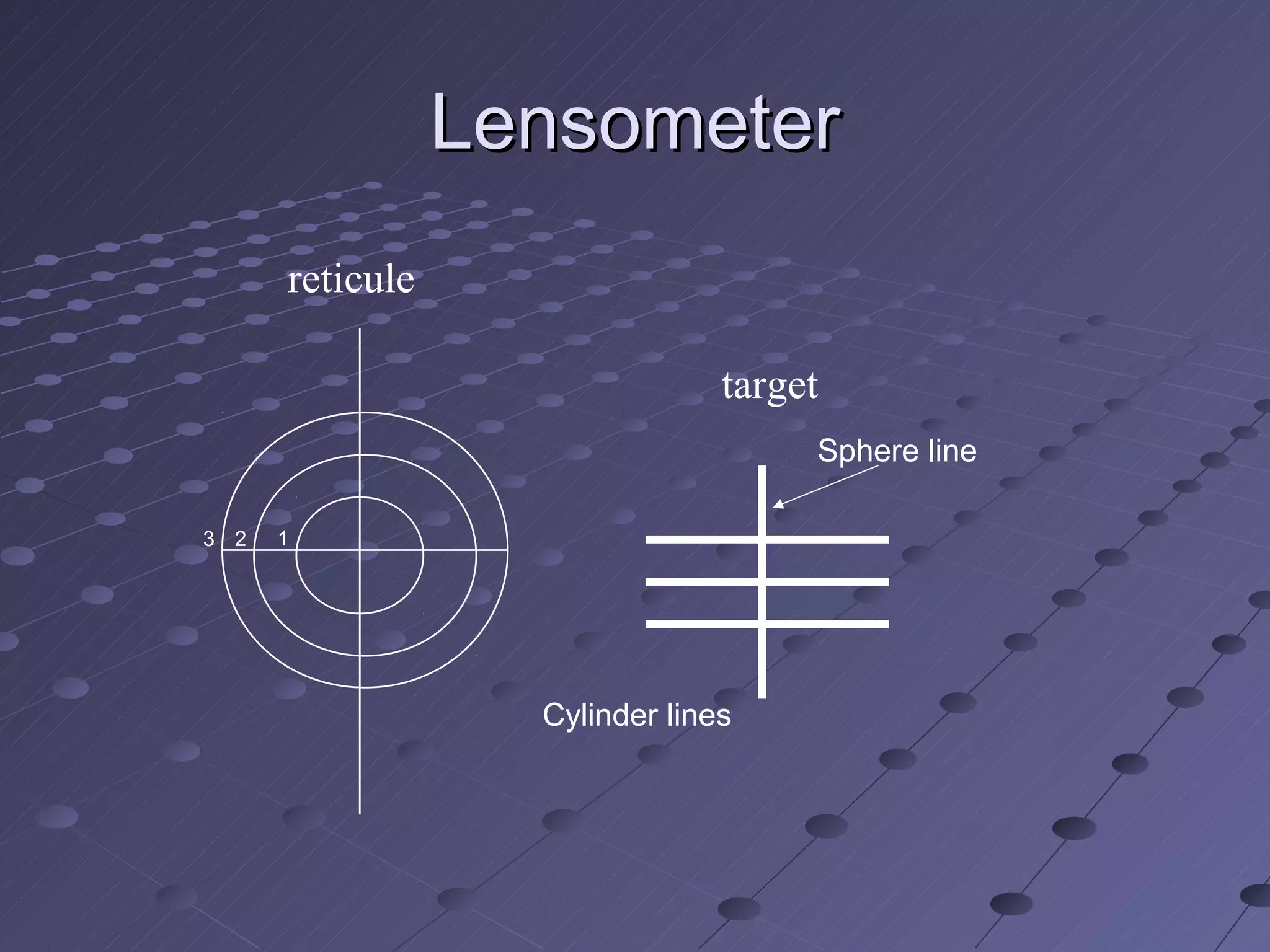
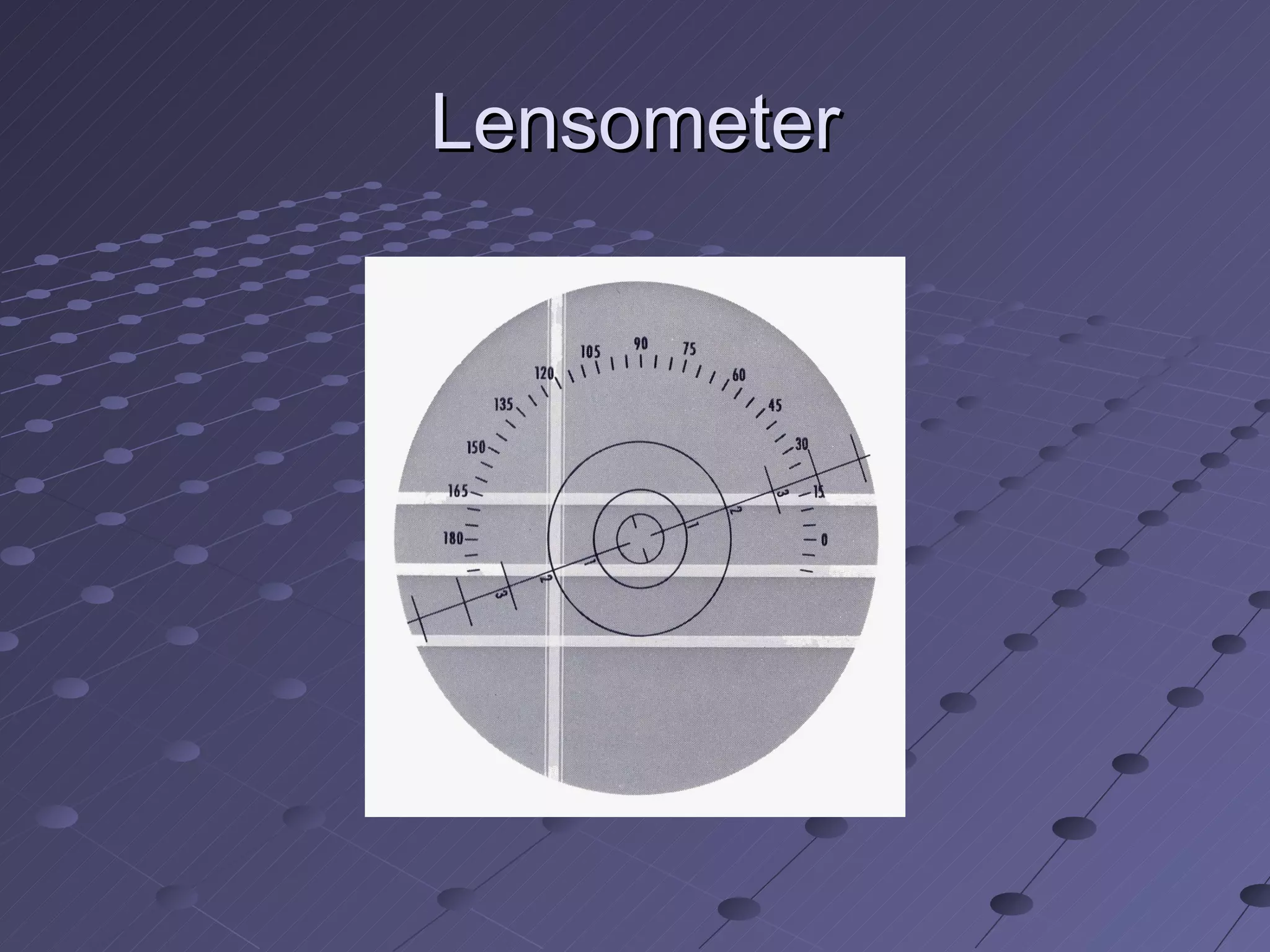
Lensometer
      reticule

                                target
                                     Sphere line

3 2   1


                   Cylinder lines
Lensometer
Lensometer Preparation
Focus the eyepiece of the lensometer for
the examiner’s eye
   With the power wheel set on zero, turn the
    eyepiece as far counter-clockwise as possible
   Then slowly turn it clockwise until the reticule
    first comes into sharp focus
Lens Measurement Preparation
Insert the spectacles
 
     If testing a pair of glasses, always check the
     right lens first
    Place the pair of glasses in the lensometer
     with the ocular surface away from you
 
     The lens is held in place by the lens holder
     and is held level on the lens table
    Center the lens by moving it so that the image
     of the lensometer target is aligned in the
     center of the eyepiece reticle
Single Vision Lens
         Measurement
To measure single vision lenses, either
back vertex powers or front vertex powers
must be found
Single Vision Lens
          Measurement
Determine which part of the target is used
for determining the spherical component
and which part of the target is used for
determining the cylindrical component
Rotate the power wheel until the lines (or
the spots) are in clear focus
If the power is spherical, all the lines (or
spots) will be clear
Note the power on the power wheel
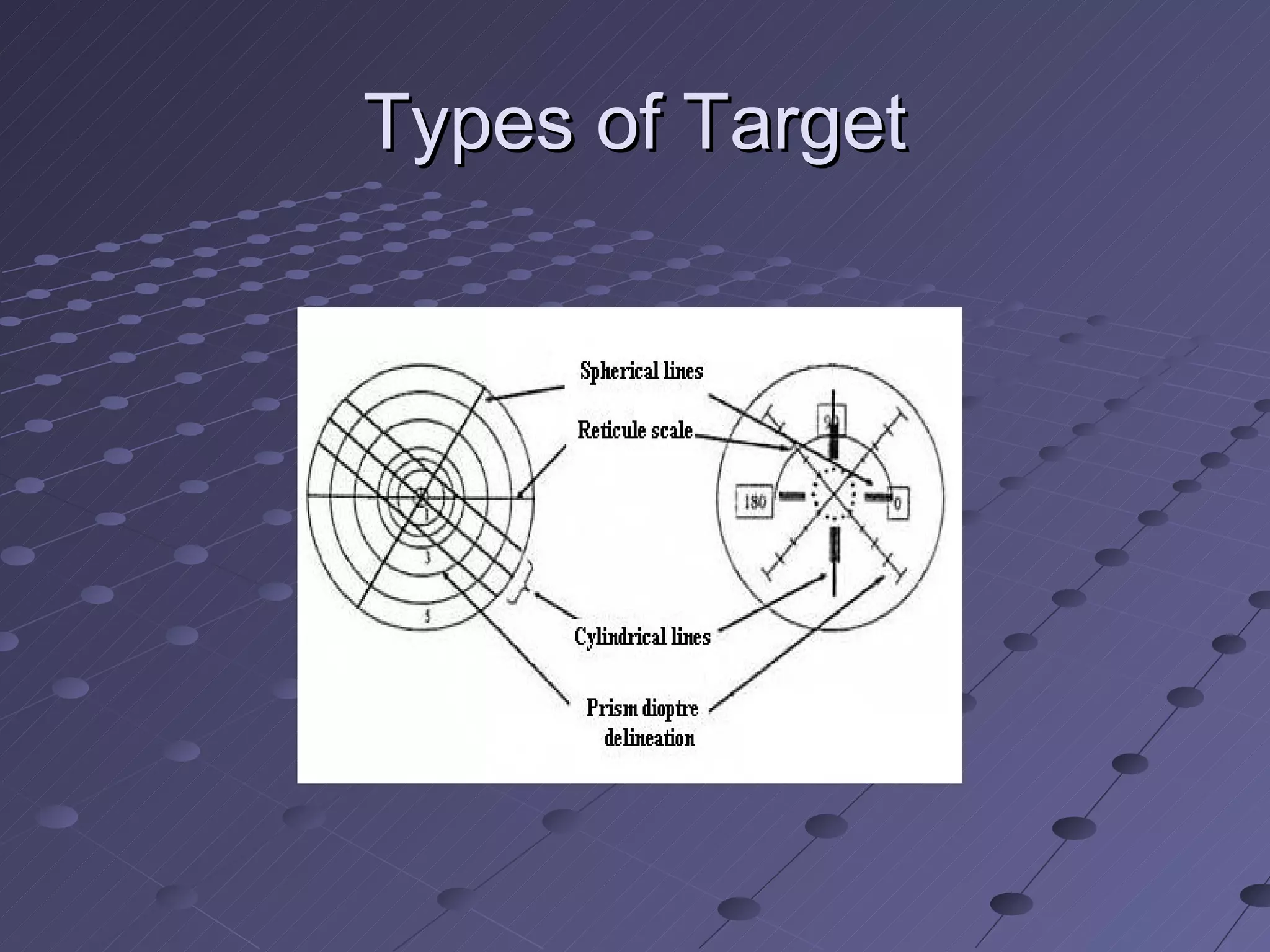
Types of Target
Single Vision Lens
          Measurement
If the spherical and cylindrical lines do not
come into focus at the same time, the lens
has a cylindrical component
Rotate the power wheel until the spherical
lines focus with the less minus (or more
plus) power
Orient the target rotation dial (axis wheel)
so that the spherical lines are perfectly
straight
Single Vision Lens
         Measurement
Read the power and record as the
spherical component of the prescription
Focus the cylindrical lines by rotating the
power wheel to more minus (or less plus)
power (90 degrees away)
The difference in power between the two
principal meridians is the amount of
minus cylinder power in the lens
Read the axis of the cylinder from the axis
wheel
Single Vision Lens
           Measurement
Example

    +1.00 -2.00 x 120
   Power wheel sphere setting
Single Vision Lens
            Measurement
Example

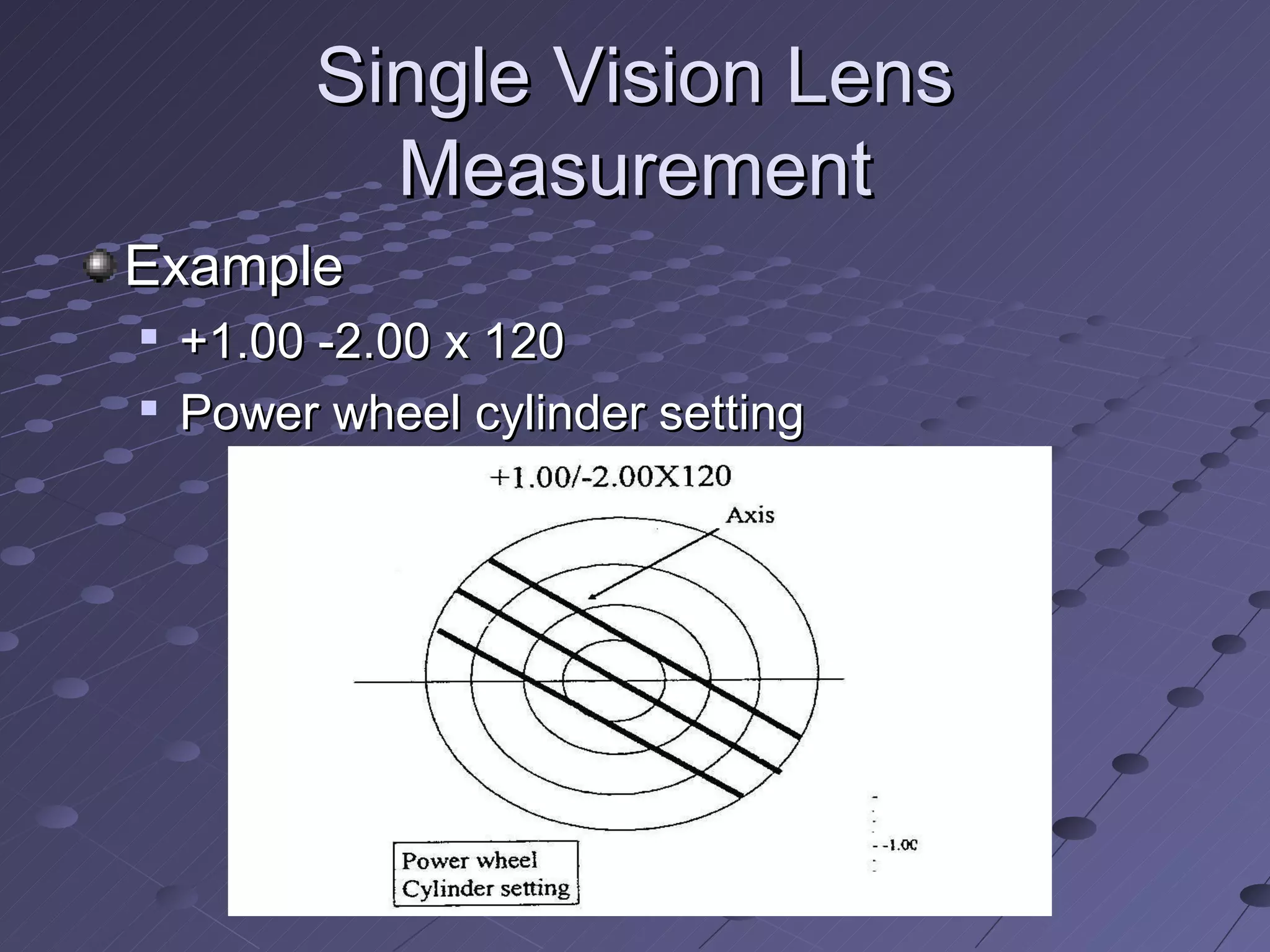
    +1.00 -2.00 x 120
   Power wheel cylinder setting
Single Vision Lens
            Measurement
Mark the optical center (OC)
   Make sure that the lens is centered and the
    spectacle is sitting on the lens table evenly
   Use the OC marker on the lensometer to spot
    the lens
   Three dots will be marked
      The center dot marks the OC
      The other two dots indicate the 0 to 180 horizontal
      line
Position and read the second lens
Single Vision Lens
         Measurement
When both lenses have been measured
and marked, measure the distance
between optical centers of the lenses
(DBOC or geometric center distance)
Multifocal Lens Measurement
To measure bifocal and trifocal lenses,
front vertex powers must be found
   This is especially true for lenses with high
    distance and near powers
   Again, front vertex power is measured by
    turning spectacles around with back surface
    of the lens toward the operator (i.e., the
    convex side of the lens against the lens stop)
Multifocal Lens Measurement
Measure the distance portion of multifocal
lenses, in the same way as with single vision
lenses
Turn the glasses around backward so that the
temples face the operator
Find the distance front vertex power
Find the near front vertex power
Record the addition power (Add), which is the
difference between the distance and near
prescriptions
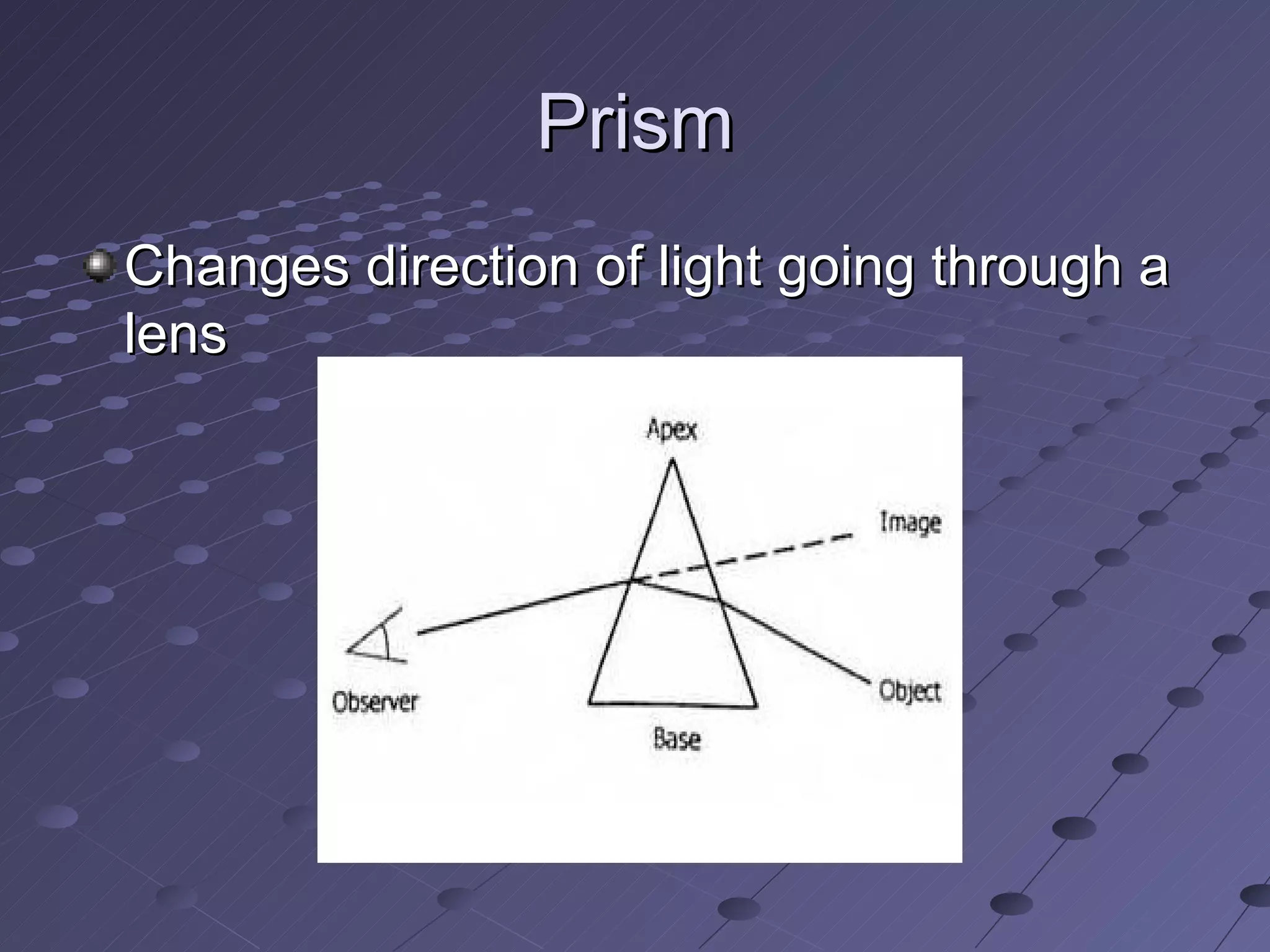
Prism
Changes direction of light going through a
lens
Prism Purpose
To treat a binocular vision problem
To shift the visual field
To improve the lens appearance through
prism thinning
Prism
It is often divided equally between the two
lenses of spectacles for balance and
aesthetic reasons
Types of Prism
Horizontal prism
   Base in (BI)
   Base out (BO)
Vertical prism
   Base up (BU)
   Base down (BD)
Oblique prism
   A combination of horizontal and vertical
    prisms
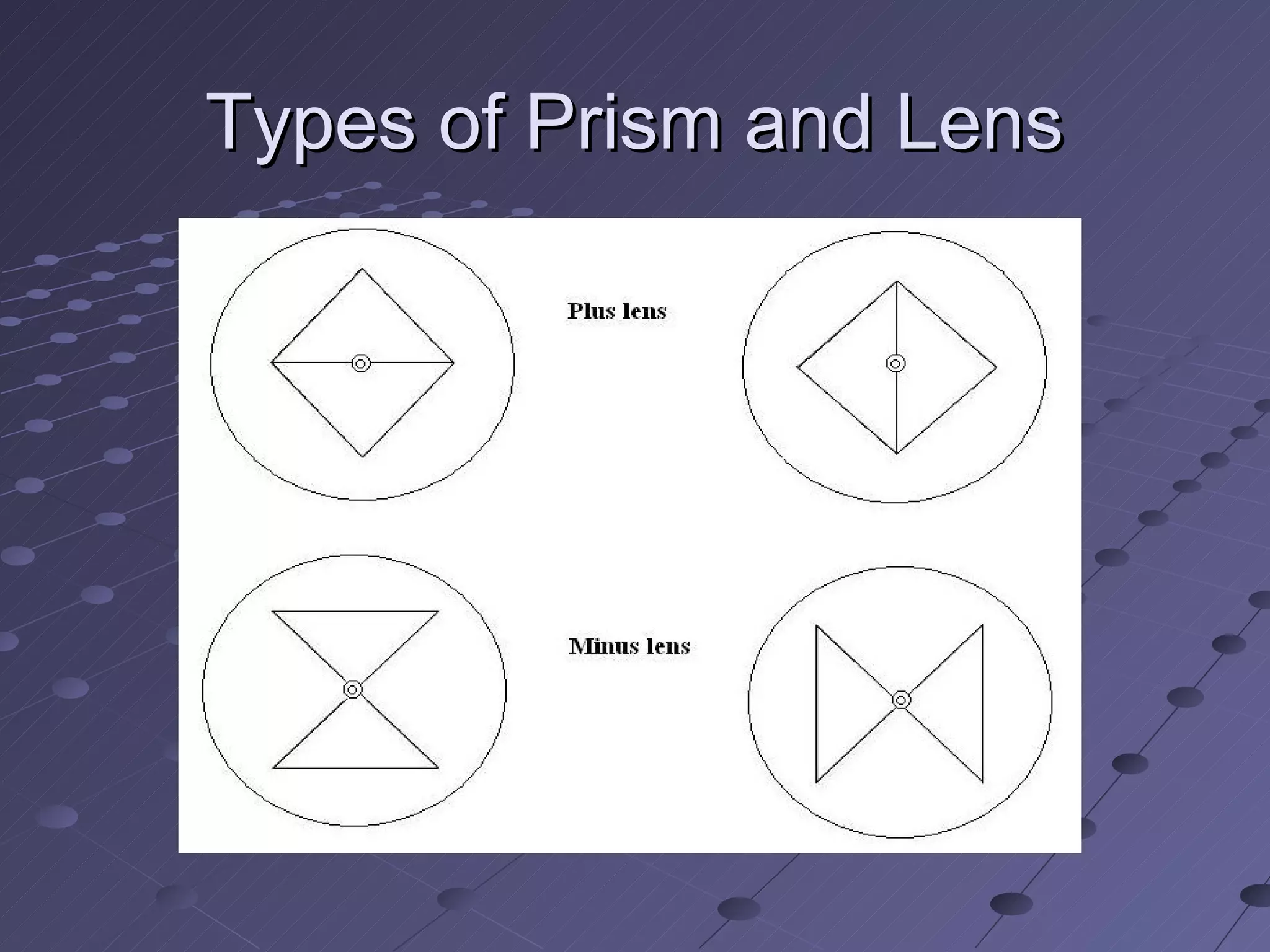
Types of Prism and Lens
Methods of Achieving Prism in
            Lens
Grinding

    Usually applied when a large amount of prism is
    required

    Lens is custom-made
   Optic center is often not on lens
Decentration
   Usually applied when a small amount of prism is
    required

    With spherical prescription, it is easier to deal with
    decentering than with spherocylindrical prescription
Prism Measurement
The purpose is to verify if the prescription
contains the desired prismatic effect
Verification of prism in prescription is done
similarly to measurement of lens power
using the lensometer
The only difference is in the means by
which the target is positioned in the
lensometer
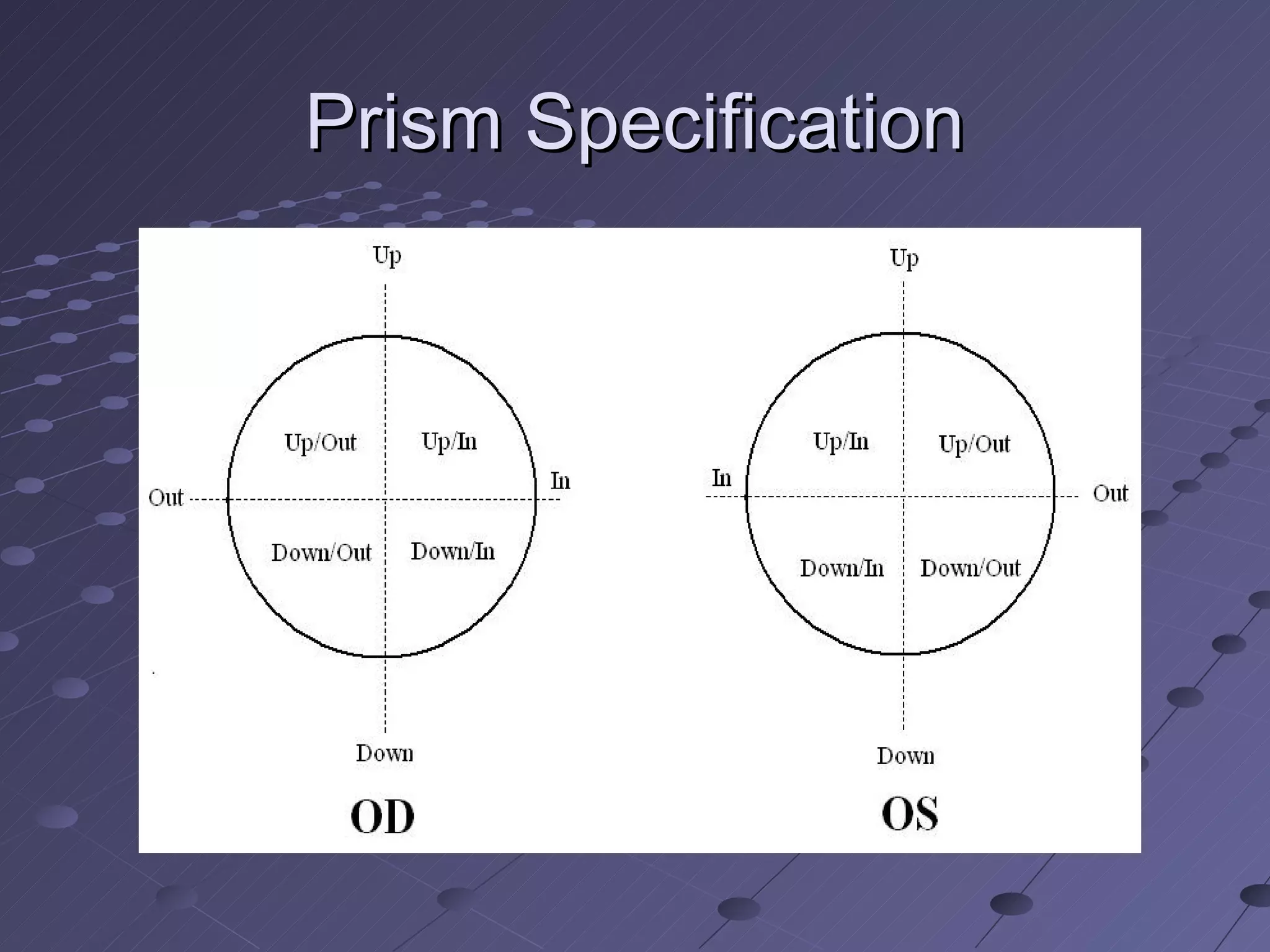
Prism Specification
Prism Verification
To verify the prescribed prism when the
amount of prism is known
   The center of the illuminated target is
    positioned at the location on the circular mires
    corresponding to the prism required
Prism Verification
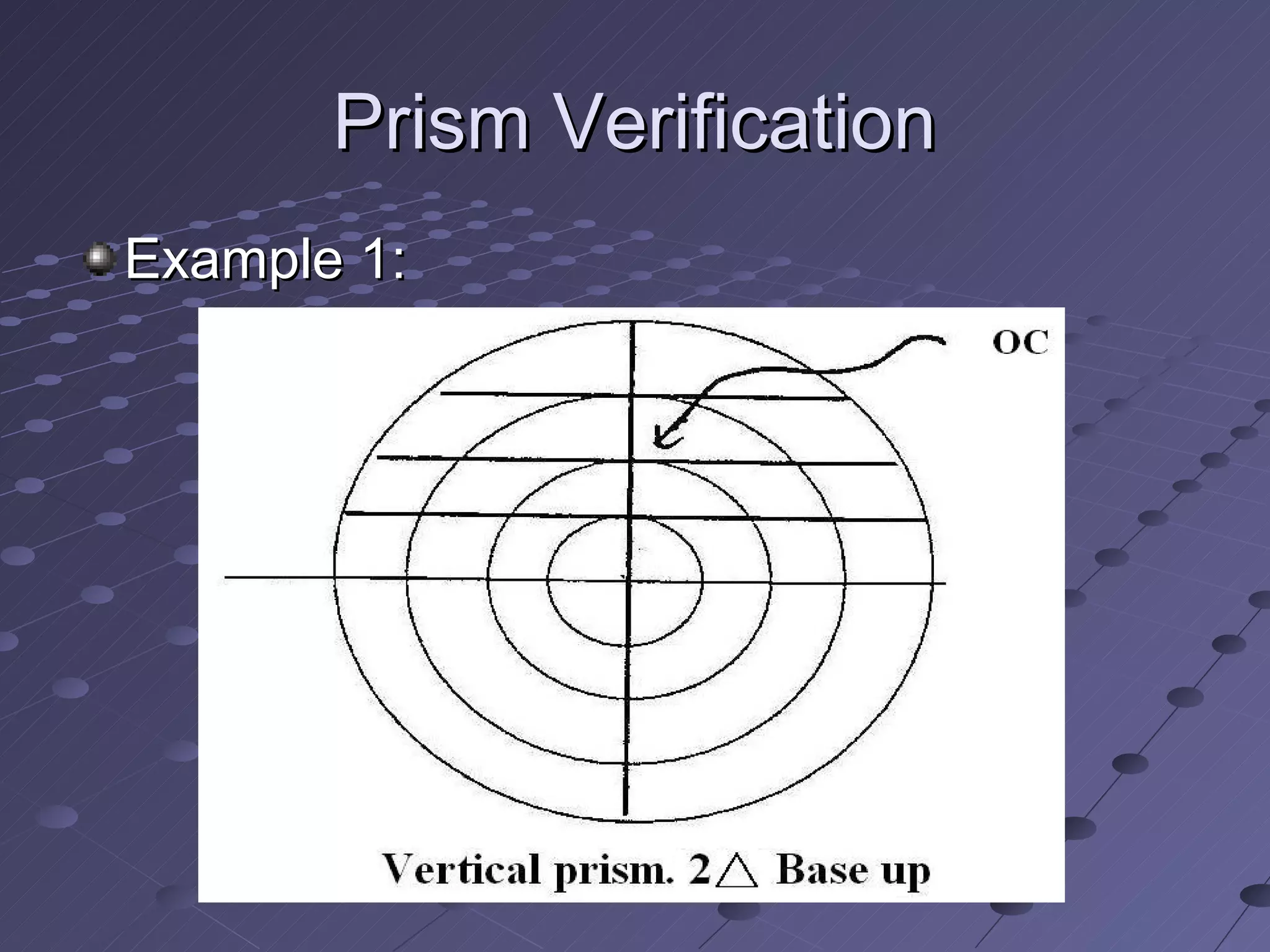
Example 1:

    If the right lens calls for 2 prism diopter BU,
    then the illuminated target would be
    positioned at the “2” ring above the center of
    the mires
Prism Verification
Example 1:
Prism Verification
Example 2:
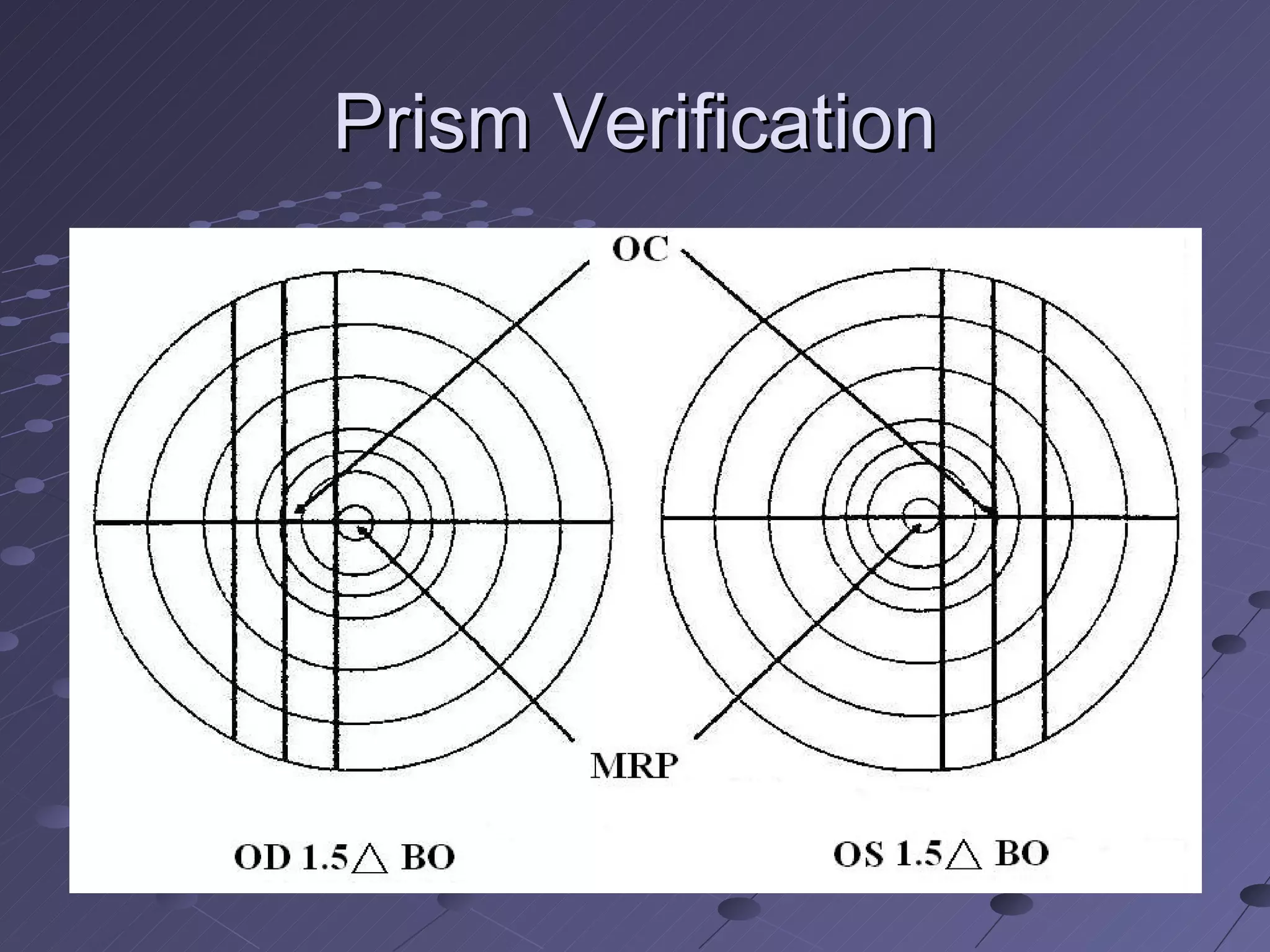
   If both lenses contain 1.5 prism diopter BO,
    then the target would be placed at the 1.5 ring
    to the left of the center of the mires for the OD
    lens and to the right of the center of the mires
    for the OS lens
   Mark the major reference point (MRP) with the
    OC marker and measure the distance
    between the MRP of the lenses (i.e, the
    patient’s distance PD)
Prism Verification
Example 2:
Prism Measurement
In an unknown lens

    Patient may come in with a prescription that
    you are not sure if it contains prism in the
    lenses
   After power of the lenses are neutralized and
    the optic centers are marked, measure the
    distance between the optic centers (DBOC)

    If DBOC does not equal to the patient’s
    distance PD, then there is prism in the lens
Prentice’s Rule
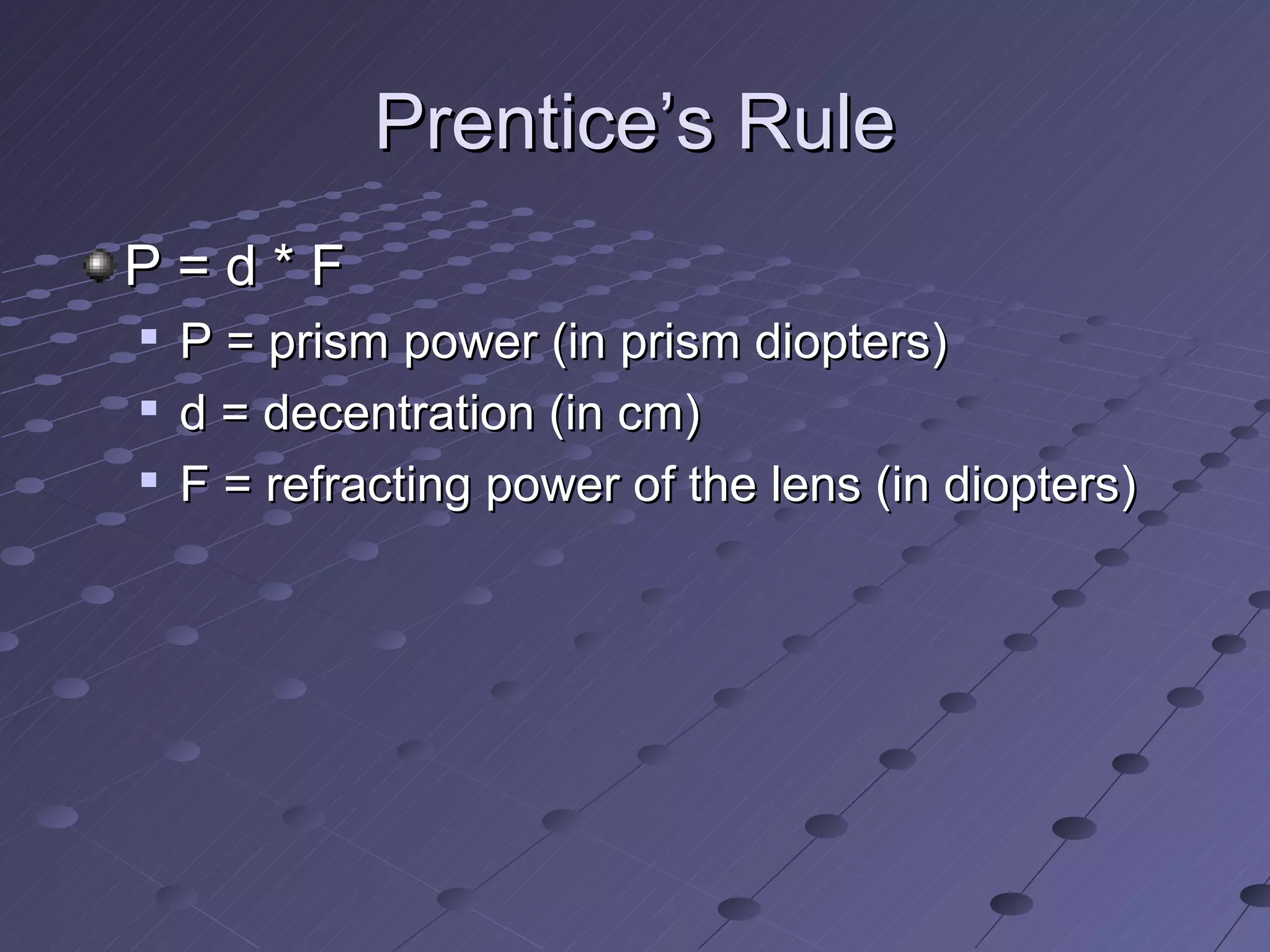
P=d*F

    P = prism power (in prism diopters)
   d = decentration (in cm)
   F = refracting power of the lens (in diopters)
Prentice’s Rule
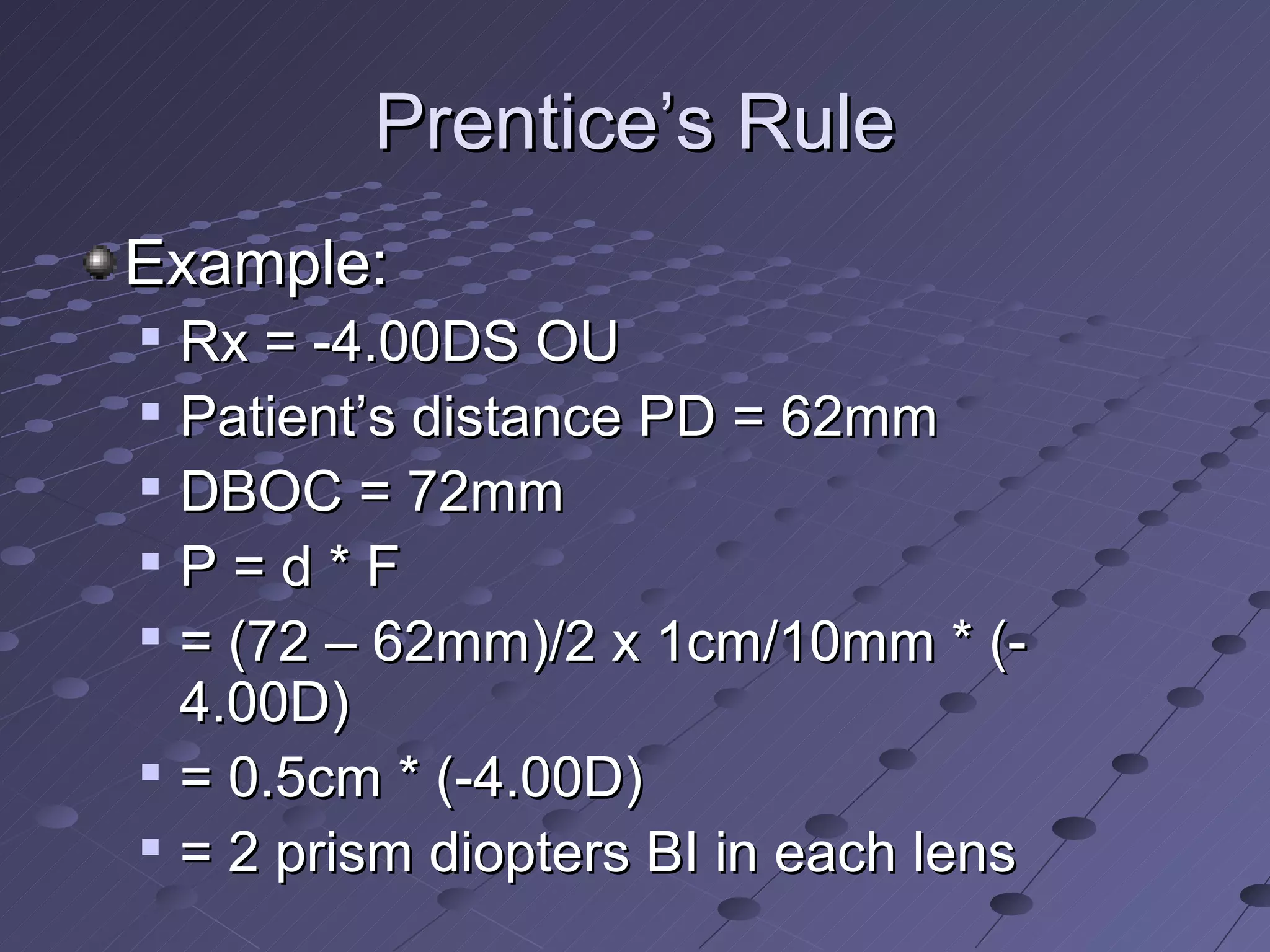
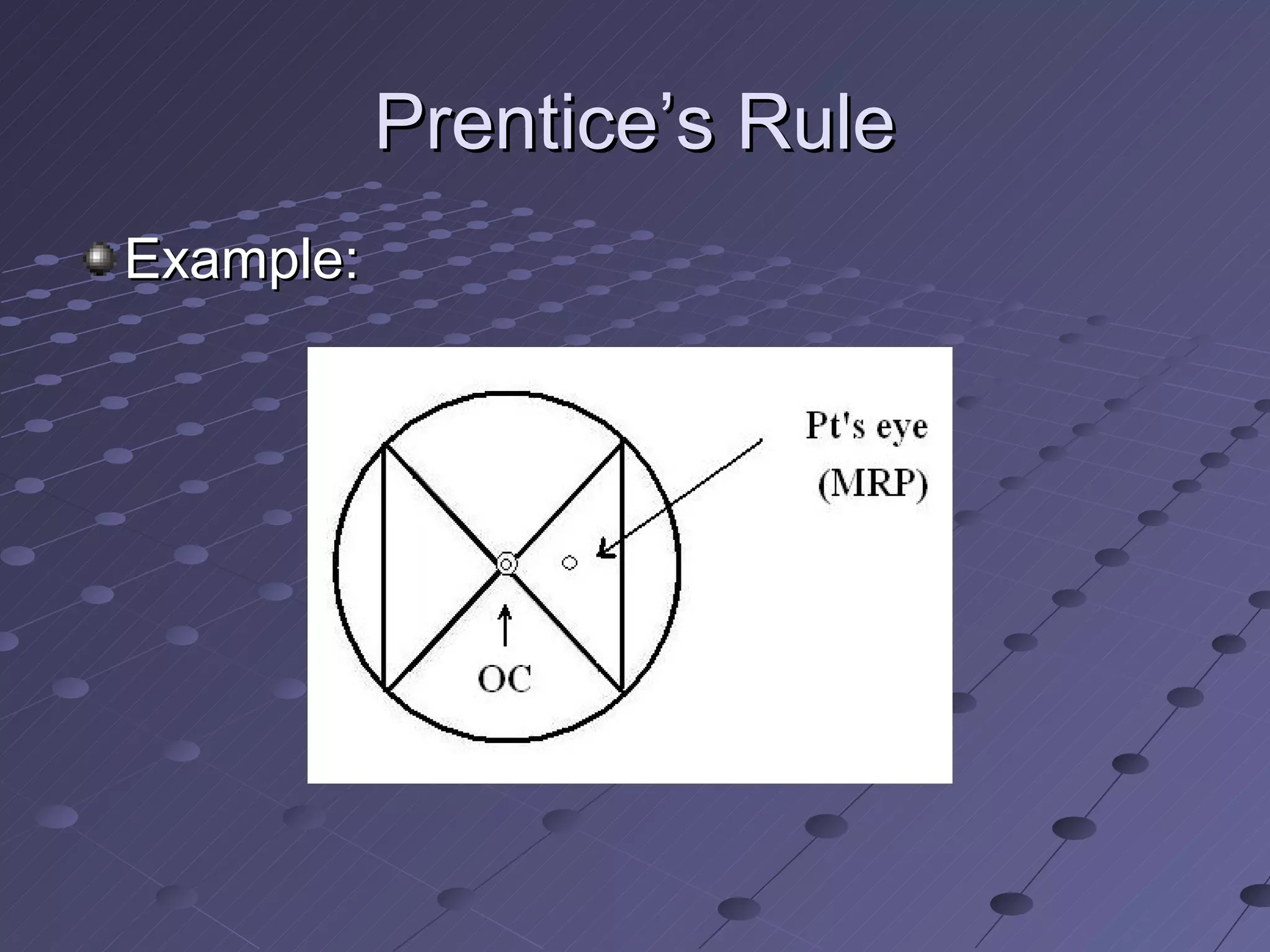
Example:
   Rx = -4.00DS OU
   Patient’s distance PD = 62mm
   DBOC = 72mm

    P=d*F

    = (72 – 62mm)/2 x 1cm/10mm * (-
    4.00D)
   = 0.5cm * (-4.00D)
   = 2 prism diopters BI in each lens
Prentice’s Rule
Example:
Recording
Record the prescription for each lens
separately
Record the amount of induced prism in
each lens, if applicable
Recording
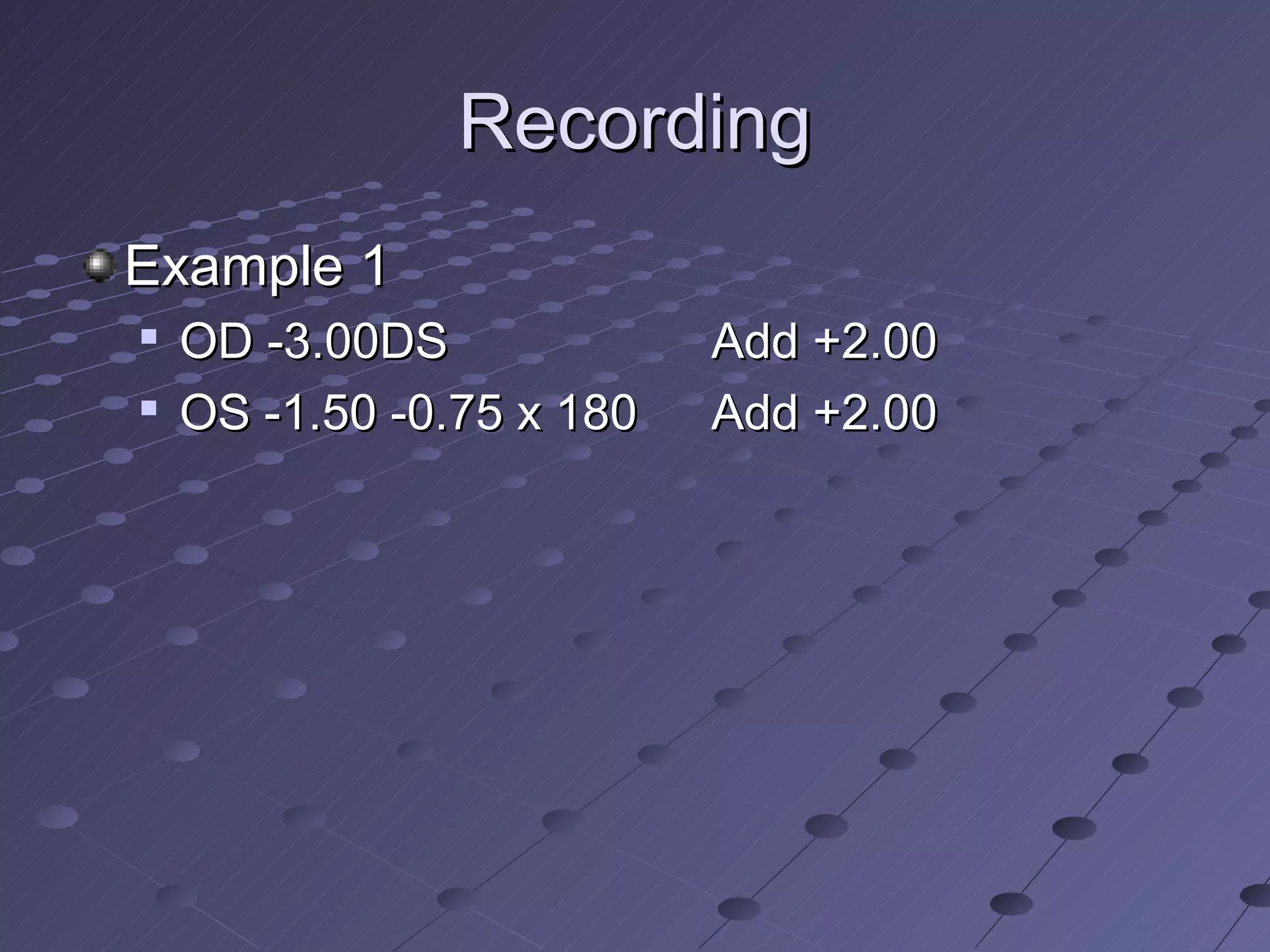
Example 1

    OD -3.00DS             Add +2.00
   OS -1.50 -0.75 x 180   Add +2.00
Recording
Example 2

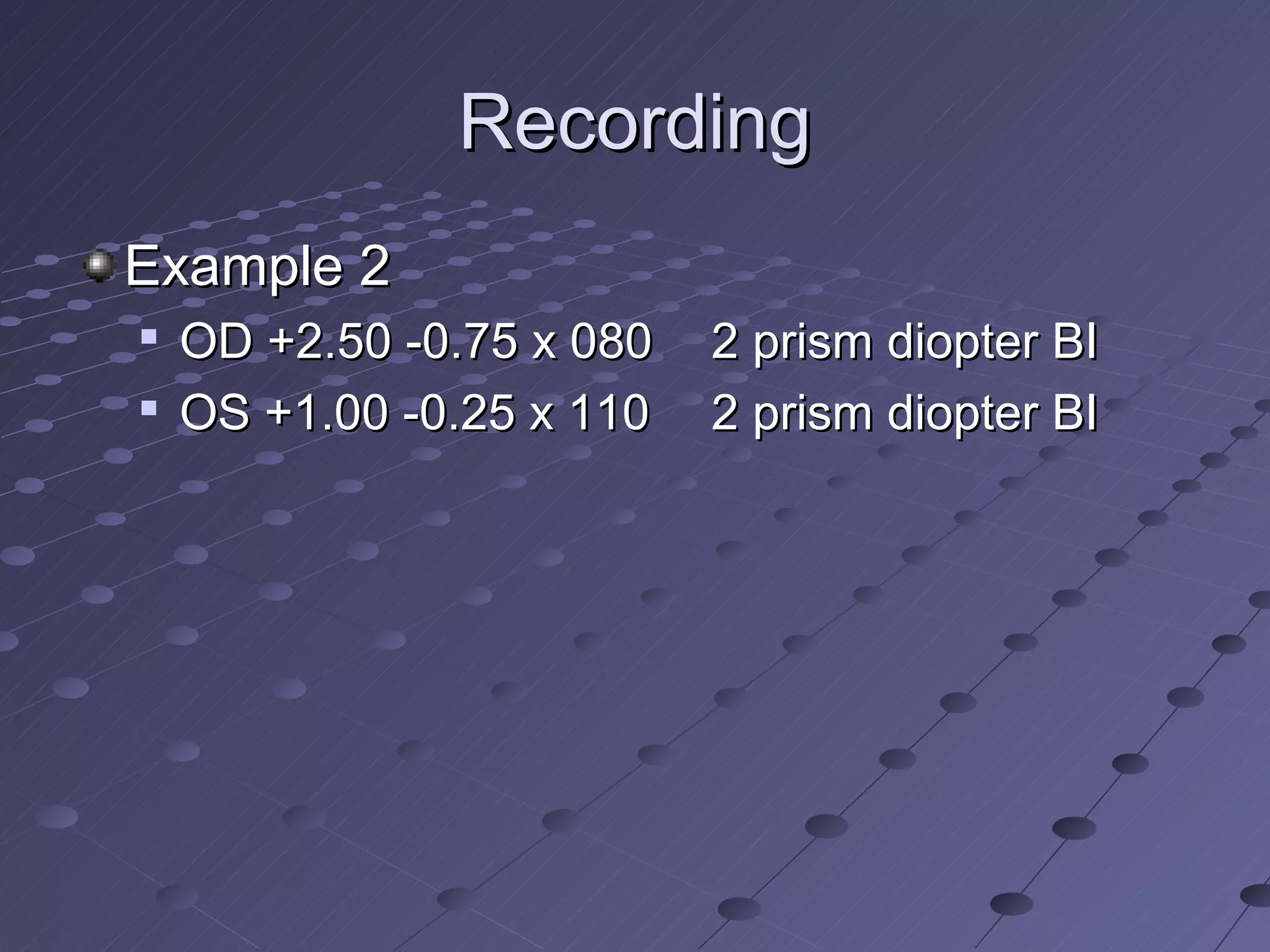
    OD +2.50 -0.75 x 080   2 prism diopter BI
   OS +1.00 -0.25 x 110   2 prism diopter BI

Lens power measurement

  • 1.
    Lens Power Measurement Walter Huang, OD Yuanpei University Department of Optometry
  • 2.
    Methods of LensPower Measurement Trial lens hand neutralization Lensometer  Much greater accuracy may be obtained with the lensometer than with trial lens hand neutralization
  • 3.
    Trial Lens HandNeutralization Two lenses neutralize each other when placed in contact with each other so that the combined power of the two lenses is equal to zero An unknown lens is neutralized by a known trial lens of equal power but opposite in sign
  • 4.
    Trial Lens HandNeutralization
  • 5.
    Trial Lens HandNeutralization This is performed in the absence of a lensometer It is used qualitatively as a means for estimation in many clinical and dispensing situations It often involves simply identifying if it is a plus, a minus, or a toric lens It more accurately estimates low power plus and minus lenses than toric lenses
  • 6.
    Trial Lens HandNeutralization It is used to measure the front vertex power of the lens
  • 7.
    Trial Lens HandNeutralization View a large distant cross target through the lens Hold lens on visual axis, at arm’s distance Align lens such that the cross target is continuous Move lens vertically, observe motion of horizontal line Move lens horizontally, observe motion of vertical line
  • 8.
    Trial Lens HandNeutralization For a plus or a minus lens, linear motion is used to neutralize power  If observe “against motion,” use plus lens  If observe “with motion,” use minus lens
  • 9.
    Trial Lens HandNeutralization For a plus or a minus lens, linear motion is used to neutralize power
  • 10.
    Trial Lens HandNeutralization For a toric lens, rotational motion is used to find the axis  If observe “against motion,” use plus cylinder axis  If observe “with motion,” use minus cylinder axis
  • 11.
    Trial Lens HandNeutralization For a toric lens, rotational motion is used to find the axis
  • 12.
    Trial Lens HandNeutralization Place known trial lens against front surface of unknown lens No movement indicates neutrality A minus or plus lens (i.e., a spherical lens) has the same speed and direction of motion in both the vertical and horizontal meridians In the case of a toric lens (i.e., spherocylindrical lens), neutralize one limb of the cross target at a time
  • 13.
    Trial Lens HandNeutralization Example  An unknown lens is neutralized in the horizontal meridian with +3.00D and the vertical meridian with +2.00D  Prescription of unknown lens: +3.00 -1.00 x 180  Power cross:
  • 14.
    Trial Lens HandNeutralization Large distant cross target
  • 15.
    Trial Lens HandNeutralization Plus lens
  • 16.
    Trial Lens HandNeutralization Minus lens
  • 17.
    Trial Lens HandNeutralization Toric lens
  • 18.
    Lensometry Definition  “Lenso” = lens  “metry” = measurement of
  • 19.
  • 20.
    Lensometer Purpose Neutralizing apair of glasses  To determine the prescription Verifying a pair of glasses  To confirm the accuracy of fabricated glasses Duplicating a pair of glasses  To determine the prescription, and the lab duplicates the exact prescription
  • 21.
    Lensometer It is usedto measure the back vertex power or front vertex power of the lens
  • 22.
    Lensometer To find theback vertex power, place the concave side of lens against lens stop
  • 23.
    Lensometer To find thefront vertex power, place the convex side of lens against lens stop
  • 24.
    Lensometer In the casethat the lens is a sphero- cylindrical prescription, the lensometer is used to determine the cylinder axis It is used to locate the optical center of the lens The lensometer is used to measure the amount of prism in the lens
  • 25.
    Lensometer Systems Observation system(Keplerian telescope with two plus lenses, an inverted target image)  Objective lens  Eyepiece (ocular lens)  Reticle (concentric circles and cross hairs focused by eyepiece)
  • 26.
    Lensometer Systems Focusing system(Badal lens system)  Light source  Target (cross hairs)  Standard lens (+20.00D)  Lens stop  Power wheel
  • 27.
  • 28.
    Observation System The Kepleriantelescope consists of an objective lens, an eyepiece, and a reticle The two plus lenses are positioned so that their two focal points coincide with each other The unknown lens whose power is to be measured or neutralized is positioned at the lens stop (the location of the secondary focal plane of the standard lens)
  • 29.
    Lensometer Operation With theinstrument set at zero, an illuminated target (light source) is positioned at the focal length of a plus lens (standard lens) usually a +20.00D lens Diverging rays of light from the illuminated target are bent by the standard lens and parallel light emerges from focusing system into the observation system, which is viewed through the telescope by the observer
  • 30.
    Lensometer Operation When thelens of unknown power is introduced, the image of the illuminated target is thrown out of focus
  • 31.
    Lensometer Operation The targetis movable By moving the target closer to or farther from the standard lens, the refractive power of the unknown lens can be neutralized  Closer to standard lens for plus lens neutralization  Farther from standard lens for minus lens neutralization
  • 32.
    Lensometer Operation The physicaldistance forward or backward that the target moves indicates the power of unknown lens for the meridian being measured
  • 33.
    Lensometer Anatomy Risleyprism Lens holder Lens stop Axis wheel eyepiece Lens stage Power wheel
  • 34.
    Lensometer reticule target Sphere line 3 2 1 Cylinder lines
  • 35.
  • 36.
    Lensometer Preparation Focus theeyepiece of the lensometer for the examiner’s eye  With the power wheel set on zero, turn the eyepiece as far counter-clockwise as possible  Then slowly turn it clockwise until the reticule first comes into sharp focus
  • 37.
    Lens Measurement Preparation Insertthe spectacles  If testing a pair of glasses, always check the right lens first  Place the pair of glasses in the lensometer with the ocular surface away from you  The lens is held in place by the lens holder and is held level on the lens table  Center the lens by moving it so that the image of the lensometer target is aligned in the center of the eyepiece reticle
  • 38.
    Single Vision Lens Measurement To measure single vision lenses, either back vertex powers or front vertex powers must be found
  • 39.
    Single Vision Lens Measurement Determine which part of the target is used for determining the spherical component and which part of the target is used for determining the cylindrical component Rotate the power wheel until the lines (or the spots) are in clear focus If the power is spherical, all the lines (or spots) will be clear Note the power on the power wheel
  • 40.
  • 41.
    Single Vision Lens Measurement If the spherical and cylindrical lines do not come into focus at the same time, the lens has a cylindrical component Rotate the power wheel until the spherical lines focus with the less minus (or more plus) power Orient the target rotation dial (axis wheel) so that the spherical lines are perfectly straight
  • 42.
    Single Vision Lens Measurement Read the power and record as the spherical component of the prescription Focus the cylindrical lines by rotating the power wheel to more minus (or less plus) power (90 degrees away) The difference in power between the two principal meridians is the amount of minus cylinder power in the lens Read the axis of the cylinder from the axis wheel
  • 43.
    Single Vision Lens Measurement Example  +1.00 -2.00 x 120  Power wheel sphere setting
  • 44.
    Single Vision Lens Measurement Example  +1.00 -2.00 x 120  Power wheel cylinder setting
  • 45.
    Single Vision Lens Measurement Mark the optical center (OC)  Make sure that the lens is centered and the spectacle is sitting on the lens table evenly  Use the OC marker on the lensometer to spot the lens  Three dots will be marked The center dot marks the OC The other two dots indicate the 0 to 180 horizontal line Position and read the second lens
  • 46.
    Single Vision Lens Measurement When both lenses have been measured and marked, measure the distance between optical centers of the lenses (DBOC or geometric center distance)
  • 47.
    Multifocal Lens Measurement Tomeasure bifocal and trifocal lenses, front vertex powers must be found  This is especially true for lenses with high distance and near powers  Again, front vertex power is measured by turning spectacles around with back surface of the lens toward the operator (i.e., the convex side of the lens against the lens stop)
  • 48.
    Multifocal Lens Measurement Measurethe distance portion of multifocal lenses, in the same way as with single vision lenses Turn the glasses around backward so that the temples face the operator Find the distance front vertex power Find the near front vertex power Record the addition power (Add), which is the difference between the distance and near prescriptions
  • 49.
    Prism Changes direction oflight going through a lens
  • 50.
    Prism Purpose To treata binocular vision problem To shift the visual field To improve the lens appearance through prism thinning
  • 51.
    Prism It is oftendivided equally between the two lenses of spectacles for balance and aesthetic reasons
  • 52.
    Types of Prism Horizontalprism  Base in (BI)  Base out (BO) Vertical prism  Base up (BU)  Base down (BD) Oblique prism  A combination of horizontal and vertical prisms
  • 53.
  • 54.
    Methods of AchievingPrism in Lens Grinding  Usually applied when a large amount of prism is required  Lens is custom-made  Optic center is often not on lens Decentration  Usually applied when a small amount of prism is required  With spherical prescription, it is easier to deal with decentering than with spherocylindrical prescription
  • 55.
    Prism Measurement The purposeis to verify if the prescription contains the desired prismatic effect Verification of prism in prescription is done similarly to measurement of lens power using the lensometer The only difference is in the means by which the target is positioned in the lensometer
  • 56.
  • 57.
    Prism Verification To verifythe prescribed prism when the amount of prism is known  The center of the illuminated target is positioned at the location on the circular mires corresponding to the prism required
  • 58.
    Prism Verification Example 1:  If the right lens calls for 2 prism diopter BU, then the illuminated target would be positioned at the “2” ring above the center of the mires
  • 59.
  • 60.
    Prism Verification Example 2:  If both lenses contain 1.5 prism diopter BO, then the target would be placed at the 1.5 ring to the left of the center of the mires for the OD lens and to the right of the center of the mires for the OS lens  Mark the major reference point (MRP) with the OC marker and measure the distance between the MRP of the lenses (i.e, the patient’s distance PD)
  • 61.
  • 62.
    Prism Measurement In anunknown lens  Patient may come in with a prescription that you are not sure if it contains prism in the lenses  After power of the lenses are neutralized and the optic centers are marked, measure the distance between the optic centers (DBOC)  If DBOC does not equal to the patient’s distance PD, then there is prism in the lens
  • 63.
    Prentice’s Rule P=d*F  P = prism power (in prism diopters)  d = decentration (in cm)  F = refracting power of the lens (in diopters)
  • 64.
    Prentice’s Rule Example:  Rx = -4.00DS OU  Patient’s distance PD = 62mm  DBOC = 72mm  P=d*F  = (72 – 62mm)/2 x 1cm/10mm * (- 4.00D)  = 0.5cm * (-4.00D)  = 2 prism diopters BI in each lens
  • 65.
  • 66.
    Recording Record the prescriptionfor each lens separately Record the amount of induced prism in each lens, if applicable
  • 67.
    Recording Example 1  OD -3.00DS Add +2.00  OS -1.50 -0.75 x 180 Add +2.00
  • 68.
    Recording Example 2  OD +2.50 -0.75 x 080 2 prism diopter BI  OS +1.00 -0.25 x 110 2 prism diopter BI