BINOCULAR SINGLE VISION:-
GOBIND SAH
INTERN
SANKARA NETHRALAYA,
KOLKATA.
MODERATOR:-
MISS DEBJANI ROY.
CHAIRPERSON:-R.VENKATARAMANAN
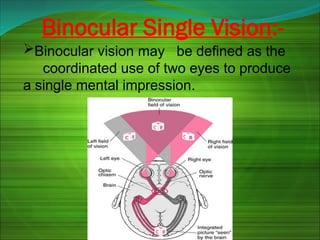
Binocular Single Vision:-
๏ƒ˜Binocular vision may be defined as the
coordinated use of two eyes to produce
a single mental impression.
Grades:-
๏‚— Given by William Worth in 1900
๏‚— Simultaneous Macular perception
๏‚— Fusion
๏‚— Stereopsis
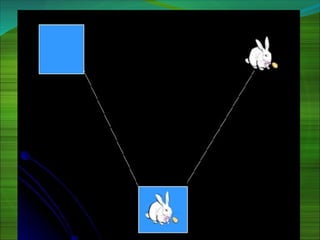
Simultaneous macular perception:
๏‚—It is defined as the ability of the two eye to
see two dissimilar objects simultaneously
and to superimposed them. It is tested by p
rojecting two dissimilar objects in front of th
e two eyes.
๏‚— Ex: Rabbit & Cage
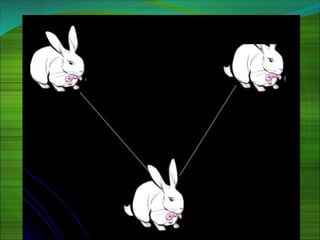
Fusion:-
๏‚— It implies the ability of the two eyes to
superimpose two incomplete but similar
object to form the complete single image. It
is also tested by projecting two incomplete
but similar object in front of the two eyes.
Components Of Fusion:-
๏‚— Sensory Fusion- Unification of visual
excitations from corresponding retinal
images into a single visual percept.
๏‚— Motor Fusion-The ability to align the eyes
in such a way that sensory fusion can be
maintained.
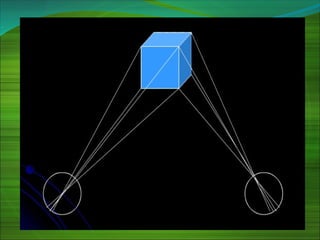
Stereopsis:-
๏‚— It implies the ability of two eyes to obtain
an impression of depth by the
superimposition of two picture of the object
which has been taken from slightly
different angle.
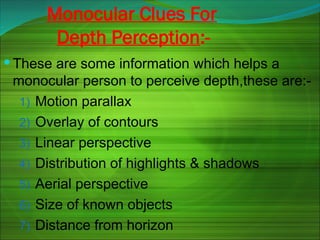
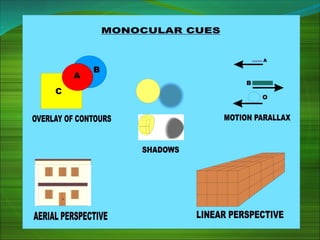
Monocular Clues For
Depth Perception:-
๏‚— These are some information which helps a
monocular person to perceive depth,these are:-
1) Motion parallax
2) Overlay of contours
3) Linear perspective
4) Distribution of highlights & shadows
5) Aerial perspective
6) Size of known objects
7) Distance from horizon
Psychophysics and sensory
Aspects of binocular vision:-
๏‚— Visual direction and visual space
๏‚— Corresponding points and normal retinal
correspondence
๏‚— Horopter
๏‚— Physiological diplopia
๏‚— Concept of panumโ€™s area
๏‚— Fixation disparity
๏‚—Visual direction:-
๏ƒ˜ It refers to a line that joins the fixation object to
the center of fovea.Each point of retina has its
on particular visual direction.
๏‚—Visual space:-
๏ƒ˜It refers to localization of any objects in the visual
system,It is also called as subjective space.
Retinal Correspondence:-
๏‚— Every retinal point or area has a partner in
the fellow eye with which it can shares a
common subjective visual direction.
๏‚— These two retinal elements are
corresponding retinal points.
๏‚— All other retinal elements are called non โ€“
corresponding or disparate retinal points.
Types:-
๏‚ง Normal Retinal Correspondence
๏‚ง Abnormal Retinal Correspondence
Normal Retinal Correspondence:-
๏‚— when both the fovea have a common
visual direction and the retinal elements
nasal to the fovea in one eye and the other
eye have retinal elements temporal to the
fovea is called normal retinal
correspondence.
Abnormal Retinal
Correspondence:-
๏‚— When the fovea of one eye has a common
visual direction with an extra foveal area in
the other eye.
๏‚— ARC may develop throughout the first
decade of life.
Types:-
๏‚— Harmonious ARC-If the angle of anomaly
is equal to the angle of strabismus.
๏‚— Unharmonious ARC-If the angle of
anomaly is less than the angle of deviation.
Investigations Of ARC
๏‚— Bagoliniโ€™s striated glasses
๏‚— Worthโ€™s four dot test
๏‚— Synaptophore
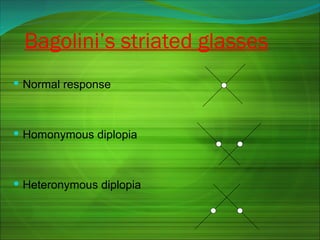
Bagoliniโ€™s striated glasses
๏‚— Normal response
๏‚— Homonymous diplopia
๏‚— Heteronymous diplopia
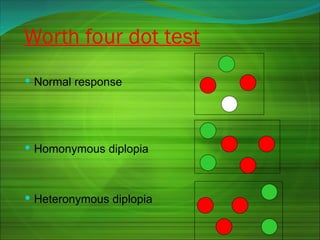
Worth four dot test
๏‚— Normal response
๏‚— Homonymous diplopia
๏‚— Heteronymous diplopia
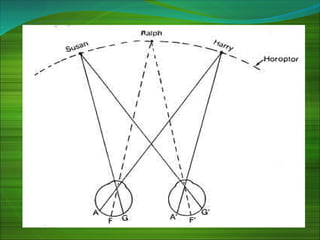
Horopter:-
๏‚— The locus of all object points that are
imaged on corresponding retinal elements
at a given fixation distance is called
horopter.
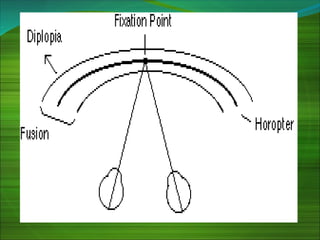
Panumโ€™s Fusional Area:-
๏‚— When a horopter is determined
experimentally,it is found that an object
may be located a certain distance in front
or behind without producing diplopia or
expected diplopia doesnโ€™t occur then is
known as panumโ€™s fusional area.
Fixation Disparity:-
๏‚— A condition in which the image of a
bifixated object do not stimulate exactly
corresponding point,But which still fall
within panumโ€™s areas, the object thus
being seen single this is called fixation
disparity.
โ€ขThe conflict which result when contradictory
and incompatible signals are transmitted from
corresponding points to the visual cortex is
called retinal rivalry.
If dissimilar contours are presented to
corresponding retinal points fusion is impossible.
Retinal Rivalry
BSV (BINOCULAR SINGAL VISION) HUMAN EYE.ppt

BSV (BINOCULAR SINGAL VISION) HUMAN EYE.ppt

  • 1.
    BINOCULAR SINGLE VISION:- GOBINDSAH INTERN SANKARA NETHRALAYA, KOLKATA. MODERATOR:- MISS DEBJANI ROY. CHAIRPERSON:-R.VENKATARAMANAN
  • 2.
    Binocular Single Vision:- ๏ƒ˜Binocularvision may be defined as the coordinated use of two eyes to produce a single mental impression.
  • 3.
    Grades:- ๏‚— Given byWilliam Worth in 1900 ๏‚— Simultaneous Macular perception ๏‚— Fusion ๏‚— Stereopsis
  • 4.
    Simultaneous macular perception: ๏‚—Itis defined as the ability of the two eye to see two dissimilar objects simultaneously and to superimposed them. It is tested by p rojecting two dissimilar objects in front of th e two eyes. ๏‚— Ex: Rabbit & Cage
  • 6.
    Fusion:- ๏‚— It impliesthe ability of the two eyes to superimpose two incomplete but similar object to form the complete single image. It is also tested by projecting two incomplete but similar object in front of the two eyes.
  • 8.
    Components Of Fusion:- ๏‚—Sensory Fusion- Unification of visual excitations from corresponding retinal images into a single visual percept. ๏‚— Motor Fusion-The ability to align the eyes in such a way that sensory fusion can be maintained.
  • 9.
    Stereopsis:- ๏‚— It impliesthe ability of two eyes to obtain an impression of depth by the superimposition of two picture of the object which has been taken from slightly different angle.
  • 11.
    Monocular Clues For DepthPerception:- ๏‚— These are some information which helps a monocular person to perceive depth,these are:- 1) Motion parallax 2) Overlay of contours 3) Linear perspective 4) Distribution of highlights & shadows 5) Aerial perspective 6) Size of known objects 7) Distance from horizon
  • 13.
    Psychophysics and sensory Aspectsof binocular vision:- ๏‚— Visual direction and visual space ๏‚— Corresponding points and normal retinal correspondence ๏‚— Horopter ๏‚— Physiological diplopia ๏‚— Concept of panumโ€™s area ๏‚— Fixation disparity
  • 14.
    ๏‚—Visual direction:- ๏ƒ˜ Itrefers to a line that joins the fixation object to the center of fovea.Each point of retina has its on particular visual direction. ๏‚—Visual space:- ๏ƒ˜It refers to localization of any objects in the visual system,It is also called as subjective space.
  • 15.
    Retinal Correspondence:- ๏‚— Everyretinal point or area has a partner in the fellow eye with which it can shares a common subjective visual direction. ๏‚— These two retinal elements are corresponding retinal points. ๏‚— All other retinal elements are called non โ€“ corresponding or disparate retinal points.
  • 16.
    Types:- ๏‚ง Normal RetinalCorrespondence ๏‚ง Abnormal Retinal Correspondence
  • 17.
    Normal Retinal Correspondence:- ๏‚—when both the fovea have a common visual direction and the retinal elements nasal to the fovea in one eye and the other eye have retinal elements temporal to the fovea is called normal retinal correspondence.
  • 18.
    Abnormal Retinal Correspondence:- ๏‚— Whenthe fovea of one eye has a common visual direction with an extra foveal area in the other eye. ๏‚— ARC may develop throughout the first decade of life.
  • 19.
    Types:- ๏‚— Harmonious ARC-Ifthe angle of anomaly is equal to the angle of strabismus. ๏‚— Unharmonious ARC-If the angle of anomaly is less than the angle of deviation.
  • 20.
    Investigations Of ARC ๏‚—Bagoliniโ€™s striated glasses ๏‚— Worthโ€™s four dot test ๏‚— Synaptophore
  • 21.
    Bagoliniโ€™s striated glasses ๏‚—Normal response ๏‚— Homonymous diplopia ๏‚— Heteronymous diplopia
  • 22.
    Worth four dottest ๏‚— Normal response ๏‚— Homonymous diplopia ๏‚— Heteronymous diplopia
  • 23.
    Horopter:- ๏‚— The locusof all object points that are imaged on corresponding retinal elements at a given fixation distance is called horopter.
  • 25.
    Panumโ€™s Fusional Area:- ๏‚—When a horopter is determined experimentally,it is found that an object may be located a certain distance in front or behind without producing diplopia or expected diplopia doesnโ€™t occur then is known as panumโ€™s fusional area.
  • 27.
    Fixation Disparity:- ๏‚— Acondition in which the image of a bifixated object do not stimulate exactly corresponding point,But which still fall within panumโ€™s areas, the object thus being seen single this is called fixation disparity.
  • 28.
    โ€ขThe conflict whichresult when contradictory and incompatible signals are transmitted from corresponding points to the visual cortex is called retinal rivalry. If dissimilar contours are presented to corresponding retinal points fusion is impossible. Retinal Rivalry