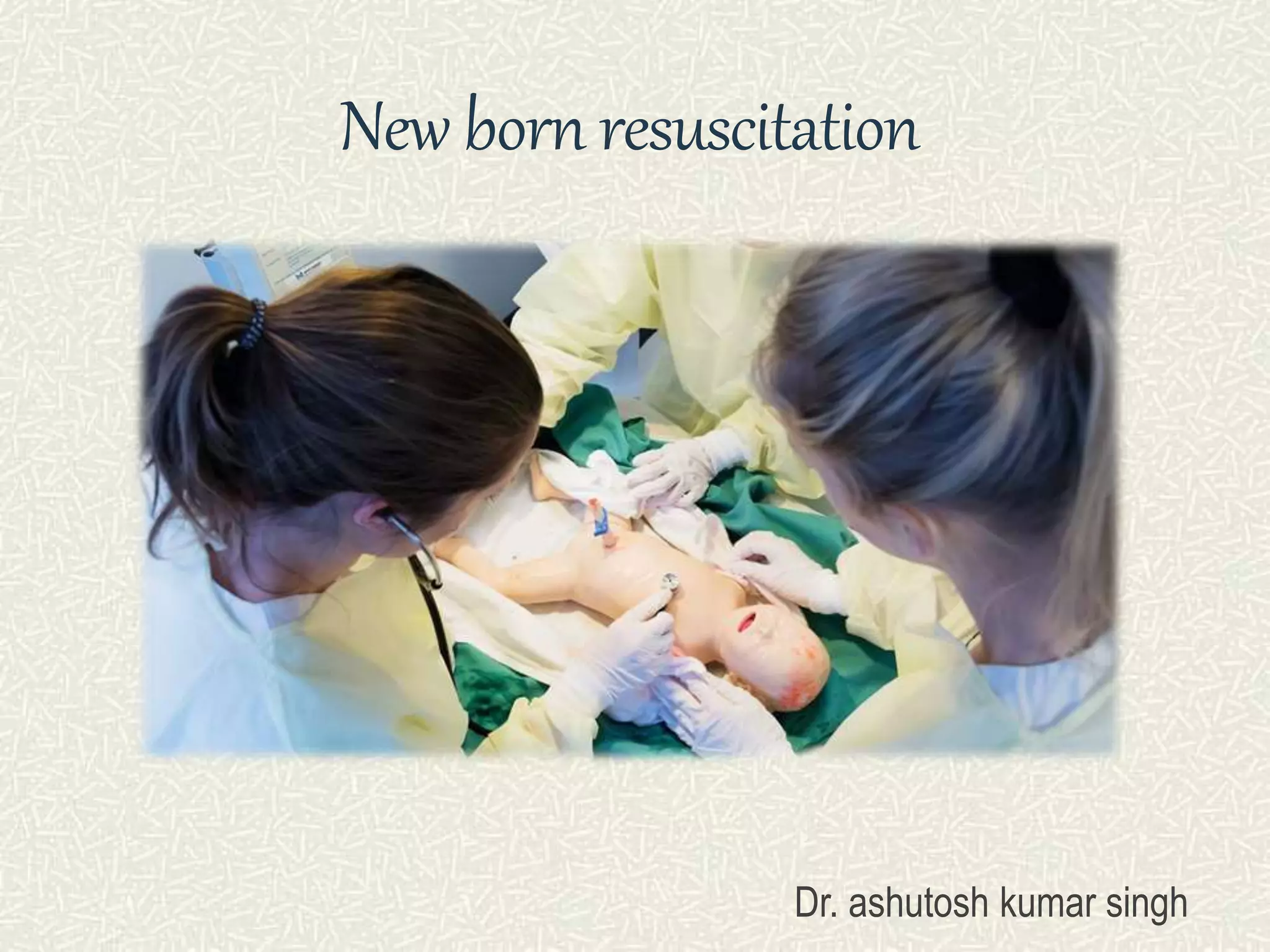
New born resuscitation
Dr. ashutosh kumar singh
Introduction
• the process of birth brings the fetus from a fluid environment to an
air environment.
• This transition is accompanied by physiological and biochemical
changes.
Causes of Neonatal Mortality
Neonatal resuscitation
• 10% neonates require some assistance at birth.
• 1% neonates need extensive resuscitative measures.
• Asphyxia accounts for 20-23% newborn deaths.
After birth
Fluid in the alveoli
is absorbed
Alveoli Expand
Get filled with air (O2
Pulmonary vessels dilate, causing
increased blood flow to lungs
Assessment after Birth
Most infants have Apgar score between 7/10 to 10/10 at one minute
and do not require resuscitation .
Infants with Apgar score 4-6 require some intervention while those
with <3/10 are severely compromised and warrant urgent
resuscitation.
Apgar score
• The compromised baby may exhibit 1 or more of the following
clinical findings:
• Low muscle tone
• Respiratory depression (apnea / gasping)
• Bradycardia
• Cyanosis
Consequences of interrupted transition
Antepartum Risks
• Maternal diabetes
• Chronic maternal illness
• Pre eclampsia
• Maternal infection
• Poly / Oligohydramnios
• PROM
• IUGR
• Post term gestation
• Multiple gestation
• Anaemia
• Age <16 or > 35
Intrapartum Risks
• Instrumental delivery
• Abnormal position
• Premature labour
• Chorioamnionitis
• Prolonged rupture of
membranes
• Prolonged labour > 24 hrs
• Prolonged 2ndstage of
labour
• Fetal bradycardia
• Narcotics administered within 4
hours of delivery
• Meconium stained liquor
• Prolapsed cord
• Abruptio placentae
• Placenta previa
Fetal asphyxia
Asphyxia means lack of oxygen and blood flow to the brain. Birth
asphyxia happens when a baby’s brain and other organs do not get
enough oxygen and nutrients before, during or right after birth.
Fetal asphyxia
Primary apnoea
 Apnoeic
 Blue
 Heart rate ↑
 Resuscitate easily
Secondary apnoea
 apnoeic
 White, floppy
 Heart rate ↓
 Require active resuscitation
Equipment Needed for Resuscitation
• Radiant warmer
• Warm towel and blankets
• Resuscitation bag & mask
 Self inflating bag
• Endotracheal tubes
• Laryngoscope
• Oxygen source and tubing
• Suction source
Equipment Needed
Overhead radiant warmer
Normal Delivery Procedures
• Place under warmer and
towel dry
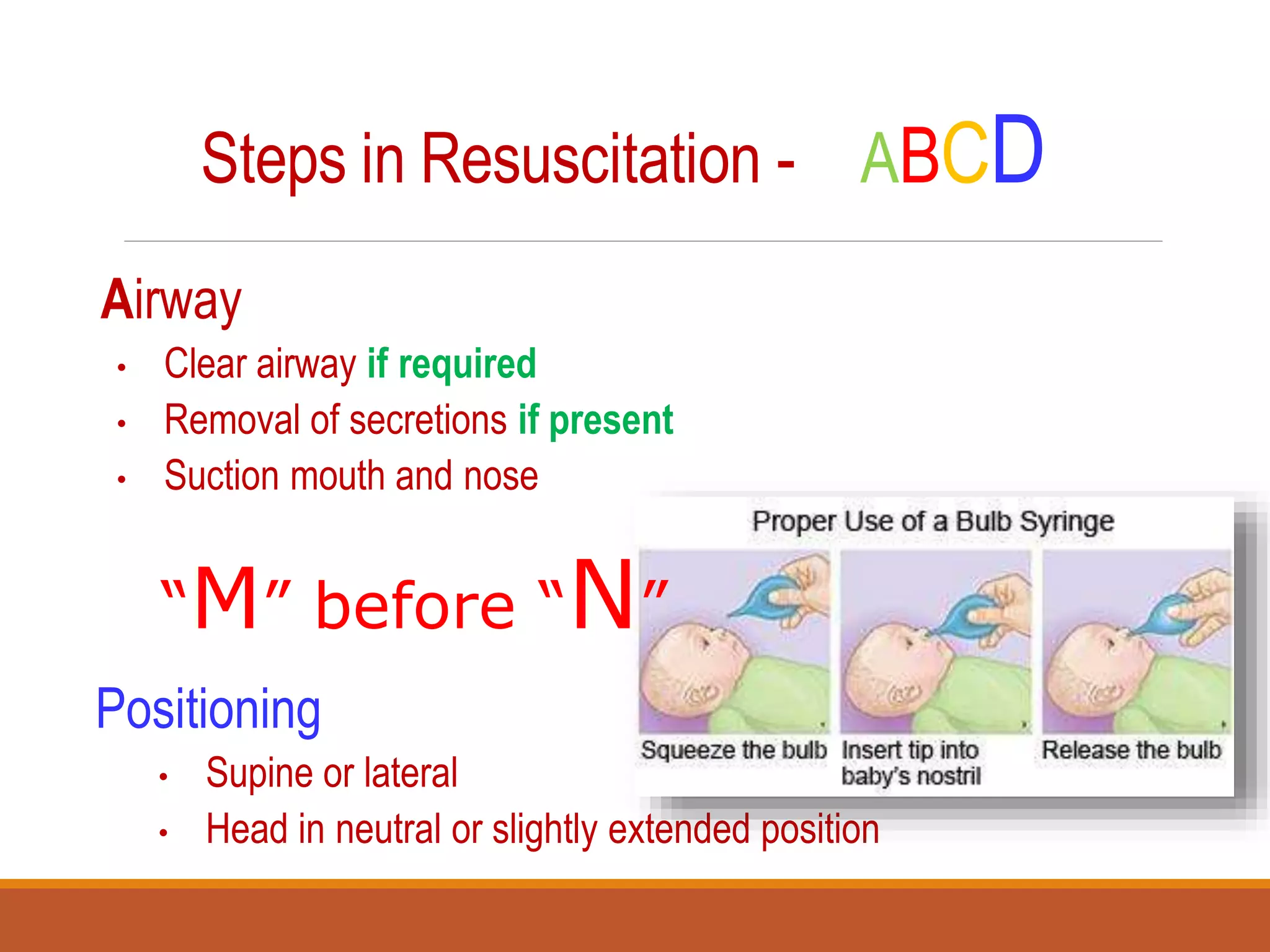
• Use bulb syringe to clear
mouth, then nose
• Tactile stimulation if not
breathing yet
• Auscultate heart and
lungs & assess color
• Free flow O2 as needed
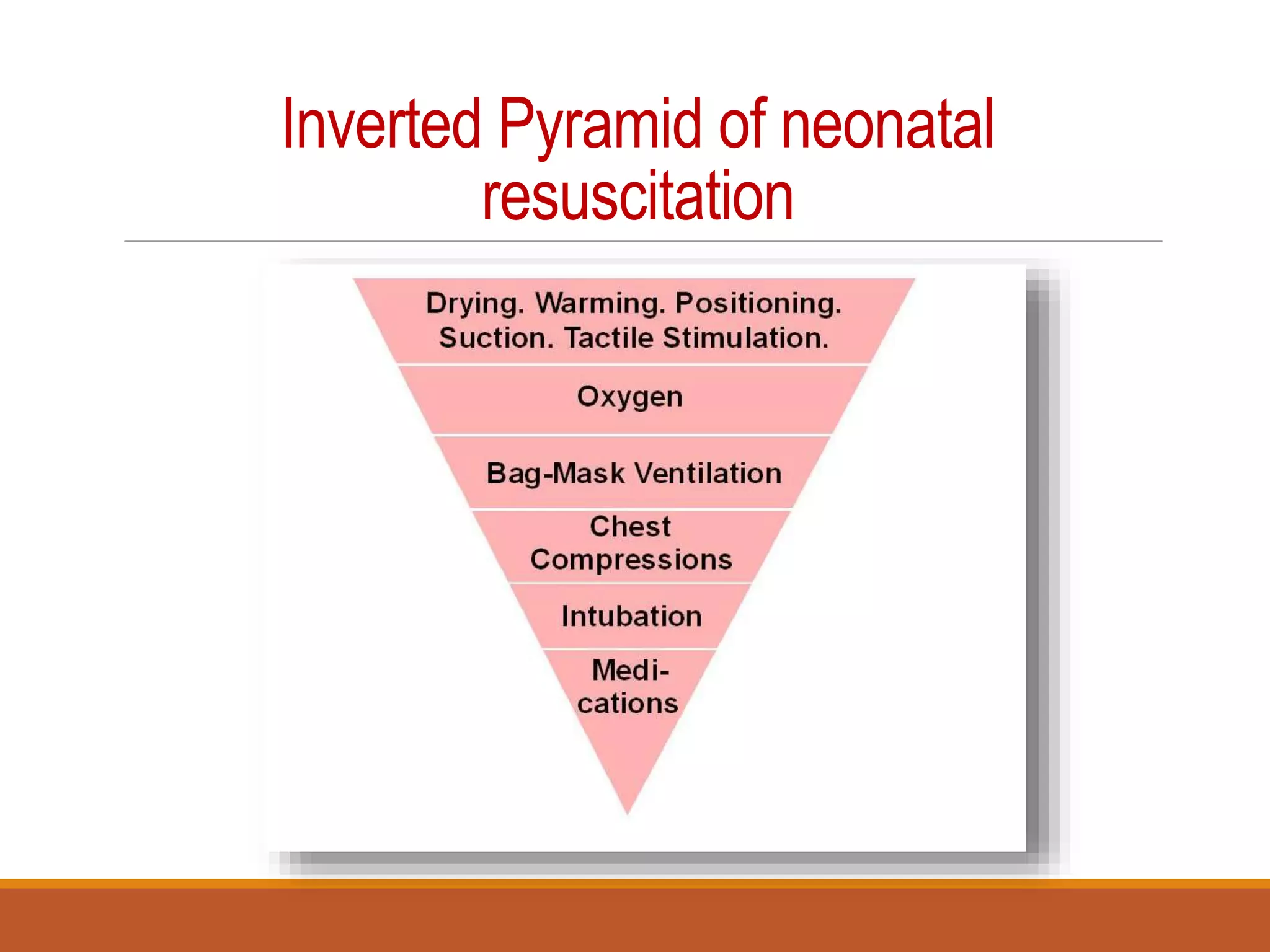
Inverted Pyramid of neonatal
resuscitation
http://eccguidelines.heart.org/wp-
content/uploads/2015/10/Neonatal-
Resuscitation-Algorithm.pdf
Steps in Resuscitation - ABCD
Airway
• Clear airway if required
• Removal of secretions if present
• Suction mouth and nose
Positioning
• Supine or lateral
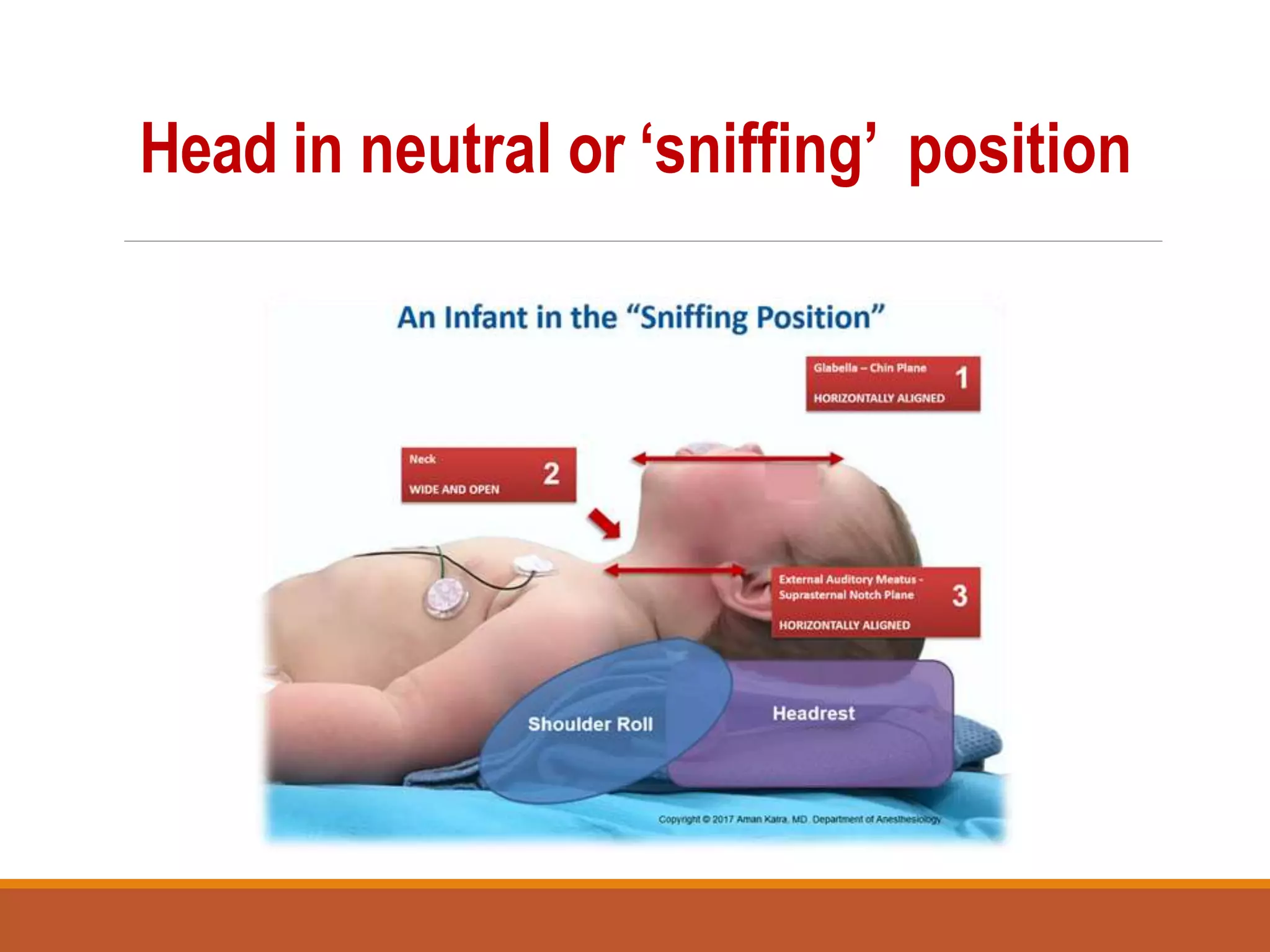
• Head in neutral or slightly extended position
“M” before “N”
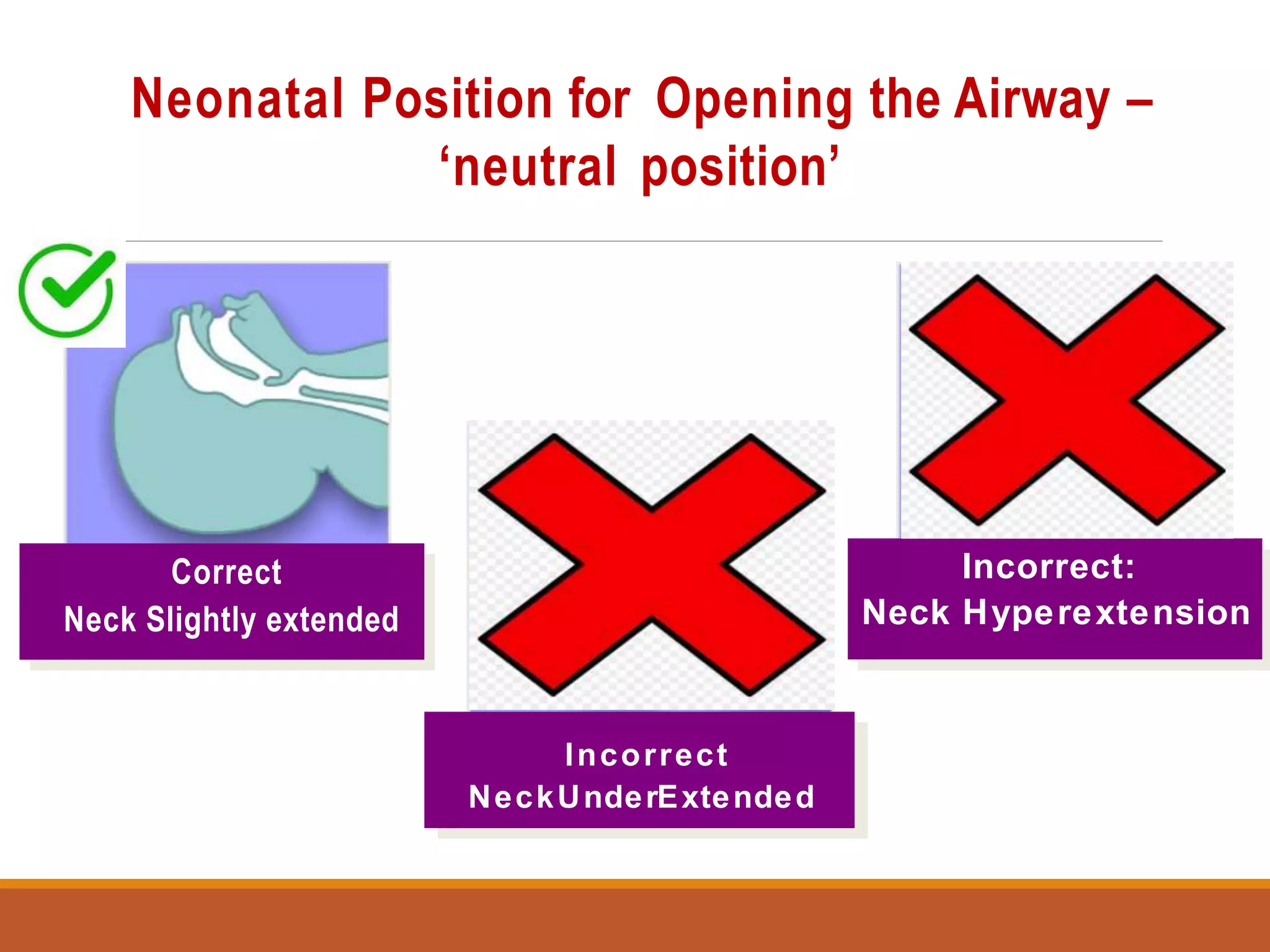
Neonatal Position for Opening the Airway –
‘neutral position’
Incorrect:
Neck Hyperextension
Incorrect
NeckUnderExtended
Correct
Neck Slightly extended
Head in neutral or ‘sniffing’ position
Acceptable methods of stimulation
Steps in Resuscitation -ABCD
Breathing
Assessment of respiratory effort and colour Indications for oxygen
administration
Cyanosis
Respiratory distress
Give free flowing oxygen 5L/min
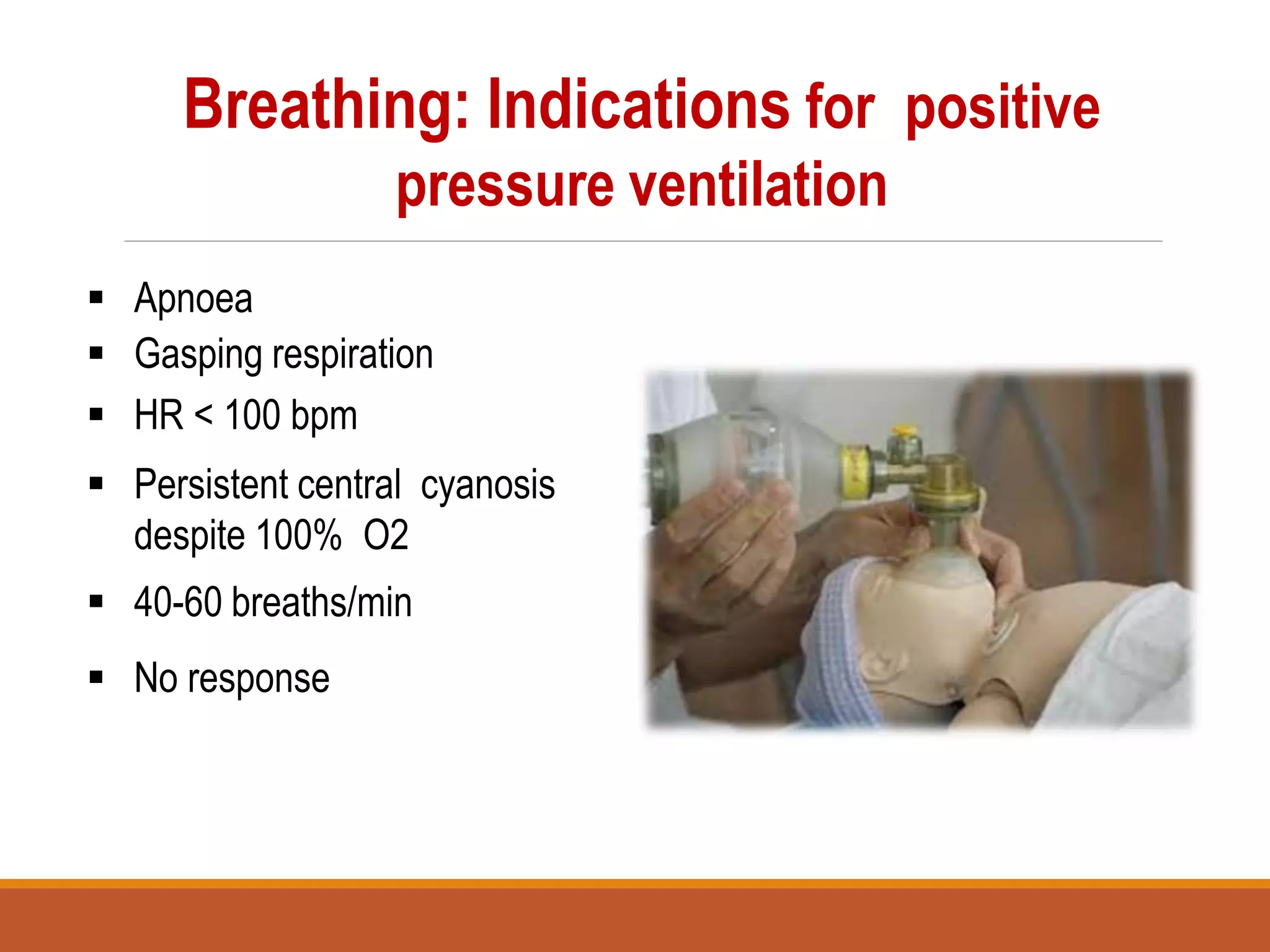
Breathing: Indications for positive
pressure ventilation
 Apnoea
 Gasping respiration
 HR < 100 bpm
 Persistent central cyanosis
despite 100% O2
 40-60 breaths/min
 No response
• Watch for slight rise of chest
• Rate is 40-60
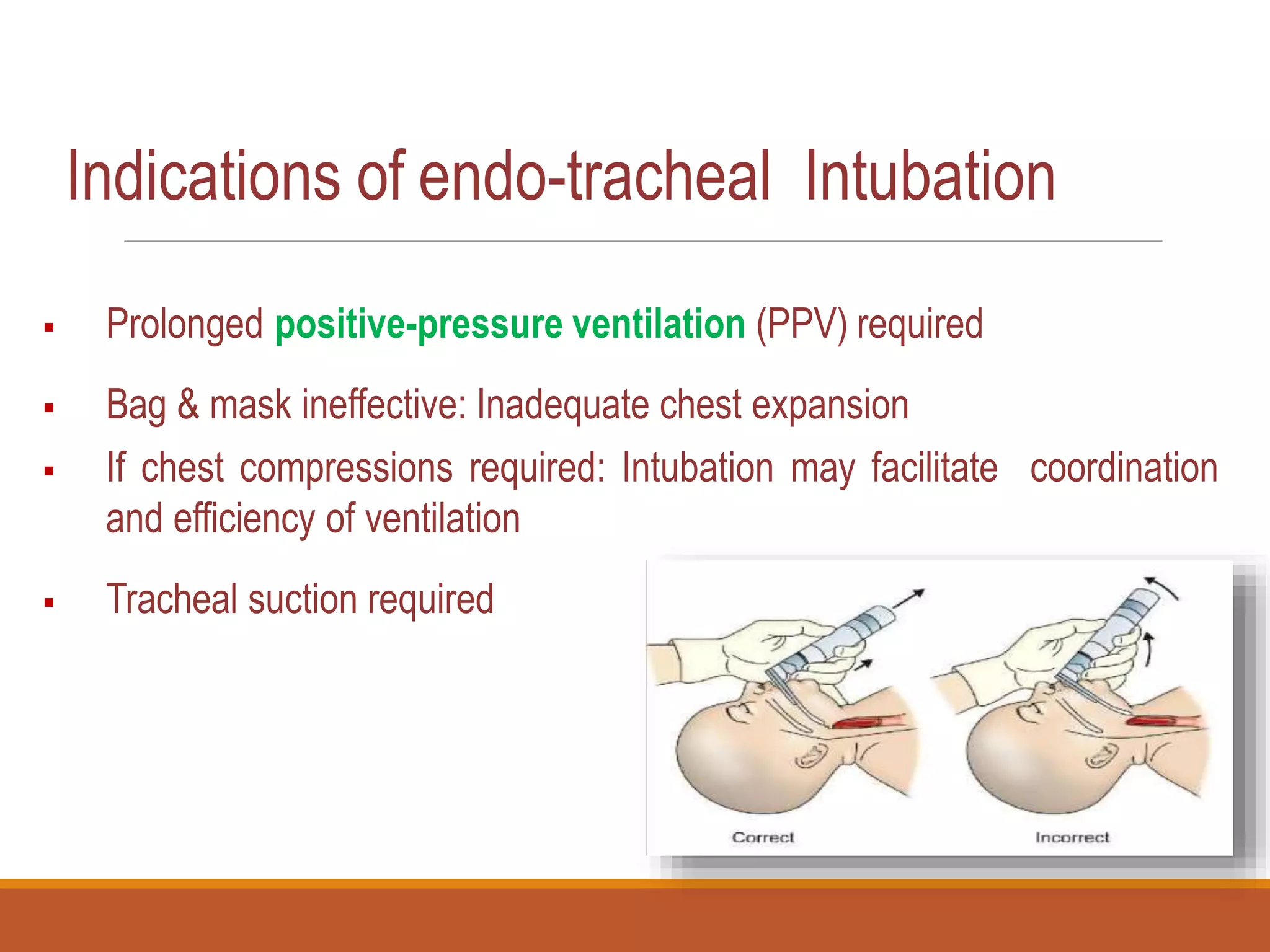
Indications of endo-tracheal Intubation
 Prolonged positive-pressure ventilation (PPV) required
 Bag & mask ineffective: Inadequate chest expansion
 If chest compressions required: Intubation may facilitate coordination
and efficiency of ventilation
 Tracheal suction required
Steps in Resuscitation -ABCDE
Circulation
Assessment of heart rate and response to previous measures
• Umbilical arteries
• Apex beat
• Auscultation
2 techniques
 2 thumb (preferred)
 2 finger
 3:1 ratio
 1/3 of AP diameter
HR < 60 bpm despite adequate vent
with 100% O2 for 30 seconds
Chest Compressions
Technique
Position of Hands on Chest
Thumb technique
Technique
Position of Hands on Chest
Two finger technique
Chest (cardiac)compressions
“Two-thumb”techniqueisusuallypreferred
Steps in resuscitation - ABCDE
Drugs
1. Epinephrine
2. Volume Expanders
3. Naloxone
Epinephrine
Indications
 HR <60 /min after PPV & CC for 30 secs
Route of administration
 Intravenous
 Endotracheal route (when I.V line is not secured )
Recommended
 Conc. – 1:10,000 (0.1mg/ml)
 Dose – 0.1-0.3 ml/kg – via IV/UVC
0.5-1ml /kg - via ET)
 Rate of admn. – as rapidly as possible
 Repeat dose if no response after 3-5 mins .
f/b 1ml NS flush
Volume Expander
Indications:
Poor response to other resuscitative measures
Evidence of blood loss or suspected (pale skin, poor perfusion, weak pulse)
Crystalloid
 Normal Saline
 Ringer Lactate
 O-negative blood cross-matched with mother’s blood
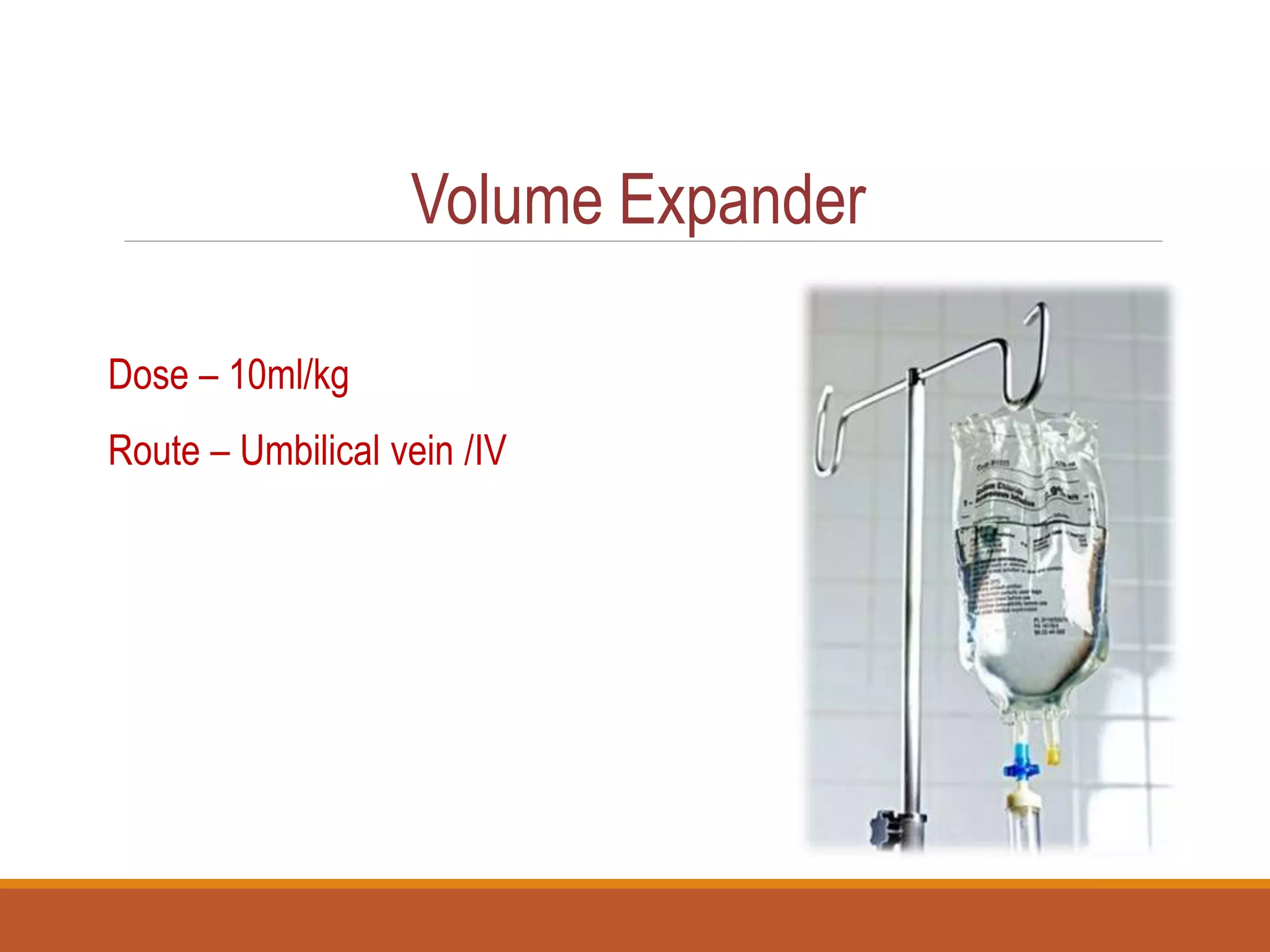
Dose – 10ml/kg
Route – Umbilical vein /IV
Volume Expander
Naloxone - Narcotic antagonist
Indications :
A history of maternal narcotic administration within the past 4
hours,Severe respiratory depression is present after PPV has
restored a normal HR & color
Recommended
 Route: Intravenous
 Dose: 0.1-0.2 mg/kg
Meconium present and baby vigorous
Vigorous Baby-
 Strong respiratory efforts,
 Good muscle tone,
 Heart rate > 100 bpm
suction catheter or bulb syringe for suction of mouth or nose ET
suction not required
Meconium present and baby not
vigorous
• Insert laryngoscope
• Clear mouth and posterior pharynx
• Insert endotracheal tube into the trachea Attach the ET to
suction source
• Apply suction as ET is slowly withdrawn
• Repeat as necessary until no meconium or heart rate indicates
further resuscitation
What to do if still no improvement?
If no improvement seen despite all efforts
Ensure adequate ventilation, chest compressions, drug delivery
If still HR < 60/min, consider
• Airway malformation
• Pneumothorax
• Diaphragmatic hernia
• Cong. Heart disease
What to do if still no improvement?
If HR absent or no progress
• Ethical considerations of when to Discontinue Resuscitation
• An Apgar score of 0 at 10 minutes is a strong predictor of
mortality and morbidity in late preterm and term infants.
Discontinuing Resuscitative Efforts
https://pediatrics.aappublications.org/content/136/Supplement_2/S196
infants with an Apgar score of 0 after 10 minutes of resuscitation, if
the heart rate remains undetectable, it may be reasonable to stop
resuscitation.
Variables to be considered may include whether the resuscitation
was considered optimal; availability of advanced neonatal care,
such as therapeutic hypothermia; specific circumstances before
delivery (Eg, known timing of the insult) and also wishes expressed
by the family
Discontinuing Resuscitative Effort
Stop resuscitation, if HR remains undetectable for 10 - 15 min
Also take into consideration factors such as
• presumed etiology of the arrest
• gestation of the baby
• presence or absence of complications
Summary
• Doing the simple things better is probably the most cost-effective
policy.
• Resuscitation can come as complete surprise So be prepared for
resuscitation.
• It may take several hours to learn but it should be implemented
over seconds.
• Practice makes one perfect.
Neonatal resuscitation

Neonatal resuscitation

  • 1.
    New born resuscitation Dr.ashutosh kumar singh
  • 2.
    Introduction • the processof birth brings the fetus from a fluid environment to an air environment. • This transition is accompanied by physiological and biochemical changes.
  • 3.
  • 4.
    Neonatal resuscitation • 10%neonates require some assistance at birth. • 1% neonates need extensive resuscitative measures. • Asphyxia accounts for 20-23% newborn deaths.
  • 5.
    After birth Fluid inthe alveoli is absorbed Alveoli Expand Get filled with air (O2
  • 6.
    Pulmonary vessels dilate,causing increased blood flow to lungs
  • 7.
    Assessment after Birth Mostinfants have Apgar score between 7/10 to 10/10 at one minute and do not require resuscitation . Infants with Apgar score 4-6 require some intervention while those with <3/10 are severely compromised and warrant urgent resuscitation.
  • 8.
  • 9.
    • The compromisedbaby may exhibit 1 or more of the following clinical findings: • Low muscle tone • Respiratory depression (apnea / gasping) • Bradycardia • Cyanosis Consequences of interrupted transition
  • 10.
    Antepartum Risks • Maternaldiabetes • Chronic maternal illness • Pre eclampsia • Maternal infection • Poly / Oligohydramnios • PROM • IUGR • Post term gestation • Multiple gestation • Anaemia • Age <16 or > 35
  • 11.
    Intrapartum Risks • Instrumentaldelivery • Abnormal position • Premature labour • Chorioamnionitis • Prolonged rupture of membranes • Prolonged labour > 24 hrs • Prolonged 2ndstage of labour • Fetal bradycardia • Narcotics administered within 4 hours of delivery • Meconium stained liquor • Prolapsed cord • Abruptio placentae • Placenta previa
  • 12.
    Fetal asphyxia Asphyxia meanslack of oxygen and blood flow to the brain. Birth asphyxia happens when a baby’s brain and other organs do not get enough oxygen and nutrients before, during or right after birth.
  • 13.
    Fetal asphyxia Primary apnoea Apnoeic  Blue  Heart rate ↑  Resuscitate easily Secondary apnoea  apnoeic  White, floppy  Heart rate ↓  Require active resuscitation
  • 14.
    Equipment Needed forResuscitation • Radiant warmer • Warm towel and blankets • Resuscitation bag & mask  Self inflating bag • Endotracheal tubes • Laryngoscope • Oxygen source and tubing • Suction source
  • 15.
  • 17.
    Normal Delivery Procedures •Place under warmer and towel dry • Use bulb syringe to clear mouth, then nose • Tactile stimulation if not breathing yet • Auscultate heart and lungs & assess color • Free flow O2 as needed
  • 18.
    Inverted Pyramid ofneonatal resuscitation
  • 19.
  • 20.
    Steps in Resuscitation- ABCD Airway • Clear airway if required • Removal of secretions if present • Suction mouth and nose Positioning • Supine or lateral • Head in neutral or slightly extended position “M” before “N”
  • 21.
    Neonatal Position forOpening the Airway – ‘neutral position’ Incorrect: Neck Hyperextension Incorrect NeckUnderExtended Correct Neck Slightly extended
  • 22.
    Head in neutralor ‘sniffing’ position
  • 23.
  • 24.
    Steps in Resuscitation-ABCD Breathing Assessment of respiratory effort and colour Indications for oxygen administration Cyanosis Respiratory distress Give free flowing oxygen 5L/min
  • 25.
    Breathing: Indications forpositive pressure ventilation  Apnoea  Gasping respiration  HR < 100 bpm  Persistent central cyanosis despite 100% O2  40-60 breaths/min  No response
  • 27.
    • Watch forslight rise of chest • Rate is 40-60
  • 28.
    Indications of endo-trachealIntubation  Prolonged positive-pressure ventilation (PPV) required  Bag & mask ineffective: Inadequate chest expansion  If chest compressions required: Intubation may facilitate coordination and efficiency of ventilation  Tracheal suction required
  • 29.
    Steps in Resuscitation-ABCDE Circulation Assessment of heart rate and response to previous measures • Umbilical arteries • Apex beat • Auscultation
  • 30.
    2 techniques  2thumb (preferred)  2 finger  3:1 ratio  1/3 of AP diameter HR < 60 bpm despite adequate vent with 100% O2 for 30 seconds Chest Compressions
  • 31.
    Technique Position of Handson Chest Thumb technique
  • 32.
    Technique Position of Handson Chest Two finger technique
  • 33.
  • 34.
    Steps in resuscitation- ABCDE Drugs 1. Epinephrine 2. Volume Expanders 3. Naloxone
  • 35.
    Epinephrine Indications  HR <60/min after PPV & CC for 30 secs Route of administration  Intravenous  Endotracheal route (when I.V line is not secured ) Recommended  Conc. – 1:10,000 (0.1mg/ml)  Dose – 0.1-0.3 ml/kg – via IV/UVC 0.5-1ml /kg - via ET)  Rate of admn. – as rapidly as possible  Repeat dose if no response after 3-5 mins . f/b 1ml NS flush
  • 37.
    Volume Expander Indications: Poor responseto other resuscitative measures Evidence of blood loss or suspected (pale skin, poor perfusion, weak pulse) Crystalloid  Normal Saline  Ringer Lactate  O-negative blood cross-matched with mother’s blood
  • 38.
    Dose – 10ml/kg Route– Umbilical vein /IV Volume Expander
  • 39.
    Naloxone - Narcoticantagonist Indications : A history of maternal narcotic administration within the past 4 hours,Severe respiratory depression is present after PPV has restored a normal HR & color Recommended  Route: Intravenous  Dose: 0.1-0.2 mg/kg
  • 40.
    Meconium present andbaby vigorous Vigorous Baby-  Strong respiratory efforts,  Good muscle tone,  Heart rate > 100 bpm suction catheter or bulb syringe for suction of mouth or nose ET suction not required
  • 41.
    Meconium present andbaby not vigorous • Insert laryngoscope • Clear mouth and posterior pharynx • Insert endotracheal tube into the trachea Attach the ET to suction source • Apply suction as ET is slowly withdrawn • Repeat as necessary until no meconium or heart rate indicates further resuscitation
  • 42.
    What to doif still no improvement? If no improvement seen despite all efforts Ensure adequate ventilation, chest compressions, drug delivery If still HR < 60/min, consider • Airway malformation • Pneumothorax • Diaphragmatic hernia • Cong. Heart disease
  • 43.
    What to doif still no improvement? If HR absent or no progress • Ethical considerations of when to Discontinue Resuscitation • An Apgar score of 0 at 10 minutes is a strong predictor of mortality and morbidity in late preterm and term infants.
  • 44.
    Discontinuing Resuscitative Efforts https://pediatrics.aappublications.org/content/136/Supplement_2/S196 infantswith an Apgar score of 0 after 10 minutes of resuscitation, if the heart rate remains undetectable, it may be reasonable to stop resuscitation. Variables to be considered may include whether the resuscitation was considered optimal; availability of advanced neonatal care, such as therapeutic hypothermia; specific circumstances before delivery (Eg, known timing of the insult) and also wishes expressed by the family
  • 45.
    Discontinuing Resuscitative Effort Stopresuscitation, if HR remains undetectable for 10 - 15 min Also take into consideration factors such as • presumed etiology of the arrest • gestation of the baby • presence or absence of complications
  • 46.
    Summary • Doing thesimple things better is probably the most cost-effective policy. • Resuscitation can come as complete surprise So be prepared for resuscitation. • It may take several hours to learn but it should be implemented over seconds. • Practice makes one perfect.