WEANING AND EXTUBATION AND
MANAGEMENT OF SEDATION
WITHDRAWAL
Dr C Abhiram Kumar
Fellow in PICU
Aster CMI Hospital
 Introduction
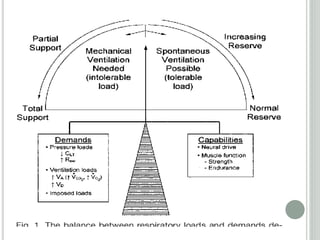
 Weaning
 Techniques of weaning
 Predictive indices for weaning
 Weaning failure
 Extubation
 Extubation failure
 Role of tracheostomy
 Sedation withdrawal
 Management of sedation withdrawal
 The thought of weaning should begin from the day
of intubation.
 Too early or too late extubation have their own
adverse consequences
 60% of accidental extubations donot require
reintubation
 Weaning- transition from ventilatory support to
spontaneous breathing during which time patient
assumes the responsibility for effective gas
exchange while positive pressure support is
reduced
 Extubation- The process of removal of the
endotracheal tube
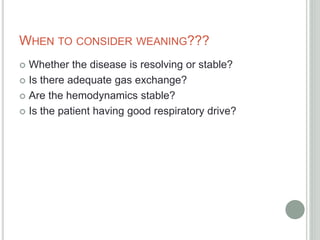
WHEN TO CONSIDER WEANING???
 Whether the disease is resolving or stable?
 Is there adequate gas exchange?
 Are the hemodynamics stable?
 Is the patient having good respiratory drive?
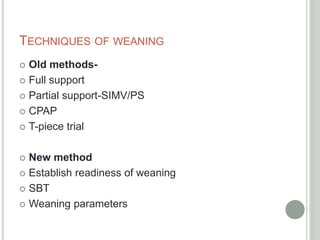
TECHNIQUES OF WEANING
 Old methods-
 Full support
 Partial support-SIMV/PS
 CPAP
 T-piece trial
 New method
 Establish readiness of weaning
 SBT
 Weaning parameters
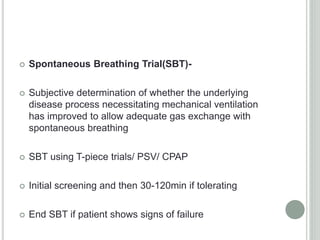
 Spontaneous Breathing Trial(SBT)-
 Subjective determination of whether the underlying
disease process necessitating mechanical ventilation
has improved to allow adequate gas exchange with
spontaneous breathing
 SBT using T-piece trials/ PSV/ CPAP
 Initial screening and then 30-120min if tolerating
 End SBT if patient shows signs of failure
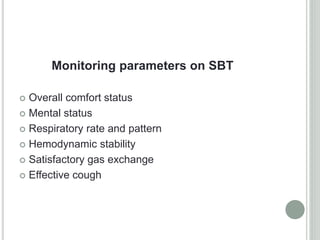
Monitoring parameters on SBT
 Overall comfort status
 Mental status
 Respiratory rate and pattern
 Hemodynamic stability
 Satisfactory gas exchange
 Effective cough
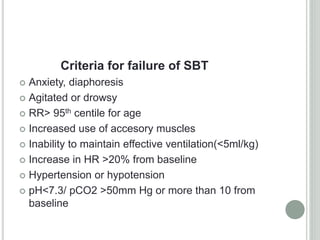
Criteria for failure of SBT
 Anxiety, diaphoresis
 Agitated or drowsy
 RR> 95th centile for age
 Increased use of accesory muscles
 Inability to maintain effective ventilation(<5ml/kg)
 Increase in HR >20% from baseline
 Hypertension or hypotension
 pH<7.3/ pCO2 >50mm Hg or more than 10 from
baseline
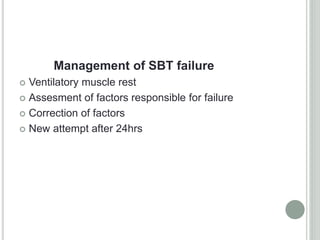
Management of SBT failure
 Ventilatory muscle rest
 Assesment of factors responsible for failure
 Correction of factors
 New attempt after 24hrs
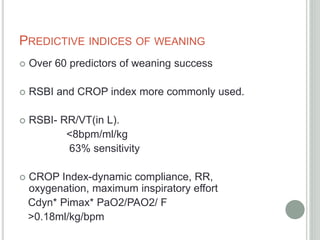
PREDICTIVE INDICES OF WEANING
 Over 60 predictors of weaning success
 RSBI and CROP index more commonly used.
 RSBI- RR/VT(in L).
<8bpm/ml/kg
63% sensitivity
 CROP Index-dynamic compliance, RR,
oxygenation, maximum inspiratory effort
Cdyn* Pimax* PaO2/PAO2/ F
>0.18ml/kg/bpm
Factors contributing to weaning failure
 A- Acid Base status
 B- Breathing/respiratory factors
 C- cardiac factors
 D- Drugs and neurologic status
 E- Electrolyte imbalance
 Nutrition
 Psychological status
EXTUBATION FEASIBILITY
 Controlled underlying disease
 No high dose of vasoactive drug
 Approved SBT
 FiO2<0.4 with SPO2>92%/ PF ratio >150MM HG
 PEEP <5-8cm H2O
 RSBI<8 cpm/ml/kg
 Intact airway reflexes
 Adequate conscience level
 No/minimal UAO(Cuff leak test)
Cuff Leak Test
 Predicts upper airway patency
 Deflate the cuff
 Hear for the leak of air
 If no leak- chances of extubation failure high
Technique of Extubation
 Withhold feeds for atleast 6 hrs prior to extubation
 Position in semifowler position
 Give 100% oxygen
 Physiotherapy and ET suctioning
 Oropharyngeal suctioning before cuff deflation
 Withdraw tube during positive pressure inflation
with AMBU bag
 Administer humidified oxygen with head end
elevated
Post Extubation Complications
1. Stridor-
Usually self limiting
Rarely require steroid and/or nebulised adrenaline
Can be minimised by administration of corticosteroids
6-12 hrs prior to extubation
2. Upper Lobe Atelectasis-
Due to microaspirations
Managed by postural physiotherapy/ 02/ CPAP
EXTUBATION FAILURE
 Reintubation within 24-48 hrs of extubation
 Early- reintubation within 6hrs
 Intermediate- reintubation within 6-24 hrs
 Late- reintubation from 24-48 hrs of extubation
SEDATION WITHDRAWAL
 Tolerance- development of a need to increase the
dose of a drug to achieve the same effect of the
drug which was previously achieved at a lower
dose
 Physical Dependance- also called as
neuroadaptation.
Repeated administration of a drug which
necessitates it’s continuous administration to prevent
the appearance of withdrawal or abstinence
syndrome that is characteristic to that drug
 Drugs that commonly cause abstinence syndrome
in PICU- Opioids, Benzodiazepines, alpha agonist
 Withdrawal syndromes usually develop after 3-5
days of continuous infusion and after 10days of
intermittent therapy
 Dependance also depends upon the duration of
receptor activation
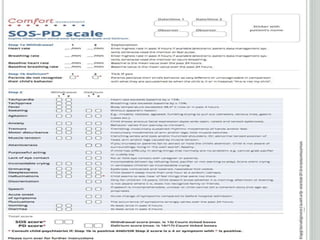
WITHDRAWAL ASSESSMENT TOOLS
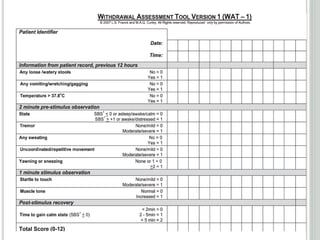
 WAT-1- Consists of four components
 1.review of patient records for past 12 hours
 2.observation of the patient for 2 minutes
 3.patient assessment during a progressive
stimulated exam to assess the level of
consciousness at beginning of each 12 hour shift
 4.assessment of poststimulation recovery
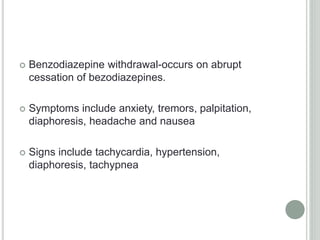
 Benzodiazepine withdrawal-occurs on abrupt
cessation of bezodiazepines.
 Symptoms include anxiety, tremors, palpitation,
diaphoresis, headache and nausea
 Signs include tachycardia, hypertension,
diaphoresis, tachypnea
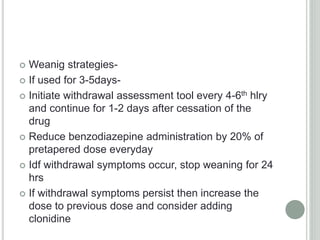
 Weanig strategies-
 If used for 3-5days-
 Initiate withdrawal assessment tool every 4-6th hlry
and continue for 1-2 days after cessation of the
drug
 Reduce benzodiazepine administration by 20% of
pretapered dose everyday
 Idf withdrawal symptoms occur, stop weaning for 24
hrs
 If withdrawal symptoms persist then increase the
dose to previous dose and consider adding
clonidine
 If used for 10days-
 Follow above guidelines
 Slower tapering of drug by 10% of pretapered dose
every day
 If withdrawal symptoms develop stop weaning for
24 hrs
 If withdrawal symptoms persist then increase the
dose to previous dose and consider adding
clonidine
Conversion strategies for benzodiazepines
 Iv midazolam to oral lorazepam-
 1.Calculate the last 24 hr midazolam infusion dose
 2.Dose in mg/8 gives the dose of lorazepam per
day in mg
 3.Give lorazepam in 4-6 divided doses
 4.After 2nd dose of lorazepam taper midazolam
infusion by 50%
 5.After 3rd taper further by 50%
 6.After 4th dose of lorazepam stop midazolam
infusion
Opioid withdrawal
 CNS- anxiety, irritability, trmors
 Gastrointestinal-nausea, vomiting, increased NG
aspirates, diarrhea
 Autonomic dysfunction-tachycardia, tachypnea,
hypertension, diaphoresis
/
 Weaning strategies-
 Conversion of IV morphine to oral-
 _mg/24 hr of IV multiplied by 3= _mg/24 hr of oral
morphine given 4-6th hrly
 Conversion of IV fentanyl to IV morphine-
 _ mcg/ 24 hrs iv fentanyl/1000 * 25= _mg/24 hr iv
morphine in 4-6 divided doses
 To convert iv fentanyl to oral morphine first convert
to iv morphine and then to oral morphine
 Once oral morphine is added then start tapering by
20%(3-5 days) or 10%(>10days) every day until 0.2
mg/ dose is achieved.
 Increase the interval rather than decreasing the
dose ie 4hrly-6hrly-8hrly-12hrly.
 Stop after 48hrs of 0.2mg 8th hrly for infants and
children and 0.2 mg 12th hrly for neonates
THANQ

Weaning and extubation

  • 1.
    WEANING AND EXTUBATIONAND MANAGEMENT OF SEDATION WITHDRAWAL Dr C Abhiram Kumar Fellow in PICU Aster CMI Hospital
  • 2.
     Introduction  Weaning Techniques of weaning  Predictive indices for weaning  Weaning failure  Extubation  Extubation failure  Role of tracheostomy  Sedation withdrawal  Management of sedation withdrawal
  • 3.
     The thoughtof weaning should begin from the day of intubation.  Too early or too late extubation have their own adverse consequences  60% of accidental extubations donot require reintubation
  • 4.
     Weaning- transitionfrom ventilatory support to spontaneous breathing during which time patient assumes the responsibility for effective gas exchange while positive pressure support is reduced  Extubation- The process of removal of the endotracheal tube
  • 6.
    WHEN TO CONSIDERWEANING???  Whether the disease is resolving or stable?  Is there adequate gas exchange?  Are the hemodynamics stable?  Is the patient having good respiratory drive?
  • 7.
    TECHNIQUES OF WEANING Old methods-  Full support  Partial support-SIMV/PS  CPAP  T-piece trial  New method  Establish readiness of weaning  SBT  Weaning parameters
  • 8.
     Spontaneous BreathingTrial(SBT)-  Subjective determination of whether the underlying disease process necessitating mechanical ventilation has improved to allow adequate gas exchange with spontaneous breathing  SBT using T-piece trials/ PSV/ CPAP  Initial screening and then 30-120min if tolerating  End SBT if patient shows signs of failure
  • 9.
    Monitoring parameters onSBT  Overall comfort status  Mental status  Respiratory rate and pattern  Hemodynamic stability  Satisfactory gas exchange  Effective cough
  • 10.
    Criteria for failureof SBT  Anxiety, diaphoresis  Agitated or drowsy  RR> 95th centile for age  Increased use of accesory muscles  Inability to maintain effective ventilation(<5ml/kg)  Increase in HR >20% from baseline  Hypertension or hypotension  pH<7.3/ pCO2 >50mm Hg or more than 10 from baseline
  • 11.
    Management of SBTfailure  Ventilatory muscle rest  Assesment of factors responsible for failure  Correction of factors  New attempt after 24hrs
  • 12.
    PREDICTIVE INDICES OFWEANING  Over 60 predictors of weaning success  RSBI and CROP index more commonly used.  RSBI- RR/VT(in L). <8bpm/ml/kg 63% sensitivity  CROP Index-dynamic compliance, RR, oxygenation, maximum inspiratory effort Cdyn* Pimax* PaO2/PAO2/ F >0.18ml/kg/bpm
  • 13.
    Factors contributing toweaning failure  A- Acid Base status  B- Breathing/respiratory factors  C- cardiac factors  D- Drugs and neurologic status  E- Electrolyte imbalance  Nutrition  Psychological status
  • 14.
    EXTUBATION FEASIBILITY  Controlledunderlying disease  No high dose of vasoactive drug  Approved SBT  FiO2<0.4 with SPO2>92%/ PF ratio >150MM HG  PEEP <5-8cm H2O  RSBI<8 cpm/ml/kg  Intact airway reflexes  Adequate conscience level  No/minimal UAO(Cuff leak test)
  • 15.
    Cuff Leak Test Predicts upper airway patency  Deflate the cuff  Hear for the leak of air  If no leak- chances of extubation failure high
  • 16.
    Technique of Extubation Withhold feeds for atleast 6 hrs prior to extubation  Position in semifowler position  Give 100% oxygen  Physiotherapy and ET suctioning  Oropharyngeal suctioning before cuff deflation  Withdraw tube during positive pressure inflation with AMBU bag  Administer humidified oxygen with head end elevated
  • 17.
    Post Extubation Complications 1.Stridor- Usually self limiting Rarely require steroid and/or nebulised adrenaline Can be minimised by administration of corticosteroids 6-12 hrs prior to extubation 2. Upper Lobe Atelectasis- Due to microaspirations Managed by postural physiotherapy/ 02/ CPAP
  • 18.
    EXTUBATION FAILURE  Reintubationwithin 24-48 hrs of extubation  Early- reintubation within 6hrs  Intermediate- reintubation within 6-24 hrs  Late- reintubation from 24-48 hrs of extubation
  • 19.
    SEDATION WITHDRAWAL  Tolerance-development of a need to increase the dose of a drug to achieve the same effect of the drug which was previously achieved at a lower dose  Physical Dependance- also called as neuroadaptation. Repeated administration of a drug which necessitates it’s continuous administration to prevent the appearance of withdrawal or abstinence syndrome that is characteristic to that drug
  • 20.
     Drugs thatcommonly cause abstinence syndrome in PICU- Opioids, Benzodiazepines, alpha agonist  Withdrawal syndromes usually develop after 3-5 days of continuous infusion and after 10days of intermittent therapy  Dependance also depends upon the duration of receptor activation
  • 21.
    WITHDRAWAL ASSESSMENT TOOLS WAT-1- Consists of four components  1.review of patient records for past 12 hours  2.observation of the patient for 2 minutes  3.patient assessment during a progressive stimulated exam to assess the level of consciousness at beginning of each 12 hour shift  4.assessment of poststimulation recovery
  • 24.
     Benzodiazepine withdrawal-occurson abrupt cessation of bezodiazepines.  Symptoms include anxiety, tremors, palpitation, diaphoresis, headache and nausea  Signs include tachycardia, hypertension, diaphoresis, tachypnea
  • 25.
     Weanig strategies- If used for 3-5days-  Initiate withdrawal assessment tool every 4-6th hlry and continue for 1-2 days after cessation of the drug  Reduce benzodiazepine administration by 20% of pretapered dose everyday  Idf withdrawal symptoms occur, stop weaning for 24 hrs  If withdrawal symptoms persist then increase the dose to previous dose and consider adding clonidine
  • 26.
     If usedfor 10days-  Follow above guidelines  Slower tapering of drug by 10% of pretapered dose every day  If withdrawal symptoms develop stop weaning for 24 hrs  If withdrawal symptoms persist then increase the dose to previous dose and consider adding clonidine
  • 27.
    Conversion strategies forbenzodiazepines  Iv midazolam to oral lorazepam-  1.Calculate the last 24 hr midazolam infusion dose  2.Dose in mg/8 gives the dose of lorazepam per day in mg  3.Give lorazepam in 4-6 divided doses  4.After 2nd dose of lorazepam taper midazolam infusion by 50%  5.After 3rd taper further by 50%  6.After 4th dose of lorazepam stop midazolam infusion
  • 28.
    Opioid withdrawal  CNS-anxiety, irritability, trmors  Gastrointestinal-nausea, vomiting, increased NG aspirates, diarrhea  Autonomic dysfunction-tachycardia, tachypnea, hypertension, diaphoresis
  • 29.
    /  Weaning strategies- Conversion of IV morphine to oral-  _mg/24 hr of IV multiplied by 3= _mg/24 hr of oral morphine given 4-6th hrly  Conversion of IV fentanyl to IV morphine-  _ mcg/ 24 hrs iv fentanyl/1000 * 25= _mg/24 hr iv morphine in 4-6 divided doses  To convert iv fentanyl to oral morphine first convert to iv morphine and then to oral morphine
  • 30.
     Once oralmorphine is added then start tapering by 20%(3-5 days) or 10%(>10days) every day until 0.2 mg/ dose is achieved.  Increase the interval rather than decreasing the dose ie 4hrly-6hrly-8hrly-12hrly.  Stop after 48hrs of 0.2mg 8th hrly for infants and children and 0.2 mg 12th hrly for neonates
  • 31.