Myers-Briggs Type Indicator
By
KUHU PATHAK
CMBA2
WHAT IS MBTI?
 A self report instrument
 Non judgmental
 An indicator of preferences
 Well researched
 Rich in theory
 Professionally interpreted
 Used internationally
 A way to sort, not to measure
History of MBTI…
 one of the most widely used self-report inventories
 based upon Swiss psychiatrist Carl Jung’s (1875-1961) notion
of psychological types
 He believed that differences between people are not random,
instead they form patterns – types
 The MBTI was first developed by Isabel Briggs Myers and her
mother, Katherine Cook Briggs in 1943
Myers-Briggs
• The Myers-Briggs test was developed by a mother/daughter team
in the 40’s based of off the lifelong work of Carl Jung.
• The test was intended to bring a everyday applications of Jung’s
work to the public in order to provide personality matches for
social and work environments.
• The test was a new interpretation of Jung’s theory and added to it
by including how people deal with the outside world.
• There have been over 600 dissertations written about the study
and 1000’s of articles and books.
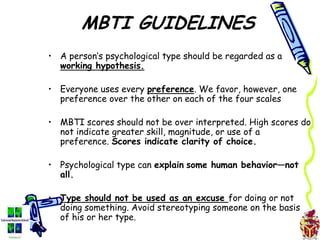
MBTI GUIDELINES
• A person’s psychological type should be regarded as a
working hypothesis.
• Everyone uses every preference. We favor, however, one
preference over the other on each of the four scales
• MBTI scores should not be over interpreted. High scores do
not indicate greater skill, magnitude, or use of a
preference. Scores indicate clarity of choice.
• Psychological type can explain some human behavior—not
all.
• Type should not be used as an excuse for doing or not
doing something. Avoid stereotyping someone on the basis
of his or her type.
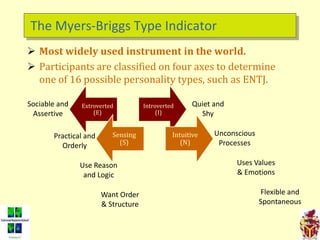
The Myers-Briggs Type Indicator
 Most widely used instrument in the world.
 Participants are classified on four axes to determine
one of 16 possible personality types, such as ENTJ.
Extroverted
(E)
Introverted
(I)
Sensing
(S)
Intuitive
(N)
Flexible and
Spontaneous
Sociable and
Assertive
Quiet and
Shy
Unconscious
Processes
Uses Values
& Emotions
Practical and
Orderly
Use Reason
and Logic
Want Order
& Structure
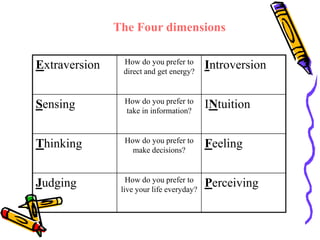
The Four dimensions
Extraversion How do you prefer to
direct and get energy?
Introversion
Sensing How do you prefer to
take in information?
INtuition
Thinking How do you prefer to
make decisions?
Feeling
Judging How do you prefer to
live your life everyday?
Perceiving
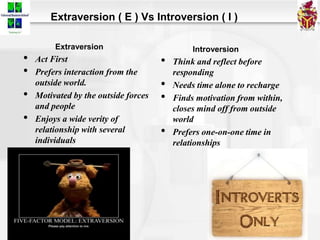
Extraversion ( E ) Vs Introversion ( I )
Extraversion
• Act First
• Prefers interaction from the
outside world.
• Motivated by the outside forces
and people
• Enjoys a wide verity of
relationship with several
individuals
Introversion
• Think and reflect before
responding
• Needs time alone to recharge
• Finds motivation from within,
closes mind off from outside
world
• Prefers one-on-one time in
relationships
MBTI
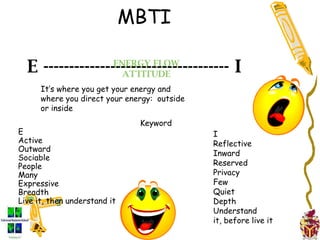
E ------------------------------------ IENERGY FLOW
ATTITUDE
It’s where you get your energy and
where you direct your energy: outside
or inside
Keyword
E
Active
Outward
Sociable
People
Many
Expressive
Breadth
Live it, then understand it
I
Reflective
Inward
Reserved
Privacy
Few
Quiet
Depth
Understand
it, before live it
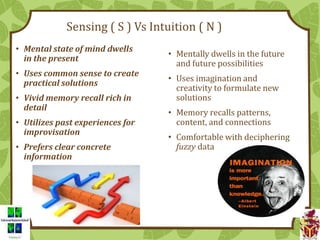
Sensing ( S ) Vs Intuition ( N )
• Mental state of mind dwells
in the present
• Uses common sense to create
practical solutions
• Vivid memory recall rich in
detail
• Utilizes past experiences for
improvisation
• Prefers clear concrete
information
• Mentally dwells in the future
and future possibilities
• Uses imagination and
creativity to formulate new
solutions
• Memory recalls patterns,
content, and connections
• Comfortable with deciphering
fuzzy data
MBTI
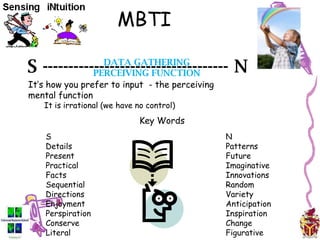
S ------------------------------------ NDATA GATHERING
PERCEIVING FUNCTION
It’s how you prefer to input - the perceiving
mental function
It is irrational (we have no control)
S
Details
Present
Practical
Facts
Sequential
Directions
Enjoyment
Perspiration
Conserve
Literal
N
Patterns
Future
Imaginative
Innovations
Random
Variety
Anticipation
Inspiration
Change
Figurative
Key Words
Thinking ( T ) Vs Feeling ( F )
• Make decisions based on
facts and logic
• Notices task and work to be
done
• Provides objective and
critical analysis
• Accept conflict as part of
human nature in relationships
• Use personal feeling to
make decisions
• Sensitive to the needs of
others and takes others into
consideration
• Seeks approval from peers
and sides with popular
opinion
• Becomes unsettled around
conflict and disorder
MBTI
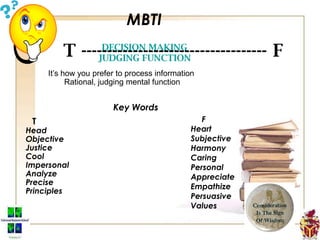
T ------------------------------------ FDECISION MAKING
JUDGING FUNCTION
It’s how you prefer to process information
Rational, judging mental function
Key Words
T
Head
Objective
Justice
Cool
Impersonal
Analyze
Precise
Principles
F
Heart
Subjective
Harmony
Caring
Personal
Appreciate
Empathize
Persuasive
Values
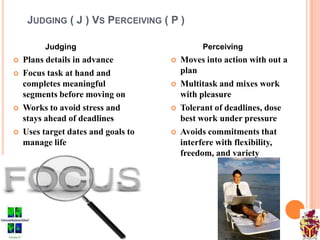
JUDGING ( J ) VS PERCEIVING ( P )
Judging
 Plans details in advance
 Focus task at hand and
completes meaningful
segments before moving on
 Works to avoid stress and
stays ahead of deadlines
 Uses target dates and goals to
manage life
Perceiving
 Moves into action with out a
plan
 Multitask and mixes work
with pleasure
 Tolerant of deadlines, dose
best work under pressure
 Avoids commitments that
interfere with flexibility,
freedom, and variety
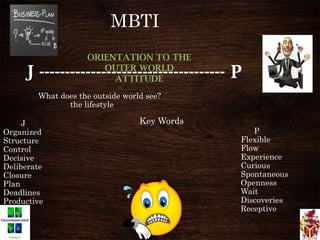
MBTI
J ------------------------------------ P
ORIENTATION TO THE
OUTER WORLD
ATTITUDE
What does the outside world see?
the lifestyle
Key WordsJ
Organized
Structure
Control
Decisive
Deliberate
Closure
Plan
Deadlines
Productive
P
Flexible
Flow
Experience
Curious
Spontaneous
Openness
Wait
Discoveries
Receptive
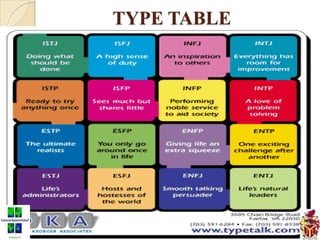
TYPE TABLE
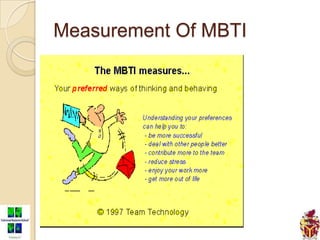
Measurement Of MBTI
CRITICS
• Trying to predict others behavior
• Trying to estimate another individual type (eg.
You must be an extravert because you are so
gregarious)
• Assuming that how a preference plays for you
is exactly how it would play out for someone
else
• Justifying behavior (eg. Declaring that the
individual must be P because he is always late)
THANK YOU

MBTI Model

  • 1.
  • 2.
    WHAT IS MBTI? A self report instrument  Non judgmental  An indicator of preferences  Well researched  Rich in theory  Professionally interpreted  Used internationally  A way to sort, not to measure
  • 3.
    History of MBTI… one of the most widely used self-report inventories  based upon Swiss psychiatrist Carl Jung’s (1875-1961) notion of psychological types  He believed that differences between people are not random, instead they form patterns – types  The MBTI was first developed by Isabel Briggs Myers and her mother, Katherine Cook Briggs in 1943
  • 4.
    Myers-Briggs • The Myers-Briggstest was developed by a mother/daughter team in the 40’s based of off the lifelong work of Carl Jung. • The test was intended to bring a everyday applications of Jung’s work to the public in order to provide personality matches for social and work environments. • The test was a new interpretation of Jung’s theory and added to it by including how people deal with the outside world. • There have been over 600 dissertations written about the study and 1000’s of articles and books.
  • 5.
    MBTI GUIDELINES • Aperson’s psychological type should be regarded as a working hypothesis. • Everyone uses every preference. We favor, however, one preference over the other on each of the four scales • MBTI scores should not be over interpreted. High scores do not indicate greater skill, magnitude, or use of a preference. Scores indicate clarity of choice. • Psychological type can explain some human behavior—not all. • Type should not be used as an excuse for doing or not doing something. Avoid stereotyping someone on the basis of his or her type.
  • 6.
    The Myers-Briggs TypeIndicator  Most widely used instrument in the world.  Participants are classified on four axes to determine one of 16 possible personality types, such as ENTJ. Extroverted (E) Introverted (I) Sensing (S) Intuitive (N) Flexible and Spontaneous Sociable and Assertive Quiet and Shy Unconscious Processes Uses Values & Emotions Practical and Orderly Use Reason and Logic Want Order & Structure
  • 7.
    The Four dimensions ExtraversionHow do you prefer to direct and get energy? Introversion Sensing How do you prefer to take in information? INtuition Thinking How do you prefer to make decisions? Feeling Judging How do you prefer to live your life everyday? Perceiving
  • 8.
    Extraversion ( E) Vs Introversion ( I ) Extraversion • Act First • Prefers interaction from the outside world. • Motivated by the outside forces and people • Enjoys a wide verity of relationship with several individuals Introversion • Think and reflect before responding • Needs time alone to recharge • Finds motivation from within, closes mind off from outside world • Prefers one-on-one time in relationships
  • 9.
    MBTI E ------------------------------------ IENERGYFLOW ATTITUDE It’s where you get your energy and where you direct your energy: outside or inside Keyword E Active Outward Sociable People Many Expressive Breadth Live it, then understand it I Reflective Inward Reserved Privacy Few Quiet Depth Understand it, before live it
  • 10.
    Sensing ( S) Vs Intuition ( N ) • Mental state of mind dwells in the present • Uses common sense to create practical solutions • Vivid memory recall rich in detail • Utilizes past experiences for improvisation • Prefers clear concrete information • Mentally dwells in the future and future possibilities • Uses imagination and creativity to formulate new solutions • Memory recalls patterns, content, and connections • Comfortable with deciphering fuzzy data
  • 11.
    MBTI S ------------------------------------ NDATAGATHERING PERCEIVING FUNCTION It’s how you prefer to input - the perceiving mental function It is irrational (we have no control) S Details Present Practical Facts Sequential Directions Enjoyment Perspiration Conserve Literal N Patterns Future Imaginative Innovations Random Variety Anticipation Inspiration Change Figurative Key Words
  • 12.
    Thinking ( T) Vs Feeling ( F ) • Make decisions based on facts and logic • Notices task and work to be done • Provides objective and critical analysis • Accept conflict as part of human nature in relationships • Use personal feeling to make decisions • Sensitive to the needs of others and takes others into consideration • Seeks approval from peers and sides with popular opinion • Becomes unsettled around conflict and disorder
  • 13.
    MBTI T ------------------------------------ FDECISIONMAKING JUDGING FUNCTION It’s how you prefer to process information Rational, judging mental function Key Words T Head Objective Justice Cool Impersonal Analyze Precise Principles F Heart Subjective Harmony Caring Personal Appreciate Empathize Persuasive Values
  • 14.
    JUDGING ( J) VS PERCEIVING ( P ) Judging  Plans details in advance  Focus task at hand and completes meaningful segments before moving on  Works to avoid stress and stays ahead of deadlines  Uses target dates and goals to manage life Perceiving  Moves into action with out a plan  Multitask and mixes work with pleasure  Tolerant of deadlines, dose best work under pressure  Avoids commitments that interfere with flexibility, freedom, and variety
  • 15.
    MBTI J ------------------------------------ P ORIENTATIONTO THE OUTER WORLD ATTITUDE What does the outside world see? the lifestyle Key WordsJ Organized Structure Control Decisive Deliberate Closure Plan Deadlines Productive P Flexible Flow Experience Curious Spontaneous Openness Wait Discoveries Receptive
  • 16.
  • 17.
  • 18.
    CRITICS • Trying topredict others behavior • Trying to estimate another individual type (eg. You must be an extravert because you are so gregarious) • Assuming that how a preference plays for you is exactly how it would play out for someone else • Justifying behavior (eg. Declaring that the individual must be P because he is always late)
  • 19.

Editor's Notes

  • #3 indicates a person’s preferred ways of functioning indicates our less preferred ways of functioning
  • #11 repeatedly come back to a subject; persistently complain about, Think moodily or anxiously about somethingOriginateFuz: Confused deciphering: Read with difficulty , Convert code into ordinary language