Type & Project Management:Putting Type on the Critical PathPresented by:Jennifer Tucker, PMPConsulting DirectorOKA (Otto Kroeger Associates)(703) 591-6284 x111jtucker@typetalk.comwww.typetalk.com
AgendaIntroduce key elements of the project life cycle – and the language that drives project managers and their teams. Explore how type can be seen across projects of all sizes and kinds, and used as a diagnostic tool. Discuss and share type-related training designs that type professionals can use with project teams.2
3Project Management TalkThe Project Management Body of Knowledge (PMBOK) describes a project as:  A project is a temporary endeavor, undertaken to create a unique product or service. This means that every project has a definite beginning and a definite end. A project team – as a team – seldom outlives the project. Once the project is complete, they are disbanded, and members move on to other projects and other teams. Projects are first and foremost outcome driven – it is the ultimate product or service, assessed against performance measures, which determines project success.
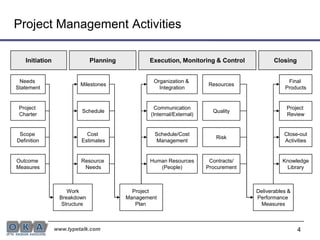
4Project Management ActivitiesInitiationPlanningExecution, Monitoring & ControlClosingNeeds StatementMilestonesOrganization & IntegrationResourcesFinal ProductsProject CharterScheduleCommunication(Internal/External)QualityProject ReviewScope DefinitionCost EstimatesRiskSchedule/CostManagementClose-outActivitiesOutcome MeasuresResource NeedsHuman Resources(People)Contracts/ProcurementKnowledgeLibraryWorkBreakdownStructure Project ManagementPlan Deliverables &Performance Measures
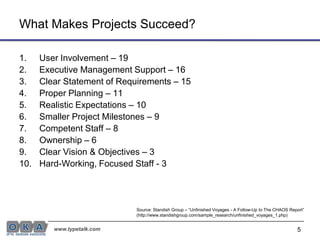
5What Makes Projects Succeed? User Involvement – 19Executive Management Support – 16Clear Statement of Requirements – 15Proper Planning – 11Realistic Expectations – 10Smaller Project Milestones – 9Competent Staff – 8Ownership – 6Clear Vision & Objectives – 3Hard-Working, Focused Staff - 3Source: Standish Group – “Unfinished Voyages - A Follow-Up to The CHAOS Report” (http://www.standishgroup.com/sample_research/unfinished_voyages_1.php)
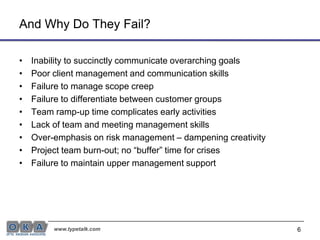
And Why Do They Fail? Inability to succinctly communicate overarching goalsPoor client management and communication skillsFailure to manage scope creepFailure to differentiate between customer groupsTeam ramp-up time complicates early activitiesLack of team and meeting management skills   Over-emphasis on risk management – dampening creativityProject team burn-out; no “buffer” time for crisesFailure to maintain upper management support6
Learning Quickly About A Project 7
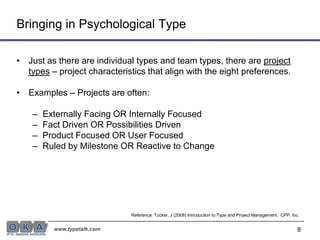
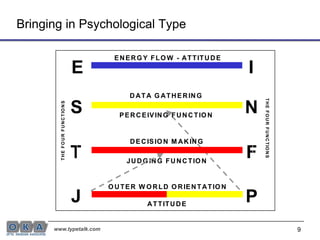
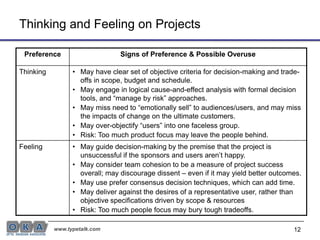
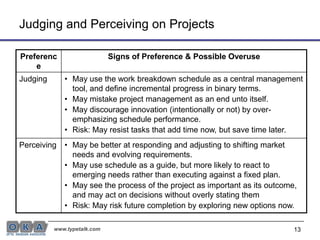
8Bringing in Psychological TypeJust as there are individual types and team types, there are project types – project characteristics that align with the eight preferences.Examples – Projects are often: Externally Facing OR Internally Focused Fact Driven OR Possibilities DrivenProduct Focused OR User FocusedRuled by Milestone OR Reactive to ChangeReference: Tucker, J (2008) Introduction to Type and Project Management.  CPP, Inc.
9Bringing in Psychological Type
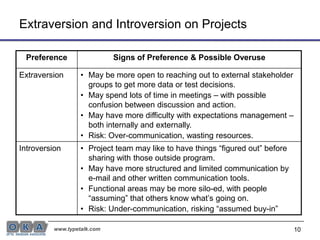
10Extraversion and Introversion on Projects
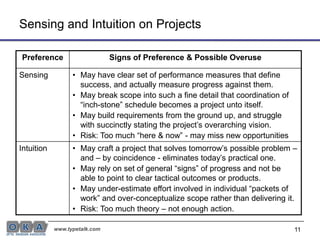
11Sensing and Intuition on Projects
12Thinking and Feeling on Projects
13Judging and Perceiving on Projects
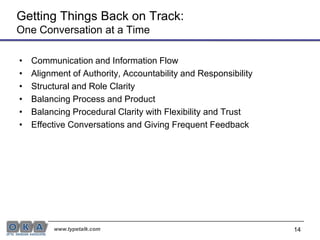
Getting Things Back on Track:One Conversation at a Time Communication and Information FlowAlignment of Authority, Accountability and ResponsibilityStructural and Role ClarityBalancing Process and Product Balancing Procedural Clarity with Flexibility and Trust Effective Conversations and Giving Frequent Feedback 14
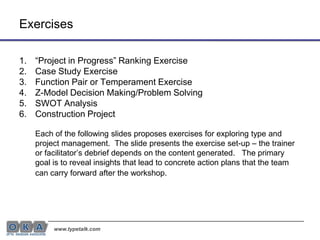
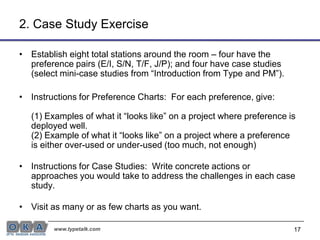
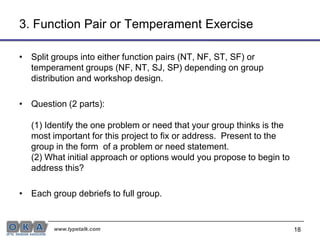
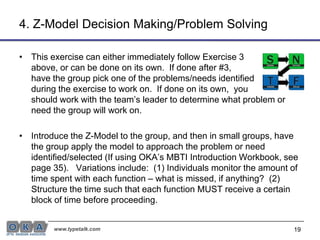
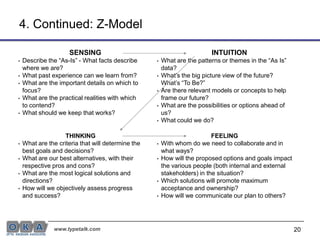
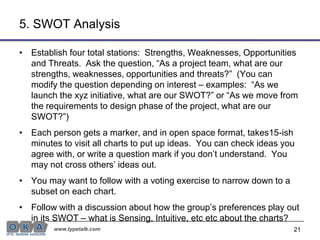
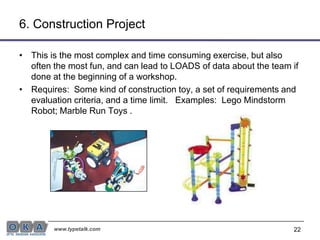
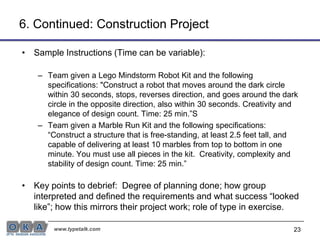
Exercises “Project in Progress” Ranking ExerciseCase Study Exercise   Function Pair or Temperament Exercise  Z-Model Decision Making/Problem Solving  SWOT Analysis  Construction Project  Each of the following slides proposes exercises for exploring type and project management.  The slide presents the exercise set-up – the trainer or facilitator’s debrief depends on the content generated.   The primary goal is to reveal insights that lead to concrete action plans that the team can carry forward after the workshop.
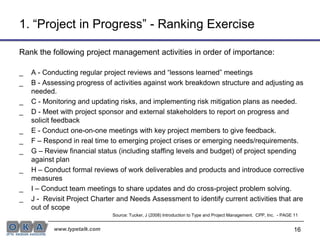
161. “Project in Progress” - Ranking ExerciseRank the following project management activities in order of importance: A - Conducting regular project reviews and “lessons learned” meetings
B - Assessing progress of activities against work breakdown structure and adjusting as needed.
C - Monitoring and updating risks, and implementing risk mitigation plans as needed.
D - Meet with project sponsor and external stakeholders to report on progress and solicit feedback
E - Conduct one-on-one meetings with key project members to give feedback.
F – Respond in real time to emerging project crises or emerging needs/requirements.
G – Review financial status (including staffing levels and budget) of project spending against plan
H – Conduct formal reviews of work deliverables and products and introduce corrective measures
I – Conduct team meetings to share updates and do cross-project problem solving.

Type/MBTI and Project Management

  • 1.
    Type & ProjectManagement:Putting Type on the Critical PathPresented by:Jennifer Tucker, PMPConsulting DirectorOKA (Otto Kroeger Associates)(703) 591-6284 x111jtucker@typetalk.comwww.typetalk.com
  • 2.
    AgendaIntroduce key elementsof the project life cycle – and the language that drives project managers and their teams. Explore how type can be seen across projects of all sizes and kinds, and used as a diagnostic tool. Discuss and share type-related training designs that type professionals can use with project teams.2
  • 3.
    3Project Management TalkTheProject Management Body of Knowledge (PMBOK) describes a project as: A project is a temporary endeavor, undertaken to create a unique product or service. This means that every project has a definite beginning and a definite end. A project team – as a team – seldom outlives the project. Once the project is complete, they are disbanded, and members move on to other projects and other teams. Projects are first and foremost outcome driven – it is the ultimate product or service, assessed against performance measures, which determines project success.
  • 4.
    4Project Management ActivitiesInitiationPlanningExecution,Monitoring & ControlClosingNeeds StatementMilestonesOrganization & IntegrationResourcesFinal ProductsProject CharterScheduleCommunication(Internal/External)QualityProject ReviewScope DefinitionCost EstimatesRiskSchedule/CostManagementClose-outActivitiesOutcome MeasuresResource NeedsHuman Resources(People)Contracts/ProcurementKnowledgeLibraryWorkBreakdownStructure Project ManagementPlan Deliverables &Performance Measures
  • 5.
    5What Makes ProjectsSucceed? User Involvement – 19Executive Management Support – 16Clear Statement of Requirements – 15Proper Planning – 11Realistic Expectations – 10Smaller Project Milestones – 9Competent Staff – 8Ownership – 6Clear Vision & Objectives – 3Hard-Working, Focused Staff - 3Source: Standish Group – “Unfinished Voyages - A Follow-Up to The CHAOS Report” (http://www.standishgroup.com/sample_research/unfinished_voyages_1.php)
  • 6.
    And Why DoThey Fail? Inability to succinctly communicate overarching goalsPoor client management and communication skillsFailure to manage scope creepFailure to differentiate between customer groupsTeam ramp-up time complicates early activitiesLack of team and meeting management skills Over-emphasis on risk management – dampening creativityProject team burn-out; no “buffer” time for crisesFailure to maintain upper management support6
  • 7.
  • 8.
    8Bringing in PsychologicalTypeJust as there are individual types and team types, there are project types – project characteristics that align with the eight preferences.Examples – Projects are often: Externally Facing OR Internally Focused Fact Driven OR Possibilities DrivenProduct Focused OR User FocusedRuled by Milestone OR Reactive to ChangeReference: Tucker, J (2008) Introduction to Type and Project Management. CPP, Inc.
  • 9.
  • 10.
  • 11.
  • 12.
  • 13.
  • 14.
    Getting Things Backon Track:One Conversation at a Time Communication and Information FlowAlignment of Authority, Accountability and ResponsibilityStructural and Role ClarityBalancing Process and Product Balancing Procedural Clarity with Flexibility and Trust Effective Conversations and Giving Frequent Feedback 14
  • 15.
    Exercises “Project inProgress” Ranking ExerciseCase Study Exercise Function Pair or Temperament Exercise Z-Model Decision Making/Problem Solving SWOT Analysis Construction Project Each of the following slides proposes exercises for exploring type and project management. The slide presents the exercise set-up – the trainer or facilitator’s debrief depends on the content generated. The primary goal is to reveal insights that lead to concrete action plans that the team can carry forward after the workshop.
  • 16.
    161. “Project inProgress” - Ranking ExerciseRank the following project management activities in order of importance: A - Conducting regular project reviews and “lessons learned” meetings
  • 17.
    B - Assessingprogress of activities against work breakdown structure and adjusting as needed.
  • 18.
    C - Monitoringand updating risks, and implementing risk mitigation plans as needed.
  • 19.
    D - Meetwith project sponsor and external stakeholders to report on progress and solicit feedback
  • 20.
    E - Conductone-on-one meetings with key project members to give feedback.
  • 21.
    F – Respondin real time to emerging project crises or emerging needs/requirements.
  • 22.
    G – Reviewfinancial status (including staffing levels and budget) of project spending against plan
  • 23.
    H – Conductformal reviews of work deliverables and products and introduce corrective measures
  • 24.
    I – Conductteam meetings to share updates and do cross-project problem solving.