


Page 1
Page 2
•Personality is
influenced by
both nature
(heredity or
genetic make-up)
and nurture
(environment).
Page 3
• There is no single
gene that creates a
trait. It is always a
complex combination
of genes,
environmental
exposure and
experiences and
cultural backgrounds.
Page 4
•Agreeableness
and openness to
experiences are
some examples
of these cross-
cultural traits.
Page 5
Example:
• Exhibits strong
“interpersonal
relatedness” or how their
behavior impacts
relationships, compared to
Westerners who look at
their behavior and its
impact on their personal
goals.
Page 6
Example:
•Asian pursuing a
career by migrating
to another country
will always consider
how this will affect
his family and social
ties at home.
Page 7
Example:
•Westerner on the
other hand will see
working overseas as
a career move that
will enhance career
growth.
Page 8
Page 9
Trait Theories
•Is an approach in
identifying types of
personalities based
on certain traits or
attributes, which vary
from one person to
the other.
Page 10
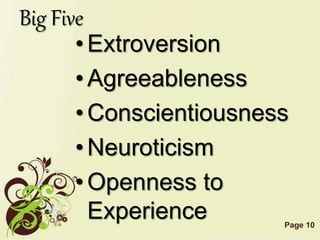
Big Five
•Extroversion
•Agreeableness
•Conscientiousness
•Neuroticism
•Openness to
Experience
Page 11
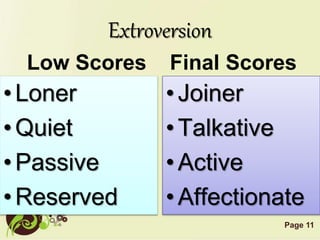
Extroversion
Low Scores
•Loner
•Quiet
•Passive
•Reserved
Final Scores
•Joiner
•Talkative
•Active
•Affectionate
Page 12
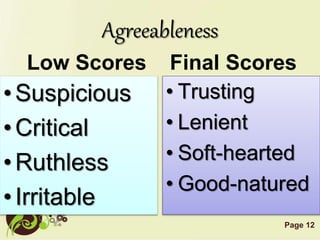
Agreeableness
Low Scores
•Suspicious
•Critical
•Ruthless
•Irritable
Final Scores
• Trusting
• Lenient
• Soft-hearted
• Good-natured
Page 13
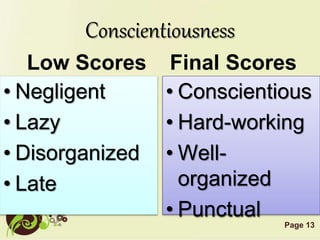
Conscientiousness
Low Scores
• Negligent
• Lazy
• Disorganized
• Late
Final Scores
• Conscientious
• Hard-working
• Well-
organized
• Punctual
Page 14
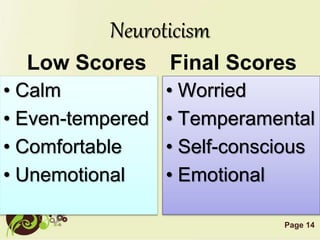
Neuroticism
Low Scores
• Calm
• Even-tempered
• Comfortable
• Unemotional
Final Scores
• Worried
• Temperamental
• Self-conscious
• Emotional
Page 15
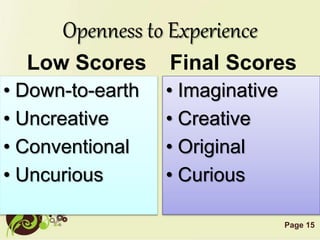
Openness to Experience
Low Scores
• Down-to-earth
• Uncreative
• Conventional
• Uncurious
Final Scores
• Imaginative
• Creative
• Original
• Curious
Page 16
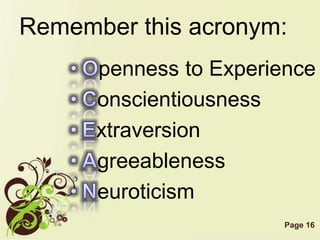
Remember this acronym:
penness to Experience
onscientiousness
xtraversion
greeableness
euroticism
Page 17
These dimensions described using its most
positive traits
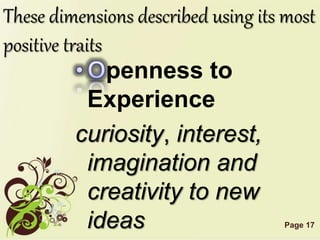
penness to
Experience
curiosity, interest,
imagination and
creativity to new
ideas
Page 18
These dimensions described using its most
positive traits
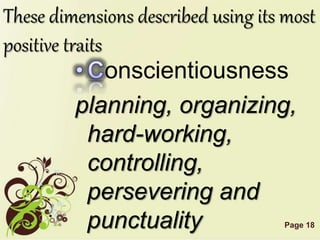
onscientiousness
planning, organizing,
hard-working,
controlling,
persevering and
punctuality
Page 19
These dimensions described using its most
positive traits
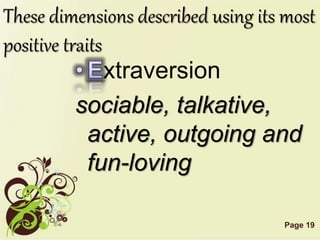
xtraversion
sociable, talkative,
active, outgoing and
fun-loving
Page 20
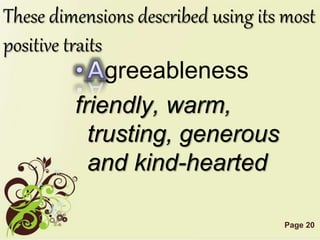
These dimensions described using its most
positive traits
greeableness
friendly, warm,
trusting, generous
and kind-hearted
Page 21
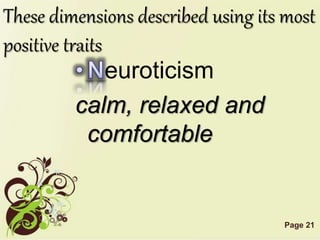
These dimensions described using its most
positive traits
euroticism
calm, relaxed and
comfortable
Page 22
Personality Traits
• is a disposition to
behave consistently in a
particular way, while
personality is a broader
term that comprises of
traits, motives,
thoughts, self-concept
and feelings.
Page 23
Performance Task # 3
•Group the class
into five and
make a short skit
about the five-
factor model.
Page 24
Assignment:
• Make a research about:
Rorschach Inkblot Test
Myer’s-Briggs Type
Indicator
Keirsey Temperament
Sorter

Nature, nurture and personality