Whatever the circumstances of your life, the understanding of type can make
your perceptions clearer, your judgments sounder and your life closer to your
heart’s desire.
Isabel Briggs Myers
Myers-Briggs Type Indicator (MBTI)
Agenda: Myers-Briggs Type Indicator (MBTI)
2
• Introductions
• Agenda and Objectives
• MBTI Review
• Identifying the “Best-Fit” MBTI Type: Self-Select and Report
• Takeaways
• Stress: Expression by Type
• Problem Solving/Conflict/Contributions of Each Type
• Communications/Change
• Teamwork/Work Styles
• Action Plan
Objectives
3
• Review the history and basics of the Myers-Briggs Type Indicator
(MBTI) and how it is used
• Identify the description and general characteristics of each preference
scale
• Indicate each participant’s type by comparing your self-selection and
the MBTI results of the “Best-Fit” Type
• Look at ways to use your MBTI Type to your advantage
The MBTI: What is it?
4
• The most valid and widely taken personality style indicator in history:
more than two million people have taken it this year
• A self-administering questionnaire
• Based on Carl Jung’s notion that behavior is predictable at some level
due to preferences people have for…
• Taking in information and focusing attention
• Making decisions
• Organizing their lives
The MBTI: The Results
5
• Results reflect hard-wired preferences akin to left- or right-handedness,
not to skill, ability, mental health or intelligence
• Respondents come out as one of 16 different personality types
• These type preferences offer profound insight into people’s tendencies,
impact on teams, style of leadership and personal and professional
development paths
The MBTI: Uses
6
A means to describe preferences
• People are different psychologically as well as physically
• Psychological differences affect how we see the world
A tool to help individuals…
• Reflect on themselves and their behaviors
• Appreciate others’ differences in a constructive fashion
• Understand the benefits of differing approaches to problem solving
A method used by teams to…
• Create an objective framework for examining emotional issues
• Facilitate team communications and problem solving
• Identify sources of conflict
• Value the unique contributions of other team members
The MBTI does NOT attempt to…
7
• Explain all of human behavior
• Measure “good” and “bad” or “best” and “worst”
• Assess ability, skills, competencies or intelligence
• Evaluate stress levels
• Create a method to stereotype or “pigeonhole”
• Diagnose psychological disorders
The MBTI: Preferences along four scales
8
• Extraversion and Introversion: Where do you get you energy from?
• Sensing and iNtuition: How do you acquire information and focus
attention?
• Thinking and Feeling: How do you make decisions?
• Judging and Perceiving: How do you deal with the external world?
There is no right or wrong answer, or better or worse preference. Everyone
uses each of the above preferences in one way to some degree. The
important question is, which side of the scale do you naturally prefer?
Attitude Function: Where do you get your energy from?
9
The Extraverted Attitude (E)
• An Extravert (E) seems to express their attention outward as if it flows,
or is drawn, out of the objects and people in their environment
• Their stimulation is essentially extracted from the environment, the outer
world of people and things
The Introverted Attitude (I)
• An Introvert (I) seems to reflect on their energy as if it is drawn from the
environment and consolidated within one’s own position
• Their stimulation is drawn from within their own environment, the inner
world of thought and reflection
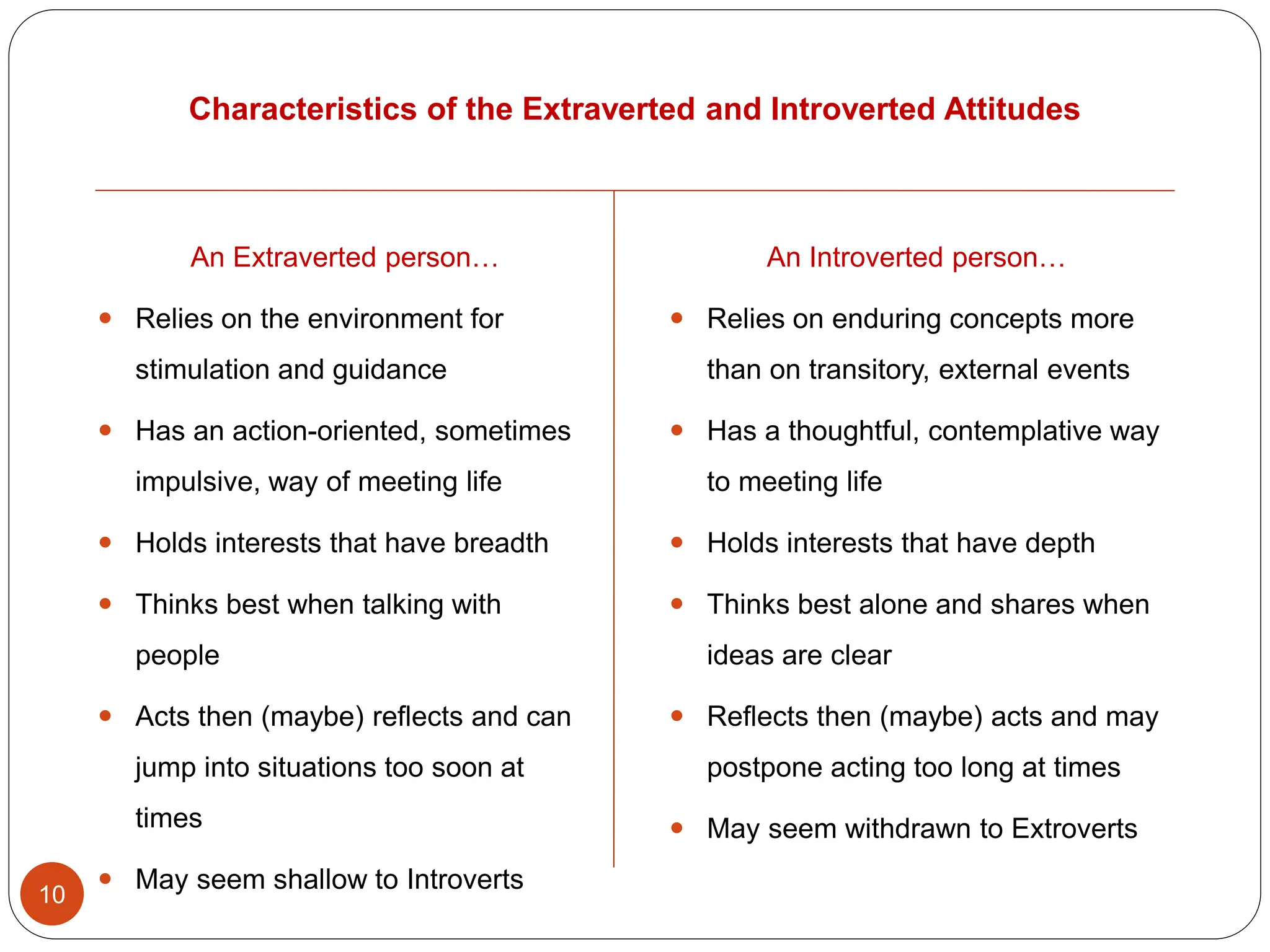
Characteristics of the Extraverted and Introverted Attitudes
10
An Introverted person…
 Relies on enduring concepts more
than on transitory, external events
 Has a thoughtful, contemplative way
to meeting life
 Holds interests that have depth
 Thinks best alone and shares when
ideas are clear
 Reflects then (maybe) acts and may
postpone acting too long at times
 May seem withdrawn to Extroverts
An Extraverted person…
 Relies on the environment for
stimulation and guidance
 Has an action-oriented, sometimes
impulsive, way of meeting life
 Holds interests that have breadth
 Thinks best when talking with
people
 Acts then (maybe) reflects and can
jump into situations too soon at
times
 May seem shallow to Introverts
Perceiving Functions: How do you focus your attention?
11
The Sensing Perception (S)
• A Sensing (S) person tends to rely on perceptions that are observable
by the five senses, sight, sound, touch, taste and smell
• A Sensing person focuses their attention on reality and on what
currently exists in the environment
The iNtuitive Perception (N)
• A iNtuitive (N) person tends to rely on the perception of possibilities
that are translated via the unconscious
• An iNtuitive person focuses attention on meanings or on possibilities
beyond what is visible to the senses
Characteristics of the Sensing and iNtuitive Functions
12
An iNtuitive person…
 Has an imaginative or theoretical
orientation
 Appreciates meaning, “the big
picture” and patterns
 Values communication that is
figurative and abstract
 Holds interests that have depth
 Focuses on patterns and
correlations
 May seem fickle or impractical to Ss
A Sensing person…
 Has a realistic and practical
orientation
 Appreciates facts, details and
specifics
 Prefers communication that is literal
and concrete
 Focuses on specific parts or pieces
of a topic
 May seem materialistic and literal-
minded to Ns
Judging Functions: How do you make decisions?
13
The Thinking Judgment (T)
• A Thinking (T) person links ideas together by making logical and often
impersonal connections and relies on the principles of cause and effect
• A Thinking person uses this decision-making function to make objective
judgments based on logic
The Feeling Judgment (F)
• A Feeling (F) person weighs relative values and merits of an issue based on
personal feelings or impact
• A Feeling person uses this decision-making function to make subjective
judgments based on personal values and relies on an understanding of personal
and group values
Characteristics of the Thinking and Feeling Functions
14
A Feeling person…
 Decides with their heart
 Tends to excel in empathetic abilities
 Is concerned with a decision’s impact on
others
 Desires harmony
 Tends to appreciate the strengths and
ideas of others
 Frequently is accommodating to others
 Offers praise
 May seem fuzzy-minded and emotional to
Ts
A Thinking person…
 Makes decisions with their head
 Tends to excel in analytical abilities
 Is concerned with a logical decision
 Is oriented toward a situation based on
connections in time—from the past
through the future
 Tends to critique the deficiencies and
ideas of others and finds flaws in most
circumstances
 Frequently questions their experiences
 May seem cold and condescending to Fs
world?
15
The Judging Attitude (J)
• A Judging (J) person is concerned with making decision, seeking
closure, planning operations or organizing activities
• Their lifestyle is decisive, planned and orderly
The Perceptive Attitude (P)
• A Perceptive (P) person is concerned with assimilating as much
incoming information as possible and postponing decision-making
• Their lifestyle is flexible, adaptable and spontaneous
Characteristics of the Judging and Perceiving Attitude
16
A Perceiving person…
 Lives to experience and seeks
opportunities
(“Pencil” to-do-list)
 Enjoys being curious and keeping options
open for as long as possible
 Meets deadlines by last minute rush
 Is adaptable in their attitude
 Prefers to experience life as it happens
 May seem disorganized, messy or
irresponsible to Js
A Judging person…
 Lives to organize, plan and decide
(“Pen” to-do list)
 Enjoys making decisions, coming to
closure or reaching conclusions
 Handles deadlines and plans well in
advance
 Is decisive in attitude and action
 Prefers to have life under control
 May seem demanding, rigid and uptight
to Ps
Class “Type” Matrix
17
ISTJ ISFJ INFJ INTJ
ISTP ISFP INFP INTP
ESTP ESFP ENFP ENTP
ESTJ ESFJ ENFJ ENTJ
N
S
E
I
P
F
J
J
T
T
“Z” Problem Solving Model
18
Sensing
Sensing individuals
focus on the present
and rely on facts and
“what is”
INtuition
Intuitive individuals focus on
the future and reflect on
possibilities and “the big
picture”
Thinking
Thinking individuals
tend to be logical and
objective
Feeling
Feeling individuals tend to
be value-based and have an
impact on others
Perceiving
Perceiving individuals take their time
Judging
Judging individuals make choices
The Power of MBTI: Awareness and Appreciation
19
On an individual level, the MBTI will help you to…
• Be aware of your preferences, strengths and potential pitfalls
• Reflect on how they may be assisting you with or detracting from your communication with
others
On an interpersonal level, the MBTI will help you to…
• Reflect on others’ thoughts and feelings
• Listen to their responses for clues about their preferences
• Acknowledge their perspective and be more empathetic
• Speak from your own perspective after you hear another’s point-of-view
On both levels, the MBTI will help you to…
• Focus dialogue on an overall goal for a particular situation or behavior, not on the person
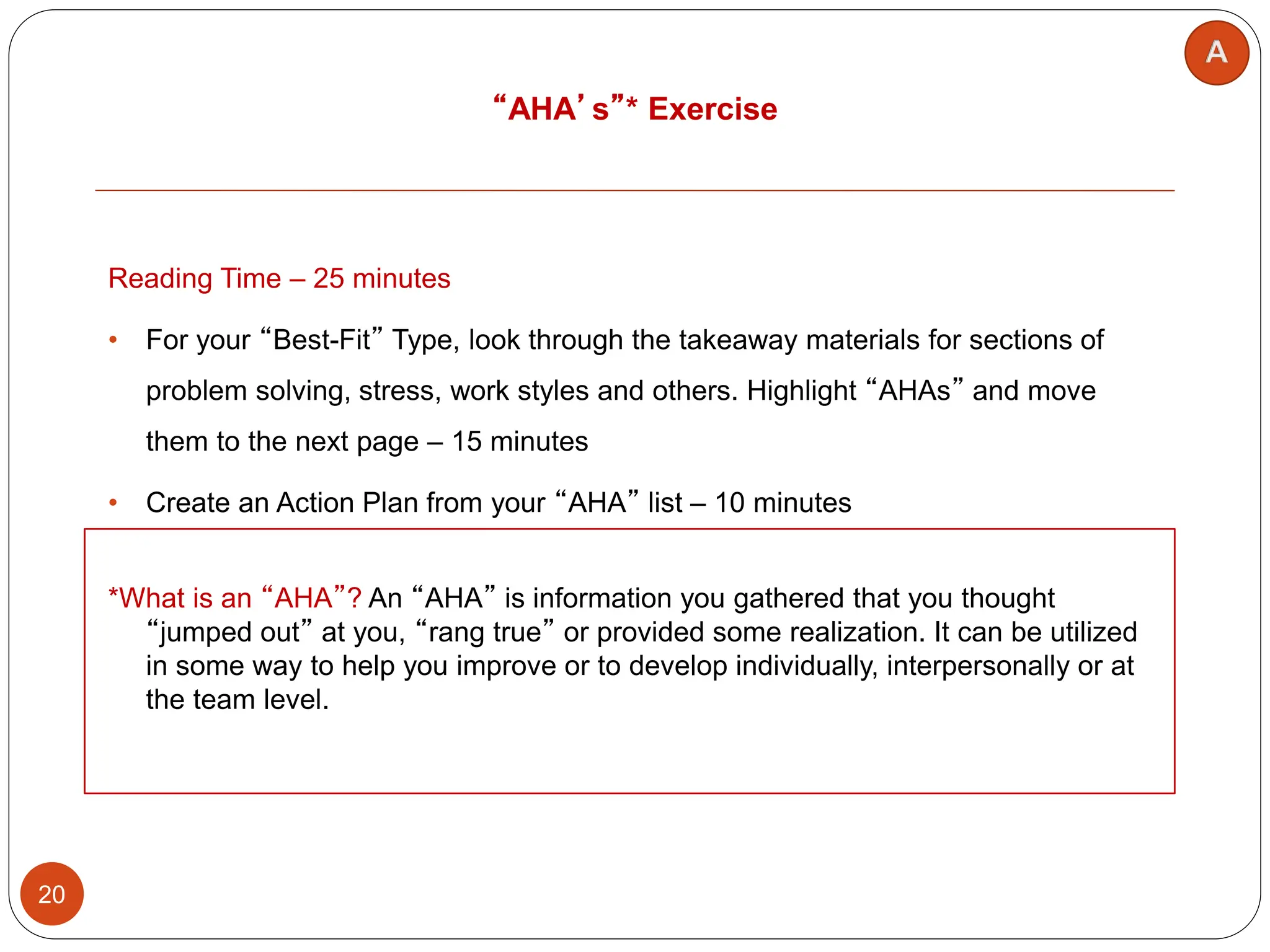
“AHA’s”* Exercise
20
Reading Time – 25 minutes
• For your “Best-Fit” Type, look through the takeaway materials for sections of
problem solving, stress, work styles and others. Highlight “AHAs” and move
them to the next page – 15 minutes
• Create an Action Plan from your “AHA” list – 10 minutes
*What is an “AHA”? An “AHA” is information you gathered that you thought
“jumped out” at you, “rang true” or provided some realization. It can be utilized
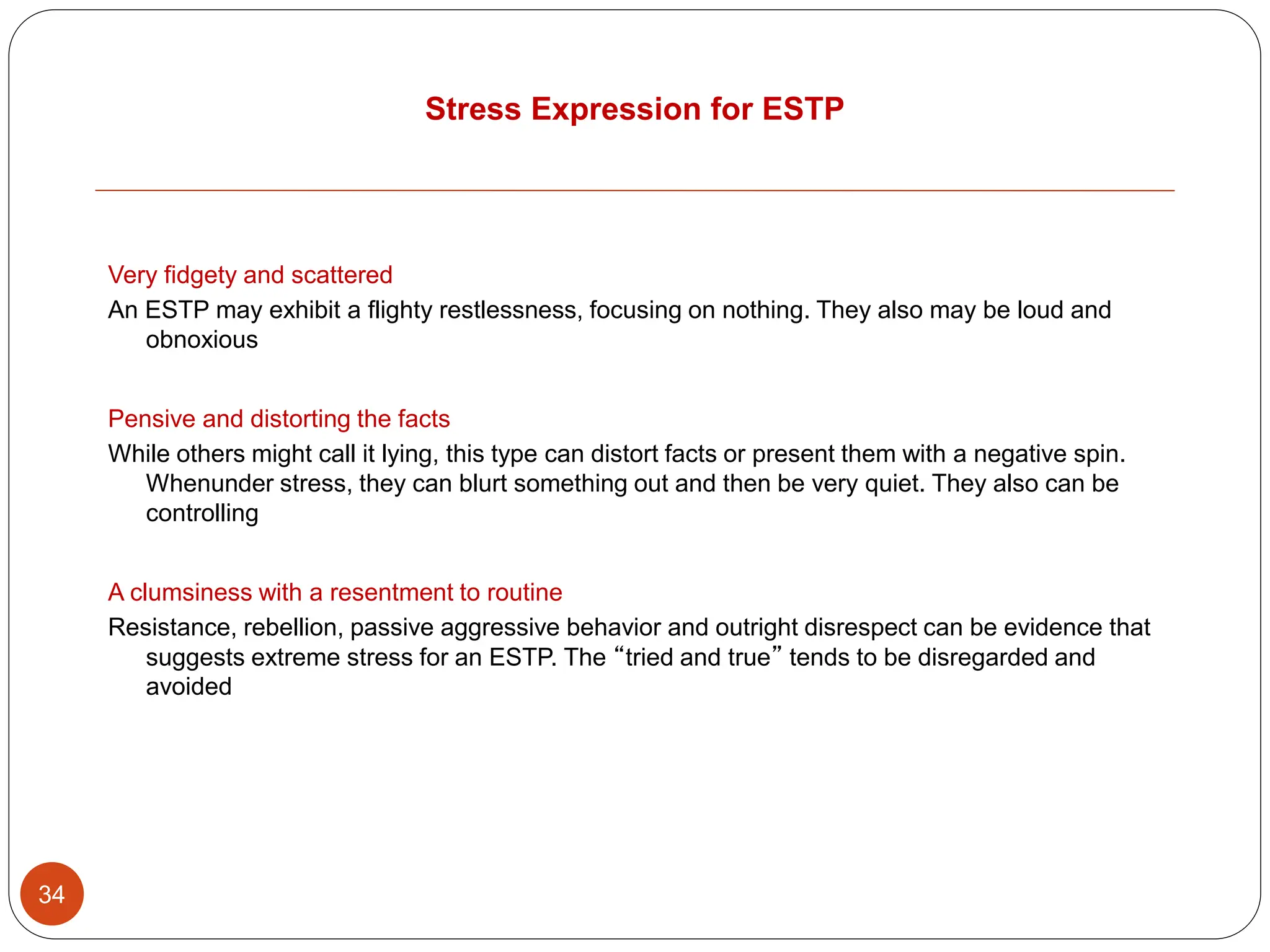
in some way to help you improve or to develop individually, interpersonally or at
the team level.
The Power of MBTI: Awareness and Appreciation
21
Individual
•
•
•
•
•
•
Interpersonal
•
•
•
•
•
•
Individual, Interpersonal or
Other
•
•
•
•
•
•
Group Discussion
22
• Those who feel comfortable doing so, share with the group which “AHAs”
emerged for you
• Capture the Themes* on a flipchart
• What Themes emerged from the discussion
• *What is a “Theme”? A Theme is a general, implicit or recurring idea that
emerges throughout your experience.
Jungian Functions: Problem Solving by Sensors
23
A Sensor approaches problem solving by…
• Listing the facts based on what experience has shown them
• Verifying the reality of the situation or problem
• Understanding the details of the problem at hand
• Being Descriptive of the problem
A Sensor deals best with problem solving by trusting the facts and evidence. A
Sensor is most adept at solving problems that they can get their hands on,
literally, and that move them toward some practical and tangible results. A Sensor
believes that it is inefficient or unproductive to spend a lot of time discussing a
solution or theorizing about alternatives.
Jungian Functions: Problem Solving by iNtuitives
24
An iNtuitive approaches problem solving by…
• Letting their imagination “run wild”
• Seeing the big picture and emerging patterns
• Generating alternatives and possibilities
• Brainstorming
An iNtuitive will not touch a problem until all of the alternatives have been considered and
various schemes have been drawn to cover every aspect of the situation. An iNtuitive
believes that problems are best solved when they are set in a context that gives perspective
to a bigger picture. For example, the iNtuitive may perceive a dripping faucet as part of a
larger problem, such as water pressure or even the design of the kitchen or bathroom. Thus,
a proper solution involves acquiring books on home repair, perusing catalogs of new fixtures
or drawing a schema of the entire system.
Jungian Functions: Problem Solving by Thinkers
25
A Thinker approaches problem solving by…
• Analyzing the situation
• Verifying the reality of the situation or problem
• Reviewing the “pros,” “cons” and logical consequences
• Being descriptive of the problem
A Thinker contributes to the group by keeping everyone aware of the potential
consequence of any given action. A Thinker tends to approach problem solving
by weighing the cause and effect of each action carefully. This allows them to
stay removed from the problem solving process so as not to become overly
involved with the personal aspects of the issues. Because they are human, a
thinker will have a more difficult time staying objective when confronted with the
same problems themselves.
Jungian Functions: Problem Solving by Feelers
26
A Feeler approaches problem solving by…
• Understanding the relationship issues involved
• Being sensitive about how the group should proceed
• Concerning themselves with others’ reactions
• Valuing others’ opinions and considering their expectations
A Feeler understands how a process affects someone, so even if it is not a Feeler’s
own problem, they still can’t give relatively accurate readings of another’s
behavior. In problem solving, the Feeler is the barometer of what the
interpersonal reaction to the solution will look like. While the Thinking and Feeling
dimensions are essential ingredients for effective problem solving, it is important
to underline that, if the best solution in the world does not take into account how
it will be received by all involved parties, it works only on paper and is doomed to
fail.
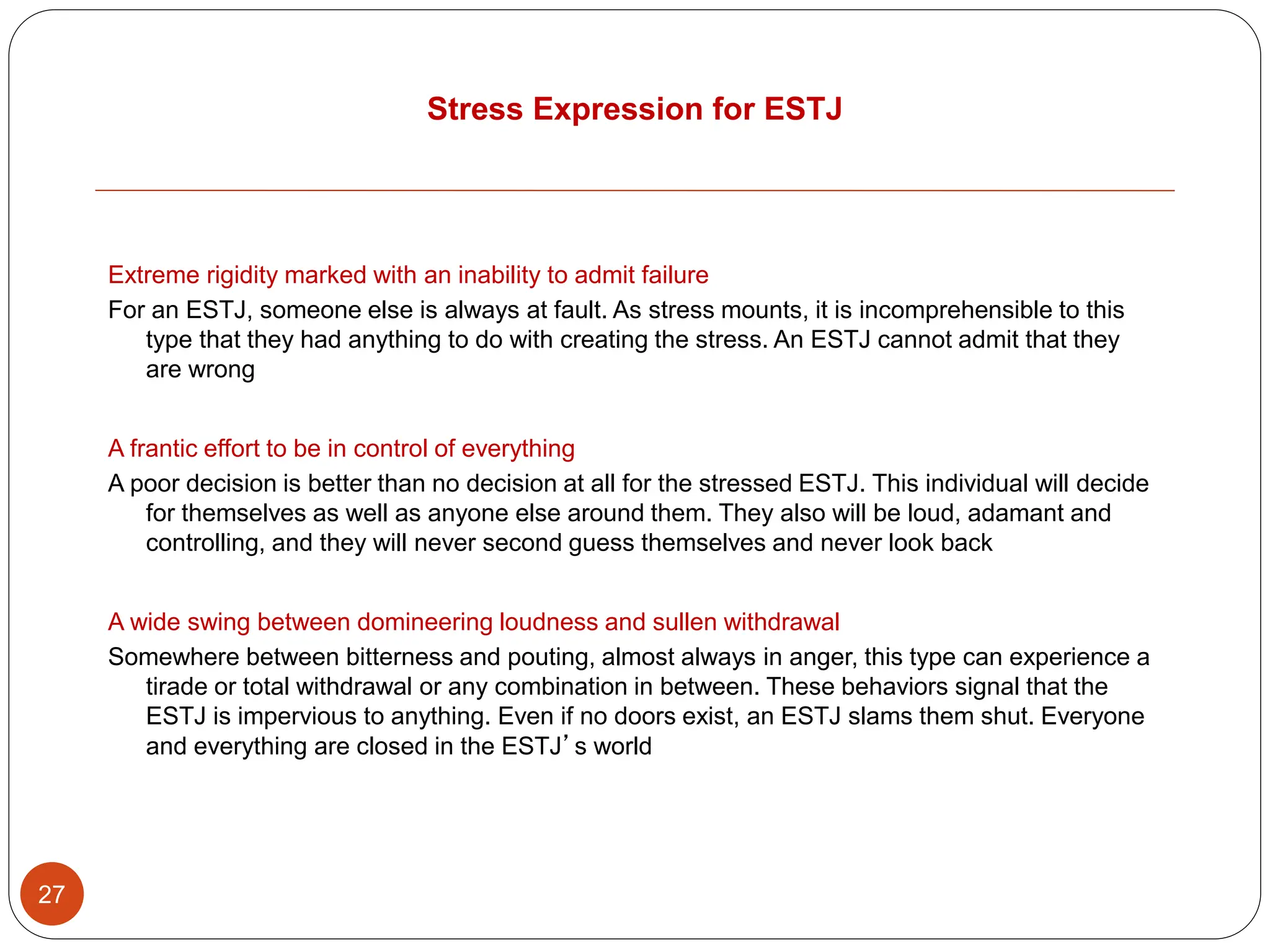
Stress Expression for ESTJ
27
Extreme rigidity marked with an inability to admit failure
For an ESTJ, someone else is always at fault. As stress mounts, it is incomprehensible to this
type that they had anything to do with creating the stress. An ESTJ cannot admit that they
are wrong
A frantic effort to be in control of everything
A poor decision is better than no decision at all for the stressed ESTJ. This individual will decide
for themselves as well as anyone else around them. They also will be loud, adamant and
controlling, and they will never second guess themselves and never look back
A wide swing between domineering loudness and sullen withdrawal
Somewhere between bitterness and pouting, almost always in anger, this type can experience a
tirade or total withdrawal or any combination in between. These behaviors signal that the
ESTJ is impervious to anything. Even if no doors exist, an ESTJ slams them shut. Everyone
and everything are closed in the ESTJ’s world
Stress Expression for ESFJ
28
A “sweep under the rug,” denial buried in sweetness
More than other types, harmony is central to this type. When it is absent, an ESFJ will focus on
others to help alleviate the stress, such as feeding someone chicken soup, cookies and milk.
An ESFJ questions a problem’s seriousness and believes that hugs and kisses will reduce
the stress and produce normalcy again
A heavy surge for control and order
An ESFJ believes that they must busy themselves—tidy things up, organize, involve oneself in
honest work or help someone—to make the stress go away
An over-personalization of everything
An ESFJ experiences extremes of both inward guilt and projected guilt. They assume that they
are a central part of the cause of any situation. If someone else is wrong, the ESFJ believes
they should be punished. If the ESFJ is wrong, though hard to believe, then they experience
feelings of extreme martyrdom and worthlessness
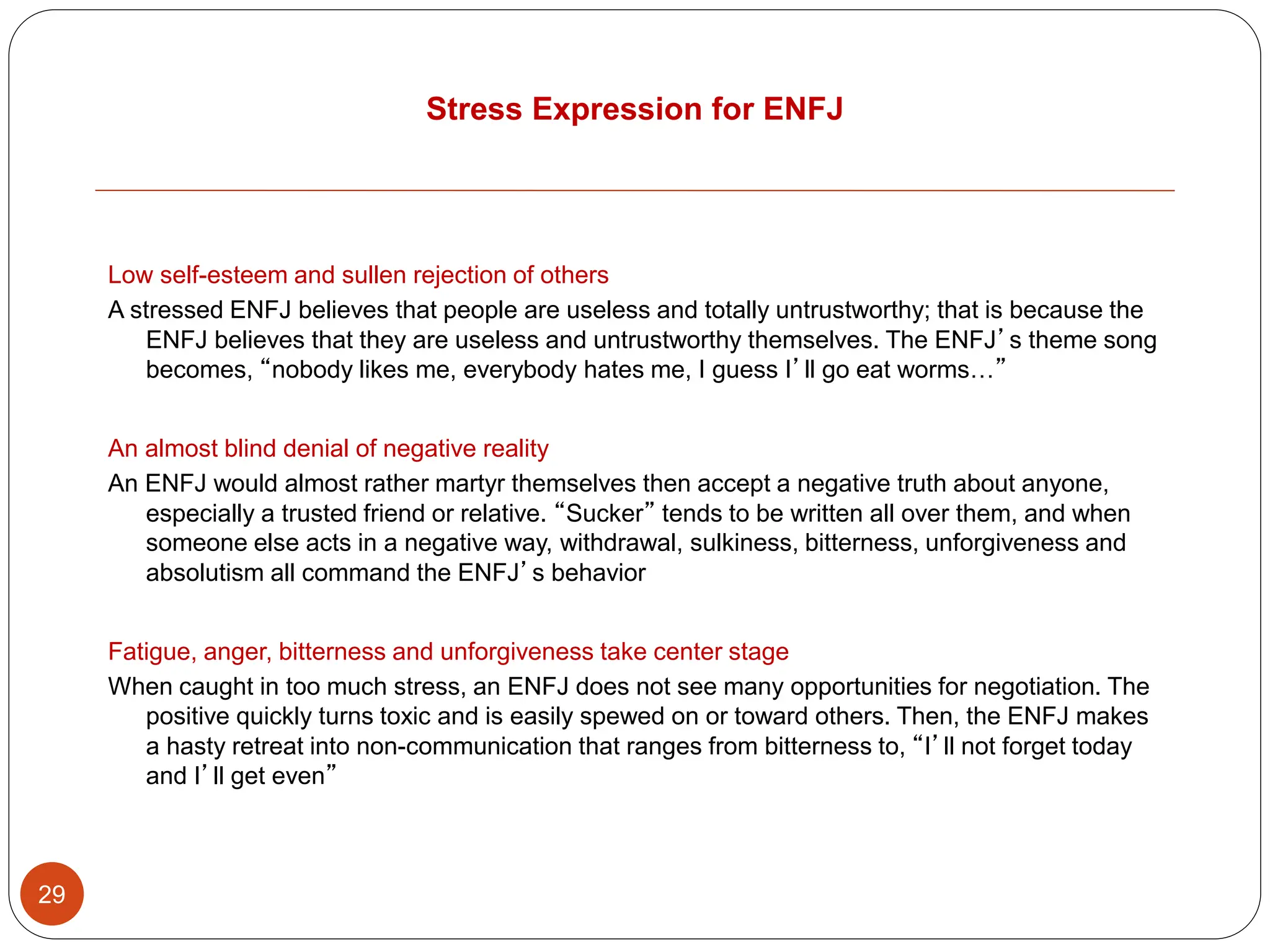
Stress Expression for ENFJ
29
Low self-esteem and sullen rejection of others
A stressed ENFJ believes that people are useless and totally untrustworthy; that is because the
ENFJ believes that they are useless and untrustworthy themselves. The ENFJ’s theme song
becomes, “nobody likes me, everybody hates me, I guess I’ll go eat worms…”
An almost blind denial of negative reality
An ENFJ would almost rather martyr themselves then accept a negative truth about anyone,
especially a trusted friend or relative. “Sucker” tends to be written all over them, and when
someone else acts in a negative way, withdrawal, sulkiness, bitterness, unforgiveness and
absolutism all command the ENFJ’s behavior
Fatigue, anger, bitterness and unforgiveness take center stage
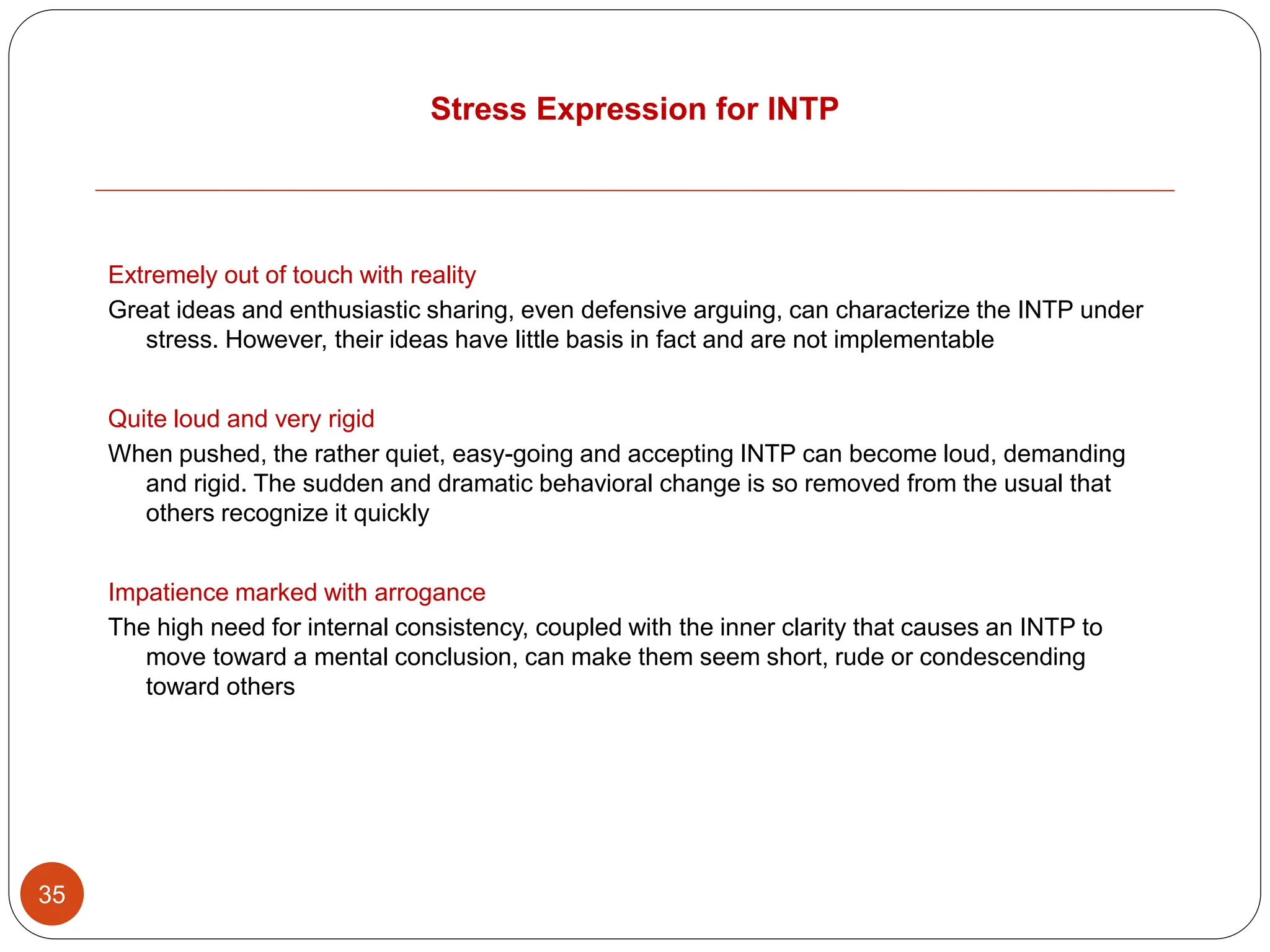
When caught in too much stress, an ENFJ does not see many opportunities for negotiation. The
positive quickly turns toxic and is easily spewed on or toward others. Then, the ENFJ makes
a hasty retreat into non-communication that ranges from bitterness to, “I’ll not forget today
and I’ll get even”
Stress Expression for ENTJ
30
A loud, arrogant and impersonal “my way or the highway” stance
It is difficult for an ENTJ to fathom being wrong. As stress mounts, so does the conviction of the
ENTJ’s righteousness, couples with an intense need to argue loudly and angrily to maintain
control
An impatient, insensitive and repressive need to take charge of everything
An ENTJ projects a “know-it-all” persona and can be at the throat of anyone who suggests
either a new idea or one of the ENTJ’s shortcomings
A detached, disinterested rejection of everything
Depending on the stress level, an ENTJ can go from a commanding voice to a total disinterest
and near refusal to communicate. Such detachment, couched in intellectual superiority,
debilitates and depersonalizes others. Rarely can or will an ENTJ admit to failure. Such non-
speak leaves others with nowhere to go and keeps an ENTJ fighting for control
Stress Expression for ENTP
31
Loud, controlling and scattered redundancies
Almost as if only to hear themselves talk, an ENTP tries to control all of the “airways.” Saying
anything, talking out of both sides of their mouth, increasing volume and repeating are
characteristics of an ENTP under stress
Pushing anything or anyone to and over the limit
Marked with great insensitivity, an ENTP can try anyone’s patience in an unending effort to stay
the center of attention. Regard for another’s needs is subjugated to a relentless grab for the
spotlight
Efforts to control are blocked by scatteredness
As with almost any perceiving type, as the stress mounts in an ENTP, so does the effort to stay
focused. It manifests itself as a swing between extremely controlling, repressive behavior and
totally “off the wall” flight of fancy that borders on the absurd
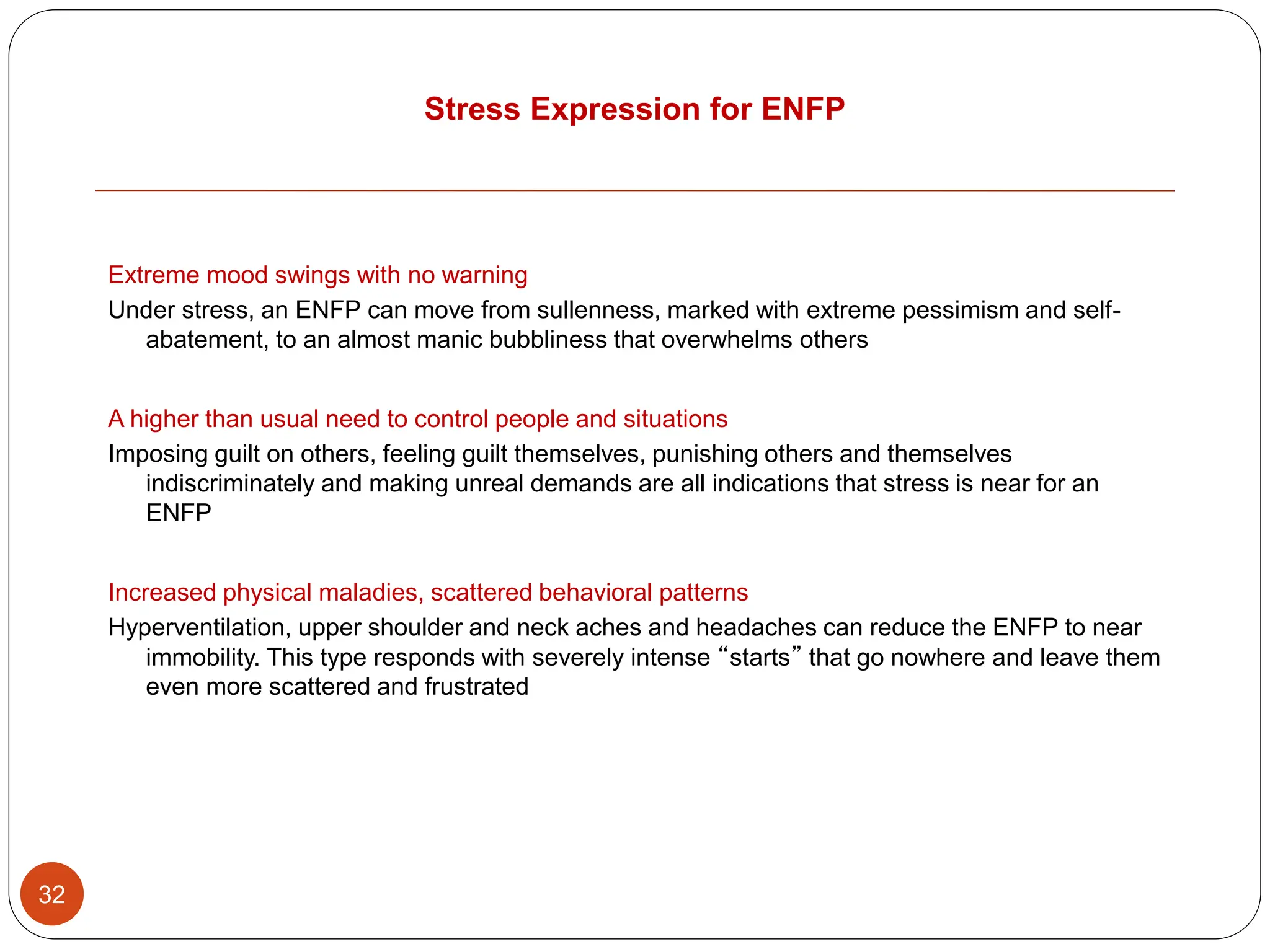
Stress Expression for ENFP
32
Extreme mood swings with no warning
Under stress, an ENFP can move from sullenness, marked with extreme pessimism and self-
abatement, to an almost manic bubbliness that overwhelms others
A higher than usual need to control people and situations
Imposing guilt on others, feeling guilt themselves, punishing others and themselves
indiscriminately and making unreal demands are all indications that stress is near for an
ENFP
Increased physical maladies, scattered behavioral patterns
Hyperventilation, upper shoulder and neck aches and headaches can reduce the ENFP to near
immobility. This type responds with severely intense “starts” that go nowhere and leave them
even more scattered and frustrated
Stress Expression for ESFP
33
Total denial of anything and everything
More than any other type, the ESFP is the “whistle while walking by the graveyard” type. They
stay happy, busy, loose and ready, and as the stress increases, the ESFP can be in a high
state of denial about what is happening around them
Fatigue marked by despair, distrust, doom and gloom
Under stress, an ESFP can be easily overextended. Being out of control can lead to one failure
after another, or at least lead to perceive failures. An ESFP can make themselves miserable
by their failure to pace themselves
A wide swing between scatteredness and rigidity
As stress mounts, the ESFP swings from an effort to control everything to an inability to control
anything. Such behaviors are marked with extremes of both loudness and silence
Stress Expression for ESTP
34
Very fidgety and scattered
An ESTP may exhibit a flighty restlessness, focusing on nothing. They also may be loud and
obnoxious
Pensive and distorting the facts
While others might call it lying, this type can distort facts or present them with a negative spin.
Whenunder stress, they can blurt something out and then be very quiet. They also can be
controlling
A clumsiness with a resentment to routine
Resistance, rebellion, passive aggressive behavior and outright disrespect can be evidence that
suggests extreme stress for an ESTP. The “tried and true” tends to be disregarded and
avoided
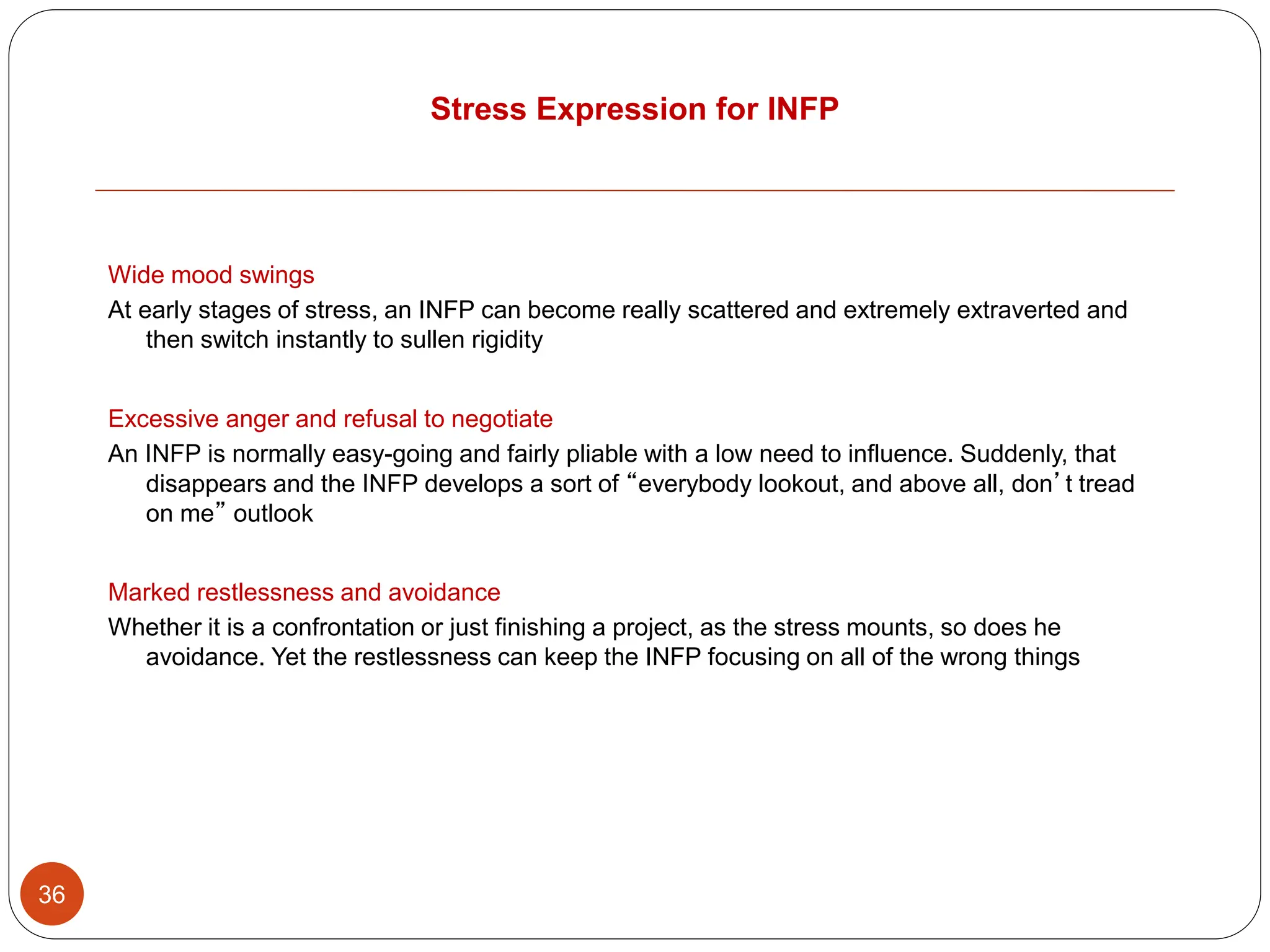
Stress Expression for INTP
35
Extremely out of touch with reality
Great ideas and enthusiastic sharing, even defensive arguing, can characterize the INTP under
stress. However, their ideas have little basis in fact and are not implementable
Quite loud and very rigid
When pushed, the rather quiet, easy-going and accepting INTP can become loud, demanding
and rigid. The sudden and dramatic behavioral change is so removed from the usual that
others recognize it quickly
Impatience marked with arrogance
The high need for internal consistency, coupled with the inner clarity that causes an INTP to
move toward a mental conclusion, can make them seem short, rude or condescending
toward others
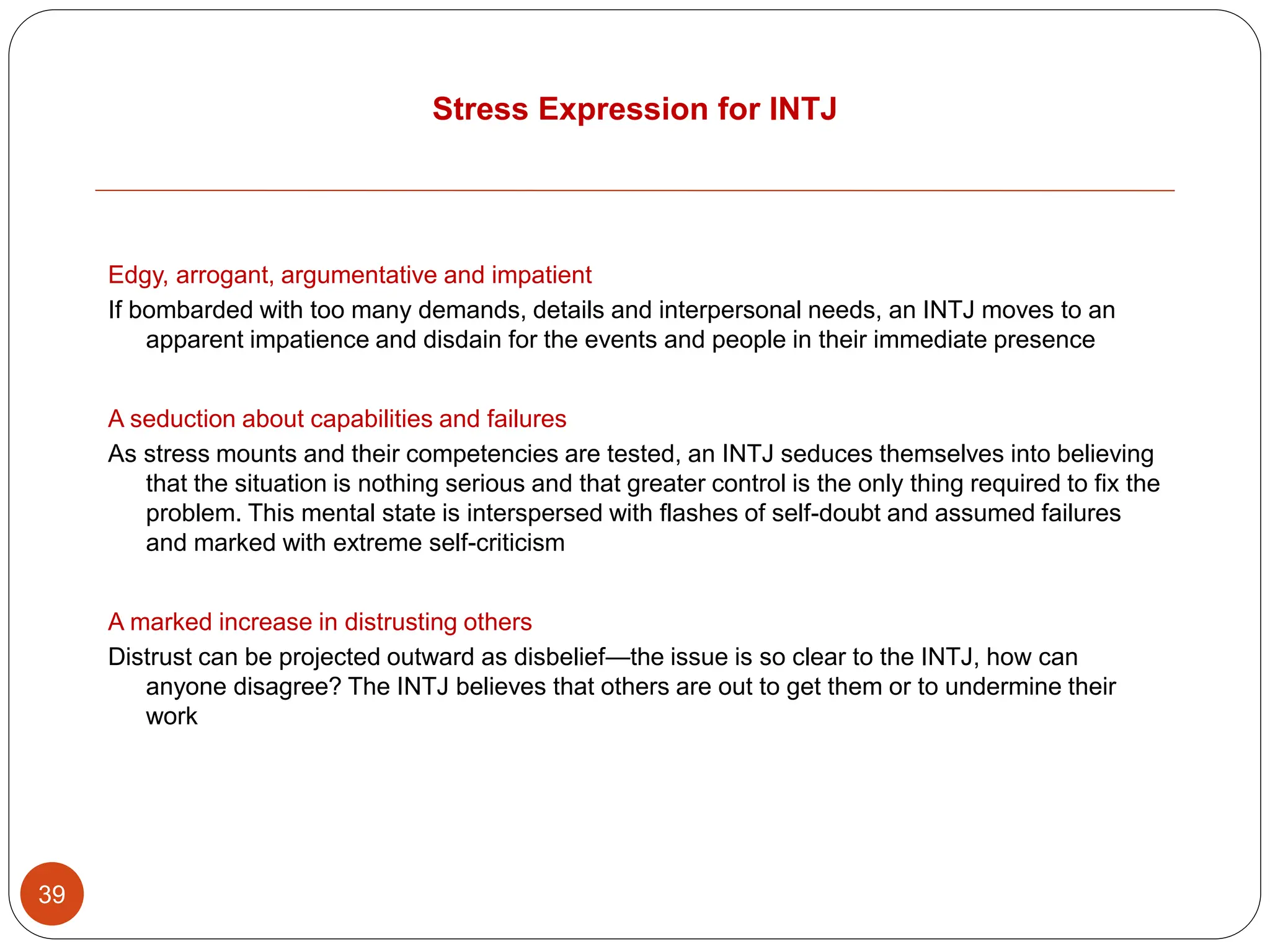
Stress Expression for INFP
36
Wide mood swings
At early stages of stress, an INFP can become really scattered and extremely extraverted and
then switch instantly to sullen rigidity
Excessive anger and refusal to negotiate
An INFP is normally easy-going and fairly pliable with a low need to influence. Suddenly, that
disappears and the INFP develops a sort of “everybody lookout, and above all, don’t tread
on me” outlook
Marked restlessness and avoidance
Whether it is a confrontation or just finishing a project, as the stress mounts, so does he
avoidance. Yet the restlessness can keep the INFP focusing on all of the wrong things
Stress Expression for ISFP
37
Extreme self-effacement and depression
Between over personalizing and underestimating, an ISFP can turn inward and, in no time at all,
convince themselves (and others too) of their meaninglessness and uselessness in any
situation—an expression that leaves them very isolated and depressed.
A closed, rigid sense of martyrdom
No matter the feedback, an ISFP quickly uses it to prove how unappreciated and disrespected
they are. They believe that, regardless of how hard they try, their efforts will be rejected
An emotional dump that is totally disproportionate to the event
Once the ISFP opens up, out comes a whole series of things that have been “welled up” inside
for a long time
Stress Expression for ISTP
38
Wide mood swings with blurts and denials
It will be obvious from the ISTP’s body language and words that something is wrong. However,
when questions, they persist in denial, “I said nothing is wrong!”
A sudden lack of precision and high disinterest
Normally, an ISTP is accurate, precise, quite proud and confident about their capabilities, but as
stress undermines confidence, their work becomes sloppy and the ISTP loses interest
A higher need to control, couple with scatteredness
For the stressed ISTP, it is a bad version of the adage, “the faster I go, the behinder I get.” An
ISTP commonly exhibits very bad self, time and project management with a low capability to
respond to external stimuli
Stress Expression for INTJ
39
Edgy, arrogant, argumentative and impatient
If bombarded with too many demands, details and interpersonal needs, an INTJ moves to an
apparent impatience and disdain for the events and people in their immediate presence
A seduction about capabilities and failures
As stress mounts and their competencies are tested, an INTJ seduces themselves into believing
that the situation is nothing serious and that greater control is the only thing required to fix the
problem. This mental state is interspersed with flashes of self-doubt and assumed failures
and marked with extreme self-criticism
A marked increase in distrusting others
Distrust can be projected outward as disbelief—the issue is so clear to the INTJ, how can
anyone disagree? The INTJ believes that others are out to get them or to undermine their
work
Stress Expression for INFJ
40
Blurts and badly-handled facts
Not concerned with accuracy, when stress mounts, an INFJ will quote, badger and explode with
a firm, even righteous, display of facts that may or may not be related to the situation
A sullen, wounded martyrdom
All of the rich, imaginative inspiration of this type quickly turns to a bitter sense of rejection as
fatigue and other stressors manifest themselves
A combination of strengths and weaknesses are maximized
Under stress, introversion becomes non-speak, inspiration and theory become convoluted
complexity and structure and closure become insensitivity and stubbornness
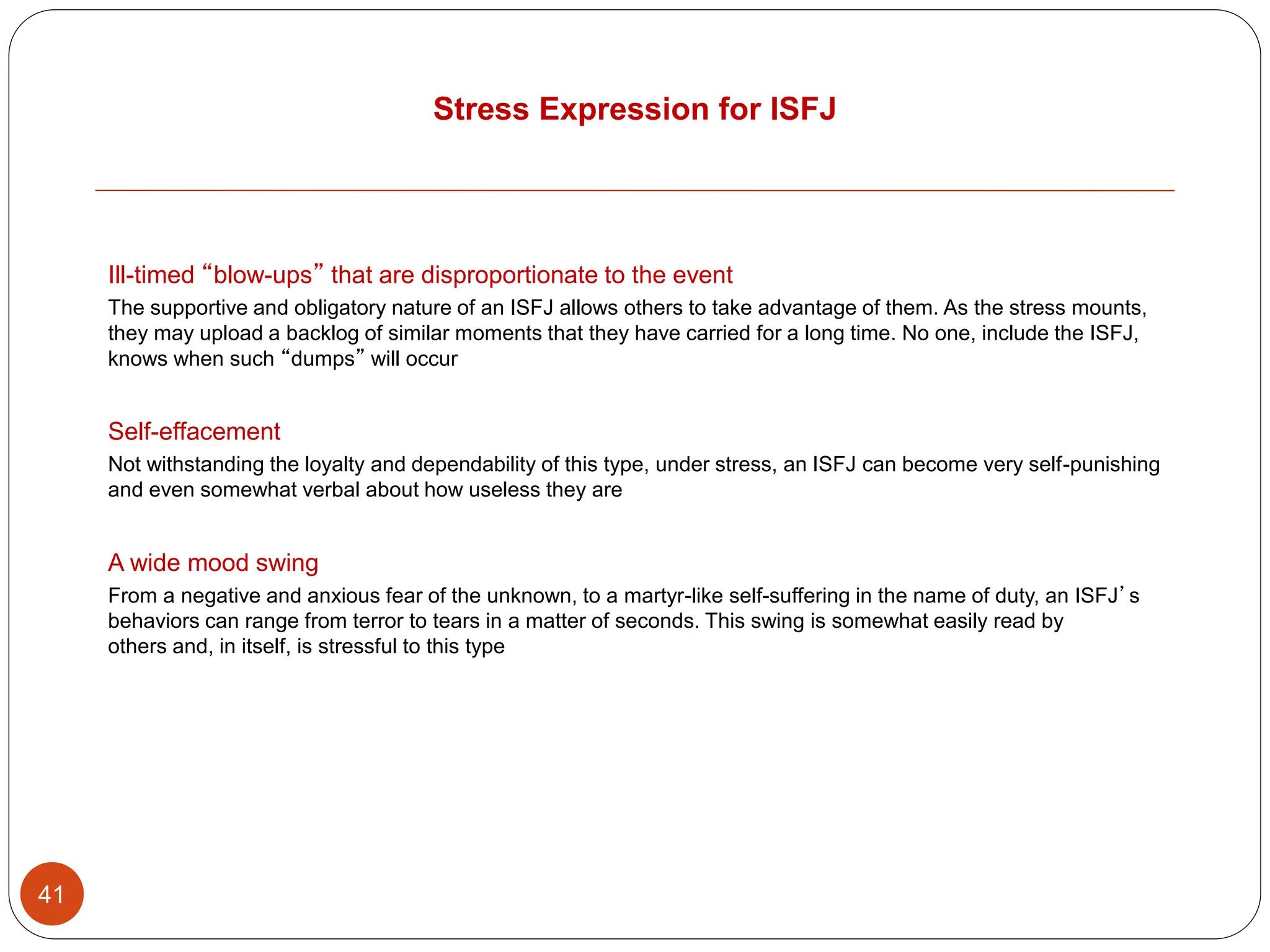
Stress Expression for ISFJ
41
Ill-timed “blow-ups” that are disproportionate to the event
The supportive and obligatory nature of an ISFJ allows others to take advantage of them. As the stress mounts,
they may upload a backlog of similar moments that they have carried for a long time. No one, include the ISFJ,
knows when such “dumps” will occur
Self-effacement
Not withstanding the loyalty and dependability of this type, under stress, an ISFJ can become very self-punishing
and even somewhat verbal about how useless they are
A wide mood swing
From a negative and anxious fear of the unknown, to a martyr-like self-suffering in the name of duty, an ISFJ’s
behaviors can range from terror to tears in a matter of seconds. This swing is somewhat easily read by
others and, in itself, is stressful to this type
Stress Expression for ISTJ
42
Extreme efforts to control
Under great stress, an ISTJ may try to control everything around them, ranging from people to objects. They
may be super-rigid, making unswerving demands on themselves and others
A very negative and pessimistic outlook
A stressed ISTJ may show high distrust of the unknown, including people, objects, future planning and
strategizing. Any show of concern or emotion is intolerable
High unpredictability
This type may swing from high rigidity and loudness to scatteredness and zero communication and back again to
the rigid. It is this swing with no apparent pattern that is so unnerving to this usually predictable and dependable
ISTJ and to others observing it
type
43
iNtuitive
 Give “the big picture”
 Create a sense of urgency for the
opportunity
 Use confidence and enthusiasm
 Point out the future benefits
Sensing
 Be factual
 Document successful applications
 Reduce risk factors
 Thoroughly work out details in advance
Thinking
 Be logical
 State the principles involved
 Be well organized, moving logically
across points
 List the costs and benefits
Feeling
 Indicate who else is for the idea
 Be personable and friendly
 Indicate how the idea is helpful
 Tell why the idea is valuable
General Descriptions Associated with MBTI® Preferences
44
Extraversion Characteristics
• Prefer to communicate verbally
• Outgoing and action-oriented
• Learn best by doing or talking
• Have many friends and acquaintances
• Enjoy sharing ideas at gatherings
• Need external stimulus and input
Sensing Characteristics
• Focus on what is here and real
• Observe and easily recall data and specifics
• Gain understanding through hands-on
experience
• Tend to be factual and concrete
Thinking Characteristics
• Value logic
• Use cause-and-effect reasoning
• Objective, striving for what’s fair
• Critical and analytical
Judging Characteristics
• Value organization
• Methodical and disciplined
• Decisive and need closure
• Prefer to make plans
Introversion Characteristics
• Prefer to communicate in writing
• Private and inwardly focused
• Learn best through thinking and processing
• Have a select circle of friends
• Appear to be good listeners
• Need time alone to reenergize self
Intuition Characteristics
• Attuned to possibilities in the future
• Are concerned with meanings and patterns
in information
• Trust “gut” feelings and inspiration
• Tend to be imaginative and creative
Feeling Characteristics
• Value compassion
• Consider effects of their decisions on people
• Seek to maintain harmony
• Softhearted and empathetic
Perceiving Characteristics
• Flexible and adaptive
• Tend to be spontaneous
• Prefer to be loose and are open to change
• Prefer to keep their options open
Type in Action! © 2002 by Barbara D. Mathews and Catharine A. Larkin. Published by CPP, Inc. Permission is hereby granted to reproduce this master for workshop
use. Duplication for any other use, including resale, is a violation of copyright law. MBTI is a trademark or registered trademark of the Myers-Briggs Type Indicator
Trust in the United States and other countries.
Contributions Made by Each Preference to Each Type
45
ISTJ ISFJ INFJ INTJ
I Depth of concentration I Depth of concentration I Depth of concentration I Depth of concentration
S Reliance on facts S Reliance on facts N Grasp of possibilities N Grasp of possibilities
T Logic and analysis F Warmth and sympathy F Warmth and sympathy T Logic and analysis
J Organization J Organization J Organization J Organization
ISTP ISFP INFP INTP
I Depth of concentration I Depth of concentration I Depth of concentration I Depth of concentration
S Reliance on facts S Reliance on facts N Grasp of possibilities N Grasp of possibilities
T Logic and analysis F Warmth and sympathy F Warmth and sympathy T Logic and analysis
P Adaptability P Adaptability P Adaptability P Adaptability
ESTP ESFP ENFP ENTP
E Breadth of interests E Breadth of interests E Breadth of interests E Breadth of interests
S Reliance on facts S Reliance on facts N Grasp of possibilities N Grasp of possibilities
T Logic and analysis F Warmth and sympathy F Warmth and sympathy T Logic and analysis
P Adaptability P Adaptability P Adaptability P Adaptability
ESTJ ESFJ ENFJ ENTJ
E Breadth of interests E Breadth of interests E Breadth of interests E Breadth of interests
S Reliance on facts S Reliance on facts N Grasp of possibilities N Grasp of possibilities
T Logic and analysis F Warmth and sympathy F Warmth and sympathy T Logic and analysis
J Organization J Organization J Organization J Organization
Type in Action! © 2002 by Barbara D. Mathews and Catharine A. Larkin. Published by CPP, Inc. Permission is hereby granted to reproduce this master for workshop use.
Duplication for any other use, including resale, is a violation of copyright law. MBTI is a trademark or registered trademark of the Myers-Briggs Type Indicator Trust in the
United States and other countries.
Source: From MBTI® Manual (3rd ed.), by I. B. Myers, M. H. McCaulley, N. L. Quenk, & A. L. Hammer, 1998, Palo Alto, CA: CPP, Inc. Copyright 1998 by CPP, Inc. Adapted with permission.
EXTRAVERTS
INTROVERTS
Judging
Types
Perceiving
Types
Perceiving
Types
Judging
Types
SENSING TYPES INTUITIVE TYPES
With Thinking With Feeling With Feeling With Thinking
Type Characteristics Underlying Conflicts
46
Extraverts
• Prefer to develop solutions by talking it through
• Often change direction or topic during course of
discussions
• Experience Introverts as “withholding”
Sensing Types
• Define the problem based on concrete events
and on what actually happened
• Seek explanations and solutions based on
experience
• Experience Intuitive types as “unrealistic”
Thinking Types
• Search for logical alternatives and apply them
• to everyone
• Believe that if a problem can be defined
accurately and the relevant evidence gathered,
there will be a “correct” solution
• Experience Feeling types as “irrational,
inconsistent, and illogical”
Judging Types
• Need structure, decisions, and closure
• Create plans, structures, and time frames to
achieve goals
• Experience Perceiving types as people they cannot
count on to follow through
Introverts
• Prefer measured pacing and need talk-free time for
internal processing
• Need a more intense focus, and to come back to
ideas after consideration
• Experience Extraverts as “invasive”
Intuitive Types
• See specific behavior as part of an underlying pattern
that is the real problem
• Seek theoretical explanations and solutions
• Experience Sensing types as “shooting down their
ideas” or blocking progress
Feeling Types
• Search for individual solutions that work for people
• Believe the solution will be found by gathering many
perspectives and finding the answer that fits every-
one’s needs
• Experience Thinking types as “cold and uncaring”
Perceiving Types
• Need flexibility, and want decisions to grow out of
the process
• Have faith in their own internal sense of timing; want
to be trusted to meet goals in their own ways
• Experience Judging types as “hemming them in”
Type in Action! © 2002 by Barbara D. Mathews and Catharine A. Larkin. Published by CPP, Inc. Permission is hereby granted to reproduce this master for workshop use.
Duplication for any other use, including resale, is a violation of copyright law. MBTI is a trademark or registered trademark of the Myers-Briggs Type Indicator Trust in the
United States and other countries.
Source: From MBTI® Manual (3rd ed.), by I. B. Myers, M. H. McCaulley, N. L. Quenk, & A. L. Hammer, 1998, Palo Alto, CA: CPP, Inc. Copyright 1998 by CPP, Inc. Adapted with permission.
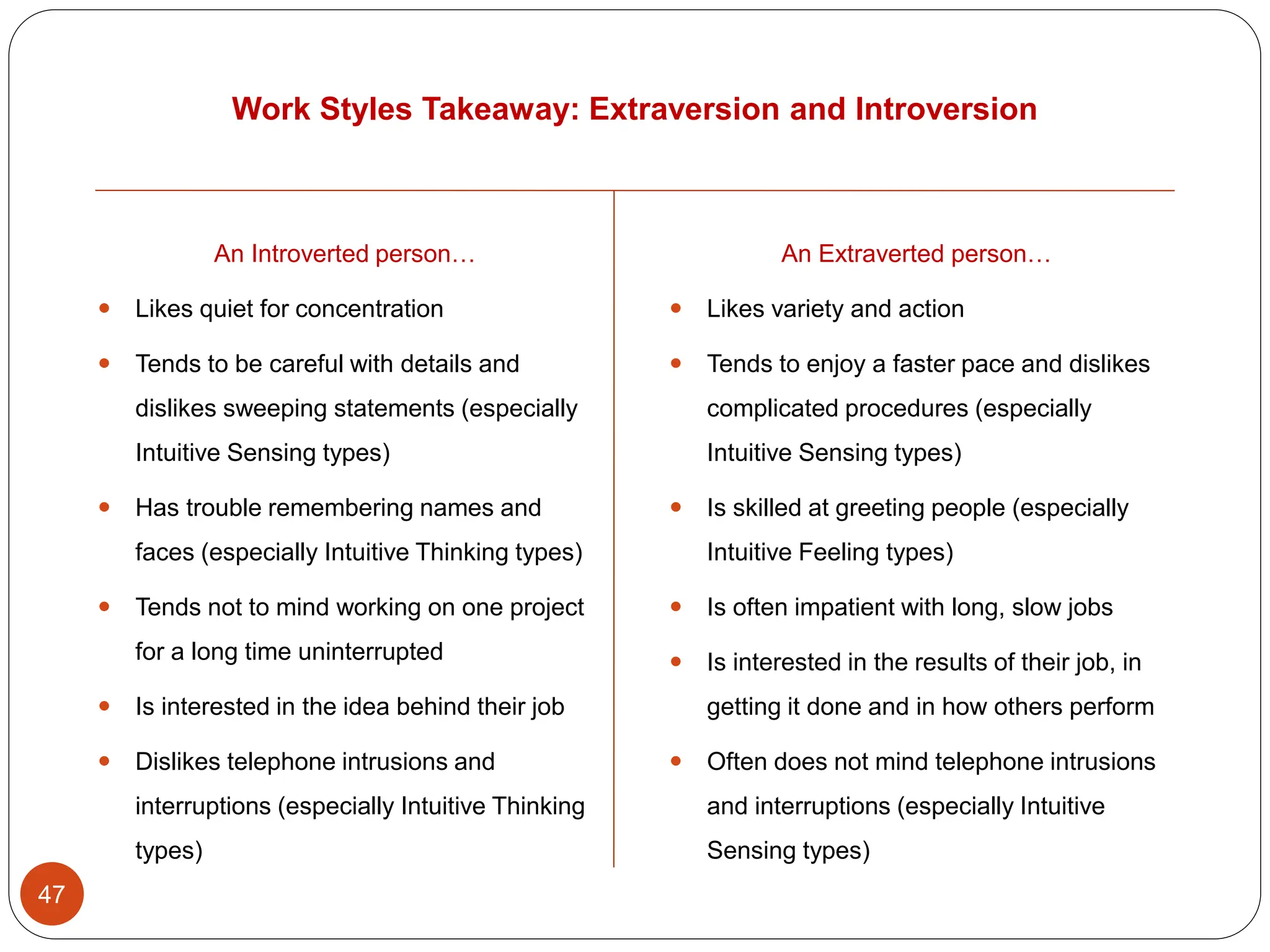
Work Styles Takeaway: Extraversion and Introversion
47
An Extraverted person…
 Likes variety and action
 Tends to enjoy a faster pace and dislikes
complicated procedures (especially
Intuitive Sensing types)
 Is skilled at greeting people (especially
Intuitive Feeling types)
 Is often impatient with long, slow jobs
 Is interested in the results of their job, in
getting it done and in how others perform
 Often does not mind telephone intrusions
and interruptions (especially Intuitive
Sensing types)
An Introverted person…
 Likes quiet for concentration
 Tends to be careful with details and
dislikes sweeping statements (especially
Intuitive Sensing types)
 Has trouble remembering names and
faces (especially Intuitive Thinking types)
 Tends not to mind working on one project
for a long time uninterrupted
 Is interested in the idea behind their job
 Dislikes telephone intrusions and
interruptions (especially Intuitive Thinking
types)
Work Styles Takeaway: Sensing and iNtuition
48
An iNuitive person…
 Likes solving new problems
 Dislikes doing the same thing repeatedly
(especially iNuitive Perceptive types)
 Enjoys learning a new skill more than using it
 Works in bursts of energy and enthusiasm with
slack periods in between (especially Extraverted
iNuitive types)
 Reaches a conclusion quickly (especially
Extraverted iNuitive Perceptive types)
 Is impatient with routine details (especially
Extraverted iNuitive Perceptive types)
 Is patient with complicated situations
A Sensing person…
 Dislikes new problems unless there are standard
ways to solve them
 Likes an established order of task performance
(especially Sensing Judging types)
 Enjoys using acquired skills more than learning
new ones
 Works steadily with a realistic idea of how long a
task will take
 Usually reaches a conclusion step-by-step
(especially Introverted Sensing types)
 Seldom makes errors of fact
 Tends to be good at precise work (especially
Extraverted Sensing types)
Work Styles Takeaway: Judgment and Perception
49
A Perceptive person…
 Adapts well to changing situations
 Does not mind leaving things open for alterations
 Has trouble making decisions (especially
Introverted Perceptive types)
 Starts several projects and sometimes has
difficulty in finishing them (especially Extraverted
iNuitive Perceptive types)
 Tends to postpone unpleasant jobs
 Wants to know all about the new job (especially
Introverted iNuitive Perspective types)
 Tends to be curious and welcomes a new light
on a situation or person
A Judging person…
 Works best when they can plan their work and
follow the plan
 Likes to get things settled and finished
 Makes decisions quickly (especially Extraverted
Judging types)
 Dislikes interrupting the project they are on for a
more urgent one (especially Introverted Sensing
Judging types)
 Does not always notice new things that need to
de done
 Wants only the essentials needed to begin their
work (especially Extraverted Sensing Judging
types)
 Tends to be satisfied once they reach a
judgment on a situation or person
Work Styles Takeaway: Thinking and Feeling
50
A Feeling person…
 Tends to be very aware of other people and their
feelings (especially Extraverted Feeling types)
 Enjoys pleasing people
 Likes harmony but efficiency could be badly
disrupted by office feuds
 Often lets decisions be influenced by their own
or other people’s personal likes and dislikes
 Needs occasional praise
 Dislikes telling people unpleasant things
A Thinking person…
 Does not readily show emotion and is often
uncomfortable dealing with others’ feelings
(especially Introverted Thinking types)
 Sometimes hurts people’s feelings without
knowing it
 Likes analysis and putting things into logical
order
 Gets along fine without harmony
 Tends to decide impersonally, sometimes paying
insufficient attention to people’s wishes
 Needs to be treated fairly
 Is able to reprimand people or fire them when
necessary
What do Extraverts and Introverts want during a time of change?
51
An Introvert thrives on…
 Reflecting on current issues and
circumstances
 Thought-out written communication
 Time to think things through before
discussing
 Assimilating changes before taking
action
An Extravert thrives on…
 Talking about current issues and
circumstances
 Involvement
 Lots of communication
 Having a “voice”
 Action and keeping the pace up
What do Sensing and iNtuitive types want during a time of change?
52
An iNtuitive type thrives on…
 An overall rationale and “the big
picture”
 A vision of the future
 The general plan
 Options and direction but not
necessarily settlement
 Opportunities to provide input
A Sensing type thrives on…
 Real data
 Specifics and details about the
changes
 Connections to the past
 Realistic descriptions of the future
 Clear guidelines about roles,
expectations and responsibilities
What do Judging and Perceiving types want during a time of change?
53
A Perceiving type thrives on…
 Open-ended approach with room for
change
 Developing a general action plan
 Flexibility and options
 Opportunities to gather more
information
 Room to adjust
 Loosening up and trusting the
process
A Judging type thrives on…
 A clear and concise plan
 Defined outcomes and clear goals
 A time frame with specific stages
spelled out
 A statement of priorities
 Completion
 Avoiding surprises
What do Thinking and Feeling types want during a time of change?
54
A Feeling type thrives on…
 Recognition of their impact on
people
 Information regarding people’s
needs and how they will be met
 Inclusion in a process
 Understanding values that are
driving the change
 Caring leadership
 Appreciation and support
A Thinking type thrives on…
 The logic behind the decision
 More information on systematic
changes
 Clarity in decision-making and
planning
 Defined goals and structure
 Competent leadership
 Equality
ISTJ: Type and Teamwork
55
Pitfalls
 An ISTJ believes that a bad decision on time is
better than no decision at all and that doing
something is better than doing nothing.
 An ISTJ allows structure and order to override
more pressing or emerging issues
 The ISTJ sees a task as more important than
team or group spirit and interpersonal issues
 This type values competitiveness over
collaboration
 Slow to communicate praise and positive
reinforcement, an ISTJ sees teamwork as
invading their personal space and privacy
Pathways
 An ISTJ lives by the motto, “work hard, play
hard”
 Accountable and productive, an ISTJ is driven
by the bottom line and give structure and order
to most projects
 This type schedules fun at appropriate times,
usually after work is finished
 The ISTJ respects authority and can be
authoritative themselves
 An ISTJ is rewarded by an accomplishment
(especially one on time and in budget), a bonus
or an organizational “perk”
ISFJ: Type and Teamwork
56
Pitfalls
 The ISFJ can be taken advantage of and
becomes a dumping ground for others
 Conflict within the team or with others is most
stressful for the ISFJ
 They may fail to respect boundaries, making the
group listless and shattering loyalty to the
organization and project
 This type loses their sense of purpose and
belonging if the team isn’t productive
 By overlooking “the big picture” and becoming
overextended in the moment, the ISFJ can leave
the group feeling fatigued, unappreciated and
worthless
Pathways
 The ISFJ is pleasant, dependable and organized
 Accomplishment is important to them though not
at interpersonal expense
 Valuing appropriate behavior, the ISFJ works
well within rules and expects others do to so as
well
 An ISFJ functions as very good team player with
a strong sense of institutional memory and
protocol
 This type has a high tolerance for detail, routine
and accomplishment and provides good
supporting an affirming atmosphere
INFJ: Type and Teamwork
57
Pitfalls
 An INFJ can beat a theory to death and prefer
an interpersonal exchange at the expense of
practicality
 The INFJ risks having their dreams remain only
dreams without implementation and follow
through
 Paralyzed by conflict, the INFJ’s denial and
avoidance can block constructive resolution
 The INFJ is aloof, complex and stubborn, but
their feelings are easily hurt
Pathways
 An INFJ keeps a balance between being
reflective and inspirational while adhering to a
schedule
 This type is helpful, supportive, accountable and
affirming and provides high intellectual
stimulation and achievement toward noble ideals
 The INFj closely observes group dynamics and
directs energy to maintain a smooth, congenial
team
 This type is quiet, theoretical, inter- and
intrapersonal and organized
INTJ: Type and Teamwork
58
Pitfalls
 The INTJ values independence and only give lip
service to team or group work
 They may try to improve areas that do not need
improving , argue for the sake of arguing and act
aloof toward others who fail to comprehend
quickly
 An INTJ may seem arrogant and uncaring by
only giving intellectual assent to the group’s
mission
 Facts and specifics can be an INTJ’s worst
enemy
 This type can appear out of touch, defensive and
intimidating to those who disagree
Pathways
 The INTJ is confident, positive and systems-
oriented with an ample amount of structure and
closure
 This type is a natural conceptalizer and
perpetual student, so whatever the team or
group is doing, they must be involved in learning
and improving
 An INTJ values excellence and competence and
is driven toward achievement
 The INTJ strives for results while being
reflective, abstract, objective and impersonal
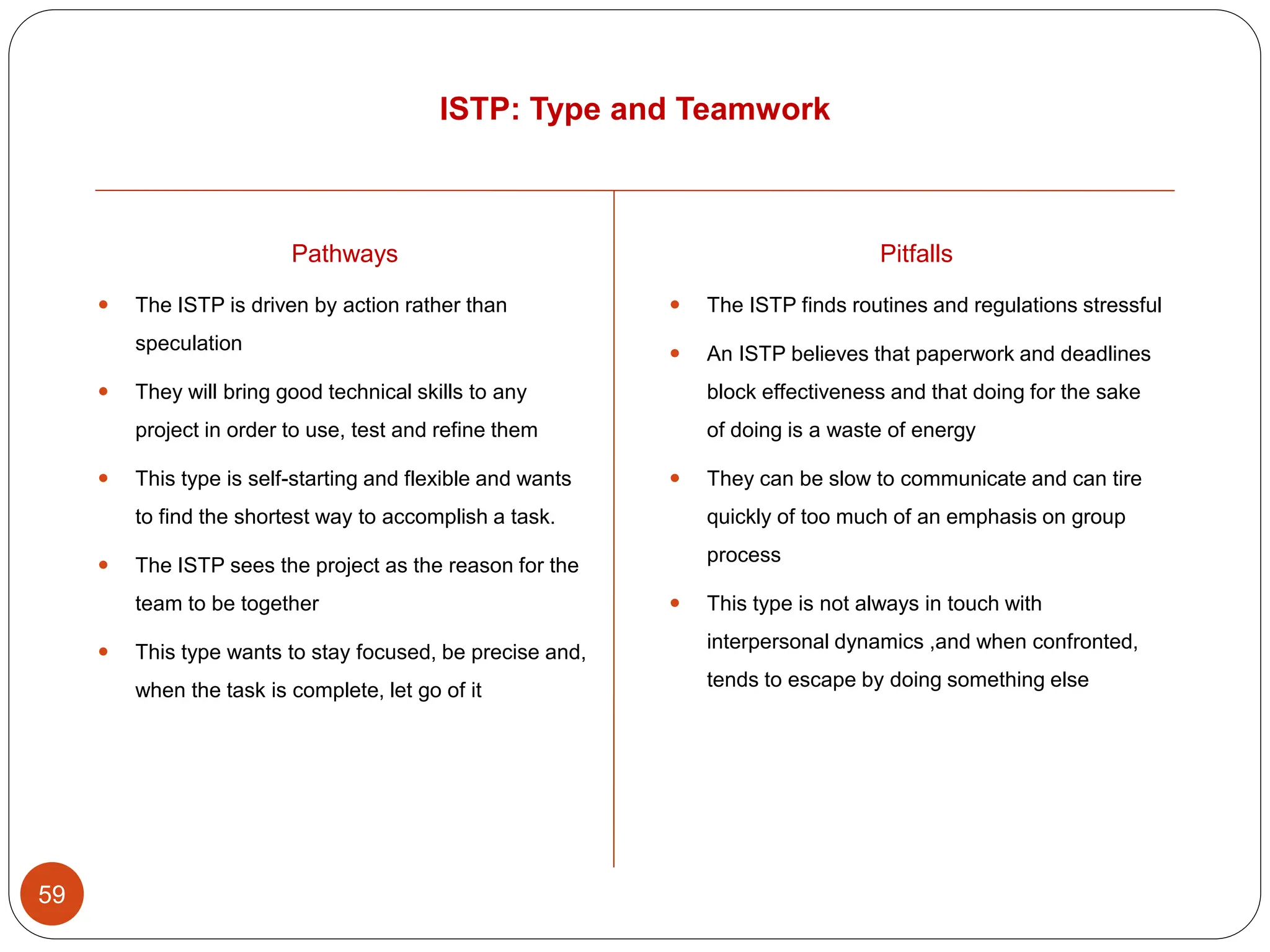
ISTP: Type and Teamwork
59
Pitfalls
 The ISTP finds routines and regulations stressful
 An ISTP believes that paperwork and deadlines
block effectiveness and that doing for the sake
of doing is a waste of energy
 They can be slow to communicate and can tire
quickly of too much of an emphasis on group
process
 This type is not always in touch with
interpersonal dynamics ,and when confronted,
tends to escape by doing something else
Pathways
 The ISTP is driven by action rather than
speculation
 They will bring good technical skills to any
project in order to use, test and refine them
 This type is self-starting and flexible and wants
to find the shortest way to accomplish a task.
 The ISTP sees the project as the reason for the
team to be together
 This type wants to stay focused, be precise and,
when the task is complete, let go of it
ISFP: Type and Teamwork
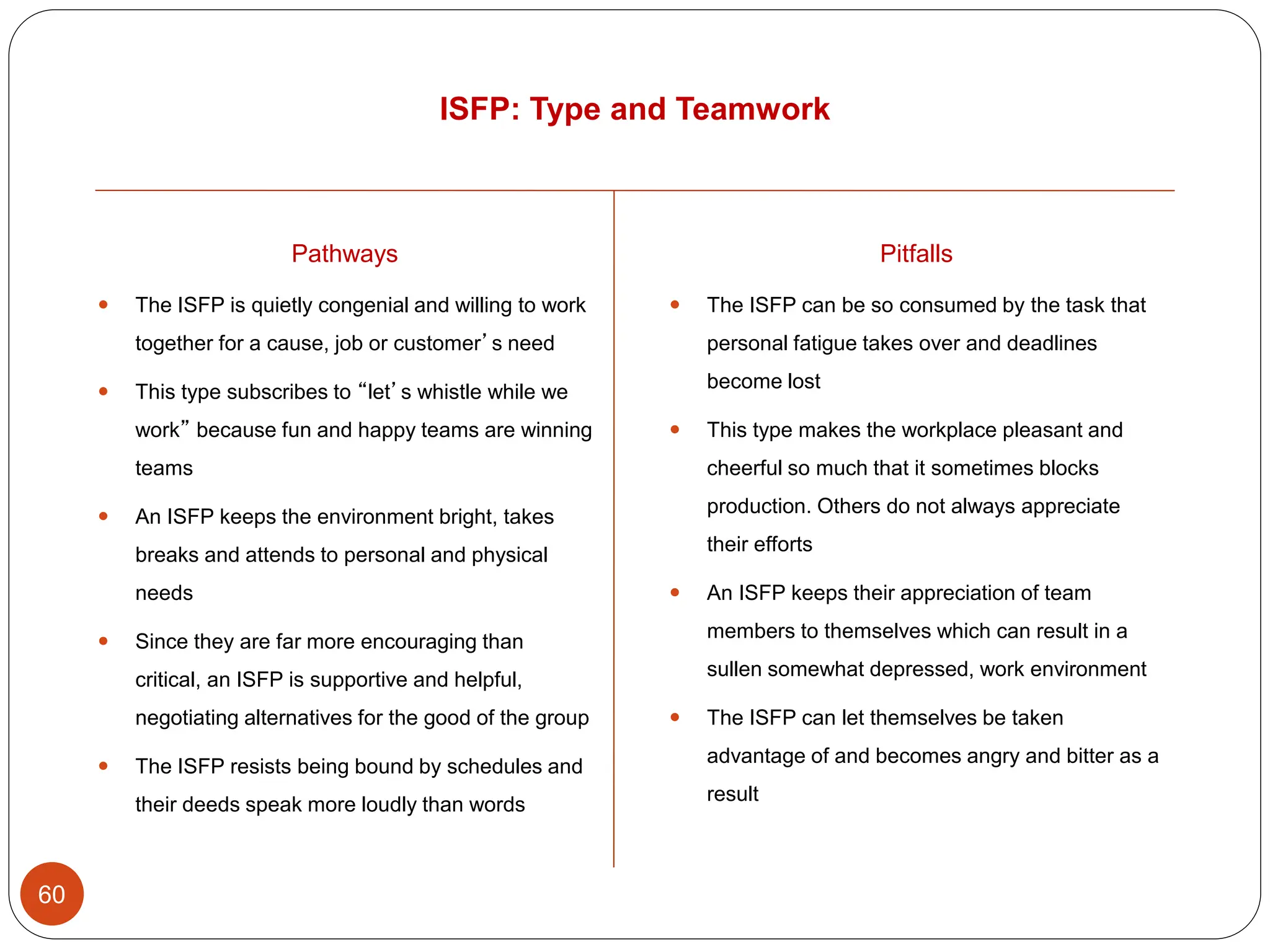
60
Pitfalls
 The ISFP can be so consumed by the task that
personal fatigue takes over and deadlines
become lost
 This type makes the workplace pleasant and
cheerful so much that it sometimes blocks
production. Others do not always appreciate
their efforts
 An ISFP keeps their appreciation of team
members to themselves which can result in a
sullen somewhat depressed, work environment
 The ISFP can let themselves be taken
advantage of and becomes angry and bitter as a
result
Pathways
 The ISFP is quietly congenial and willing to work
together for a cause, job or customer’s need
 This type subscribes to “let’s whistle while we
work” because fun and happy teams are winning
teams
 An ISFP keeps the environment bright, takes
breaks and attends to personal and physical
needs
 Since they are far more encouraging than
critical, an ISFP is supportive and helpful,
negotiating alternatives for the good of the group
 The ISFP resists being bound by schedules and
their deeds speak more loudly than words
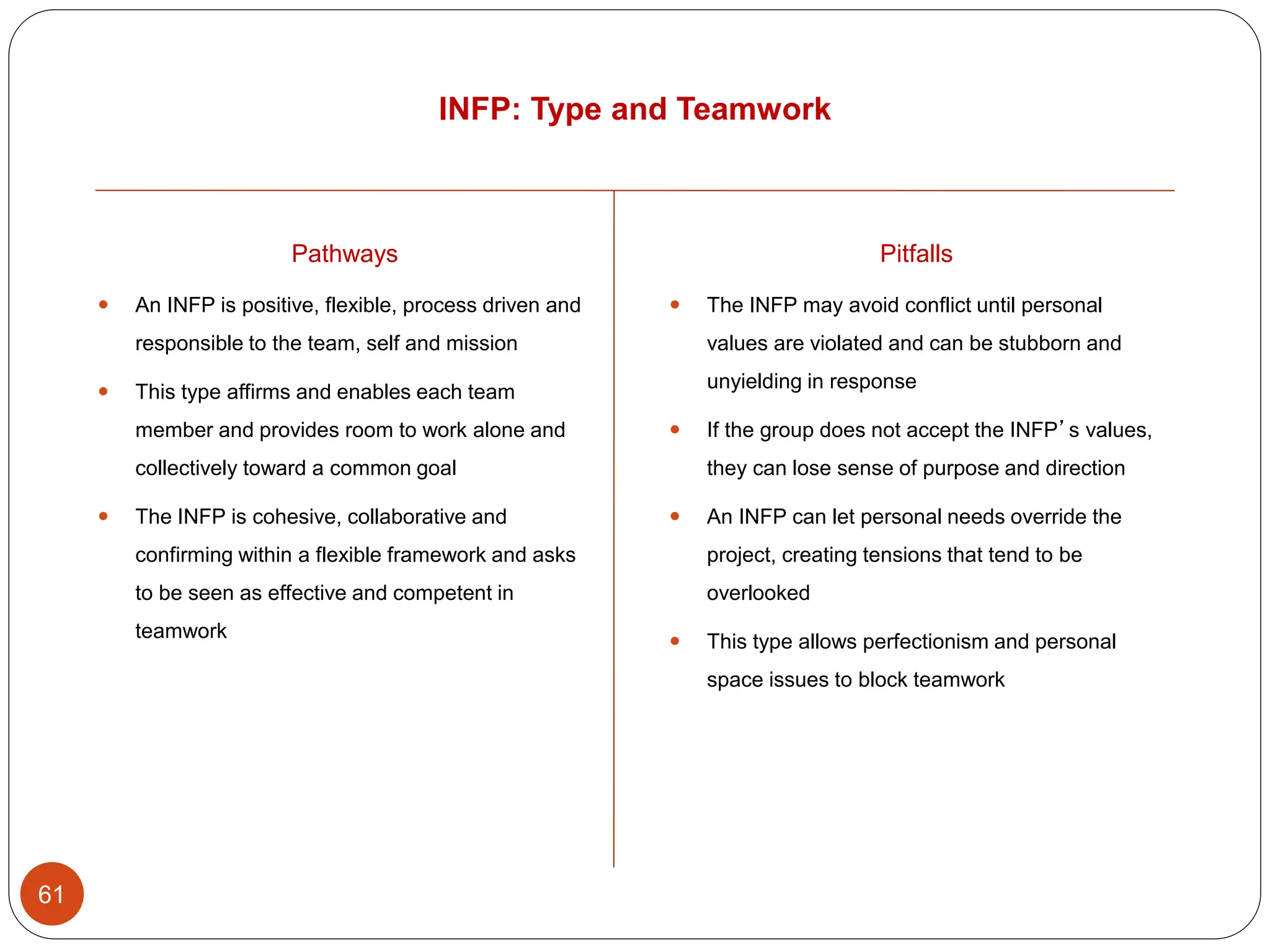
INFP: Type and Teamwork
61
Pitfalls
 The INFP may avoid conflict until personal
values are violated and can be stubborn and
unyielding in response
 If the group does not accept the INFP’s values,
they can lose sense of purpose and direction
 An INFP can let personal needs override the
project, creating tensions that tend to be
overlooked
 This type allows perfectionism and personal
space issues to block teamwork
Pathways
 An INFP is positive, flexible, process driven and
responsible to the team, self and mission
 This type affirms and enables each team
member and provides room to work alone and
collectively toward a common goal
 The INFP is cohesive, collaborative and
confirming within a flexible framework and asks
to be seen as effective and competent in
teamwork
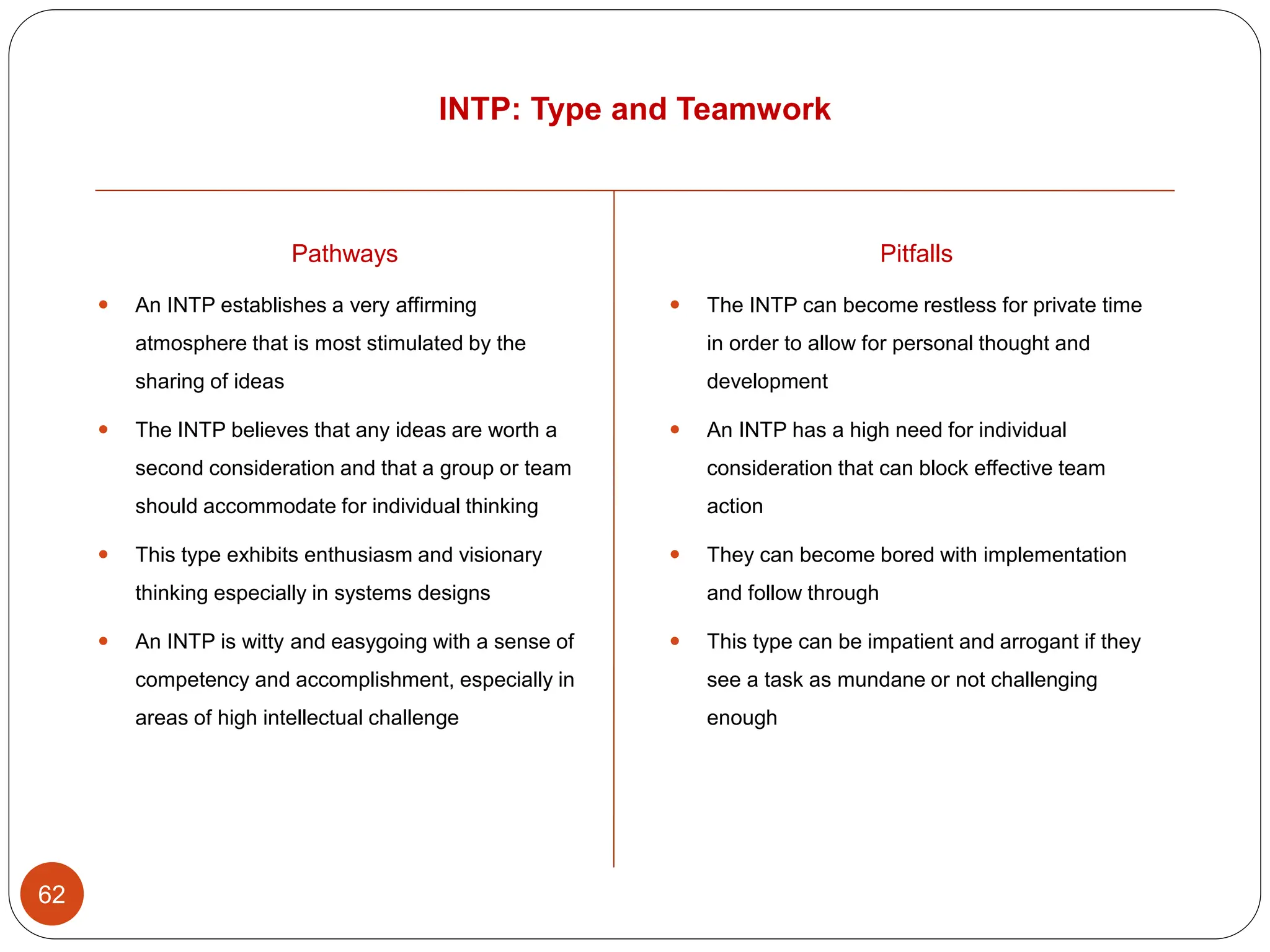
INTP: Type and Teamwork
62
Pitfalls
 The INTP can become restless for private time
in order to allow for personal thought and
development
 An INTP has a high need for individual
consideration that can block effective team
action
 They can become bored with implementation
and follow through
 This type can be impatient and arrogant if they
see a task as mundane or not challenging
enough
Pathways
 An INTP establishes a very affirming
atmosphere that is most stimulated by the
sharing of ideas
 The INTP believes that any ideas are worth a
second consideration and that a group or team
should accommodate for individual thinking
 This type exhibits enthusiasm and visionary
thinking especially in systems designs
 An INTP is witty and easygoing with a sense of
competency and accomplishment, especially in
areas of high intellectual challenge
ESTP: Type and Teamwork
63
Pitfalls
 An ESTP does not always see or value a theory
or theoretical frame of reference
 They may “ruffle feathers” or alienate others by
creating problems where none existed
 The ESTP can make large mistakes and be
offensive
 This type is easily bored and has a low attention
span
 They can appear insensitive and impulsive
Pathways
 The ESTP is non-conforming, will try anything
once and is restless
 For an ESTP, it is better to be doing something
than sitting around doing nothing
 This type cuts through to the center or core of an
issue and begins immediately to problem solve
 An ESTP is not bothered by deadlines, protocol
or procedures
 The ESTP is pragmatic and grounded and takes
life one day at a time
ESFP: Type and Teamwork
64
Pitfalls
 The ESFP can be loud, frustrating and
seemingly superficial
 An ESFP may tire others and may stretch the
patience of people around them as they may
appear to be unpredictable
 They can be easily scattered and start many
things with the best intentions only to get
sidetracked
 This type reflects a disdain for routine and
structure that can stress others
 The ESFP’s groundedness may cause them to
miss “the big picture”
Pathways
 An ESFP is effervescent, free-spirited, fun-loving
and non-conforming
 The ESFP has many projects and events going
on at once—the more the merrier
 This type exhibits high energy, has jovial
interactions, holds high respect and affirms
other’s differences
 The ESFP lives for the moment, has a good
grasp on reality and is not easily stressed
 An ESFP is a good team member and enjoys
involvement
ENFP: Type and Teamwork
65
Pitfalls
 The ENFP exhibits mood swings and “flies by
the seat of their pants”
 They can sometimes neglect advanced planning
 An ENFP can become easily depressed and
self-deprecating when people question their
motives
 This type finds routine to be boring, can easily
become restless and finds starting projects ore
exciting then finishing them
 The ENFP becomes listless and depressed
when people do not respond to their enthusiasm
or reject their leadership
Pathways
 The ENFP is enthusiastic, spontaneous,
gregarious, energetic, interpersonal and
affirming
 An ENFP has high inspiration and motivations
for people and projects, pushing to try the
untried and to be unconventional
 This type delights in brainstorming and
generating options and have a high sense of
team and group
 The ENFP functions as good team players, have
excellent people skills and are great at keeping
spirits high
ENTP: Type and Teamwork
66
Pitfalls
 The ENTP experiences volatile mood swings,
seems to never be satisfied and is exasperating
to others
 They can argue for the sake of arguing and it
can get to the point of beating dead issues.
Others can become impatient quickly
 An ENTP delights in overturning the tried and
the true, which is stressful to other types
 This type can be read as arrogant and
disinterested and wastes time though constant
competitiveness
 The ENTP’s failure to follow through can be
frustrating and their free spirit can be seen as
disrespectful of established methods
Pathways
 An ENTP exhibits high energy, creativity,
resiliency and dynamism and is argumentative
and readily engaged in intellectual banter
 The ENTP delights in endless possibilities
centered on theoretical connections and random
abstractions
 The ENTP is very flexible
 An ENTP lives on the edge of the future in an
expectant manner, always trying to change for
the sake of change—just to learn
 The ENTP is a competitive and free-wheeling,
visionary and high achieving.
 To the ENTP, all encounters are opportunities for
learning
ESTJ: Type and Teamwork
67
Pitfalls
 The ESTJ can be impatient, overbearing,
obnoxious and quite insensitive
 An ESTJ is controlling and suffocating,
engendering passive aggressive behaviors from
others, bringing out the rebellion in many
 They may not always allow or even hear
opposite points-of-view and may disregard
diversity and subordinate positions
 This type can accomplish the wrong thing in a
timely fashion through their compulsion, and in
the process, waste valuable personal and
organizational resources
Pathways
 The ESTJ is upbeat and affirming with a high
social awareness of others’ needs and concerns.
 An ESTJ has a strong need to lead and for
structure, schedules and deadlines
 This type believes that productivity is important
and that people are to be inspired to achieve
 The ESTJ is gregarious, interpersonal in
decision-making, a team player and idealistic
 The ESTJ believes that harmony and a pleasant
environment contributes to a successful team
effort
ESFJ: Type and Teamwork
68
Pitfalls
 The ESFJ generates guilt in others and can be
stifling around rules, regulations and procedures
 They can avoid conflict, smother and rescue
others and easily see themselves as martyrs
 An ESFJ sets themselves up to be taken
advantage of and later vents anger within the
team or elsewhere
 This type believes that too much diversity can
cause stress and conflict and they view
disagreement as poor team spirit
Pathways
 The ESFJ is gracious, appropriate, goal-oriented
and interpersonally aware
 An ESFJ has good organizational skills and is a
great team player who values and affirms
personal contributions
 This type is punctual, neat, responsible and
highly productive with a great concern for others
 An ESFJ nurtures diversity, affirms differing
points-of-view verbally and has a high
commitment to organization and goals
ENFJ: Type and Teamwork
69
Pitfalls
 An ENFJ avoids conflict by burying it or carrying
it rather than finding a good solution; the ENFJ is
a grudge carrier and guilt inducer
 The ENFJ places scheduling and goal ahead of
people, causing self-doubts and inner conflicts
 This type can become over-personalizing, self-
centered, bruised and angry when others do not
accept their leadership, ideals or advice
 An ENFJ exhibits jealousy and bickers
frequently, contributing to pettiness and
divisiveness within the team
Pathways
 An ENFJ is upbeat and affirming with a high
social awareness of others’ needs and concerns
 The ENFJ has a strong need to lead and a need
for structure, schedules and deadlines.
 This type believes that productivity is important
and that people are to be inspired to achieve
 The ENFJ is gregarious, interpersonal in
decision-making and is an idealistic team player
 The ENFJ believes that harmony and a pleasant
environment contributes to a successful team
effort
ENTJ: Type and Teamwork
70
Pitfalls
 The ENTJ meets disagreements head on with
hearty force, exhibiting an attitude of disbelief
 They can be consumed by goals causing
winning to be the primary interest
 An ENTJ can arouse hostility in those around
them through their intensity, penchant for
complexity and goal-orientation
 This type can exhibit arrogance, impatience and
insensitivity toward all who are not one hundred
percent for the team
 The ENTJ believes it is better to be right than to
be liked
Pathways
 The ENTJ is socially strategic, visionary,
systems-oriented and goal-driven
 They can see productive potential and
possibilities everywhere
 A ENTJ views life as a chessboard and believes
complexity is better than simplicity and that
learning happens as the team accomplishes
tasks
 This type has a high need for vision with
fulfillment, structure, scheduling and closure.
 The ENTJ is highly committed to people and
projects
Action Plan: Start, stop or continue?
71
• What will I start doing more of as a result of what I learned today?
• What will I stop doing as a result of what I learned today?
• What will I continue to do as a result of what I learned today?
Note: A common tendency among some people after taking the MBTI is to decide to try to be “less” of their type
and “more” of another type. While this is a noble and laudable goal, it is not generally a practical, attainable or
long-term solution. It would be like deciding to start writing with your opposite hand. Instead, think about ways to
highlight the strengths inherent in your type and how you might increase awareness of the pitfalls of your type.
And learn to show appreciate for others’ strengths.
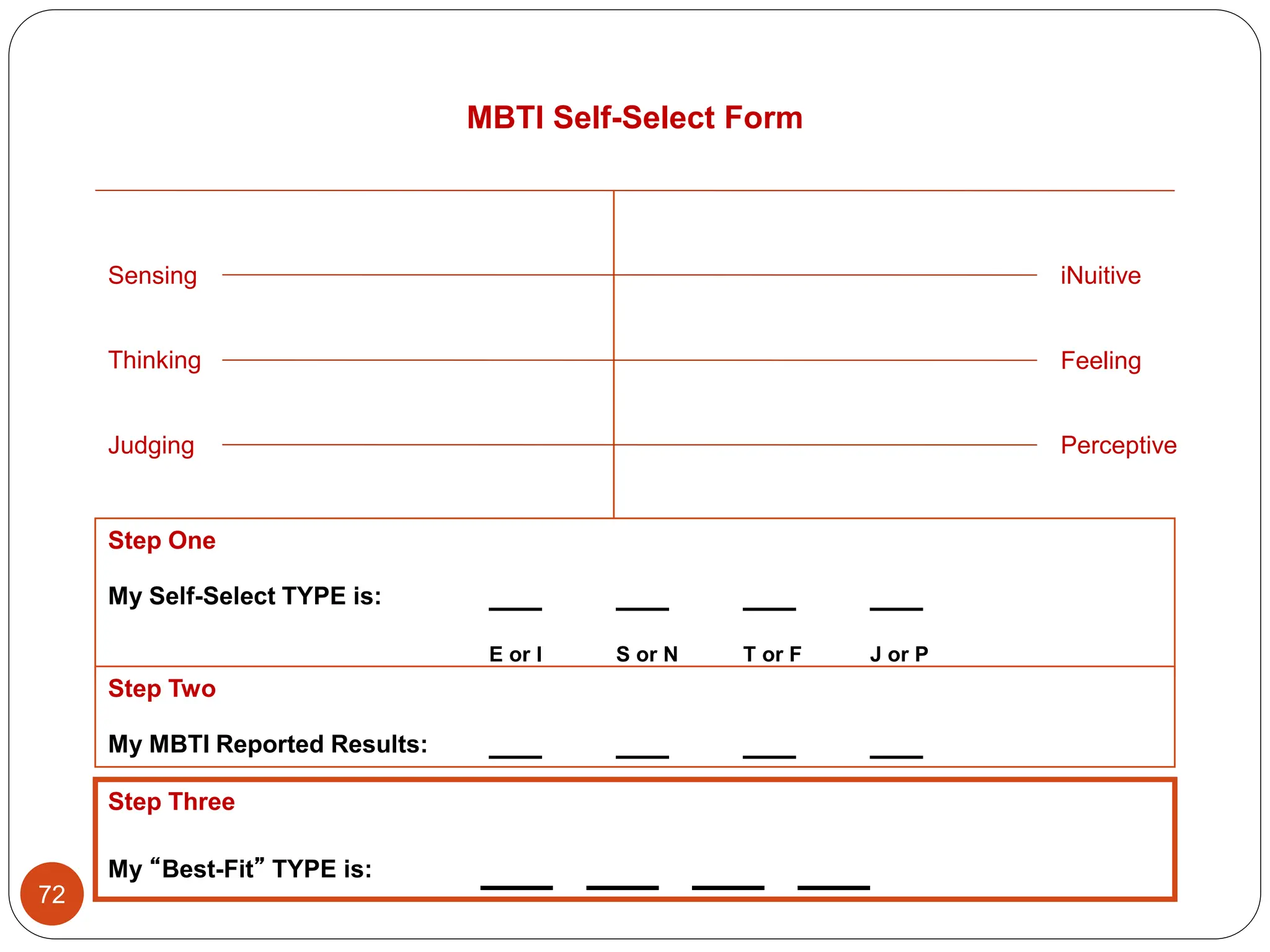
MBTI Self-Select Form
72
Step One
My Self-Select TYPE is: ___ ___ ___ ___
E or I S or N T or F J or P
Step Two
My MBTI Reported Results: ___ ___ ___ ___
Step Three
My “Best-Fit” TYPE is: __ __ __ __
Sensing iNuitive
Thinking Feeling
Judging Perceptive
Afternoon Activities
1) Meyers-Briggs Inspiration Activity: MBTI was developed by two every day
women whose intrigue led to a larger dream. Their dream then led to vision.
That vision then led to the creation of the MBTI which has a powerful impact
on the field of psychology. What are the implications of this for you? Spend
some time writing down your work/occupational/job related dreams.
Consider what you are intrigued by? How might this relate to your work or
vocational journey?
 -Prompt: Close your eyes and think about: What type of work would
you do if the sky was the limit and you could do anything? What would
your ideal work tasks, work setting, schedule, co-workers be like?
Who/what would you impact? How would the work impact you?
 -Spend 20 minutes thinking about this, individually. Then meet with
your trio, and share as much as you feel comfortable sharing regarding
your dream. There is power in speaking aspects of your dream out loud
in the presence of others. Engage one another’s dreams for 30 minutes.
73
Afternoon Activities
 2) AHAs Activity (Slides 20-22). Work independently from 12-12:30. Come
together and share insights as a group from 12:30-1:00.
 3) Share your MBTI with your group to the extent that you are comfortable.
Each participant share examples of how your MBTI has created Pathways and
Pitfalls (see slides 55-70) for you at your current/past position. Each
participant share examples of how you can use information gained about your
MBTI to support more Pathways and less Pitfalls. 1:10-2:00
 4) Review slides 51-54, then discuss how you might best communicate your
desire to make a process change to a supervisor or someone in upper
management who has each of the 4 preferences (Sensing, Intuiting, Thinking,
Feeling)? Second, share how you might communicate a significant process
change to a supervisee who has each of the 4 preferences above. 2:10-3:00pm
74
Afternoon Activities
 5) Read through your MBTI Interpretive Report, independently, and identify
any questions that you have. Identify any specific aspects of your results that
you would like us to focus on when we have our one on one next week. Email
those questions to the administrator by the end of the day today. 3:10-
4:00pm
75

MBTI_bnjjnjnigufhfyrdyfufygiygiyyifyikk.ppt

  • 1.
    Whatever the circumstancesof your life, the understanding of type can make your perceptions clearer, your judgments sounder and your life closer to your heart’s desire. Isabel Briggs Myers Myers-Briggs Type Indicator (MBTI)
  • 2.
    Agenda: Myers-Briggs TypeIndicator (MBTI) 2 • Introductions • Agenda and Objectives • MBTI Review • Identifying the “Best-Fit” MBTI Type: Self-Select and Report • Takeaways • Stress: Expression by Type • Problem Solving/Conflict/Contributions of Each Type • Communications/Change • Teamwork/Work Styles • Action Plan
  • 3.
    Objectives 3 • Review thehistory and basics of the Myers-Briggs Type Indicator (MBTI) and how it is used • Identify the description and general characteristics of each preference scale • Indicate each participant’s type by comparing your self-selection and the MBTI results of the “Best-Fit” Type • Look at ways to use your MBTI Type to your advantage
  • 4.
    The MBTI: Whatis it? 4 • The most valid and widely taken personality style indicator in history: more than two million people have taken it this year • A self-administering questionnaire • Based on Carl Jung’s notion that behavior is predictable at some level due to preferences people have for… • Taking in information and focusing attention • Making decisions • Organizing their lives
  • 5.
    The MBTI: TheResults 5 • Results reflect hard-wired preferences akin to left- or right-handedness, not to skill, ability, mental health or intelligence • Respondents come out as one of 16 different personality types • These type preferences offer profound insight into people’s tendencies, impact on teams, style of leadership and personal and professional development paths
  • 6.
    The MBTI: Uses 6 Ameans to describe preferences • People are different psychologically as well as physically • Psychological differences affect how we see the world A tool to help individuals… • Reflect on themselves and their behaviors • Appreciate others’ differences in a constructive fashion • Understand the benefits of differing approaches to problem solving A method used by teams to… • Create an objective framework for examining emotional issues • Facilitate team communications and problem solving • Identify sources of conflict • Value the unique contributions of other team members
  • 7.
    The MBTI doesNOT attempt to… 7 • Explain all of human behavior • Measure “good” and “bad” or “best” and “worst” • Assess ability, skills, competencies or intelligence • Evaluate stress levels • Create a method to stereotype or “pigeonhole” • Diagnose psychological disorders
  • 8.
    The MBTI: Preferencesalong four scales 8 • Extraversion and Introversion: Where do you get you energy from? • Sensing and iNtuition: How do you acquire information and focus attention? • Thinking and Feeling: How do you make decisions? • Judging and Perceiving: How do you deal with the external world? There is no right or wrong answer, or better or worse preference. Everyone uses each of the above preferences in one way to some degree. The important question is, which side of the scale do you naturally prefer?
  • 9.
    Attitude Function: Wheredo you get your energy from? 9 The Extraverted Attitude (E) • An Extravert (E) seems to express their attention outward as if it flows, or is drawn, out of the objects and people in their environment • Their stimulation is essentially extracted from the environment, the outer world of people and things The Introverted Attitude (I) • An Introvert (I) seems to reflect on their energy as if it is drawn from the environment and consolidated within one’s own position • Their stimulation is drawn from within their own environment, the inner world of thought and reflection
  • 10.
    Characteristics of theExtraverted and Introverted Attitudes 10 An Introverted person…  Relies on enduring concepts more than on transitory, external events  Has a thoughtful, contemplative way to meeting life  Holds interests that have depth  Thinks best alone and shares when ideas are clear  Reflects then (maybe) acts and may postpone acting too long at times  May seem withdrawn to Extroverts An Extraverted person…  Relies on the environment for stimulation and guidance  Has an action-oriented, sometimes impulsive, way of meeting life  Holds interests that have breadth  Thinks best when talking with people  Acts then (maybe) reflects and can jump into situations too soon at times  May seem shallow to Introverts
  • 11.
    Perceiving Functions: Howdo you focus your attention? 11 The Sensing Perception (S) • A Sensing (S) person tends to rely on perceptions that are observable by the five senses, sight, sound, touch, taste and smell • A Sensing person focuses their attention on reality and on what currently exists in the environment The iNtuitive Perception (N) • A iNtuitive (N) person tends to rely on the perception of possibilities that are translated via the unconscious • An iNtuitive person focuses attention on meanings or on possibilities beyond what is visible to the senses
  • 12.
    Characteristics of theSensing and iNtuitive Functions 12 An iNtuitive person…  Has an imaginative or theoretical orientation  Appreciates meaning, “the big picture” and patterns  Values communication that is figurative and abstract  Holds interests that have depth  Focuses on patterns and correlations  May seem fickle or impractical to Ss A Sensing person…  Has a realistic and practical orientation  Appreciates facts, details and specifics  Prefers communication that is literal and concrete  Focuses on specific parts or pieces of a topic  May seem materialistic and literal- minded to Ns
  • 13.
    Judging Functions: Howdo you make decisions? 13 The Thinking Judgment (T) • A Thinking (T) person links ideas together by making logical and often impersonal connections and relies on the principles of cause and effect • A Thinking person uses this decision-making function to make objective judgments based on logic The Feeling Judgment (F) • A Feeling (F) person weighs relative values and merits of an issue based on personal feelings or impact • A Feeling person uses this decision-making function to make subjective judgments based on personal values and relies on an understanding of personal and group values
  • 14.
    Characteristics of theThinking and Feeling Functions 14 A Feeling person…  Decides with their heart  Tends to excel in empathetic abilities  Is concerned with a decision’s impact on others  Desires harmony  Tends to appreciate the strengths and ideas of others  Frequently is accommodating to others  Offers praise  May seem fuzzy-minded and emotional to Ts A Thinking person…  Makes decisions with their head  Tends to excel in analytical abilities  Is concerned with a logical decision  Is oriented toward a situation based on connections in time—from the past through the future  Tends to critique the deficiencies and ideas of others and finds flaws in most circumstances  Frequently questions their experiences  May seem cold and condescending to Fs
  • 15.
    world? 15 The Judging Attitude(J) • A Judging (J) person is concerned with making decision, seeking closure, planning operations or organizing activities • Their lifestyle is decisive, planned and orderly The Perceptive Attitude (P) • A Perceptive (P) person is concerned with assimilating as much incoming information as possible and postponing decision-making • Their lifestyle is flexible, adaptable and spontaneous
  • 16.
    Characteristics of theJudging and Perceiving Attitude 16 A Perceiving person…  Lives to experience and seeks opportunities (“Pencil” to-do-list)  Enjoys being curious and keeping options open for as long as possible  Meets deadlines by last minute rush  Is adaptable in their attitude  Prefers to experience life as it happens  May seem disorganized, messy or irresponsible to Js A Judging person…  Lives to organize, plan and decide (“Pen” to-do list)  Enjoys making decisions, coming to closure or reaching conclusions  Handles deadlines and plans well in advance  Is decisive in attitude and action  Prefers to have life under control  May seem demanding, rigid and uptight to Ps
  • 17.
    Class “Type” Matrix 17 ISTJISFJ INFJ INTJ ISTP ISFP INFP INTP ESTP ESFP ENFP ENTP ESTJ ESFJ ENFJ ENTJ N S E I P F J J T T
  • 18.
    “Z” Problem SolvingModel 18 Sensing Sensing individuals focus on the present and rely on facts and “what is” INtuition Intuitive individuals focus on the future and reflect on possibilities and “the big picture” Thinking Thinking individuals tend to be logical and objective Feeling Feeling individuals tend to be value-based and have an impact on others Perceiving Perceiving individuals take their time Judging Judging individuals make choices
  • 19.
    The Power ofMBTI: Awareness and Appreciation 19 On an individual level, the MBTI will help you to… • Be aware of your preferences, strengths and potential pitfalls • Reflect on how they may be assisting you with or detracting from your communication with others On an interpersonal level, the MBTI will help you to… • Reflect on others’ thoughts and feelings • Listen to their responses for clues about their preferences • Acknowledge their perspective and be more empathetic • Speak from your own perspective after you hear another’s point-of-view On both levels, the MBTI will help you to… • Focus dialogue on an overall goal for a particular situation or behavior, not on the person
  • 20.
    “AHA’s”* Exercise 20 Reading Time– 25 minutes • For your “Best-Fit” Type, look through the takeaway materials for sections of problem solving, stress, work styles and others. Highlight “AHAs” and move them to the next page – 15 minutes • Create an Action Plan from your “AHA” list – 10 minutes *What is an “AHA”? An “AHA” is information you gathered that you thought “jumped out” at you, “rang true” or provided some realization. It can be utilized in some way to help you improve or to develop individually, interpersonally or at the team level.
  • 21.
    The Power ofMBTI: Awareness and Appreciation 21 Individual • • • • • • Interpersonal • • • • • • Individual, Interpersonal or Other • • • • • •
  • 22.
    Group Discussion 22 • Thosewho feel comfortable doing so, share with the group which “AHAs” emerged for you • Capture the Themes* on a flipchart • What Themes emerged from the discussion • *What is a “Theme”? A Theme is a general, implicit or recurring idea that emerges throughout your experience.
  • 23.
    Jungian Functions: ProblemSolving by Sensors 23 A Sensor approaches problem solving by… • Listing the facts based on what experience has shown them • Verifying the reality of the situation or problem • Understanding the details of the problem at hand • Being Descriptive of the problem A Sensor deals best with problem solving by trusting the facts and evidence. A Sensor is most adept at solving problems that they can get their hands on, literally, and that move them toward some practical and tangible results. A Sensor believes that it is inefficient or unproductive to spend a lot of time discussing a solution or theorizing about alternatives.
  • 24.
    Jungian Functions: ProblemSolving by iNtuitives 24 An iNtuitive approaches problem solving by… • Letting their imagination “run wild” • Seeing the big picture and emerging patterns • Generating alternatives and possibilities • Brainstorming An iNtuitive will not touch a problem until all of the alternatives have been considered and various schemes have been drawn to cover every aspect of the situation. An iNtuitive believes that problems are best solved when they are set in a context that gives perspective to a bigger picture. For example, the iNtuitive may perceive a dripping faucet as part of a larger problem, such as water pressure or even the design of the kitchen or bathroom. Thus, a proper solution involves acquiring books on home repair, perusing catalogs of new fixtures or drawing a schema of the entire system.
  • 25.
    Jungian Functions: ProblemSolving by Thinkers 25 A Thinker approaches problem solving by… • Analyzing the situation • Verifying the reality of the situation or problem • Reviewing the “pros,” “cons” and logical consequences • Being descriptive of the problem A Thinker contributes to the group by keeping everyone aware of the potential consequence of any given action. A Thinker tends to approach problem solving by weighing the cause and effect of each action carefully. This allows them to stay removed from the problem solving process so as not to become overly involved with the personal aspects of the issues. Because they are human, a thinker will have a more difficult time staying objective when confronted with the same problems themselves.
  • 26.
    Jungian Functions: ProblemSolving by Feelers 26 A Feeler approaches problem solving by… • Understanding the relationship issues involved • Being sensitive about how the group should proceed • Concerning themselves with others’ reactions • Valuing others’ opinions and considering their expectations A Feeler understands how a process affects someone, so even if it is not a Feeler’s own problem, they still can’t give relatively accurate readings of another’s behavior. In problem solving, the Feeler is the barometer of what the interpersonal reaction to the solution will look like. While the Thinking and Feeling dimensions are essential ingredients for effective problem solving, it is important to underline that, if the best solution in the world does not take into account how it will be received by all involved parties, it works only on paper and is doomed to fail.
  • 27.
    Stress Expression forESTJ 27 Extreme rigidity marked with an inability to admit failure For an ESTJ, someone else is always at fault. As stress mounts, it is incomprehensible to this type that they had anything to do with creating the stress. An ESTJ cannot admit that they are wrong A frantic effort to be in control of everything A poor decision is better than no decision at all for the stressed ESTJ. This individual will decide for themselves as well as anyone else around them. They also will be loud, adamant and controlling, and they will never second guess themselves and never look back A wide swing between domineering loudness and sullen withdrawal Somewhere between bitterness and pouting, almost always in anger, this type can experience a tirade or total withdrawal or any combination in between. These behaviors signal that the ESTJ is impervious to anything. Even if no doors exist, an ESTJ slams them shut. Everyone and everything are closed in the ESTJ’s world
  • 28.
    Stress Expression forESFJ 28 A “sweep under the rug,” denial buried in sweetness More than other types, harmony is central to this type. When it is absent, an ESFJ will focus on others to help alleviate the stress, such as feeding someone chicken soup, cookies and milk. An ESFJ questions a problem’s seriousness and believes that hugs and kisses will reduce the stress and produce normalcy again A heavy surge for control and order An ESFJ believes that they must busy themselves—tidy things up, organize, involve oneself in honest work or help someone—to make the stress go away An over-personalization of everything An ESFJ experiences extremes of both inward guilt and projected guilt. They assume that they are a central part of the cause of any situation. If someone else is wrong, the ESFJ believes they should be punished. If the ESFJ is wrong, though hard to believe, then they experience feelings of extreme martyrdom and worthlessness
  • 29.
    Stress Expression forENFJ 29 Low self-esteem and sullen rejection of others A stressed ENFJ believes that people are useless and totally untrustworthy; that is because the ENFJ believes that they are useless and untrustworthy themselves. The ENFJ’s theme song becomes, “nobody likes me, everybody hates me, I guess I’ll go eat worms…” An almost blind denial of negative reality An ENFJ would almost rather martyr themselves then accept a negative truth about anyone, especially a trusted friend or relative. “Sucker” tends to be written all over them, and when someone else acts in a negative way, withdrawal, sulkiness, bitterness, unforgiveness and absolutism all command the ENFJ’s behavior Fatigue, anger, bitterness and unforgiveness take center stage When caught in too much stress, an ENFJ does not see many opportunities for negotiation. The positive quickly turns toxic and is easily spewed on or toward others. Then, the ENFJ makes a hasty retreat into non-communication that ranges from bitterness to, “I’ll not forget today and I’ll get even”
  • 30.
    Stress Expression forENTJ 30 A loud, arrogant and impersonal “my way or the highway” stance It is difficult for an ENTJ to fathom being wrong. As stress mounts, so does the conviction of the ENTJ’s righteousness, couples with an intense need to argue loudly and angrily to maintain control An impatient, insensitive and repressive need to take charge of everything An ENTJ projects a “know-it-all” persona and can be at the throat of anyone who suggests either a new idea or one of the ENTJ’s shortcomings A detached, disinterested rejection of everything Depending on the stress level, an ENTJ can go from a commanding voice to a total disinterest and near refusal to communicate. Such detachment, couched in intellectual superiority, debilitates and depersonalizes others. Rarely can or will an ENTJ admit to failure. Such non- speak leaves others with nowhere to go and keeps an ENTJ fighting for control
  • 31.
    Stress Expression forENTP 31 Loud, controlling and scattered redundancies Almost as if only to hear themselves talk, an ENTP tries to control all of the “airways.” Saying anything, talking out of both sides of their mouth, increasing volume and repeating are characteristics of an ENTP under stress Pushing anything or anyone to and over the limit Marked with great insensitivity, an ENTP can try anyone’s patience in an unending effort to stay the center of attention. Regard for another’s needs is subjugated to a relentless grab for the spotlight Efforts to control are blocked by scatteredness As with almost any perceiving type, as the stress mounts in an ENTP, so does the effort to stay focused. It manifests itself as a swing between extremely controlling, repressive behavior and totally “off the wall” flight of fancy that borders on the absurd
  • 32.
    Stress Expression forENFP 32 Extreme mood swings with no warning Under stress, an ENFP can move from sullenness, marked with extreme pessimism and self- abatement, to an almost manic bubbliness that overwhelms others A higher than usual need to control people and situations Imposing guilt on others, feeling guilt themselves, punishing others and themselves indiscriminately and making unreal demands are all indications that stress is near for an ENFP Increased physical maladies, scattered behavioral patterns Hyperventilation, upper shoulder and neck aches and headaches can reduce the ENFP to near immobility. This type responds with severely intense “starts” that go nowhere and leave them even more scattered and frustrated
  • 33.
    Stress Expression forESFP 33 Total denial of anything and everything More than any other type, the ESFP is the “whistle while walking by the graveyard” type. They stay happy, busy, loose and ready, and as the stress increases, the ESFP can be in a high state of denial about what is happening around them Fatigue marked by despair, distrust, doom and gloom Under stress, an ESFP can be easily overextended. Being out of control can lead to one failure after another, or at least lead to perceive failures. An ESFP can make themselves miserable by their failure to pace themselves A wide swing between scatteredness and rigidity As stress mounts, the ESFP swings from an effort to control everything to an inability to control anything. Such behaviors are marked with extremes of both loudness and silence
  • 34.
    Stress Expression forESTP 34 Very fidgety and scattered An ESTP may exhibit a flighty restlessness, focusing on nothing. They also may be loud and obnoxious Pensive and distorting the facts While others might call it lying, this type can distort facts or present them with a negative spin. Whenunder stress, they can blurt something out and then be very quiet. They also can be controlling A clumsiness with a resentment to routine Resistance, rebellion, passive aggressive behavior and outright disrespect can be evidence that suggests extreme stress for an ESTP. The “tried and true” tends to be disregarded and avoided
  • 35.
    Stress Expression forINTP 35 Extremely out of touch with reality Great ideas and enthusiastic sharing, even defensive arguing, can characterize the INTP under stress. However, their ideas have little basis in fact and are not implementable Quite loud and very rigid When pushed, the rather quiet, easy-going and accepting INTP can become loud, demanding and rigid. The sudden and dramatic behavioral change is so removed from the usual that others recognize it quickly Impatience marked with arrogance The high need for internal consistency, coupled with the inner clarity that causes an INTP to move toward a mental conclusion, can make them seem short, rude or condescending toward others
  • 36.
    Stress Expression forINFP 36 Wide mood swings At early stages of stress, an INFP can become really scattered and extremely extraverted and then switch instantly to sullen rigidity Excessive anger and refusal to negotiate An INFP is normally easy-going and fairly pliable with a low need to influence. Suddenly, that disappears and the INFP develops a sort of “everybody lookout, and above all, don’t tread on me” outlook Marked restlessness and avoidance Whether it is a confrontation or just finishing a project, as the stress mounts, so does he avoidance. Yet the restlessness can keep the INFP focusing on all of the wrong things
  • 37.
    Stress Expression forISFP 37 Extreme self-effacement and depression Between over personalizing and underestimating, an ISFP can turn inward and, in no time at all, convince themselves (and others too) of their meaninglessness and uselessness in any situation—an expression that leaves them very isolated and depressed. A closed, rigid sense of martyrdom No matter the feedback, an ISFP quickly uses it to prove how unappreciated and disrespected they are. They believe that, regardless of how hard they try, their efforts will be rejected An emotional dump that is totally disproportionate to the event Once the ISFP opens up, out comes a whole series of things that have been “welled up” inside for a long time
  • 38.
    Stress Expression forISTP 38 Wide mood swings with blurts and denials It will be obvious from the ISTP’s body language and words that something is wrong. However, when questions, they persist in denial, “I said nothing is wrong!” A sudden lack of precision and high disinterest Normally, an ISTP is accurate, precise, quite proud and confident about their capabilities, but as stress undermines confidence, their work becomes sloppy and the ISTP loses interest A higher need to control, couple with scatteredness For the stressed ISTP, it is a bad version of the adage, “the faster I go, the behinder I get.” An ISTP commonly exhibits very bad self, time and project management with a low capability to respond to external stimuli
  • 39.
    Stress Expression forINTJ 39 Edgy, arrogant, argumentative and impatient If bombarded with too many demands, details and interpersonal needs, an INTJ moves to an apparent impatience and disdain for the events and people in their immediate presence A seduction about capabilities and failures As stress mounts and their competencies are tested, an INTJ seduces themselves into believing that the situation is nothing serious and that greater control is the only thing required to fix the problem. This mental state is interspersed with flashes of self-doubt and assumed failures and marked with extreme self-criticism A marked increase in distrusting others Distrust can be projected outward as disbelief—the issue is so clear to the INTJ, how can anyone disagree? The INTJ believes that others are out to get them or to undermine their work
  • 40.
    Stress Expression forINFJ 40 Blurts and badly-handled facts Not concerned with accuracy, when stress mounts, an INFJ will quote, badger and explode with a firm, even righteous, display of facts that may or may not be related to the situation A sullen, wounded martyrdom All of the rich, imaginative inspiration of this type quickly turns to a bitter sense of rejection as fatigue and other stressors manifest themselves A combination of strengths and weaknesses are maximized Under stress, introversion becomes non-speak, inspiration and theory become convoluted complexity and structure and closure become insensitivity and stubbornness
  • 41.
    Stress Expression forISFJ 41 Ill-timed “blow-ups” that are disproportionate to the event The supportive and obligatory nature of an ISFJ allows others to take advantage of them. As the stress mounts, they may upload a backlog of similar moments that they have carried for a long time. No one, include the ISFJ, knows when such “dumps” will occur Self-effacement Not withstanding the loyalty and dependability of this type, under stress, an ISFJ can become very self-punishing and even somewhat verbal about how useless they are A wide mood swing From a negative and anxious fear of the unknown, to a martyr-like self-suffering in the name of duty, an ISFJ’s behaviors can range from terror to tears in a matter of seconds. This swing is somewhat easily read by others and, in itself, is stressful to this type
  • 42.
    Stress Expression forISTJ 42 Extreme efforts to control Under great stress, an ISTJ may try to control everything around them, ranging from people to objects. They may be super-rigid, making unswerving demands on themselves and others A very negative and pessimistic outlook A stressed ISTJ may show high distrust of the unknown, including people, objects, future planning and strategizing. Any show of concern or emotion is intolerable High unpredictability This type may swing from high rigidity and loudness to scatteredness and zero communication and back again to the rigid. It is this swing with no apparent pattern that is so unnerving to this usually predictable and dependable ISTJ and to others observing it
  • 43.
    type 43 iNtuitive  Give “thebig picture”  Create a sense of urgency for the opportunity  Use confidence and enthusiasm  Point out the future benefits Sensing  Be factual  Document successful applications  Reduce risk factors  Thoroughly work out details in advance Thinking  Be logical  State the principles involved  Be well organized, moving logically across points  List the costs and benefits Feeling  Indicate who else is for the idea  Be personable and friendly  Indicate how the idea is helpful  Tell why the idea is valuable
  • 44.
    General Descriptions Associatedwith MBTI® Preferences 44 Extraversion Characteristics • Prefer to communicate verbally • Outgoing and action-oriented • Learn best by doing or talking • Have many friends and acquaintances • Enjoy sharing ideas at gatherings • Need external stimulus and input Sensing Characteristics • Focus on what is here and real • Observe and easily recall data and specifics • Gain understanding through hands-on experience • Tend to be factual and concrete Thinking Characteristics • Value logic • Use cause-and-effect reasoning • Objective, striving for what’s fair • Critical and analytical Judging Characteristics • Value organization • Methodical and disciplined • Decisive and need closure • Prefer to make plans Introversion Characteristics • Prefer to communicate in writing • Private and inwardly focused • Learn best through thinking and processing • Have a select circle of friends • Appear to be good listeners • Need time alone to reenergize self Intuition Characteristics • Attuned to possibilities in the future • Are concerned with meanings and patterns in information • Trust “gut” feelings and inspiration • Tend to be imaginative and creative Feeling Characteristics • Value compassion • Consider effects of their decisions on people • Seek to maintain harmony • Softhearted and empathetic Perceiving Characteristics • Flexible and adaptive • Tend to be spontaneous • Prefer to be loose and are open to change • Prefer to keep their options open Type in Action! © 2002 by Barbara D. Mathews and Catharine A. Larkin. Published by CPP, Inc. Permission is hereby granted to reproduce this master for workshop use. Duplication for any other use, including resale, is a violation of copyright law. MBTI is a trademark or registered trademark of the Myers-Briggs Type Indicator Trust in the United States and other countries.
  • 45.
    Contributions Made byEach Preference to Each Type 45 ISTJ ISFJ INFJ INTJ I Depth of concentration I Depth of concentration I Depth of concentration I Depth of concentration S Reliance on facts S Reliance on facts N Grasp of possibilities N Grasp of possibilities T Logic and analysis F Warmth and sympathy F Warmth and sympathy T Logic and analysis J Organization J Organization J Organization J Organization ISTP ISFP INFP INTP I Depth of concentration I Depth of concentration I Depth of concentration I Depth of concentration S Reliance on facts S Reliance on facts N Grasp of possibilities N Grasp of possibilities T Logic and analysis F Warmth and sympathy F Warmth and sympathy T Logic and analysis P Adaptability P Adaptability P Adaptability P Adaptability ESTP ESFP ENFP ENTP E Breadth of interests E Breadth of interests E Breadth of interests E Breadth of interests S Reliance on facts S Reliance on facts N Grasp of possibilities N Grasp of possibilities T Logic and analysis F Warmth and sympathy F Warmth and sympathy T Logic and analysis P Adaptability P Adaptability P Adaptability P Adaptability ESTJ ESFJ ENFJ ENTJ E Breadth of interests E Breadth of interests E Breadth of interests E Breadth of interests S Reliance on facts S Reliance on facts N Grasp of possibilities N Grasp of possibilities T Logic and analysis F Warmth and sympathy F Warmth and sympathy T Logic and analysis J Organization J Organization J Organization J Organization Type in Action! © 2002 by Barbara D. Mathews and Catharine A. Larkin. Published by CPP, Inc. Permission is hereby granted to reproduce this master for workshop use. Duplication for any other use, including resale, is a violation of copyright law. MBTI is a trademark or registered trademark of the Myers-Briggs Type Indicator Trust in the United States and other countries. Source: From MBTI® Manual (3rd ed.), by I. B. Myers, M. H. McCaulley, N. L. Quenk, & A. L. Hammer, 1998, Palo Alto, CA: CPP, Inc. Copyright 1998 by CPP, Inc. Adapted with permission. EXTRAVERTS INTROVERTS Judging Types Perceiving Types Perceiving Types Judging Types SENSING TYPES INTUITIVE TYPES With Thinking With Feeling With Feeling With Thinking
  • 46.
    Type Characteristics UnderlyingConflicts 46 Extraverts • Prefer to develop solutions by talking it through • Often change direction or topic during course of discussions • Experience Introverts as “withholding” Sensing Types • Define the problem based on concrete events and on what actually happened • Seek explanations and solutions based on experience • Experience Intuitive types as “unrealistic” Thinking Types • Search for logical alternatives and apply them • to everyone • Believe that if a problem can be defined accurately and the relevant evidence gathered, there will be a “correct” solution • Experience Feeling types as “irrational, inconsistent, and illogical” Judging Types • Need structure, decisions, and closure • Create plans, structures, and time frames to achieve goals • Experience Perceiving types as people they cannot count on to follow through Introverts • Prefer measured pacing and need talk-free time for internal processing • Need a more intense focus, and to come back to ideas after consideration • Experience Extraverts as “invasive” Intuitive Types • See specific behavior as part of an underlying pattern that is the real problem • Seek theoretical explanations and solutions • Experience Sensing types as “shooting down their ideas” or blocking progress Feeling Types • Search for individual solutions that work for people • Believe the solution will be found by gathering many perspectives and finding the answer that fits every- one’s needs • Experience Thinking types as “cold and uncaring” Perceiving Types • Need flexibility, and want decisions to grow out of the process • Have faith in their own internal sense of timing; want to be trusted to meet goals in their own ways • Experience Judging types as “hemming them in” Type in Action! © 2002 by Barbara D. Mathews and Catharine A. Larkin. Published by CPP, Inc. Permission is hereby granted to reproduce this master for workshop use. Duplication for any other use, including resale, is a violation of copyright law. MBTI is a trademark or registered trademark of the Myers-Briggs Type Indicator Trust in the United States and other countries. Source: From MBTI® Manual (3rd ed.), by I. B. Myers, M. H. McCaulley, N. L. Quenk, & A. L. Hammer, 1998, Palo Alto, CA: CPP, Inc. Copyright 1998 by CPP, Inc. Adapted with permission.
  • 47.
    Work Styles Takeaway:Extraversion and Introversion 47 An Extraverted person…  Likes variety and action  Tends to enjoy a faster pace and dislikes complicated procedures (especially Intuitive Sensing types)  Is skilled at greeting people (especially Intuitive Feeling types)  Is often impatient with long, slow jobs  Is interested in the results of their job, in getting it done and in how others perform  Often does not mind telephone intrusions and interruptions (especially Intuitive Sensing types) An Introverted person…  Likes quiet for concentration  Tends to be careful with details and dislikes sweeping statements (especially Intuitive Sensing types)  Has trouble remembering names and faces (especially Intuitive Thinking types)  Tends not to mind working on one project for a long time uninterrupted  Is interested in the idea behind their job  Dislikes telephone intrusions and interruptions (especially Intuitive Thinking types)
  • 48.
    Work Styles Takeaway:Sensing and iNtuition 48 An iNuitive person…  Likes solving new problems  Dislikes doing the same thing repeatedly (especially iNuitive Perceptive types)  Enjoys learning a new skill more than using it  Works in bursts of energy and enthusiasm with slack periods in between (especially Extraverted iNuitive types)  Reaches a conclusion quickly (especially Extraverted iNuitive Perceptive types)  Is impatient with routine details (especially Extraverted iNuitive Perceptive types)  Is patient with complicated situations A Sensing person…  Dislikes new problems unless there are standard ways to solve them  Likes an established order of task performance (especially Sensing Judging types)  Enjoys using acquired skills more than learning new ones  Works steadily with a realistic idea of how long a task will take  Usually reaches a conclusion step-by-step (especially Introverted Sensing types)  Seldom makes errors of fact  Tends to be good at precise work (especially Extraverted Sensing types)
  • 49.
    Work Styles Takeaway:Judgment and Perception 49 A Perceptive person…  Adapts well to changing situations  Does not mind leaving things open for alterations  Has trouble making decisions (especially Introverted Perceptive types)  Starts several projects and sometimes has difficulty in finishing them (especially Extraverted iNuitive Perceptive types)  Tends to postpone unpleasant jobs  Wants to know all about the new job (especially Introverted iNuitive Perspective types)  Tends to be curious and welcomes a new light on a situation or person A Judging person…  Works best when they can plan their work and follow the plan  Likes to get things settled and finished  Makes decisions quickly (especially Extraverted Judging types)  Dislikes interrupting the project they are on for a more urgent one (especially Introverted Sensing Judging types)  Does not always notice new things that need to de done  Wants only the essentials needed to begin their work (especially Extraverted Sensing Judging types)  Tends to be satisfied once they reach a judgment on a situation or person
  • 50.
    Work Styles Takeaway:Thinking and Feeling 50 A Feeling person…  Tends to be very aware of other people and their feelings (especially Extraverted Feeling types)  Enjoys pleasing people  Likes harmony but efficiency could be badly disrupted by office feuds  Often lets decisions be influenced by their own or other people’s personal likes and dislikes  Needs occasional praise  Dislikes telling people unpleasant things A Thinking person…  Does not readily show emotion and is often uncomfortable dealing with others’ feelings (especially Introverted Thinking types)  Sometimes hurts people’s feelings without knowing it  Likes analysis and putting things into logical order  Gets along fine without harmony  Tends to decide impersonally, sometimes paying insufficient attention to people’s wishes  Needs to be treated fairly  Is able to reprimand people or fire them when necessary
  • 51.
    What do Extravertsand Introverts want during a time of change? 51 An Introvert thrives on…  Reflecting on current issues and circumstances  Thought-out written communication  Time to think things through before discussing  Assimilating changes before taking action An Extravert thrives on…  Talking about current issues and circumstances  Involvement  Lots of communication  Having a “voice”  Action and keeping the pace up
  • 52.
    What do Sensingand iNtuitive types want during a time of change? 52 An iNtuitive type thrives on…  An overall rationale and “the big picture”  A vision of the future  The general plan  Options and direction but not necessarily settlement  Opportunities to provide input A Sensing type thrives on…  Real data  Specifics and details about the changes  Connections to the past  Realistic descriptions of the future  Clear guidelines about roles, expectations and responsibilities
  • 53.
    What do Judgingand Perceiving types want during a time of change? 53 A Perceiving type thrives on…  Open-ended approach with room for change  Developing a general action plan  Flexibility and options  Opportunities to gather more information  Room to adjust  Loosening up and trusting the process A Judging type thrives on…  A clear and concise plan  Defined outcomes and clear goals  A time frame with specific stages spelled out  A statement of priorities  Completion  Avoiding surprises
  • 54.
    What do Thinkingand Feeling types want during a time of change? 54 A Feeling type thrives on…  Recognition of their impact on people  Information regarding people’s needs and how they will be met  Inclusion in a process  Understanding values that are driving the change  Caring leadership  Appreciation and support A Thinking type thrives on…  The logic behind the decision  More information on systematic changes  Clarity in decision-making and planning  Defined goals and structure  Competent leadership  Equality
  • 55.
    ISTJ: Type andTeamwork 55 Pitfalls  An ISTJ believes that a bad decision on time is better than no decision at all and that doing something is better than doing nothing.  An ISTJ allows structure and order to override more pressing or emerging issues  The ISTJ sees a task as more important than team or group spirit and interpersonal issues  This type values competitiveness over collaboration  Slow to communicate praise and positive reinforcement, an ISTJ sees teamwork as invading their personal space and privacy Pathways  An ISTJ lives by the motto, “work hard, play hard”  Accountable and productive, an ISTJ is driven by the bottom line and give structure and order to most projects  This type schedules fun at appropriate times, usually after work is finished  The ISTJ respects authority and can be authoritative themselves  An ISTJ is rewarded by an accomplishment (especially one on time and in budget), a bonus or an organizational “perk”
  • 56.
    ISFJ: Type andTeamwork 56 Pitfalls  The ISFJ can be taken advantage of and becomes a dumping ground for others  Conflict within the team or with others is most stressful for the ISFJ  They may fail to respect boundaries, making the group listless and shattering loyalty to the organization and project  This type loses their sense of purpose and belonging if the team isn’t productive  By overlooking “the big picture” and becoming overextended in the moment, the ISFJ can leave the group feeling fatigued, unappreciated and worthless Pathways  The ISFJ is pleasant, dependable and organized  Accomplishment is important to them though not at interpersonal expense  Valuing appropriate behavior, the ISFJ works well within rules and expects others do to so as well  An ISFJ functions as very good team player with a strong sense of institutional memory and protocol  This type has a high tolerance for detail, routine and accomplishment and provides good supporting an affirming atmosphere
  • 57.
    INFJ: Type andTeamwork 57 Pitfalls  An INFJ can beat a theory to death and prefer an interpersonal exchange at the expense of practicality  The INFJ risks having their dreams remain only dreams without implementation and follow through  Paralyzed by conflict, the INFJ’s denial and avoidance can block constructive resolution  The INFJ is aloof, complex and stubborn, but their feelings are easily hurt Pathways  An INFJ keeps a balance between being reflective and inspirational while adhering to a schedule  This type is helpful, supportive, accountable and affirming and provides high intellectual stimulation and achievement toward noble ideals  The INFj closely observes group dynamics and directs energy to maintain a smooth, congenial team  This type is quiet, theoretical, inter- and intrapersonal and organized
  • 58.
    INTJ: Type andTeamwork 58 Pitfalls  The INTJ values independence and only give lip service to team or group work  They may try to improve areas that do not need improving , argue for the sake of arguing and act aloof toward others who fail to comprehend quickly  An INTJ may seem arrogant and uncaring by only giving intellectual assent to the group’s mission  Facts and specifics can be an INTJ’s worst enemy  This type can appear out of touch, defensive and intimidating to those who disagree Pathways  The INTJ is confident, positive and systems- oriented with an ample amount of structure and closure  This type is a natural conceptalizer and perpetual student, so whatever the team or group is doing, they must be involved in learning and improving  An INTJ values excellence and competence and is driven toward achievement  The INTJ strives for results while being reflective, abstract, objective and impersonal
  • 59.
    ISTP: Type andTeamwork 59 Pitfalls  The ISTP finds routines and regulations stressful  An ISTP believes that paperwork and deadlines block effectiveness and that doing for the sake of doing is a waste of energy  They can be slow to communicate and can tire quickly of too much of an emphasis on group process  This type is not always in touch with interpersonal dynamics ,and when confronted, tends to escape by doing something else Pathways  The ISTP is driven by action rather than speculation  They will bring good technical skills to any project in order to use, test and refine them  This type is self-starting and flexible and wants to find the shortest way to accomplish a task.  The ISTP sees the project as the reason for the team to be together  This type wants to stay focused, be precise and, when the task is complete, let go of it
  • 60.
    ISFP: Type andTeamwork 60 Pitfalls  The ISFP can be so consumed by the task that personal fatigue takes over and deadlines become lost  This type makes the workplace pleasant and cheerful so much that it sometimes blocks production. Others do not always appreciate their efforts  An ISFP keeps their appreciation of team members to themselves which can result in a sullen somewhat depressed, work environment  The ISFP can let themselves be taken advantage of and becomes angry and bitter as a result Pathways  The ISFP is quietly congenial and willing to work together for a cause, job or customer’s need  This type subscribes to “let’s whistle while we work” because fun and happy teams are winning teams  An ISFP keeps the environment bright, takes breaks and attends to personal and physical needs  Since they are far more encouraging than critical, an ISFP is supportive and helpful, negotiating alternatives for the good of the group  The ISFP resists being bound by schedules and their deeds speak more loudly than words
  • 61.
    INFP: Type andTeamwork 61 Pitfalls  The INFP may avoid conflict until personal values are violated and can be stubborn and unyielding in response  If the group does not accept the INFP’s values, they can lose sense of purpose and direction  An INFP can let personal needs override the project, creating tensions that tend to be overlooked  This type allows perfectionism and personal space issues to block teamwork Pathways  An INFP is positive, flexible, process driven and responsible to the team, self and mission  This type affirms and enables each team member and provides room to work alone and collectively toward a common goal  The INFP is cohesive, collaborative and confirming within a flexible framework and asks to be seen as effective and competent in teamwork
  • 62.
    INTP: Type andTeamwork 62 Pitfalls  The INTP can become restless for private time in order to allow for personal thought and development  An INTP has a high need for individual consideration that can block effective team action  They can become bored with implementation and follow through  This type can be impatient and arrogant if they see a task as mundane or not challenging enough Pathways  An INTP establishes a very affirming atmosphere that is most stimulated by the sharing of ideas  The INTP believes that any ideas are worth a second consideration and that a group or team should accommodate for individual thinking  This type exhibits enthusiasm and visionary thinking especially in systems designs  An INTP is witty and easygoing with a sense of competency and accomplishment, especially in areas of high intellectual challenge
  • 63.
    ESTP: Type andTeamwork 63 Pitfalls  An ESTP does not always see or value a theory or theoretical frame of reference  They may “ruffle feathers” or alienate others by creating problems where none existed  The ESTP can make large mistakes and be offensive  This type is easily bored and has a low attention span  They can appear insensitive and impulsive Pathways  The ESTP is non-conforming, will try anything once and is restless  For an ESTP, it is better to be doing something than sitting around doing nothing  This type cuts through to the center or core of an issue and begins immediately to problem solve  An ESTP is not bothered by deadlines, protocol or procedures  The ESTP is pragmatic and grounded and takes life one day at a time
  • 64.
    ESFP: Type andTeamwork 64 Pitfalls  The ESFP can be loud, frustrating and seemingly superficial  An ESFP may tire others and may stretch the patience of people around them as they may appear to be unpredictable  They can be easily scattered and start many things with the best intentions only to get sidetracked  This type reflects a disdain for routine and structure that can stress others  The ESFP’s groundedness may cause them to miss “the big picture” Pathways  An ESFP is effervescent, free-spirited, fun-loving and non-conforming  The ESFP has many projects and events going on at once—the more the merrier  This type exhibits high energy, has jovial interactions, holds high respect and affirms other’s differences  The ESFP lives for the moment, has a good grasp on reality and is not easily stressed  An ESFP is a good team member and enjoys involvement
  • 65.
    ENFP: Type andTeamwork 65 Pitfalls  The ENFP exhibits mood swings and “flies by the seat of their pants”  They can sometimes neglect advanced planning  An ENFP can become easily depressed and self-deprecating when people question their motives  This type finds routine to be boring, can easily become restless and finds starting projects ore exciting then finishing them  The ENFP becomes listless and depressed when people do not respond to their enthusiasm or reject their leadership Pathways  The ENFP is enthusiastic, spontaneous, gregarious, energetic, interpersonal and affirming  An ENFP has high inspiration and motivations for people and projects, pushing to try the untried and to be unconventional  This type delights in brainstorming and generating options and have a high sense of team and group  The ENFP functions as good team players, have excellent people skills and are great at keeping spirits high
  • 66.
    ENTP: Type andTeamwork 66 Pitfalls  The ENTP experiences volatile mood swings, seems to never be satisfied and is exasperating to others  They can argue for the sake of arguing and it can get to the point of beating dead issues. Others can become impatient quickly  An ENTP delights in overturning the tried and the true, which is stressful to other types  This type can be read as arrogant and disinterested and wastes time though constant competitiveness  The ENTP’s failure to follow through can be frustrating and their free spirit can be seen as disrespectful of established methods Pathways  An ENTP exhibits high energy, creativity, resiliency and dynamism and is argumentative and readily engaged in intellectual banter  The ENTP delights in endless possibilities centered on theoretical connections and random abstractions  The ENTP is very flexible  An ENTP lives on the edge of the future in an expectant manner, always trying to change for the sake of change—just to learn  The ENTP is a competitive and free-wheeling, visionary and high achieving.  To the ENTP, all encounters are opportunities for learning
  • 67.
    ESTJ: Type andTeamwork 67 Pitfalls  The ESTJ can be impatient, overbearing, obnoxious and quite insensitive  An ESTJ is controlling and suffocating, engendering passive aggressive behaviors from others, bringing out the rebellion in many  They may not always allow or even hear opposite points-of-view and may disregard diversity and subordinate positions  This type can accomplish the wrong thing in a timely fashion through their compulsion, and in the process, waste valuable personal and organizational resources Pathways  The ESTJ is upbeat and affirming with a high social awareness of others’ needs and concerns.  An ESTJ has a strong need to lead and for structure, schedules and deadlines  This type believes that productivity is important and that people are to be inspired to achieve  The ESTJ is gregarious, interpersonal in decision-making, a team player and idealistic  The ESTJ believes that harmony and a pleasant environment contributes to a successful team effort
  • 68.
    ESFJ: Type andTeamwork 68 Pitfalls  The ESFJ generates guilt in others and can be stifling around rules, regulations and procedures  They can avoid conflict, smother and rescue others and easily see themselves as martyrs  An ESFJ sets themselves up to be taken advantage of and later vents anger within the team or elsewhere  This type believes that too much diversity can cause stress and conflict and they view disagreement as poor team spirit Pathways  The ESFJ is gracious, appropriate, goal-oriented and interpersonally aware  An ESFJ has good organizational skills and is a great team player who values and affirms personal contributions  This type is punctual, neat, responsible and highly productive with a great concern for others  An ESFJ nurtures diversity, affirms differing points-of-view verbally and has a high commitment to organization and goals
  • 69.
    ENFJ: Type andTeamwork 69 Pitfalls  An ENFJ avoids conflict by burying it or carrying it rather than finding a good solution; the ENFJ is a grudge carrier and guilt inducer  The ENFJ places scheduling and goal ahead of people, causing self-doubts and inner conflicts  This type can become over-personalizing, self- centered, bruised and angry when others do not accept their leadership, ideals or advice  An ENFJ exhibits jealousy and bickers frequently, contributing to pettiness and divisiveness within the team Pathways  An ENFJ is upbeat and affirming with a high social awareness of others’ needs and concerns  The ENFJ has a strong need to lead and a need for structure, schedules and deadlines.  This type believes that productivity is important and that people are to be inspired to achieve  The ENFJ is gregarious, interpersonal in decision-making and is an idealistic team player  The ENFJ believes that harmony and a pleasant environment contributes to a successful team effort
  • 70.
    ENTJ: Type andTeamwork 70 Pitfalls  The ENTJ meets disagreements head on with hearty force, exhibiting an attitude of disbelief  They can be consumed by goals causing winning to be the primary interest  An ENTJ can arouse hostility in those around them through their intensity, penchant for complexity and goal-orientation  This type can exhibit arrogance, impatience and insensitivity toward all who are not one hundred percent for the team  The ENTJ believes it is better to be right than to be liked Pathways  The ENTJ is socially strategic, visionary, systems-oriented and goal-driven  They can see productive potential and possibilities everywhere  A ENTJ views life as a chessboard and believes complexity is better than simplicity and that learning happens as the team accomplishes tasks  This type has a high need for vision with fulfillment, structure, scheduling and closure.  The ENTJ is highly committed to people and projects
  • 71.
    Action Plan: Start,stop or continue? 71 • What will I start doing more of as a result of what I learned today? • What will I stop doing as a result of what I learned today? • What will I continue to do as a result of what I learned today? Note: A common tendency among some people after taking the MBTI is to decide to try to be “less” of their type and “more” of another type. While this is a noble and laudable goal, it is not generally a practical, attainable or long-term solution. It would be like deciding to start writing with your opposite hand. Instead, think about ways to highlight the strengths inherent in your type and how you might increase awareness of the pitfalls of your type. And learn to show appreciate for others’ strengths.
  • 72.
    MBTI Self-Select Form 72 StepOne My Self-Select TYPE is: ___ ___ ___ ___ E or I S or N T or F J or P Step Two My MBTI Reported Results: ___ ___ ___ ___ Step Three My “Best-Fit” TYPE is: __ __ __ __ Sensing iNuitive Thinking Feeling Judging Perceptive
  • 73.
    Afternoon Activities 1) Meyers-BriggsInspiration Activity: MBTI was developed by two every day women whose intrigue led to a larger dream. Their dream then led to vision. That vision then led to the creation of the MBTI which has a powerful impact on the field of psychology. What are the implications of this for you? Spend some time writing down your work/occupational/job related dreams. Consider what you are intrigued by? How might this relate to your work or vocational journey?  -Prompt: Close your eyes and think about: What type of work would you do if the sky was the limit and you could do anything? What would your ideal work tasks, work setting, schedule, co-workers be like? Who/what would you impact? How would the work impact you?  -Spend 20 minutes thinking about this, individually. Then meet with your trio, and share as much as you feel comfortable sharing regarding your dream. There is power in speaking aspects of your dream out loud in the presence of others. Engage one another’s dreams for 30 minutes. 73
  • 74.
    Afternoon Activities  2)AHAs Activity (Slides 20-22). Work independently from 12-12:30. Come together and share insights as a group from 12:30-1:00.  3) Share your MBTI with your group to the extent that you are comfortable. Each participant share examples of how your MBTI has created Pathways and Pitfalls (see slides 55-70) for you at your current/past position. Each participant share examples of how you can use information gained about your MBTI to support more Pathways and less Pitfalls. 1:10-2:00  4) Review slides 51-54, then discuss how you might best communicate your desire to make a process change to a supervisor or someone in upper management who has each of the 4 preferences (Sensing, Intuiting, Thinking, Feeling)? Second, share how you might communicate a significant process change to a supervisee who has each of the 4 preferences above. 2:10-3:00pm 74
  • 75.
    Afternoon Activities  5)Read through your MBTI Interpretive Report, independently, and identify any questions that you have. Identify any specific aspects of your results that you would like us to focus on when we have our one on one next week. Email those questions to the administrator by the end of the day today. 3:10- 4:00pm 75