The  Meyers   and   Briggs
Foundation
Meyers and briggs research institute


   Meyers and Briggs Type Indicator(MBTI)
    personality inventory is to make the theory of
    psychological types described by C. G. Jung
    understandable and useful in people’s lives.


   The essence of the theory is that much
    seemingly random variation in the behavior is
    actually quite orderly and consistent, being due
    to basic differences in the ways individuals
    prefer to use their perception and judgment.
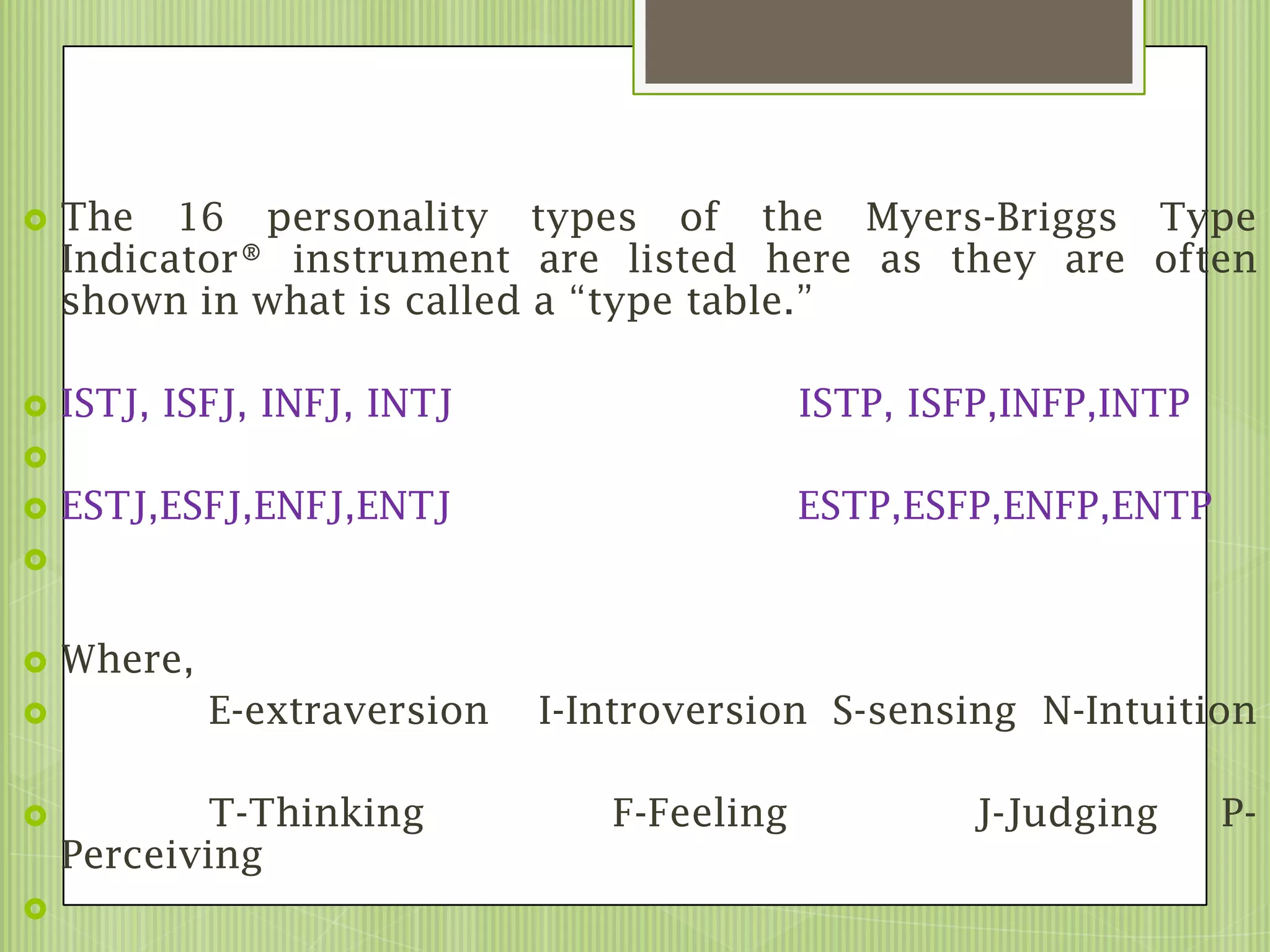
   The 16 personality types of the Myers-Briggs Type
    Indicator® instrument are listed here as they are often
    shown in what is called a “type table.”

   ISTJ, ISFJ, INFJ, INTJ                   ISTP, ISFP,INFP,INTP

   ESTJ,ESFJ,ENFJ,ENTJ                      ESTP,ESFP,ENFP,ENTP



   Where,
            E-extraversion   I-Introversion S-sensing N-Intuition

           T-Thinking           F-Feeling            J-Judging     P-
    Perceiving

LEADERSHIP REPORT


• Using the FIRO-B( fundamental interpersonal   relations-
  orientation-behavior) and MBTI Indicator.
   Leaders develop relationships with each
    member of work group

   High quality relationship
     member  is part of “in-group”
     more responsibility, higher satisfaction


   Low quality relationship
     member   is part of “out-group”
     less responsibility, lower satisfaction
AIM OF THE STUDY

• To explore and expand the understanding of the leadership style
  people
• show in an organization and how others might perceive and react
  to it.


• recognize that each person has both strengths and possible blind
  spots
• allow for wide divergence in people’s views, attitudes, values, and
  behaviors
• see different operating styles as an opportunity to bring diverse
  talents and strengths together in an organization.
• use leadership approaches that match the situation and people’s
  differing needs, in spite of your own
• The FIRO-B instrument measures the extent to which people
  attempt to satisfy three basic social needs:

Inclusion     (participation,   recognition,   belonging),
Control      (power,       authority,  influence),    and
Affection(openness, warmth, closeness). The FIRO-B
tool reports on how much one initiates behavior in these
three areas (Expressed Behavior) and how much one
would like others to initiate that behavior toward them
(Wanted Behavior)
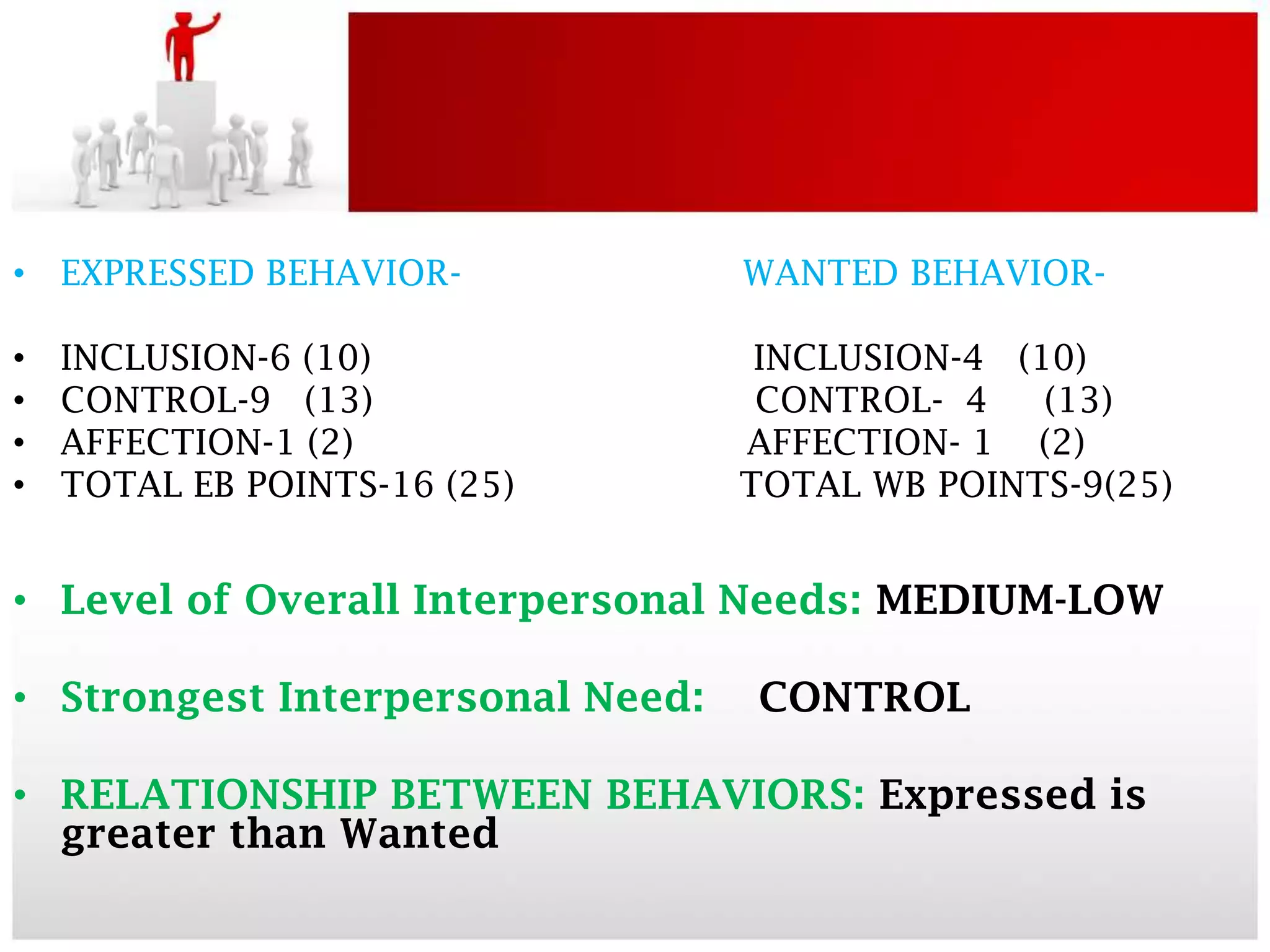
• EXPRESSED BEHAVIOR-             WANTED BEHAVIOR-

•   INCLUSION-6 (10)               INCLUSION-4 (10)
•   CONTROL-9 (13)                 CONTROL- 4    (13)
•   AFFECTION-1 (2)               AFFECTION- 1 (2)
•   TOTAL EB POINTS-16 (25)       TOTAL WB POINTS-9(25)


• Level of Overall Interpersonal Needs: MEDIUM-LOW

• Strongest Interpersonal Need:   CONTROL

• RELATIONSHIP BETWEEN BEHAVIORS: Expressed is
  greater than Wanted
ANALYSIS

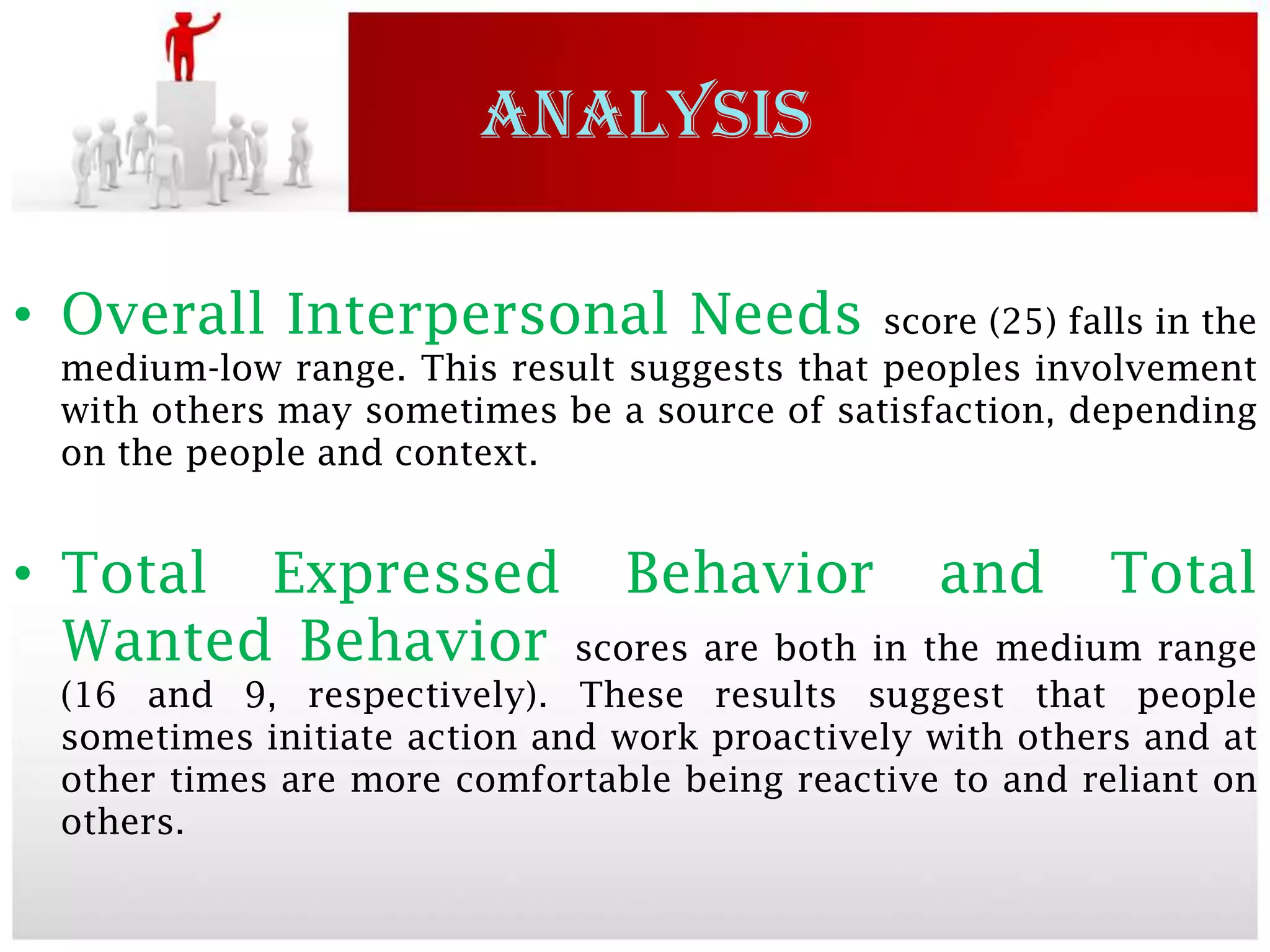
• Overall Interpersonal Needs                 score (25) falls in the
  medium-low range. This result suggests that peoples involvement
  with others may sometimes be a source of satisfaction, depending
  on the people and context.


• Total Expressed Behavior and Total
  Wanted Behavior scores are both in the medium range
  (16 and 9, respectively). These results suggest that people
  sometimes initiate action and work proactively with others and at
  other times are more comfortable being reactive to and reliant on
  others.
suggestions

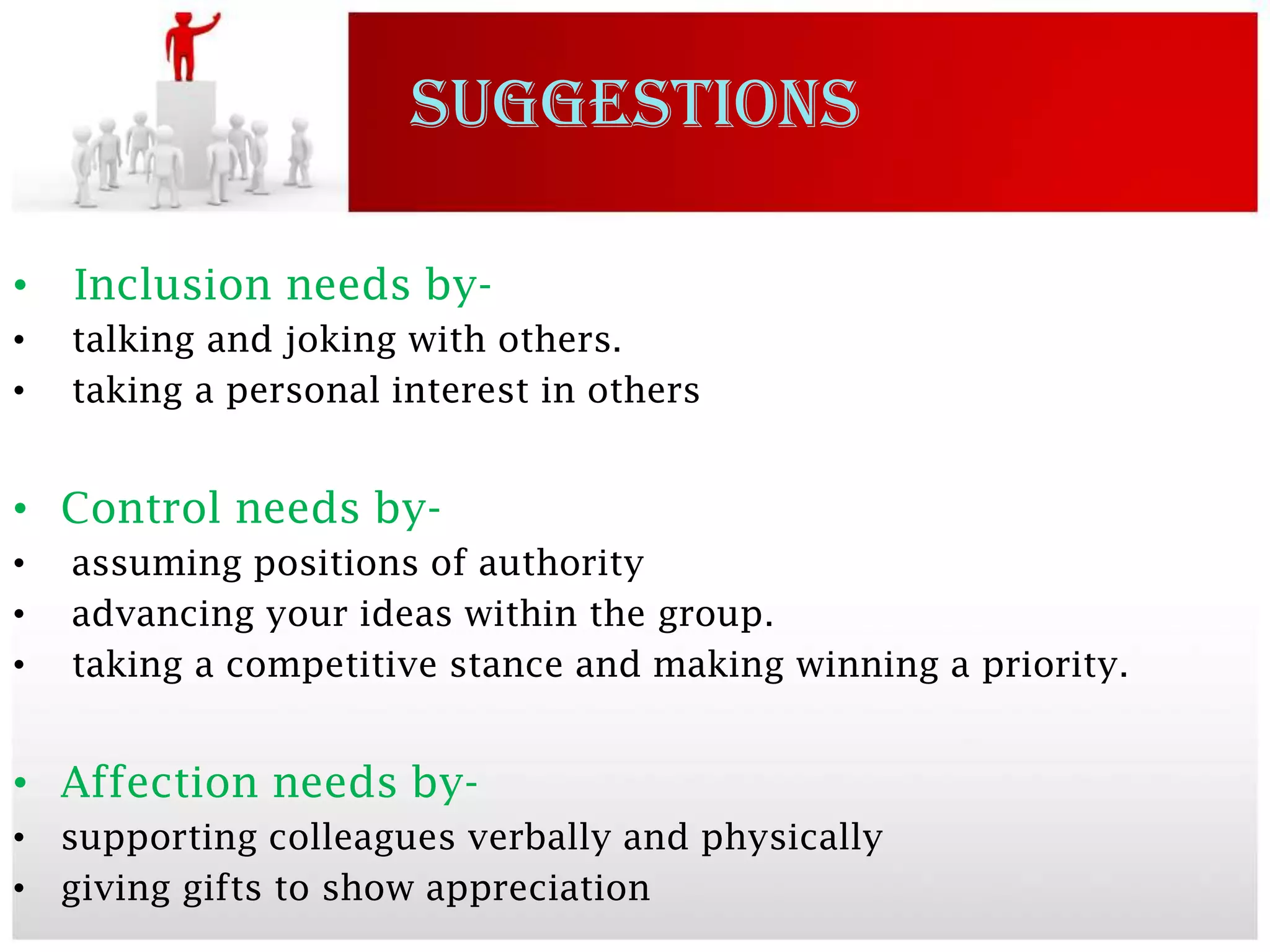
•   Inclusion needs by-
•   talking and joking with others.
•   taking a personal interest in others


• Control needs by-
•   assuming positions of authority
•   advancing your ideas within the group.
•   taking a competitive stance and making winning a priority.


• Affection needs by-
• supporting colleagues verbally and physically
• giving gifts to show appreciation
MBTI RESULTS

• The MBTI instrument describes four pairs of opposite preferences,
  called dichotomies. All eight preferences are valuable, and
  everyone uses each of them at least some of the time.

• The MBTI preferences for a LEADER are-

• E-Extraversion

• N-Intuition

• T-Thinking

• J-Judging
EFFECTS OF PREFERENCES IN WORK
                                 SETTINGS

• Extraversion [E] -
• Like variety and action
• Are often impatient with long, slow jobs
• Are interested in the activities of your work and in how other
  people do them.
• Act quickly, sometimes without thinking.


• Intuition [N]-
•   Like solving new, complex problems.
•   Enjoy learning a new skill more than using it
•   May follow your inspirations, good or bad
•   May make errors of fact
• Thinking [T]-
•   Use logical analysis to reach conclusions.
•   Can work without harmony.
•   May hurt people’s feelings without knowing it.
•   Tend to decide impersonally.


• Judging [J]-
•    Work best when you can plan your work and follow your plan.
•    Like to get things settled and finished.
•    May not notice new things that need to be done.
•    Tend to be satisfied once you reach a decision on a thing,
    situation, or person.
INTERPERSONAL RELATIONS

• Although the MBTI instrument shows that People have a
  preference for Extraversion, the overall interpersonal needs are in
  the medium-low range. This combination of results suggests that
  they enjoy the social aspects of work but keep their interactions
  focused on a particular group of individuals.


• People may have learned to limit interpersonal activity over time
  because of the organization’s work culture which may be very
  unit oriented and doesn’t encourage the use of groups and teams.
  He may also be the type of person who enjoys interacting with
  others but does not like to rely on relationships or groups to get
  things done. He may enjoy being included in groups, but feel
  inhibited in bringing people together yourself.
INTERPRETIVE
 REPORT

MBTI INDICATOR BASED
AIM

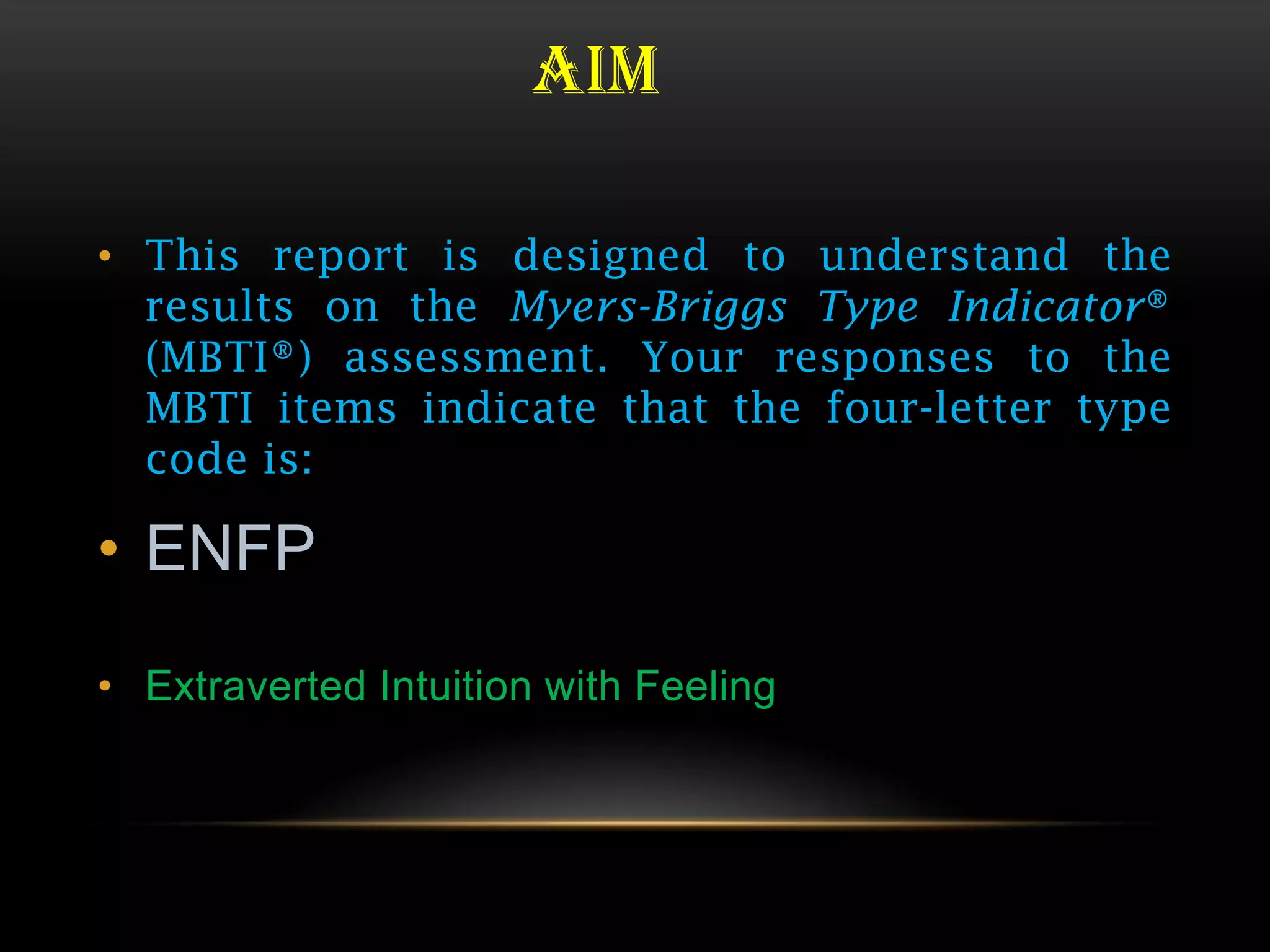
• This report is designed to understand the
  results on the Myers-Briggs Type Indicator®
  (MBTI®) assessment. Your responses to the
  MBTI items indicate that the four-letter type
  code is:

• ENFP

• Extraverted Intuition with Feeling
TYPE DESCRIPTION-
• ENFP-

• Warmly enthusiastic and imaginative
• See life as full of possibilities
•    Make connections between events and information very
    quickly, and confidently proceed based on the patterns
    they see
•    Want a lot of affirmation from others, and readily give
    appreciation and support
• Spontaneous and flexible, often rely on their ability to
  improvise and their verbal fluency
UNIQUE PATTERN PREFERENCES
 ENFPs like and use Intuition first and Feeling second. Their
third   favored process is Thinking, and their
• least preferred is Sensing. Youth is the time for ENFPs to
  develop Intuition and Feeling. At midlife,
• Thinking and Sensing often become more interesting and
  easier to use.


•   #1 Intuition Most preferred
•   #2 Feeling Second most preferred
•   #3 Thinking Third most preferred
•   #4 Sensing Least preferred
CLARITY OF PREFERENCES
MBTI responses also indicate the clarity of your
preferences, that is, how clear you were in selecting
each preference over its opposite. This is known as
the preference clarity index, or pci.


Because MBTI results are subject to a variety of
influences, such as work tasks, family
demands, and other factors, they need to be
individually verified.
WORK STYLE-
• ENFP Snapshot:
• ENFPs are enthusiastic, insightful, innovative, versatile, and
  tireless in pursuit
• of new possibilities. They enjoy working on teams to bring
  about change related
• to making things better for people.
• Creative
• Curious
• Energetic
• Enthusiastic
• Expressive
• Friendly
• Imaginative
• Independent
PROBLEM SOLVING APPROACH-
• 1. When solving a problem or making a decision, you
    are most likely to start with your dominant function
    ,INTUITION, by asking:
• What interpretations can be made from the facts?
• What insights and hunches come to mind about this situation?
• What would the possibilities be if there were no restrictions?
•   May then proceed to the #2 function, FEELING, and
    ask:
• How will the outcome affect the people, the process, and/or
  the organization?
• What is my personal reaction to (my likes/dislikes about) each
  alternative?
• Not as likely to ask questions related to #3
  function, THINKING, such as:
• What are the pros and cons of each alternative?
• What are the logical consequences of the options?
• What are the objective criteria that need to be satisfied?


• Are least likely to ask questions related to #4
  function, SENSING, such as:
• How did we get into this situation?
• What are the verifiable facts?
• What exactly is the situation now?
career report


  MBTI INDICATOR
AIM

This report applies the results from the Myers-
Briggs Type Indicator® (MBTI®) assessment to help
us identify job families and occupations that are a
good fit for the reported MBTI type.

• The responses on the MBTI instrument indicate
  that the reported type is: ENFP.
HOW TYPE DECIDES CAREER CHOICE

• Preferred Work Tasks-
•   Helping others develop or learn.
•   Developing multiple solutions to problems.
•   Seeing the possibilities in any situation or person.
•   Creating new products or services.
• Preferred Work Environment-
• Offers opportunities to work with a variety of people
• Provides opportunities to travel or to work with people in other
  countries
• Encourages and rewards creativity
• Has people who get excited by new possibilities
TYPE AFFECTS CAREER EXPLORATION
• Type strengths will help you:
•   Think of all the things you have ever wanted to do
•   Be willing to consider almost any possibility
•   Take advantage of unexpected opportunities
•   Establish an extensive network of people you can contact
•   Convey enthusiasm and energy to interviewers.


• Type has probably helped to develop strengths:
•   Identifying and pursuing multiple possibilities
•   Brainstorming and creatively solving problems; developing
    new products or services
•   Motivating others by bringing energy and enthusiasm to any
    task
Job families
• Most Attractive Job Families-

• Personal Care and Service
• Lodging manager, personal trainer, hairdresser, child care
  provider

• Arts, Design, Entertainment, Sports, and Media
• Artist, coach, musician, reporter

• Community and Social Services
• Community service manager, career counselor, clergy, social
  worker.
• Moderately Attractive Job Families-

•   Office and Administrative Support
•   Bank teller, receptionist, clerical services, legal secretary

•   Life, Physical, and Social Sciences
•   Biologist, chemist, economist, psychologist

•   Legal
•   Lawyer, arbitrator, paralegal, court reporter

•   Construction and Extraction
•   Carpenter, plumber, electrician, stonemason

•   Building and Grounds Maintenance
•   Gardener, tree trimmer, housekeeping, lawn service supervisor
Least attractive job families

• Protective Services
• Firefighter, correctional officer, security guard, police officer

• Transportation and Materials Moving
• Pilot, air traffic controller, driver, freight handler

• Installation, Maintenance, and Repair
• Office machine repair, mechanic, line installer, electronics repair

• Computers and Mathematics
• Programmer, systems analyst, database administrator, mathematician
ENTREPRENEUR
REPORT
     MBTI®
MBTI PERSONALITY TYPE

• The MBTI identifies 16 personality types. The letters that
  make up the type are derived from the four scales of the
  MBTI. The results indicate that type is ESTJ.

• ESTJs like to take charge and organize tasks and people to
  accomplish well-defined, tangible goals. Their firm grasp
  of the relevant details and facts enables them to proceed
  methodically, working step by step toward their goal. They
  tend to rely on experience and common sense and
  sometimes have little patience for abstractions. Active and
  outgoing people who enjoy directing and delegating to
  others, ESTJs are often found in management and
  administrative positions.
Type and Entrepreneurship

• Based on the MBTI results of a sample of female small
  business owners and a small sample of female
  entrepreneurs whose businesses made the Inc. 500 list of
  the fastest growing small companies. It was found that
  ESTJ women are more than twice as likely as would be
  expected to become small business owners given the
  percentage of ESTJs among U.S. women. In addition, ESTJ
  women are somewhat more likely than would be expected
  to found one of the fastest growing small companies.
YOUR STRONG INTERESTS

• The Strong Interest Inventory measures interests by
  comparing the results on the inventory with the results of
  diverse samples of employed people who are experienced
  in and satisfied with their careers. This Entrepreneur
  Report will specifically compare the interests with the
  interests of small business owners who are satisfied or
  very satisfied in their careers.
A Snapshot of Small Business
Owners (SBOs)
• A national sample of 206 women who own and run small
  businesses responded to the items on the Strong.
  Throughout this report, are being compared with these
  women—small business owners of the same gender as
  yourself—because research has shown that women’s and
  men’s interests differ, even within the same occupation.
  Research has also suggested that female and male small
  business owners differ in their motives for owning a
  business, in the kind of business they choose, and in their
  managerial style.
General Occupational Theme
Results
• The Strong’s General Occupational Themes represent six
  types of people and work environments.

• CONVENTIONAL (C)

• ENTERPRISING (E)

• ARTISTIC (A)

• SOCIAL (S)

• REALISTIC (R)

• INVESTIGATIVE (I)
PERSONAL STYLES AND
  ENTREPRENEURSHIP
• The Strong Personal Style Scales identify styles that may
  affect how you would run a business.
• Small business owners, like women in the general
  population, are more interested in working with people
  than with ideas, data, or things. Your score is near the
  middle of this scale, but still within the range of small
  business owners. You may find that alternating between
  working alone with ideas, data, or things and working with
  others is a good balance for you.
• Small business owners have more interest in practical, on-
  the-job learning than do women in general. You also prefer
  learning on the job.
SUMMARY
 For more than 60 years, the MBTI tool has
 helped millions of people throughout the world
 gain a deeper understanding of themselves
 and how they interact with others and
 improve how they communicate, work, and
 learn. Visit www.cpp.com to discover practical
 tools for lifetime learning and development.
Mbti

Mbti

  • 1.
    The Meyers and Briggs Foundation
  • 2.
    Meyers and briggsresearch institute  Meyers and Briggs Type Indicator(MBTI) personality inventory is to make the theory of psychological types described by C. G. Jung understandable and useful in people’s lives.  The essence of the theory is that much seemingly random variation in the behavior is actually quite orderly and consistent, being due to basic differences in the ways individuals prefer to use their perception and judgment.
  • 3.
    The 16 personality types of the Myers-Briggs Type Indicator® instrument are listed here as they are often shown in what is called a “type table.”  ISTJ, ISFJ, INFJ, INTJ ISTP, ISFP,INFP,INTP   ESTJ,ESFJ,ENFJ,ENTJ ESTP,ESFP,ENFP,ENTP   Where,  E-extraversion I-Introversion S-sensing N-Intuition  T-Thinking F-Feeling J-Judging P- Perceiving 
  • 4.
    LEADERSHIP REPORT • Usingthe FIRO-B( fundamental interpersonal relations- orientation-behavior) and MBTI Indicator.
  • 5.
    Leaders develop relationships with each member of work group  High quality relationship  member is part of “in-group”  more responsibility, higher satisfaction  Low quality relationship  member is part of “out-group”  less responsibility, lower satisfaction
  • 6.
    AIM OF THESTUDY • To explore and expand the understanding of the leadership style people • show in an organization and how others might perceive and react to it. • recognize that each person has both strengths and possible blind spots • allow for wide divergence in people’s views, attitudes, values, and behaviors • see different operating styles as an opportunity to bring diverse talents and strengths together in an organization. • use leadership approaches that match the situation and people’s differing needs, in spite of your own
  • 7.
    • The FIRO-Binstrument measures the extent to which people attempt to satisfy three basic social needs: Inclusion (participation, recognition, belonging), Control (power, authority, influence), and Affection(openness, warmth, closeness). The FIRO-B tool reports on how much one initiates behavior in these three areas (Expressed Behavior) and how much one would like others to initiate that behavior toward them (Wanted Behavior)
  • 8.
    • EXPRESSED BEHAVIOR- WANTED BEHAVIOR- • INCLUSION-6 (10) INCLUSION-4 (10) • CONTROL-9 (13) CONTROL- 4 (13) • AFFECTION-1 (2) AFFECTION- 1 (2) • TOTAL EB POINTS-16 (25) TOTAL WB POINTS-9(25) • Level of Overall Interpersonal Needs: MEDIUM-LOW • Strongest Interpersonal Need: CONTROL • RELATIONSHIP BETWEEN BEHAVIORS: Expressed is greater than Wanted
  • 9.
    ANALYSIS • Overall InterpersonalNeeds score (25) falls in the medium-low range. This result suggests that peoples involvement with others may sometimes be a source of satisfaction, depending on the people and context. • Total Expressed Behavior and Total Wanted Behavior scores are both in the medium range (16 and 9, respectively). These results suggest that people sometimes initiate action and work proactively with others and at other times are more comfortable being reactive to and reliant on others.
  • 10.
    suggestions • Inclusion needs by- • talking and joking with others. • taking a personal interest in others • Control needs by- • assuming positions of authority • advancing your ideas within the group. • taking a competitive stance and making winning a priority. • Affection needs by- • supporting colleagues verbally and physically • giving gifts to show appreciation
  • 11.
    MBTI RESULTS • TheMBTI instrument describes four pairs of opposite preferences, called dichotomies. All eight preferences are valuable, and everyone uses each of them at least some of the time. • The MBTI preferences for a LEADER are- • E-Extraversion • N-Intuition • T-Thinking • J-Judging
  • 12.
    EFFECTS OF PREFERENCESIN WORK SETTINGS • Extraversion [E] - • Like variety and action • Are often impatient with long, slow jobs • Are interested in the activities of your work and in how other people do them. • Act quickly, sometimes without thinking. • Intuition [N]- • Like solving new, complex problems. • Enjoy learning a new skill more than using it • May follow your inspirations, good or bad • May make errors of fact
  • 13.
    • Thinking [T]- • Use logical analysis to reach conclusions. • Can work without harmony. • May hurt people’s feelings without knowing it. • Tend to decide impersonally. • Judging [J]- • Work best when you can plan your work and follow your plan. • Like to get things settled and finished. • May not notice new things that need to be done. • Tend to be satisfied once you reach a decision on a thing, situation, or person.
  • 14.
    INTERPERSONAL RELATIONS • Althoughthe MBTI instrument shows that People have a preference for Extraversion, the overall interpersonal needs are in the medium-low range. This combination of results suggests that they enjoy the social aspects of work but keep their interactions focused on a particular group of individuals. • People may have learned to limit interpersonal activity over time because of the organization’s work culture which may be very unit oriented and doesn’t encourage the use of groups and teams. He may also be the type of person who enjoys interacting with others but does not like to rely on relationships or groups to get things done. He may enjoy being included in groups, but feel inhibited in bringing people together yourself.
  • 15.
  • 16.
    AIM • This reportis designed to understand the results on the Myers-Briggs Type Indicator® (MBTI®) assessment. Your responses to the MBTI items indicate that the four-letter type code is: • ENFP • Extraverted Intuition with Feeling
  • 17.
    TYPE DESCRIPTION- • ENFP- •Warmly enthusiastic and imaginative • See life as full of possibilities • Make connections between events and information very quickly, and confidently proceed based on the patterns they see • Want a lot of affirmation from others, and readily give appreciation and support • Spontaneous and flexible, often rely on their ability to improvise and their verbal fluency
  • 18.
    UNIQUE PATTERN PREFERENCES ENFPs like and use Intuition first and Feeling second. Their third favored process is Thinking, and their • least preferred is Sensing. Youth is the time for ENFPs to develop Intuition and Feeling. At midlife, • Thinking and Sensing often become more interesting and easier to use. • #1 Intuition Most preferred • #2 Feeling Second most preferred • #3 Thinking Third most preferred • #4 Sensing Least preferred
  • 19.
    CLARITY OF PREFERENCES MBTIresponses also indicate the clarity of your preferences, that is, how clear you were in selecting each preference over its opposite. This is known as the preference clarity index, or pci. Because MBTI results are subject to a variety of influences, such as work tasks, family demands, and other factors, they need to be individually verified.
  • 20.
    WORK STYLE- • ENFPSnapshot: • ENFPs are enthusiastic, insightful, innovative, versatile, and tireless in pursuit • of new possibilities. They enjoy working on teams to bring about change related • to making things better for people. • Creative • Curious • Energetic • Enthusiastic • Expressive • Friendly • Imaginative • Independent
  • 21.
    PROBLEM SOLVING APPROACH- •1. When solving a problem or making a decision, you are most likely to start with your dominant function ,INTUITION, by asking: • What interpretations can be made from the facts? • What insights and hunches come to mind about this situation? • What would the possibilities be if there were no restrictions? • May then proceed to the #2 function, FEELING, and ask: • How will the outcome affect the people, the process, and/or the organization? • What is my personal reaction to (my likes/dislikes about) each alternative?
  • 22.
    • Not aslikely to ask questions related to #3 function, THINKING, such as: • What are the pros and cons of each alternative? • What are the logical consequences of the options? • What are the objective criteria that need to be satisfied? • Are least likely to ask questions related to #4 function, SENSING, such as: • How did we get into this situation? • What are the verifiable facts? • What exactly is the situation now?
  • 23.
    career report MBTI INDICATOR
  • 24.
    AIM This report appliesthe results from the Myers- Briggs Type Indicator® (MBTI®) assessment to help us identify job families and occupations that are a good fit for the reported MBTI type. • The responses on the MBTI instrument indicate that the reported type is: ENFP.
  • 25.
    HOW TYPE DECIDESCAREER CHOICE • Preferred Work Tasks- • Helping others develop or learn. • Developing multiple solutions to problems. • Seeing the possibilities in any situation or person. • Creating new products or services. • Preferred Work Environment- • Offers opportunities to work with a variety of people • Provides opportunities to travel or to work with people in other countries • Encourages and rewards creativity • Has people who get excited by new possibilities
  • 26.
    TYPE AFFECTS CAREEREXPLORATION • Type strengths will help you: • Think of all the things you have ever wanted to do • Be willing to consider almost any possibility • Take advantage of unexpected opportunities • Establish an extensive network of people you can contact • Convey enthusiasm and energy to interviewers. • Type has probably helped to develop strengths: • Identifying and pursuing multiple possibilities • Brainstorming and creatively solving problems; developing new products or services • Motivating others by bringing energy and enthusiasm to any task
  • 27.
    Job families • MostAttractive Job Families- • Personal Care and Service • Lodging manager, personal trainer, hairdresser, child care provider • Arts, Design, Entertainment, Sports, and Media • Artist, coach, musician, reporter • Community and Social Services • Community service manager, career counselor, clergy, social worker.
  • 28.
    • Moderately AttractiveJob Families- • Office and Administrative Support • Bank teller, receptionist, clerical services, legal secretary • Life, Physical, and Social Sciences • Biologist, chemist, economist, psychologist • Legal • Lawyer, arbitrator, paralegal, court reporter • Construction and Extraction • Carpenter, plumber, electrician, stonemason • Building and Grounds Maintenance • Gardener, tree trimmer, housekeeping, lawn service supervisor
  • 29.
    Least attractive jobfamilies • Protective Services • Firefighter, correctional officer, security guard, police officer • Transportation and Materials Moving • Pilot, air traffic controller, driver, freight handler • Installation, Maintenance, and Repair • Office machine repair, mechanic, line installer, electronics repair • Computers and Mathematics • Programmer, systems analyst, database administrator, mathematician
  • 30.
  • 31.
    MBTI PERSONALITY TYPE •The MBTI identifies 16 personality types. The letters that make up the type are derived from the four scales of the MBTI. The results indicate that type is ESTJ. • ESTJs like to take charge and organize tasks and people to accomplish well-defined, tangible goals. Their firm grasp of the relevant details and facts enables them to proceed methodically, working step by step toward their goal. They tend to rely on experience and common sense and sometimes have little patience for abstractions. Active and outgoing people who enjoy directing and delegating to others, ESTJs are often found in management and administrative positions.
  • 32.
    Type and Entrepreneurship •Based on the MBTI results of a sample of female small business owners and a small sample of female entrepreneurs whose businesses made the Inc. 500 list of the fastest growing small companies. It was found that ESTJ women are more than twice as likely as would be expected to become small business owners given the percentage of ESTJs among U.S. women. In addition, ESTJ women are somewhat more likely than would be expected to found one of the fastest growing small companies.
  • 33.
    YOUR STRONG INTERESTS •The Strong Interest Inventory measures interests by comparing the results on the inventory with the results of diverse samples of employed people who are experienced in and satisfied with their careers. This Entrepreneur Report will specifically compare the interests with the interests of small business owners who are satisfied or very satisfied in their careers.
  • 34.
    A Snapshot ofSmall Business Owners (SBOs) • A national sample of 206 women who own and run small businesses responded to the items on the Strong. Throughout this report, are being compared with these women—small business owners of the same gender as yourself—because research has shown that women’s and men’s interests differ, even within the same occupation. Research has also suggested that female and male small business owners differ in their motives for owning a business, in the kind of business they choose, and in their managerial style.
  • 35.
    General Occupational Theme Results •The Strong’s General Occupational Themes represent six types of people and work environments. • CONVENTIONAL (C) • ENTERPRISING (E) • ARTISTIC (A) • SOCIAL (S) • REALISTIC (R) • INVESTIGATIVE (I)
  • 36.
    PERSONAL STYLES AND ENTREPRENEURSHIP • The Strong Personal Style Scales identify styles that may affect how you would run a business. • Small business owners, like women in the general population, are more interested in working with people than with ideas, data, or things. Your score is near the middle of this scale, but still within the range of small business owners. You may find that alternating between working alone with ideas, data, or things and working with others is a good balance for you. • Small business owners have more interest in practical, on- the-job learning than do women in general. You also prefer learning on the job.
  • 37.
    SUMMARY  For morethan 60 years, the MBTI tool has helped millions of people throughout the world gain a deeper understanding of themselves and how they interact with others and improve how they communicate, work, and learn. Visit www.cpp.com to discover practical tools for lifetime learning and development.