WRITINGWRITING
DISSERTATIONSDISSERTATIONS
Kuhu Pathak
MBA-Marketing
1
EFFECTIVE LEARNING PROGRAMMEEFFECTIVE LEARNING PROGRAMME
DISSERTATION WRITING: OUTLINEDISSERTATION WRITING: OUTLINE
 Introduction
 What is a dissertation?
 Planning your study: generating a research
question; background reading & method
 Planning a research schedule
 Structuring your dissertation
 Working with your supervisor
2
WHAT IS A DISSERTATION :WHAT IS A DISSERTATION :
Depends on department
 Extended lab/field report & conclusions
 Extended study
 Analysis of case study
 Project work from company placement
 Library driven examination of problem
 Model testing [e.g. Acc & Fin]
Metaphor of a journey
3
RESEARCH PROPOSALSRESEARCH PROPOSALS i.e. plan for the dissertationi.e. plan for the dissertation
Required by many depts. Example from Linguistics:
 Area of research
 Questions you aim to answer
 Rationale i.e. reasons for researching this area-
contribution to understanding & practical use
 Your background in this area: previous knowledge &
gaps
 Data you will collect
 How you will collect data and how you will analyse it
 Initial bibliography i.e. review of key studies
* [progress report/ grant proposal-science]
4
GENERATING A RESEARCH QUESTIONGENERATING A RESEARCH QUESTION
 Start with expected outcome or hunches
 Develop research question[s] or hypothesis
 Research question= well specified critical
question rather than description of what
aspect you want to find an answer to.
 2 stages: What am I interested in? What
questions can I make about this topic that
could lead to an investigation?
 Examples of RQs in psychology from Oxford
http://www.psych.ox.ac.uk/babylab/research.html
5
GENERATING A RESEARCH QUESTIONGENERATING A RESEARCH QUESTION
 Hypothesis = A tentative proposition which is
subject to verification through subsequent
verification…. Guide to the researcher depicting
& describing the method to be followed in
studying the problem. In many cases hypotheses
are the hunches that the researcher has about
the existence between the variables [Verma and
Bear 1981 in Bell 1993]
 Forms framework of study: i.e. which literature
to investigate, how to select/devise methods;
how you discuss results and write conclusions
 NB need to modify question as study develops
6
DECIDING ON RESEARCH METHODSDECIDING ON RESEARCH METHODS
 What data will you collect?
 How will you collect this data?
-interviews, questionnaires, case study
-lab or field work
-writing code and trialling software
designing a model or
hardware
-simulating/testing
-analysis of primary sources e.g. documents
[original historical, legal sources etc];
-secondary sources-
library & web sources- peer reviewed?
7
ANALYSING DATAANALYSING DATA
How will you analyse this data?
 theory or framework,
 quantitative or qualitative
quantitative e.g larger scale, number/statistically based.
qualitative e.g. small scale, detailed description
 using software for analysis e.g. SPSS, Excel etc
How much data can you deal with in time allotted?
8
READING: BACKGROUND THEORY OR LITERATURE REVIEWREADING: BACKGROUND THEORY OR LITERATURE REVIEW
 Read efficiently using SQ3RSQ3R
 SQ3R= Survey, Question, Read, Recall, Review
http://www2.ntu.ac.uk/sss/studysupport/Information
/Reading/SQ3R/SQ3R.htm
 Read critically- see Toronto Uni
http://www.utoronto.ca/writing/critrdg.html
 Library –database searches –see subject
librarian
 Keep a careful record of reading & where used
in your dissertation 
9
10
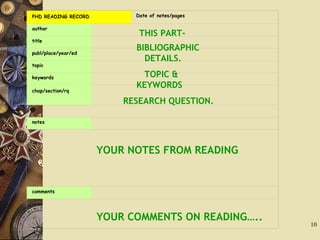
PHD READING RECORD  Date of notes/pages
author    
title  
publ/place/year/ed  
topic  
keywords  
chap/section/rq  
 
notes  


comments  


YOUR COMMENTS ON READING…..
YOUR NOTES FROM READING
BIBLIOGRAPHIC
THIS PART-
DETAILS.
TOPIC &
KEYWORDS
RESEARCH QUESTION.
SCHEDULING YOUR DISSERTATION WORKSCHEDULING YOUR DISSERTATION WORK
 Make a timetable or wall chart e.g. Gantt
Chart
 Identify best work times and keep to a daily
writing slot
 Split your dissertation into bite size-chunks
 Be realistic about daily targets
 Include time for input [supervisor & critical
friends] & for drafts & redrafts
 Familiarise yourself with deadlines* & plan
accordingly
11
3 key questions
1. Do I have the skills & knowledge to carry
out this research?
2. What time is needed?
3. Do I have time within my schedule?
 E.g. need to learn/improve knowledge of
statistics
 Learning software: Excel SPSS,
 Learning new techniques & other skills
12
SKILLS AND KNOWLEDGE REQUIREDSKILLS AND KNOWLEDGE REQUIRED
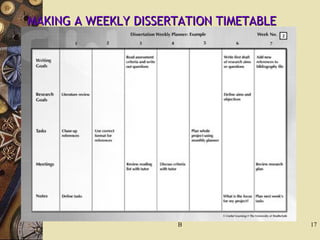
MAKING A DISSERTATION TIMETABLEMAKING A DISSERTATION TIMETABLE
How many words?
How much practical work & analysis?
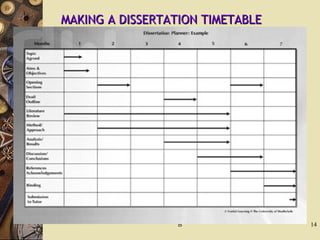
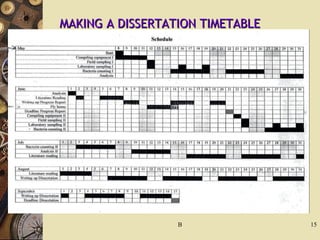
2 ways of timetabling dissertations:
 Whole dissertation timetable: examples 1 & 2
 Weekly timetables: example 3
Important to break down dissertation into realistic
weekly tasks to make it more achievable
Look at the 2 examples of dissertation timetables
What level of detail would work best for you?
[Examples 1 &2 are from Strathclyde University's Centre for Academic practice webs
pages on Dissertation writing. See:
http://www.strath.ac.uk/Departments/CAP/dissertation/frameset4.html
13
MAKING A DISSERTATION TIMETABLEMAKING A DISSERTATION TIMETABLE
B 14
MAKING A DISSERTATION TIMETABLEMAKING A DISSERTATION TIMETABLE
B 15
MAKING A DISSERTATION TIMETABLEMAKING A DISSERTATION TIMETABLE
The next slide shows how the plan for the
whole dissertation can be broken into weekly
tasks.
Allows you see progress at manageable level-
 focus on individual tasks
 tick off these tasks
 not be overwhelmed by totality
 know exactly where you are or should be
16
MAKING A WEEKLY DISSERTATION TIMETABLEMAKING A WEEKLY DISSERTATION TIMETABLE
B 17
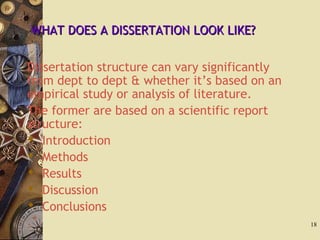
WHAT DOES A DISSERTATION LOOK LIKE?WHAT DOES A DISSERTATION LOOK LIKE?
Dissertation structure can vary significantly
from dept to dept & whether it’s based on an
empirical study or analysis of literature.
The former are based on a scientific report
structure:
 Introduction
 Methods
 Results
 Discussion
 Conclusions
18
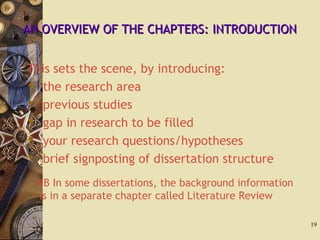
AN OVERVIEW OF THE CHAPTERS: INTRODUCTIONAN OVERVIEW OF THE CHAPTERS: INTRODUCTION
This sets the scene, by introducing:
 the research area
 previous studies
 gap in research to be filled
 your research questions/hypotheses
 brief signposting of dissertation structure
NB In some dissertations, the background information
is in a separate chapter called Literature Review
19
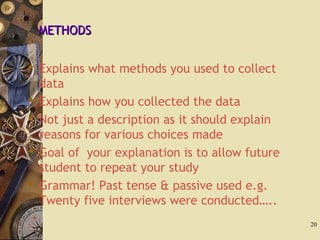
METHODSMETHODS
 Explains what methods you used to collect
data
 Explains how you collected the data
 Not just a description as it should explain
reasons for various choices made
 Goal of your explanation is to allow future
student to repeat your study
 Grammar! Past tense & passive used e.g.
Twenty five interviews were conducted…..
20
RESULTSRESULTS
 Presents the results collected from the
method[s] you used
 But does not analyse these results
 May use a series of tables and figures to present
the results more effectively
 Talks the reader through the series of results
i.e. refers to figures
Figure 4.2 shows that the incidence of x rises when…
 Highlights key patterns
NB Some writers combine the Results & Discussion
headings and organise by topic
21
DISCUSSIONDISCUSSION
 Interprets the results i.e. explains what they
mean
 Broadens from discussion of your results to how
they can be compared with the results of others
who’ve done similar research
 Refers to the previous studies you introduced
earlier
 Discusses any problems with results
 Doesn’t include tables & figures, except when
comparing your results with others
22
CONCLUSIONSCONCLUSIONS
 A short, succinctly written summary
 Must addresses the research
question/hypotheses presented in the
introduction
 May include limitations of your study and
suggestions for further work
23
OTHER BITSOTHER BITS
FRONT
 Title page
 Acknowledgements
 Contents
 List of figures*
 Glossary*
BACK
 References
 Appendices*
24
*if your study requires this
WORKING WITH YOUR SUPERVISORWORKING WITH YOUR SUPERVISOR
 What can my supervisor?
 What won’t my supervisor do?
 Will they approve the research proposal/research
questions?
 Will they read with drafts of work & if so, to
what extent?
 Will they advise on methodology & help with
difficulties
~~~
NB Make agendas for supervision meetings/ Tape as a
record
25
SOME DISSERTATION WRITING TIPS [i]SOME DISSERTATION WRITING TIPS [i]
 Keep a research journal with you to record ideas
 Write a dissertation timetable: whole process &
weekly
 Start writing early
 Set a daily writing slot
 Allow time for problems:personal & with your data
collection
 Set plenty of editing and rewriting time
 Get a critical friend to read through drafts and
feed them!
26
MORE DISSERTATION WRITING TIPS [ii]MORE DISSERTATION WRITING TIPS [ii]
 Read at a couple of past dissertations
 Compare their structure by tracing through the
research questions from the introduction to
conclusion.
 Start writing in the middle- methodology or
background
 Write the introduction and abstract last, when you
know what you’ve found
 Introduce and conclude chapters. Guide the
reader through with signposting & cross
referencing
27
28
Thank You
Thank You

How To Write Dissertations

  • 1.
  • 2.
    DISSERTATION WRITING: OUTLINEDISSERTATIONWRITING: OUTLINE  Introduction  What is a dissertation?  Planning your study: generating a research question; background reading & method  Planning a research schedule  Structuring your dissertation  Working with your supervisor 2
  • 3.
    WHAT IS ADISSERTATION :WHAT IS A DISSERTATION : Depends on department  Extended lab/field report & conclusions  Extended study  Analysis of case study  Project work from company placement  Library driven examination of problem  Model testing [e.g. Acc & Fin] Metaphor of a journey 3
  • 4.
    RESEARCH PROPOSALSRESEARCH PROPOSALSi.e. plan for the dissertationi.e. plan for the dissertation Required by many depts. Example from Linguistics:  Area of research  Questions you aim to answer  Rationale i.e. reasons for researching this area- contribution to understanding & practical use  Your background in this area: previous knowledge & gaps  Data you will collect  How you will collect data and how you will analyse it  Initial bibliography i.e. review of key studies * [progress report/ grant proposal-science] 4
  • 5.
    GENERATING A RESEARCHQUESTIONGENERATING A RESEARCH QUESTION  Start with expected outcome or hunches  Develop research question[s] or hypothesis  Research question= well specified critical question rather than description of what aspect you want to find an answer to.  2 stages: What am I interested in? What questions can I make about this topic that could lead to an investigation?  Examples of RQs in psychology from Oxford http://www.psych.ox.ac.uk/babylab/research.html 5
  • 6.
    GENERATING A RESEARCHQUESTIONGENERATING A RESEARCH QUESTION  Hypothesis = A tentative proposition which is subject to verification through subsequent verification…. Guide to the researcher depicting & describing the method to be followed in studying the problem. In many cases hypotheses are the hunches that the researcher has about the existence between the variables [Verma and Bear 1981 in Bell 1993]  Forms framework of study: i.e. which literature to investigate, how to select/devise methods; how you discuss results and write conclusions  NB need to modify question as study develops 6
  • 7.
    DECIDING ON RESEARCHMETHODSDECIDING ON RESEARCH METHODS  What data will you collect?  How will you collect this data? -interviews, questionnaires, case study -lab or field work -writing code and trialling software designing a model or hardware -simulating/testing -analysis of primary sources e.g. documents [original historical, legal sources etc]; -secondary sources- library & web sources- peer reviewed? 7
  • 8.
    ANALYSING DATAANALYSING DATA Howwill you analyse this data?  theory or framework,  quantitative or qualitative quantitative e.g larger scale, number/statistically based. qualitative e.g. small scale, detailed description  using software for analysis e.g. SPSS, Excel etc How much data can you deal with in time allotted? 8
  • 9.
    READING: BACKGROUND THEORYOR LITERATURE REVIEWREADING: BACKGROUND THEORY OR LITERATURE REVIEW  Read efficiently using SQ3RSQ3R  SQ3R= Survey, Question, Read, Recall, Review http://www2.ntu.ac.uk/sss/studysupport/Information /Reading/SQ3R/SQ3R.htm  Read critically- see Toronto Uni http://www.utoronto.ca/writing/critrdg.html  Library –database searches –see subject librarian  Keep a careful record of reading & where used in your dissertation  9
  • 10.
    10 PHD READING RECORD Date of notes/pages author     title   publ/place/year/ed   topic   keywords   chap/section/rq     notes                                 comments               YOUR COMMENTS ON READING….. YOUR NOTES FROM READING BIBLIOGRAPHIC THIS PART- DETAILS. TOPIC & KEYWORDS RESEARCH QUESTION.
  • 11.
    SCHEDULING YOUR DISSERTATIONWORKSCHEDULING YOUR DISSERTATION WORK  Make a timetable or wall chart e.g. Gantt Chart  Identify best work times and keep to a daily writing slot  Split your dissertation into bite size-chunks  Be realistic about daily targets  Include time for input [supervisor & critical friends] & for drafts & redrafts  Familiarise yourself with deadlines* & plan accordingly 11
  • 12.
    3 key questions 1.Do I have the skills & knowledge to carry out this research? 2. What time is needed? 3. Do I have time within my schedule?  E.g. need to learn/improve knowledge of statistics  Learning software: Excel SPSS,  Learning new techniques & other skills 12 SKILLS AND KNOWLEDGE REQUIREDSKILLS AND KNOWLEDGE REQUIRED
  • 13.
    MAKING A DISSERTATIONTIMETABLEMAKING A DISSERTATION TIMETABLE How many words? How much practical work & analysis? 2 ways of timetabling dissertations:  Whole dissertation timetable: examples 1 & 2  Weekly timetables: example 3 Important to break down dissertation into realistic weekly tasks to make it more achievable Look at the 2 examples of dissertation timetables What level of detail would work best for you? [Examples 1 &2 are from Strathclyde University's Centre for Academic practice webs pages on Dissertation writing. See: http://www.strath.ac.uk/Departments/CAP/dissertation/frameset4.html 13
  • 14.
    MAKING A DISSERTATIONTIMETABLEMAKING A DISSERTATION TIMETABLE B 14
  • 15.
    MAKING A DISSERTATIONTIMETABLEMAKING A DISSERTATION TIMETABLE B 15
  • 16.
    MAKING A DISSERTATIONTIMETABLEMAKING A DISSERTATION TIMETABLE The next slide shows how the plan for the whole dissertation can be broken into weekly tasks. Allows you see progress at manageable level-  focus on individual tasks  tick off these tasks  not be overwhelmed by totality  know exactly where you are or should be 16
  • 17.
    MAKING A WEEKLYDISSERTATION TIMETABLEMAKING A WEEKLY DISSERTATION TIMETABLE B 17
  • 18.
    WHAT DOES ADISSERTATION LOOK LIKE?WHAT DOES A DISSERTATION LOOK LIKE? Dissertation structure can vary significantly from dept to dept & whether it’s based on an empirical study or analysis of literature. The former are based on a scientific report structure:  Introduction  Methods  Results  Discussion  Conclusions 18
  • 19.
    AN OVERVIEW OFTHE CHAPTERS: INTRODUCTIONAN OVERVIEW OF THE CHAPTERS: INTRODUCTION This sets the scene, by introducing:  the research area  previous studies  gap in research to be filled  your research questions/hypotheses  brief signposting of dissertation structure NB In some dissertations, the background information is in a separate chapter called Literature Review 19
  • 20.
    METHODSMETHODS  Explains whatmethods you used to collect data  Explains how you collected the data  Not just a description as it should explain reasons for various choices made  Goal of your explanation is to allow future student to repeat your study  Grammar! Past tense & passive used e.g. Twenty five interviews were conducted….. 20
  • 21.
    RESULTSRESULTS  Presents theresults collected from the method[s] you used  But does not analyse these results  May use a series of tables and figures to present the results more effectively  Talks the reader through the series of results i.e. refers to figures Figure 4.2 shows that the incidence of x rises when…  Highlights key patterns NB Some writers combine the Results & Discussion headings and organise by topic 21
  • 22.
    DISCUSSIONDISCUSSION  Interprets theresults i.e. explains what they mean  Broadens from discussion of your results to how they can be compared with the results of others who’ve done similar research  Refers to the previous studies you introduced earlier  Discusses any problems with results  Doesn’t include tables & figures, except when comparing your results with others 22
  • 23.
    CONCLUSIONSCONCLUSIONS  A short,succinctly written summary  Must addresses the research question/hypotheses presented in the introduction  May include limitations of your study and suggestions for further work 23
  • 24.
    OTHER BITSOTHER BITS FRONT Title page  Acknowledgements  Contents  List of figures*  Glossary* BACK  References  Appendices* 24 *if your study requires this
  • 25.
    WORKING WITH YOURSUPERVISORWORKING WITH YOUR SUPERVISOR  What can my supervisor?  What won’t my supervisor do?  Will they approve the research proposal/research questions?  Will they read with drafts of work & if so, to what extent?  Will they advise on methodology & help with difficulties ~~~ NB Make agendas for supervision meetings/ Tape as a record 25
  • 26.
    SOME DISSERTATION WRITINGTIPS [i]SOME DISSERTATION WRITING TIPS [i]  Keep a research journal with you to record ideas  Write a dissertation timetable: whole process & weekly  Start writing early  Set a daily writing slot  Allow time for problems:personal & with your data collection  Set plenty of editing and rewriting time  Get a critical friend to read through drafts and feed them! 26
  • 27.
    MORE DISSERTATION WRITINGTIPS [ii]MORE DISSERTATION WRITING TIPS [ii]  Read at a couple of past dissertations  Compare their structure by tracing through the research questions from the introduction to conclusion.  Start writing in the middle- methodology or background  Write the introduction and abstract last, when you know what you’ve found  Introduce and conclude chapters. Guide the reader through with signposting & cross referencing 27
  • 28.

Editor's Notes

  • #9 learning about data collection methods, analysis (learning software), writing up -Results & Discussion] Qual +words rather than numbers
  • #10 card index system
  • #20 [theory & review of previous studies] General-specific pattern
  • #26 Record your dissertation timetable, when your supervisor is away.