TRAINING AND
DEVELOPMENT
Course: MBA SEM 2
Subject: Human Resource Management
Unit 3
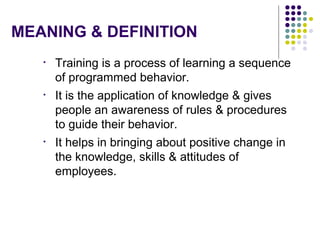
MEANING & DEFINITION
• Training is a process of learning a sequence
of programmed behavior.
• It is the application of knowledge & gives
people an awareness of rules & procedures
to guide their behavior.
• It helps in bringing about positive change in
the knowledge, skills & attitudes of
employees.
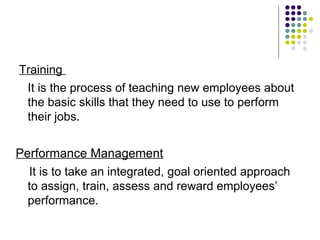
Training
It is the process of teaching new employees about
the basic skills that they need to use to perform
their jobs.
Performance Management
It is to take an integrated, goal oriented approach
to assign, train, assess and reward employees’
performance.
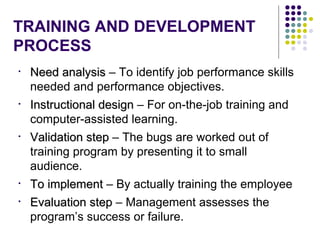
TRAINING AND DEVELOPMENT
PROCESS
• Need analysisNeed analysis – To identify job performance skills
needed and performance objectives.
• Instructional designInstructional design – For on-the-job training and
computer-assisted learning.
• Validation stepValidation step – The bugs are worked out of
training program by presenting it to small
audience.
• To implementTo implement – By actually training the employee
• Evaluation stepEvaluation step – Management assesses the
program’s success or failure.
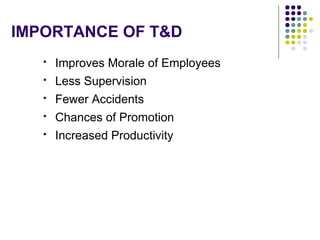
IMPORTANCE OF T&D
 Improves Morale of Employees
 Less Supervision
 Fewer Accidents
 Chances of Promotion
 Increased Productivity
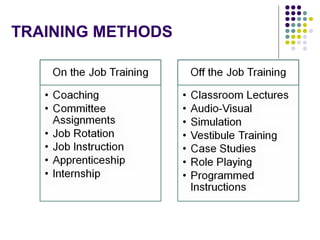
TRAINING METHODS
MANAGEMENT
DEVELOPMENT
•It is an attempt to improve current or
future management performance by
imparting knowledge, changing attitudes
or increasing skills.
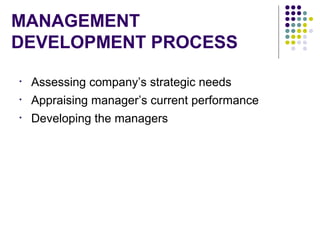
MANAGEMENT
DEVELOPMENT PROCESS
• Assessing company’s strategic needs
• Appraising manager’s current performance
• Developing the managers
MANAGERIAL ON-THE-JOB
TRAINING
• Job rotation – It is the management training
technique that involves moving a trainee from
department to department to broaden his or her
experience and identify strong and weak points.
• Coaching/Understudy approach – Here the trainee
works with the senior management who is
responsible for the trainee’s coaching.
• Action learning – It is the training technique by
which management trainees are allowed to work
full-time analyzing and solving problems in other
departments.
OFF-THE-JOB MANAGEMENT
TRAINING
Case study method – It is the development method in
which the manager is presented with a written
description of an organizational problem to diagnose
and solve it.
Management games – It is the development technique in
which teams of managers compete by making
computerized decisions regarding realistic but
simulated situations.
Role playing – It is a training technique in which trainees
act out parts in a realistic management situations.
Behavior modeling – It is the technique in which trainees
are first shown good management techniques in a film
and asked about to play roles in a simulated situations
and the given feedback and praise by their supervisor.
OVERCOMING RESISTANCE TO
CHANGE : LEWIN’S CHANGE
PROCESS
Unfreezing – It means reducing the forces that
are striving to maintain the status quo by
representing a problem.
Moving – It means developing new behaviors,
attitudes and structural change.
Refreezing – It means instituting new system
and procedure to support and maintain
changes.
ORGANIZATIONAL
DEVELOPMENT
 It is a special approach to organizational change
in which employees themselves formulate and
implement the change that is required
CHARACTERISTICS OF
ORGANIZATIONAL DEVELOPMENT
 It involves action research which means collecting
data about a group and giving feedback to
employees so that they can analyze it.
 It applies behavioral science knowledge to
improve organizational effectiveness.
 It changes the organization in a particular direction
towards improved problem solving, quality of work
and effectiveness.
CONTROLLED
EXPERIMENTATION
 It is the formal method for testing the effectiveness
of a training program preferably with before and
after tests and control group.
TRAINING EFFECTS TO MEASURE
• Reaction – Evaluate trainees’ reaction to the
program.
• Learning – Test the trainees to determine whether
they learned d the principles, skills and facts that
they were supposed to learn.
• Behavior – Ask whether the trainees’ on-the-job
behavior change because of the training program.
• Results – To know whether thee final results were
achieved in the terms of the training objectives.
Bibliography
http://www.whatishumanresource.com
http://www.mbaofficial.com
Human Resource and Personnel
Management- K. Aswathappa, Tata
McGraw Hill

Mba ii hrm u-3.1 training and development

  • 1.
    TRAINING AND DEVELOPMENT Course: MBASEM 2 Subject: Human Resource Management Unit 3
  • 2.
    MEANING & DEFINITION •Training is a process of learning a sequence of programmed behavior. • It is the application of knowledge & gives people an awareness of rules & procedures to guide their behavior. • It helps in bringing about positive change in the knowledge, skills & attitudes of employees.
  • 3.
    Training It is theprocess of teaching new employees about the basic skills that they need to use to perform their jobs. Performance Management It is to take an integrated, goal oriented approach to assign, train, assess and reward employees’ performance.
  • 4.
    TRAINING AND DEVELOPMENT PROCESS •Need analysisNeed analysis – To identify job performance skills needed and performance objectives. • Instructional designInstructional design – For on-the-job training and computer-assisted learning. • Validation stepValidation step – The bugs are worked out of training program by presenting it to small audience. • To implementTo implement – By actually training the employee • Evaluation stepEvaluation step – Management assesses the program’s success or failure.
  • 5.
    IMPORTANCE OF T&D Improves Morale of Employees  Less Supervision  Fewer Accidents  Chances of Promotion  Increased Productivity
  • 6.
  • 7.
    MANAGEMENT DEVELOPMENT •It is anattempt to improve current or future management performance by imparting knowledge, changing attitudes or increasing skills.
  • 8.
    MANAGEMENT DEVELOPMENT PROCESS • Assessingcompany’s strategic needs • Appraising manager’s current performance • Developing the managers
  • 9.
    MANAGERIAL ON-THE-JOB TRAINING • Jobrotation – It is the management training technique that involves moving a trainee from department to department to broaden his or her experience and identify strong and weak points. • Coaching/Understudy approach – Here the trainee works with the senior management who is responsible for the trainee’s coaching. • Action learning – It is the training technique by which management trainees are allowed to work full-time analyzing and solving problems in other departments.
  • 10.
    OFF-THE-JOB MANAGEMENT TRAINING Case studymethod – It is the development method in which the manager is presented with a written description of an organizational problem to diagnose and solve it. Management games – It is the development technique in which teams of managers compete by making computerized decisions regarding realistic but simulated situations. Role playing – It is a training technique in which trainees act out parts in a realistic management situations. Behavior modeling – It is the technique in which trainees are first shown good management techniques in a film and asked about to play roles in a simulated situations and the given feedback and praise by their supervisor.
  • 11.
    OVERCOMING RESISTANCE TO CHANGE: LEWIN’S CHANGE PROCESS Unfreezing – It means reducing the forces that are striving to maintain the status quo by representing a problem. Moving – It means developing new behaviors, attitudes and structural change. Refreezing – It means instituting new system and procedure to support and maintain changes.
  • 12.
    ORGANIZATIONAL DEVELOPMENT  It isa special approach to organizational change in which employees themselves formulate and implement the change that is required
  • 13.
    CHARACTERISTICS OF ORGANIZATIONAL DEVELOPMENT It involves action research which means collecting data about a group and giving feedback to employees so that they can analyze it.  It applies behavioral science knowledge to improve organizational effectiveness.  It changes the organization in a particular direction towards improved problem solving, quality of work and effectiveness.
  • 14.
    CONTROLLED EXPERIMENTATION  It isthe formal method for testing the effectiveness of a training program preferably with before and after tests and control group.
  • 15.
    TRAINING EFFECTS TOMEASURE • Reaction – Evaluate trainees’ reaction to the program. • Learning – Test the trainees to determine whether they learned d the principles, skills and facts that they were supposed to learn. • Behavior – Ask whether the trainees’ on-the-job behavior change because of the training program. • Results – To know whether thee final results were achieved in the terms of the training objectives.
  • 16.