Orientation: Training and Development
1
Introduction to Orientation
Orientation is the process of acquainting new employees with the
organization.
Orientation topics range from such basic items as the location of the
company cafeteria to such concerns as various career paths within the
firm.
2
Objectives of Orientation
Removes fears
Creates a good impression
Act as a valuable source of information
3
Steps in Induction Program
Explain about the company.
Show the location, department where the new recruit will work.
Give the company’s manual to the new recruit.
Provide details about various work groups and the extent of unionism
within the company.
Give details about pay, benefits, holidays, leave, etc.
Emphasize the importance of attendance or punctuality.
Explain about future training opportunities and career prospects.
Clarify doubts, by encouraging the employee to come out with
questions.
Take the employee on a guided tour of buildings, facilities, etc. Hand
him over to his supervisor.
4
Purposes of Orientation
To Reduce Startup Costs
To Reduce Anxiety
To Reduce Employee Turnover
To Save Time for the Supervisor
To Develop Realistic Job Expectations, Positive Attitudes and Job
Satisfaction
5
Areas covered in employee induction
Program
Introduction: Regarding the organization
Job Duties
Organizational Issues
Employee Benefits
6
TRAINING AND DEVELOPMENT
‘Training is the formal and systematic modification of behavior through
learning which occurs as a result of education, instruction, development and
planned experience.”
“Development is any learning activity, which is directed towards future,
needs rather than present needs, and which is concerned more with career
growth than immediate performance.”
7
Nature of Training and Development
It is a process of acquiring specific skills which enhances job performance.
It is a process of teaching, informing or educating people.
It provides required qualification to individuals in order to perform their job
in a better way.
It provides qualification to employees so that they can perform in positions
of greater difficulty and responsibility.
It is and act of increasing knowledge and skills.
8
PURPOSES OF TRAINING &
DEVELOPMENT
Satisfy personal growth needs
Improve performance
Avoid Managerial Obsolescence
Solve organizational problems
Increase productivity and quality
To reduce labor turnover
To reduce the number of accidents
Increase productivity and quality
9
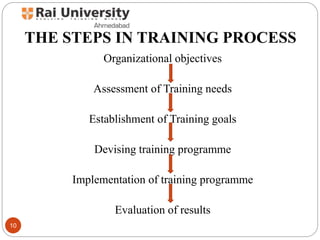
THE STEPS IN TRAINING PROCESS
Organizational objectives
Assessment of Training needs
Establishment of Training goals
Devising training programme
Implementation of training programme
Evaluation of results
10
Explanation!!
Organizational objectives
i. The first step in the training process in an organization is the
assessment of its objectives and strategies.
ii. What business are we in?
iii. At what level of quality do we wish to provide this product or
service?
iv. Where do we want to be in the future?
v. It is only after answering these related questions that the organization
must assess the strengths and weaknesses of its human resources.11
Designing Training Programs and Manuals: This step establishes the
designing & development of current job descriptions and standards and
procedures. Job descriptions should be clear and concise and may serve
as a major training tool for the identification of guidelines.
Every training and development programme must address certain vital
issues:
• Who participates in the programme?
• Who are the trainers?
• What methods and techniques are to be used for training?
• What should be the level of training?
• What learning principles are needed?
• Where is the program conducted?
12
Assessment of Training needs: Needs assessment diagnosis present
problems and future challenges to be met through training and
development? Organizations spend vast sums of money (usually as a
percentage on turnover) on training and development.
The objective in establishing a needs analysis / or need assessment is to
find out the answers to the following questions:
• “Why” is training needed?
• “What” type of training is needed?
• “When” is the training needed?
• “Where” is the training needed?
• “Who” needs the training? And "Who" will conduct the training?
• “How” will the training be performed?
13
Deliver The Training Program: This step is responsible for the
instruction and delivery of the training program. Once you have
designated your trainers, the training technique must be decided.
The trainer should have:
• A desire to teach the subject being taught.
• A working knowledge of the subject being taught.
• An ability to motivate participants to “want” to learn.
• A good sense of humor.
• A dynamic appearance and good posture.
• A strong passion for their topic.
• A strong compassion towards their participants.
• Appropriate audio/visual equipment to enhance the training session.
14
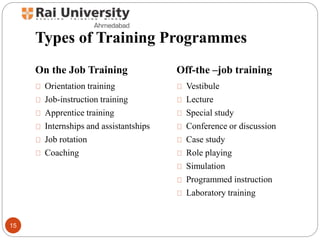
Types of Training Programmes
On the Job Training Off-the –job training
Orientation training
Job-instruction training
Apprentice training
Internships and assistantships
Job rotation
Coaching
Vestibule
Lecture
Special study
Conference or discussion
Case study
Role playing
Simulation
Programmed instruction
Laboratory training
15
Evaluate The Training Program:This step will determine how
effective and profitable your training program has been.
Methods for evaluation are pre-and post- surveys of customer
comments cards, the establishment of a cost/benefit analysis outlining
your expenses and returns, and an increase in customer satisfaction and
profits.
16
Various methods can be used to collect
data on the outcomes of training
Questionnaires
Tests
Interviews
Human resource factors
Cost benefit analysis
Feedback
17
ISSUES IN EMPLOYEE TRAINING
Communications
Computer skills
Customer service
Diversity
Ethics
Human relations
Quality initiatives
Safety
18
Thank you!!
19

Training and Development - Principles of Human Resource Management

  • 1.
  • 2.
    Introduction to Orientation Orientationis the process of acquainting new employees with the organization. Orientation topics range from such basic items as the location of the company cafeteria to such concerns as various career paths within the firm. 2
  • 3.
    Objectives of Orientation Removesfears Creates a good impression Act as a valuable source of information 3
  • 4.
    Steps in InductionProgram Explain about the company. Show the location, department where the new recruit will work. Give the company’s manual to the new recruit. Provide details about various work groups and the extent of unionism within the company. Give details about pay, benefits, holidays, leave, etc. Emphasize the importance of attendance or punctuality. Explain about future training opportunities and career prospects. Clarify doubts, by encouraging the employee to come out with questions. Take the employee on a guided tour of buildings, facilities, etc. Hand him over to his supervisor. 4
  • 5.
    Purposes of Orientation ToReduce Startup Costs To Reduce Anxiety To Reduce Employee Turnover To Save Time for the Supervisor To Develop Realistic Job Expectations, Positive Attitudes and Job Satisfaction 5
  • 6.
    Areas covered inemployee induction Program Introduction: Regarding the organization Job Duties Organizational Issues Employee Benefits 6
  • 7.
    TRAINING AND DEVELOPMENT ‘Trainingis the formal and systematic modification of behavior through learning which occurs as a result of education, instruction, development and planned experience.” “Development is any learning activity, which is directed towards future, needs rather than present needs, and which is concerned more with career growth than immediate performance.” 7
  • 8.
    Nature of Trainingand Development It is a process of acquiring specific skills which enhances job performance. It is a process of teaching, informing or educating people. It provides required qualification to individuals in order to perform their job in a better way. It provides qualification to employees so that they can perform in positions of greater difficulty and responsibility. It is and act of increasing knowledge and skills. 8
  • 9.
    PURPOSES OF TRAINING& DEVELOPMENT Satisfy personal growth needs Improve performance Avoid Managerial Obsolescence Solve organizational problems Increase productivity and quality To reduce labor turnover To reduce the number of accidents Increase productivity and quality 9
  • 10.
    THE STEPS INTRAINING PROCESS Organizational objectives Assessment of Training needs Establishment of Training goals Devising training programme Implementation of training programme Evaluation of results 10
  • 11.
    Explanation!! Organizational objectives i. Thefirst step in the training process in an organization is the assessment of its objectives and strategies. ii. What business are we in? iii. At what level of quality do we wish to provide this product or service? iv. Where do we want to be in the future? v. It is only after answering these related questions that the organization must assess the strengths and weaknesses of its human resources.11
  • 12.
    Designing Training Programsand Manuals: This step establishes the designing & development of current job descriptions and standards and procedures. Job descriptions should be clear and concise and may serve as a major training tool for the identification of guidelines. Every training and development programme must address certain vital issues: • Who participates in the programme? • Who are the trainers? • What methods and techniques are to be used for training? • What should be the level of training? • What learning principles are needed? • Where is the program conducted? 12
  • 13.
    Assessment of Trainingneeds: Needs assessment diagnosis present problems and future challenges to be met through training and development? Organizations spend vast sums of money (usually as a percentage on turnover) on training and development. The objective in establishing a needs analysis / or need assessment is to find out the answers to the following questions: • “Why” is training needed? • “What” type of training is needed? • “When” is the training needed? • “Where” is the training needed? • “Who” needs the training? And "Who" will conduct the training? • “How” will the training be performed? 13
  • 14.
    Deliver The TrainingProgram: This step is responsible for the instruction and delivery of the training program. Once you have designated your trainers, the training technique must be decided. The trainer should have: • A desire to teach the subject being taught. • A working knowledge of the subject being taught. • An ability to motivate participants to “want” to learn. • A good sense of humor. • A dynamic appearance and good posture. • A strong passion for their topic. • A strong compassion towards their participants. • Appropriate audio/visual equipment to enhance the training session. 14
  • 15.
    Types of TrainingProgrammes On the Job Training Off-the –job training Orientation training Job-instruction training Apprentice training Internships and assistantships Job rotation Coaching Vestibule Lecture Special study Conference or discussion Case study Role playing Simulation Programmed instruction Laboratory training 15
  • 16.
    Evaluate The TrainingProgram:This step will determine how effective and profitable your training program has been. Methods for evaluation are pre-and post- surveys of customer comments cards, the establishment of a cost/benefit analysis outlining your expenses and returns, and an increase in customer satisfaction and profits. 16
  • 17.
    Various methods canbe used to collect data on the outcomes of training Questionnaires Tests Interviews Human resource factors Cost benefit analysis Feedback 17
  • 18.
    ISSUES IN EMPLOYEETRAINING Communications Computer skills Customer service Diversity Ethics Human relations Quality initiatives Safety 18
  • 19.