TRAINING AND DEVELOPMENT
Concept of training
Training is the process of teaching the new and/or present
employees the basic skills they need to effectively perform their jobs.
Alternatively speaking, training is the act of increasing the knowledge and
skill of an employee for doing his/her job.
Thus, training refers to the teaching and learning activities carried
on for the primary purpose of helping members of an organization to
acquire and also to apply the required knowledge, skill and attitudes to
perform their jobs effectively.
Concept of Development
 Compared to the term ‘training’, the term ‘development’ has broader
scope and aim to develop people in all respects. Accordingly,
development covers not only activities/skills which improve job
performance, but also those activities which bring about growth of the
personality, help individuals progress toward maturity and
actualization of their potential.
 Thus, development enables individuals to become not only good
employees but better men and women also.
Definition
 Training:
“Training is the act of increasing the knowledge and skills of an
employee for doing a particular job.”
- According to Edwin B. Flippo,
 Development:
“The systematic use of scientific and technical knowledge to
meet specific objectives or requirements.”
Difference between training and
development:
(i) What is learned?
(ii) Who learns?
(iii) Why such learning takes place; and
(iv) When learning occurs?
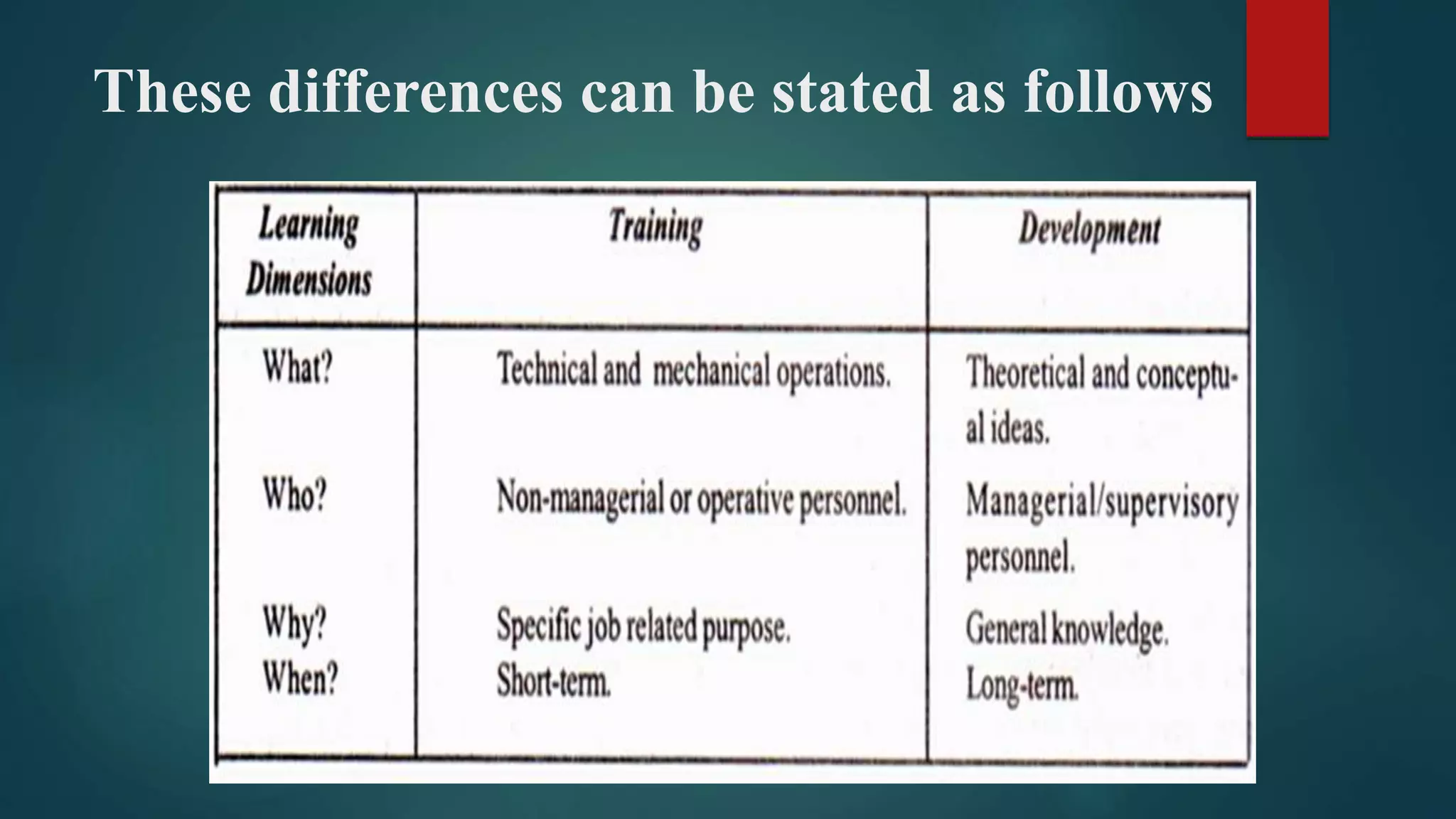
These differences can be stated as follows
Role of training and development
 Increasing efficiency
 Increase morale of employees
 Better human relation
 Reduce supervision
 Personal growth
 Favorable
 organizational climate
Need of training and development
 Technological change necessitating acquisition of new
knowledge, ability and skills.
 Increasing qualitative demand for managers and workmen.
 Increasing uncertainties and complexities in the total
environment necessitating flexible and adaptive responses
from organizations.
 Need for both individuals and organizations to grow at rapid
pace.
 To meet challenges posed by the global competition.
 To harness the human potential and give expression to their
creative urges.
 To enable employees to move from one job to another.
 To bridge the gap between what employees has in terms of
knowledge and skill and what his/ her job actually demands.
Objective of training & development
1. Individual objective
2. Organizational objective
3. Functional objective
4. Societal objective
Advantages of training & development
1. Better performance
2. Improved quality
3. Less supervision
4. Less learning period
5. high morale
6. Favorable organizational climate
Disadvantages of training &
development
1. Expensive process
2. Risk
3. Little acceptance
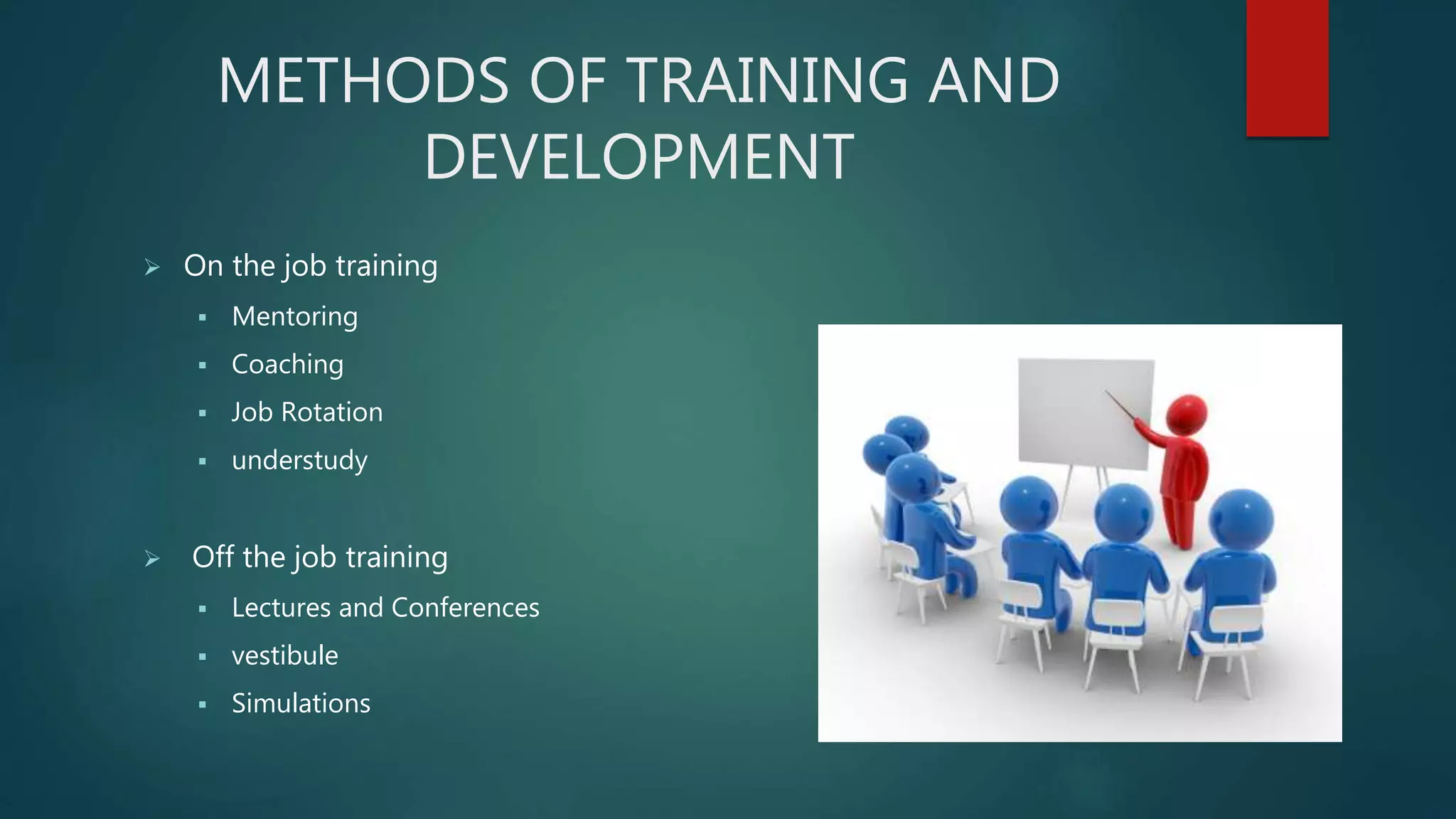
 On the job training
 Mentoring
 Coaching
 Job Rotation
 understudy
 Off the job training
 Lectures and Conferences
 vestibule
 Simulations
METHODS OF TRAINING AND
DEVELOPMENT
Under these methods new or inexperienced employees learn through observing peers
or managers performing the job and trying to imitate their behavior. These methods do not cost
much and are less disruptive as employees are always on the job, training is given on the same
machines and experience would be on already approved standards, and above all the trainee is
learning while earning. Some of the commonly used methods are:
 Mentoring
 Coaching
 Job Rotation
 understudy
A. On the job training
1. Mentoring:
The focus in this training is on the development of
attitude. It is used for managerial employees. Mentoring is always done by a
senior inside person. It is also one-to- one interaction, like coaching.
2. Coaching:
Coaching is a one-to-one training. It helps in quickly identifying the
weak areas and tries to focus on them. It also offers the benefit of transferring
theory learning to practice. The biggest problem is that it perpetrates the existing
practices and styles.
3. Job Rotation
It is the process of training employees by rotating them through a
series of related jobs. Rotation not only makes a person well acquainted with
different jobs, but it also alleviates boredom and allows to develop rapport with a
number of people. Rotation must be logical.
4. Understudy :
In this method, a superior gives training to a subordinate as his
understudy like an assistant to a manager or director (in a film). The subordinate
learns through experience and observation by participating in handling day to day
problems. Basic purpose is to prepare subordinate for assuming the full
responsibilities and duties
B. Off the job training
Off-the-job training methods are conducted in separate from the job
environment, study material is supplied, there is full concentration on learning rather than
performing, and there is freedom of expression. Important methods include:
1. Lectures and Conferences
Lectures and conferences are the traditional and direct method of
instruction. Every training programme starts with lecture and conference. It’s a verbal
presentation for a large audience. However, the lectures have to be motivating and creating
interest among trainees. The speaker must have considerable depth in the subject. In the
colleges and universities, lectures and seminars are the most common methods used for
training.
2. Vestibule Training
Vestibule Training is a term for near-the-job training, as it offers access to
something new (learning). In vestibule training, the workers are trained in a prototype
environment on specific jobs in a special part of the plant.
3. Simulation Exercises:
Simulation is any artificial environment exactly similar to the actual
situation.
 Management Games:
 Case Study
 Role Playing
 In-basket training
 Management Games:
Properly designed games help to ingrain thinking habits, analytical,
logical and reasoning capabilities, importance of team work, time management,
make decisions lacking complete information, communication and leadership
capabilities. Use of management games can encourage novel, innovative
mechanisms for coping with stress.
 Case Study:
Case studies are complex examples which give an insight into the
context of a problem as well as illustrating the main point. Case Studies are
centered activities based on topics that demonstrate theoretical concepts in an
applied setting.
 Role Playing:
Each trainee takes the role of a person affected by an issue and
studies the impacts of the issues on human life and/or the effects of human
activities on the world around us from the perspective of that person.
 In-basket training:
In-basket exercise, also known as in-tray training, consists of a set of
business papers which may include e-mail SMSs, reports, memos, and other
Now the trainer is asked to priorities the decisions to be made immediately and
the ones that can be delayed.
Factor influencing T & D
 Top management support
 Technical advances
 Learning style
Reasons to conduct management
training inside the company
 Training more specific to needs
 Lower costs
 Less time
 Consistent, relevant material
THANK YOU……

Training and development

  • 1.
  • 2.
    Concept of training Trainingis the process of teaching the new and/or present employees the basic skills they need to effectively perform their jobs. Alternatively speaking, training is the act of increasing the knowledge and skill of an employee for doing his/her job. Thus, training refers to the teaching and learning activities carried on for the primary purpose of helping members of an organization to acquire and also to apply the required knowledge, skill and attitudes to perform their jobs effectively.
  • 3.
    Concept of Development Compared to the term ‘training’, the term ‘development’ has broader scope and aim to develop people in all respects. Accordingly, development covers not only activities/skills which improve job performance, but also those activities which bring about growth of the personality, help individuals progress toward maturity and actualization of their potential.  Thus, development enables individuals to become not only good employees but better men and women also.
  • 4.
    Definition  Training: “Training isthe act of increasing the knowledge and skills of an employee for doing a particular job.” - According to Edwin B. Flippo,  Development: “The systematic use of scientific and technical knowledge to meet specific objectives or requirements.”
  • 5.
    Difference between trainingand development: (i) What is learned? (ii) Who learns? (iii) Why such learning takes place; and (iv) When learning occurs?
  • 6.
    These differences canbe stated as follows
  • 7.
    Role of trainingand development  Increasing efficiency  Increase morale of employees  Better human relation  Reduce supervision  Personal growth  Favorable  organizational climate
  • 8.
    Need of trainingand development  Technological change necessitating acquisition of new knowledge, ability and skills.  Increasing qualitative demand for managers and workmen.  Increasing uncertainties and complexities in the total environment necessitating flexible and adaptive responses from organizations.  Need for both individuals and organizations to grow at rapid pace.
  • 9.
     To meetchallenges posed by the global competition.  To harness the human potential and give expression to their creative urges.  To enable employees to move from one job to another.  To bridge the gap between what employees has in terms of knowledge and skill and what his/ her job actually demands.
  • 10.
    Objective of training& development 1. Individual objective 2. Organizational objective 3. Functional objective 4. Societal objective
  • 11.
    Advantages of training& development 1. Better performance 2. Improved quality 3. Less supervision 4. Less learning period 5. high morale 6. Favorable organizational climate
  • 12.
    Disadvantages of training& development 1. Expensive process 2. Risk 3. Little acceptance
  • 15.
     On thejob training  Mentoring  Coaching  Job Rotation  understudy  Off the job training  Lectures and Conferences  vestibule  Simulations METHODS OF TRAINING AND DEVELOPMENT
  • 16.
    Under these methodsnew or inexperienced employees learn through observing peers or managers performing the job and trying to imitate their behavior. These methods do not cost much and are less disruptive as employees are always on the job, training is given on the same machines and experience would be on already approved standards, and above all the trainee is learning while earning. Some of the commonly used methods are:  Mentoring  Coaching  Job Rotation  understudy A. On the job training
  • 17.
    1. Mentoring: The focusin this training is on the development of attitude. It is used for managerial employees. Mentoring is always done by a senior inside person. It is also one-to- one interaction, like coaching. 2. Coaching: Coaching is a one-to-one training. It helps in quickly identifying the weak areas and tries to focus on them. It also offers the benefit of transferring theory learning to practice. The biggest problem is that it perpetrates the existing practices and styles.
  • 18.
    3. Job Rotation Itis the process of training employees by rotating them through a series of related jobs. Rotation not only makes a person well acquainted with different jobs, but it also alleviates boredom and allows to develop rapport with a number of people. Rotation must be logical. 4. Understudy : In this method, a superior gives training to a subordinate as his understudy like an assistant to a manager or director (in a film). The subordinate learns through experience and observation by participating in handling day to day problems. Basic purpose is to prepare subordinate for assuming the full responsibilities and duties
  • 19.
    B. Off thejob training Off-the-job training methods are conducted in separate from the job environment, study material is supplied, there is full concentration on learning rather than performing, and there is freedom of expression. Important methods include: 1. Lectures and Conferences Lectures and conferences are the traditional and direct method of instruction. Every training programme starts with lecture and conference. It’s a verbal presentation for a large audience. However, the lectures have to be motivating and creating interest among trainees. The speaker must have considerable depth in the subject. In the colleges and universities, lectures and seminars are the most common methods used for training.
  • 20.
    2. Vestibule Training VestibuleTraining is a term for near-the-job training, as it offers access to something new (learning). In vestibule training, the workers are trained in a prototype environment on specific jobs in a special part of the plant. 3. Simulation Exercises: Simulation is any artificial environment exactly similar to the actual situation.  Management Games:  Case Study  Role Playing  In-basket training
  • 21.
     Management Games: Properlydesigned games help to ingrain thinking habits, analytical, logical and reasoning capabilities, importance of team work, time management, make decisions lacking complete information, communication and leadership capabilities. Use of management games can encourage novel, innovative mechanisms for coping with stress.  Case Study: Case studies are complex examples which give an insight into the context of a problem as well as illustrating the main point. Case Studies are centered activities based on topics that demonstrate theoretical concepts in an applied setting.
  • 22.
     Role Playing: Eachtrainee takes the role of a person affected by an issue and studies the impacts of the issues on human life and/or the effects of human activities on the world around us from the perspective of that person.  In-basket training: In-basket exercise, also known as in-tray training, consists of a set of business papers which may include e-mail SMSs, reports, memos, and other Now the trainer is asked to priorities the decisions to be made immediately and the ones that can be delayed.
  • 23.
    Factor influencing T& D  Top management support  Technical advances  Learning style
  • 24.
    Reasons to conductmanagement training inside the company  Training more specific to needs  Lower costs  Less time  Consistent, relevant material
  • 25.