Human Resource Management
Training and Development
Human Resource Development
1. Human Resource Development is a system of developing in a continuous and planned way helping
employees to acquire competencies. It is an organised series of learning activities, within a specified time
limit, designed to produce a desired behavioural change in the learner.
2. It maximize the congruence between the individual and the organisational goals of employees an develops
an organisational culture in which superior- subordinate relationships, teamwork and collaboration among
various units become strong and contribute to the professional well-being, motivation and pride of
employees.
3. HRD is a process which helps employees of an organisation to improve their functional capabilities for their
present and future roles.
4. It helps in developing their potentialities for self and organisational growth.
5. It develops organisational culture and sustains superior-subordinate relationships, teamwork and quality.
6. Assists in productive utilisation of the human resources.
7. It brings about job enrichment, better planning and evaluation.
Important characteristics of HRD
1. HRD is a system and HRD develops the competencies at all levels.
2. HRD is continuous and planned development effort.
3. The ultimate object of HRD is to contribute to the professional
well-being, motivation and pride of the employees.
Indicators of HRD at the organisational level
• HRD instruments/sub-systems/mechanisms, (e.g., HRD departments,
appraisal systems, job-rotation, training, and development etc.)
• HRD processes, (e.g., role clarity, trust, openness, pro-action,
collaboration, etc.)
• HRD outcomes (E.g. more competent people, work, etc.)
• Organisational outcomes (improved performance, profits,
diversification, image productivity, etc.)
HRD Outcomes
1. People in the organisation become more competent because on the one hand they become better aware
of the skills required for job performance and on the other hand there is greater clarity of norms and
standards.
2. People understand their roles better because through increased communication they become aware of
the expectation which other members of their role set have from them.
3. People become more committed to their jobs because now there is greater objectivity in the
administration of rewards. They come forward with better and more creative ideas.
4. People develop greater trust and respect for each other. They become more open and authentic in their
behavior. Thus new values are generated.
5. There is greater collaboration and teamwork which produces synergy effects.
6. The people find themselves better equipped with problem-solving capabilities. They become more prone
to risk taking and proactive in their orientation. There is greater readiness on their part to accept changes.
7. Lot of useful and objective data on employees are generated which facilitates better human resource
planning.
8. The top management becomes more sensitive to employees problems and human processes due to
increased openness in communication.
Relationship between HRM and HRD
HRM
HRM is a strategic approach to the acquisition, motivation, development and management of the
organisation’s human resources. It is a specialised field that attempts to develop programs,
policies and activities to promote the satisfaction of the individual and organisational needs,
goals and objectives. HRM shapes an appropriate corporate culture. HRM is concerned with
integration by getting all members of the organisation involved.
HRD
HRD, Organisation Development and Industrial Relations are three important aspects or sub
systems of HRM. The term HRD has been repeatedly used for different functions of Training,
performance appraisal, industrial relations, salary administration, career planning, etc. and many
organisations have renamed the personnel or training department as HRD department without any role
change. HRM refers to the philosophy, policies, procedures and practices related to the management of
people.
HRD functions in a business organisation include everything concerning “EMPLOYEES” (people) -
1. Training
2. Recruitment
3. Retention
4. Welfare
5. Appraisal
6. Growth
7. Induction
8. Skill development
9. Attitudinal orientation
10. Motivation
11. Compensation
12. Industrial relation
13. Separation
14. Organisation development
Training
Training - Process of imparting specific skills, abilities & knowledge to an employee
Training & Development need = Standard Performance - Actual Performance
T&D offers competitive advantage to a firm by removing performance deficiencies, making
employees stay long, minimizing accidents & meeting future employee needs.
BENEFITS/ IMPORTANCE of employee training
• Optimum utilization of human resources
• Leads to increased profitability & productivity
• Improves job knowledge & skills at all levels
• Improves morale of the workforce
• Help employees identify with organizational goals
• Helps in creating a better corporate image
• Fosters openness and trust
• Improves the relationship between boss & subordinate as well as labour management relation
• Improves interpersonal skills
STEPS IN THE TRAINING PROCESS
1. Training Need Analysis -TNA
2. Designing T&D program
3. Implementation
4. Evaluation of the training program
Step 1 - TRAINING NEED ANALYSIS (TNA)
• TNA is very crucial as organizations spend a lot of resources, money
on it
• TNA occurs at 2 levels - Individual Level and Group Level
At Individual level, it could be through - Performance Appraisal,
Interview, Questionnaire, Attitude surveys, etc, e.g. for promotion,
unsatisfactory performance
At group/ organisation level, it could be through - Organisation goals
& objectives, climate indices, exit interviews, quality circles,
customer satisfaction data, etc, e.g. when organisation vision
changes, or it introduces a new line of product
Step 2 - TRAINING DESIGN
• Who are the trainees?
• Who are the trainers?
• What methods & techniques are used for training?
• What should be the level of training?
• Developing the course material, handouts, work books, visual aids, props,
etc
• Where is the programme to be conducted?
TRAINING AND DEVELOPMENT (T&D) METHODS
There are several T&D methods available. The use of a particular method depends which method accomplishes
the training needs and objectives.
Training methods can be classified into two categories:
1. On the Job Training
2. Off the Job Training
There are several T&D methods available. The use of a particular method depends which method accomplishes
the training needs and objectives.
On The Job – On site Training Off The Job – Off site Training
Developmental objectives
To acquire knowledge with full devotion
Expensive
Understudy Special courses and lectures
Job rotation Conferences and seminars
Special projects Selected reading
Experience Case study method
Committee assignment Programmed instruction/learning
Coaching – Instruction and guidance Brainstorming
Mentoring – Instruction, guidance, grooming,
developing attitude, teacher, philosopher, counselor,
facilitator
Role-playing
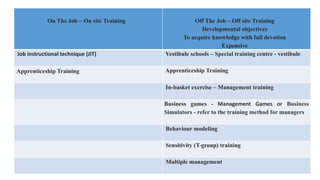
On The Job – On site Training Off The Job – Off site Training
Developmental objectives
To acquire knowledge with full devotion
Expensive
Job instructional technique (JIT) Vestibule schools – Special training centre - vestibule
Apprenticeship Training Apprenticeship Training
In-basket exercise – Management training
Business games - Management Games or Business
Simulators - refer to the training method for managers
Behaviour modeling
Sensitivity (T-group) training
Multiple management
On-the-Job Methods
This refers to the methods of training in which a person learns a job by
actually doing/performing it. A person works on a job and learns and
develops expertise at the same time.
Also known as On-site training, is such training programs which are
conducted inside the office’s premises. Under this method, the
inexperienced staffs learn new things by observing and imitating
coworkers or superiors performing the job. Such training are cheaper
and easier to conduct, and the best thing is official works are not
disturbed.
1.Understudy - In this the employee is trained by his or her supervisor. The trainee is attached with his or her
senior and called understudy or assistant. For example, a future manager might spend few months as assistant to
the present manager. Understudy is basically the person who replaces any staff in their absence. Understudy
training is the process in which superior instructs the staff by considering them as an understudy or assistant. The
staff then learns from the senior by observing and experiencing to handle day to day tasks. Such training finally
makes the staff ready to handle full responsibility on his / her own. Understudy Method - the trainee works
directly with a senior manager or with the person he or she is to replace; the latter is responsible for the trainee’s
coaching.
Advantages of Understudy Method:
1. New managers feel more confident in taking over their responsibilities because they have shadowed their
predecessors and have a better knowledge of the history, current state and future direction of the company.
2.Provides excellent on-the-job training for current employees and enhances their leadership skills and
productivity.
Disadvantages of Understudy Method:
1.It requires that the outgoing manager take extra time to train the incoming employee, which can take away from
daily responsibilities and tasks.
2.Taking extra time may slow down productivity temporarily.
3.Expensive- the company may have to pay two higher salaries simultaneously while the new employee is getting
trained.
2. Job rotation - This refers to shifting/movement of an employee from one job to another on
regular intervals. Job Rotation is a management approach where employees are shifted between
two or more assignments or jobs at regular intervals of time in order to expose them to all verticals
of an organization. Job rotation is an interesting way of training employees by rotating them through
a series of closely related jobs. Such training allows the employee to learn many things and make
them familiar with different jobs. Also, such training program promotes rapport between the
workers and is really helpful to eliminate boredom at the workplace.
Advantages of Job Rotation
1. Provides an opportunity to broaden one’s knowledge- Due to job rotation the person is able to
learn different job in the organization this broadens his knowledge.
Disadvantages of Job Rotation
1. Frequent interruption - Job rotation results in frequent interruption of work .A person who is
doing a particular job and get it comfortable suddenly finds himself shifted to another job or
department. This interrupts the work in both the departments.
2. Reduces uniformity in quality - Quality of work done by a trained worker is different from that
of a new worker. When a new worker is shifted or rotated in the department, he takes time to
learn the new job, makes mistakes in the process and affects the quality of the job.
3. Misunderstanding with the union member - Sometimes job rotation may lead to
misunderstanding with members of the union. The union might think that employees are being
harassed and more work is being taken from them. In reality this is not the case.
3. Special projects - The trainees' may ask to work on special projects
related with departmental objectives. By this, the trainees will acquire the
knowledge of the assigned work and also learn how to work with others.
4. Experience - It refers to learning by doing. This is one of the oldest
methods of on-the-job training. Although this is very effective method but it
also very time-consuming and wasteful. Thus it should be followed by other
training methods.
5. Committee assignment - In this, the trainees become members of a
committee. The committee is assigned a problem to discuss and
make recommendations.
6. Coaching – Instruction and guidance - In this, the supervisor or the superior
acts as a guide and instructor of the trainee. This involves extensive
demonstration and continuous critical evaluation and correction. Coaching is a
one-to-one training, meaning a single employee is trained by a single senior.
Under this training method, the senior first identifies the weak point of the
employee and then focuses on fixing them theoretically or practically. This
method can be adopted to guide operational level employees.
7. Mentoring – Instruction, guidance, grooming, developing attitude, teacher,
philosopher, counselor, facilitator - Mentoring is similar to coaching as it is
also one-to-one training. However, it is different from coaching as it focuses on
developing attitudes of employees rather than technical skills. Such training is
provided to the employee of managerial level by the seniors of the company.
8. Job instructional technique (JIT) - Job Instructional Technique (JIT) is a structured training method, under
which the staffs are provided training step by step. Two or more trainers can be involved in a single JIT.
For an example, let us suppose that there are 4 instructors A, B, C and D. At first, trainer A provides overview of
the job to the staff. Overview is concerned with the purpose of the job and the desired output from it.
Secondly, trainer B practically exhibits or explains the job. After that, trainer C observes how well the staff can
comply their knowledge, and finally, trainer D provides feedback as well as helps the staff if necessary. All these
steps can be carried out by single or lesser number of trainers.
9. Apprenticeship Training - Apprenticeship is the modern approach of training the practitioners. Such method
of training is adopted while training inexperienced staffs or fresh graduates, especially from technical field.
Under this method, the staff at first serves as an apprentice to the superiors or experts. They do the same task
as an ordinary staff would do but under the guidance or supervision of their superiors.
Apprentices are paid less than other staffs of same post would receive. However, it is an expensive method of
training because there is no assurance that the staff will continue to work for the same company.
Apprenticeship Act – 1962
Off-the-Job Methods
Off-site or off-the-job training are those training programs which are conducted away from
the workplace. It is an expensive but effective way of training staffs.
These methods require trainees to leave their workplace and concentrate their entire time
towards the training objectives. These days off-the-job training methods have become
popular due to limitations of the on-the-job training methods such as facilities and
environment, lack of group discussion and full participation among the trainees from
different disciplines, etc.
In the off-the job methods, the development of trainees is the primary task rest
everything is secondary.
1. Special courses and lectures - These are the most traditional and even famous today, method of developing
personnel. Special courses and lectures are either designed by the company itself or by the
management/professional schools. Companies then sponsor their trainees to attend these courses or lectures.
These are the quick and most simple ways to provide knowledge to a large group of trainees. These programs
aim at training a large audience through verbal presentation and interaction.
Lectures and conferences should be motivating in order to be effective and a strong speaker is a must to
conduct such programs.
Either by regular instructor appointed by the firm or by the specialist
Is to send the personnel programmes established by other colleges or University
Is to work with a college or other institutions – by experienced faculty members
2. Conferences and seminars - In this, the participants are required to pool their thoughts, ideas, viewpoints,
suggestions and recommendations. By attending conferences and seminars, trainees try to look at a problem
from different angles as the participants are normally from different fields and sectors.
a) Directed or guided conference
b) Consultative conference
c) Problem solving conference
3. Selected reading - This is the self-improvement training technique. The persons acquire knowledge and
awareness by reading various trade journals and magazines. Most of the companies have their own libraries.
The employees become the members of the professional associations to keep abreast of latest developments
in their respective fields.
4. Case study method - This technique was developed by Harvard Business School, U.S.A. It is used as a
supplement to lecture method. A case is a written record of a real business situation/problem faced by a
company. The case is provided to the trainees for discussion and analysis. Identification and diagnose of the
problem is the aim in case study method. Alternate courses of action are suggested from participants.
5. Programmed instruction/learning - This is step-by-step self-learning method where the medium may be a
textbook, computer or the internet. This is a systematic method for teaching job skills involving presenting
questions or facts, allowing the person to respond and giving the learner immediate feedback on the
accuracy of his or her answers.
Provides information to the learner
Provides feed back
6. Brainstorming - This is creativity-training technique, it helps people to solve
problems in a new and different way. In this technique, the trainees are given the
opportunity to generate ideas openly and without any fear of judgment. Criticism of
any idea is not allowed so as to reduce inhibiting forces. Once a lot of ideas are
generated then they are evaluated for their cost and feasibility.
7. Role-playing - In this method, the trainees are assigned a role, which they have to
play in an artificially created situation. For example, a trainee is asked to play the role of
a trade union leader and another trainee is required to perform the role of a HR
manager. This technique results in better understanding of each other's situation by
putting foot in other's shoes.
HR manager and Trade union leader
8. Vestibule schools – Special training centre – vestibule - Large organisations
frequently provide what are described as vestibule schools a preliminary to actual
shop experience. As far as possible, shop conditions are duplicated, but instruction,
not output is major objective." A vestibule school is operated as a specialized
endeavor by the personnel department. This training is required when the amount
of training that has to be done exceeds the capacity of the line supervisor; a
portion of training is evolved from the line and assigned to staff through a vestibule
school." The advantage of a vestibule school is specialization.
Vestibule training is a modern method of training staffs under which the staffs are
trained at prototype environment of specific jobs. Such training makes the staff
ready to work at real workplace as the work environment and conditions are
similar to the actual workplace. This training is also known to reduce initial
nervousness.
In the vestibule an attempt is made to duplicate nearly as possible the actual work
conditions of the work place
9. Apprenticeship training - This training approach began in the Middle Ages when those who wanted to
learn trade skill bound themselves to a master craftsman and worked under his guidance. Apprenticeship
training is a structured process by which people become skilled workers through a combination of classroom
instruction and on-the-job training.
10. In-basket exercise - In this technique, the trainees are provided background information on a simulated
firm and its products, and key personnel. After this, the trainees are provided with in-basket of memos,
letters, reports, requests and other documents related with the firm. The trainee must make sense out of
this mass of paperwork and prepare memos, make notes and delegate tasks within a limited time period."
The in-basket exercise measures administrative skills that are critical for effective performance in
supervisory and managerial jobs.
An in-basket exercise assesses a candidate's ability to perform a manager’s job from an administrative
perspective.
In the exercise, the candidate is confronted with issues and problems that have accumulated in the
manager’s "in-basket" after returning to work from an extended absence. A sample of in-basket items
might include memos, correspondence, e-mails, directives, requests, reports, forms, messages, minutes,
hand-written notes, etc., from management, supervisors, staff members, inmates, and other stakeholders.
The candidate's task is to review the in-basket items and then take action on these varied issues.
Standardized criteria and predefined rating scales are used to assess the candidate.
11. Business games - Management Games or Business Simulators - refer to the training method
for managers - Business games involve teams of trainees. The teams discuss and analyse the
problem and arrive at decisions. Generally, issues related with inventories, sales, R&D, production
process, etc. are taken up for consideration.
This form of training is based on an artificial environment that simulates the real situation in the
management of the organization.
Whether it’s planning, decision making, control, communications or management itself.
Business games allow monitoring of the consequences of decisions, and respond naturally to
various situations.
Business games are part of a larger group of simulation games.
Business games in practice: Business games allow creation of the most complex problems, are
strongly interactive and communication, problem solving and discussion play an important role.
Management games can take different forms:
Desktop business games (such as Monopoly)
Computer games (e.g. various turn-based strategies, building games)
Team learning games (e.g. through teambuilding)
12. Behaviour modeling - This is structured approach to teach specific supervisory skill. This is based on the
social learning theory in which the trainee is provided with a specific model of behaviour and is informed in
advance of the consequences of engaging in that type of behaviour. In this method, some kind of process or
behavior is videotaped and then is watched by the trainees. Games and simulation section (imitation of a
situation or process, imitation - copy something else.) is also included because once the trainees see the
videotape, they practice the behavior through role plays or other kind of simulation techniques. The trainee
first observes the behavior modeled in the video and then reproduces the behavior on the job.
Process -
The skills that are required to build up are defined. A brief overview of the theory is then provided to the
trainers. Then, trainees are given instructions that what specific learning points or critical behavior they have
to watch. Then the expert is used to model the suitable behaviors. Then, the trainees are encouraged to
practice the suitable behavior in a role play or through any other method of simulation. Trainees are then
provided with some opportunities to give reinforcement for appropriate imitation of the model’s behavior. In
the end, trainer ensures that trainees appropriately reinforces the behavior on the work place.
Application -
Behavior modeling focuses on developing behavioral and interpersonal skills. This type of method can be used
for training in –
Sales training, Interviewee training, Interviewer training, Safety training, Interpersonal skills training
13. Sensitivity (T-group) training - In this type of training, a small group of trainees consisting of
10 to 12 persons are formed which meets in an unstructured situation. There is no set agenda or
schedule or plan. The main objectives are more openness with each other, increased listening
skills, trust, support, tolerance and concern for others. The trainers serve a catalytic role. The
group meets in isolation without any formal agenda. There is great focus on inter-personal
behaviour. And, the trainer provides honest but supportive feedback to members on how they
interacted with one another.
A number of people work together in the company and it is very essential for every staff to
consider his/her co-workers sentiments and feelings. Sensitivity training is a special training
provided to the employees to make them capable of understanding about themselves and
about others reasonably.
Such training aims at developing behavioral flexibility and social sensitivity in the employees, in
an attempt to develop the ability to sense others feelings and opinions. These training also help
an individual to realize his/her personal qualities as well as issues.
14. Multiple management - This technique of training was first introduced by
McCormick, President of McCormick & co. of Baltimore in 1932.
He gave the idea of establishing a junior board of directors.
Authority and power is given to the junior board members to discuss any problem that
could be discuss in senior board and give recommendations to the senior board.
Innovative and productive ideas became available for senior board.
Step 3 - IMPLEMENTATION of the training program
• To put training program into effect according to definite plan or procedure is called
training implementation.
• Training implementation is the hardest part of the system because one wrong step
can lead to the failure of whole training program
Step 4 - EVALUATION of training program
• The process of examining a training program is called training evaluation
• Training evaluation is necessary to see the effectiveness of the training program
• Training evaluation ensures that whether candidates are able to implement their
learning in their respective workplaces, or to the regular work routines
• Hence, in order to see the strengths & weaknesses of the training program its
evaluation is important
METHOD OF TRAINING EVALUATION
Kirkpatrick has given 4 criteria by which training can be evaluated -
1. REACTION- immediate thoughts & reactions of trainees regarding the
training through interview, questionnaire, feedback forms, etc
2. LEARNING - the resulting increase in knowledge or capability through
tests
3. BEHAVIOUR - extent of application of the skills acquired through training
at the workplace. This can be checked through performance appraisal.
4. RESULTS - the effects on the business resulting from the trainee's
performance, i.e.; increase in productivity, efficiency, quality, morale,
reduction in costs, accidents, etc.
The CIRO Model
1. The CIRO model was developed by Warr, Bird and Rackham and published in
1970 in their book “Evaluation of Management Training”.
2. CIRO stands for context, input, reaction and output and organisational level.
3. The key difference in CIRO and Kirkpatrick’s models is that CIRO focuses on
measurements taken before and after the training has been carried out.
4. One criticism of this model is that it does not take into account behaviour.
Some practitioners feel that it is, therefore, more suited to management
focused training programmes rather than those designed for people working
at lower levels in the organisation.
C - Context - This is about identifying and evaluating training needs based on collecting information about
performance deficiencies and based on these, setting training objectives which may be at three levels:
1. The ultimate objective: The particular organisational deficiency that the training program will eliminate.
2. The intermediate objectives: The changes to the employees work behaviours necessary if the ultimate
objective is to be achieved.
3. The immediate objectives: The new knowledge, skills or attitudes that employees need to acquire in order to
change their behavior and so achieve the intermediate objectives.
I - Input - This is about analysing the effectiveness of the training courses in terms of their design, planning,
management and delivery. It also involves analysing the organisational resources available and determining how
these can be best used to achieve the desired objectives.
R - Reaction - This is about analysing the reactions of the delegates to the training in order to make improvements.
This evaluation is obviously subjective so needs to be collected in as systematic and objective way as possible.
O - Outcome - Outcomes are evaluated in terms of what actually happened as a result of training. Outcomes are
measured at any or all of the following four levels, depending on the purpose of the evaluation and on the resources
that are available. The learner level
1. The workplace level
2. The team or department level or unit level
3. The business level or organizational level

Human Resource Management - Training and Development.pptx

  • 1.
  • 2.
    Human Resource Development 1.Human Resource Development is a system of developing in a continuous and planned way helping employees to acquire competencies. It is an organised series of learning activities, within a specified time limit, designed to produce a desired behavioural change in the learner. 2. It maximize the congruence between the individual and the organisational goals of employees an develops an organisational culture in which superior- subordinate relationships, teamwork and collaboration among various units become strong and contribute to the professional well-being, motivation and pride of employees. 3. HRD is a process which helps employees of an organisation to improve their functional capabilities for their present and future roles. 4. It helps in developing their potentialities for self and organisational growth. 5. It develops organisational culture and sustains superior-subordinate relationships, teamwork and quality. 6. Assists in productive utilisation of the human resources. 7. It brings about job enrichment, better planning and evaluation.
  • 3.
    Important characteristics ofHRD 1. HRD is a system and HRD develops the competencies at all levels. 2. HRD is continuous and planned development effort. 3. The ultimate object of HRD is to contribute to the professional well-being, motivation and pride of the employees.
  • 4.
    Indicators of HRDat the organisational level • HRD instruments/sub-systems/mechanisms, (e.g., HRD departments, appraisal systems, job-rotation, training, and development etc.) • HRD processes, (e.g., role clarity, trust, openness, pro-action, collaboration, etc.) • HRD outcomes (E.g. more competent people, work, etc.) • Organisational outcomes (improved performance, profits, diversification, image productivity, etc.)
  • 5.
    HRD Outcomes 1. Peoplein the organisation become more competent because on the one hand they become better aware of the skills required for job performance and on the other hand there is greater clarity of norms and standards. 2. People understand their roles better because through increased communication they become aware of the expectation which other members of their role set have from them. 3. People become more committed to their jobs because now there is greater objectivity in the administration of rewards. They come forward with better and more creative ideas. 4. People develop greater trust and respect for each other. They become more open and authentic in their behavior. Thus new values are generated. 5. There is greater collaboration and teamwork which produces synergy effects. 6. The people find themselves better equipped with problem-solving capabilities. They become more prone to risk taking and proactive in their orientation. There is greater readiness on their part to accept changes. 7. Lot of useful and objective data on employees are generated which facilitates better human resource planning. 8. The top management becomes more sensitive to employees problems and human processes due to increased openness in communication.
  • 6.
    Relationship between HRMand HRD HRM HRM is a strategic approach to the acquisition, motivation, development and management of the organisation’s human resources. It is a specialised field that attempts to develop programs, policies and activities to promote the satisfaction of the individual and organisational needs, goals and objectives. HRM shapes an appropriate corporate culture. HRM is concerned with integration by getting all members of the organisation involved. HRD HRD, Organisation Development and Industrial Relations are three important aspects or sub systems of HRM. The term HRD has been repeatedly used for different functions of Training, performance appraisal, industrial relations, salary administration, career planning, etc. and many organisations have renamed the personnel or training department as HRD department without any role change. HRM refers to the philosophy, policies, procedures and practices related to the management of people.
  • 7.
    HRD functions ina business organisation include everything concerning “EMPLOYEES” (people) - 1. Training 2. Recruitment 3. Retention 4. Welfare 5. Appraisal 6. Growth 7. Induction 8. Skill development 9. Attitudinal orientation 10. Motivation 11. Compensation 12. Industrial relation 13. Separation 14. Organisation development
  • 8.
    Training Training - Processof imparting specific skills, abilities & knowledge to an employee Training & Development need = Standard Performance - Actual Performance T&D offers competitive advantage to a firm by removing performance deficiencies, making employees stay long, minimizing accidents & meeting future employee needs. BENEFITS/ IMPORTANCE of employee training • Optimum utilization of human resources • Leads to increased profitability & productivity • Improves job knowledge & skills at all levels • Improves morale of the workforce • Help employees identify with organizational goals • Helps in creating a better corporate image • Fosters openness and trust • Improves the relationship between boss & subordinate as well as labour management relation • Improves interpersonal skills
  • 9.
    STEPS IN THETRAINING PROCESS 1. Training Need Analysis -TNA 2. Designing T&D program 3. Implementation 4. Evaluation of the training program
  • 10.
    Step 1 -TRAINING NEED ANALYSIS (TNA) • TNA is very crucial as organizations spend a lot of resources, money on it • TNA occurs at 2 levels - Individual Level and Group Level At Individual level, it could be through - Performance Appraisal, Interview, Questionnaire, Attitude surveys, etc, e.g. for promotion, unsatisfactory performance At group/ organisation level, it could be through - Organisation goals & objectives, climate indices, exit interviews, quality circles, customer satisfaction data, etc, e.g. when organisation vision changes, or it introduces a new line of product
  • 11.
    Step 2 -TRAINING DESIGN • Who are the trainees? • Who are the trainers? • What methods & techniques are used for training? • What should be the level of training? • Developing the course material, handouts, work books, visual aids, props, etc • Where is the programme to be conducted?
  • 12.
    TRAINING AND DEVELOPMENT(T&D) METHODS There are several T&D methods available. The use of a particular method depends which method accomplishes the training needs and objectives. Training methods can be classified into two categories: 1. On the Job Training 2. Off the Job Training There are several T&D methods available. The use of a particular method depends which method accomplishes the training needs and objectives.
  • 13.
    On The Job– On site Training Off The Job – Off site Training Developmental objectives To acquire knowledge with full devotion Expensive Understudy Special courses and lectures Job rotation Conferences and seminars Special projects Selected reading Experience Case study method Committee assignment Programmed instruction/learning Coaching – Instruction and guidance Brainstorming Mentoring – Instruction, guidance, grooming, developing attitude, teacher, philosopher, counselor, facilitator Role-playing
  • 14.
    On The Job– On site Training Off The Job – Off site Training Developmental objectives To acquire knowledge with full devotion Expensive Job instructional technique (JIT) Vestibule schools – Special training centre - vestibule Apprenticeship Training Apprenticeship Training In-basket exercise – Management training Business games - Management Games or Business Simulators - refer to the training method for managers Behaviour modeling Sensitivity (T-group) training Multiple management
  • 15.
    On-the-Job Methods This refersto the methods of training in which a person learns a job by actually doing/performing it. A person works on a job and learns and develops expertise at the same time. Also known as On-site training, is such training programs which are conducted inside the office’s premises. Under this method, the inexperienced staffs learn new things by observing and imitating coworkers or superiors performing the job. Such training are cheaper and easier to conduct, and the best thing is official works are not disturbed.
  • 16.
    1.Understudy - Inthis the employee is trained by his or her supervisor. The trainee is attached with his or her senior and called understudy or assistant. For example, a future manager might spend few months as assistant to the present manager. Understudy is basically the person who replaces any staff in their absence. Understudy training is the process in which superior instructs the staff by considering them as an understudy or assistant. The staff then learns from the senior by observing and experiencing to handle day to day tasks. Such training finally makes the staff ready to handle full responsibility on his / her own. Understudy Method - the trainee works directly with a senior manager or with the person he or she is to replace; the latter is responsible for the trainee’s coaching. Advantages of Understudy Method: 1. New managers feel more confident in taking over their responsibilities because they have shadowed their predecessors and have a better knowledge of the history, current state and future direction of the company. 2.Provides excellent on-the-job training for current employees and enhances their leadership skills and productivity. Disadvantages of Understudy Method: 1.It requires that the outgoing manager take extra time to train the incoming employee, which can take away from daily responsibilities and tasks. 2.Taking extra time may slow down productivity temporarily. 3.Expensive- the company may have to pay two higher salaries simultaneously while the new employee is getting trained.
  • 17.
    2. Job rotation- This refers to shifting/movement of an employee from one job to another on regular intervals. Job Rotation is a management approach where employees are shifted between two or more assignments or jobs at regular intervals of time in order to expose them to all verticals of an organization. Job rotation is an interesting way of training employees by rotating them through a series of closely related jobs. Such training allows the employee to learn many things and make them familiar with different jobs. Also, such training program promotes rapport between the workers and is really helpful to eliminate boredom at the workplace. Advantages of Job Rotation 1. Provides an opportunity to broaden one’s knowledge- Due to job rotation the person is able to learn different job in the organization this broadens his knowledge. Disadvantages of Job Rotation 1. Frequent interruption - Job rotation results in frequent interruption of work .A person who is doing a particular job and get it comfortable suddenly finds himself shifted to another job or department. This interrupts the work in both the departments. 2. Reduces uniformity in quality - Quality of work done by a trained worker is different from that of a new worker. When a new worker is shifted or rotated in the department, he takes time to learn the new job, makes mistakes in the process and affects the quality of the job. 3. Misunderstanding with the union member - Sometimes job rotation may lead to misunderstanding with members of the union. The union might think that employees are being harassed and more work is being taken from them. In reality this is not the case.
  • 18.
    3. Special projects- The trainees' may ask to work on special projects related with departmental objectives. By this, the trainees will acquire the knowledge of the assigned work and also learn how to work with others. 4. Experience - It refers to learning by doing. This is one of the oldest methods of on-the-job training. Although this is very effective method but it also very time-consuming and wasteful. Thus it should be followed by other training methods. 5. Committee assignment - In this, the trainees become members of a committee. The committee is assigned a problem to discuss and make recommendations.
  • 19.
    6. Coaching –Instruction and guidance - In this, the supervisor or the superior acts as a guide and instructor of the trainee. This involves extensive demonstration and continuous critical evaluation and correction. Coaching is a one-to-one training, meaning a single employee is trained by a single senior. Under this training method, the senior first identifies the weak point of the employee and then focuses on fixing them theoretically or practically. This method can be adopted to guide operational level employees. 7. Mentoring – Instruction, guidance, grooming, developing attitude, teacher, philosopher, counselor, facilitator - Mentoring is similar to coaching as it is also one-to-one training. However, it is different from coaching as it focuses on developing attitudes of employees rather than technical skills. Such training is provided to the employee of managerial level by the seniors of the company.
  • 20.
    8. Job instructionaltechnique (JIT) - Job Instructional Technique (JIT) is a structured training method, under which the staffs are provided training step by step. Two or more trainers can be involved in a single JIT. For an example, let us suppose that there are 4 instructors A, B, C and D. At first, trainer A provides overview of the job to the staff. Overview is concerned with the purpose of the job and the desired output from it. Secondly, trainer B practically exhibits or explains the job. After that, trainer C observes how well the staff can comply their knowledge, and finally, trainer D provides feedback as well as helps the staff if necessary. All these steps can be carried out by single or lesser number of trainers. 9. Apprenticeship Training - Apprenticeship is the modern approach of training the practitioners. Such method of training is adopted while training inexperienced staffs or fresh graduates, especially from technical field. Under this method, the staff at first serves as an apprentice to the superiors or experts. They do the same task as an ordinary staff would do but under the guidance or supervision of their superiors. Apprentices are paid less than other staffs of same post would receive. However, it is an expensive method of training because there is no assurance that the staff will continue to work for the same company. Apprenticeship Act – 1962
  • 21.
    Off-the-Job Methods Off-site oroff-the-job training are those training programs which are conducted away from the workplace. It is an expensive but effective way of training staffs. These methods require trainees to leave their workplace and concentrate their entire time towards the training objectives. These days off-the-job training methods have become popular due to limitations of the on-the-job training methods such as facilities and environment, lack of group discussion and full participation among the trainees from different disciplines, etc. In the off-the job methods, the development of trainees is the primary task rest everything is secondary.
  • 22.
    1. Special coursesand lectures - These are the most traditional and even famous today, method of developing personnel. Special courses and lectures are either designed by the company itself or by the management/professional schools. Companies then sponsor their trainees to attend these courses or lectures. These are the quick and most simple ways to provide knowledge to a large group of trainees. These programs aim at training a large audience through verbal presentation and interaction. Lectures and conferences should be motivating in order to be effective and a strong speaker is a must to conduct such programs. Either by regular instructor appointed by the firm or by the specialist Is to send the personnel programmes established by other colleges or University Is to work with a college or other institutions – by experienced faculty members 2. Conferences and seminars - In this, the participants are required to pool their thoughts, ideas, viewpoints, suggestions and recommendations. By attending conferences and seminars, trainees try to look at a problem from different angles as the participants are normally from different fields and sectors. a) Directed or guided conference b) Consultative conference c) Problem solving conference
  • 23.
    3. Selected reading- This is the self-improvement training technique. The persons acquire knowledge and awareness by reading various trade journals and magazines. Most of the companies have their own libraries. The employees become the members of the professional associations to keep abreast of latest developments in their respective fields. 4. Case study method - This technique was developed by Harvard Business School, U.S.A. It is used as a supplement to lecture method. A case is a written record of a real business situation/problem faced by a company. The case is provided to the trainees for discussion and analysis. Identification and diagnose of the problem is the aim in case study method. Alternate courses of action are suggested from participants. 5. Programmed instruction/learning - This is step-by-step self-learning method where the medium may be a textbook, computer or the internet. This is a systematic method for teaching job skills involving presenting questions or facts, allowing the person to respond and giving the learner immediate feedback on the accuracy of his or her answers. Provides information to the learner Provides feed back
  • 24.
    6. Brainstorming -This is creativity-training technique, it helps people to solve problems in a new and different way. In this technique, the trainees are given the opportunity to generate ideas openly and without any fear of judgment. Criticism of any idea is not allowed so as to reduce inhibiting forces. Once a lot of ideas are generated then they are evaluated for their cost and feasibility. 7. Role-playing - In this method, the trainees are assigned a role, which they have to play in an artificially created situation. For example, a trainee is asked to play the role of a trade union leader and another trainee is required to perform the role of a HR manager. This technique results in better understanding of each other's situation by putting foot in other's shoes. HR manager and Trade union leader
  • 25.
    8. Vestibule schools– Special training centre – vestibule - Large organisations frequently provide what are described as vestibule schools a preliminary to actual shop experience. As far as possible, shop conditions are duplicated, but instruction, not output is major objective." A vestibule school is operated as a specialized endeavor by the personnel department. This training is required when the amount of training that has to be done exceeds the capacity of the line supervisor; a portion of training is evolved from the line and assigned to staff through a vestibule school." The advantage of a vestibule school is specialization. Vestibule training is a modern method of training staffs under which the staffs are trained at prototype environment of specific jobs. Such training makes the staff ready to work at real workplace as the work environment and conditions are similar to the actual workplace. This training is also known to reduce initial nervousness. In the vestibule an attempt is made to duplicate nearly as possible the actual work conditions of the work place
  • 26.
    9. Apprenticeship training- This training approach began in the Middle Ages when those who wanted to learn trade skill bound themselves to a master craftsman and worked under his guidance. Apprenticeship training is a structured process by which people become skilled workers through a combination of classroom instruction and on-the-job training. 10. In-basket exercise - In this technique, the trainees are provided background information on a simulated firm and its products, and key personnel. After this, the trainees are provided with in-basket of memos, letters, reports, requests and other documents related with the firm. The trainee must make sense out of this mass of paperwork and prepare memos, make notes and delegate tasks within a limited time period." The in-basket exercise measures administrative skills that are critical for effective performance in supervisory and managerial jobs. An in-basket exercise assesses a candidate's ability to perform a manager’s job from an administrative perspective. In the exercise, the candidate is confronted with issues and problems that have accumulated in the manager’s "in-basket" after returning to work from an extended absence. A sample of in-basket items might include memos, correspondence, e-mails, directives, requests, reports, forms, messages, minutes, hand-written notes, etc., from management, supervisors, staff members, inmates, and other stakeholders. The candidate's task is to review the in-basket items and then take action on these varied issues. Standardized criteria and predefined rating scales are used to assess the candidate.
  • 27.
    11. Business games- Management Games or Business Simulators - refer to the training method for managers - Business games involve teams of trainees. The teams discuss and analyse the problem and arrive at decisions. Generally, issues related with inventories, sales, R&D, production process, etc. are taken up for consideration. This form of training is based on an artificial environment that simulates the real situation in the management of the organization. Whether it’s planning, decision making, control, communications or management itself. Business games allow monitoring of the consequences of decisions, and respond naturally to various situations. Business games are part of a larger group of simulation games. Business games in practice: Business games allow creation of the most complex problems, are strongly interactive and communication, problem solving and discussion play an important role. Management games can take different forms: Desktop business games (such as Monopoly) Computer games (e.g. various turn-based strategies, building games) Team learning games (e.g. through teambuilding)
  • 28.
    12. Behaviour modeling- This is structured approach to teach specific supervisory skill. This is based on the social learning theory in which the trainee is provided with a specific model of behaviour and is informed in advance of the consequences of engaging in that type of behaviour. In this method, some kind of process or behavior is videotaped and then is watched by the trainees. Games and simulation section (imitation of a situation or process, imitation - copy something else.) is also included because once the trainees see the videotape, they practice the behavior through role plays or other kind of simulation techniques. The trainee first observes the behavior modeled in the video and then reproduces the behavior on the job. Process - The skills that are required to build up are defined. A brief overview of the theory is then provided to the trainers. Then, trainees are given instructions that what specific learning points or critical behavior they have to watch. Then the expert is used to model the suitable behaviors. Then, the trainees are encouraged to practice the suitable behavior in a role play or through any other method of simulation. Trainees are then provided with some opportunities to give reinforcement for appropriate imitation of the model’s behavior. In the end, trainer ensures that trainees appropriately reinforces the behavior on the work place. Application - Behavior modeling focuses on developing behavioral and interpersonal skills. This type of method can be used for training in – Sales training, Interviewee training, Interviewer training, Safety training, Interpersonal skills training
  • 29.
    13. Sensitivity (T-group)training - In this type of training, a small group of trainees consisting of 10 to 12 persons are formed which meets in an unstructured situation. There is no set agenda or schedule or plan. The main objectives are more openness with each other, increased listening skills, trust, support, tolerance and concern for others. The trainers serve a catalytic role. The group meets in isolation without any formal agenda. There is great focus on inter-personal behaviour. And, the trainer provides honest but supportive feedback to members on how they interacted with one another. A number of people work together in the company and it is very essential for every staff to consider his/her co-workers sentiments and feelings. Sensitivity training is a special training provided to the employees to make them capable of understanding about themselves and about others reasonably. Such training aims at developing behavioral flexibility and social sensitivity in the employees, in an attempt to develop the ability to sense others feelings and opinions. These training also help an individual to realize his/her personal qualities as well as issues.
  • 30.
    14. Multiple management- This technique of training was first introduced by McCormick, President of McCormick & co. of Baltimore in 1932. He gave the idea of establishing a junior board of directors. Authority and power is given to the junior board members to discuss any problem that could be discuss in senior board and give recommendations to the senior board. Innovative and productive ideas became available for senior board.
  • 31.
    Step 3 -IMPLEMENTATION of the training program • To put training program into effect according to definite plan or procedure is called training implementation. • Training implementation is the hardest part of the system because one wrong step can lead to the failure of whole training program Step 4 - EVALUATION of training program • The process of examining a training program is called training evaluation • Training evaluation is necessary to see the effectiveness of the training program • Training evaluation ensures that whether candidates are able to implement their learning in their respective workplaces, or to the regular work routines • Hence, in order to see the strengths & weaknesses of the training program its evaluation is important
  • 32.
    METHOD OF TRAININGEVALUATION Kirkpatrick has given 4 criteria by which training can be evaluated - 1. REACTION- immediate thoughts & reactions of trainees regarding the training through interview, questionnaire, feedback forms, etc 2. LEARNING - the resulting increase in knowledge or capability through tests 3. BEHAVIOUR - extent of application of the skills acquired through training at the workplace. This can be checked through performance appraisal. 4. RESULTS - the effects on the business resulting from the trainee's performance, i.e.; increase in productivity, efficiency, quality, morale, reduction in costs, accidents, etc.
  • 33.
    The CIRO Model 1.The CIRO model was developed by Warr, Bird and Rackham and published in 1970 in their book “Evaluation of Management Training”. 2. CIRO stands for context, input, reaction and output and organisational level. 3. The key difference in CIRO and Kirkpatrick’s models is that CIRO focuses on measurements taken before and after the training has been carried out. 4. One criticism of this model is that it does not take into account behaviour. Some practitioners feel that it is, therefore, more suited to management focused training programmes rather than those designed for people working at lower levels in the organisation.
  • 34.
    C - Context- This is about identifying and evaluating training needs based on collecting information about performance deficiencies and based on these, setting training objectives which may be at three levels: 1. The ultimate objective: The particular organisational deficiency that the training program will eliminate. 2. The intermediate objectives: The changes to the employees work behaviours necessary if the ultimate objective is to be achieved. 3. The immediate objectives: The new knowledge, skills or attitudes that employees need to acquire in order to change their behavior and so achieve the intermediate objectives. I - Input - This is about analysing the effectiveness of the training courses in terms of their design, planning, management and delivery. It also involves analysing the organisational resources available and determining how these can be best used to achieve the desired objectives. R - Reaction - This is about analysing the reactions of the delegates to the training in order to make improvements. This evaluation is obviously subjective so needs to be collected in as systematic and objective way as possible. O - Outcome - Outcomes are evaluated in terms of what actually happened as a result of training. Outcomes are measured at any or all of the following four levels, depending on the purpose of the evaluation and on the resources that are available. The learner level 1. The workplace level 2. The team or department level or unit level 3. The business level or organizational level