T R A I N I N G &
D E V E L O P M E N T
TRAINING
Training is an organized activity for increasing the knowledge and skills
of people for a definite purpose.
It involves systematic procedures for transferring technical know-how
to the employees so as to increase their knowledge and skills for
doing specific jobs with proficiency.
Training is a learning experience in that it seeks a relatively permanent
change in an individual that will improve his or her ability to perform
on the job.
Edwin B. Flippo defines Training as “The act of increasing the skills of
an employee for doing a particular job”.
TRAINING
Training is provided to improve KSA
❖KNOWLEDGE – The attributes required to perform a job.
(Intellectual or theoretical aspect)
❖SKILLS – the proficient manual, verbal, or mental manipulation of
data or things. (Physical aspect)
❖ABILITIES – the power or capacity to perform an activity or task.
(Analytical and decision making aspect)
The quest for knowledge is universal, knowledge needs to be
transformed into skills
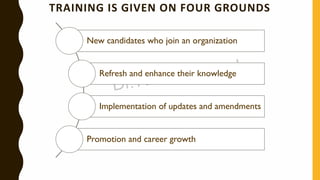
TRAINING IS GIVEN ON FOUR GROUNDS
New candidates who join an organization
Refresh and enhance their knowledge
Implementation of updates and amendments
Promotion and career growth
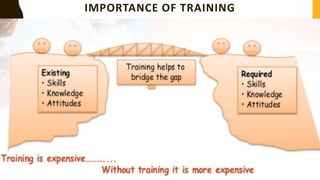
IMPORTANCE OF TRAINING
• Increase Efficiency
• Helps in Fulfilling the Future Personnel Needs
• Competent and CapableWorkforce
• Innovation
• Improving Health and Safety
• Enhance Corporate Image
• Optimum Utilization of Resources
• Reduce Supervision
• Reduce Absenteeism and LabourTurnover
• Better Relations and Improved Organizational Climate
• Personal / Individual Growth of Employees
OBJECTIVES OF TRAINING PROGRAM
• To Motivate Workforce
• To Develop Positive Attitude
• To Face Challenges Effectively
• To Reduce Wastages and Improve Efficiency
• To Enhance Corporate Image
• To Optimally Utilization of Resources
• To Reduce Absenteeism and Labor Turnover
• To Improve Relations
• To Help in Succession Planning
• To Gain Sustainable Competitive Advantage
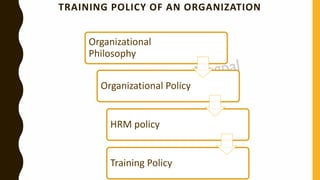
TRAINING POLICY OF AN ORGANIZATION
Organizational
Philosophy
Organizational Policy
HRM policy
Training Policy
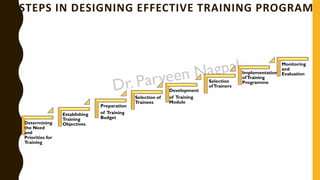
STEPS IN DESIGNING EFFECTIVE TRAINING PROGRAM
Determining
the Need
and
Priorities for
Training
Establishing
Training
Objectives
Preparation
of Training
Budget
Selection of
Trainees
Development
of Training
Module
Selection
ofTrainers
Implementation
ofTraining
Programme
Monitoring
and
Evaluation
CHALLENGES BEFORE TRAINERS
• Need - BasedTraining
• Individual Differences
• Scheduling
• Attitude ofTrainees
• Training Techniques
• Problem of Language
• Resistance
• Cost – Effectiveness
• Constant Feedback
MANAGEMENT DEVELOPMENT
According to P. N. Singh, “Management Development is an activity
designed to improve the performance of existing managers, provide a
supply of managers to meet the need of organizations in future and
extend the understanding of the management activity by drawing from
the following three resource areas :
a) Knowledge
b) Experience and
c) Trainee himself”.
It is viewed as a systematic, long term learning process of management
training and growth by which individuals gain and apply knowledge, skills,
insights, and attitudes to manage managers, workers and organizations
effectively.
MANAGEMENT DEVELOPMENT
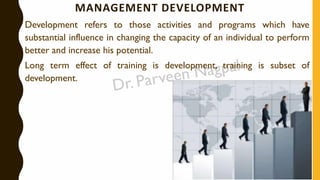
Development refers to those activities and programs which have
substantial influence in changing the capacity of an individual to perform
better and increase his potential.
Long term effect of training is development, training is subset of
development.
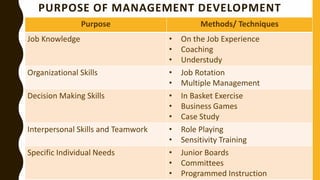
PURPOSE OF MANAGEMENT DEVELOPMENT
Purpose Methods/ Techniques
Job Knowledge • On the Job Experience
• Coaching
• Understudy
Organizational Skills • Job Rotation
• Multiple Management
Decision Making Skills • In Basket Exercise
• Business Games
• Case Study
Interpersonal Skills and Teamwork • Role Playing
• Sensitivity Training
Specific Individual Needs • Junior Boards
• Committees
• Programmed Instruction
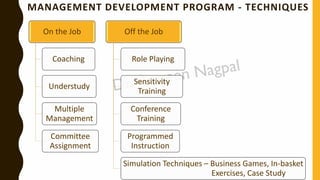
MANAGEMENT DEVELOPMENT PROGRAM - TECHNIQUES
On the Job
Coaching
Understudy
Multiple
Management
Committee
Assignment
Off the Job
Role Playing
Sensitivity
Training
Conference
Training
Programmed
Instruction
Simulation Techniques – Business Games, In-basket
Exercises, Case Study
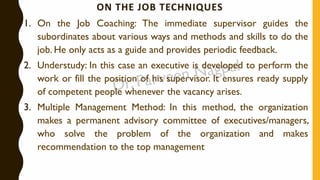
ON THE JOB TECHNIQUES
1. On the Job Coaching: The immediate supervisor guides the
subordinates about various ways and methods and skills to do the
job. He only acts as a guide and provides periodic feedback.
2. Understudy: In this case an executive is developed to perform the
work or fill the position of his supervisor. It ensures ready supply
of competent people whenever the vacancy arises.
3. Multiple Management Method: In this method, the organization
makes a permanent advisory committee of executives/managers,
who solve the problem of the organization and makes
recommendation to the top management
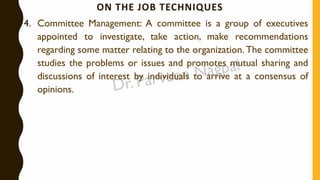
ON THE JOB TECHNIQUES
4. Committee Management: A committee is a group of executives
appointed to investigate, take action, make recommendations
regarding some matter relating to the organization. The committee
studies the problems or issues and promotes mutual sharing and
discussions of interest by individuals to arrive at a consensus of
opinions.
OFF THE JOB TECHNIQUES
1. Role Playing: It may be described as a technique of creating a life
situation, usually one involving conflict between people, and then
having persons in a group to play the parts or roles of specific
personalities.
2. Sensitivity Training: It was originally developed by Kurt Lewin. It is
also called as laboratory training, T Group or Group Dynamic
Training. Here managers are gathered in a place for discussion
sessions and the focus is on aspects such as the ability to listen to
others, ability to communicate, ability to diagnose human problems
correctly, learning to give and receive constructive feedback and
understanding the complexities of group dynamics.
OFF THE JOB TECHNIQUES
1. Role Playing: It may be described as a technique of creating a life
situation, usually one involving conflict between people, and then
having persons in a group to play the parts or roles of specific
personalities.
2. Sensitivity Training: Originally developed by Kurt Lewin, it is also
called laboratory training, T Group or Group Dynamic Training.
Here managers are gathered for discussion sessions and the focus
is on aspects such as the ability to listen to others, communicate,
diagnose human problems correctly, give and receive constructive
feedback and understanding the complexities of group dynamics.
Thus they learn how to work more effectively as a group or a
team member and perform leadership roles.
OFF THE JOB TECHNIQUES
3. Conference Training: A conference is group meeting conducted
according to an organized plan in which the participants seek to
develop the knowledge and understanding by obtaining
considerable amount of oral participation.
4. Programmed Instructions: It is the application of the science of
learning to the task of education and training using computer
applications. The material to be learnt is broken down into very
small units or stages and trainees learn at their own pace.
OFF THE JOB TECHNIQUES
5. Simulation Techniques: The basic idea is to create or construct a
situation which closely represents the actual one. It is conducted
in a controlled environment on trial basis.
• Business Games - Classroom simulation exercises which are
designed to be representative of the real life condition.
• In basket Training – Participants are given all the material in basket
which will help them to solve the problems.
• Case Study Method: Developed by Christopher C Langdell, here the
facts of the case that needs to be solved or has already occurred in
the organization are given for analysis and decision-making to a
group of participants. They study the problem, analyse it, find
alternatives and give suggestions.
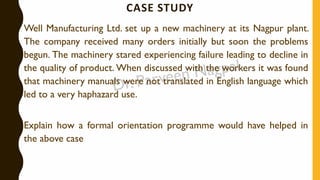
CASE STUDY
Well Manufacturing Ltd. set up a new machinery at its Nagpur plant.
The company received many orders initially but soon the problems
begun. The machinery stared experiencing failure leading to decline in
the quality of product. When discussed with the workers it was found
that machinery manuals were not translated in English language which
led to a very haphazard use.
Explain how a formal orientation programme would have helped in
the above case
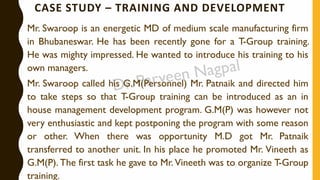
CASE STUDY – TRAINING AND DEVELOPMENT
Mr. Swaroop is an energetic MD of medium scale manufacturing firm
in Bhubaneswar. He has been recently gone for a T-Group training.
He was mighty impressed. He wanted to introduce his training to his
own managers.
Mr. Swaroop called his G.M(Personnel) Mr. Patnaik and directed him
to take steps so that T-Group training can be introduced as an in
house management development program. G.M(P) was however not
very enthusiastic and kept postponing the program with some reason
or other. When there was opportunity M.D got Mr. Patnaik
transferred to another unit. In his place he promoted Mr. Vineeth as
G.M(P). The first task he gave to Mr. Vineeth was to organize T-Group
training.
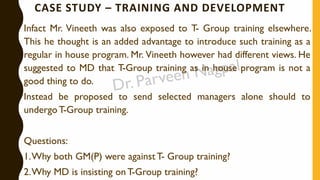
CASE STUDY – TRAINING AND DEVELOPMENT
Infact Mr. Vineeth was also exposed to T- Group training elsewhere.
This he thought is an added advantage to introduce such training as a
regular in house program. Mr. Vineeth however had different views. He
suggested to MD that T-Group training as in house program is not a
good thing to do.
Instead be proposed to send selected managers alone should to
undergoT-Group training.
Questions:
1.Why both GM(P) were againstT- Group training?
2.Why MD is insisting on T-Group training?
REFERENCES
1. Aswathappa, K., Human Resource Management: Text and cases.
Delhi:Tata McGraw-. Hill Publishing Company Limited, 2008
2. Gary Dessler, “A Framework for Human Resource Management”,
Pearson
3. Sharma, Nagpal,Training and Development, BMS,Vipul Prakashan
4. Nagpal, Human Resource Management, M. Com Part II, Sem 3,
Sheth Publishers
Thank You
Dr. Parveen Nagpal
www.linkedin.com/in/dr-parveen-kaur-nagpal-82965b15

3. Training and Development

  • 1.
    T R AI N I N G & D E V E L O P M E N T
  • 2.
    TRAINING Training is anorganized activity for increasing the knowledge and skills of people for a definite purpose. It involves systematic procedures for transferring technical know-how to the employees so as to increase their knowledge and skills for doing specific jobs with proficiency. Training is a learning experience in that it seeks a relatively permanent change in an individual that will improve his or her ability to perform on the job. Edwin B. Flippo defines Training as “The act of increasing the skills of an employee for doing a particular job”.
  • 3.
    TRAINING Training is providedto improve KSA ❖KNOWLEDGE – The attributes required to perform a job. (Intellectual or theoretical aspect) ❖SKILLS – the proficient manual, verbal, or mental manipulation of data or things. (Physical aspect) ❖ABILITIES – the power or capacity to perform an activity or task. (Analytical and decision making aspect) The quest for knowledge is universal, knowledge needs to be transformed into skills
  • 4.
    TRAINING IS GIVENON FOUR GROUNDS New candidates who join an organization Refresh and enhance their knowledge Implementation of updates and amendments Promotion and career growth
  • 5.
  • 6.
    IMPORTANCE OF TRAINING •Increase Efficiency • Helps in Fulfilling the Future Personnel Needs • Competent and CapableWorkforce • Innovation • Improving Health and Safety • Enhance Corporate Image • Optimum Utilization of Resources • Reduce Supervision • Reduce Absenteeism and LabourTurnover • Better Relations and Improved Organizational Climate • Personal / Individual Growth of Employees
  • 7.
    OBJECTIVES OF TRAININGPROGRAM • To Motivate Workforce • To Develop Positive Attitude • To Face Challenges Effectively • To Reduce Wastages and Improve Efficiency • To Enhance Corporate Image • To Optimally Utilization of Resources • To Reduce Absenteeism and Labor Turnover • To Improve Relations • To Help in Succession Planning • To Gain Sustainable Competitive Advantage
  • 8.
    TRAINING POLICY OFAN ORGANIZATION Organizational Philosophy Organizational Policy HRM policy Training Policy
  • 9.
    STEPS IN DESIGNINGEFFECTIVE TRAINING PROGRAM Determining the Need and Priorities for Training Establishing Training Objectives Preparation of Training Budget Selection of Trainees Development of Training Module Selection ofTrainers Implementation ofTraining Programme Monitoring and Evaluation
  • 10.
    CHALLENGES BEFORE TRAINERS •Need - BasedTraining • Individual Differences • Scheduling • Attitude ofTrainees • Training Techniques • Problem of Language • Resistance • Cost – Effectiveness • Constant Feedback
  • 11.
    MANAGEMENT DEVELOPMENT According toP. N. Singh, “Management Development is an activity designed to improve the performance of existing managers, provide a supply of managers to meet the need of organizations in future and extend the understanding of the management activity by drawing from the following three resource areas : a) Knowledge b) Experience and c) Trainee himself”. It is viewed as a systematic, long term learning process of management training and growth by which individuals gain and apply knowledge, skills, insights, and attitudes to manage managers, workers and organizations effectively.
  • 12.
    MANAGEMENT DEVELOPMENT Development refersto those activities and programs which have substantial influence in changing the capacity of an individual to perform better and increase his potential. Long term effect of training is development, training is subset of development.
  • 13.
    PURPOSE OF MANAGEMENTDEVELOPMENT Purpose Methods/ Techniques Job Knowledge • On the Job Experience • Coaching • Understudy Organizational Skills • Job Rotation • Multiple Management Decision Making Skills • In Basket Exercise • Business Games • Case Study Interpersonal Skills and Teamwork • Role Playing • Sensitivity Training Specific Individual Needs • Junior Boards • Committees • Programmed Instruction
  • 14.
    MANAGEMENT DEVELOPMENT PROGRAM- TECHNIQUES On the Job Coaching Understudy Multiple Management Committee Assignment Off the Job Role Playing Sensitivity Training Conference Training Programmed Instruction Simulation Techniques – Business Games, In-basket Exercises, Case Study
  • 15.
    ON THE JOBTECHNIQUES 1. On the Job Coaching: The immediate supervisor guides the subordinates about various ways and methods and skills to do the job. He only acts as a guide and provides periodic feedback. 2. Understudy: In this case an executive is developed to perform the work or fill the position of his supervisor. It ensures ready supply of competent people whenever the vacancy arises. 3. Multiple Management Method: In this method, the organization makes a permanent advisory committee of executives/managers, who solve the problem of the organization and makes recommendation to the top management
  • 16.
    ON THE JOBTECHNIQUES 4. Committee Management: A committee is a group of executives appointed to investigate, take action, make recommendations regarding some matter relating to the organization. The committee studies the problems or issues and promotes mutual sharing and discussions of interest by individuals to arrive at a consensus of opinions.
  • 17.
    OFF THE JOBTECHNIQUES 1. Role Playing: It may be described as a technique of creating a life situation, usually one involving conflict between people, and then having persons in a group to play the parts or roles of specific personalities. 2. Sensitivity Training: It was originally developed by Kurt Lewin. It is also called as laboratory training, T Group or Group Dynamic Training. Here managers are gathered in a place for discussion sessions and the focus is on aspects such as the ability to listen to others, ability to communicate, ability to diagnose human problems correctly, learning to give and receive constructive feedback and understanding the complexities of group dynamics.
  • 18.
    OFF THE JOBTECHNIQUES 1. Role Playing: It may be described as a technique of creating a life situation, usually one involving conflict between people, and then having persons in a group to play the parts or roles of specific personalities. 2. Sensitivity Training: Originally developed by Kurt Lewin, it is also called laboratory training, T Group or Group Dynamic Training. Here managers are gathered for discussion sessions and the focus is on aspects such as the ability to listen to others, communicate, diagnose human problems correctly, give and receive constructive feedback and understanding the complexities of group dynamics. Thus they learn how to work more effectively as a group or a team member and perform leadership roles.
  • 19.
    OFF THE JOBTECHNIQUES 3. Conference Training: A conference is group meeting conducted according to an organized plan in which the participants seek to develop the knowledge and understanding by obtaining considerable amount of oral participation. 4. Programmed Instructions: It is the application of the science of learning to the task of education and training using computer applications. The material to be learnt is broken down into very small units or stages and trainees learn at their own pace.
  • 20.
    OFF THE JOBTECHNIQUES 5. Simulation Techniques: The basic idea is to create or construct a situation which closely represents the actual one. It is conducted in a controlled environment on trial basis. • Business Games - Classroom simulation exercises which are designed to be representative of the real life condition. • In basket Training – Participants are given all the material in basket which will help them to solve the problems. • Case Study Method: Developed by Christopher C Langdell, here the facts of the case that needs to be solved or has already occurred in the organization are given for analysis and decision-making to a group of participants. They study the problem, analyse it, find alternatives and give suggestions.
  • 21.
    CASE STUDY Well ManufacturingLtd. set up a new machinery at its Nagpur plant. The company received many orders initially but soon the problems begun. The machinery stared experiencing failure leading to decline in the quality of product. When discussed with the workers it was found that machinery manuals were not translated in English language which led to a very haphazard use. Explain how a formal orientation programme would have helped in the above case
  • 22.
    CASE STUDY –TRAINING AND DEVELOPMENT Mr. Swaroop is an energetic MD of medium scale manufacturing firm in Bhubaneswar. He has been recently gone for a T-Group training. He was mighty impressed. He wanted to introduce his training to his own managers. Mr. Swaroop called his G.M(Personnel) Mr. Patnaik and directed him to take steps so that T-Group training can be introduced as an in house management development program. G.M(P) was however not very enthusiastic and kept postponing the program with some reason or other. When there was opportunity M.D got Mr. Patnaik transferred to another unit. In his place he promoted Mr. Vineeth as G.M(P). The first task he gave to Mr. Vineeth was to organize T-Group training.
  • 23.
    CASE STUDY –TRAINING AND DEVELOPMENT Infact Mr. Vineeth was also exposed to T- Group training elsewhere. This he thought is an added advantage to introduce such training as a regular in house program. Mr. Vineeth however had different views. He suggested to MD that T-Group training as in house program is not a good thing to do. Instead be proposed to send selected managers alone should to undergoT-Group training. Questions: 1.Why both GM(P) were againstT- Group training? 2.Why MD is insisting on T-Group training?
  • 24.
    REFERENCES 1. Aswathappa, K.,Human Resource Management: Text and cases. Delhi:Tata McGraw-. Hill Publishing Company Limited, 2008 2. Gary Dessler, “A Framework for Human Resource Management”, Pearson 3. Sharma, Nagpal,Training and Development, BMS,Vipul Prakashan 4. Nagpal, Human Resource Management, M. Com Part II, Sem 3, Sheth Publishers
  • 25.
    Thank You Dr. ParveenNagpal www.linkedin.com/in/dr-parveen-kaur-nagpal-82965b15