What is Matrix?
• In mathematics, a matrix (plural matrices) is a rectangular
array of numbers, symbols, or expressions, arranged in rows
and columns. Matrices are commonly written in box brackets.
The horizontal and vertical lines of entries in a matrix are
called rows and columns, respectively. The size of a matrix is
defined by the number of rows and columns that it contains.
A matrix with m rows and n columns is called
an m × n matrix or m-by-n matrix, while m and n are called
its dimensions.
Matrix Dimensions: Each element of a matrix is often denoted by a variable with two
subscripts. For instance, a2,1a2,1 represents the element at the second row and first
column of a matrix A.
Classification of Matrix
Row Matrix – Any Matrix of order 1 × n is refers to as Row
Matrix. In other words, we can say that a Matrix having its only
1(one) row is refers to as Row Matrix.
For example
A = [2 3 – 5 y z] is a Row Matrix or order
1 × 5.
Column Matrix – Any Matrix of order m × 1 is called Column Matrix.
In other words, we can say that a Matrix having its only 1(one)
Column is refers to as Row Matrix. For example
Square Matrix – Any matrix having its Number of Rows equals
to number of Rows is called Square Matrix. For example
Rectangular Matrix – Any Matrix of order m × n such that m ≠ n is
refers to as Rectangular Matrix. In other words, we can say that a Matrix
having its number of rows is not equal to the number of columns is refers
to as Rectangular Matrix. For example – let us consider a Matrix
Matrix A is a Rectangular Matrix of
order 3 × 4.
Null Matrix or Zero Matrix – Any matrix having all its
element Zero(0) is called Null Matrix or Zero Matrix. It is
denoted by capital letter Om × n or O of the English
Alphabets. For example
Diagonal Matrix – It is a one type of square Matrix in
which all the elements are zero(0) except those in the
main diagonal or leading diagonal.
For example –
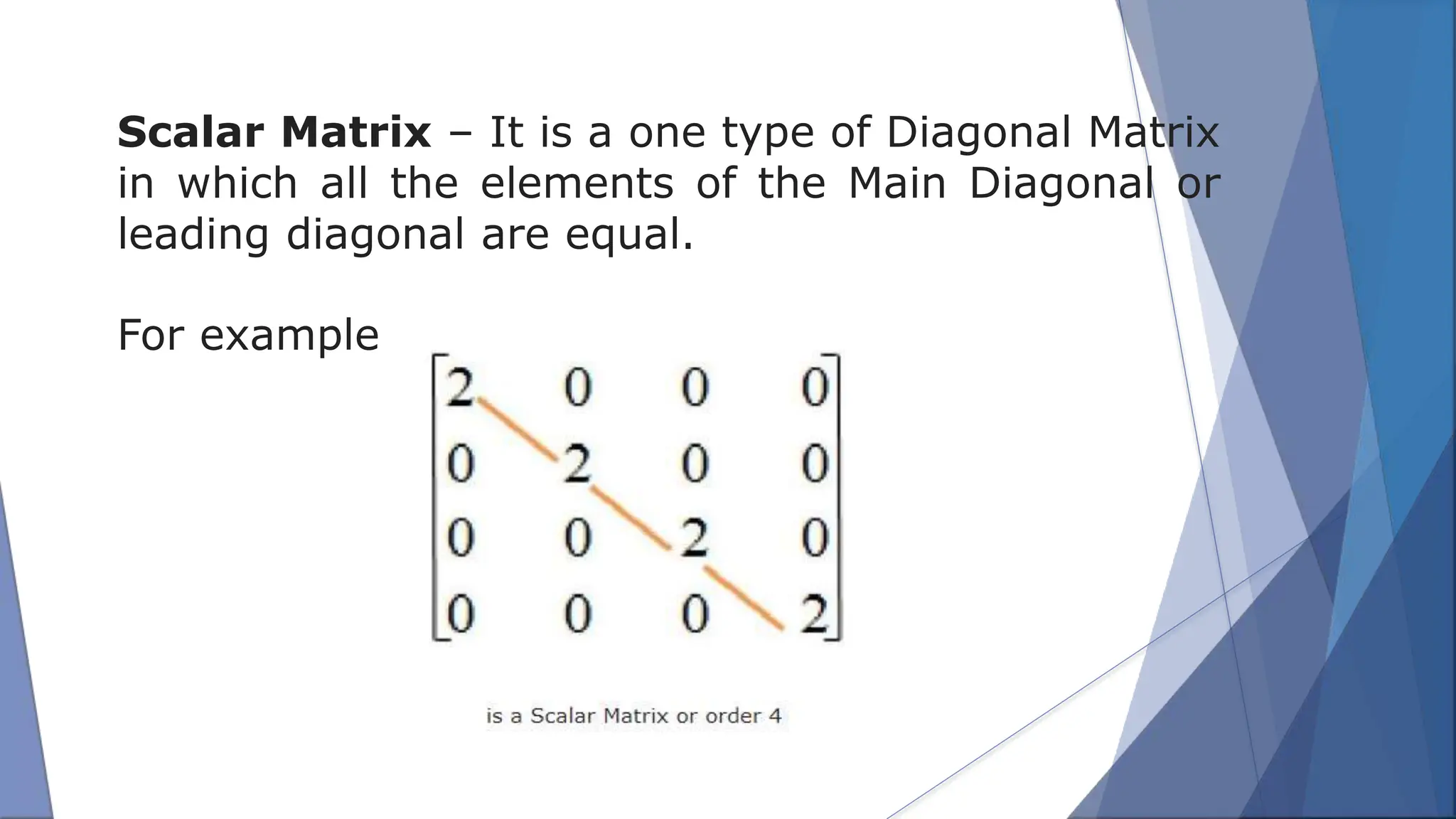
Scalar Matrix – It is a one type of Diagonal Matrix
in which all the elements of the Main Diagonal or
leading diagonal are equal.
For example
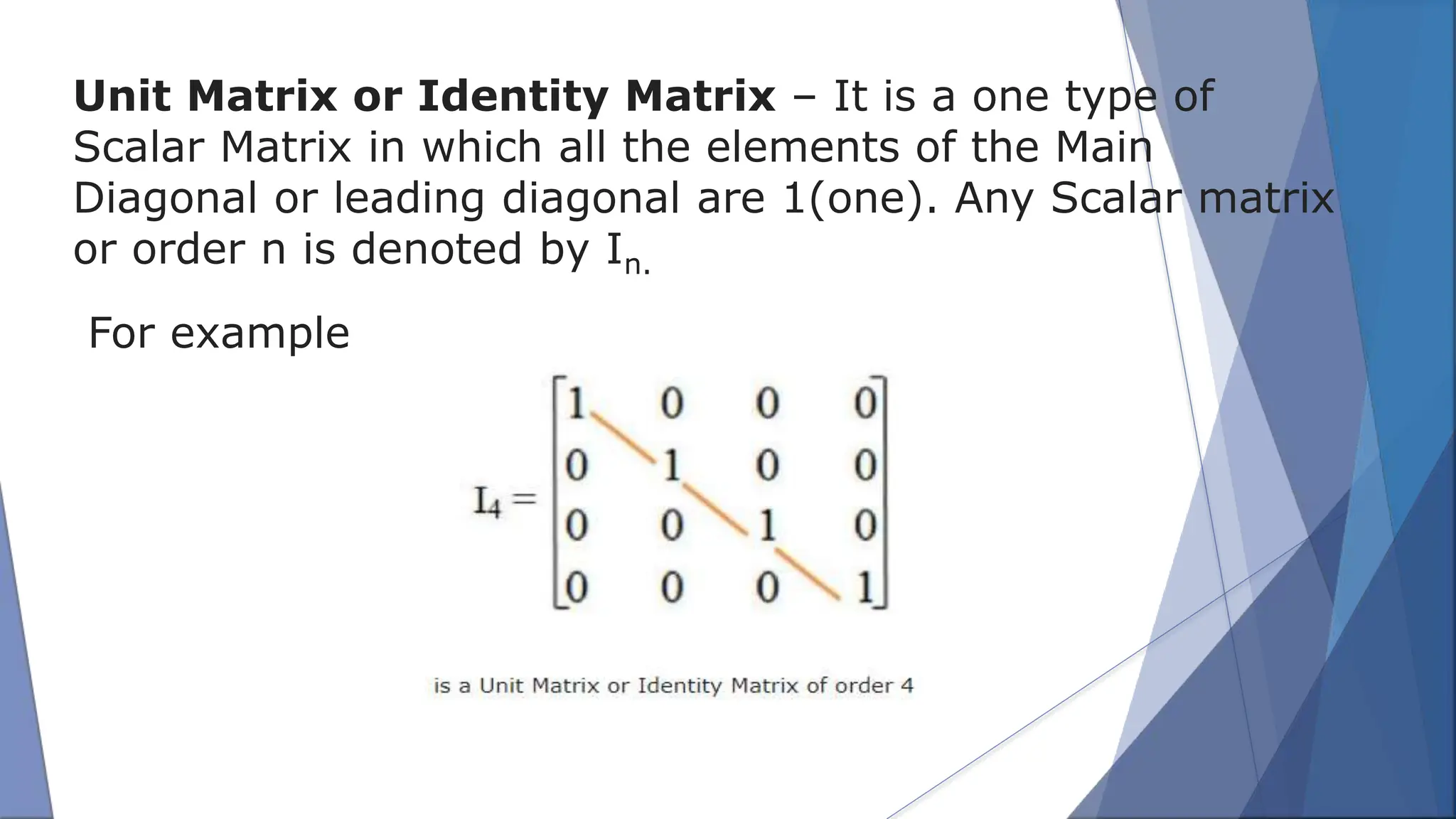
Unit Matrix or Identity Matrix – It is a one type of
Scalar Matrix in which all the elements of the Main
Diagonal or leading diagonal are 1(one). Any Scalar matrix
or order n is denoted by In.
For example
Sub-Matrix – A Matrix obtained by deletion of row(s) or column(s) or both
from another Matrix is known as Sub-Matrix. For example –
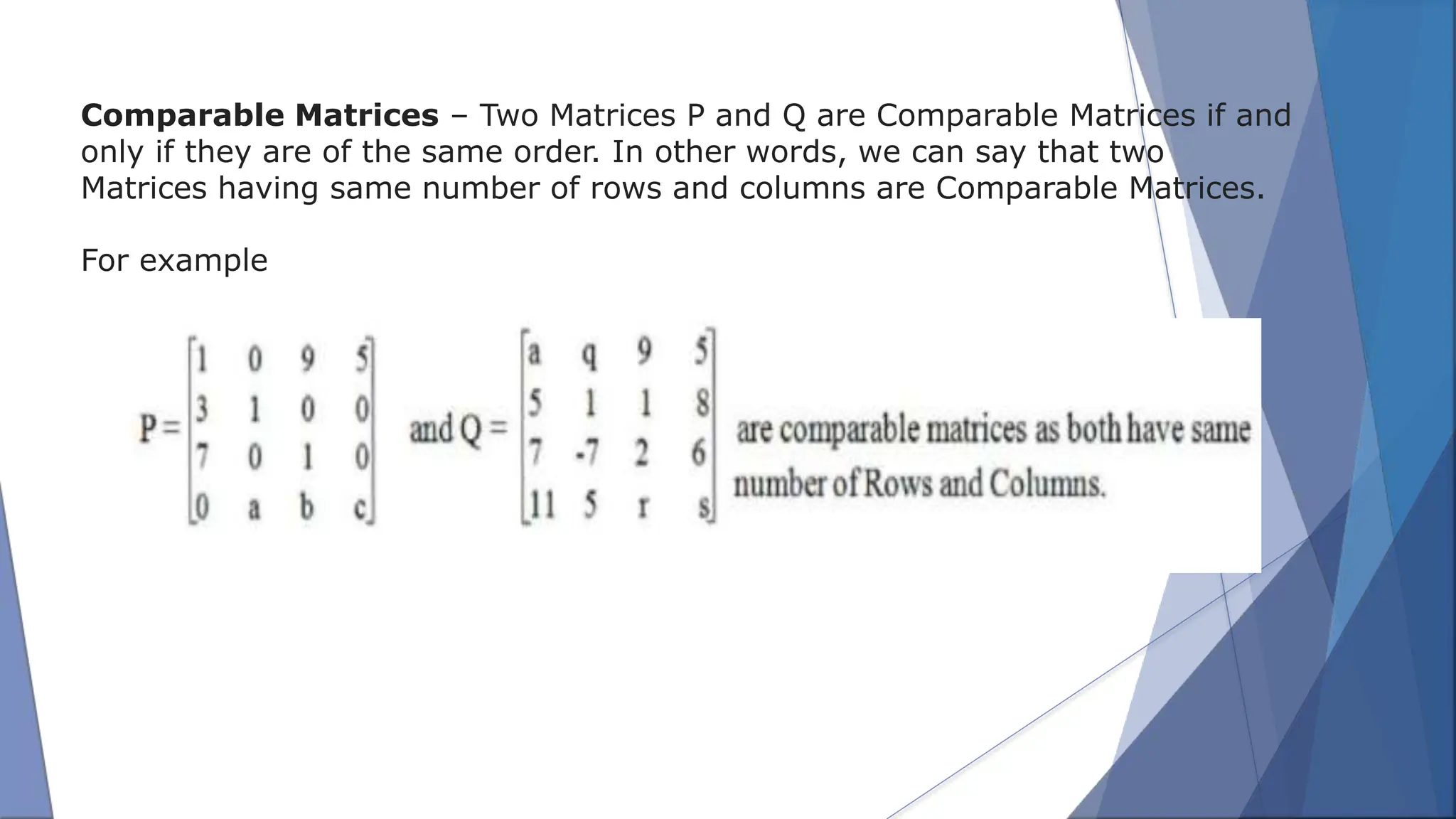
Comparable Matrices – Two Matrices P and Q are Comparable Matrices if and
only if they are of the same order. In other words, we can say that two
Matrices having same number of rows and columns are Comparable Matrices.
For example
Fast Facts:
•Diagonal Matrix is Square Matrix but all Square Matrix cannot be Diagonal Matrix.
•Scalar Matrix is Diagonal Matrix but all Diagonal Matrix cannot be a Scalar Matrix.
Scalar Matrix is Square Matrix but all Square Matrix cannot be a Scalar Matrix.
•Unit Matrix or Identity Matrix is Scalar Matrix but all Scalar Matrix cannot be Unit Matrix or
Identity Matrix.
•The Unit Matrix or Identity Matrix is Diagonal Matrix but all Diagonal Matrix cannot be Unit
Matrix or Identity Matrix.
•Unit Matrix or Identity Matrix is Square Matrix but all Square Matrix cannot be Unit Matrix
or Identity Matrix.
Adding and Subtracting Matrices
Matrix addition is commutative and is also
associative, so the following is true:
A+B=B+A
(A+B)+C=A+(B+C)
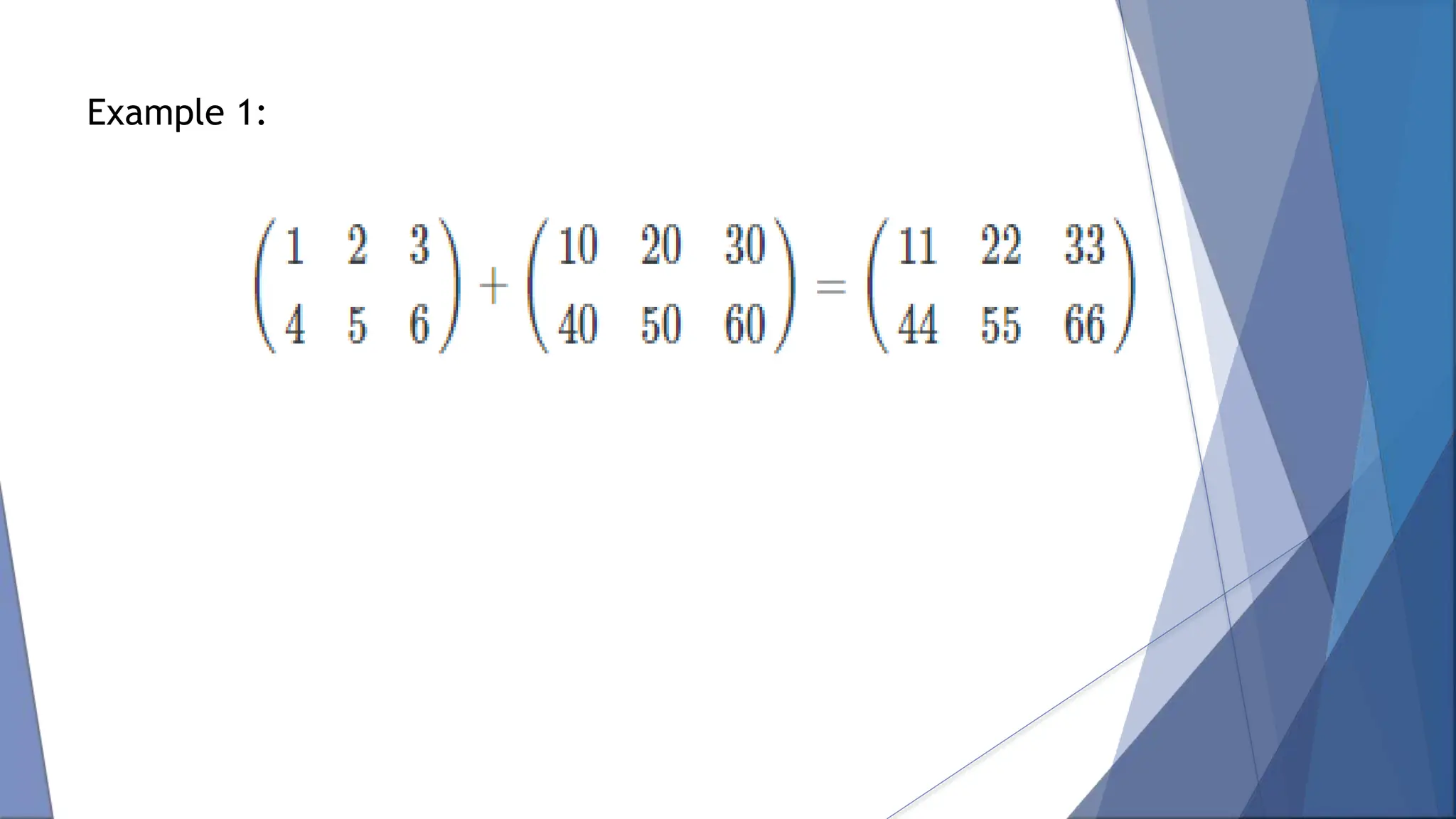
Adding matrices is very simple. Just add each
element in the first matrix to the corresponding
element in the second matrix.
Example 1:
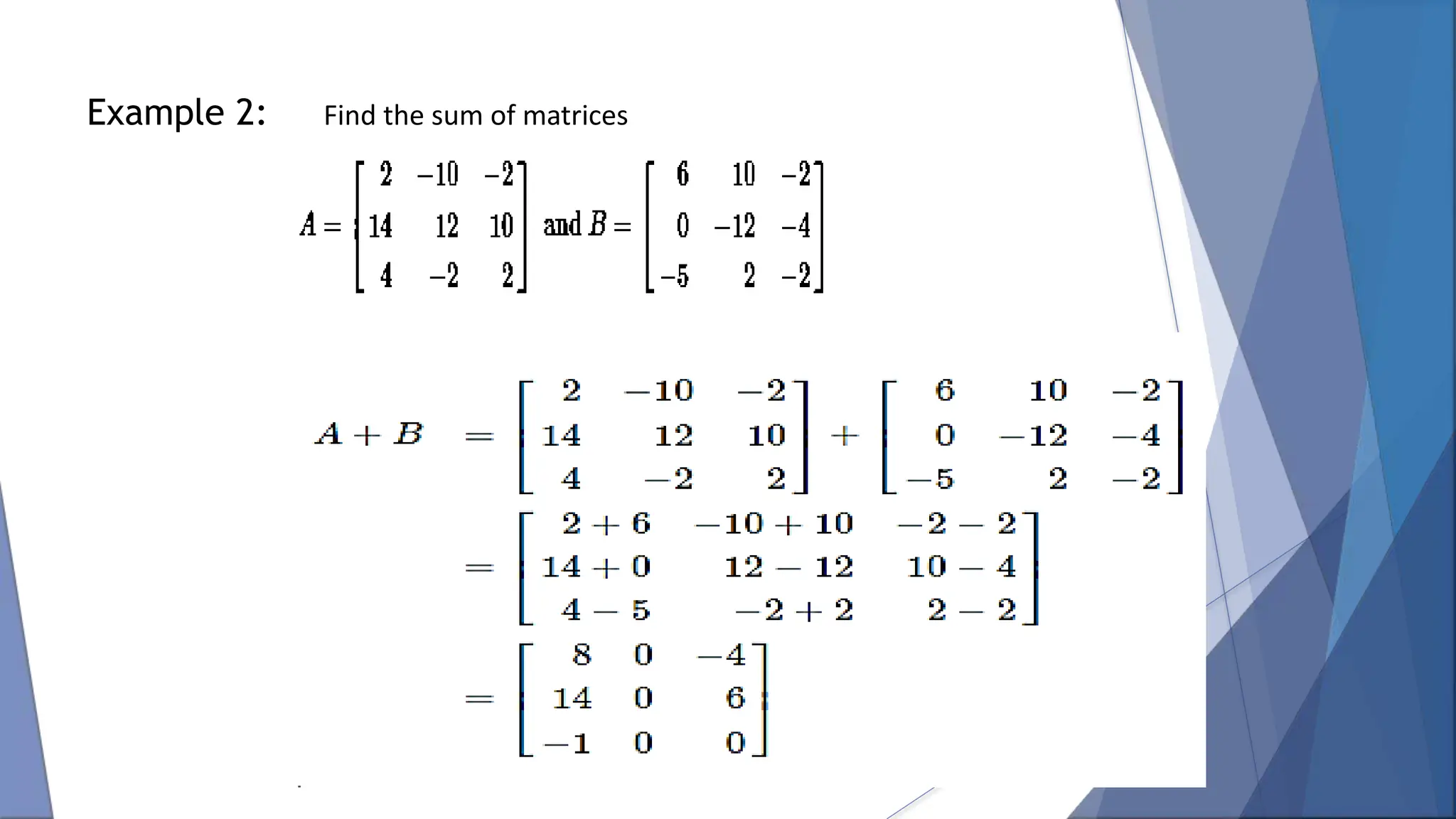
Example 2: Find the sum of matrices
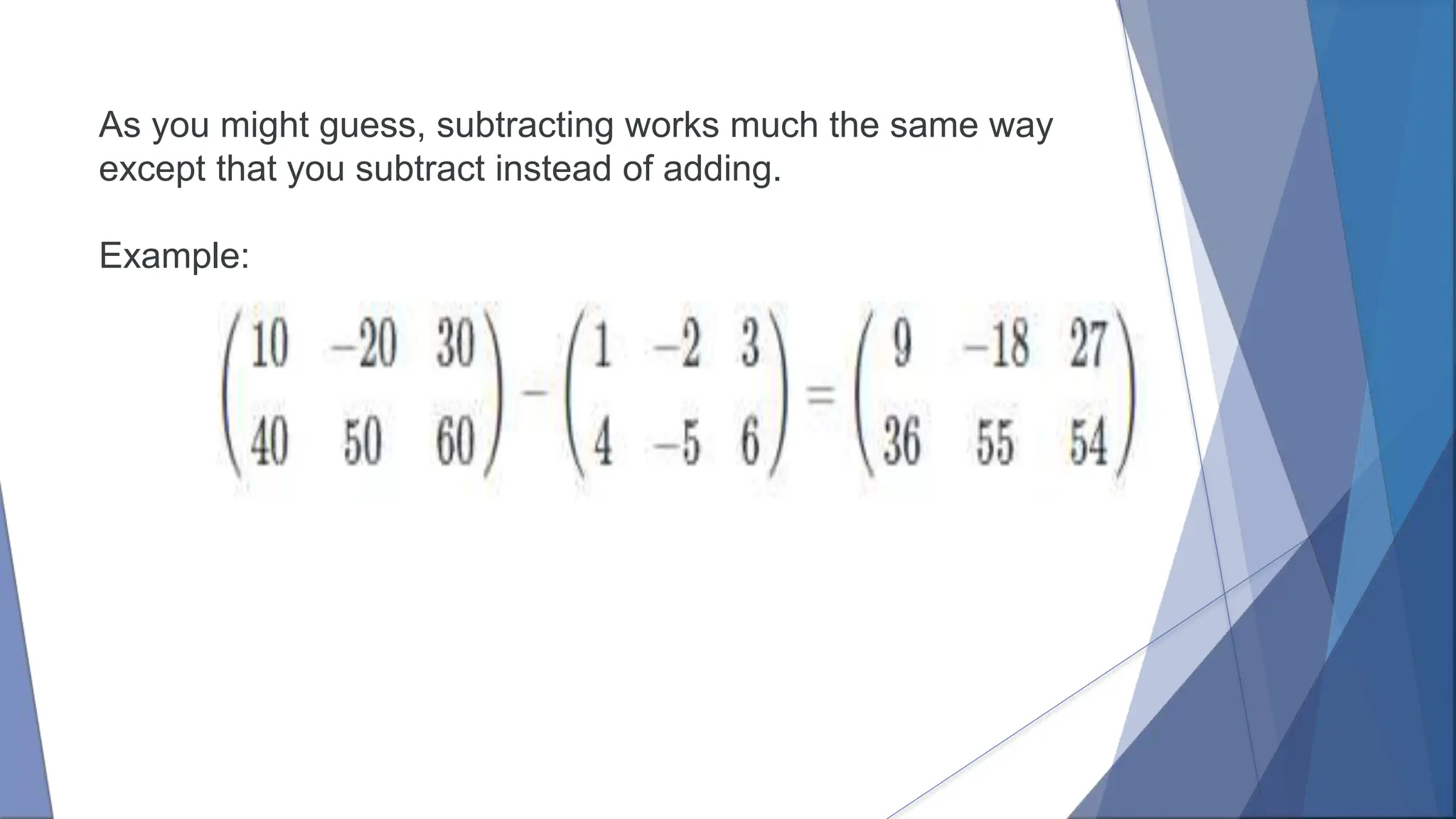
As you might guess, subtracting works much the same way
except that you subtract instead of adding.
Example:
Find the difference of matrices
Example 2:
Scalar Multiplication
A scalar is a real number quantity that has magnitude
but not direction. For example, time, temperature, and
distance are scalar quantities. The process of scalar
multiplication involves multiplying each entry in a
matrix by a scalar. A scalar multiple is any entry of a
matrix that results from scalar multiplication.
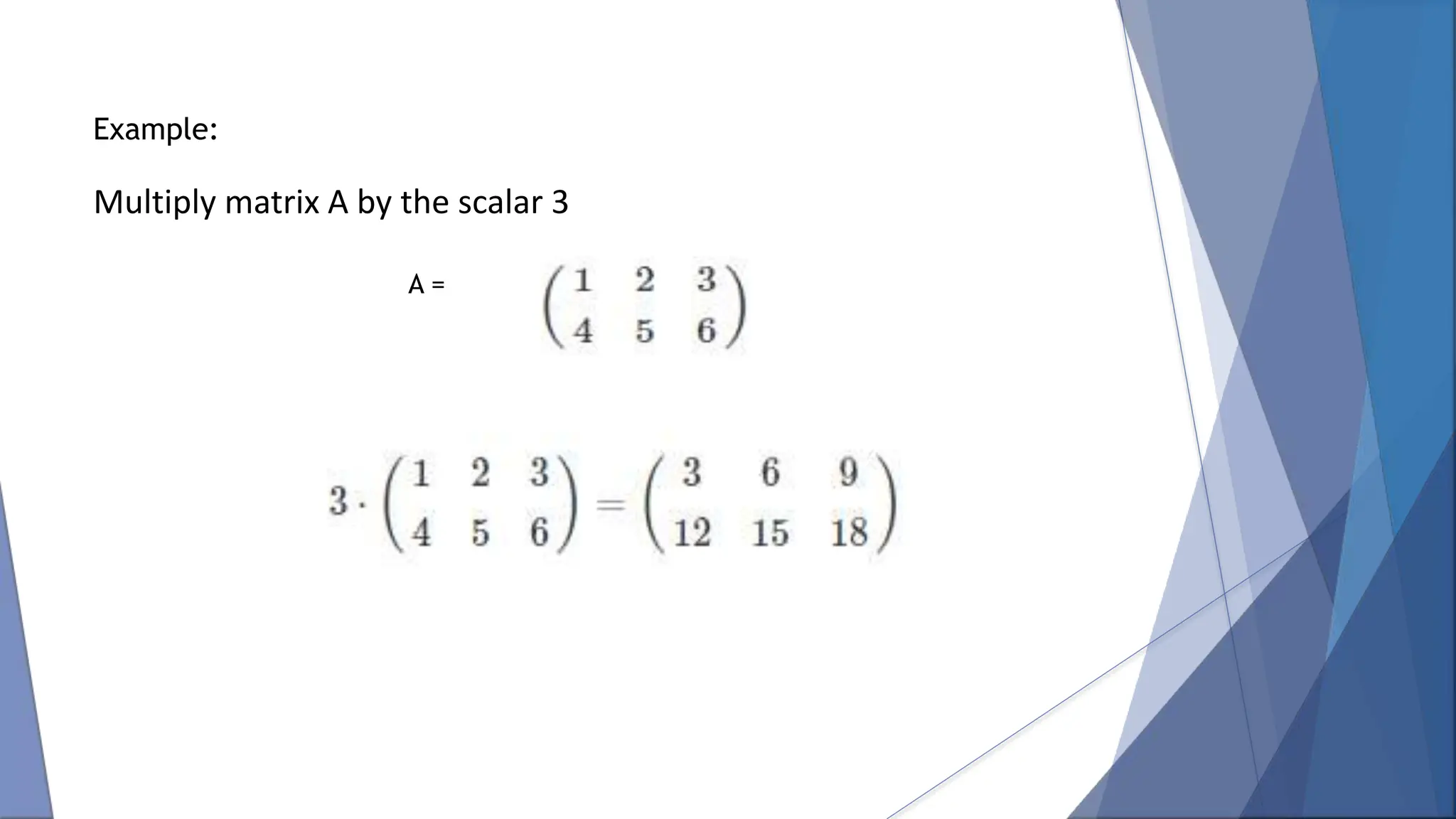
Example:
Multiply matrix A by the scalar 3
A =
Finding the Product of Two Matrices
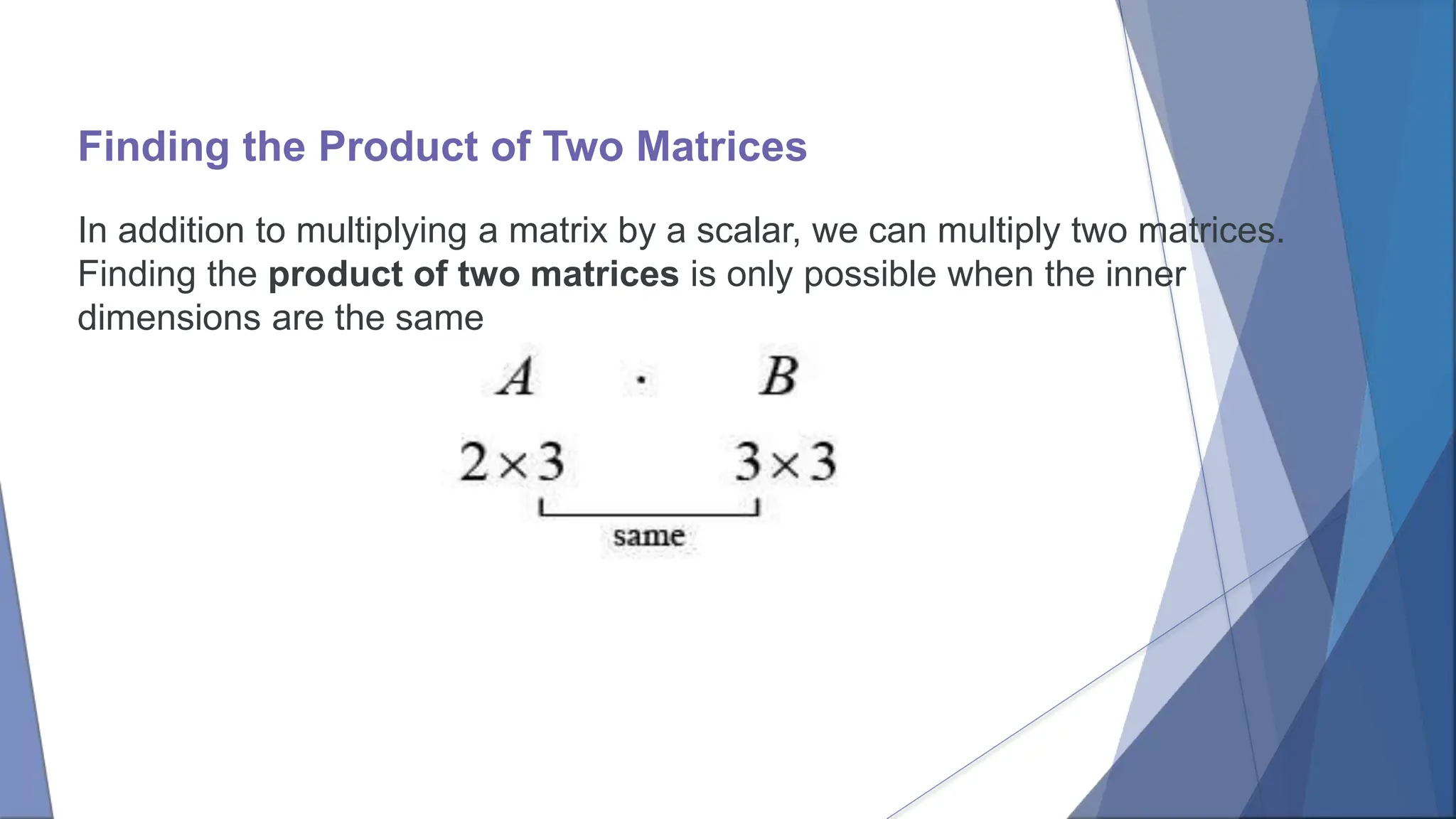
In addition to multiplying a matrix by a scalar, we can multiply two matrices.
Finding the product of two matrices is only possible when the inner
dimensions are the same
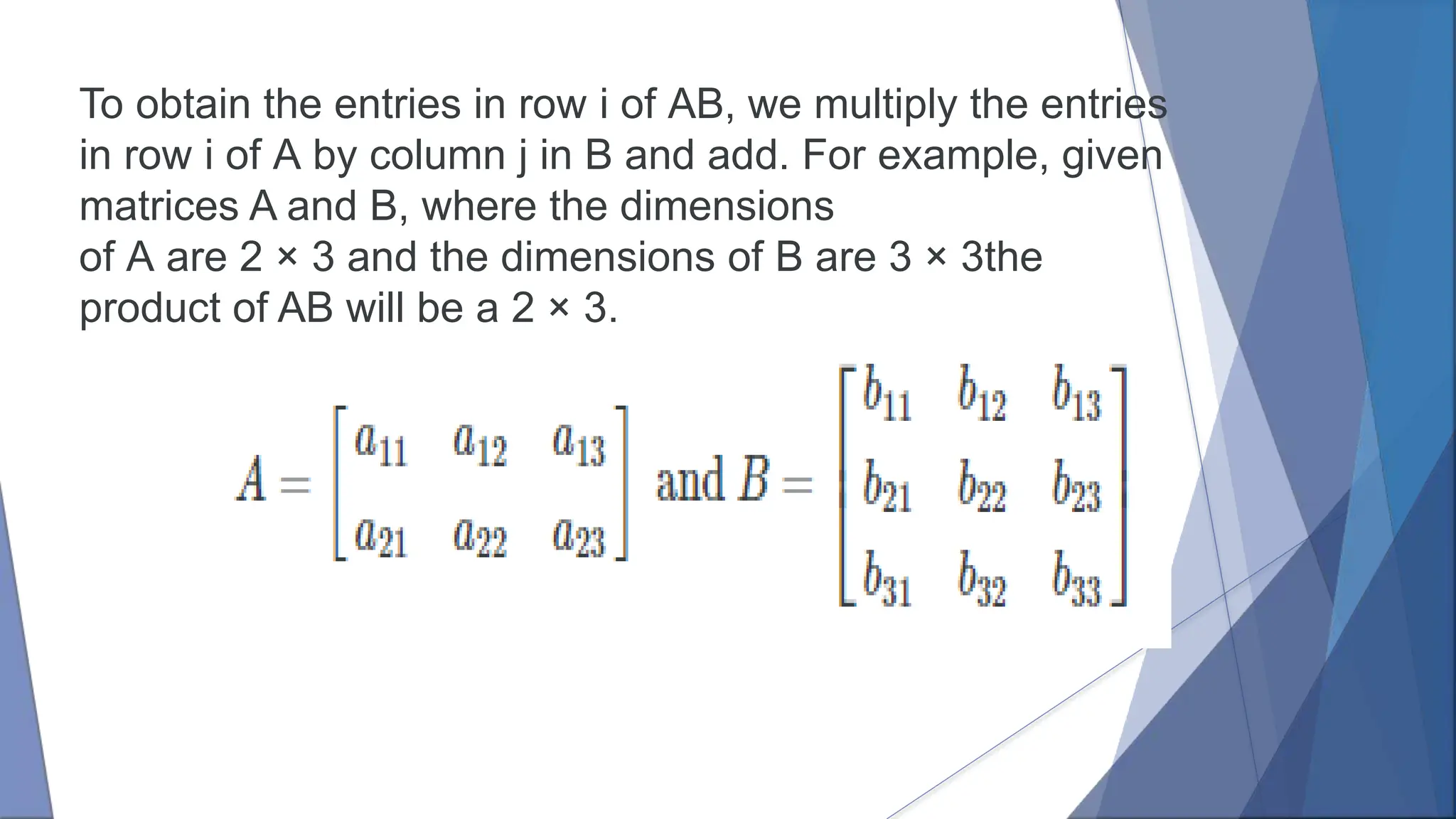
To obtain the entries in row i of AB, we multiply the entries
in row i of A by column j in B and add. For example, given
matrices A and B, where the dimensions
of A are 2 × 3 and the dimensions of B are 3 × 3the
product of AB will be a 2 × 3.
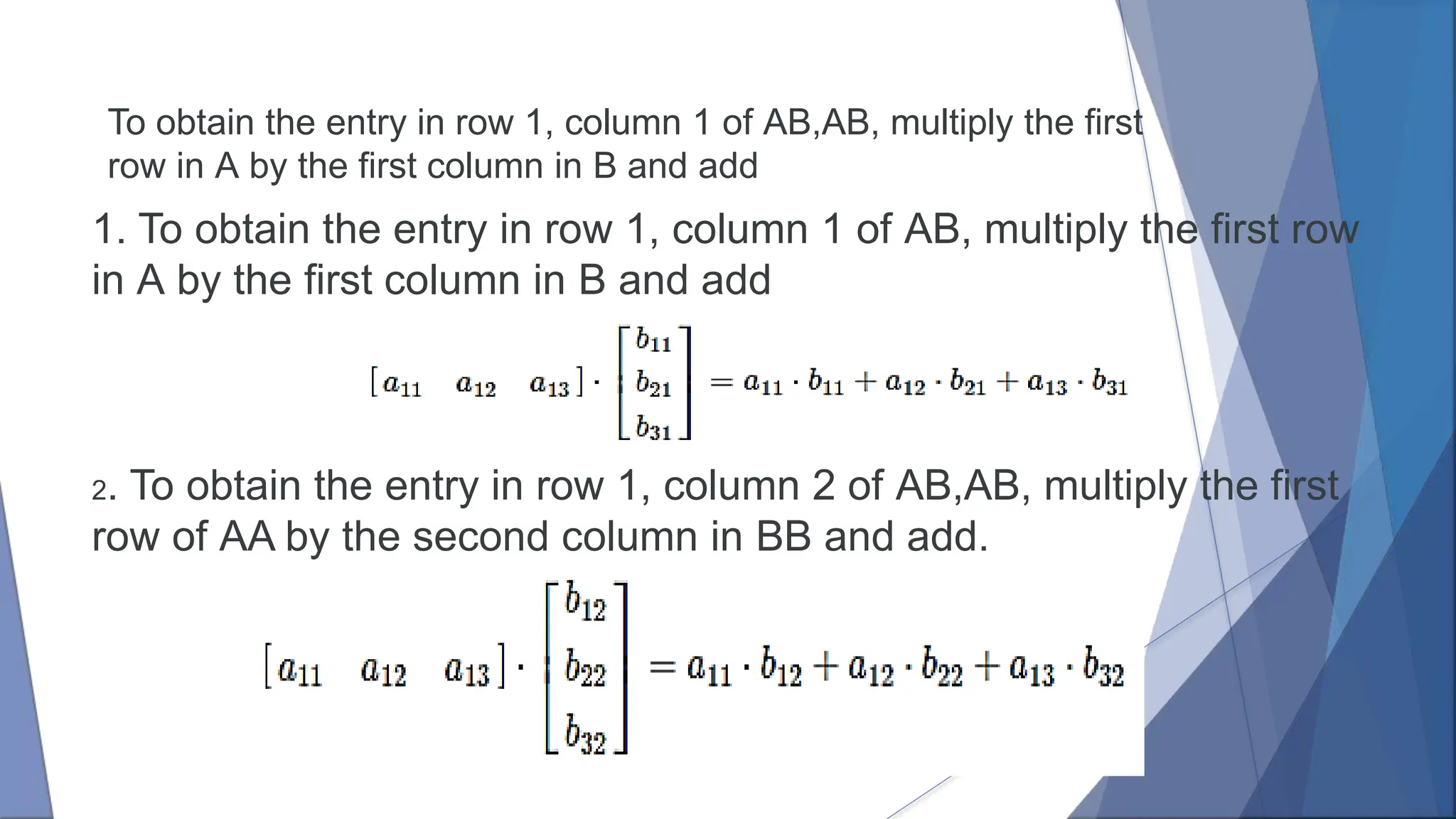
To obtain the entry in row 1, column 1 of AB,AB, multiply the first
row in A by the first column in B and add
1. To obtain the entry in row 1, column 1 of AB, multiply the first row
in A by the first column in B and add
2. To obtain the entry in row 1, column 2 of AB,AB, multiply the first
row of AA by the second column in BB and add.
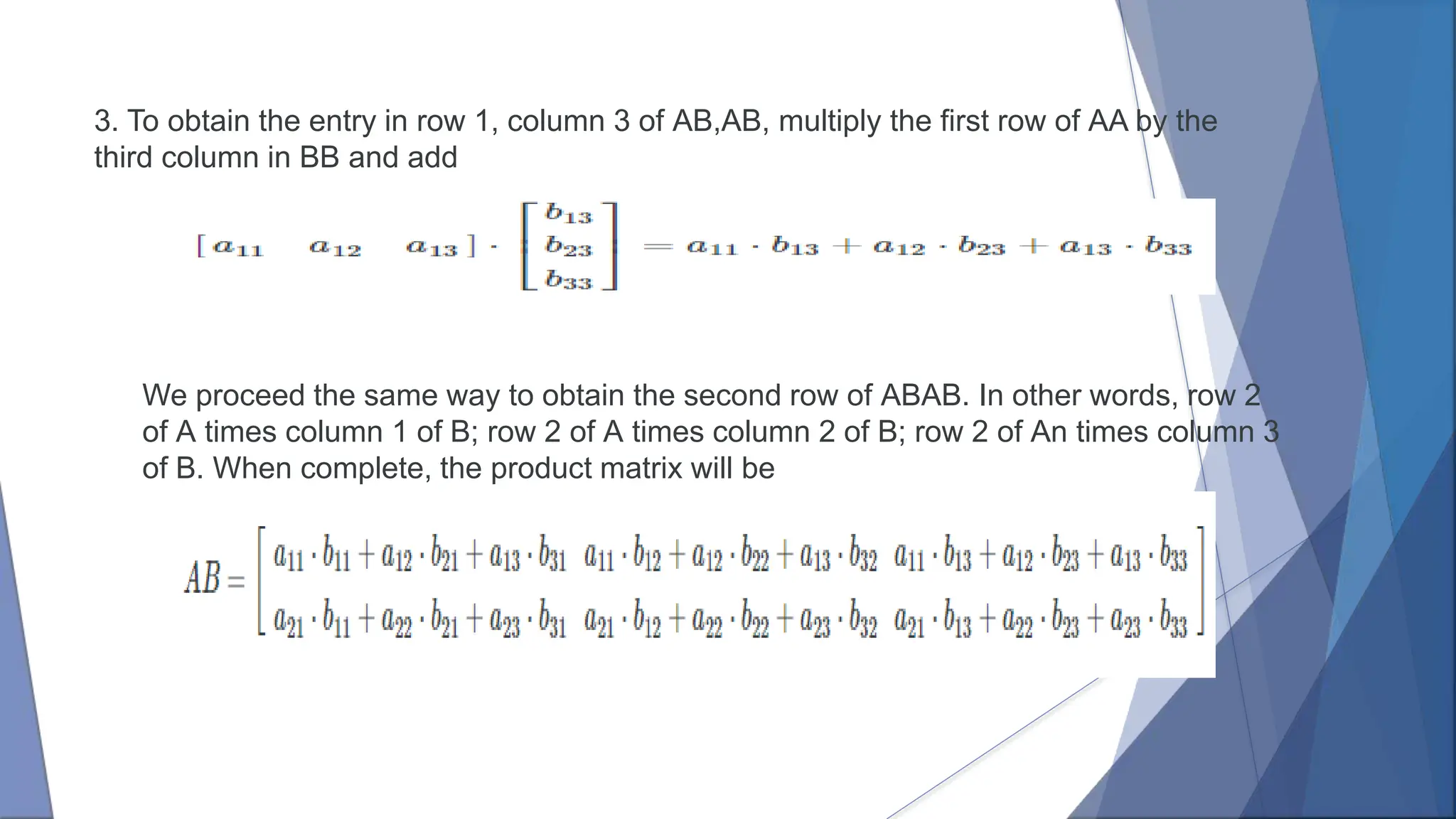
3. To obtain the entry in row 1, column 3 of AB,AB, multiply the first row of AA by the
third column in BB and add
We proceed the same way to obtain the second row of ABAB. In other words, row 2
of A times column 1 of B; row 2 of A times column 2 of B; row 2 of An times column 3
of B. When complete, the product matrix will be
Example:
Given AA and B:B:
1.Find AB.
2.Find BA
1. As the dimensions of A are 2×3 and the dimensions
of B are 3×2, these matrices can be multiplied together because
the number of columns in A matches the number of rows in B.
The resulting product will be a 2×2 matrix, the number of rows
in A by the number of columns in B.
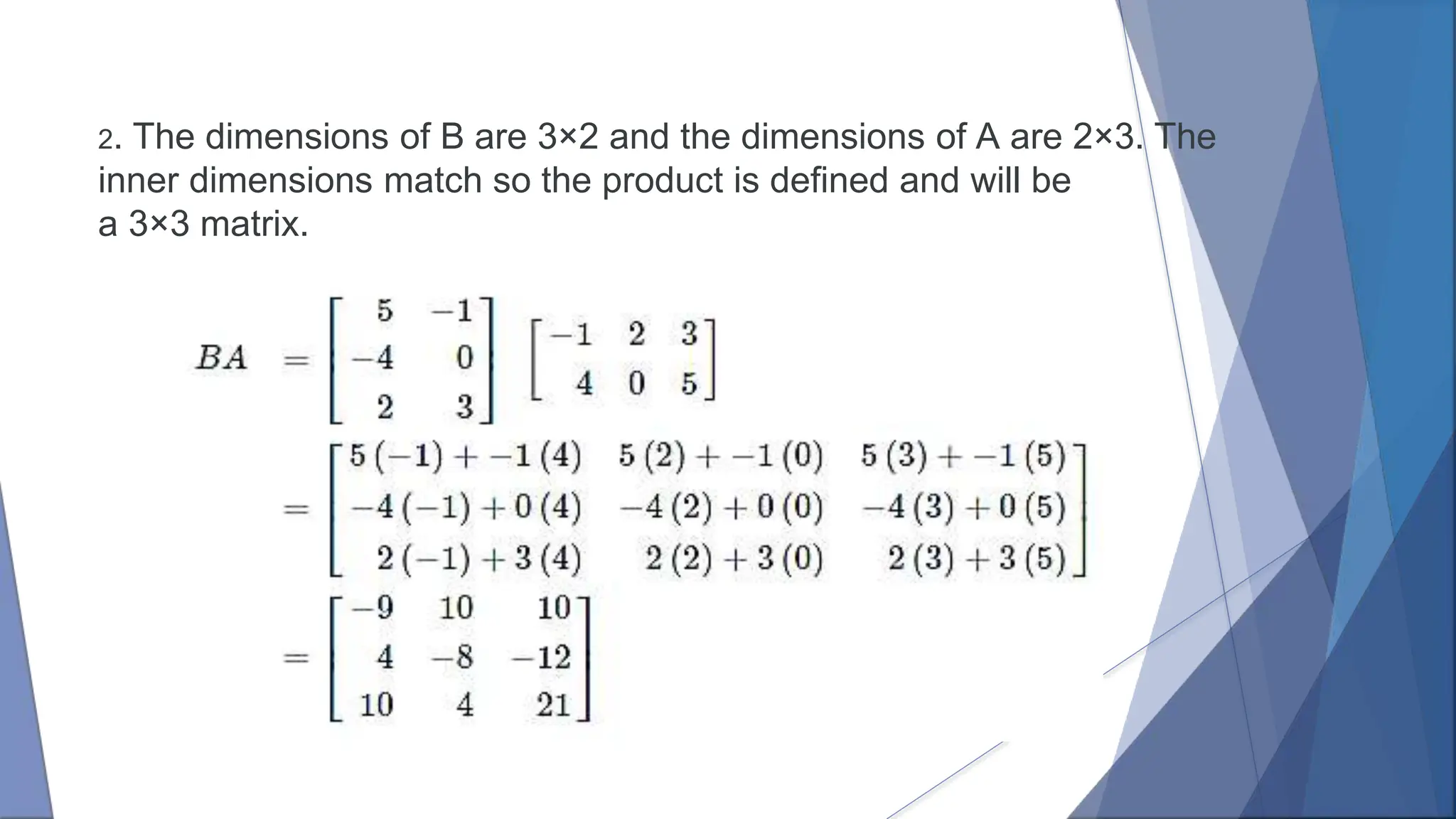
2. The dimensions of B are 3×2 and the dimensions of A are 2×3. The
inner dimensions match so the product is defined and will be
a 3×3 matrix.
Analysis of the Solution
Notice that the products AB and BA are not equal.
References:
 Introduction to Matrices. Lumen Boundless Algebra retrieved from
https://courses.lumenlearning.com/boundless-algebra/chapter/introduction-to-matrices/
 (2021) Classification of Matrices. GLOBALDISHA retrieved from
https://globaldisha.com/classification-matrix/
 Matrices and Matrices Operation. Lumen College Algebra retrieved from
https://courses.lumenlearning.com/wmopen-collegealgebra/chapter/introduction-
matrices-and-matrix-operations/
introduction-MATRIX-algebramathematics .pptx

introduction-MATRIX-algebramathematics .pptx

  • 2.
    What is Matrix? •In mathematics, a matrix (plural matrices) is a rectangular array of numbers, symbols, or expressions, arranged in rows and columns. Matrices are commonly written in box brackets. The horizontal and vertical lines of entries in a matrix are called rows and columns, respectively. The size of a matrix is defined by the number of rows and columns that it contains. A matrix with m rows and n columns is called an m × n matrix or m-by-n matrix, while m and n are called its dimensions.
  • 3.
    Matrix Dimensions: Eachelement of a matrix is often denoted by a variable with two subscripts. For instance, a2,1a2,1 represents the element at the second row and first column of a matrix A.
  • 4.
  • 5.
    Row Matrix –Any Matrix of order 1 × n is refers to as Row Matrix. In other words, we can say that a Matrix having its only 1(one) row is refers to as Row Matrix. For example A = [2 3 – 5 y z] is a Row Matrix or order 1 × 5.
  • 6.
    Column Matrix –Any Matrix of order m × 1 is called Column Matrix. In other words, we can say that a Matrix having its only 1(one) Column is refers to as Row Matrix. For example
  • 7.
    Square Matrix –Any matrix having its Number of Rows equals to number of Rows is called Square Matrix. For example
  • 8.
    Rectangular Matrix –Any Matrix of order m × n such that m ≠ n is refers to as Rectangular Matrix. In other words, we can say that a Matrix having its number of rows is not equal to the number of columns is refers to as Rectangular Matrix. For example – let us consider a Matrix Matrix A is a Rectangular Matrix of order 3 × 4.
  • 9.
    Null Matrix orZero Matrix – Any matrix having all its element Zero(0) is called Null Matrix or Zero Matrix. It is denoted by capital letter Om × n or O of the English Alphabets. For example
  • 10.
    Diagonal Matrix –It is a one type of square Matrix in which all the elements are zero(0) except those in the main diagonal or leading diagonal. For example –
  • 11.
    Scalar Matrix –It is a one type of Diagonal Matrix in which all the elements of the Main Diagonal or leading diagonal are equal. For example
  • 12.
    Unit Matrix orIdentity Matrix – It is a one type of Scalar Matrix in which all the elements of the Main Diagonal or leading diagonal are 1(one). Any Scalar matrix or order n is denoted by In. For example
  • 13.
    Sub-Matrix – AMatrix obtained by deletion of row(s) or column(s) or both from another Matrix is known as Sub-Matrix. For example –
  • 14.
    Comparable Matrices –Two Matrices P and Q are Comparable Matrices if and only if they are of the same order. In other words, we can say that two Matrices having same number of rows and columns are Comparable Matrices. For example
  • 15.
    Fast Facts: •Diagonal Matrixis Square Matrix but all Square Matrix cannot be Diagonal Matrix. •Scalar Matrix is Diagonal Matrix but all Diagonal Matrix cannot be a Scalar Matrix. Scalar Matrix is Square Matrix but all Square Matrix cannot be a Scalar Matrix. •Unit Matrix or Identity Matrix is Scalar Matrix but all Scalar Matrix cannot be Unit Matrix or Identity Matrix. •The Unit Matrix or Identity Matrix is Diagonal Matrix but all Diagonal Matrix cannot be Unit Matrix or Identity Matrix. •Unit Matrix or Identity Matrix is Square Matrix but all Square Matrix cannot be Unit Matrix or Identity Matrix.
  • 17.
    Adding and SubtractingMatrices Matrix addition is commutative and is also associative, so the following is true: A+B=B+A (A+B)+C=A+(B+C) Adding matrices is very simple. Just add each element in the first matrix to the corresponding element in the second matrix.
  • 18.
  • 19.
    Example 2: Findthe sum of matrices
  • 20.
    As you mightguess, subtracting works much the same way except that you subtract instead of adding. Example:
  • 21.
    Find the differenceof matrices Example 2:
  • 22.
    Scalar Multiplication A scalaris a real number quantity that has magnitude but not direction. For example, time, temperature, and distance are scalar quantities. The process of scalar multiplication involves multiplying each entry in a matrix by a scalar. A scalar multiple is any entry of a matrix that results from scalar multiplication.
  • 23.
    Example: Multiply matrix Aby the scalar 3 A =
  • 24.
    Finding the Productof Two Matrices In addition to multiplying a matrix by a scalar, we can multiply two matrices. Finding the product of two matrices is only possible when the inner dimensions are the same
  • 25.
    To obtain theentries in row i of AB, we multiply the entries in row i of A by column j in B and add. For example, given matrices A and B, where the dimensions of A are 2 × 3 and the dimensions of B are 3 × 3the product of AB will be a 2 × 3.
  • 26.
    To obtain theentry in row 1, column 1 of AB,AB, multiply the first row in A by the first column in B and add 1. To obtain the entry in row 1, column 1 of AB, multiply the first row in A by the first column in B and add 2. To obtain the entry in row 1, column 2 of AB,AB, multiply the first row of AA by the second column in BB and add.
  • 27.
    3. To obtainthe entry in row 1, column 3 of AB,AB, multiply the first row of AA by the third column in BB and add We proceed the same way to obtain the second row of ABAB. In other words, row 2 of A times column 1 of B; row 2 of A times column 2 of B; row 2 of An times column 3 of B. When complete, the product matrix will be
  • 29.
    Example: Given AA andB:B: 1.Find AB. 2.Find BA
  • 30.
    1. As thedimensions of A are 2×3 and the dimensions of B are 3×2, these matrices can be multiplied together because the number of columns in A matches the number of rows in B. The resulting product will be a 2×2 matrix, the number of rows in A by the number of columns in B.
  • 31.
    2. The dimensionsof B are 3×2 and the dimensions of A are 2×3. The inner dimensions match so the product is defined and will be a 3×3 matrix.
  • 32.
    Analysis of theSolution Notice that the products AB and BA are not equal.
  • 33.
    References:  Introduction toMatrices. Lumen Boundless Algebra retrieved from https://courses.lumenlearning.com/boundless-algebra/chapter/introduction-to-matrices/  (2021) Classification of Matrices. GLOBALDISHA retrieved from https://globaldisha.com/classification-matrix/  Matrices and Matrices Operation. Lumen College Algebra retrieved from https://courses.lumenlearning.com/wmopen-collegealgebra/chapter/introduction- matrices-and-matrix-operations/