DISCOVER . LEARN . EMPOWER
AU4-UNIVERSITY INSTITUTE OF
ENGINEERING
COMPUTER SCIENCE ENGINEERING
22SMT-121 MATHEMATICS-1
22BCS401, 22BCS402 & 22BCS416
DISCOVER . LEARN . EMPOWER
Dr. P. BASKER, M.Sc., M.Phil., Ph.D.,
(Teaching Experience: 13 Years & 2 Months)
ASSOCIATE PROFESSOR OF MATHEMATICS
Academic Unit-4
University Institute of Engineering
Chandigarh University
Punjab-140 413.
MATRICES
UNIT - I
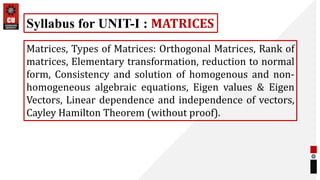
Matrices, Types of Matrices: Orthogonal Matrices, Rank of
matrices, Elementary transformation, reduction to normal
form, Consistency and solution of homogenous and non-
homogeneous algebraic equations, Eigen values & Eigen
Vectors, Linear dependence and independence of vectors,
Cayley Hamilton Theorem (without proof).
Syllabus for UNIT-I : MATRICES
A matrix is a Rectangular Array (or)
Arrangement of Entries (or) Elements
displayed in Rows and Columns put within a
Square Bracket [ ]
In general, the entries of a matrix may be Real or Complex
Numbers or Functions of one variable (such as Polynomials,
Trigonometric functions or a combination of them) or more
variables or any other object.
Usually, matrices are denoted by CAPITAL LETTERS A, B, C, ... etc
1. Matrices
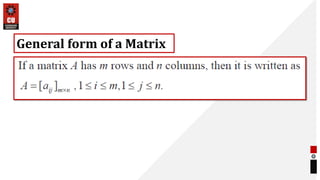
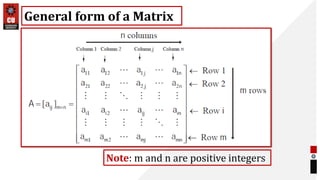
General form of a Matrix
Note: m and n are positive integers
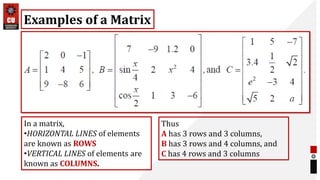
Examples of a Matrix
In a matrix,
•HORIZONTAL LINES of elements
are known as ROWS
•VERTICAL LINES of elements are
known as COLUMNS.
Thus
A has 3 rows and 3 columns,
B has 3 rows and 4 columns, and
C has 4 rows and 3 columns
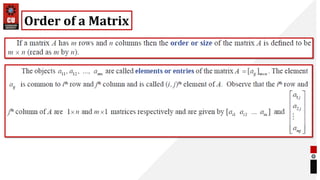
Order of a Matrix
Generally, a MATRIX is nothing but a Rectangular Array of
objects.
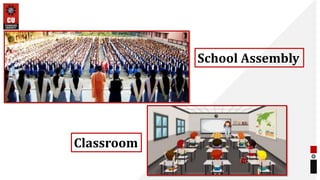
These matrices can be Visualised in Day-To-Day
Applications where we use matrices to represent a Military
Parade, School Assembly, Vegetation, Class room etc.
1. APPLICATIONS OF MATRICES
Vegetation
Military Parade
School Assembly
Classroom
13
Engineering & Technology
In Cryptography: In encryption, we use it to very sensitive data for
security purposes to Encode And To Decode this data we need matrices.
There is a key that helps encode and decode data which is generated by
matrices.
In Animation: It can help make animations more PRECISE AND
PERFECT.
In Games Especially 3D: They use it to ALTER THE OBJECT, in 3D
space. They use the 3D Matrix to 2D Matrix to convert it into the different
objects as per requirement.
14
Engineering & Technology
In IT companies: Use Matrices as Data Structures to Track
User Information, perform Search Queries, and Manage
Databases. In the world of information security, many systems
are designed to work with matrices.
Matrices are very important and absolutely
necessary in handling system of linear equations which
arise as mathematical models of real-world problems.
Mathematicians Gauss, Jordan, Cayley, and
Hamilton have developed the THEORY OF MATRICES
which has been used in investigating solutions of
Systems of Linear Equations.
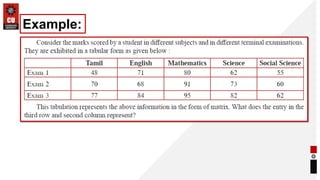
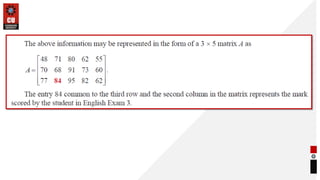
Example:
18
TYPES OF MATRICES
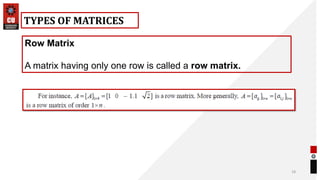
Row Matrix
A matrix having only one row is called a row matrix.
19
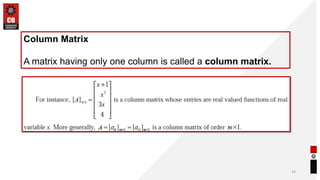
Column Matrix
A matrix having only one column is called a column matrix.
20
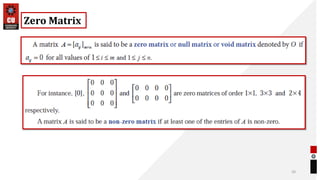
Zero Matrix
21
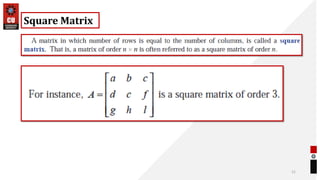
Square Matrix
22
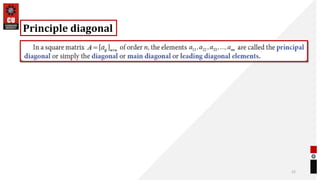
Principle diagonal
23
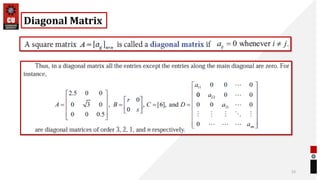
Diagonal Matrix
24
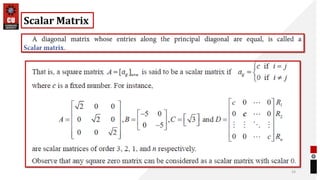
Scalar Matrix
25
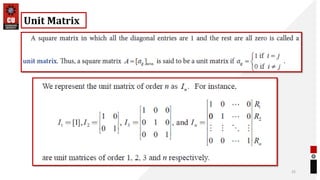
Unit Matrix
26
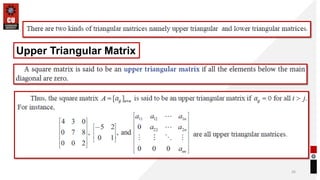
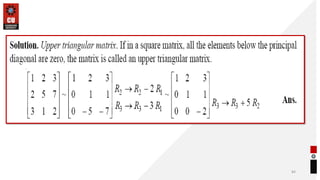
Upper Triangular Matrix
27
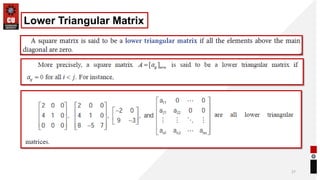
Lower Triangular Matrix
28
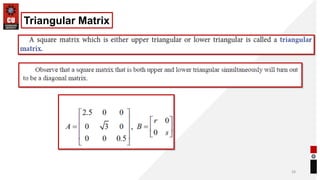
Triangular Matrix
29
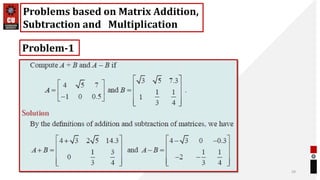
Problems based on Matrix Addition,
Subtraction and Multiplication
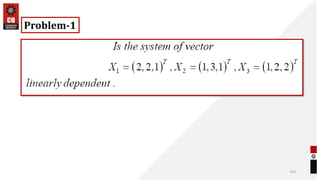
Problem-1
30
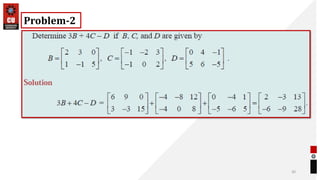
Problem-2
31
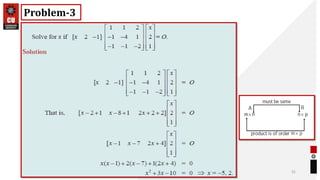
Problem-3
32
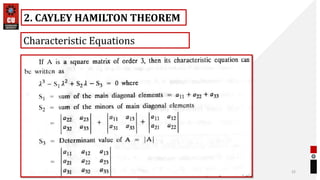
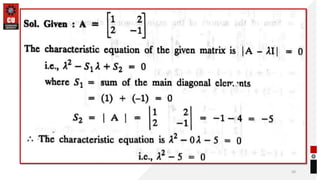
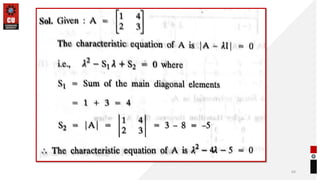
Characteristic Equations
2. CAYLEY HAMILTON THEOREM
33
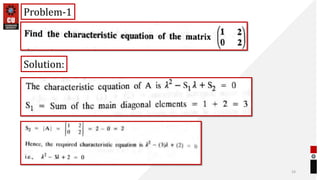
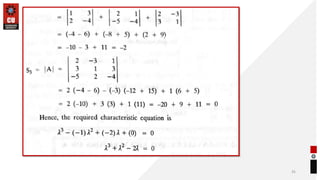
Problem-1
Solution:
34
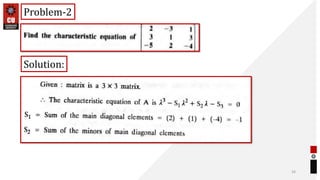
Problem-2
Solution:
35
36
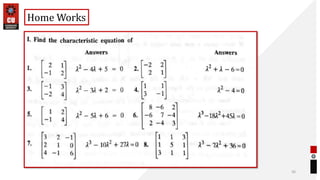
Home Works
37
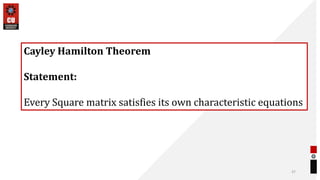
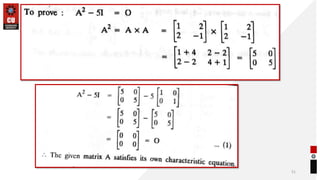
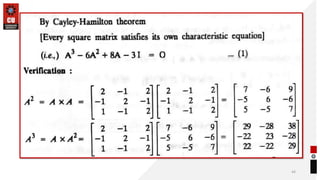
Cayley Hamilton Theorem
Statement:
Every Square matrix satisfies its own characteristic equations
38
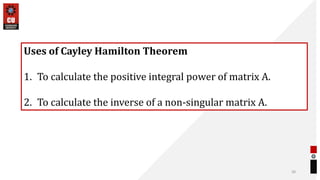
Uses of Cayley Hamilton Theorem
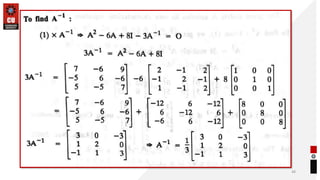
1. To calculate the positive integral power of matrix A.
2. To calculate the inverse of a non-singular matrix A.
39
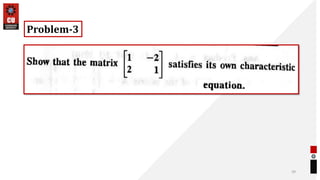
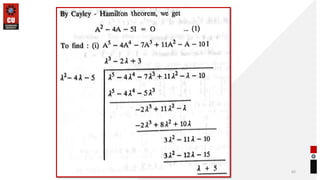
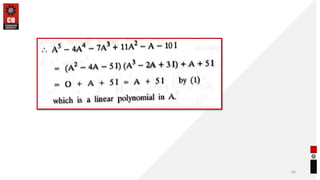
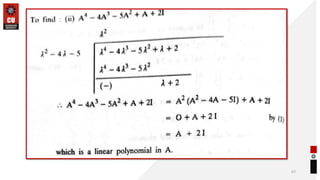
Problem-3
40
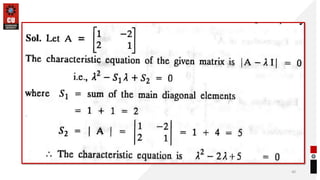
41
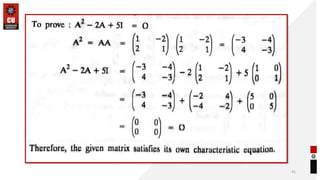
42
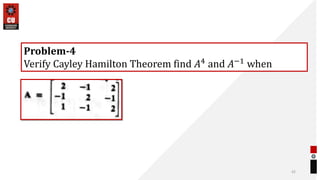
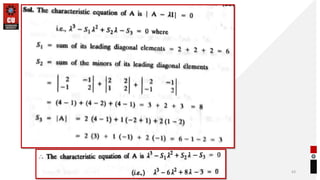
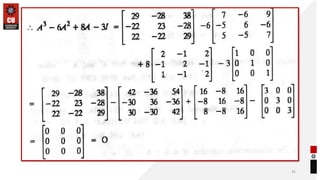
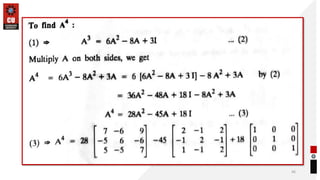
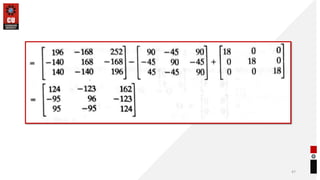
Problem-4
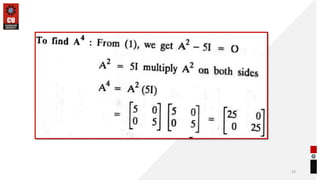
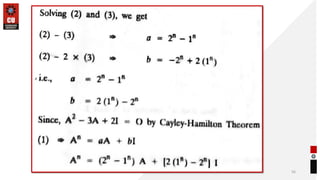
Verify Cayley Hamilton Theorem find 𝐴4
and 𝐴−1
when
43
44
45
46
47
48
49
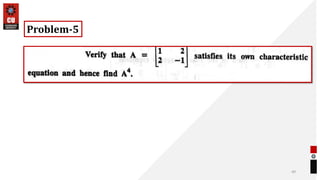
Problem-5
50
51
52
53
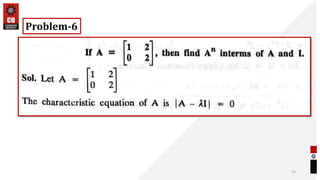
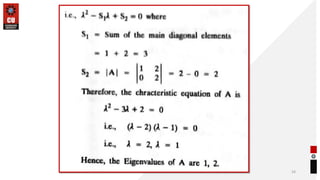
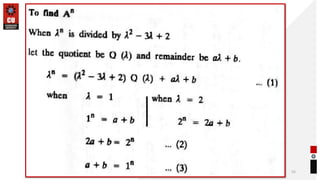
Problem-6
54
55
56
57
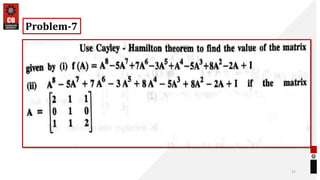
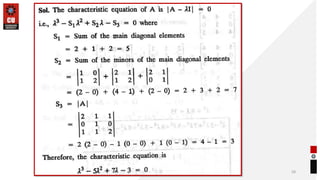
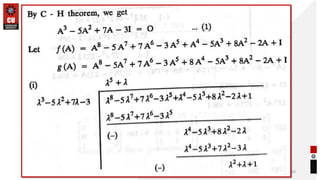
Problem-7
58
59
60
61
62
63
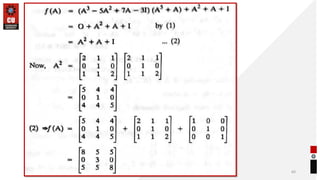
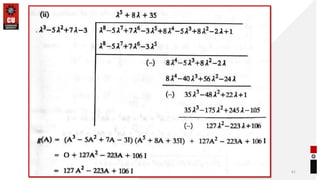
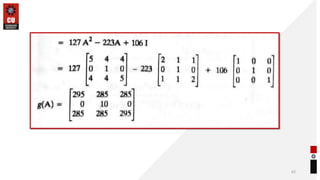
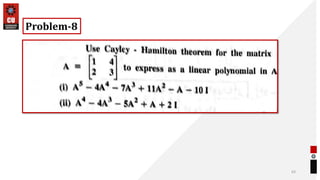
Problem-8
64
65
66
67
68
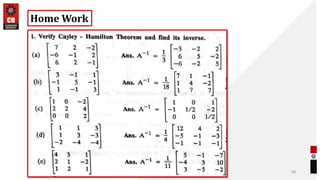
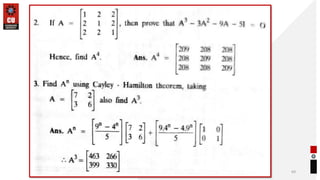
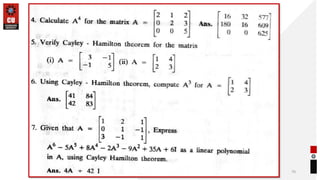
Home Work
69
70
71
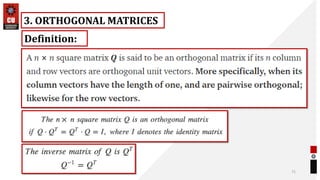
3. ORTHOGONAL MATRICES
Definition:
72
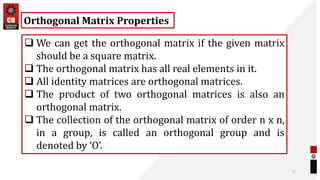
Orthogonal Matrix Properties
 We can get the orthogonal matrix if the given matrix
should be a square matrix.
 The orthogonal matrix has all real elements in it.
 All identity matrices are orthogonal matrices.
 The product of two orthogonal matrices is also an
orthogonal matrix.
 The collection of the orthogonal matrix of order n x n,
in a group, is called an orthogonal group and is
denoted by ‘O’.
73
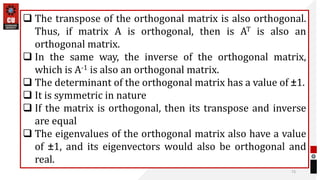
 The transpose of the orthogonal matrix is also orthogonal.
Thus, if matrix A is orthogonal, then is AT is also an
orthogonal matrix.
 In the same way, the inverse of the orthogonal matrix,
which is A-1 is also an orthogonal matrix.
 The determinant of the orthogonal matrix has a value of ±1.
 It is symmetric in nature
 If the matrix is orthogonal, then its transpose and inverse
are equal
 The eigenvalues of the orthogonal matrix also have a value
of ±1, and its eigenvectors would also be orthogonal and
real.
74
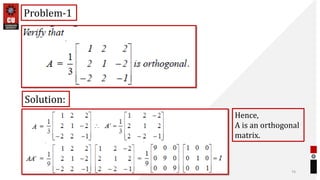
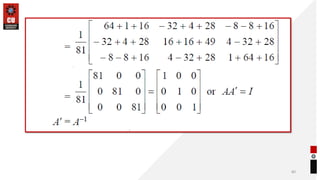
Problem-1
Solution:
Hence,
A is an orthogonal
matrix.
75
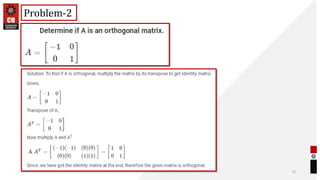
Problem-2
76
Problem-3
77
Problem-4
78
79
Problem-5
80
81
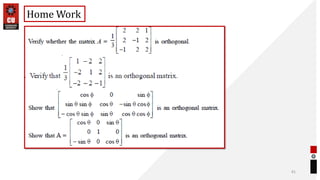
Home Work
82
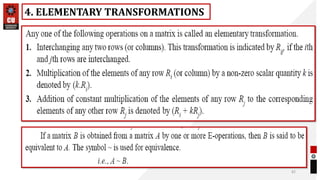
4. ELEMENTARY TRANSFORMATIONS
83
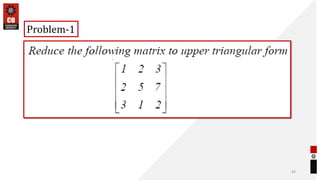
Problem-1
84
85
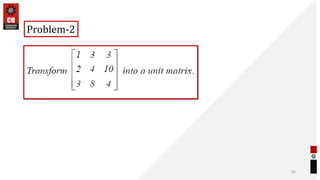
Problem-2
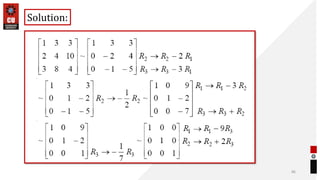
86
Solution:
87
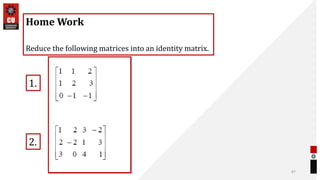
Home Work
Reduce the following matrices into an identity matrix.
1.
2.
88
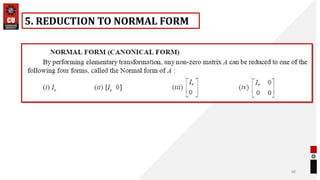
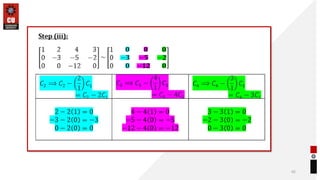
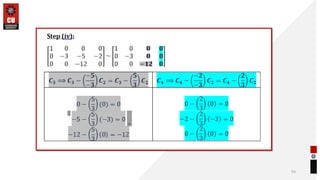
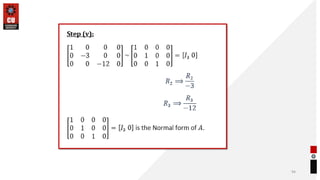
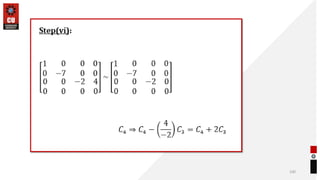
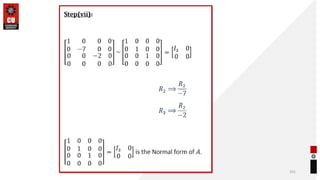
5. REDUCTION TO NORMAL FORM
89
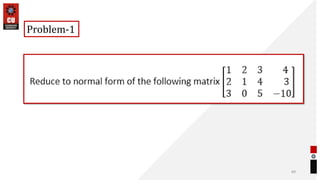
Problem-1
90
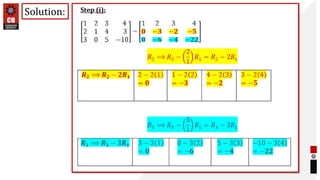
Solution:
91
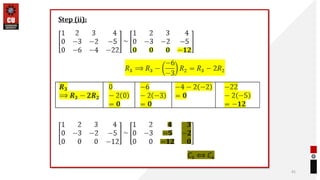
92
93
94
95
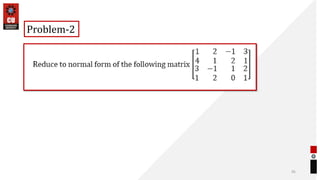
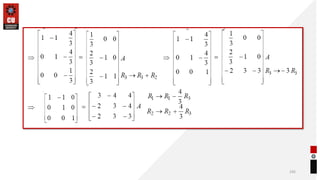
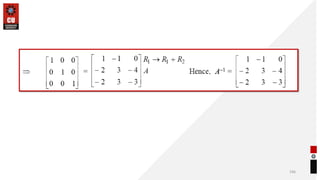
Problem-2
96
Solution:
97
98
99
100
101
102
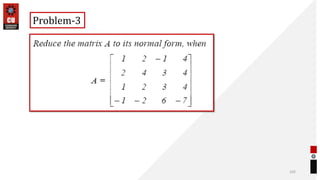
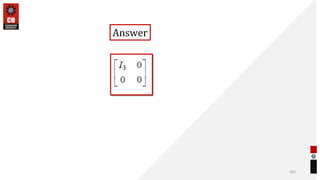
Problem-3
103
Answer
104
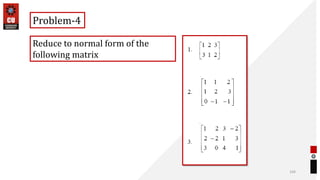
Problem-4
Reduce to normal form of the
following matrix
105
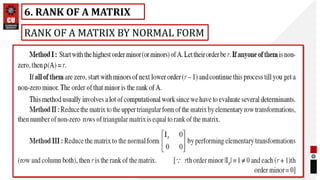
RANK OF A MATRIX BY NORMAL FORM
6. RANK OF A MATRIX
106
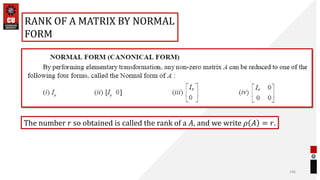
RANK OF A MATRIX BY NORMAL
FORM
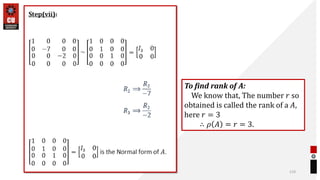
The number 𝑟 so obtained is called the rank of a 𝐴, and we write 𝜌 𝐴 = 𝑟.
107
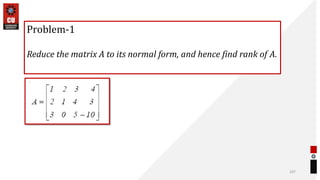
Problem-1
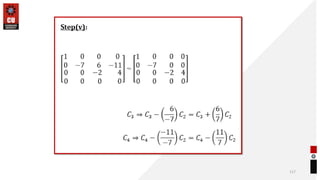
Reduce the matrix A to its normal form, and hence find rank of 𝐴.
108
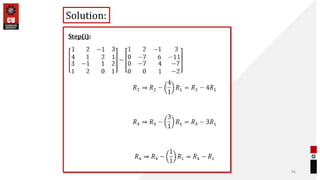
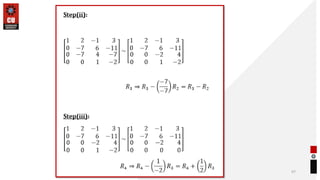
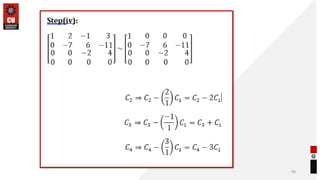
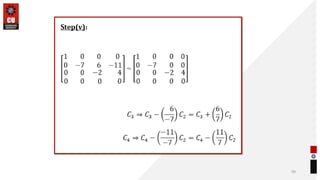
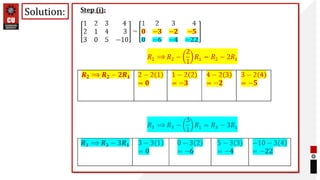
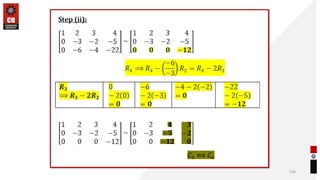
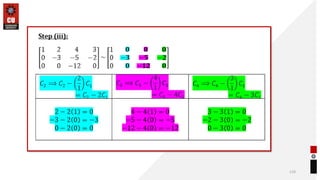
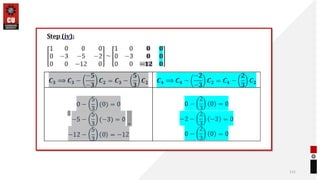
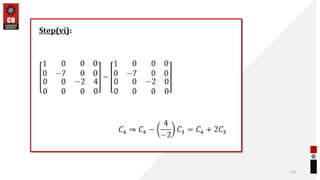
Solution:
109
110
111
112
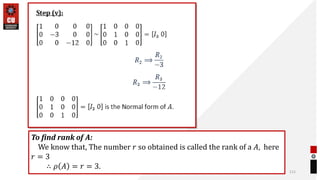
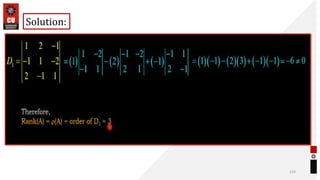
To find rank of 𝑨:
We know that, The number 𝑟 so obtained is called the rank of a 𝐴, here
𝑟 = 3
∴ 𝜌 𝐴 = 𝑟 = 3.
113
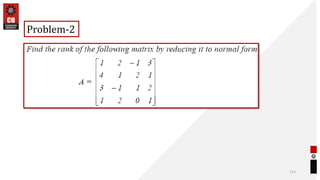
Problem-2
114
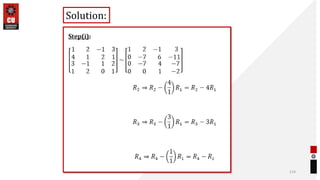
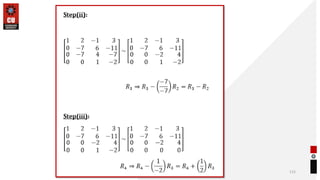
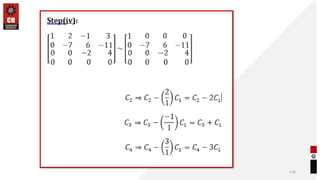
Solution:
115
116
117
118
119
To find rank of 𝑨:
We know that, The number 𝑟 so
obtained is called the rank of a 𝐴,
here 𝑟 = 3
∴ 𝜌 𝐴 = 𝑟 = 3.
120
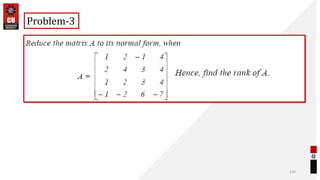
Problem-3
121
Answer
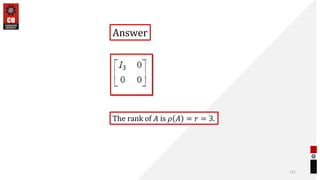
The rank of 𝐴 is 𝜌 𝐴 = 𝑟 = 3.
122
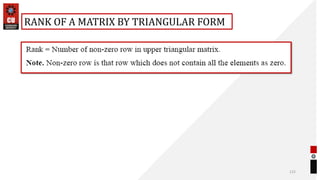
RANK OF A MATRIX BY TRIANGULAR FORM
123
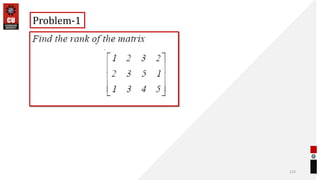
Problem-1
124
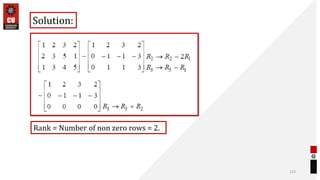
Solution:
Rank = Number of non zero rows = 2.
125
Problem-2
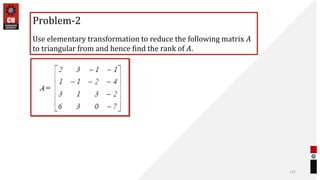
Use elementary transformation to reduce the following matrix 𝐴
to triangular from and hence find the rank of 𝐴.
126
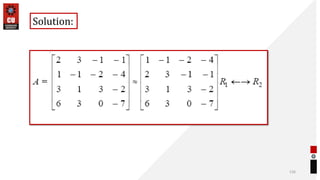
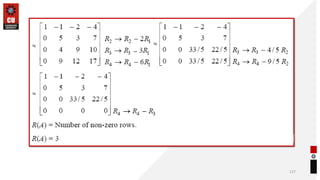
Solution:
127
128
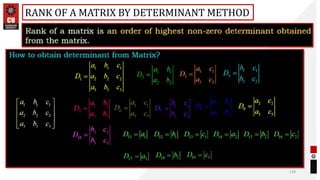
RANK OF A MATRIX BY DETERMINANT METHOD
129
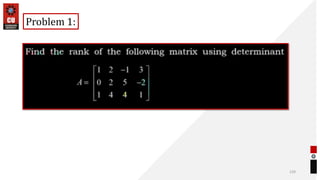
Problem 1:
130
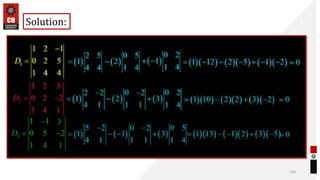
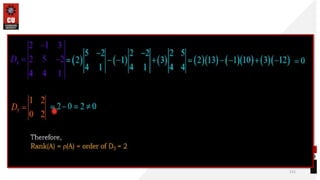
Solution:
131
132
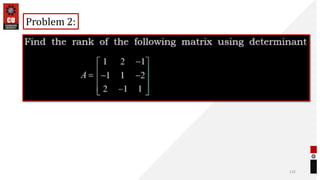
Problem 2:
133
Solution:
134
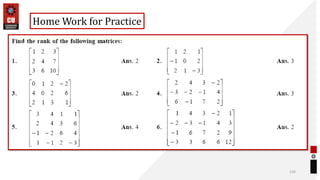
Home Work for Practice
135
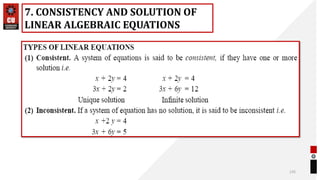
7. CONSISTENCY AND SOLUTION OF
LINEAR ALGEBRAIC EQUATIONS
136
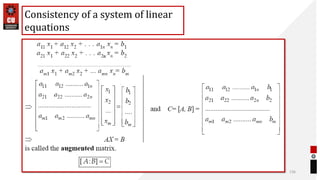
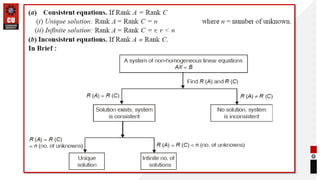
Consistency of a system of linear
equations
137
138
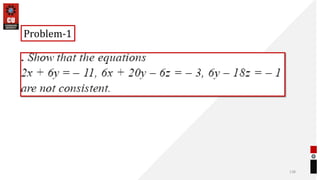
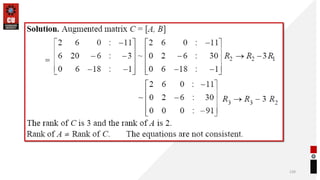
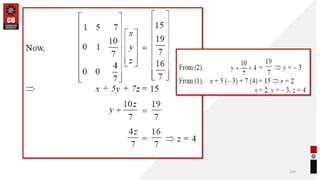
Problem-1
139
140
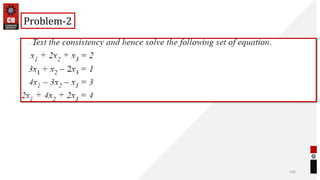
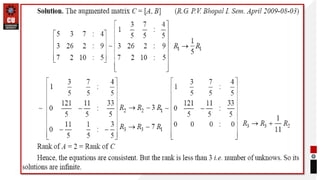
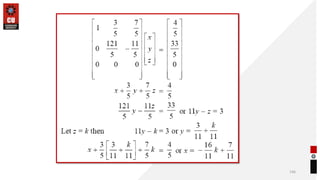
Problem-2
141
142
143
144
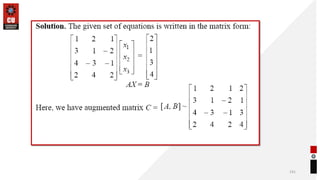
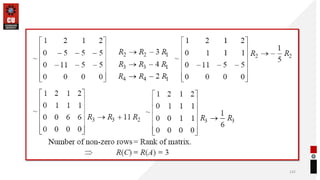
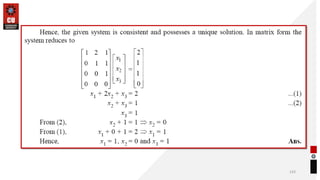
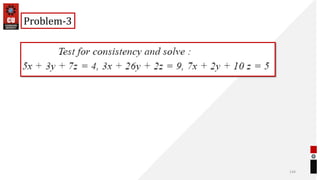
Problem-3
145
146
147
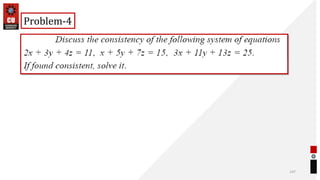
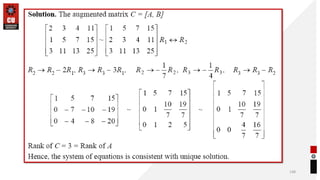
Problem-4
148
149
150
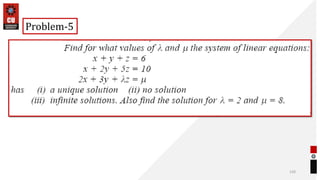
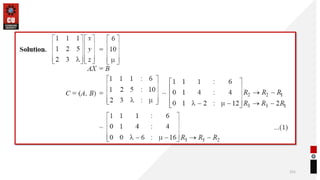
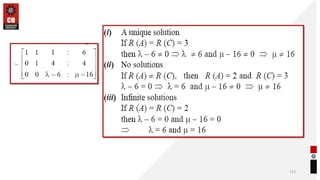
Problem-5
151
152
153
154
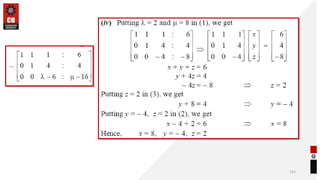
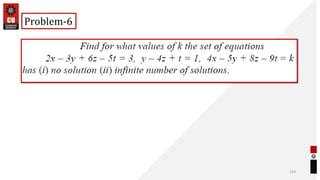
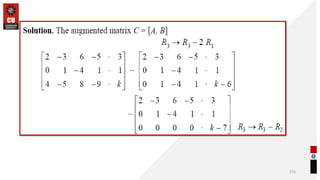
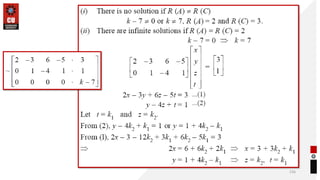
Problem-6
155
156
157
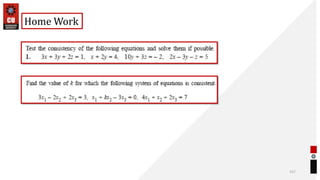
Home Work
158
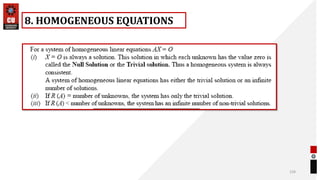
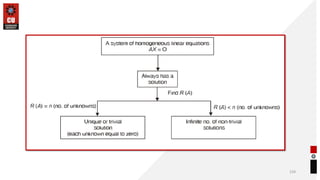
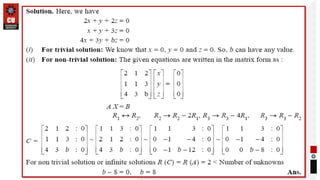
8. HOMOGENEOUS EQUATIONS
159
160
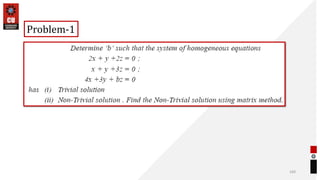
Problem-1
161
162
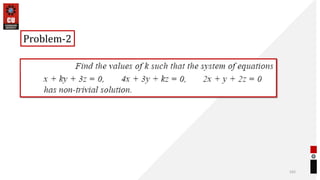
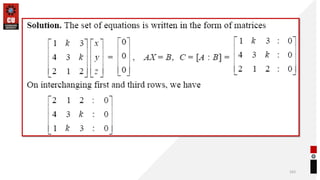
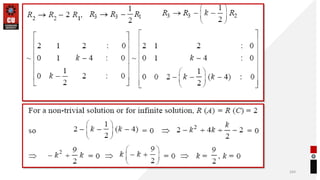
Problem-2
163
164
165
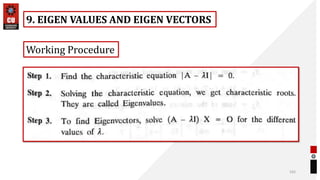
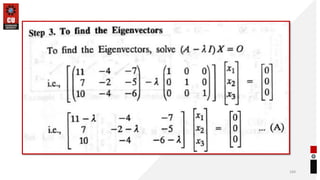
Working Procedure
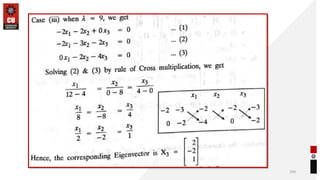
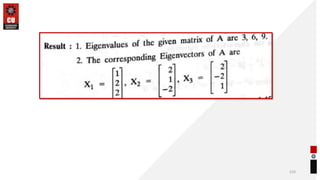
9. EIGEN VALUES AND EIGEN VECTORS
166
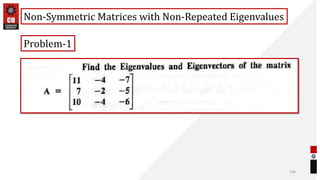
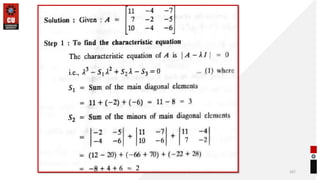
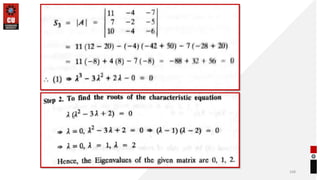
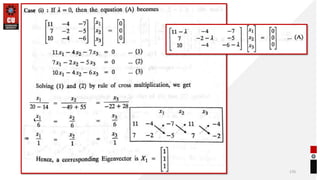
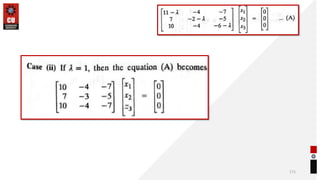
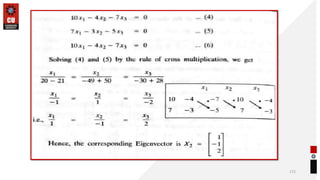
Problem-1
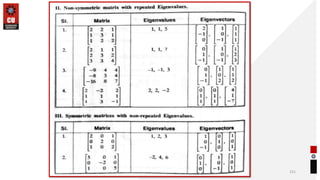
Non-Symmetric Matrices with Non-Repeated Eigenvalues
167
168
169
170
171
172
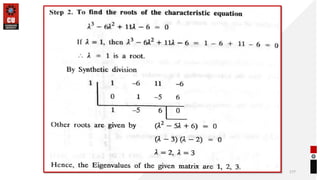
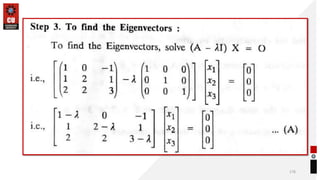
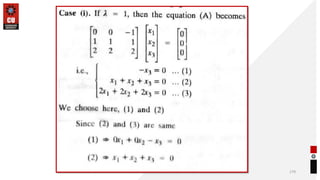
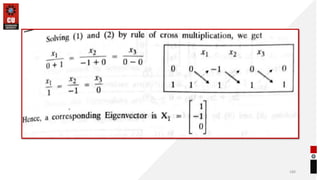
173
174
175
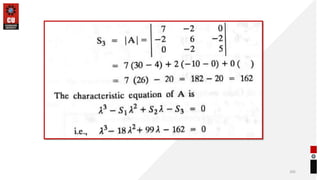
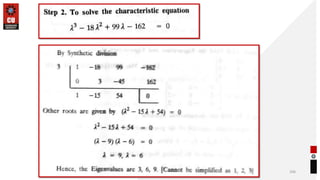
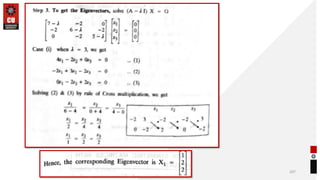
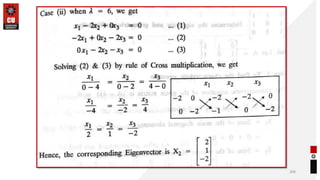
Problem-2
176
177
178
179
180
181
182
183
184
185
Non-Symmetric Matrices with Repeated Eigenvalues
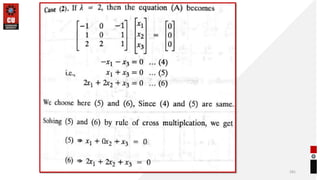
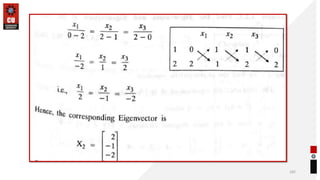
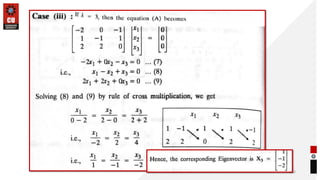
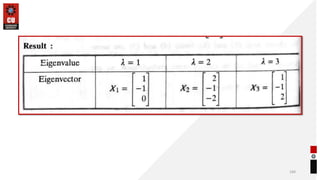
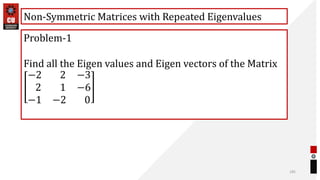
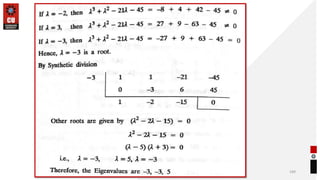
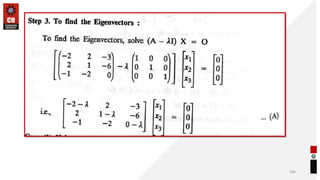
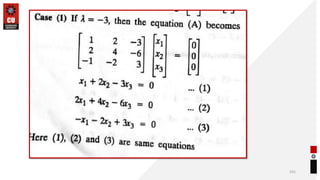
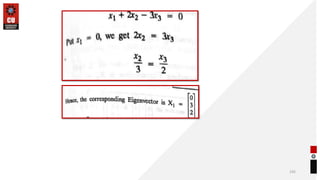
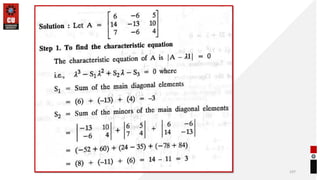
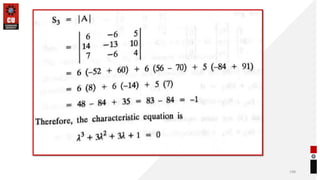
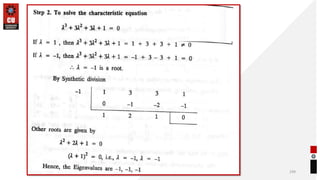
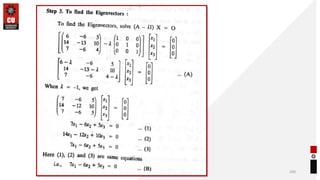
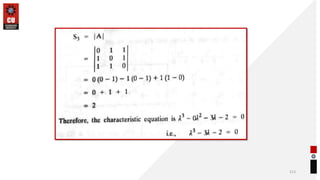
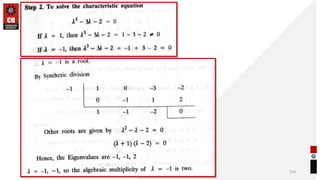
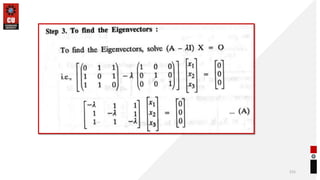
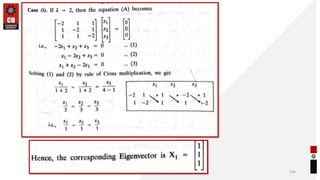
Problem-1
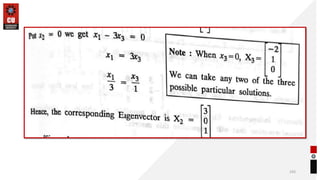
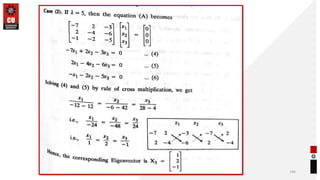
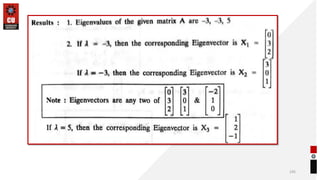
Find all the Eigen values and Eigen vectors of the Matrix
−2 2 −3
2 1 −6
−1 −2 0
186
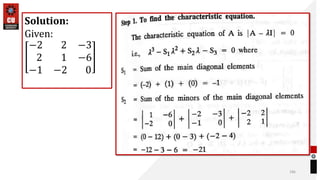
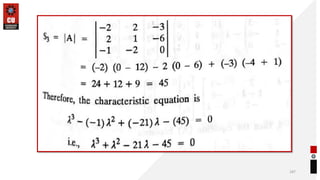
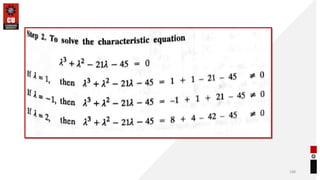
Solution:
Given:
−2 2 −3
2 1 −6
−1 −2 0
187
188
189
190
191
192
193
194
195
196
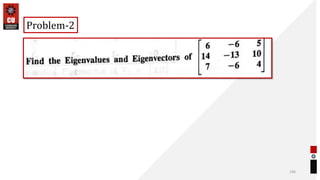
Problem-2
197
198
199
200
201
202
203
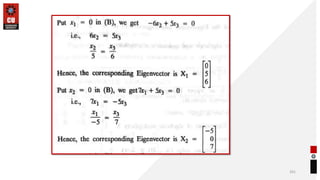
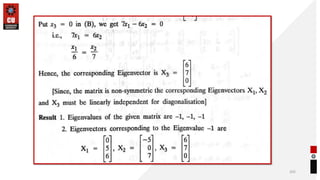
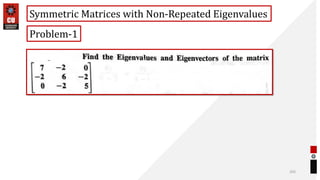
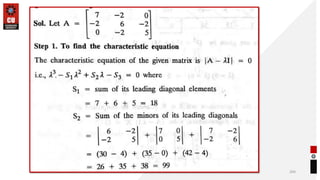
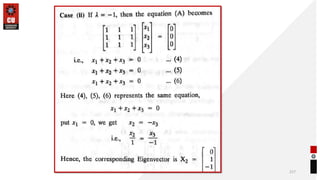
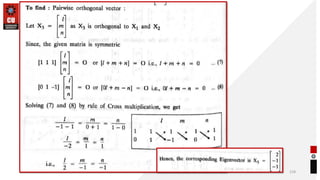
Symmetric Matrices with Non-Repeated Eigenvalues
Problem-1
204
205
206
207
208
209
210
211
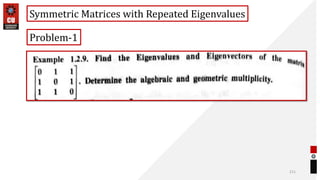
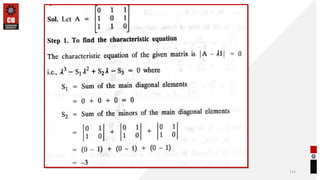
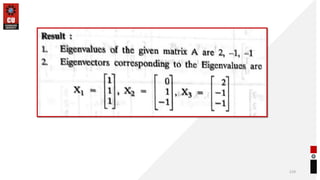
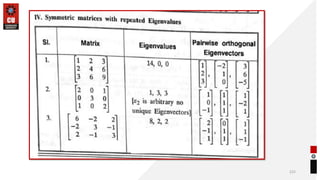
Symmetric Matrices with Repeated Eigenvalues
Problem-1
212
213
214
215
216
217
218
219
220
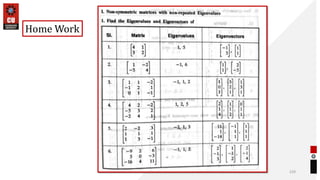
Home Work
221
222
223
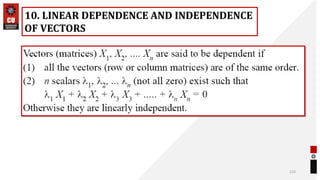
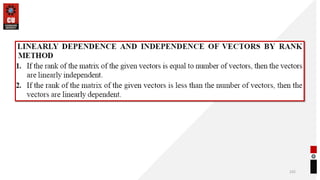
10. LINEAR DEPENDENCE AND INDEPENDENCE
OF VECTORS
224
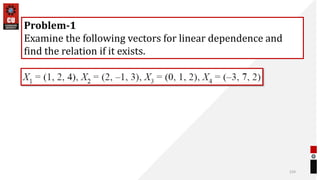
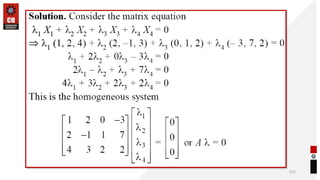
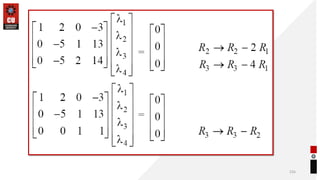
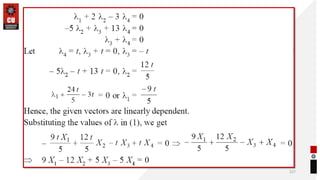
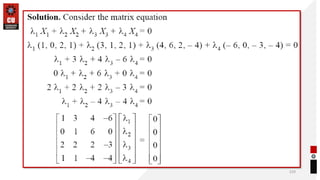
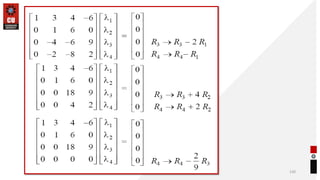
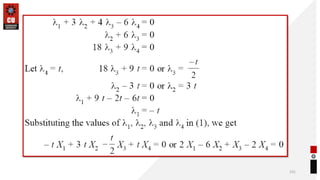
Problem-1
Examine the following vectors for linear dependence and
find the relation if it exists.
225
226
227
228
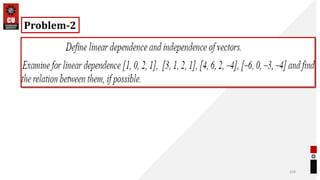
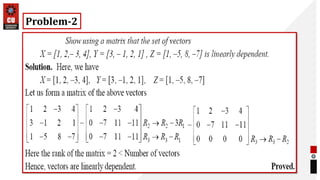
Problem-2
229
230
231
232
233
Problem-1
234
235
236
237
Problem-2
238
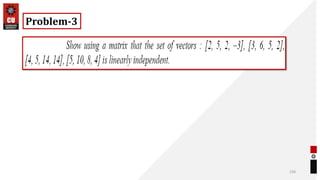
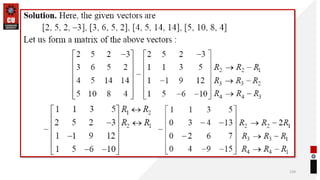
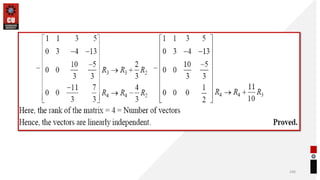
Problem-3
239
240
241
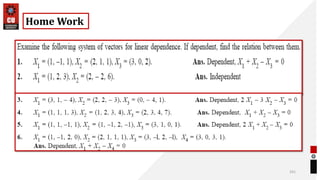
Home Work
242
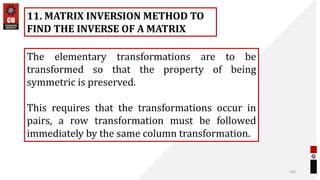
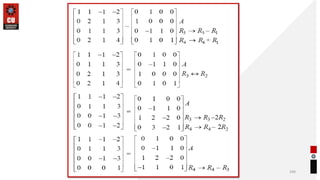
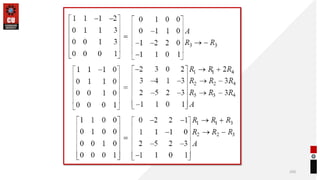
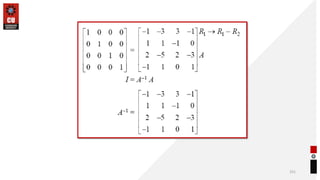
11. MATRIX INVERSION METHOD TO
FIND THE INVERSE OF A MATRIX
The elementary transformations are to be
transformed so that the property of being
symmetric is preserved.
This requires that the transformations occur in
pairs, a row transformation must be followed
immediately by the same column transformation.
243
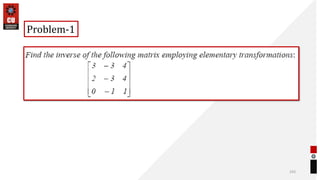
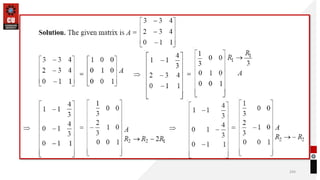
Problem-1
244
245
246
247
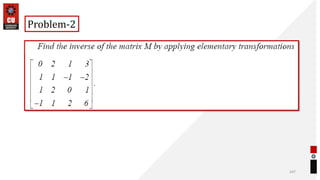
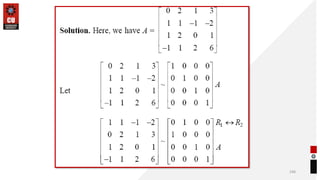
Problem-2
248
249
250
251
252
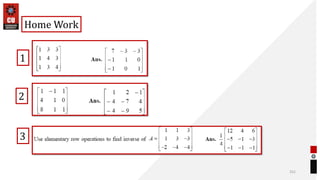
Home Work
1
2
3

UNIT-1 MATRICES (All the Topics).pdf