Lecture 2
Matrix Operations
• transpose, sum & difference, scalar multiplication
• matrix multiplication, matrix-vector product
• matrix inverse
2–1
Matrix transpose
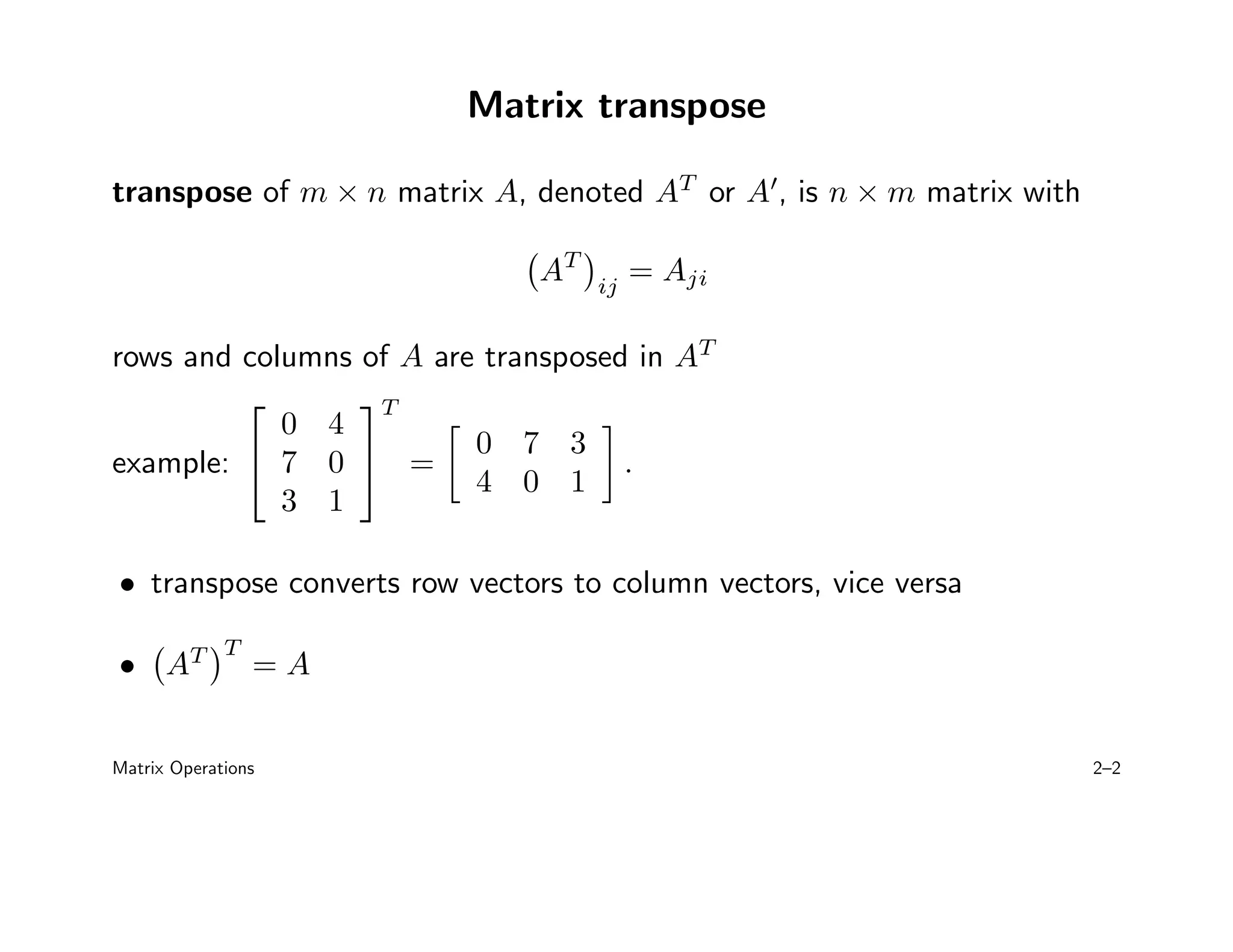
transpose of m × n matrix A, denoted AT
or A′
, is n × m matrix with
AT

ij
= Aji
rows and columns of A are transposed in AT
example:


0 4
7 0
3 1


T
=

0 7 3
4 0 1

.
• transpose converts row vectors to column vectors, vice versa
• AT
T
= A
Matrix Operations 2–2
Matrix addition  subtraction
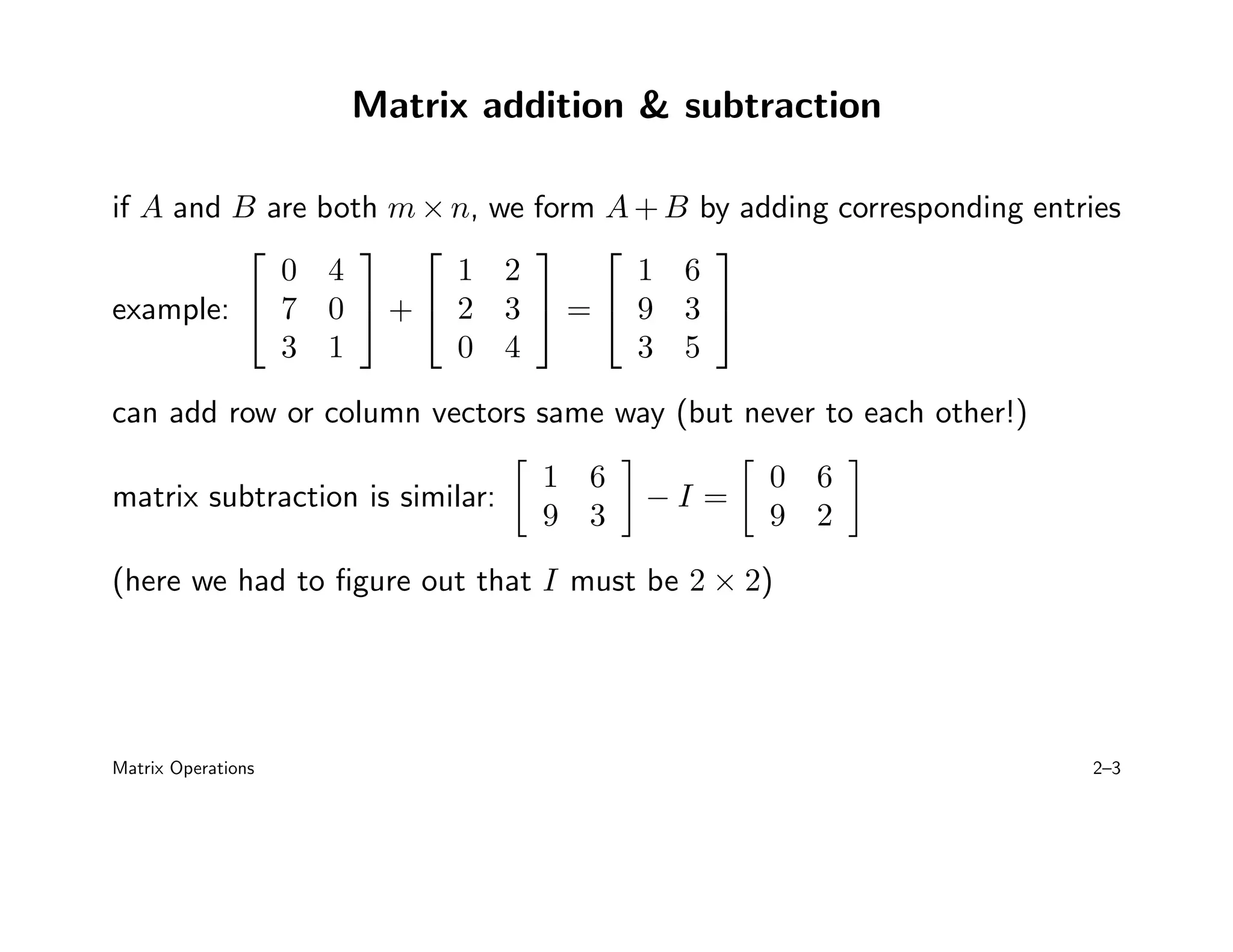
if A and B are both m × n, we form A + B by adding corresponding entries
example:


0 4
7 0
3 1

 +


1 2
2 3
0 4

 =


1 6
9 3
3 5


can add row or column vectors same way (but never to each other!)
matrix subtraction is similar:

1 6
9 3

− I =

0 6
9 2

(here we had to figure out that I must be 2 × 2)
Matrix Operations 2–3
Properties of matrix addition
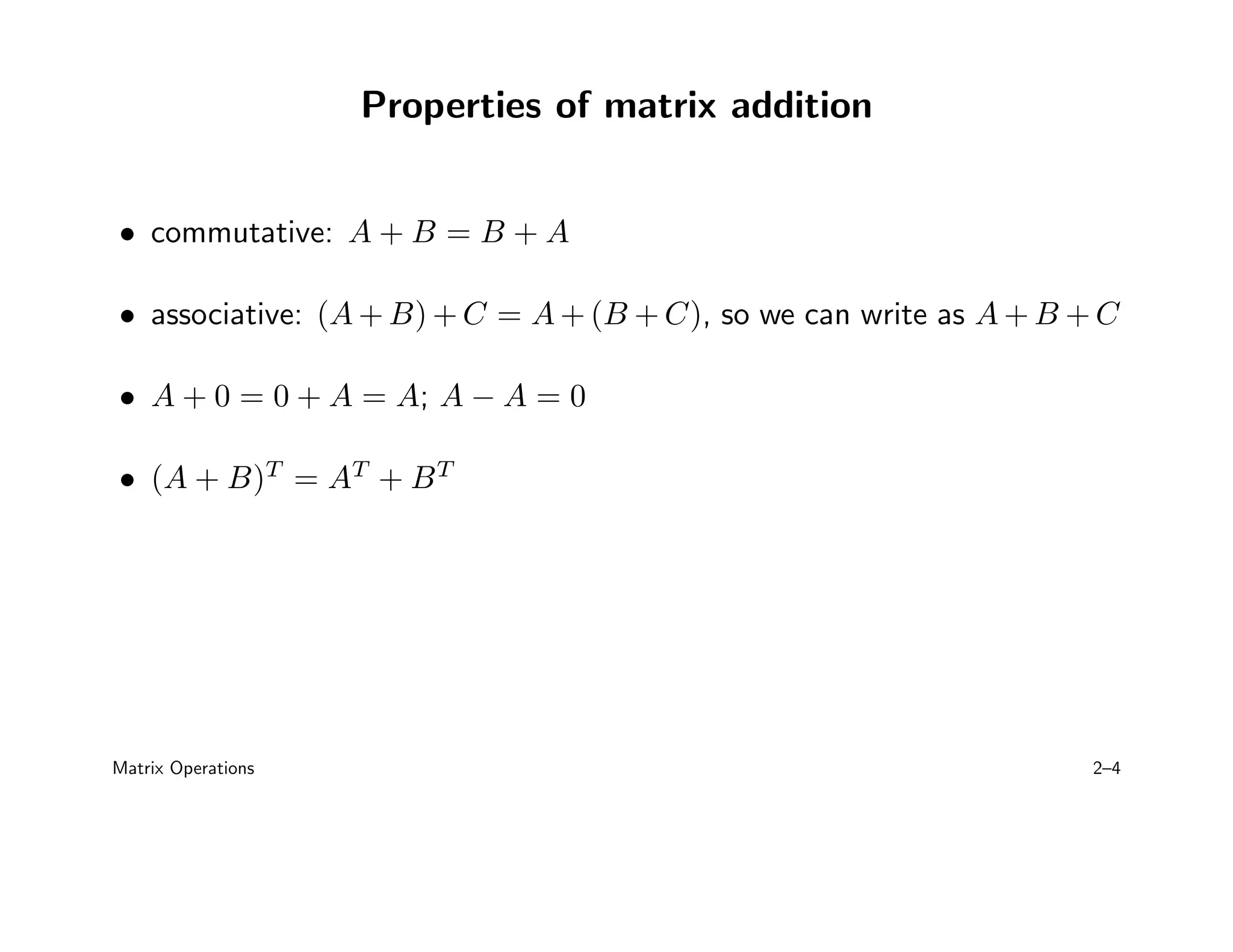
• commutative: A + B = B + A
• associative: (A + B) + C = A + (B + C), so we can write as A + B + C
• A + 0 = 0 + A = A; A − A = 0
• (A + B)T
= AT
+ BT
Matrix Operations 2–4
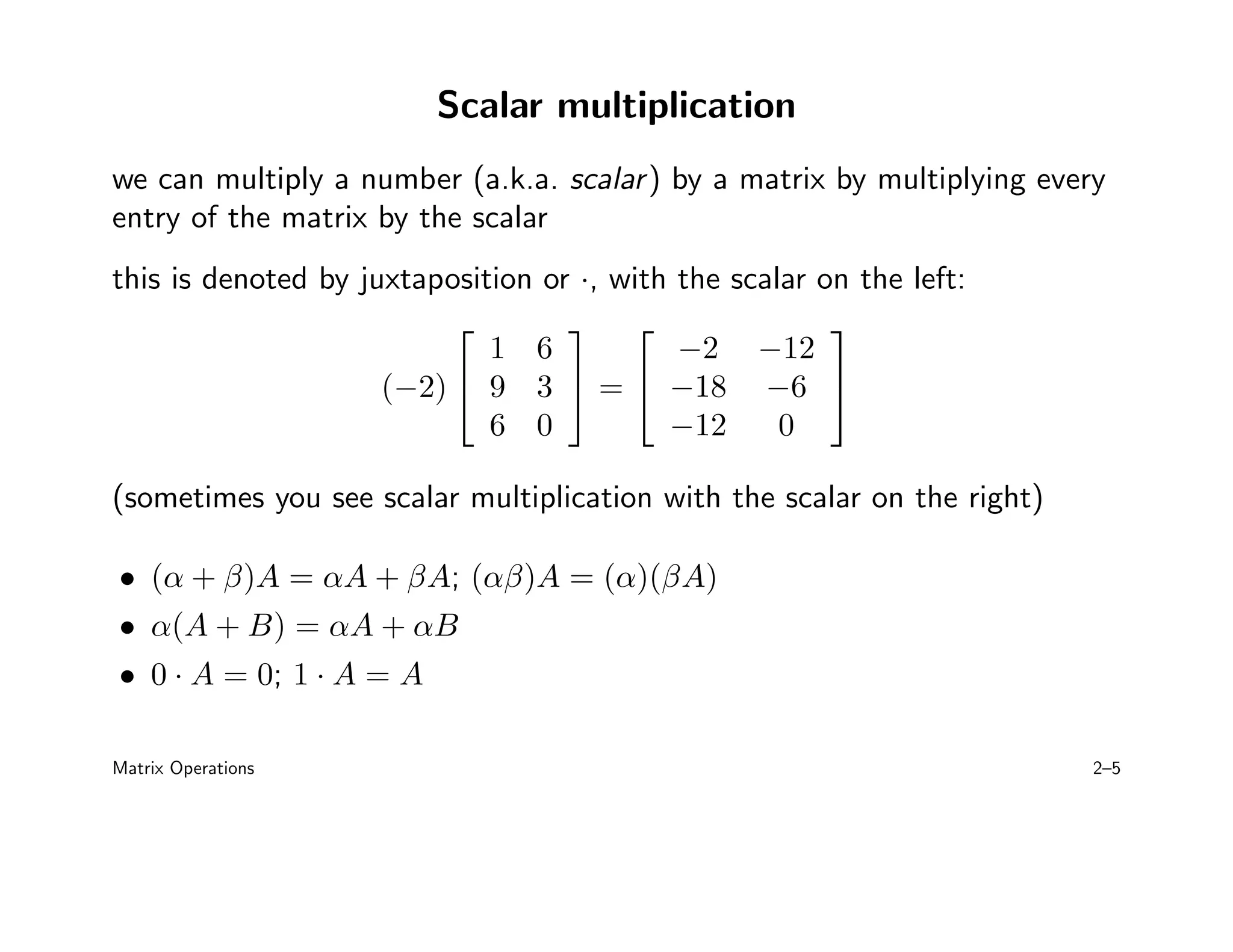
Scalar multiplication
we can multiply a number (a.k.a. scalar) by a matrix by multiplying every
entry of the matrix by the scalar
this is denoted by juxtaposition or ·, with the scalar on the left:
(−2)


1 6
9 3
6 0

 =


−2 −12
−18 −6
−12 0


(sometimes you see scalar multiplication with the scalar on the right)
• (α + β)A = αA + βA; (αβ)A = (α)(βA)
• α(A + B) = αA + αB
• 0 · A = 0; 1 · A = A
Matrix Operations 2–5
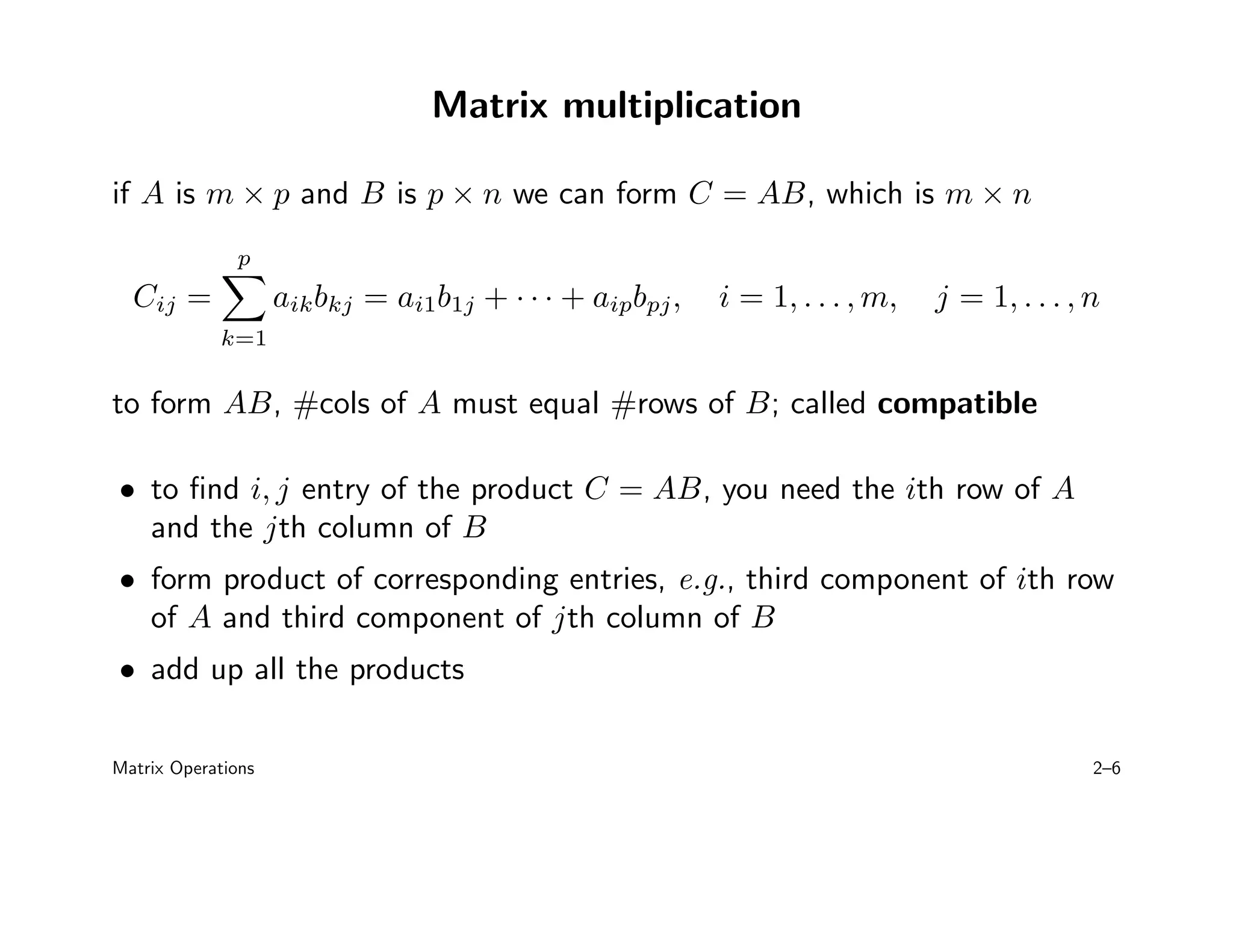
Matrix multiplication
if A is m × p and B is p × n we can form C = AB, which is m × n
Cij =
p
X
k=1
aikbkj = ai1b1j + · · · + aipbpj, i = 1, . . . , m, j = 1, . . . , n
to form AB, #cols of A must equal #rows of B; called compatible
• to find i, j entry of the product C = AB, you need the ith row of A
and the jth column of B
• form product of corresponding entries, e.g., third component of ith row
of A and third component of jth column of B
• add up all the products
Matrix Operations 2–6
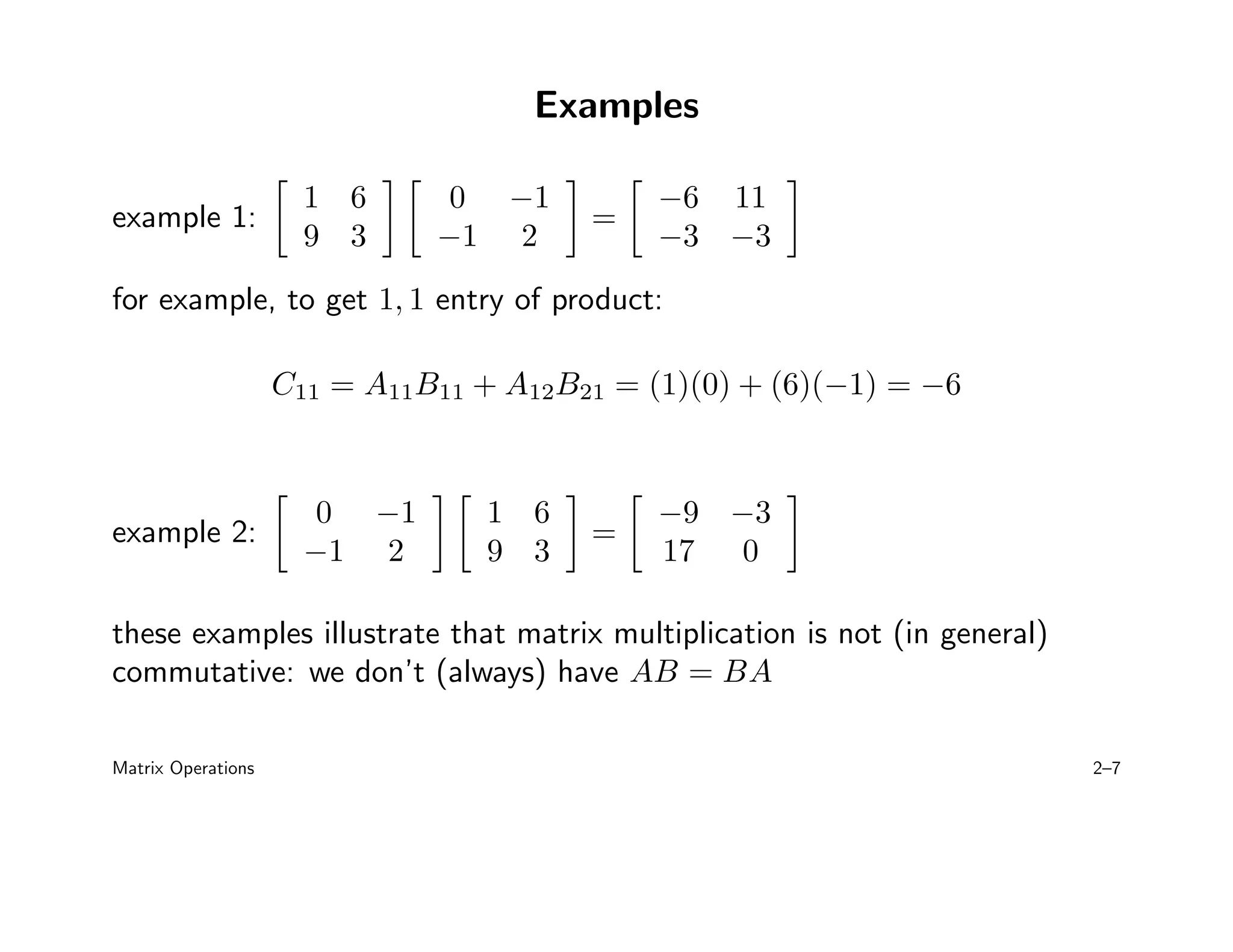
Examples
example 1:

1 6
9 3
 
0 −1
−1 2

=

−6 11
−3 −3

for example, to get 1, 1 entry of product:
C11 = A11B11 + A12B21 = (1)(0) + (6)(−1) = −6
example 2:

0 −1
−1 2
 
1 6
9 3

=

−9 −3
17 0

these examples illustrate that matrix multiplication is not (in general)
commutative: we don’t (always) have AB = BA
Matrix Operations 2–7
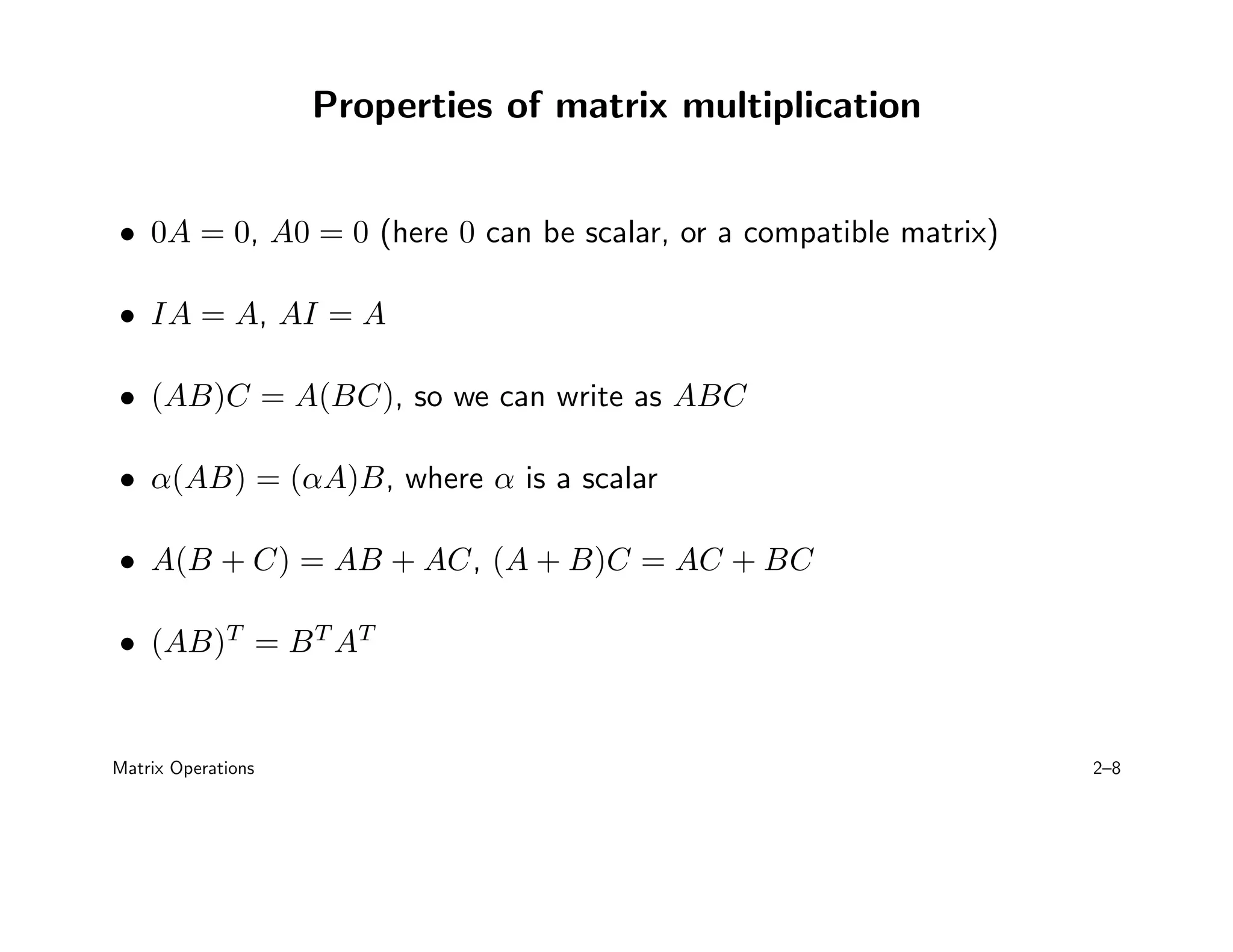
Properties of matrix multiplication
• 0A = 0, A0 = 0 (here 0 can be scalar, or a compatible matrix)
• IA = A, AI = A
• (AB)C = A(BC), so we can write as ABC
• α(AB) = (αA)B, where α is a scalar
• A(B + C) = AB + AC, (A + B)C = AC + BC
• (AB)T
= BT
AT
Matrix Operations 2–8
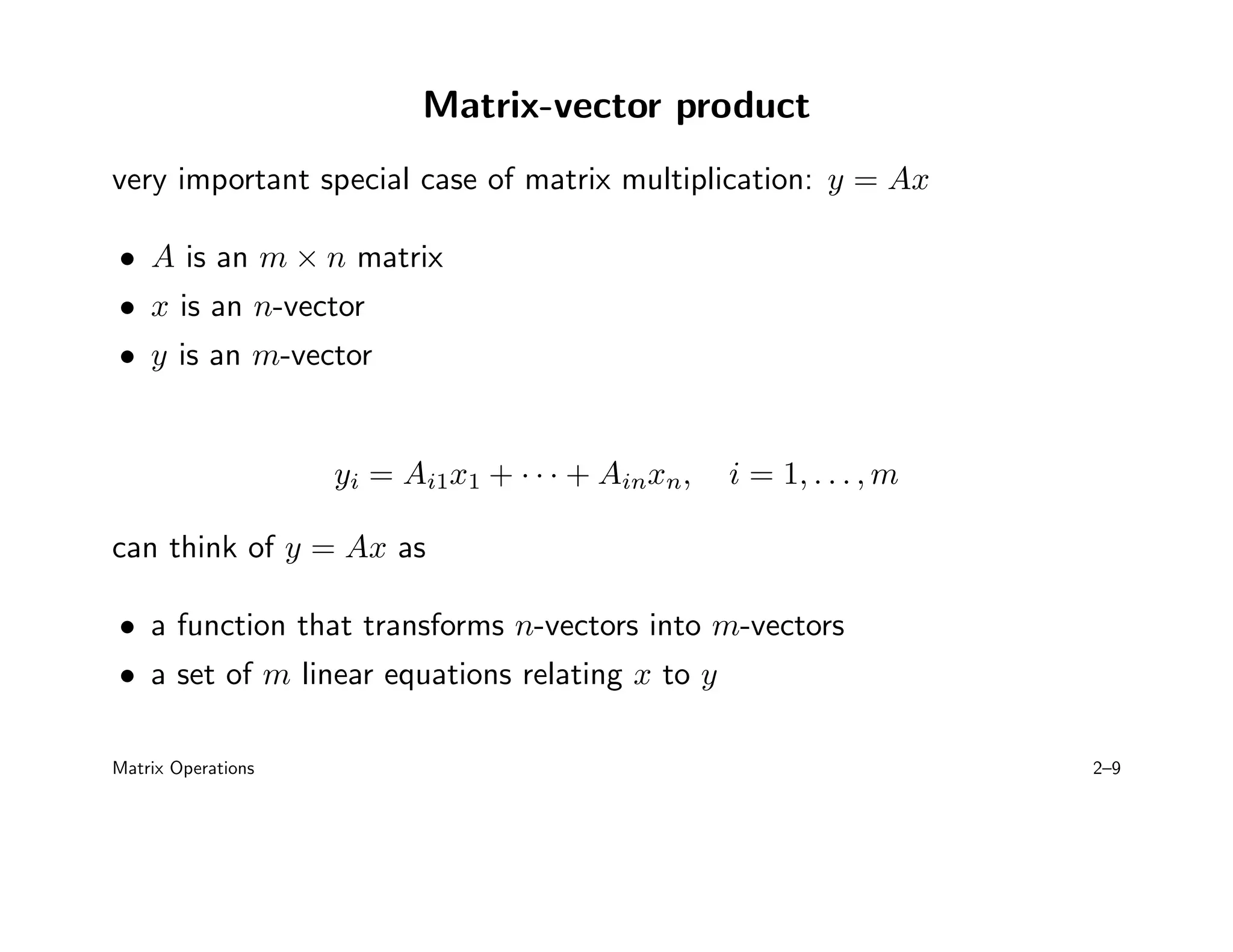
Matrix-vector product
very important special case of matrix multiplication: y = Ax
• A is an m × n matrix
• x is an n-vector
• y is an m-vector
yi = Ai1x1 + · · · + Ainxn, i = 1, . . . , m
can think of y = Ax as
• a function that transforms n-vectors into m-vectors
• a set of m linear equations relating x to y
Matrix Operations 2–9
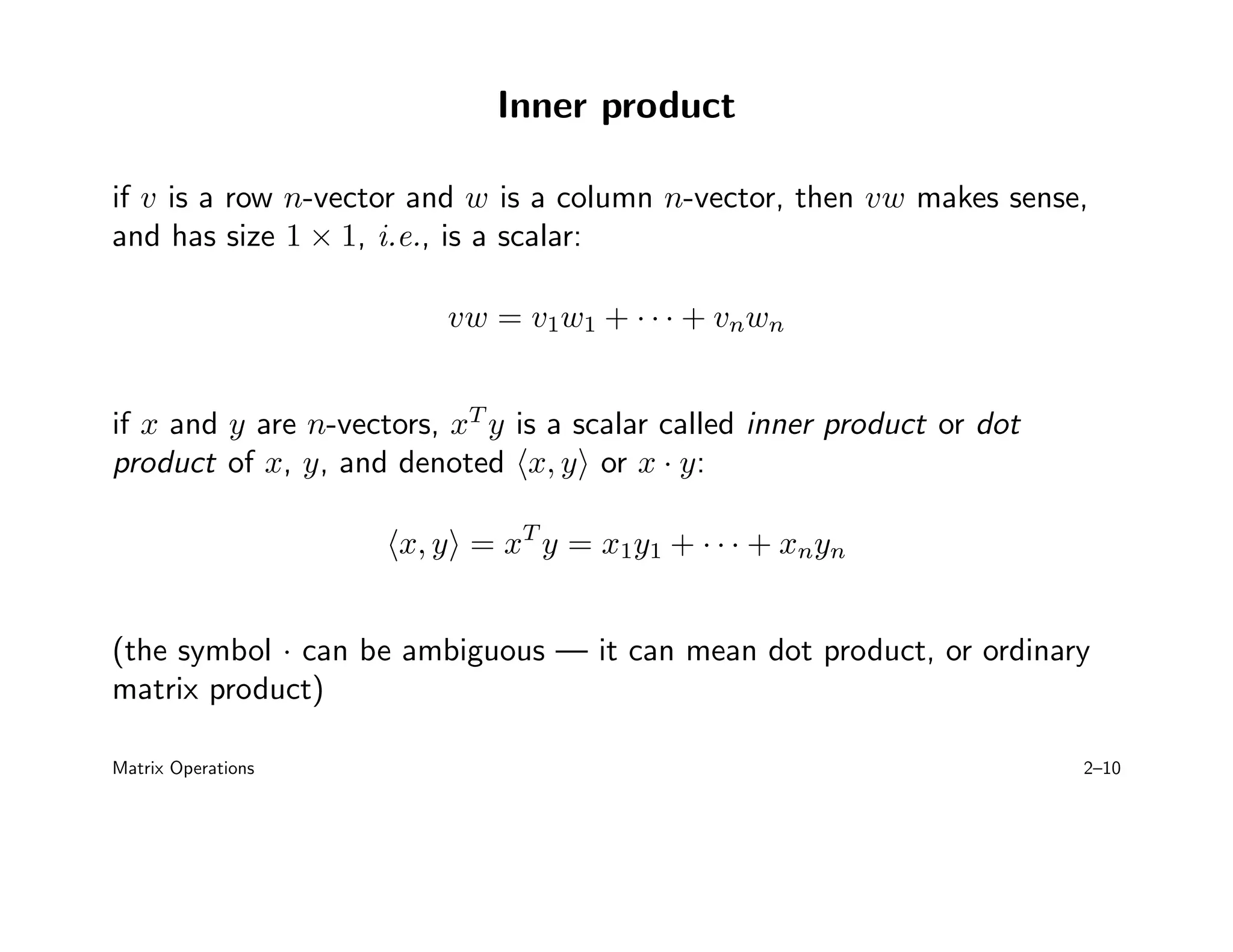
Inner product
if v is a row n-vector and w is a column n-vector, then vw makes sense,
and has size 1 × 1, i.e., is a scalar:
vw = v1w1 + · · · + vnwn
if x and y are n-vectors, xT
y is a scalar called inner product or dot
product of x, y, and denoted hx, yi or x · y:
hx, yi = xT
y = x1y1 + · · · + xnyn
(the symbol · can be ambiguous — it can mean dot product, or ordinary
matrix product)
Matrix Operations 2–10
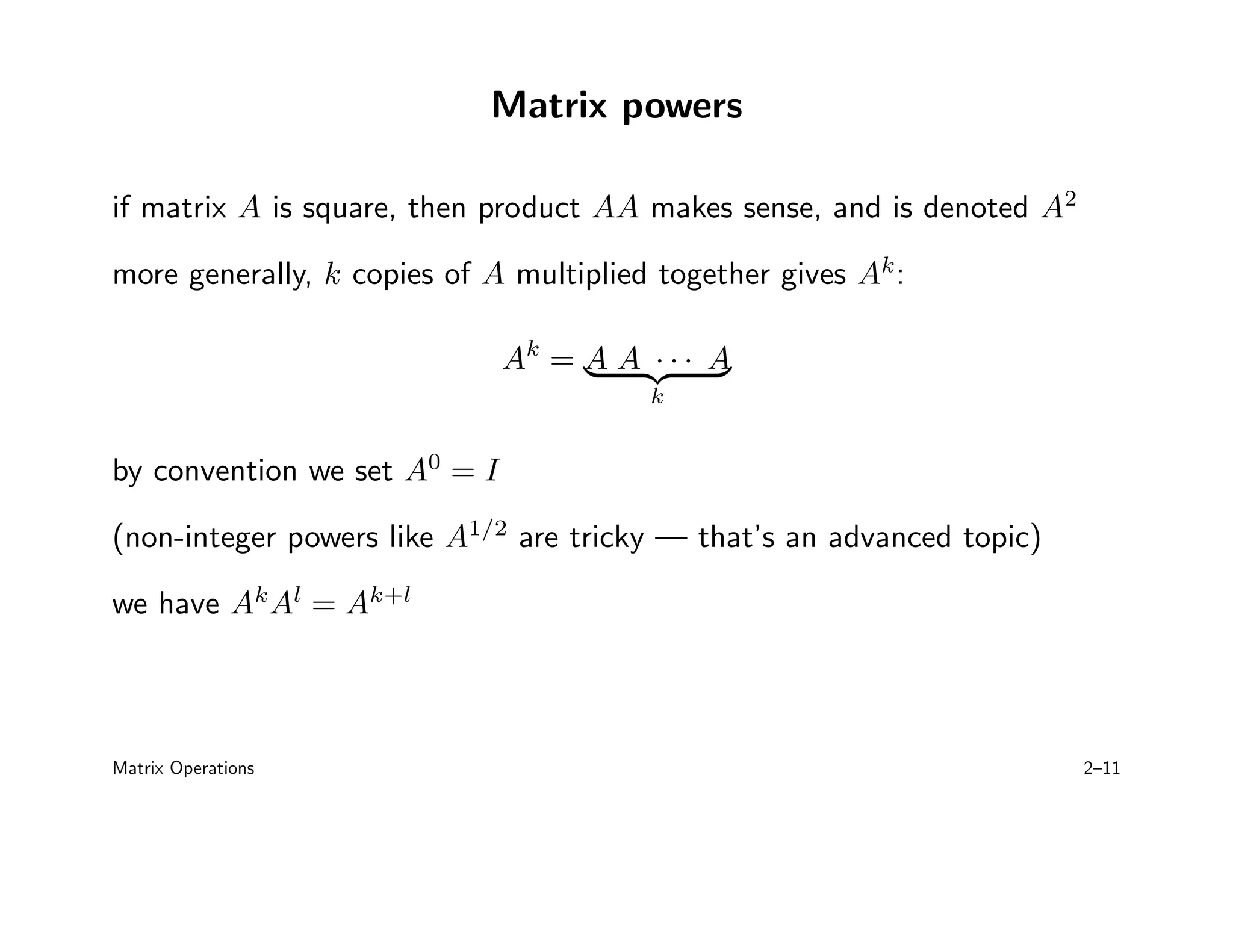
Matrix powers
if matrix A is square, then product AA makes sense, and is denoted A2
more generally, k copies of A multiplied together gives Ak
:
Ak
= A A · · · A
| {z }
k
by convention we set A0
= I
(non-integer powers like A1/2
are tricky — that’s an advanced topic)
we have Ak
Al
= Ak+l
Matrix Operations 2–11
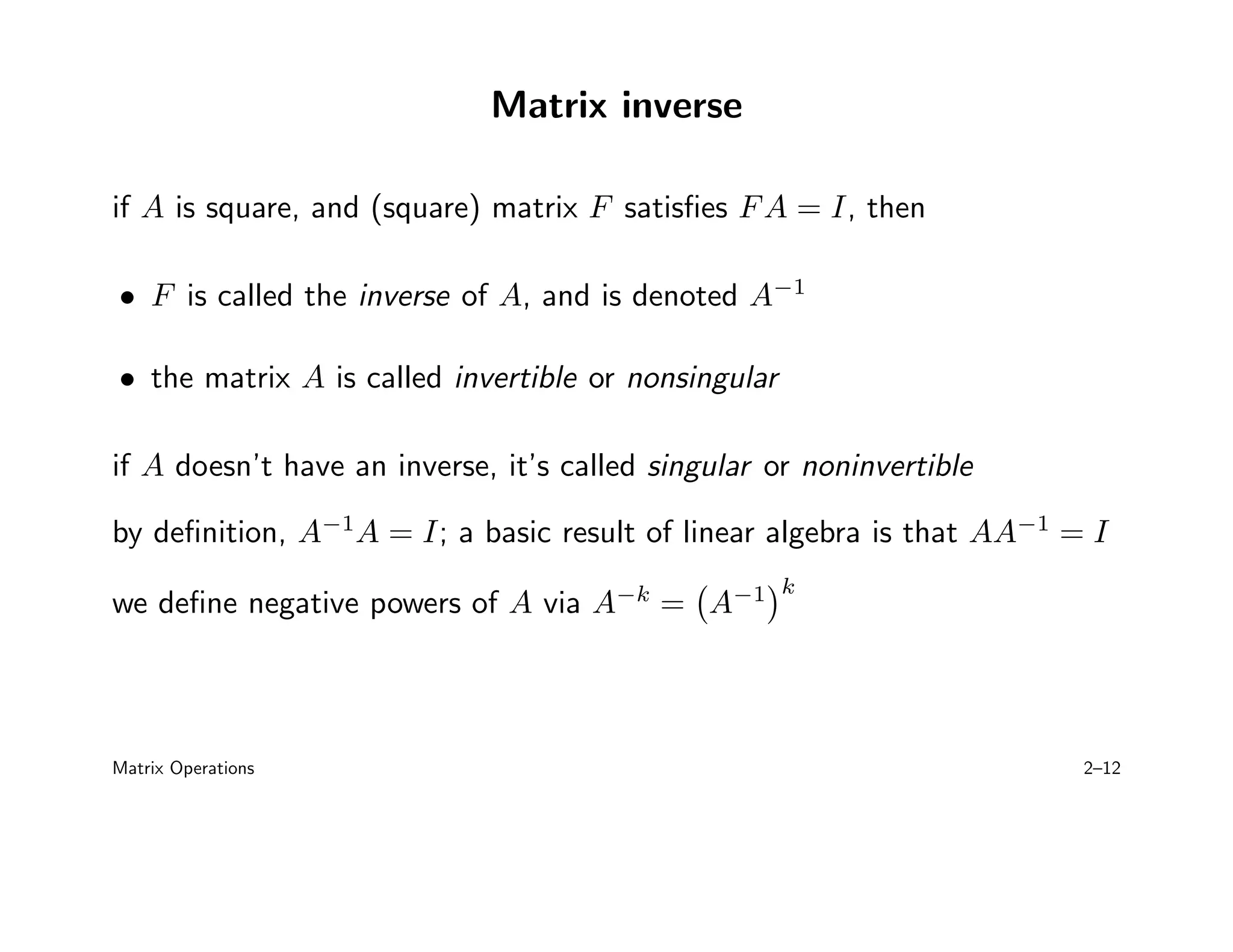
Matrix inverse
if A is square, and (square) matrix F satisfies FA = I, then
• F is called the inverse of A, and is denoted A−1
• the matrix A is called invertible or nonsingular
if A doesn’t have an inverse, it’s called singular or noninvertible
by definition, A−1
A = I; a basic result of linear algebra is that AA−1
= I
we define negative powers of A via A−k
= A−1
k
Matrix Operations 2–12
Examples
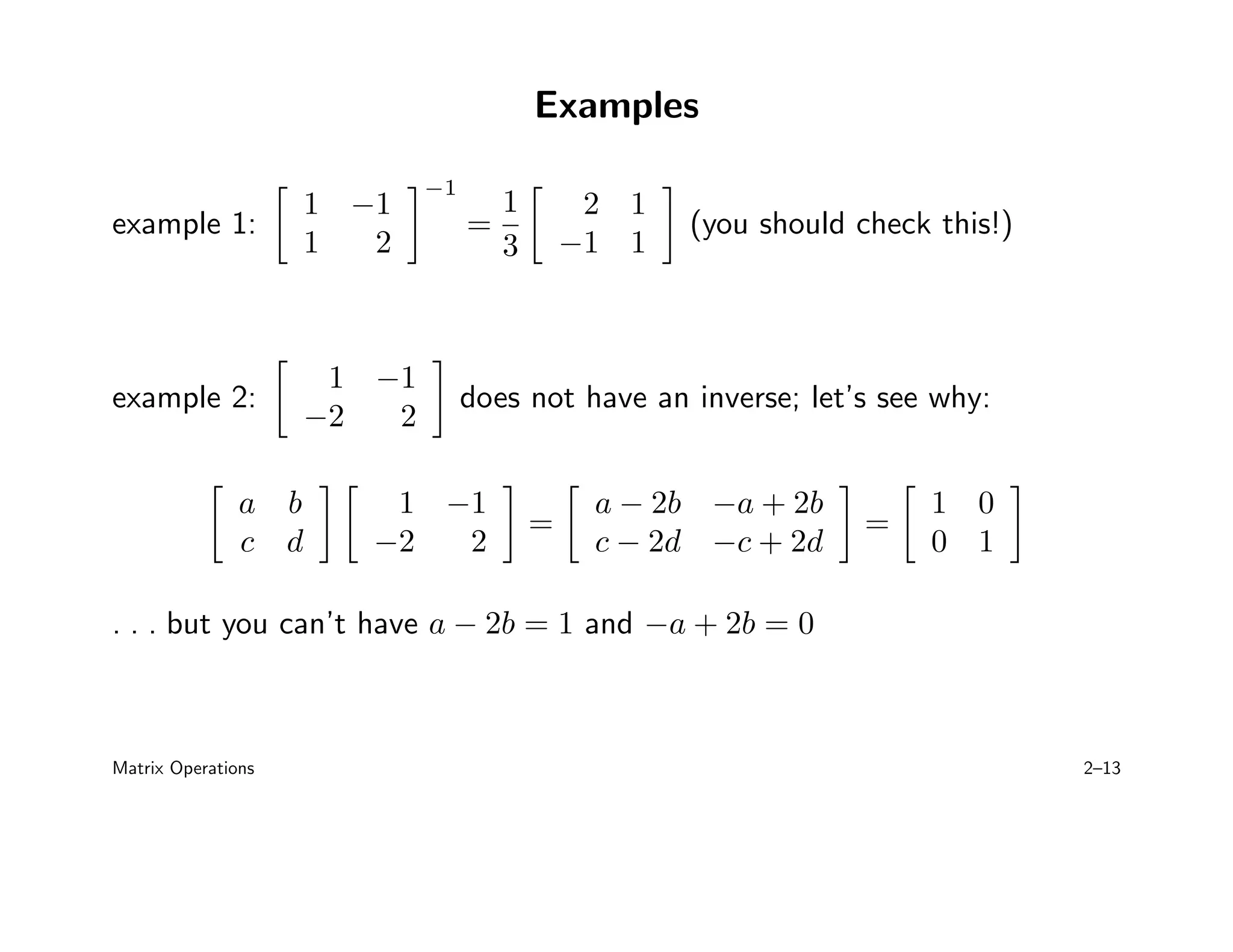
example 1:

1 −1
1 2
−1
=
1
3

2 1
−1 1

(you should check this!)
example 2:

1 −1
−2 2

does not have an inverse; let’s see why:

a b
c d
 
1 −1
−2 2

=

a − 2b −a + 2b
c − 2d −c + 2d

=

1 0
0 1

. . . but you can’t have a − 2b = 1 and −a + 2b = 0
Matrix Operations 2–13
Properties of inverse
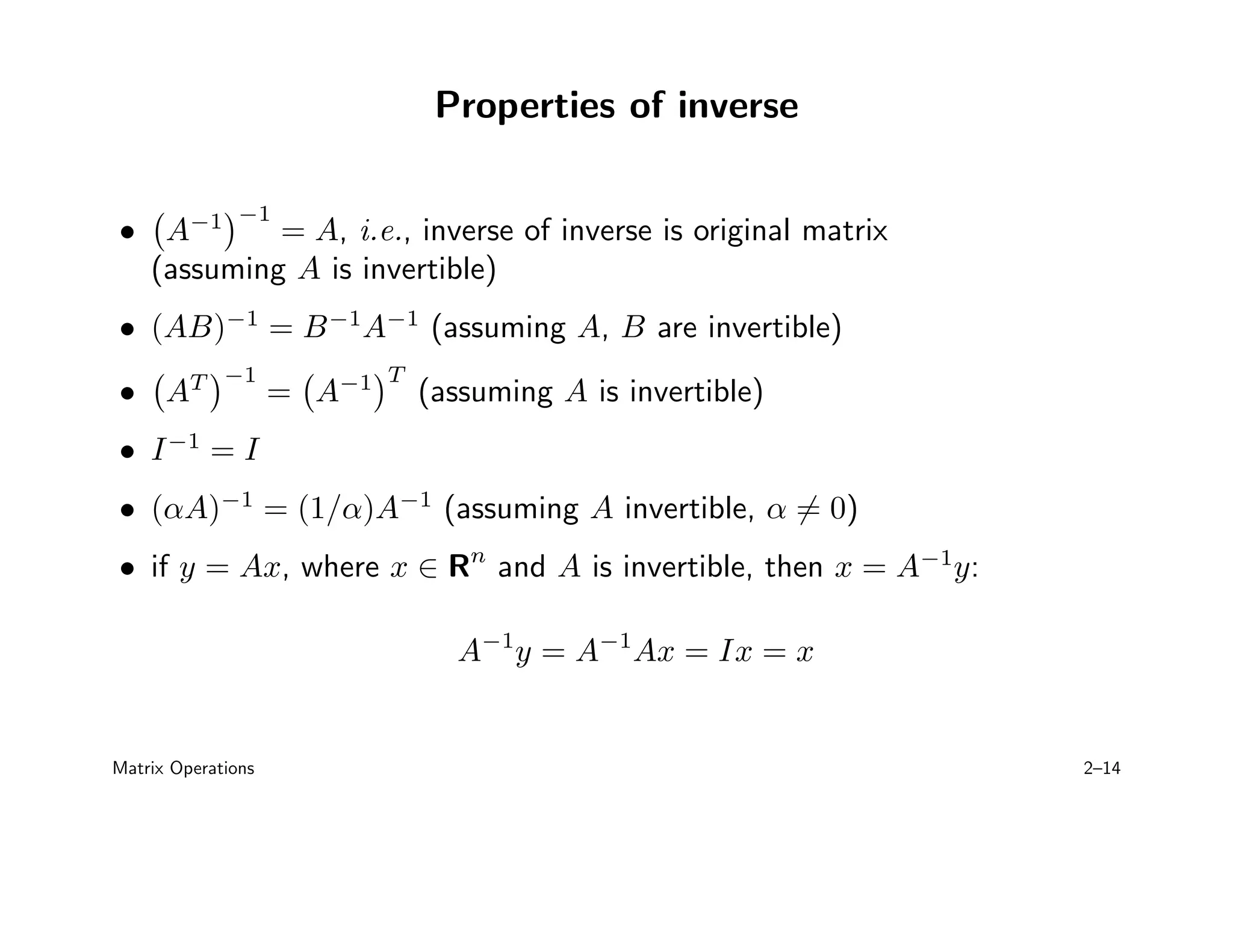
• A−1
−1
= A, i.e., inverse of inverse is original matrix
(assuming A is invertible)
• (AB)−1
= B−1
A−1
(assuming A, B are invertible)
• AT
−1
= A−1
T
(assuming A is invertible)
• I−1
= I
• (αA)−1
= (1/α)A−1
(assuming A invertible, α 6= 0)
• if y = Ax, where x ∈ Rn
and A is invertible, then x = A−1
y:
A−1
y = A−1
Ax = Ix = x
Matrix Operations 2–14
Inverse of 2 × 2 matrix
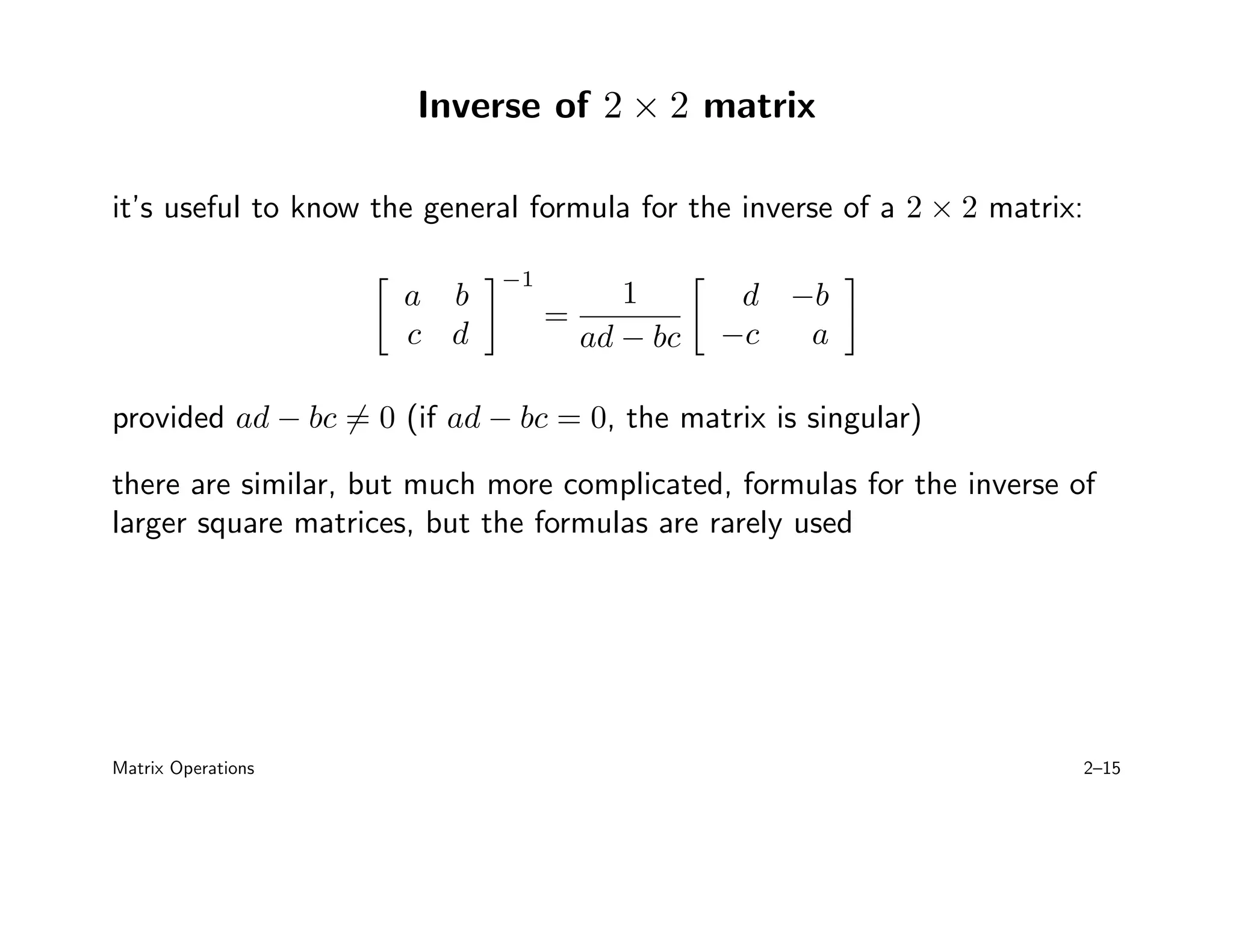
it’s useful to know the general formula for the inverse of a 2 × 2 matrix:

a b
c d
−1
=
1
ad − bc

d −b
−c a

provided ad − bc 6= 0 (if ad − bc = 0, the matrix is singular)
there are similar, but much more complicated, formulas for the inverse of
larger square matrices, but the formulas are rarely used
Matrix Operations 2–15

3.-Matrix.pdf

  • 1.
    Lecture 2 Matrix Operations •transpose, sum & difference, scalar multiplication • matrix multiplication, matrix-vector product • matrix inverse 2–1
  • 2.
    Matrix transpose transpose ofm × n matrix A, denoted AT or A′ , is n × m matrix with AT ij = Aji rows and columns of A are transposed in AT example:   0 4 7 0 3 1   T = 0 7 3 4 0 1 . • transpose converts row vectors to column vectors, vice versa • AT T = A Matrix Operations 2–2
  • 3.
    Matrix addition subtraction if A and B are both m × n, we form A + B by adding corresponding entries example:   0 4 7 0 3 1   +   1 2 2 3 0 4   =   1 6 9 3 3 5   can add row or column vectors same way (but never to each other!) matrix subtraction is similar: 1 6 9 3 − I = 0 6 9 2 (here we had to figure out that I must be 2 × 2) Matrix Operations 2–3
  • 4.
    Properties of matrixaddition • commutative: A + B = B + A • associative: (A + B) + C = A + (B + C), so we can write as A + B + C • A + 0 = 0 + A = A; A − A = 0 • (A + B)T = AT + BT Matrix Operations 2–4
  • 5.
    Scalar multiplication we canmultiply a number (a.k.a. scalar) by a matrix by multiplying every entry of the matrix by the scalar this is denoted by juxtaposition or ·, with the scalar on the left: (−2)   1 6 9 3 6 0   =   −2 −12 −18 −6 −12 0   (sometimes you see scalar multiplication with the scalar on the right) • (α + β)A = αA + βA; (αβ)A = (α)(βA) • α(A + B) = αA + αB • 0 · A = 0; 1 · A = A Matrix Operations 2–5
  • 6.
    Matrix multiplication if Ais m × p and B is p × n we can form C = AB, which is m × n Cij = p X k=1 aikbkj = ai1b1j + · · · + aipbpj, i = 1, . . . , m, j = 1, . . . , n to form AB, #cols of A must equal #rows of B; called compatible • to find i, j entry of the product C = AB, you need the ith row of A and the jth column of B • form product of corresponding entries, e.g., third component of ith row of A and third component of jth column of B • add up all the products Matrix Operations 2–6
  • 7.
    Examples example 1: 1 6 93 0 −1 −1 2 = −6 11 −3 −3 for example, to get 1, 1 entry of product: C11 = A11B11 + A12B21 = (1)(0) + (6)(−1) = −6 example 2: 0 −1 −1 2 1 6 9 3 = −9 −3 17 0 these examples illustrate that matrix multiplication is not (in general) commutative: we don’t (always) have AB = BA Matrix Operations 2–7
  • 8.
    Properties of matrixmultiplication • 0A = 0, A0 = 0 (here 0 can be scalar, or a compatible matrix) • IA = A, AI = A • (AB)C = A(BC), so we can write as ABC • α(AB) = (αA)B, where α is a scalar • A(B + C) = AB + AC, (A + B)C = AC + BC • (AB)T = BT AT Matrix Operations 2–8
  • 9.
    Matrix-vector product very importantspecial case of matrix multiplication: y = Ax • A is an m × n matrix • x is an n-vector • y is an m-vector yi = Ai1x1 + · · · + Ainxn, i = 1, . . . , m can think of y = Ax as • a function that transforms n-vectors into m-vectors • a set of m linear equations relating x to y Matrix Operations 2–9
  • 10.
    Inner product if vis a row n-vector and w is a column n-vector, then vw makes sense, and has size 1 × 1, i.e., is a scalar: vw = v1w1 + · · · + vnwn if x and y are n-vectors, xT y is a scalar called inner product or dot product of x, y, and denoted hx, yi or x · y: hx, yi = xT y = x1y1 + · · · + xnyn (the symbol · can be ambiguous — it can mean dot product, or ordinary matrix product) Matrix Operations 2–10
  • 11.
    Matrix powers if matrixA is square, then product AA makes sense, and is denoted A2 more generally, k copies of A multiplied together gives Ak : Ak = A A · · · A | {z } k by convention we set A0 = I (non-integer powers like A1/2 are tricky — that’s an advanced topic) we have Ak Al = Ak+l Matrix Operations 2–11
  • 12.
    Matrix inverse if Ais square, and (square) matrix F satisfies FA = I, then • F is called the inverse of A, and is denoted A−1 • the matrix A is called invertible or nonsingular if A doesn’t have an inverse, it’s called singular or noninvertible by definition, A−1 A = I; a basic result of linear algebra is that AA−1 = I we define negative powers of A via A−k = A−1 k Matrix Operations 2–12
  • 13.
    Examples example 1: 1 −1 12 −1 = 1 3 2 1 −1 1 (you should check this!) example 2: 1 −1 −2 2 does not have an inverse; let’s see why: a b c d 1 −1 −2 2 = a − 2b −a + 2b c − 2d −c + 2d = 1 0 0 1 . . . but you can’t have a − 2b = 1 and −a + 2b = 0 Matrix Operations 2–13
  • 14.
    Properties of inverse •A−1 −1 = A, i.e., inverse of inverse is original matrix (assuming A is invertible) • (AB)−1 = B−1 A−1 (assuming A, B are invertible) • AT −1 = A−1 T (assuming A is invertible) • I−1 = I • (αA)−1 = (1/α)A−1 (assuming A invertible, α 6= 0) • if y = Ax, where x ∈ Rn and A is invertible, then x = A−1 y: A−1 y = A−1 Ax = Ix = x Matrix Operations 2–14
  • 15.
    Inverse of 2× 2 matrix it’s useful to know the general formula for the inverse of a 2 × 2 matrix: a b c d −1 = 1 ad − bc d −b −c a provided ad − bc 6= 0 (if ad − bc = 0, the matrix is singular) there are similar, but much more complicated, formulas for the inverse of larger square matrices, but the formulas are rarely used Matrix Operations 2–15