MATERNAL
SERUM
SCREENING
M.PRASAD NAIDU
MSC MEDICAL BIOCHEMISTRY,
Ph.D.RESEARCH SCHOLAR
•Second trimester biochemical screening[BCS] started
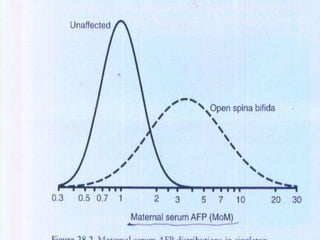
in the 1970’s when it was found that fetal neural tube
defects[NTD’s] were associated with increase in
maternal serum alpha feto protein[MSAFP].
•Such measurements were offered to pregnant woman
for screening purposes.
•While the screening protocols for NTD’s were being
refined, it was noted that MSAFP tended to be low in
fetal down’s syndrome.
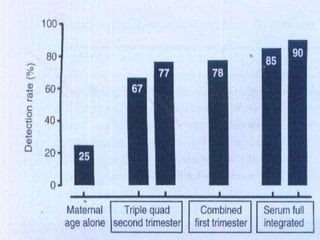
•With a cut off of 2.0 multiples of median[MOM] 85% of
NTD’s would be screened in & with a threshold of 0.5
MOM approx 33% of DS fetus would be screened in.
 With the addition of two other analytes
Estriol [which is low in DS] & Human
chorionic gonadotropin[hCG] [which is
increased in DS] the sensitivity of
biochemical screening for DS rose to
approx 65% across all ages & was over 85%
in those above 35 years of age.
 The most recent addition to the biochemical
screening regimen taking the above “Triple
screen” to “Quad screen” is inhibin A.
 This increases the sensitivity of the
combined test by approx 8%.
•Woman with elevated serum AFP levels were offered
Diagnostic amniotic fluid AFP testing[AFAFP].
•Initially the presence of open spina bifida could be
confirmed only by ultrasound examination of the fetal
spine.
•Now the recommendation is to perform the Triple
marker screen test on all pregnant woman’s between 14
& 20 weeks gestation to assess the risk for neural tube
defects, trisomy 21 & trisomy 18.
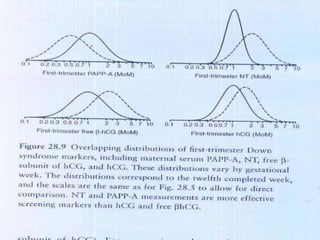
 A further important breakthrough occurred
with the identification of two biochemical
markers [Pregnancy associated plasma protein
A {PAPP-A} ; Free beta subunit of human
chorionic gonadotrophin {βhCG} ] AND
Ultrasound marker [Nuchal Translucency{NT}]
as markers for down’s syndrome & trisomy 18
in the First trimester.
 When used together these markers perform
better than second trimester screening and
have the added advantage of early detection.
 These tests may also aid in the asessment of
risk for obstetric complications such as pre-
eclampsia,abruption,preterm labour & IUGR.
Suggested protocol for screening
1. Measurement of nuchal translucency[NT] & PAPP-A
in the 1st trimester, but not interpreted or acted upon
until the second trimester.
2. In the second trimester a second serum sample is
drawn and Quadruple test performed.
3. Results for all the six tests , NT, PAPP-A, AFP, uE3
, hCG & DIA are combined into a single risk estimate
for interpretation in the 2nd trimester.
4. 85% detection rate for Down’s Syndrome with only
1% false positive is achieved.
•TRIPLE SCREEN TEST
•1.ALPHA FETO PROTEIN
•In 1956,Bergstrand & czar described a protein
in fetal serum,located in the α1 region on
electrophoresis[subsequently labelled as α1-
Feto Protein[AFP] that was not present in
maternal serum.
•It is this unique protein that serves as a
marker for leakage of fetal serum into the
amniotic fluid & which is therefore helpful in
diagnosing open fetal lesions.
•AFP is the major serum protein of fetus
synthesized by the fetal yolk sac & fetal liver
• Gene located on chromosome 4,is
also part of a family of genes that
also encodes for albumin & vitamin
D- binding protein.
.The protein is composed of
carbohydrate & a single
polypeptide chain containing 591
amino acids.
 The molecular weight and structure of
AFP is similar to that of albumin[about
69kd],but antibodies rised against AFP
have virtual no cross reactivity.
 This characteristic was critical in allowing
the development of a veriety of antibody
based assays for reliably measuring AFP
in amniotic fluid & maternal serum.
 The protein is very stable @room
temperature in serum as long as a week.
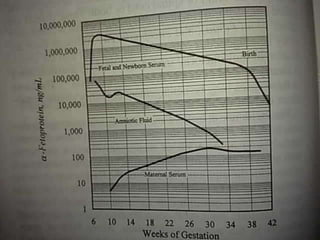
•Maximum concncentration of AFP in
fetal serum~3,000,000ng/ml reaches by 9
wk gestation decreases to 20,000ng/ml
@ term.
•Maternal serum AFP first detectable
[~5ng/ml] at about 10 wk gestation.
•The concentration increases at a rate of
15% per week to a peak at about
~180ng/ml @ 25 wk gestation,decline
slowly till term.
After birth MSAFPdecreases
to less than 2ng/ml.
In infant,serum AFP level
decreases exponentially to
reach adult level by 10th
month of life.
MULTIPLES OF MEDIAN
[MOM]
•To simplify interpretation of the result , each patient AFP result
expressed as a Multiples of Median[MOM].
•Screening programmes should determine the AFP medians for each
week of gestation from 14 to 20 weeks using at least 100 patients at
each week.
METHODS FOR DETERMINING α-Feto Protein.
•TRADITIONALLY MEASURED BY RADIO IMMUNO ASSAY [RIA]
•NEWER METHODS USE IMMUNO ENZYMATIC ASSAYS [IEMA]
•Because of it’s lower detection limits , better precision
, speed, avoidance of radiation & ease of automation.
•The FDA has licenced three immuno assay AFP kits for
use in maternal serum screening for neural tube defects,
1. A monoclonal bead assay
2. A microparticles immuno assay
3. A polyclonal bead assay
•Each assay uses a sandwich design
•A solid phase antibody captures the AFP
present in serum, then, after washing a
second enzyme labelled antibody is
added.After a second wash that removes
unbound labelled antibody, substrate is
added to produce a coloured product.
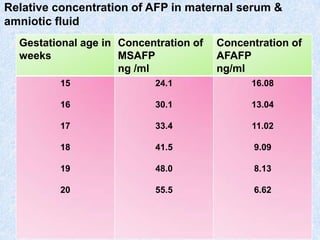
Relative concentration of AFP in maternal serum &
amniotic fluid
Gestational age in
weeks
Concentration of
MSAFP
ng /ml
Concentration of
AFAFP
ng/ml
15
16
17
18
19
20
24.1
30.1
33.4
41.5
48.0
55.5
16.08
13.04
11.02
9.09
8.13
6.62
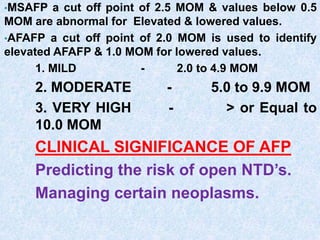
•MSAFP a cut off point of 2.5 MOM & values below 0.5
MOM are abnormal for Elevated & lowered values.
•AFAFP a cut off point of 2.0 MOM is used to identify
elevated AFAFP & 1.0 MOM for lowered values.
1. MILD - 2.0 to 4.9 MOM
2. MODERATE - 5.0 to 9.9 MOM
3. VERY HIGH - > or Equal to
10.0 MOM
CLINICAL SIGNIFICANCE OF AFP
Predicting the risk of open NTD’s.
Managing certain neoplasms.
HUMAN CHORIONIC GONADOTROPHIN[hCG]
 It is a glycoprotein hormone with molecular
weight of 36 to 40 kd that is biologically &
immunologically similer to LH[Leutenizing
hormone] but with a longer half life.
 Produced during normal pregnancy by the
trophoblast & placenta.
 hCG is a hetero dimer having α & β subunits
of which the β subunit is specific for hCG.
 All the glycoprotein
hormones[hCG,LH,FSH,TSH] have a similer
biological activity which is characteristic of
It is because of this similarity that hCG
seems to have a stimulatory effect on
the maternal thyroid in early pregnancy
when hCG levels arehighest.
 The α subunit & carbohydrate components
are required for expression of the biological
activity unique to the β subunit.
 The 28-30 AA on the C-terminal end of the β
subunit of hCG are unique compared with
LH.
In spontaneous pregnancy, hCG
can be detected by the 9th day
after the LH surge.
This initial detection in maternal
blood has been found to
correlate with the implantation of
the blastocyst & specifically with
the moment that lacunae receive
maternal blood.
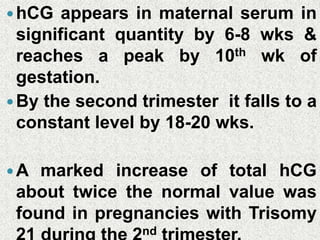
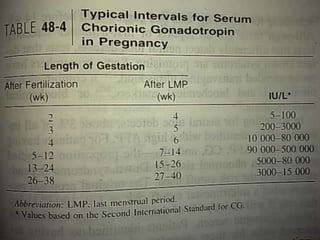
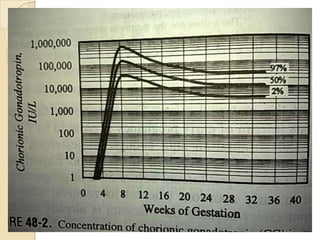
hCG appears in maternal serum in
significant quantity by 6-8 wks &
reaches a peak by 10th wk of
gestation.
By the second trimester it falls to a
constant level by 18-20 wks.
A marked increase of total hCG
about twice the normal value was
found in pregnancies with Trisomy
nd
Free β-hCG was increased
during the 1st trimester in
Trisomy 21[DS] even though
total hCG remained normal.
@16 wk gestation hCG
median level in normal
pregnancy is 20,000 –
METHODS FOR DETERMINING
hCG QUALITATIVE TESTS
1.HOME TEST KITS : MOST COMMONLY USED
PREGNANCY
TESTS.
2.RADIO IMMUNO ASSAY.
3.IMMUNO ENZYMATIC ASSAY[IEMA].
4.IMMUNO RADIOMETRIC ASSAY[IRMA].
QUANTITATIVE TEST : By
IMMUNOCHROMATOGRAPHY
CLINICAL SIGNIFICANCE OF hCG
1. Diagnosis & dating of pregnancy.
2. Predicting the risk of Trisomy 21 & 18.
3. Managing certain neoplasms.
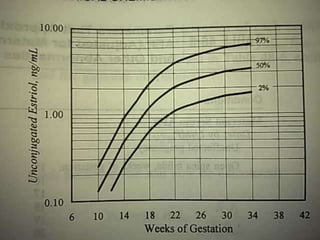
UNCONJUGATED ESTRIOL [uE3]
 Estriol as it’s name implies, is an estrogen with 3
hydroxyl groups [at position 3,16, & 17 ].
3 organs involved in the biosynthesis
1.Fetal adrenal - Cholesterol
2.Fetal liver -
DHEAs[DehydroEpiAndrosteroneSulfate]
3.Placenta - Estriol
Only a minor amount [9%]of the hormone
circulates in plasma unconjugated.
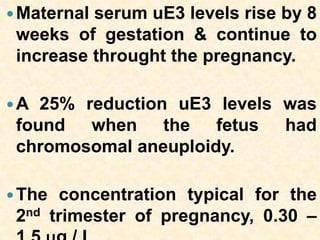
Maternal serum uE3 levels rise by 8
weeks of gestation & continue to
increase throught the pregnancy.
A 25% reduction uE3 levels was
found when the fetus had
chromosomal aneuploidy.
The concentration typical for the
2nd trimester of pregnancy, 0.30 –
METHODS OF DETERMINING UNCONJUGATED
ESTRIOL
By ULTRA SENSITIVE RADIO IMMUNO ASSAY METHOD
The determination of uE3 is the most difficult
The analyte has a concentration lower than & is
lower in molecular weight than AFP & hCG .
The Triple screen has a high detection rate, 80% for
neural tube defecs & 55-60% for chromosomal
aneuploidy & a false positive less than 5 % .
Conditions associated with abnormal maternal
serum screening results
condition AFP hCG uE3
NTD’s VERY
HIGH
- VERY LOW
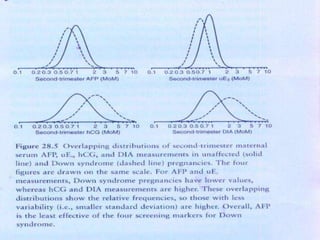
TRISOMY 21
[DOWN’S
SYNDROME]
LOW HIGH LOW
TRISOMY 18
[EDWARDS
SYNDROME]
LOW LOW VERY LOW
THE QUADRUPLE TEST[QUAD
TEST]
 This includes AFP, Ue3, hCG & an additional marker
INHIBIN-A .
 Dimeric Inhibin-A[DIA] is a glycoprotein produced by the
placenta.
 It is a dimer , but with dissimilar subunits α & β.
 Inhibin-A is measurable in maternal serum & has a
feedback effect on FSH secretion.
 The level increases in the 1st trimester until 10 wks & then
remains stable upto 25wks of gestation.
 The DIA levels are increased in DS &
remains elevated throught the second
trimester.
 DIA is an independent variable having no
correlation with maternal age, race, diabetes
mellitus.
 Referance value is 0.7 – 2.5 μg / L . In
unaffected pregnancy at second trimester.
 MSIA - At 14 – 16 wk ---- 150 to 200 pg / ml
 AFIA - At 14 – 16 wk ---- 800 to 1200 pg /
FACTORS AFFECTING THE LEVEL OF THE QUAD
SCREEN
1. Maternal weight was found to have an
inverse relation with the levels of all
four markers.
2. In Diabetes mellitus,AFP was found to
be 40% lower than in non Diabetics.
3. In twin pregnancy, AFP was Higher
than those having singlet fetus.
RATES OF DETCTION OF DOWN’s
SYNDROME
MATERNAL
AGE[YEAR
S]
TRIPLE
TEST
QUADRUP
LE TEST
DETE
CTION
RATE
FALSE
POSITI
VE
RATE
DETE
CTION
RATE
FALSE
POSITI
VE
RATE
15 - 34 58 3.7 69 4.1
>35 88 19 91 17
<15 69 4.9 77 5.2
Pregnancy associated plasma protein – A [PAPP-A]
 Measured in the 1st trimester as an early marker
for Down’s Syndrome.
 PAPP-A is a high molecular weight Zinc containing
metalloprotein.
 It is produced by the trophoblast.
 In addition to being a marker of chromosomal
aneuploidy , it is an indicator of early pregnancy
failure & complications.
 The level of PAPP-A was found to be significantly
lower in pregnancy with trisomy 21 compared to
unaffected pregnancy.
 Persistently lower levels of PAPP-A in second
trimester is indicative of Trisomy 18 .
First trimester Ultrasound findings in
Down syndrome pregnancies
INDICATIONS.
1.Advanced maternal age(>35)
2.Prior pregnancy with a chromosomal
disorder
3.Family H/o mental retardation or Birth
defects.
In his initial description of the
syndrome that bears his name, Langdon
Down described skin which was so
deficient in elasticity that it appeared to be
too large for the body.
This was perticularly evident in the neck
Since that time it has been clearly
demomstrated that,as early as 10
weeks’ gestation,the fetal neck
area is expanded in Down
syndrome.Although all fetuses
demonstrate a small amount of
fluid in the posterior nuchal
area(called nuchal
translucency(NT)) at between 10 &
13 weeks’gestation,fetuses with
Down syndrome will,on
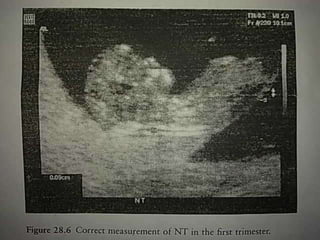
NT is defined as the
maximum fluid-filled space
between the skin of the
posterior fetal neck area &
the underlying strutures.
This area can be measured
by transabdominal
ultrasound in 95% of cases.
Scond trimester ultrasound markers
for Down syndrome.
 An increased nuchal fold is the most
distinctive second trimester marker.
 The distance between the external surface
of the occipital bone & the external surface
of the skin is measured.
 About 35% of Down syndrome fetuses have
a nuchal skinfold measurement that is
greater than 6mm compared with only 0.7%
of unaffected fetuses.
FOLLOW-UP OF PATIENTS WITH SCREEN POSITIVE
RESULTS
1. Genetic counseling if patient is screen positive.
2. For moderately elevated results [ MOM 2-3 ] a
second test should be done .
3. If second test is negative, screen is taken as
negative.
4. If second test is also gives elevated results
further diagnostic testing to be done.
5. Ultra sonography, Amniocentesis & Analysis of
amniotic fluid for Acetyl choline esterase to
confirm neural tube defects.
6. Amniotic fluid AFP results may
give false positive due to
contamination by fetal blood,Hence
confirmed by acetyl choline
esterase.
7. Acetyl choline esterase is not
normally present in amniotic fluid
but appears in open neural tube
defects.
8. In cases of suspected
chromosomal aneuploidy, fetal
ACETYL CHOLINE ESTERASE
 AChE is a neuronally derived protein.
 Measurements of AChE in amniotic fluid
also used to significantly improve the
ability to distinguish between affected &
unaffected pregnancies.
 DETERMINED BY GEL-
ELECTROPHORESIS.
 This approach has not only proved to be
highly sensitive at detecting open neural
tube defects [99% anencephaly cases &
98% of open spina bifida cases with
positive AFP results ].
KEY POINTS
1. In 1956, a fetal-specific protein (alpha-
fetoprotein or AFP ) was discovered in fetal
serum.
2. Elevated AFP in second-trimester amniotic
fluid is strong indicator of the presence of
a fetal open neural tube defect (NTD).
3. AFP levels in maternal serum can be used
as a screening (but not diagnostic) test for
open NTD’s in the second trimester.
4. AFP measurements in both amniotic fluid
and maternal serum very with gestation.
5. They are routenely expressed as a multiple
of median (MOM) AFP value found in
unaffected pregnancies of the same
gestational age.
6. Beginning in the 1970s, a woman’s age was
used as a determinant in screening for
Down syndrome, with those aged 35 and
older being offered amniocentesis and
karyotyping.
7. In 1984, reduced levels of maternal serum AFP in
the second trimester were reported in Down
syndrome pregnancies.
8. Second trimester multiple marker screening is
also able to identify 60% of Trisomy 18
pregnancies.
9. At about the same time, ultrasound
measurements of nuchal translucency (NT)
thickness > 5 mm (at between 11 and 13
completed gestational weeks ) were found to be
the best single marker for Down syndrome.
10. Combining [NT ]measurement with biochemical
markers (combined testing ) in the first trimester
THANK YOU

Maternal serum screening

  • 1.
    MATERNAL SERUM SCREENING M.PRASAD NAIDU MSC MEDICALBIOCHEMISTRY, Ph.D.RESEARCH SCHOLAR
  • 2.
    •Second trimester biochemicalscreening[BCS] started in the 1970’s when it was found that fetal neural tube defects[NTD’s] were associated with increase in maternal serum alpha feto protein[MSAFP]. •Such measurements were offered to pregnant woman for screening purposes. •While the screening protocols for NTD’s were being refined, it was noted that MSAFP tended to be low in fetal down’s syndrome. •With a cut off of 2.0 multiples of median[MOM] 85% of NTD’s would be screened in & with a threshold of 0.5 MOM approx 33% of DS fetus would be screened in.
  • 3.
     With theaddition of two other analytes Estriol [which is low in DS] & Human chorionic gonadotropin[hCG] [which is increased in DS] the sensitivity of biochemical screening for DS rose to approx 65% across all ages & was over 85% in those above 35 years of age.  The most recent addition to the biochemical screening regimen taking the above “Triple screen” to “Quad screen” is inhibin A.  This increases the sensitivity of the combined test by approx 8%.
  • 4.
    •Woman with elevatedserum AFP levels were offered Diagnostic amniotic fluid AFP testing[AFAFP]. •Initially the presence of open spina bifida could be confirmed only by ultrasound examination of the fetal spine. •Now the recommendation is to perform the Triple marker screen test on all pregnant woman’s between 14 & 20 weeks gestation to assess the risk for neural tube defects, trisomy 21 & trisomy 18.
  • 5.
     A furtherimportant breakthrough occurred with the identification of two biochemical markers [Pregnancy associated plasma protein A {PAPP-A} ; Free beta subunit of human chorionic gonadotrophin {βhCG} ] AND Ultrasound marker [Nuchal Translucency{NT}] as markers for down’s syndrome & trisomy 18 in the First trimester.  When used together these markers perform better than second trimester screening and have the added advantage of early detection.  These tests may also aid in the asessment of risk for obstetric complications such as pre- eclampsia,abruption,preterm labour & IUGR.
  • 6.
    Suggested protocol forscreening 1. Measurement of nuchal translucency[NT] & PAPP-A in the 1st trimester, but not interpreted or acted upon until the second trimester. 2. In the second trimester a second serum sample is drawn and Quadruple test performed. 3. Results for all the six tests , NT, PAPP-A, AFP, uE3 , hCG & DIA are combined into a single risk estimate for interpretation in the 2nd trimester. 4. 85% detection rate for Down’s Syndrome with only 1% false positive is achieved.
  • 7.
    •TRIPLE SCREEN TEST •1.ALPHAFETO PROTEIN •In 1956,Bergstrand & czar described a protein in fetal serum,located in the α1 region on electrophoresis[subsequently labelled as α1- Feto Protein[AFP] that was not present in maternal serum. •It is this unique protein that serves as a marker for leakage of fetal serum into the amniotic fluid & which is therefore helpful in diagnosing open fetal lesions. •AFP is the major serum protein of fetus synthesized by the fetal yolk sac & fetal liver
  • 8.
    • Gene locatedon chromosome 4,is also part of a family of genes that also encodes for albumin & vitamin D- binding protein. .The protein is composed of carbohydrate & a single polypeptide chain containing 591 amino acids.
  • 9.
     The molecularweight and structure of AFP is similar to that of albumin[about 69kd],but antibodies rised against AFP have virtual no cross reactivity.  This characteristic was critical in allowing the development of a veriety of antibody based assays for reliably measuring AFP in amniotic fluid & maternal serum.  The protein is very stable @room temperature in serum as long as a week.
  • 11.
    •Maximum concncentration ofAFP in fetal serum~3,000,000ng/ml reaches by 9 wk gestation decreases to 20,000ng/ml @ term. •Maternal serum AFP first detectable [~5ng/ml] at about 10 wk gestation. •The concentration increases at a rate of 15% per week to a peak at about ~180ng/ml @ 25 wk gestation,decline slowly till term.
  • 12.
    After birth MSAFPdecreases toless than 2ng/ml. In infant,serum AFP level decreases exponentially to reach adult level by 10th month of life.
  • 14.
    MULTIPLES OF MEDIAN [MOM] •Tosimplify interpretation of the result , each patient AFP result expressed as a Multiples of Median[MOM]. •Screening programmes should determine the AFP medians for each week of gestation from 14 to 20 weeks using at least 100 patients at each week.
  • 15.
    METHODS FOR DETERMININGα-Feto Protein. •TRADITIONALLY MEASURED BY RADIO IMMUNO ASSAY [RIA] •NEWER METHODS USE IMMUNO ENZYMATIC ASSAYS [IEMA] •Because of it’s lower detection limits , better precision , speed, avoidance of radiation & ease of automation. •The FDA has licenced three immuno assay AFP kits for use in maternal serum screening for neural tube defects, 1. A monoclonal bead assay 2. A microparticles immuno assay 3. A polyclonal bead assay
  • 16.
    •Each assay usesa sandwich design •A solid phase antibody captures the AFP present in serum, then, after washing a second enzyme labelled antibody is added.After a second wash that removes unbound labelled antibody, substrate is added to produce a coloured product.
  • 17.
    Relative concentration ofAFP in maternal serum & amniotic fluid Gestational age in weeks Concentration of MSAFP ng /ml Concentration of AFAFP ng/ml 15 16 17 18 19 20 24.1 30.1 33.4 41.5 48.0 55.5 16.08 13.04 11.02 9.09 8.13 6.62
  • 18.
    •MSAFP a cutoff point of 2.5 MOM & values below 0.5 MOM are abnormal for Elevated & lowered values. •AFAFP a cut off point of 2.0 MOM is used to identify elevated AFAFP & 1.0 MOM for lowered values. 1. MILD - 2.0 to 4.9 MOM 2. MODERATE - 5.0 to 9.9 MOM 3. VERY HIGH - > or Equal to 10.0 MOM CLINICAL SIGNIFICANCE OF AFP Predicting the risk of open NTD’s. Managing certain neoplasms.
  • 19.
    HUMAN CHORIONIC GONADOTROPHIN[hCG] It is a glycoprotein hormone with molecular weight of 36 to 40 kd that is biologically & immunologically similer to LH[Leutenizing hormone] but with a longer half life.  Produced during normal pregnancy by the trophoblast & placenta.  hCG is a hetero dimer having α & β subunits of which the β subunit is specific for hCG.  All the glycoprotein hormones[hCG,LH,FSH,TSH] have a similer biological activity which is characteristic of
  • 20.
    It is becauseof this similarity that hCG seems to have a stimulatory effect on the maternal thyroid in early pregnancy when hCG levels arehighest.  The α subunit & carbohydrate components are required for expression of the biological activity unique to the β subunit.  The 28-30 AA on the C-terminal end of the β subunit of hCG are unique compared with LH.
  • 21.
    In spontaneous pregnancy,hCG can be detected by the 9th day after the LH surge. This initial detection in maternal blood has been found to correlate with the implantation of the blastocyst & specifically with the moment that lacunae receive maternal blood.
  • 22.
    hCG appears inmaternal serum in significant quantity by 6-8 wks & reaches a peak by 10th wk of gestation. By the second trimester it falls to a constant level by 18-20 wks. A marked increase of total hCG about twice the normal value was found in pregnancies with Trisomy nd
  • 24.
    Free β-hCG wasincreased during the 1st trimester in Trisomy 21[DS] even though total hCG remained normal. @16 wk gestation hCG median level in normal pregnancy is 20,000 –
  • 26.
    METHODS FOR DETERMINING hCGQUALITATIVE TESTS 1.HOME TEST KITS : MOST COMMONLY USED PREGNANCY TESTS. 2.RADIO IMMUNO ASSAY. 3.IMMUNO ENZYMATIC ASSAY[IEMA]. 4.IMMUNO RADIOMETRIC ASSAY[IRMA]. QUANTITATIVE TEST : By IMMUNOCHROMATOGRAPHY CLINICAL SIGNIFICANCE OF hCG 1. Diagnosis & dating of pregnancy. 2. Predicting the risk of Trisomy 21 & 18. 3. Managing certain neoplasms.
  • 27.
    UNCONJUGATED ESTRIOL [uE3] Estriol as it’s name implies, is an estrogen with 3 hydroxyl groups [at position 3,16, & 17 ]. 3 organs involved in the biosynthesis 1.Fetal adrenal - Cholesterol 2.Fetal liver - DHEAs[DehydroEpiAndrosteroneSulfate] 3.Placenta - Estriol Only a minor amount [9%]of the hormone circulates in plasma unconjugated.
  • 28.
    Maternal serum uE3levels rise by 8 weeks of gestation & continue to increase throught the pregnancy. A 25% reduction uE3 levels was found when the fetus had chromosomal aneuploidy. The concentration typical for the 2nd trimester of pregnancy, 0.30 –
  • 30.
    METHODS OF DETERMININGUNCONJUGATED ESTRIOL By ULTRA SENSITIVE RADIO IMMUNO ASSAY METHOD The determination of uE3 is the most difficult The analyte has a concentration lower than & is lower in molecular weight than AFP & hCG .
  • 31.
    The Triple screenhas a high detection rate, 80% for neural tube defecs & 55-60% for chromosomal aneuploidy & a false positive less than 5 % . Conditions associated with abnormal maternal serum screening results condition AFP hCG uE3 NTD’s VERY HIGH - VERY LOW TRISOMY 21 [DOWN’S SYNDROME] LOW HIGH LOW TRISOMY 18 [EDWARDS SYNDROME] LOW LOW VERY LOW
  • 33.
    THE QUADRUPLE TEST[QUAD TEST] This includes AFP, Ue3, hCG & an additional marker INHIBIN-A .  Dimeric Inhibin-A[DIA] is a glycoprotein produced by the placenta.  It is a dimer , but with dissimilar subunits α & β.  Inhibin-A is measurable in maternal serum & has a feedback effect on FSH secretion.  The level increases in the 1st trimester until 10 wks & then remains stable upto 25wks of gestation.
  • 34.
     The DIAlevels are increased in DS & remains elevated throught the second trimester.  DIA is an independent variable having no correlation with maternal age, race, diabetes mellitus.  Referance value is 0.7 – 2.5 μg / L . In unaffected pregnancy at second trimester.  MSIA - At 14 – 16 wk ---- 150 to 200 pg / ml  AFIA - At 14 – 16 wk ---- 800 to 1200 pg /
  • 35.
    FACTORS AFFECTING THELEVEL OF THE QUAD SCREEN 1. Maternal weight was found to have an inverse relation with the levels of all four markers. 2. In Diabetes mellitus,AFP was found to be 40% lower than in non Diabetics. 3. In twin pregnancy, AFP was Higher than those having singlet fetus.
  • 36.
    RATES OF DETCTIONOF DOWN’s SYNDROME MATERNAL AGE[YEAR S] TRIPLE TEST QUADRUP LE TEST DETE CTION RATE FALSE POSITI VE RATE DETE CTION RATE FALSE POSITI VE RATE 15 - 34 58 3.7 69 4.1 >35 88 19 91 17 <15 69 4.9 77 5.2
  • 37.
    Pregnancy associated plasmaprotein – A [PAPP-A]  Measured in the 1st trimester as an early marker for Down’s Syndrome.  PAPP-A is a high molecular weight Zinc containing metalloprotein.  It is produced by the trophoblast.  In addition to being a marker of chromosomal aneuploidy , it is an indicator of early pregnancy failure & complications.  The level of PAPP-A was found to be significantly lower in pregnancy with trisomy 21 compared to unaffected pregnancy.  Persistently lower levels of PAPP-A in second trimester is indicative of Trisomy 18 .
  • 39.
    First trimester Ultrasoundfindings in Down syndrome pregnancies INDICATIONS. 1.Advanced maternal age(>35) 2.Prior pregnancy with a chromosomal disorder 3.Family H/o mental retardation or Birth defects. In his initial description of the syndrome that bears his name, Langdon Down described skin which was so deficient in elasticity that it appeared to be too large for the body. This was perticularly evident in the neck
  • 40.
    Since that timeit has been clearly demomstrated that,as early as 10 weeks’ gestation,the fetal neck area is expanded in Down syndrome.Although all fetuses demonstrate a small amount of fluid in the posterior nuchal area(called nuchal translucency(NT)) at between 10 & 13 weeks’gestation,fetuses with Down syndrome will,on
  • 41.
    NT is definedas the maximum fluid-filled space between the skin of the posterior fetal neck area & the underlying strutures. This area can be measured by transabdominal ultrasound in 95% of cases.
  • 43.
    Scond trimester ultrasoundmarkers for Down syndrome.  An increased nuchal fold is the most distinctive second trimester marker.  The distance between the external surface of the occipital bone & the external surface of the skin is measured.  About 35% of Down syndrome fetuses have a nuchal skinfold measurement that is greater than 6mm compared with only 0.7% of unaffected fetuses.
  • 44.
    FOLLOW-UP OF PATIENTSWITH SCREEN POSITIVE RESULTS 1. Genetic counseling if patient is screen positive. 2. For moderately elevated results [ MOM 2-3 ] a second test should be done . 3. If second test is negative, screen is taken as negative. 4. If second test is also gives elevated results further diagnostic testing to be done. 5. Ultra sonography, Amniocentesis & Analysis of amniotic fluid for Acetyl choline esterase to confirm neural tube defects.
  • 45.
    6. Amniotic fluidAFP results may give false positive due to contamination by fetal blood,Hence confirmed by acetyl choline esterase. 7. Acetyl choline esterase is not normally present in amniotic fluid but appears in open neural tube defects. 8. In cases of suspected chromosomal aneuploidy, fetal
  • 46.
    ACETYL CHOLINE ESTERASE AChE is a neuronally derived protein.  Measurements of AChE in amniotic fluid also used to significantly improve the ability to distinguish between affected & unaffected pregnancies.  DETERMINED BY GEL- ELECTROPHORESIS.  This approach has not only proved to be highly sensitive at detecting open neural tube defects [99% anencephaly cases & 98% of open spina bifida cases with positive AFP results ].
  • 47.
    KEY POINTS 1. In1956, a fetal-specific protein (alpha- fetoprotein or AFP ) was discovered in fetal serum. 2. Elevated AFP in second-trimester amniotic fluid is strong indicator of the presence of a fetal open neural tube defect (NTD). 3. AFP levels in maternal serum can be used as a screening (but not diagnostic) test for open NTD’s in the second trimester.
  • 48.
    4. AFP measurementsin both amniotic fluid and maternal serum very with gestation. 5. They are routenely expressed as a multiple of median (MOM) AFP value found in unaffected pregnancies of the same gestational age. 6. Beginning in the 1970s, a woman’s age was used as a determinant in screening for Down syndrome, with those aged 35 and older being offered amniocentesis and karyotyping.
  • 49.
    7. In 1984,reduced levels of maternal serum AFP in the second trimester were reported in Down syndrome pregnancies. 8. Second trimester multiple marker screening is also able to identify 60% of Trisomy 18 pregnancies. 9. At about the same time, ultrasound measurements of nuchal translucency (NT) thickness > 5 mm (at between 11 and 13 completed gestational weeks ) were found to be the best single marker for Down syndrome. 10. Combining [NT ]measurement with biochemical markers (combined testing ) in the first trimester
  • 51.