1Copyright © 2014 Well Woman Clinic. All rights reserved.
Maternal Serum Screening:
Advancements
Dr Nupur Gupta
Department of Obstetrics &
Gynecology
2Copyright © 2014 Well Woman Clinic. All rights reserved.
3Copyright © 2014 Well Woman Clinic. All rights reserved.
What is a screening test?
 These tests DO NOT diagnose a problem; they only signal that
further testing should be done.
 As diagnostic tests tend to be more expensive and have a degree of
risk; screening tests are quick and easy to do.
 Screening tests have a greater chance of being wrong; there are
“false-positive” (test indicates the baby has the condition when the
baby really does not) and “false-negatives” (baby has the condition
but the test indicates they do not).
4Copyright © 2014 Well Woman Clinic. All rights reserved.
 Most babies are born healthy
 About 4 in 100 will be born with a birth defect
 Type of tests: SCREENING & DIAGNOSTIC
 Genetic Counseling
Introduction to Prenatal Screening
5Copyright © 2014 Well Woman Clinic. All rights reserved.
What is Maternal Serum Screening?
 Measurement of proteins produced by fetus or placenta
 Results are calculated relative to population standards
(MoMs)
 Screening tests do not look only at results from the
blood test
 They compare a number of different factors (including
age, ethnicity, results from blood tests, etc...) and then
estimate what are a person’s chances of having an
abnormality
6Copyright © 2014 Well Woman Clinic. All rights reserved.
 It is a prenatal screening test
 Offered in first (9 to 13+6 weeks) and second
trimester (14 to 22 weeks)
 It gives an estimate of the risk but doesn’t give a
definitive diagnosis
What is this test?
7Copyright © 2014 Well Woman Clinic. All rights reserved. 7
What is Fetal Aneuploidy?
Aneuploidy is having one or more extra or
missing chromosomes, leading to an
unbalanced chromosome number in a cell
8Copyright © 2014 Well Woman Clinic. All rights reserved.
 FIRST TRIMESTER SCREEN
 TRIPLE SCREEN
 QUADRUPLE SCREEN
 PENTA SCREEN
 INTEGRATED SCREENING
 SEQUENTIAL SCREENING
SINGLE SCREENING TESTS
COMBINED FIRST & SECOND
TRIMESTER SCREENING
TYPES OF SCREENING
9Copyright © 2014 Well Woman Clinic. All rights reserved.
 To detect the risk of having a baby with
chromosomal abnormality
 Risk of developing early onset preeclampsia
Why maternal serum screen?
10Copyright © 2014 Well Woman Clinic. All rights reserved.
Why Maternal Serum Screen ?
 Provides a non-invasive method to identify pregnancies at risk
for birth defects rather than performing Chorionic Villous
Sampling (CVS) or Amniocentesis in every case
 Fewer invasive procedures will be required to identify an
aneuploid fetus in patients who have screening
 Individual patient risk is affected by parental age,
medical/pregnancy history, family history of hereditary
disease, mental retardation, or birth defects
11Copyright © 2014 Well Woman Clinic. All rights reserved.
All women; choice depends upon
Desire for information before delivery
Prior obstetric history
Family history
Number of foetuses
Availability of reliable NT measurement
Cost of screening
Options for pregnancy care or termination for an
abnormal diagnostic test result
Who should be offered screening
for aneuploidy?
12Copyright © 2014 Well Woman Clinic. All rights reserved. 12
13Copyright © 2014 Well Woman Clinic. All rights reserved.
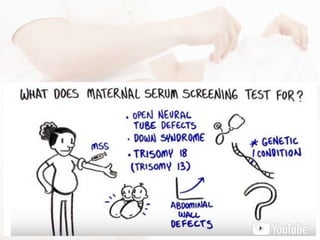
 Down’s syndrome
 Edward’s syndrome
 Patau syndrome
 Down’s syndrome
 Edward’s syndrome
 Neural tube defects
First Trimester Second Trimester
What conditions do these tests look for?
14Copyright © 2014 Well Woman Clinic. All rights reserved.
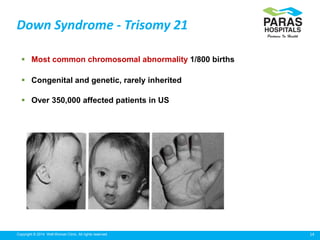
Down Syndrome - Trisomy 21
 Most common chromosomal abnormality 1/800 births
 Congenital and genetic, rarely inherited
 Over 350,000 affected patients in US
15Copyright © 2014 Well Woman Clinic. All rights reserved.
Down Syndrome - Trisomy 21
 JLH Down first described it in 1866
 “Observations on an ethnic classification of idiots”
– Average life expectancy 30 years
– Characteristic phenotype
– Learning disability (IQ 20-60)
– Developmental delay
– Delayed puberty / Early menopause
 Major Causes of Morbidity & Mortality
– > 50% visual or hearing impairment
– 30-50% minor to severe heart defects
– 10-20% intestinal malformations
 Others: leukemia-thyroid disease-presenile dementia….
16Copyright © 2014 Well Woman Clinic. All rights reserved.
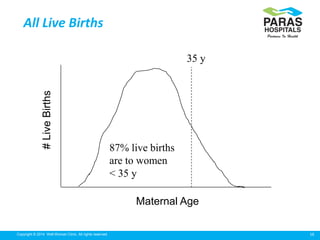
All Live Births
Maternal Age
35 y
87% live births
are to women
< 35 y
#LiveBirths
17Copyright © 2014 Well Woman Clinic. All rights reserved.
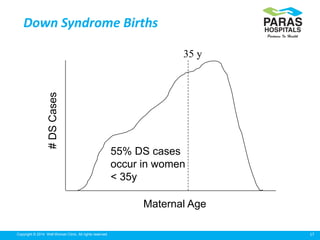
Down Syndrome Births
35 y
Maternal Age
#DSCases
55% DS cases
occur in women
< 35y
18Copyright © 2014 Well Woman Clinic. All rights reserved.
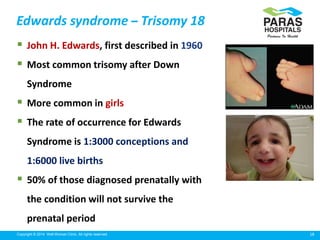
Edwards syndrome – Trisomy 18
 John H. Edwards, first described in 1960
 Most common trisomy after Down
Syndrome
 More common in girls
 The rate of occurrence for Edwards
Syndrome is 1:3000 conceptions and
1:6000 live births
 50% of those diagnosed prenatally with
the condition will not survive the
prenatal period
19Copyright © 2014 Well Woman Clinic. All rights reserved.
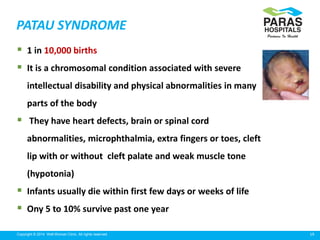
PATAU SYNDROME
 1 in 10,000 births
 It is a chromosomal condition associated with severe
intellectual disability and physical abnormalities in many
parts of the body
 They have heart defects, brain or spinal cord
abnormalities, microphthalmia, extra fingers or toes, cleft
lip with or without cleft palate and weak muscle tone
(hypotonia)
 Infants usually die within first few days or weeks of life
 Ony 5 to 10% survive past one year
20Copyright © 2014 Well Woman Clinic. All rights reserved.
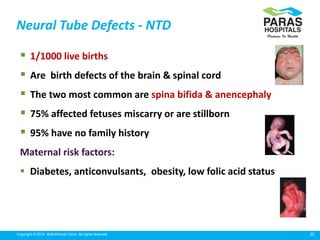
Neural Tube Defects - NTD
 1/1000 live births
 Are birth defects of the brain & spinal cord
 The two most common are spina bifida & anencephaly
 75% affected fetuses miscarry or are stillborn
 95% have no family history
Maternal risk factors:
 Diabetes, anticonvulsants, obesity, low folic acid status
21Copyright © 2014 Well Woman Clinic. All rights reserved.
To obtain a complete report…
Patient’s date of birth (not chronological age)
Specimen collection date
Gestational age (Ultrasound report)
Weight at the time of sample collection
 Race
Insulin-dependent diabetes status prior to the pregnancy
Whether this is a repeat sample
Number of fetuses
History of NTD
22Copyright © 2014 Well Woman Clinic. All rights reserved.
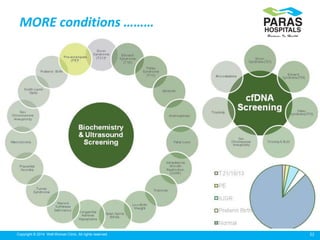
MORE conditions ………
23Copyright © 2014 Well Woman Clinic. All rights reserved.
 Blood tests
 Ultrasound
SCREENING TESTS (Noninvasive)
24Copyright © 2014 Well Woman Clinic. All rights reserved. 24
Role of Ultrasound: Soft markers
 First trimester increased NT: congenital heart &
abdominal wall defects, diaphragmatic hernia
 Second trimester scan detects only 50 to 60% of
Down’s syndrome fetuses
 Third trimester followup: isolated renal pelvis
dilatation, echogenic bowel, or shortened humerus
or femur
25Copyright © 2014 Well Woman Clinic. All rights reserved.
 When there is a family history of a particular
condition
 Screening tests show an increased risk of a particular
condition
 Fetal anomaly scan is abnormal
 A woman more than 37 years who does not choose
to have screening
Diagnostic Tests: Amniocentensis/
Chorionic villous sampling
26Copyright © 2014 Well Woman Clinic. All rights reserved.
27Copyright © 2014 Well Woman Clinic. All rights reserved.
ACOG Recommendations (2007)
 All pregnancies have baseline risk of major malformations and
congenital disorders: approx 3% of newborns have congenital
malformation
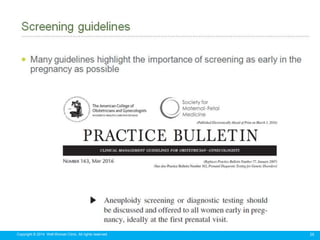
 Ideally, all women should be offered aneuploidy screening
before 20 weeks of gestation, regardless of age
 The goal is to offer screening tests with high detection rates
and low false-positive rates
28Copyright © 2014 Well Woman Clinic. All rights reserved.
 PAPP A, Free Beta HCG
 Nuchal Translucency
 Maternal age, weight & gestation
First Trimester (11 to 13+6 weeks)
29Copyright © 2014 Well Woman Clinic. All rights reserved.
 It is the collection of fluid under the skin at the
back of baby's neck.
 The amount of fluid is measured during a nuchal
translucency (NT) ultrasound scan
What is Nuchal Translucency (NT)?
30Copyright © 2014 Well Woman Clinic. All rights reserved.
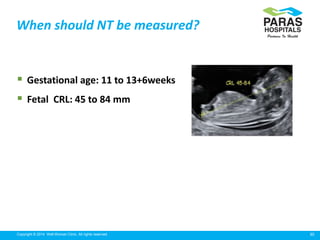
 Gestational age: 11 to 13+6weeks
 Fetal CRL: 45 to 84 mm
When should NT be measured?
31Copyright © 2014 Well Woman Clinic. All rights reserved.
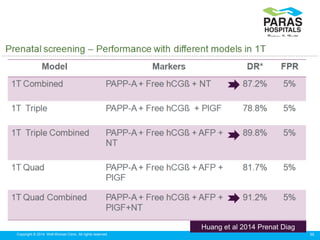
 First trimester Combined
(PAPP-A + Free beta HCG + NT)
 First trimester Triple Combined
(PAPP-A + Free beta HCG + NT + AFP)
 First Trimester Quad Combined
(PAPP-A + Free beta HCG + NT + PlGF +AFP)
 Triple marker
(Free beta HCG + AFP + uE3)
 Quadruple marker
(Free beta HCG + AFP + uE3 +
Inhibin A)
First Trimester Second Trimester
Different models for Prenatal Screening
32Copyright © 2014 Well Woman Clinic. All rights reserved.
 Protein produced in the baby’s liver during the
second trimester of pregnancy.
 The levels of AFP generally increase in the
pregnancy & in Open Neural Tube Defects, such as
spina bifida, levels are very high
 AFP levels tend to be lower than average in babies
who have Down syndrome or trisomy 18.
Maternal Serum Alpha Fetoprotein
(MSAFP)
33Copyright © 2014 Well Woman Clinic. All rights reserved.
 It is produced by the placenta and crosses into mom’s
blood stream
 Its levels rise about mid-pregnancy and then begin to
decline
 Babies with Down syndrome tend to have higher than
average levels of hCG
 Babies with trisomy 18 tend to have lower than
average levels of hCG
hCG or Human Chorionic Gonadotropin
34Copyright © 2014 Well Woman Clinic. All rights reserved.
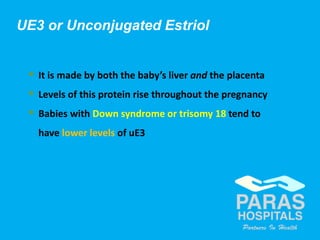
 It is made by both the baby’s liver and the placenta
 Levels of this protein rise throughout the pregnancy
 Babies with Down syndrome or trisomy 18 tend to
have lower levels of uE3
UE3 or Unconjugated Estriol
35Copyright © 2014 Well Woman Clinic. All rights reserved.
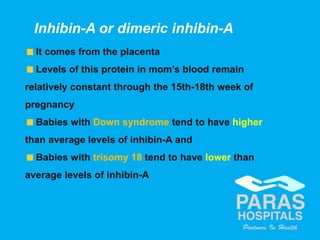
It comes from the placenta
Levels of this protein in mom’s blood remain
relatively constant through the 15th-18th week of
pregnancy
Babies with Down syndrome tend to have higher
than average levels of inhibin-A and
Babies with trisomy 18 tend to have lower than
average levels of inhibin-A
Inhibin-A or dimeric inhibin-A
36Copyright © 2014 Well Woman Clinic. All rights reserved.
Huang et al 2014 Prenat Diag
37Copyright © 2014 Well Woman Clinic. All rights reserved.
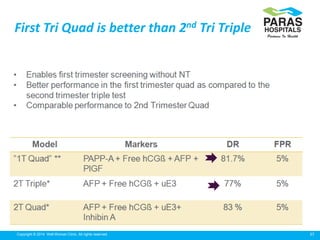
First Tri Quad is better than 2nd Tri Triple
38Copyright © 2014 Well Woman Clinic. All rights reserved.
 Started in the 1970’s when it was found that fetal neural tube
defects were associated with increase in maternal MSAFP
 Such measurements were offered to pregnant woman for
screening purposes
 It was also noted that MSAFP tended to be low in fetal down’s
syndrome.
 With a cut off of 2.0 multiples of median[MOM] 85% of NTD’s
would be screened in & with a threshold of 0.5 MOM approx
33% of DS fetus would be screened
Second trimester biochemical screening
39Copyright © 2014 Well Woman Clinic. All rights reserved.
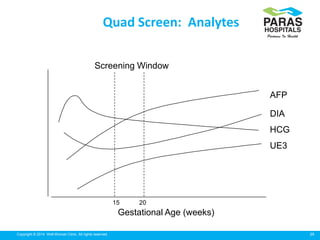
Quad Screen: Analytes
15 20
Gestational Age (weeks)
AFP
UE3
HCG
Screening Window
DIA
40Copyright © 2014 Well Woman Clinic. All rights reserved.
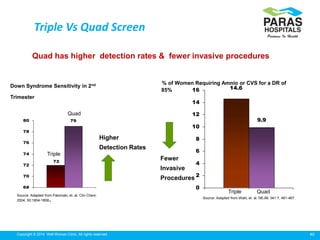
Triple Vs Quad Screen
79
72
68
70
72
74
76
78
80
Higher
Detection Rates
Fewer
Invasive
Procedures
Triple
Quad
Triple Quad
Source: Adapted from Wald, et. al. NEJM, 341:7, 461-467
Source: Adapted from Palomaki, et. al. Clin Chem.
2004; 50:1804-1808.
Down Syndrome Sensitivity in 2nd
Trimester
9.9
14.6
0
2
4
6
8
10
12
14
16
% of Women Requiring Amnio or CVS for a DR of
85%
Quad has higher detection rates & fewer invasive procedures
41Copyright © 2014 Well Woman Clinic. All rights reserved.
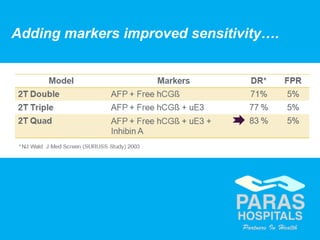
Adding markers improved sensitivity….
42Copyright © 2014 Well Woman Clinic. All rights reserved.
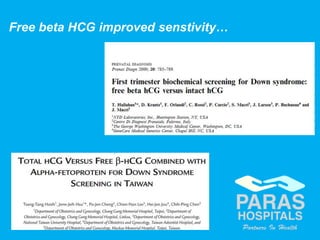
Free beta HCG improved senstivity…
43Copyright © 2014 Well Woman Clinic. All rights reserved.
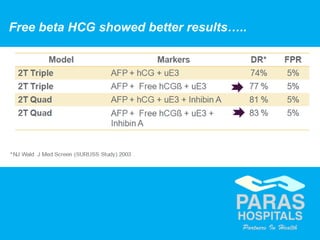
Free beta HCG showed better results…..
44Copyright © 2014 Well Woman Clinic. All rights reserved.
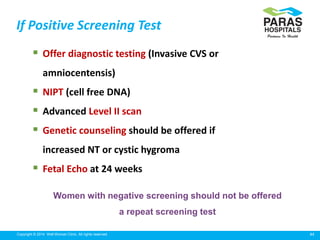
If Positive Screening Test
 Offer diagnostic testing (Invasive CVS or
amniocentensis)
 NIPT (cell free DNA)
 Advanced Level II scan
 Genetic counseling should be offered if
increased NT or cystic hygroma
 Fetal Echo at 24 weeks
Women with negative screening should not be offered
a repeat screening test
45Copyright © 2014 Well Woman Clinic. All rights reserved. 45
Preeclampsia Screening
46Copyright © 2014 Well Woman Clinic. All rights reserved.
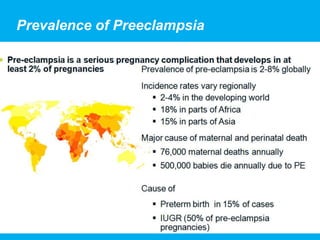
Prevalence of Preeclampsia
47Copyright © 2014 Well Woman Clinic. All rights reserved.
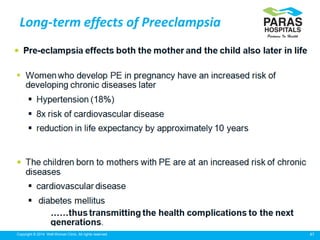
Long-term effects of Preeclampsia
48Copyright © 2014 Well Woman Clinic. All rights reserved.
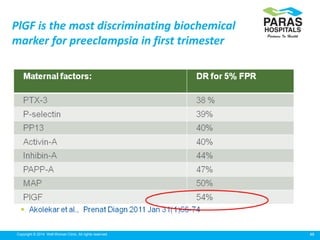
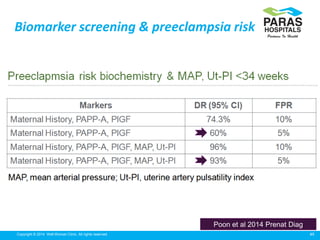
PlGF is the most discriminating biochemical
marker for preeclampsia in first trimester
49Copyright © 2014 Well Woman Clinic. All rights reserved.
Biomarker screening & preeclampsia risk
Poon et al 2014 Prenat Diag
50Copyright © 2014 Well Woman Clinic. All rights reserved.
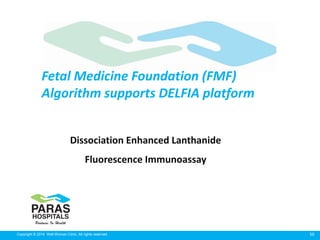
Dissociation Enhanced Lanthanide
Fluorescence Immunoassay
Fetal Medicine Foundation (FMF)
Algorithm supports DELFIA platform
51Copyright © 2014 Well Woman Clinic. All rights reserved. 51
Conclusion
 Future is Prenatal Testing
 In First Trimester
 Prevention of morbidity
52Copyright © 2014 Well Woman Clinic. All rights reserved. 52
THANK YOU

Maternal screening in Pregnancy (Double & quadruple marker)

  • 1.
    1Copyright © 2014Well Woman Clinic. All rights reserved. Maternal Serum Screening: Advancements Dr Nupur Gupta Department of Obstetrics & Gynecology
  • 2.
    2Copyright © 2014Well Woman Clinic. All rights reserved.
  • 3.
    3Copyright © 2014Well Woman Clinic. All rights reserved. What is a screening test?  These tests DO NOT diagnose a problem; they only signal that further testing should be done.  As diagnostic tests tend to be more expensive and have a degree of risk; screening tests are quick and easy to do.  Screening tests have a greater chance of being wrong; there are “false-positive” (test indicates the baby has the condition when the baby really does not) and “false-negatives” (baby has the condition but the test indicates they do not).
  • 4.
    4Copyright © 2014Well Woman Clinic. All rights reserved.  Most babies are born healthy  About 4 in 100 will be born with a birth defect  Type of tests: SCREENING & DIAGNOSTIC  Genetic Counseling Introduction to Prenatal Screening
  • 5.
    5Copyright © 2014Well Woman Clinic. All rights reserved. What is Maternal Serum Screening?  Measurement of proteins produced by fetus or placenta  Results are calculated relative to population standards (MoMs)  Screening tests do not look only at results from the blood test  They compare a number of different factors (including age, ethnicity, results from blood tests, etc...) and then estimate what are a person’s chances of having an abnormality
  • 6.
    6Copyright © 2014Well Woman Clinic. All rights reserved.  It is a prenatal screening test  Offered in first (9 to 13+6 weeks) and second trimester (14 to 22 weeks)  It gives an estimate of the risk but doesn’t give a definitive diagnosis What is this test?
  • 7.
    7Copyright © 2014Well Woman Clinic. All rights reserved. 7 What is Fetal Aneuploidy? Aneuploidy is having one or more extra or missing chromosomes, leading to an unbalanced chromosome number in a cell
  • 8.
    8Copyright © 2014Well Woman Clinic. All rights reserved.  FIRST TRIMESTER SCREEN  TRIPLE SCREEN  QUADRUPLE SCREEN  PENTA SCREEN  INTEGRATED SCREENING  SEQUENTIAL SCREENING SINGLE SCREENING TESTS COMBINED FIRST & SECOND TRIMESTER SCREENING TYPES OF SCREENING
  • 9.
    9Copyright © 2014Well Woman Clinic. All rights reserved.  To detect the risk of having a baby with chromosomal abnormality  Risk of developing early onset preeclampsia Why maternal serum screen?
  • 10.
    10Copyright © 2014Well Woman Clinic. All rights reserved. Why Maternal Serum Screen ?  Provides a non-invasive method to identify pregnancies at risk for birth defects rather than performing Chorionic Villous Sampling (CVS) or Amniocentesis in every case  Fewer invasive procedures will be required to identify an aneuploid fetus in patients who have screening  Individual patient risk is affected by parental age, medical/pregnancy history, family history of hereditary disease, mental retardation, or birth defects
  • 11.
    11Copyright © 2014Well Woman Clinic. All rights reserved. All women; choice depends upon Desire for information before delivery Prior obstetric history Family history Number of foetuses Availability of reliable NT measurement Cost of screening Options for pregnancy care or termination for an abnormal diagnostic test result Who should be offered screening for aneuploidy?
  • 12.
    12Copyright © 2014Well Woman Clinic. All rights reserved. 12
  • 13.
    13Copyright © 2014Well Woman Clinic. All rights reserved.  Down’s syndrome  Edward’s syndrome  Patau syndrome  Down’s syndrome  Edward’s syndrome  Neural tube defects First Trimester Second Trimester What conditions do these tests look for?
  • 14.
    14Copyright © 2014Well Woman Clinic. All rights reserved. Down Syndrome - Trisomy 21  Most common chromosomal abnormality 1/800 births  Congenital and genetic, rarely inherited  Over 350,000 affected patients in US
  • 15.
    15Copyright © 2014Well Woman Clinic. All rights reserved. Down Syndrome - Trisomy 21  JLH Down first described it in 1866  “Observations on an ethnic classification of idiots” – Average life expectancy 30 years – Characteristic phenotype – Learning disability (IQ 20-60) – Developmental delay – Delayed puberty / Early menopause  Major Causes of Morbidity & Mortality – > 50% visual or hearing impairment – 30-50% minor to severe heart defects – 10-20% intestinal malformations  Others: leukemia-thyroid disease-presenile dementia….
  • 16.
    16Copyright © 2014Well Woman Clinic. All rights reserved. All Live Births Maternal Age 35 y 87% live births are to women < 35 y #LiveBirths
  • 17.
    17Copyright © 2014Well Woman Clinic. All rights reserved. Down Syndrome Births 35 y Maternal Age #DSCases 55% DS cases occur in women < 35y
  • 18.
    18Copyright © 2014Well Woman Clinic. All rights reserved. Edwards syndrome – Trisomy 18  John H. Edwards, first described in 1960  Most common trisomy after Down Syndrome  More common in girls  The rate of occurrence for Edwards Syndrome is 1:3000 conceptions and 1:6000 live births  50% of those diagnosed prenatally with the condition will not survive the prenatal period
  • 19.
    19Copyright © 2014Well Woman Clinic. All rights reserved. PATAU SYNDROME  1 in 10,000 births  It is a chromosomal condition associated with severe intellectual disability and physical abnormalities in many parts of the body  They have heart defects, brain or spinal cord abnormalities, microphthalmia, extra fingers or toes, cleft lip with or without cleft palate and weak muscle tone (hypotonia)  Infants usually die within first few days or weeks of life  Ony 5 to 10% survive past one year
  • 20.
    20Copyright © 2014Well Woman Clinic. All rights reserved. Neural Tube Defects - NTD  1/1000 live births  Are birth defects of the brain & spinal cord  The two most common are spina bifida & anencephaly  75% affected fetuses miscarry or are stillborn  95% have no family history Maternal risk factors:  Diabetes, anticonvulsants, obesity, low folic acid status
  • 21.
    21Copyright © 2014Well Woman Clinic. All rights reserved. To obtain a complete report… Patient’s date of birth (not chronological age) Specimen collection date Gestational age (Ultrasound report) Weight at the time of sample collection  Race Insulin-dependent diabetes status prior to the pregnancy Whether this is a repeat sample Number of fetuses History of NTD
  • 22.
    22Copyright © 2014Well Woman Clinic. All rights reserved. MORE conditions ………
  • 23.
    23Copyright © 2014Well Woman Clinic. All rights reserved.  Blood tests  Ultrasound SCREENING TESTS (Noninvasive)
  • 24.
    24Copyright © 2014Well Woman Clinic. All rights reserved. 24 Role of Ultrasound: Soft markers  First trimester increased NT: congenital heart & abdominal wall defects, diaphragmatic hernia  Second trimester scan detects only 50 to 60% of Down’s syndrome fetuses  Third trimester followup: isolated renal pelvis dilatation, echogenic bowel, or shortened humerus or femur
  • 25.
    25Copyright © 2014Well Woman Clinic. All rights reserved.  When there is a family history of a particular condition  Screening tests show an increased risk of a particular condition  Fetal anomaly scan is abnormal  A woman more than 37 years who does not choose to have screening Diagnostic Tests: Amniocentensis/ Chorionic villous sampling
  • 26.
    26Copyright © 2014Well Woman Clinic. All rights reserved.
  • 27.
    27Copyright © 2014Well Woman Clinic. All rights reserved. ACOG Recommendations (2007)  All pregnancies have baseline risk of major malformations and congenital disorders: approx 3% of newborns have congenital malformation  Ideally, all women should be offered aneuploidy screening before 20 weeks of gestation, regardless of age  The goal is to offer screening tests with high detection rates and low false-positive rates
  • 28.
    28Copyright © 2014Well Woman Clinic. All rights reserved.  PAPP A, Free Beta HCG  Nuchal Translucency  Maternal age, weight & gestation First Trimester (11 to 13+6 weeks)
  • 29.
    29Copyright © 2014Well Woman Clinic. All rights reserved.  It is the collection of fluid under the skin at the back of baby's neck.  The amount of fluid is measured during a nuchal translucency (NT) ultrasound scan What is Nuchal Translucency (NT)?
  • 30.
    30Copyright © 2014Well Woman Clinic. All rights reserved.  Gestational age: 11 to 13+6weeks  Fetal CRL: 45 to 84 mm When should NT be measured?
  • 31.
    31Copyright © 2014Well Woman Clinic. All rights reserved.  First trimester Combined (PAPP-A + Free beta HCG + NT)  First trimester Triple Combined (PAPP-A + Free beta HCG + NT + AFP)  First Trimester Quad Combined (PAPP-A + Free beta HCG + NT + PlGF +AFP)  Triple marker (Free beta HCG + AFP + uE3)  Quadruple marker (Free beta HCG + AFP + uE3 + Inhibin A) First Trimester Second Trimester Different models for Prenatal Screening
  • 32.
    32Copyright © 2014Well Woman Clinic. All rights reserved.  Protein produced in the baby’s liver during the second trimester of pregnancy.  The levels of AFP generally increase in the pregnancy & in Open Neural Tube Defects, such as spina bifida, levels are very high  AFP levels tend to be lower than average in babies who have Down syndrome or trisomy 18. Maternal Serum Alpha Fetoprotein (MSAFP)
  • 33.
    33Copyright © 2014Well Woman Clinic. All rights reserved.  It is produced by the placenta and crosses into mom’s blood stream  Its levels rise about mid-pregnancy and then begin to decline  Babies with Down syndrome tend to have higher than average levels of hCG  Babies with trisomy 18 tend to have lower than average levels of hCG hCG or Human Chorionic Gonadotropin
  • 34.
    34Copyright © 2014Well Woman Clinic. All rights reserved.  It is made by both the baby’s liver and the placenta  Levels of this protein rise throughout the pregnancy  Babies with Down syndrome or trisomy 18 tend to have lower levels of uE3 UE3 or Unconjugated Estriol
  • 35.
    35Copyright © 2014Well Woman Clinic. All rights reserved. It comes from the placenta Levels of this protein in mom’s blood remain relatively constant through the 15th-18th week of pregnancy Babies with Down syndrome tend to have higher than average levels of inhibin-A and Babies with trisomy 18 tend to have lower than average levels of inhibin-A Inhibin-A or dimeric inhibin-A
  • 36.
    36Copyright © 2014Well Woman Clinic. All rights reserved. Huang et al 2014 Prenat Diag
  • 37.
    37Copyright © 2014Well Woman Clinic. All rights reserved. First Tri Quad is better than 2nd Tri Triple
  • 38.
    38Copyright © 2014Well Woman Clinic. All rights reserved.  Started in the 1970’s when it was found that fetal neural tube defects were associated with increase in maternal MSAFP  Such measurements were offered to pregnant woman for screening purposes  It was also noted that MSAFP tended to be low in fetal down’s syndrome.  With a cut off of 2.0 multiples of median[MOM] 85% of NTD’s would be screened in & with a threshold of 0.5 MOM approx 33% of DS fetus would be screened Second trimester biochemical screening
  • 39.
    39Copyright © 2014Well Woman Clinic. All rights reserved. Quad Screen: Analytes 15 20 Gestational Age (weeks) AFP UE3 HCG Screening Window DIA
  • 40.
    40Copyright © 2014Well Woman Clinic. All rights reserved. Triple Vs Quad Screen 79 72 68 70 72 74 76 78 80 Higher Detection Rates Fewer Invasive Procedures Triple Quad Triple Quad Source: Adapted from Wald, et. al. NEJM, 341:7, 461-467 Source: Adapted from Palomaki, et. al. Clin Chem. 2004; 50:1804-1808. Down Syndrome Sensitivity in 2nd Trimester 9.9 14.6 0 2 4 6 8 10 12 14 16 % of Women Requiring Amnio or CVS for a DR of 85% Quad has higher detection rates & fewer invasive procedures
  • 41.
    41Copyright © 2014Well Woman Clinic. All rights reserved. Adding markers improved sensitivity….
  • 42.
    42Copyright © 2014Well Woman Clinic. All rights reserved. Free beta HCG improved senstivity…
  • 43.
    43Copyright © 2014Well Woman Clinic. All rights reserved. Free beta HCG showed better results…..
  • 44.
    44Copyright © 2014Well Woman Clinic. All rights reserved. If Positive Screening Test  Offer diagnostic testing (Invasive CVS or amniocentensis)  NIPT (cell free DNA)  Advanced Level II scan  Genetic counseling should be offered if increased NT or cystic hygroma  Fetal Echo at 24 weeks Women with negative screening should not be offered a repeat screening test
  • 45.
    45Copyright © 2014Well Woman Clinic. All rights reserved. 45 Preeclampsia Screening
  • 46.
    46Copyright © 2014Well Woman Clinic. All rights reserved. Prevalence of Preeclampsia
  • 47.
    47Copyright © 2014Well Woman Clinic. All rights reserved. Long-term effects of Preeclampsia
  • 48.
    48Copyright © 2014Well Woman Clinic. All rights reserved. PlGF is the most discriminating biochemical marker for preeclampsia in first trimester
  • 49.
    49Copyright © 2014Well Woman Clinic. All rights reserved. Biomarker screening & preeclampsia risk Poon et al 2014 Prenat Diag
  • 50.
    50Copyright © 2014Well Woman Clinic. All rights reserved. Dissociation Enhanced Lanthanide Fluorescence Immunoassay Fetal Medicine Foundation (FMF) Algorithm supports DELFIA platform
  • 51.
    51Copyright © 2014Well Woman Clinic. All rights reserved. 51 Conclusion  Future is Prenatal Testing  In First Trimester  Prevention of morbidity
  • 52.
    52Copyright © 2014Well Woman Clinic. All rights reserved. 52 THANK YOU