Fetal measures
Review of Topic:
 Aims Of Fetal Monitoring
 Introduction
 Terminologies
 Common Indicators Of Antepartum Fetal Monitoring
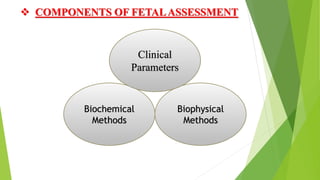
 Components Of Fetal Assessment
1. Clinical Parameters
2. Biochemical Methods
Introduction :-
 Majority of (80%) fetal deaths occurs in the
ante partum period. The main causes of
deaths are :-
Fetal hypoxia
Maternal complication.
Congenital malformation.
So it is necessary to avoid fetal and maternal
death during pregnancy
Aims of Fetal Monitoring:-
To ensure satisfactory growth and well being
of the fetus throughout pregnancy.
To screen out the high risk factors that
affects the growth of the fetus.
Terminologies:-
Abortion :-
• Explusion or extraction from its mother of an
embryo or fetus weight less than 500gm or
when it is not capable of independent survival.
Multipal pregnancy:
• When more than one fetus simultaneously
develops in the uterus.
Polyhydramnios:-
• Liquor amnii exceeds 2000ml
Oligohydramnios:-
• Liquior amnii less than 200 ml.
Preterm labour:-
• Labour start before 37 completed
weeks (<259 days)
 Common indicators of antepartum fetal
monitoring:-
 Pregnancy with obstetric complication:-
- IUGR,
-Oligohydramnions
- Ectopic pregnancy
 Pregnancy with medical complications:-
-Diabetes mellitus, Epilepsy
-Renal and cardiac disease,
-Infection.
CONT…
 Others:-
- Advanced maternal age (>35 years)
- Previous still birth, recurrent
abortion.
- Previous birth of baby with structural
or chromosomal abnormalities.
Routine antenatal testing
Biochemical
Methods
Biophysical
Methods
Clinical
Parameters
 COMPONENTS OF FETALASSESSMENT
1.Clinical Parameters:-
Maternal Weight gain,
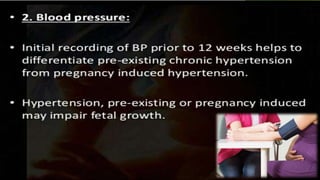
Blood Pressure,
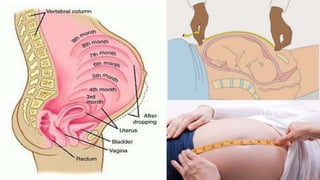
Assessment of size of uterus & height
of fundus.
2. Biochemical Methods:-
 Maternal serum alpha feto protein(MSAFP),
 Acetyl choline esterage(AchE),
 Triple test,
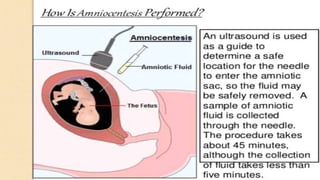
 Amniocentesis,
 Cordocenthesis,
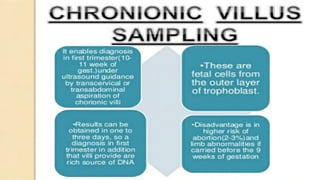
 Chorionic villus sampling(CVS).
3. Biophysical Methods:-
 US IMAGING,
 Foetal Movement Count
 Ultra Sonography,
 Cardiotocography,
 Cardiotomography,
 Non Stress Test(NST),
 Contraction stress Test(CST),
 Amnioscopy,
 Foetoscopy
1.Maternal alpha-fetoprotein screening
(MAFP) :-
 AFP is a oncofetal protein(Molecular weight
70,000) normally produced by the fetal liver
and is present in the fluid surrounding the
fetus (amniotic fluid), and crosses the
placenta into the mother's blood.
 Normal values:- 2.5 MOM ( Multiples Of
the Median)
 MSAFP level high indicates:-
a) Wrong gestational age
b) Open Neural Tube Defects(NTDs)
c) Multiple Pregnancy,
d) IUFD
e) Renal anomalies
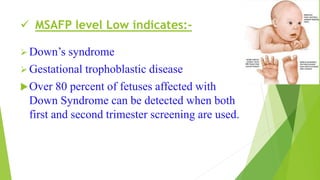
 MSAFP level Low indicates:-
 Down’s syndrome
 Gestational trophoblastic disease
Over 80 percent of fetuses affected with
Down Syndrome can be detected when both
first and second trimester screening are used.
Who takes the AFP test?
All pregnant women are usually
offered the AFP test. But, your doctor
may recommend the test, especially
if you:
Have a family history of birth defects
Age 35 year or older
Have diabetes
Have taken certain drugs or
medication during pregnancy
 Time of performing test:- 15-18 weeks
Procedure:-
Nursing responsibility :-
Explain procedure before
performing test.
Informed consent should
be given prior to testing,
and a woman has the right
to refuse this test if she
chooses.
 What are the risks and benefits of
alpha-fetoprotein screening?
Risks Benefits
 There are no risks of having the
actual test performed other than
the usual risks of a blood test.
Abnormal test results of AFP and
other markers may indicate the
need for additional testing.
Usually an ultrasound is
performed to confirm the dates
of the pregnancy and to examine
the fetal spine and other body
parts for defects. An
amniocentesis may be needed for
accurate diagnosis.
The purpose of this screening
test is to identify those women
in the population who are at
increased risk of having a baby
with a birth defect, whose
pregnancies need additional
testing, who otherwise would
not have been offered this
additional fetal testing.
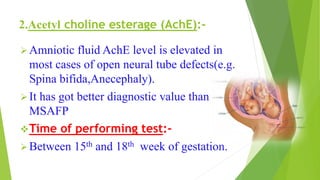
2.Acetyl choline esterage (AchE):-
Amniotic fluid AchE level is elevated in
most cases of open neural tube defects(e.g.
Spina bifida,Anecephaly).
It has got better diagnostic value than
MSAFP
Time of performing test:-
Between 15th and 18th week of gestation.
 Cont…
 Procedure:
AFP testing is the sequence of tests.
The first-two are of maternal serum and the
final test of amniotic fluid.
An Elevated AFP Level is indicative of
significant fetal pathology.
A low level of AFP may be associated with
Down syndrome.
The Normal AFP concentration in liquor amnii
at the 16th week is about 20mg/L.
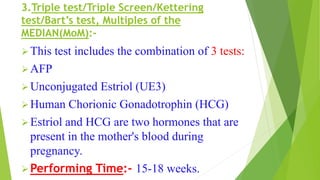
3.Triple test/Triple Screen/Kettering
test/Bart’s test, Multiples of the
MEDIAN(MoM):-
This test includes the combination of 3 tests:
AFP
Unconjugated Estriol (UE3)
Human Chorionic Gonadotrophin (HCG)
Estriol and HCG are two hormones that are
present in the mother's blood during
pregnancy.
Performing Time:- 15-18 weeks.
 Cont…
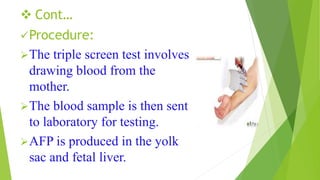
Procedure:
The triple screen test involves
drawing blood from the
mother.
The blood sample is then sent
to laboratory for testing.
AFP is produced in the yolk
sac and fetal liver.
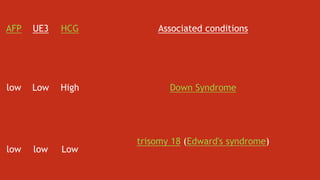
AFP UE3 HCG Associated conditions
low Low High Down Syndrome
low low Low
trisomy 18 (Edward's syndrome)
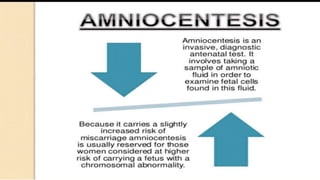
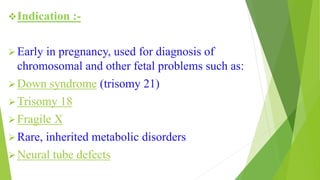
Indication :-
Early in pregnancy, used for diagnosis of
chromosomal and other fetal problems such as:
Down syndrome (trisomy 21)
Trisomy 18
Fragile X
Rare, inherited metabolic disorders
Neural tube defects
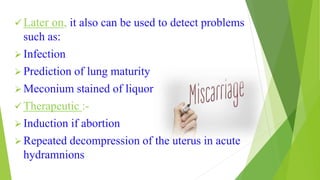
 Later on, it also can be used to detect problems
such as:
 Infection
 Prediction of lung maturity
 Meconium stained of liquor
 Therapeutic :-
 Induction if abortion
 Repeated decompression of the uterus in acute
hydramnions
 Nursing responsibility before
procedure:-
 Before procedure take written consent.
 Explain the purpose of procedure and how it
will be done.
 Emptying the bladder.
 Provide privacy.
 Provide supine position with elevated head 20-
30degree. (dorsal position).
 The abdominal wall is prepared aseptically and
draped.
Cont…
Check the vital sign and FHR to obtain
base line data.
Check USG.
Prophylactic administration of 100 mg of
anti –D immunoglobuline in Rh negative
mother.
The proposed site of puncture is infiltered
with 2 ml of 1% lignocain.
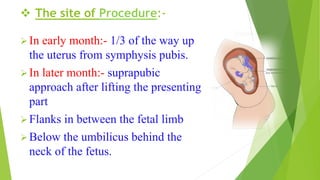
 The site of Procedure:-
In early month:- 1/3 of the way up
the uterus from symphysis pubis.
In later month:- suprapubic
approach after lifting the presenting
part
Flanks in between the fetal limb
Below the umbilicus behind the
neck of the fetus.
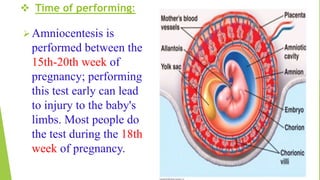
 Time of performing:
Amniocentesis is
performed between the
15th-20th week of
pregnancy; performing
this test early can lead
to injury to the baby's
limbs. Most people do
the test during the 18th
week of pregnancy.
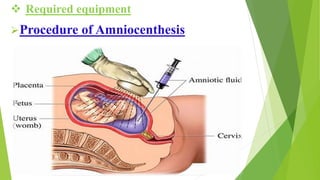
 Required equipment
Procedure of Amniocenthesis
Contraindication:-
Acute skin infections
Maternal fever
Allergies to material used like skin
prepration materials, local anesthesia.
May be difficulty in patient with
multiple pregnancy.
 Indications:-
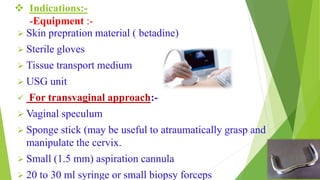
-Equipment :-
 Skin prepration material ( betadine)
 Sterile gloves
 Tissue transport medium
 USG unit
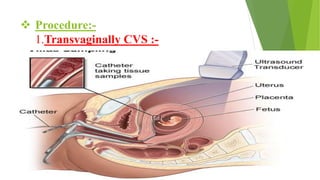
 For transvaginal approach:-
 Vaginal speculum
 Sponge stick (may be useful to atraumatically grasp and
manipulate the cervix.
 Small (1.5 mm) aspiration cannula
 20 to 30 ml syringe or small biopsy forceps
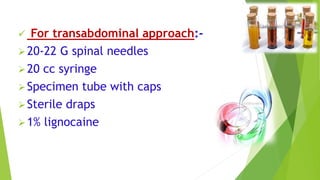
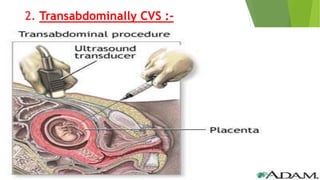
 For transabdominal approach:-
20-22 G spinal needles
20 cc syringe
Specimen tube with caps
Sterile draps
1% lignocaine
 Procedure:-
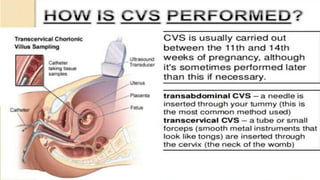
1.Transvaginally CVS :-
2. Transabdominally CVS :-
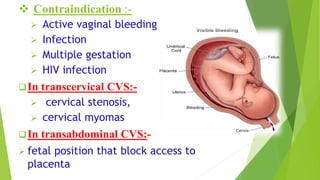
 Contraindication :-
 Active vaginal bleeding
 Infection
 Multiple gestation
 HIV infection
In transcervical CVS:-
 cervical stenosis,
 cervical myomas
In transabdominal CVS:-
 fetal position that block access to
placenta
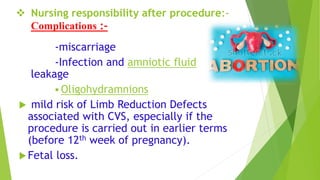
 Nursing responsibility after procedure:-
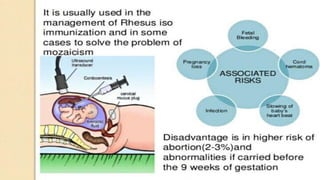
Complications :-
-miscarriage
-Infection and amniotic fluid
leakage
 Oligohydramnions
 mild risk of Limb Reduction Defects
associated with CVS, especially if the
procedure is carried out in earlier terms
(before 12th week of pregnancy).
Fetal loss.
Cont…
•Infection
•Vaginal bleeding.
There is some evidence
focus increase risk of
pre eclampsia.
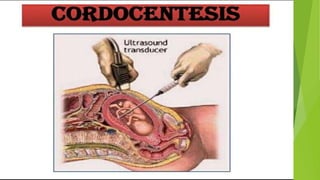
6.Cordocenthesis OR Percutaneous
umbilical cord blood sampling (PUBS),
PUBS provides a means of rapid chromosome
analysis and is useful when information cannot be
obtained through amniocentesis, CVS, or
ultrasound (or if the results of these tests were
inconclusive).
 Time of performance:-
 18 weeks of gestation.
Summary
 Aims Of Fetal Monitoring
 Introduction
 Terminologies
 Common Indicators Of Antepartum Fetal
Monitoring
 Components Of Fetal Assessment
1. Clinical Parameters
2. Biochemical Methods
 BIBLIOGRAPHY
1. Annamma Jacob, “A Comprehensive Textbook of
Midwifery and Gynecological Nursing” Jaypee
Brothers Medical Publishers (P) LTD, Third
Edition,2012.
Page No:125-127
2. WWW.Slideshare.com
Foetal measures ppt

Foetal measures ppt

  • 1.
  • 2.
    Review of Topic: Aims Of Fetal Monitoring  Introduction  Terminologies  Common Indicators Of Antepartum Fetal Monitoring  Components Of Fetal Assessment 1. Clinical Parameters 2. Biochemical Methods
  • 3.
    Introduction :-  Majorityof (80%) fetal deaths occurs in the ante partum period. The main causes of deaths are :- Fetal hypoxia Maternal complication. Congenital malformation. So it is necessary to avoid fetal and maternal death during pregnancy
  • 4.
    Aims of FetalMonitoring:- To ensure satisfactory growth and well being of the fetus throughout pregnancy. To screen out the high risk factors that affects the growth of the fetus.
  • 5.
    Terminologies:- Abortion :- • Explusionor extraction from its mother of an embryo or fetus weight less than 500gm or when it is not capable of independent survival. Multipal pregnancy: • When more than one fetus simultaneously develops in the uterus. Polyhydramnios:- • Liquor amnii exceeds 2000ml
  • 6.
    Oligohydramnios:- • Liquior amniiless than 200 ml. Preterm labour:- • Labour start before 37 completed weeks (<259 days)
  • 7.
     Common indicatorsof antepartum fetal monitoring:-  Pregnancy with obstetric complication:- - IUGR, -Oligohydramnions - Ectopic pregnancy  Pregnancy with medical complications:- -Diabetes mellitus, Epilepsy -Renal and cardiac disease, -Infection.
  • 8.
    CONT…  Others:- - Advancedmaternal age (>35 years) - Previous still birth, recurrent abortion. - Previous birth of baby with structural or chromosomal abnormalities. Routine antenatal testing
  • 9.
  • 10.
    1.Clinical Parameters:- Maternal Weightgain, Blood Pressure, Assessment of size of uterus & height of fundus.
  • 11.
    2. Biochemical Methods:- Maternal serum alpha feto protein(MSAFP),  Acetyl choline esterage(AchE),  Triple test,  Amniocentesis,  Cordocenthesis,  Chorionic villus sampling(CVS).
  • 12.
    3. Biophysical Methods:- US IMAGING,  Foetal Movement Count  Ultra Sonography,  Cardiotocography,  Cardiotomography,  Non Stress Test(NST),  Contraction stress Test(CST),  Amnioscopy,  Foetoscopy
  • 19.
    1.Maternal alpha-fetoprotein screening (MAFP):-  AFP is a oncofetal protein(Molecular weight 70,000) normally produced by the fetal liver and is present in the fluid surrounding the fetus (amniotic fluid), and crosses the placenta into the mother's blood.  Normal values:- 2.5 MOM ( Multiples Of the Median)
  • 20.
     MSAFP levelhigh indicates:- a) Wrong gestational age b) Open Neural Tube Defects(NTDs) c) Multiple Pregnancy, d) IUFD e) Renal anomalies
  • 21.
     MSAFP levelLow indicates:-  Down’s syndrome  Gestational trophoblastic disease Over 80 percent of fetuses affected with Down Syndrome can be detected when both first and second trimester screening are used.
  • 22.
    Who takes theAFP test? All pregnant women are usually offered the AFP test. But, your doctor may recommend the test, especially if you: Have a family history of birth defects Age 35 year or older Have diabetes Have taken certain drugs or medication during pregnancy
  • 23.
     Time ofperforming test:- 15-18 weeks Procedure:- Nursing responsibility :- Explain procedure before performing test. Informed consent should be given prior to testing, and a woman has the right to refuse this test if she chooses.
  • 24.
     What arethe risks and benefits of alpha-fetoprotein screening? Risks Benefits  There are no risks of having the actual test performed other than the usual risks of a blood test. Abnormal test results of AFP and other markers may indicate the need for additional testing. Usually an ultrasound is performed to confirm the dates of the pregnancy and to examine the fetal spine and other body parts for defects. An amniocentesis may be needed for accurate diagnosis. The purpose of this screening test is to identify those women in the population who are at increased risk of having a baby with a birth defect, whose pregnancies need additional testing, who otherwise would not have been offered this additional fetal testing.
  • 25.
    2.Acetyl choline esterage(AchE):- Amniotic fluid AchE level is elevated in most cases of open neural tube defects(e.g. Spina bifida,Anecephaly). It has got better diagnostic value than MSAFP Time of performing test:- Between 15th and 18th week of gestation.
  • 26.
     Cont…  Procedure: AFPtesting is the sequence of tests. The first-two are of maternal serum and the final test of amniotic fluid. An Elevated AFP Level is indicative of significant fetal pathology. A low level of AFP may be associated with Down syndrome. The Normal AFP concentration in liquor amnii at the 16th week is about 20mg/L.
  • 27.
    3.Triple test/Triple Screen/Kettering test/Bart’stest, Multiples of the MEDIAN(MoM):- This test includes the combination of 3 tests: AFP Unconjugated Estriol (UE3) Human Chorionic Gonadotrophin (HCG) Estriol and HCG are two hormones that are present in the mother's blood during pregnancy. Performing Time:- 15-18 weeks.
  • 28.
     Cont… Procedure: The triplescreen test involves drawing blood from the mother. The blood sample is then sent to laboratory for testing. AFP is produced in the yolk sac and fetal liver.
  • 29.
    AFP UE3 HCGAssociated conditions low Low High Down Syndrome low low Low trisomy 18 (Edward's syndrome)
  • 32.
    Indication :- Early inpregnancy, used for diagnosis of chromosomal and other fetal problems such as: Down syndrome (trisomy 21) Trisomy 18 Fragile X Rare, inherited metabolic disorders Neural tube defects
  • 33.
     Later on,it also can be used to detect problems such as:  Infection  Prediction of lung maturity  Meconium stained of liquor  Therapeutic :-  Induction if abortion  Repeated decompression of the uterus in acute hydramnions
  • 34.
     Nursing responsibilitybefore procedure:-  Before procedure take written consent.  Explain the purpose of procedure and how it will be done.  Emptying the bladder.  Provide privacy.  Provide supine position with elevated head 20- 30degree. (dorsal position).  The abdominal wall is prepared aseptically and draped.
  • 35.
    Cont… Check the vitalsign and FHR to obtain base line data. Check USG. Prophylactic administration of 100 mg of anti –D immunoglobuline in Rh negative mother. The proposed site of puncture is infiltered with 2 ml of 1% lignocain.
  • 36.
     The siteof Procedure:- In early month:- 1/3 of the way up the uterus from symphysis pubis. In later month:- suprapubic approach after lifting the presenting part Flanks in between the fetal limb Below the umbilicus behind the neck of the fetus.
  • 37.
     Time ofperforming: Amniocentesis is performed between the 15th-20th week of pregnancy; performing this test early can lead to injury to the baby's limbs. Most people do the test during the 18th week of pregnancy.
  • 38.
  • 39.
    Contraindication:- Acute skin infections Maternalfever Allergies to material used like skin prepration materials, local anesthesia. May be difficulty in patient with multiple pregnancy.
  • 43.
     Indications:- -Equipment :- Skin prepration material ( betadine)  Sterile gloves  Tissue transport medium  USG unit  For transvaginal approach:-  Vaginal speculum  Sponge stick (may be useful to atraumatically grasp and manipulate the cervix.  Small (1.5 mm) aspiration cannula  20 to 30 ml syringe or small biopsy forceps
  • 44.
     For transabdominalapproach:- 20-22 G spinal needles 20 cc syringe Specimen tube with caps Sterile draps 1% lignocaine
  • 45.
  • 46.
  • 47.
     Contraindication :- Active vaginal bleeding  Infection  Multiple gestation  HIV infection In transcervical CVS:-  cervical stenosis,  cervical myomas In transabdominal CVS:-  fetal position that block access to placenta
  • 48.
     Nursing responsibilityafter procedure:- Complications :- -miscarriage -Infection and amniotic fluid leakage  Oligohydramnions  mild risk of Limb Reduction Defects associated with CVS, especially if the procedure is carried out in earlier terms (before 12th week of pregnancy). Fetal loss.
  • 49.
    Cont… •Infection •Vaginal bleeding. There issome evidence focus increase risk of pre eclampsia.
  • 50.
    6.Cordocenthesis OR Percutaneous umbilicalcord blood sampling (PUBS), PUBS provides a means of rapid chromosome analysis and is useful when information cannot be obtained through amniocentesis, CVS, or ultrasound (or if the results of these tests were inconclusive).  Time of performance:-  18 weeks of gestation.
  • 54.
    Summary  Aims OfFetal Monitoring  Introduction  Terminologies  Common Indicators Of Antepartum Fetal Monitoring  Components Of Fetal Assessment 1. Clinical Parameters 2. Biochemical Methods
  • 55.
     BIBLIOGRAPHY 1. AnnammaJacob, “A Comprehensive Textbook of Midwifery and Gynecological Nursing” Jaypee Brothers Medical Publishers (P) LTD, Third Edition,2012. Page No:125-127 2. WWW.Slideshare.com