MATERIAL REQUIREMENT PLANNING
Kathmandu University School Of Management (KUSOM)
Subject: Managing Operations and Technology
Term/Trimester: MBA Second Term
Year: 2017
Presented by:
Dipesh Raj Pandey
Roll - 17321
Material Requirements Planning
(MRP)
• INTRODUCTION OF MRP
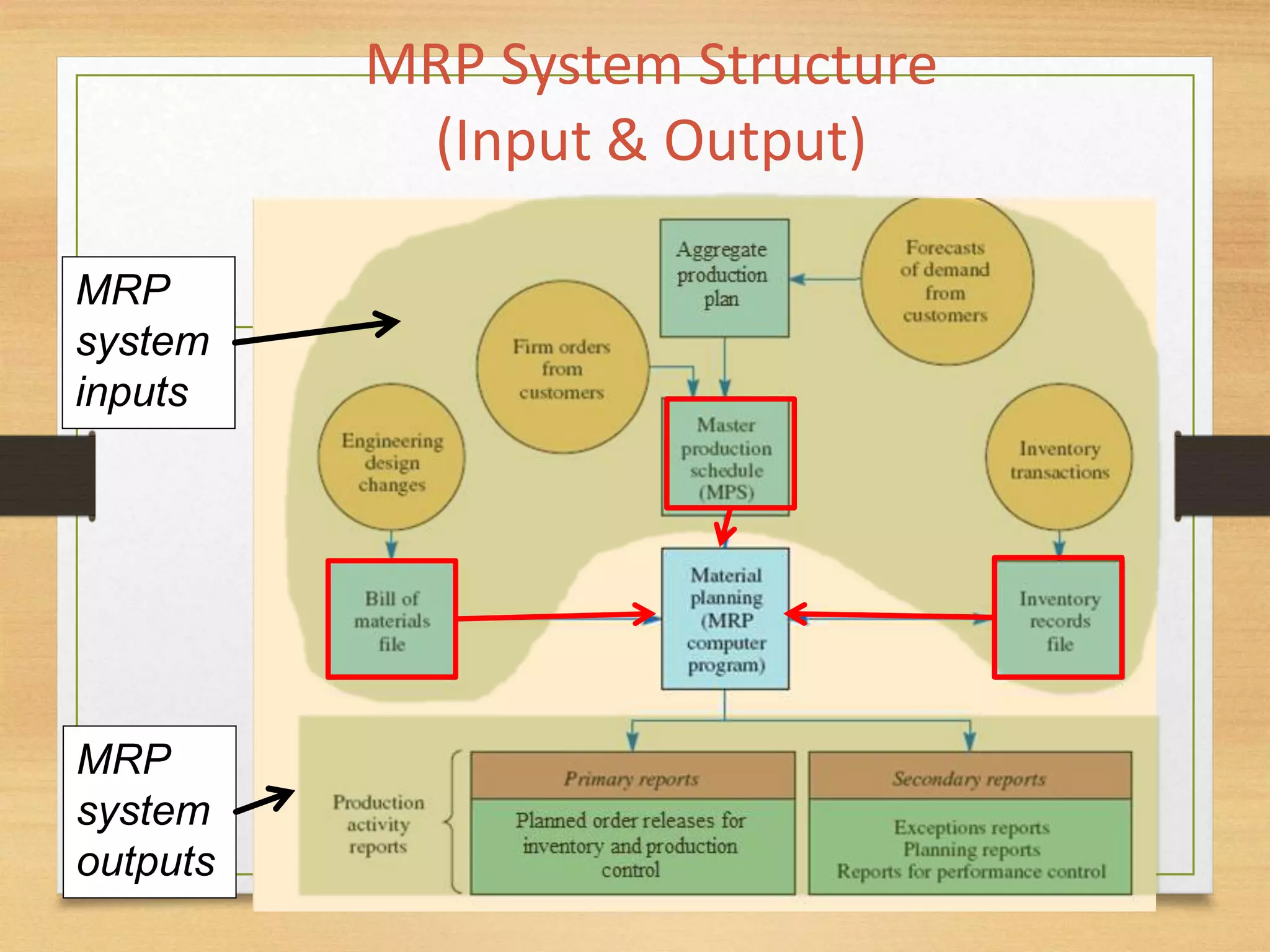
MRP System Structure
(Input & Output)
MRP
system
inputs
MRP
system
outputs
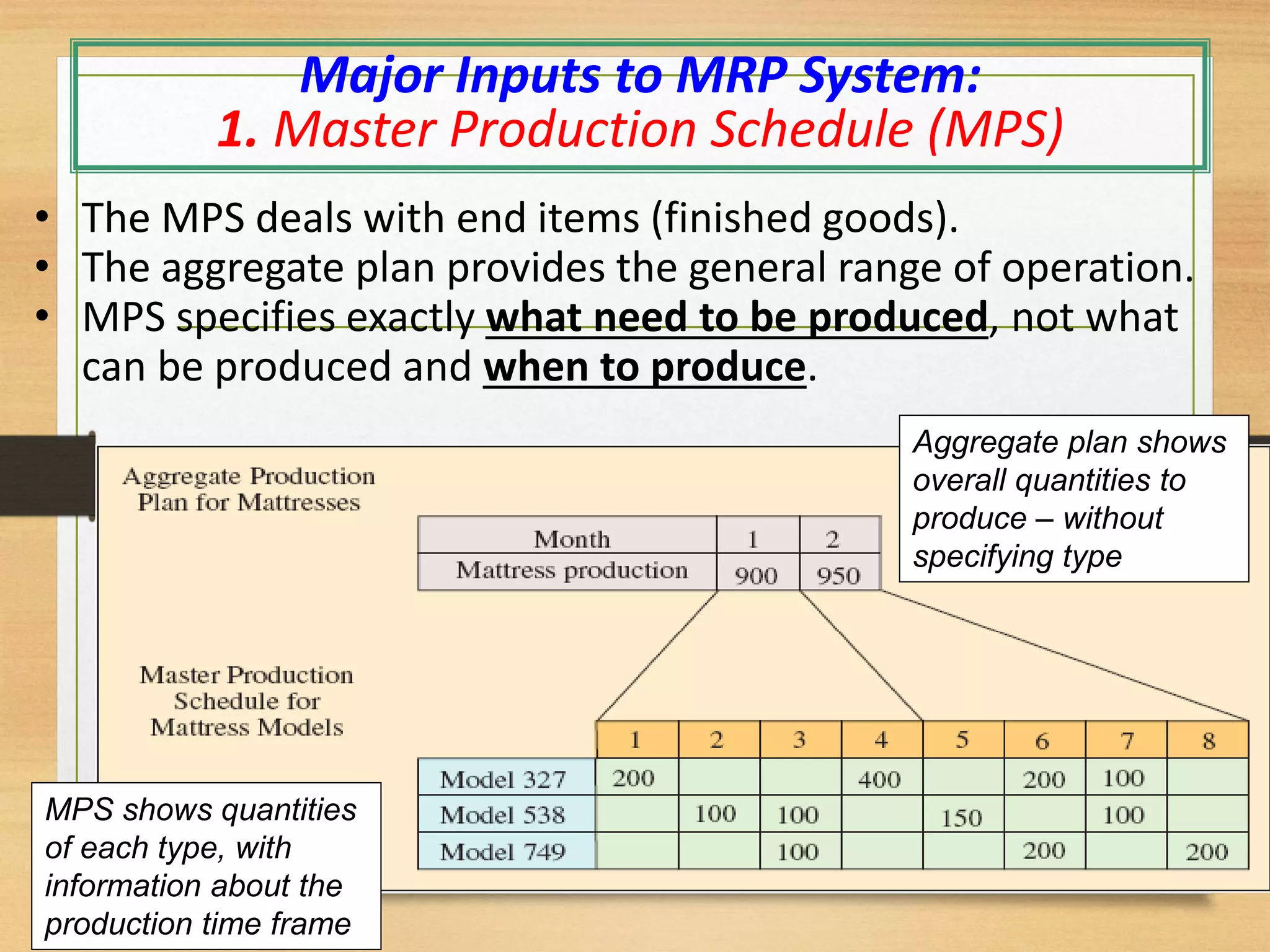
Aggregate plan shows
overall quantities to
produce – without
specifying type
Major Inputs to MRP System:
1. Master Production Schedule (MPS)
• The MPS deals with end items (finished goods).
• The aggregate plan provides the general range of operation.
• MPS specifies exactly what need to be produced, not what
can be produced and when to produce.
MPS shows quantities
of each type, with
information about the
production time frame
• BOM is often called product structure file or product tree.
• Contains the complete product description, listing the
materials, parts, and components along with the sequence
in which the product is created
Major Inputs to MRP System:
2. Bill of Material (BOM)
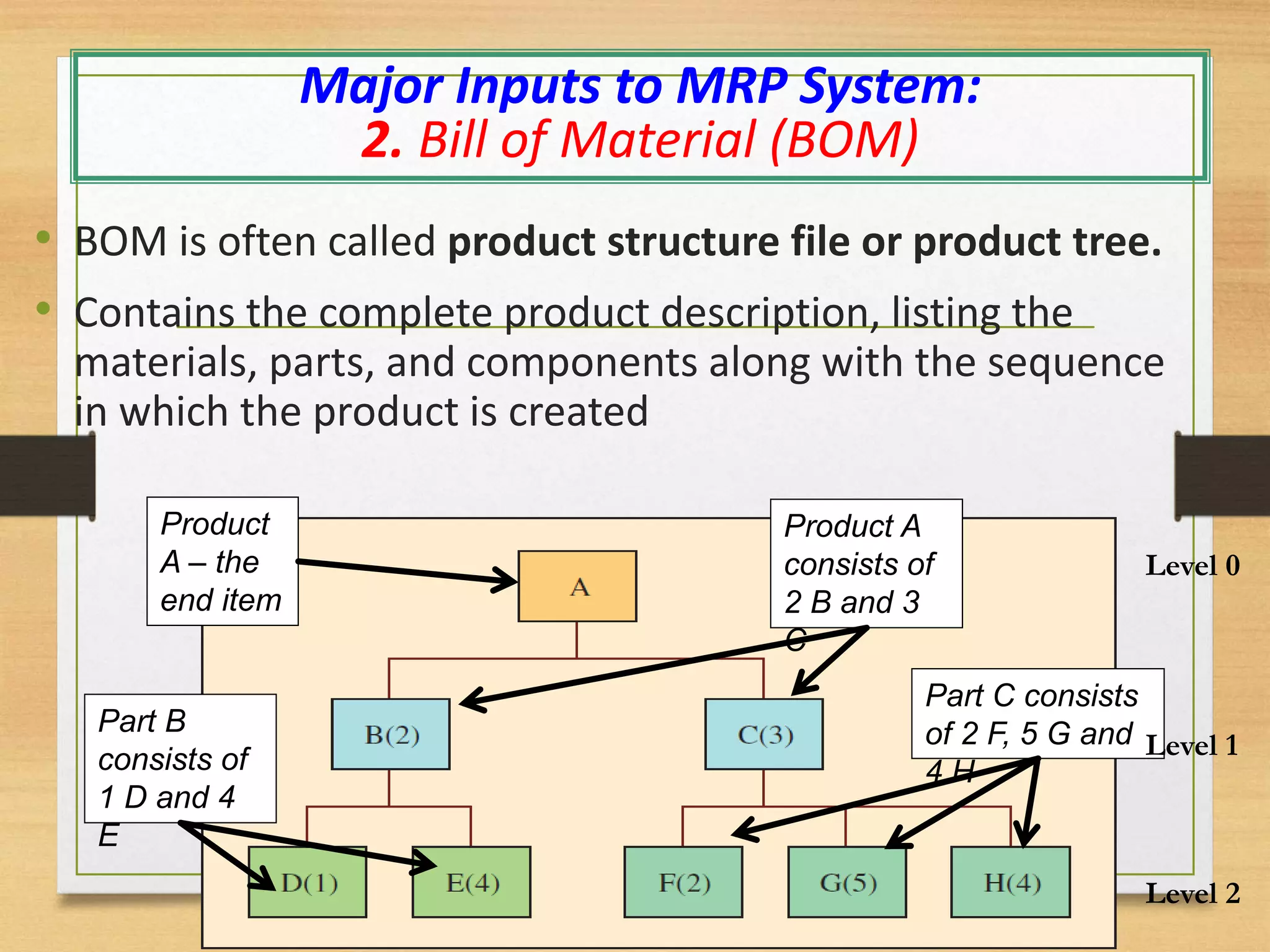
Product
A – the
end item
Product A
consists of
2 B and 3
C
Part C consists
of 2 F, 5 G and
4 H
Part B
consists of
1 D and 4
E
Level 0
Level 1
Level 2
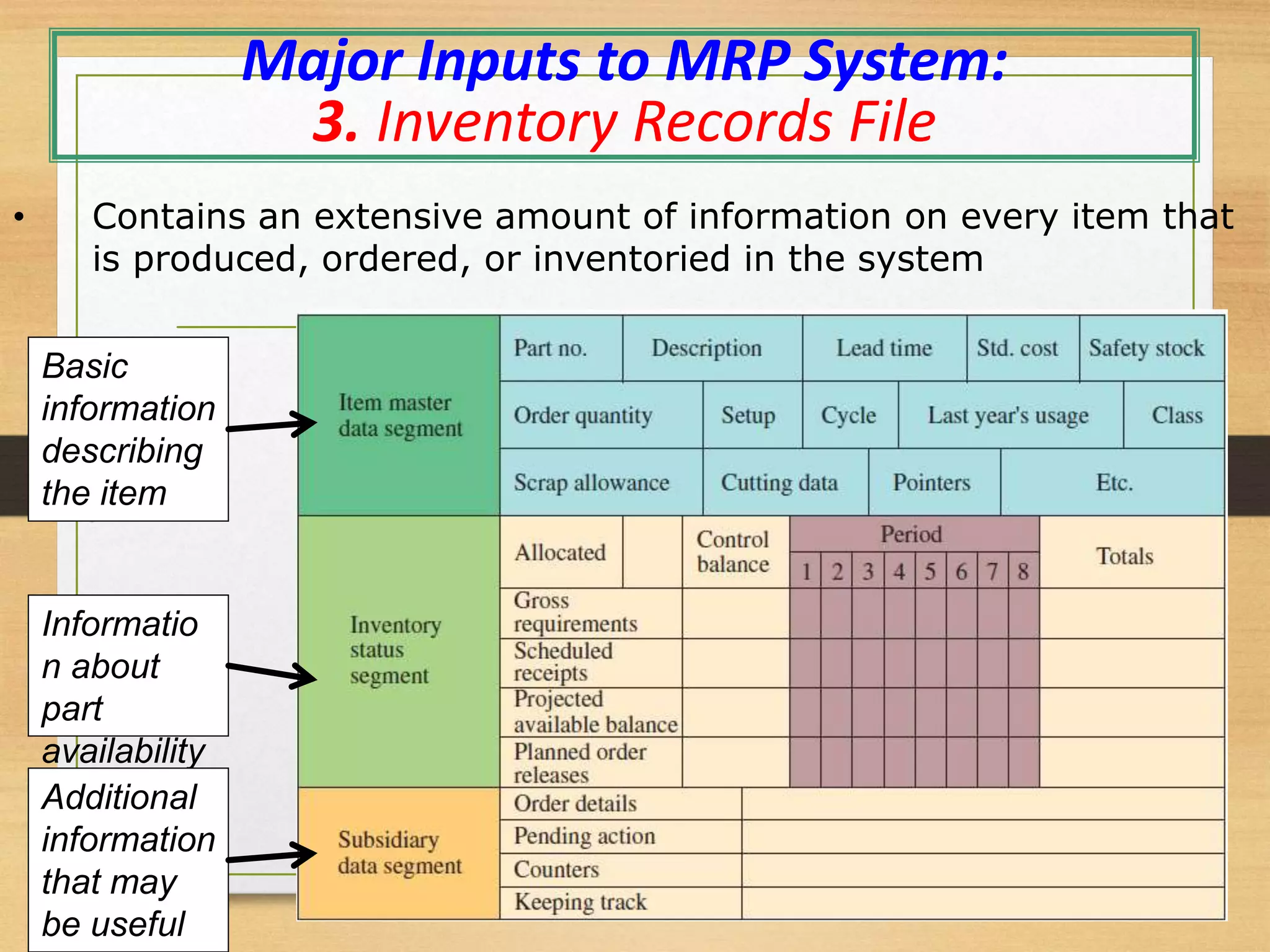
Basic
information
describing
the item
Informatio
n about
part
availability
Additional
information
that may
be useful
• Contains an extensive amount of information on every item that
is produced, ordered, or inventoried in the system
Major Inputs to MRP System:
3. Inventory Records File
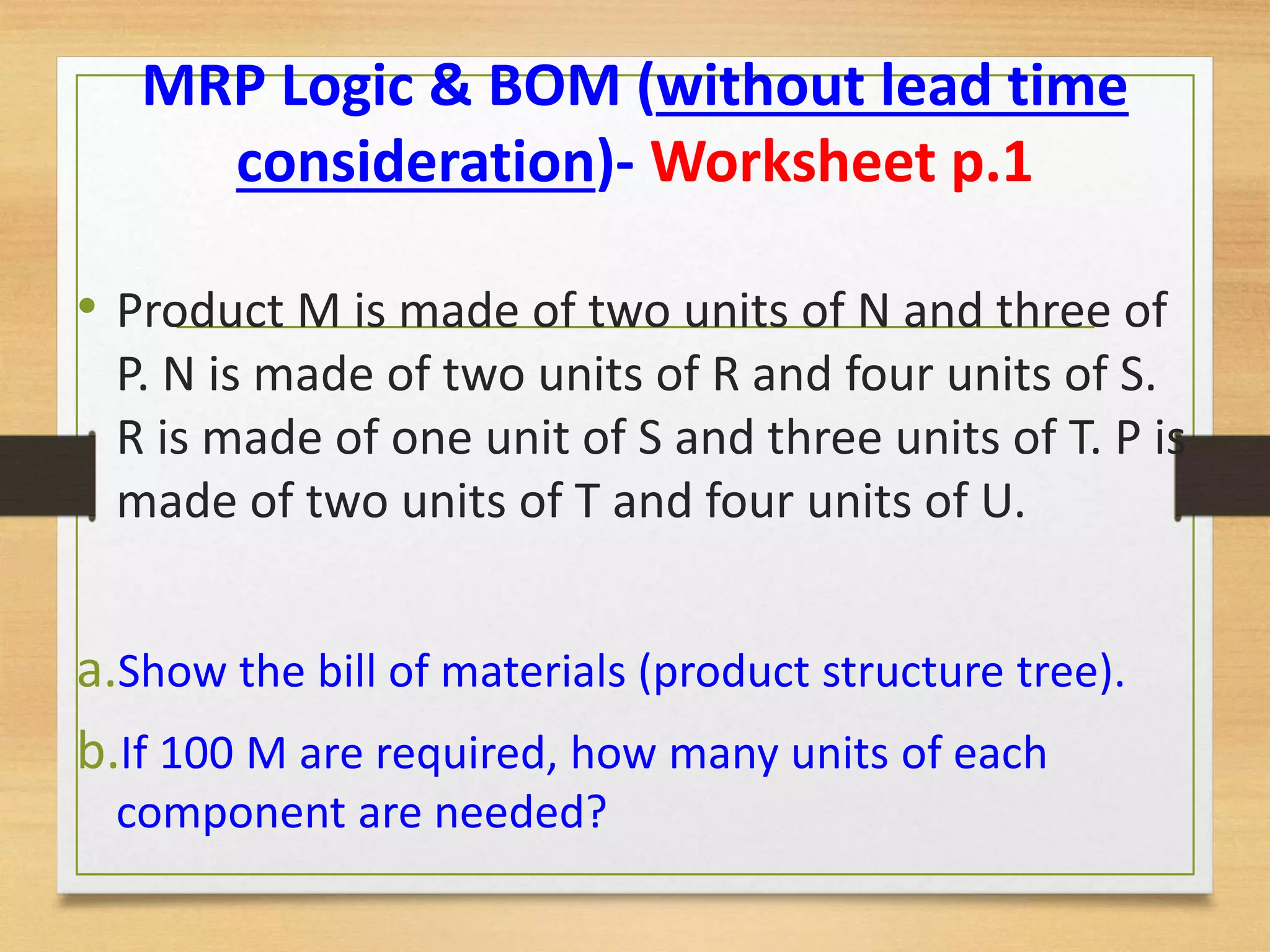
MRP Logic & BOM (without lead time
consideration)- Worksheet p.1
• Product M is made of two units of N and three of
P. N is made of two units of R and four units of S.
R is made of one unit of S and three units of T. P is
made of two units of T and four units of U.
a.Show the bill of materials (product structure tree).
b.If 100 M are required, how many units of each
component are needed?
a. Show the bill of materials (product
structure tree).
M
N (2) P (3)
R (2) S (4) T (2) U (4)
S (1) T (3)
Level 0
Level 1
Level 2
Level 3
b. If 100 M are required, how many
units of each component are needed?
• M= 100
• N= 2M = 2X 100= 200
• P= 3M = 3 X 100= 300
• R= 2N = 2X 200= 400
• S= 4N + 1R= 4X 200+ 1X400= 800+ 400= 1,200
• T= 2P + 3R= 2X300+ 3X400= 600+ 1,200=1,800
• U= 4P = 4X300= 1,200
MRP Logic and BOM (with lead time
consideration)
B(4)
E(1)D(2)
C(2)
F(2)D(3)
A
Product Structure Tree for Assembly A
Lead Times
A 1 day
B 2 days
C 1 day
D 3 days
E 4 days
F 1 day
Demand
Day 10 50 A
Given the product structure tree for “A” and the lead time and
demand information below, provide a materials requirements
plan that defines the number of units of each component and
when they will be needed.
Lead Times
A 1 day
B 2 days
C 1 day
D 3 days
E 4 days
F 1 day
LT = 1 day
Day: 1 2 3 4 5 6 7 8 9 10
A Required 50
Order Placement 50
First, the number of units of “A” are scheduled backwards
to allow for their lead time. So, in the materials
requirement plan below, we have to place an order for 50
units of “A” in the 9th week to receive them in the 10th
week.
Next, we need to start scheduling the components that make up “A”. In
the case of component “B” we need 4 B’s for each A. Since we need 50
A’s, that means 200 B’s. And again, we back the schedule up for the
necessary 2 days of lead time.
Day: 1 2 3 4 5 6 7 8 9 10
A Required 50
Order Placement 50
B Required 200
Order Placement 200
LT = 2
B(4)
E(1)D(2)
C(2)
F(2)D(3)
A 4x50=200
A Required 50
LT=1 Order Placement
B Required
LT=2 Order Placement
C Required
LT=1 Order Placement
D Required
LT=3 Order Placement
E Required
LT=4 Order Placement
F Required
LT=1 Order Placement
B(4)
E(1)D(2)
C(2)
F(2)D(3)
A
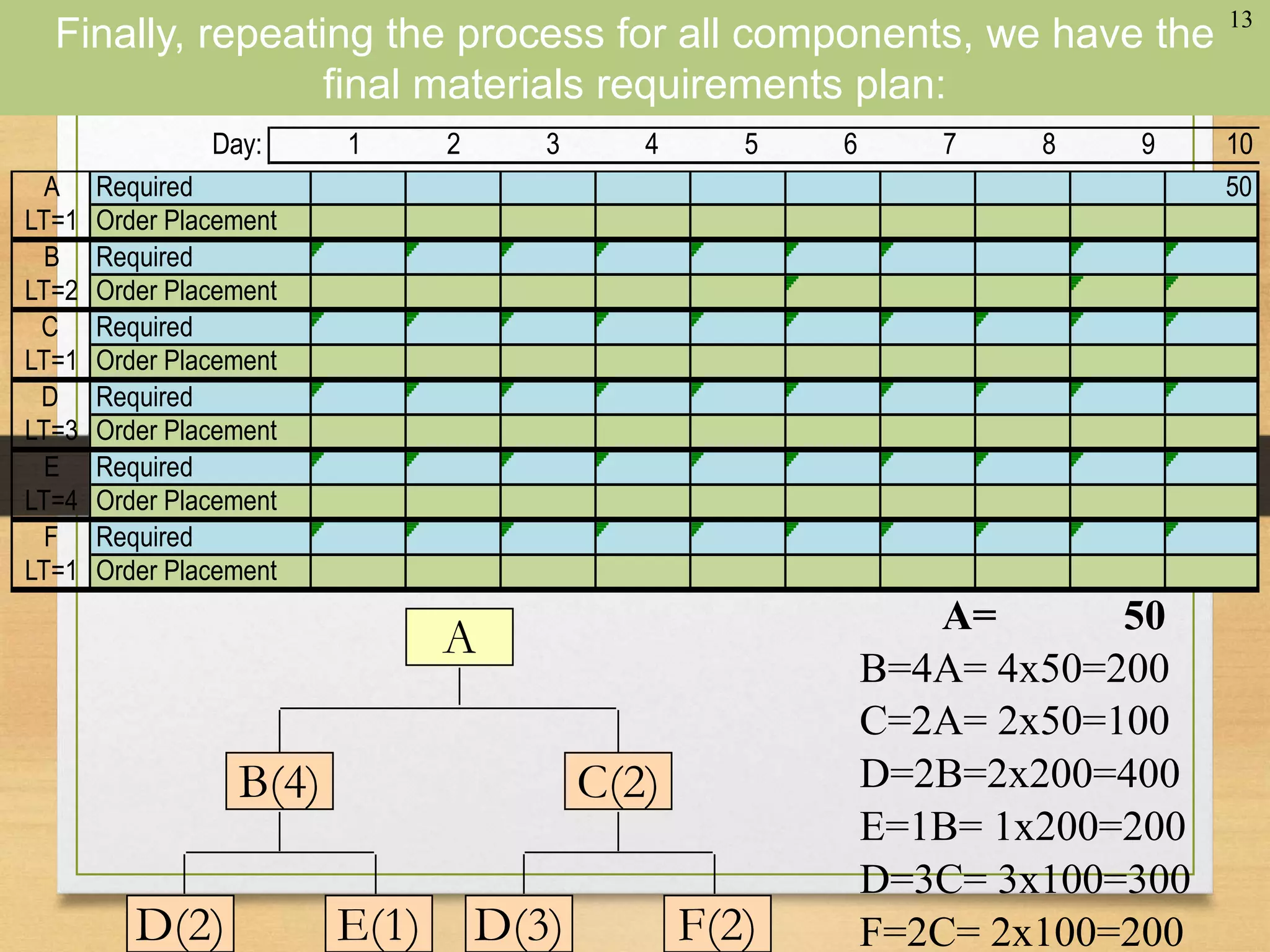
Finally, repeating the process for all components, we have the
final materials requirements plan:
13
B=4A= 4x50=200
C=2A= 2x50=100
D=2B=2x200=400
E=1B= 1x200=200
D=3C= 3x100=300
F=2C= 2x100=200
A= 50
Day: 1 2 3 4 5 6 7 8 9 10
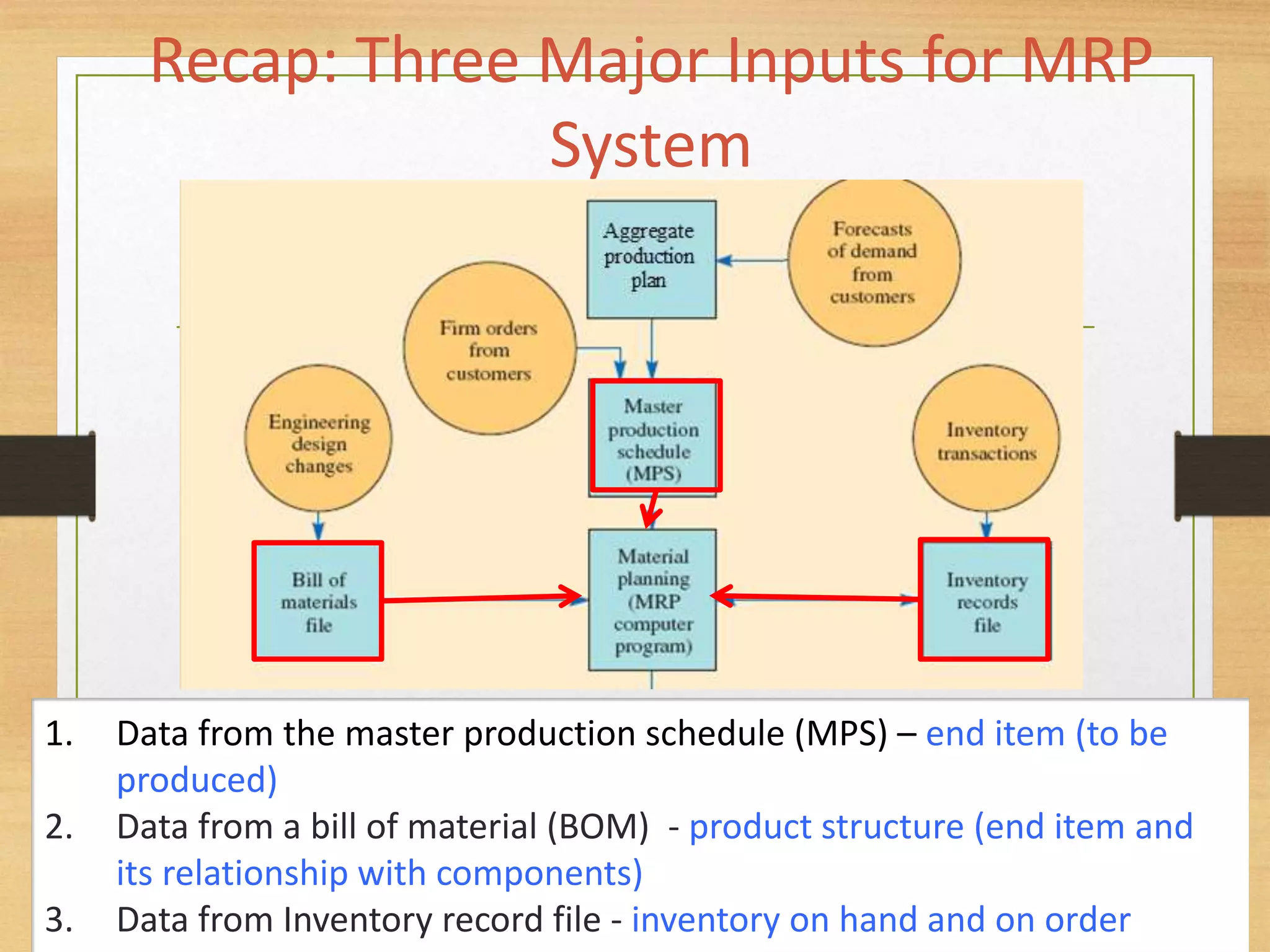
Recap: Three Major Inputs for MRP
System
1. Data from the master production schedule (MPS) – end item (to be
produced)
2. Data from a bill of material (BOM) - product structure (end item and
its relationship with components)
3. Data from Inventory record file - inventory on hand and on order
MRP Explosion
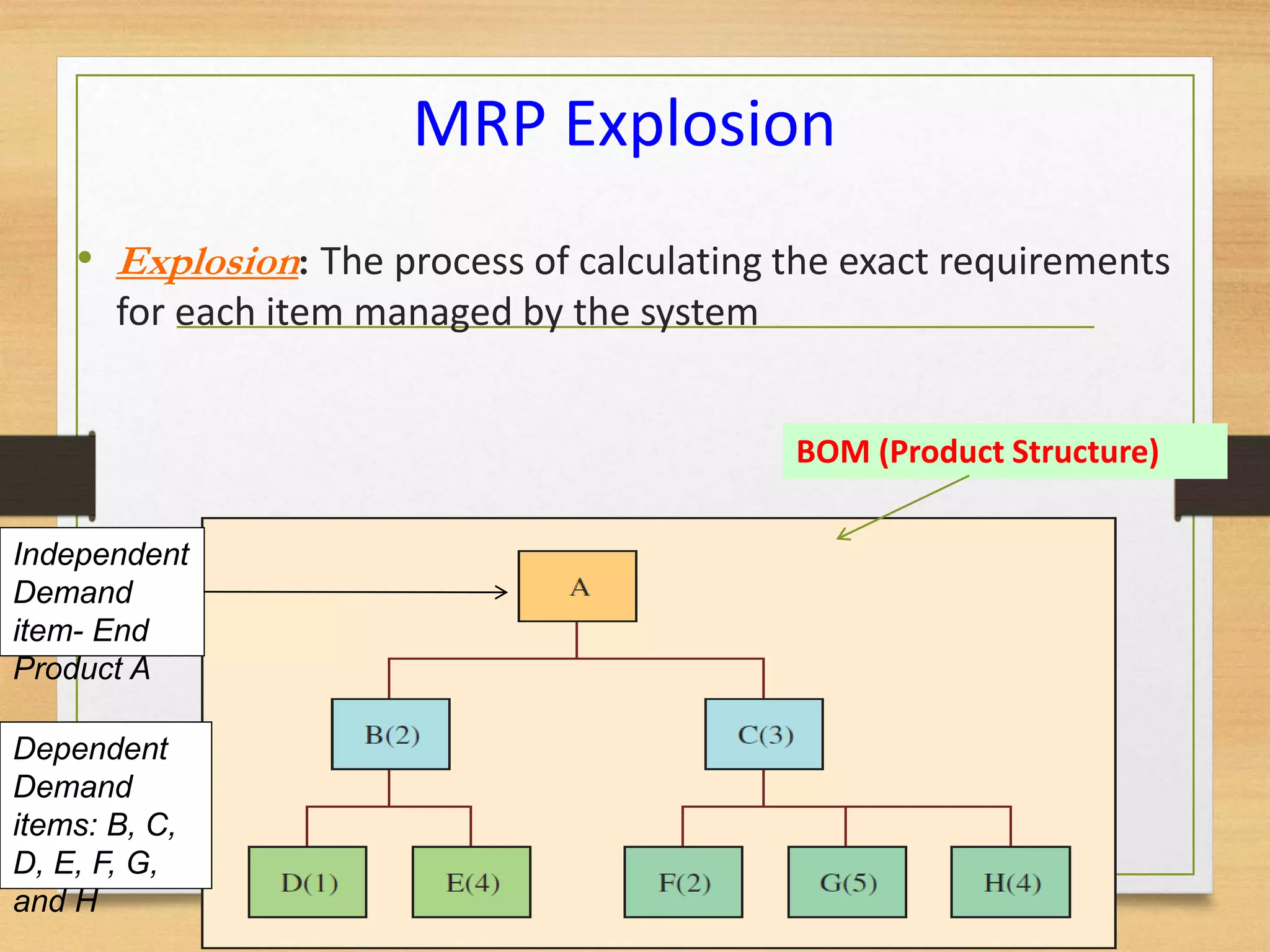
• Explosion: The process of calculating the exact requirements
for each item managed by the system
Independent
Demand
item- End
Product A
Dependent
Demand
items: B, C,
D, E, F, G,
and H
BOM (Product Structure)
50 60 70A
Master Production Schedule (MPS)- Gross
Requirements for End items
Inventory Record file
MRP Terminology
• Gross Requirements: The total amount required for a particular
item.
• Scheduled Receipts: Existing orders that arrive at beginning of
period.
• Projected available balance: Amount of inventory expected as of
the end of a period
• Net requirements: The amount needed when the project available
balance in a period is not sufficient to cover the gross requirement
• Planned order receipt: the amount of an order that is required to
meet a net requirement; arrives at beginning of period.
• Planned order release: the planned order receipt offset by the
lead time
MRP Explosion Process
8. Repeat for all items in bill of materials
7. Net requirements, planned-order receipts, and planned-order releases are calculated as described in steps
2–4
6. Gross requirements for each level 1 item are calculated from the planned-order release schedule for the
parents of each level 1 item
5. Move to Level 1 items
4. Planned order releases are generated by offsetting to allow for lead time
3. Net requirements data is used to calculate when orders should be received to meet these
requirements
2. On-hand balance and schedule of orders are used to calculate the “net requirements”
1. The requirements for end items are retrieved from the master schedule
These are referred to as “gross requirements” by the MRP program
MRP Management
 MRP is a dynamic system
 Facilitates replanning when changes occur
 System nervousness can result from too many
changes
 Time fences put limits on replanning
 Pegging links each item to its parent allowing
effective analysis of changes
MRP and JIT
 MRP is a planning system that does not
do detailed scheduling
 MRP requires fixed lead times which
might actually vary with batch size
 JIT excels at rapidly moving small batches
of material through the system
MRP and JIT
• MRP is concerned with ordering raw materials and
planning resource deployments based on sales
forecasts.
• JIT focuses on production as it relates not to forecast
sales, but to actual orders in-hand.
Small Bucket Approach
1. MRP “buckets” are reduced to daily or hourly
 The most common planning period (time bucket) for MRP systems is weekly
2. Planned receipts are used internally to sequence production
3. Inventory is moved through the plant on a JIT basis
4. Completed products are moved to finished goods inventory which reduces
required quantities for subsequent planned orders
5. Back flushing based on the BOM is used to deduct inventory that was used in
production
Balanced Flow
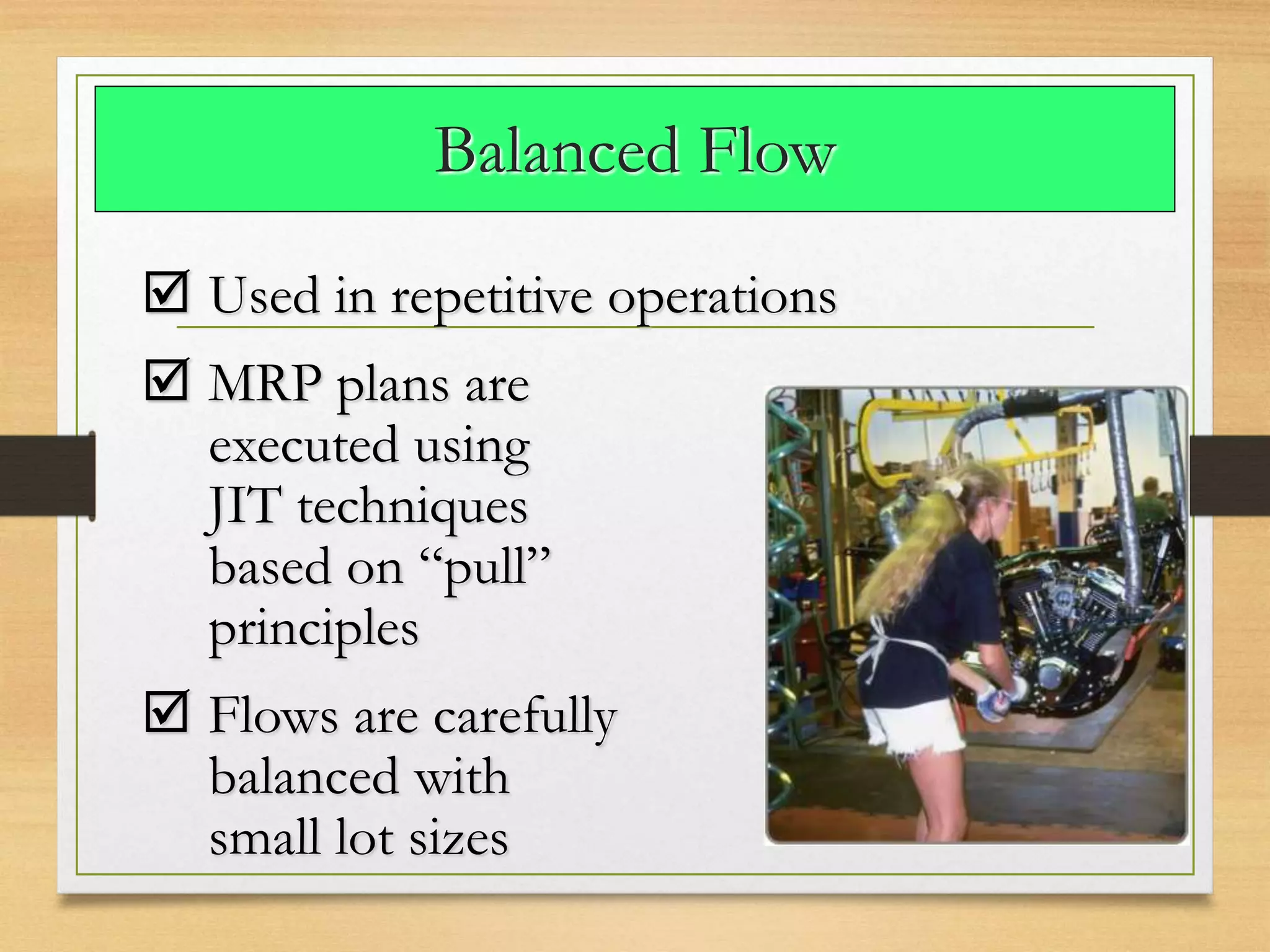
 Used in repetitive operations
 MRP plans are
executed using
JIT techniques
based on “pull”
principles
 Flows are carefully
balanced with
small lot sizes
Finite Capacity Scheduling
 MRP systems do not consider capacity
during normal planning cycles
 Finite capacity scheduling (FCS)
recognizes actual capacity limits
 By merging MRP and FCS, a finite
schedule is created with feasible capacities
which facilitates rapid material movement
THANK
YOU!

MATERIAL REQUIREMENTS PLANNING (MRP)

  • 1.
    MATERIAL REQUIREMENT PLANNING KathmanduUniversity School Of Management (KUSOM) Subject: Managing Operations and Technology Term/Trimester: MBA Second Term Year: 2017 Presented by: Dipesh Raj Pandey Roll - 17321
  • 2.
  • 3.
    MRP System Structure (Input& Output) MRP system inputs MRP system outputs
  • 4.
    Aggregate plan shows overallquantities to produce – without specifying type Major Inputs to MRP System: 1. Master Production Schedule (MPS) • The MPS deals with end items (finished goods). • The aggregate plan provides the general range of operation. • MPS specifies exactly what need to be produced, not what can be produced and when to produce. MPS shows quantities of each type, with information about the production time frame
  • 5.
    • BOM isoften called product structure file or product tree. • Contains the complete product description, listing the materials, parts, and components along with the sequence in which the product is created Major Inputs to MRP System: 2. Bill of Material (BOM) Product A – the end item Product A consists of 2 B and 3 C Part C consists of 2 F, 5 G and 4 H Part B consists of 1 D and 4 E Level 0 Level 1 Level 2
  • 6.
    Basic information describing the item Informatio n about part availability Additional information thatmay be useful • Contains an extensive amount of information on every item that is produced, ordered, or inventoried in the system Major Inputs to MRP System: 3. Inventory Records File
  • 7.
    MRP Logic &BOM (without lead time consideration)- Worksheet p.1 • Product M is made of two units of N and three of P. N is made of two units of R and four units of S. R is made of one unit of S and three units of T. P is made of two units of T and four units of U. a.Show the bill of materials (product structure tree). b.If 100 M are required, how many units of each component are needed?
  • 8.
    a. Show thebill of materials (product structure tree). M N (2) P (3) R (2) S (4) T (2) U (4) S (1) T (3) Level 0 Level 1 Level 2 Level 3
  • 9.
    b. If 100M are required, how many units of each component are needed? • M= 100 • N= 2M = 2X 100= 200 • P= 3M = 3 X 100= 300 • R= 2N = 2X 200= 400 • S= 4N + 1R= 4X 200+ 1X400= 800+ 400= 1,200 • T= 2P + 3R= 2X300+ 3X400= 600+ 1,200=1,800 • U= 4P = 4X300= 1,200
  • 10.
    MRP Logic andBOM (with lead time consideration) B(4) E(1)D(2) C(2) F(2)D(3) A Product Structure Tree for Assembly A Lead Times A 1 day B 2 days C 1 day D 3 days E 4 days F 1 day Demand Day 10 50 A Given the product structure tree for “A” and the lead time and demand information below, provide a materials requirements plan that defines the number of units of each component and when they will be needed. Lead Times A 1 day B 2 days C 1 day D 3 days E 4 days F 1 day
  • 11.
    LT = 1day Day: 1 2 3 4 5 6 7 8 9 10 A Required 50 Order Placement 50 First, the number of units of “A” are scheduled backwards to allow for their lead time. So, in the materials requirement plan below, we have to place an order for 50 units of “A” in the 9th week to receive them in the 10th week.
  • 12.
    Next, we needto start scheduling the components that make up “A”. In the case of component “B” we need 4 B’s for each A. Since we need 50 A’s, that means 200 B’s. And again, we back the schedule up for the necessary 2 days of lead time. Day: 1 2 3 4 5 6 7 8 9 10 A Required 50 Order Placement 50 B Required 200 Order Placement 200 LT = 2 B(4) E(1)D(2) C(2) F(2)D(3) A 4x50=200
  • 13.
    A Required 50 LT=1Order Placement B Required LT=2 Order Placement C Required LT=1 Order Placement D Required LT=3 Order Placement E Required LT=4 Order Placement F Required LT=1 Order Placement B(4) E(1)D(2) C(2) F(2)D(3) A Finally, repeating the process for all components, we have the final materials requirements plan: 13 B=4A= 4x50=200 C=2A= 2x50=100 D=2B=2x200=400 E=1B= 1x200=200 D=3C= 3x100=300 F=2C= 2x100=200 A= 50 Day: 1 2 3 4 5 6 7 8 9 10
  • 14.
    Recap: Three MajorInputs for MRP System 1. Data from the master production schedule (MPS) – end item (to be produced) 2. Data from a bill of material (BOM) - product structure (end item and its relationship with components) 3. Data from Inventory record file - inventory on hand and on order
  • 15.
    MRP Explosion • Explosion:The process of calculating the exact requirements for each item managed by the system Independent Demand item- End Product A Dependent Demand items: B, C, D, E, F, G, and H BOM (Product Structure)
  • 16.
    50 60 70A MasterProduction Schedule (MPS)- Gross Requirements for End items Inventory Record file
  • 17.
    MRP Terminology • GrossRequirements: The total amount required for a particular item. • Scheduled Receipts: Existing orders that arrive at beginning of period. • Projected available balance: Amount of inventory expected as of the end of a period • Net requirements: The amount needed when the project available balance in a period is not sufficient to cover the gross requirement • Planned order receipt: the amount of an order that is required to meet a net requirement; arrives at beginning of period. • Planned order release: the planned order receipt offset by the lead time
  • 18.
    MRP Explosion Process 8.Repeat for all items in bill of materials 7. Net requirements, planned-order receipts, and planned-order releases are calculated as described in steps 2–4 6. Gross requirements for each level 1 item are calculated from the planned-order release schedule for the parents of each level 1 item 5. Move to Level 1 items 4. Planned order releases are generated by offsetting to allow for lead time 3. Net requirements data is used to calculate when orders should be received to meet these requirements 2. On-hand balance and schedule of orders are used to calculate the “net requirements” 1. The requirements for end items are retrieved from the master schedule These are referred to as “gross requirements” by the MRP program
  • 19.
    MRP Management  MRPis a dynamic system  Facilitates replanning when changes occur  System nervousness can result from too many changes  Time fences put limits on replanning  Pegging links each item to its parent allowing effective analysis of changes
  • 20.
    MRP and JIT MRP is a planning system that does not do detailed scheduling  MRP requires fixed lead times which might actually vary with batch size  JIT excels at rapidly moving small batches of material through the system
  • 21.
    MRP and JIT •MRP is concerned with ordering raw materials and planning resource deployments based on sales forecasts. • JIT focuses on production as it relates not to forecast sales, but to actual orders in-hand.
  • 22.
    Small Bucket Approach 1.MRP “buckets” are reduced to daily or hourly  The most common planning period (time bucket) for MRP systems is weekly 2. Planned receipts are used internally to sequence production 3. Inventory is moved through the plant on a JIT basis 4. Completed products are moved to finished goods inventory which reduces required quantities for subsequent planned orders 5. Back flushing based on the BOM is used to deduct inventory that was used in production
  • 23.
    Balanced Flow  Usedin repetitive operations  MRP plans are executed using JIT techniques based on “pull” principles  Flows are carefully balanced with small lot sizes
  • 24.
    Finite Capacity Scheduling MRP systems do not consider capacity during normal planning cycles  Finite capacity scheduling (FCS) recognizes actual capacity limits  By merging MRP and FCS, a finite schedule is created with feasible capacities which facilitates rapid material movement
  • 25.