Material Requirements
and Resource Planning
Prepared by:
IRELYN I. JASMIN
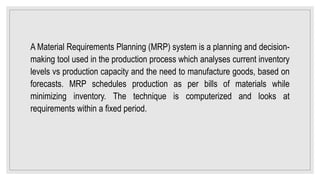
A Material Requirements Planning (MRP) system is a planning and decision-
making tool used in the production process which analyses current inventory
levels vs production capacity and the need to manufacture goods, based on
forecasts. MRP schedules production as per bills of materials while
minimizing inventory. The technique is computerized and looks at
requirements within a fixed period.
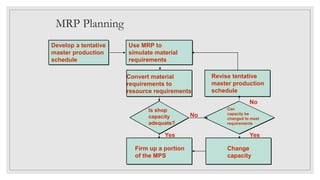
MRP Planning
Develop a tentative
master production
schedule
Use MRP to
simulate material
requirements
Convert material
requirements to
resource requirements
Firm up a portion
of the MPS
Is shop
capacity
adequate?
Can
capacity be
changed to meet
requirements
Revise tentative
master production
schedule
Change
capacity
Yes
No
Yes
No
What are the main features of an MRP system?
• A master production schedule: A statement of the planning
including orders, forecasts and capacity.
• Bill of materials (BOM): All the materials and components
required to make the final product.
• Inventory status file: Stock records that allow gross
requirements to be adjusted to net requirements.
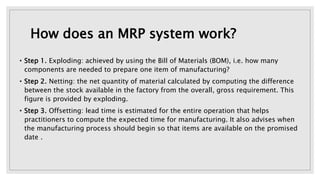
How does an MRP system work?
• Step 1. Exploding: achieved by using the Bill of Materials (BOM), i.e. how many
components are needed to prepare one item of manufacturing?
• Step 2. Netting: the net quantity of material calculated by computing the difference
between the stock available in the factory from the overall, gross requirement. This
figure is provided by exploding.
• Step 3. Offsetting: lead time is estimated for the entire operation that helps
practitioners to compute the expected time for manufacturing. It also advises when
the manufacturing process should begin so that items are available on the promised
date .
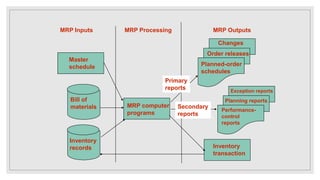
MRP Inputs MRP Processing MRP Outputs
Master
schedule
Bill of
materials
Inventory
records
MRP computer
programs
Changes
Order releases
Planned-order
schedules
Exception reports
Planning reports
Performance-
control
reports
Inventory
transaction
Primary
reports
Secondary
reports
7
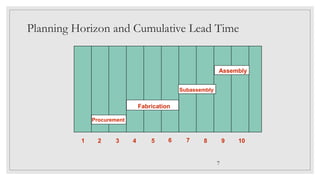
Planning Horizon and Cumulative Lead Time
1 2 3 4 5 6 7 8 9 10
Procurement
Fabrication
Subassembly
Assembly
What are the advantages of an MRP system?
• The MRP system is widely credited for playing a crucial part in
decreasing factory inventory. It also assists in manufacturing
industrial products that are more complex
• MRP focus is on what materials are required and when they need to
be sourced. It is also helpful in product customization
• MRP has historically been seen as giving additional advantage
because it is known to schedule and track every order whether for
production or purchase.
The disadvantages when using a material requirement
planning inventory system include:
• Reliance on the precise input information
• There are scheduling delays, wrong order quantities, and inefficient tracking if the
information is inputted inaccurately within the system
• Requires extensive maintenance of robust databases
• In order to use the system, proper training is required
• The system is not cheap and requires a substantial capital investment
THANK YOU! 

Material Requirements Planning (MRP).pptx

  • 1.
    Material Requirements and ResourcePlanning Prepared by: IRELYN I. JASMIN
  • 2.
    A Material RequirementsPlanning (MRP) system is a planning and decision- making tool used in the production process which analyses current inventory levels vs production capacity and the need to manufacture goods, based on forecasts. MRP schedules production as per bills of materials while minimizing inventory. The technique is computerized and looks at requirements within a fixed period.
  • 3.
    MRP Planning Develop atentative master production schedule Use MRP to simulate material requirements Convert material requirements to resource requirements Firm up a portion of the MPS Is shop capacity adequate? Can capacity be changed to meet requirements Revise tentative master production schedule Change capacity Yes No Yes No
  • 4.
    What are themain features of an MRP system? • A master production schedule: A statement of the planning including orders, forecasts and capacity. • Bill of materials (BOM): All the materials and components required to make the final product. • Inventory status file: Stock records that allow gross requirements to be adjusted to net requirements.
  • 5.
    How does anMRP system work? • Step 1. Exploding: achieved by using the Bill of Materials (BOM), i.e. how many components are needed to prepare one item of manufacturing? • Step 2. Netting: the net quantity of material calculated by computing the difference between the stock available in the factory from the overall, gross requirement. This figure is provided by exploding. • Step 3. Offsetting: lead time is estimated for the entire operation that helps practitioners to compute the expected time for manufacturing. It also advises when the manufacturing process should begin so that items are available on the promised date .
  • 6.
    MRP Inputs MRPProcessing MRP Outputs Master schedule Bill of materials Inventory records MRP computer programs Changes Order releases Planned-order schedules Exception reports Planning reports Performance- control reports Inventory transaction Primary reports Secondary reports
  • 7.
    7 Planning Horizon andCumulative Lead Time 1 2 3 4 5 6 7 8 9 10 Procurement Fabrication Subassembly Assembly
  • 8.
    What are theadvantages of an MRP system? • The MRP system is widely credited for playing a crucial part in decreasing factory inventory. It also assists in manufacturing industrial products that are more complex • MRP focus is on what materials are required and when they need to be sourced. It is also helpful in product customization • MRP has historically been seen as giving additional advantage because it is known to schedule and track every order whether for production or purchase.
  • 9.
    The disadvantages whenusing a material requirement planning inventory system include: • Reliance on the precise input information • There are scheduling delays, wrong order quantities, and inefficient tracking if the information is inputted inaccurately within the system • Requires extensive maintenance of robust databases • In order to use the system, proper training is required • The system is not cheap and requires a substantial capital investment
  • 10.