
Maslow's hierarchy of
       needs
Abraham Maslow
What Motivates Us?
       Have you ever thought about what
                motivates you?
   Why do we get up and go to work or
    school?
   Why do we hang out with our friends?
   Why do schools provide recess or
    employers provide paid vacation days?
NEEDS


WHICH?           HOW??
Teachers, leaders,
businesses...every
 one needs to be
 aware of needs.
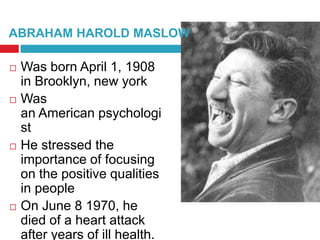
ABRAHAM HAROLD MASLOW

   Was born April 1, 1908
    in Brooklyn, new york
   Was
    an American psychologi
    st
   He stressed the
    importance of focusing
    on the positive qualities
    in people
   On June 8 1970, he
    died of a heart attack
    after years of ill health.
ABRAHAM MASLOW
                               In the 1950s

Was one of the founders                     Developed a theory called the
of humanistic psychology                         hierarchy of needs


Which emphasizes the
individual's potential and         Developed a list that classified all
stresses the importance of         needs into five general groups
growth

                                   He asserted that there was a hierarchy
Developing a psychology            of these five groups of needs in terms
that was not based in
                                   of their importance for human
clinical studies, but rather
focused on normal human            development
growth and development.
Today, is the end of the world
Classify the objects that you have on your bag in the pyramid of
                              needs
MASLOW'S HIERARCHY OF
NEEDS
1. PHYSIOLOGICAL NEEDS
Have you ever had a hard time paying
attention to what the professor is saying when
               you are hungry?
2. SAFETY NEEDS
3. THE LOVE AND BELONGING
NEEDS
4. THE ESTEEM NEEDS


         THE LOWER


         THE HIGHER
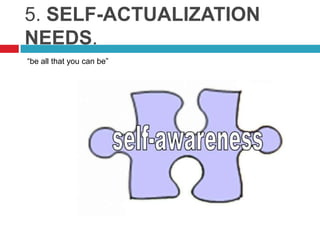
5. SELF-ACTUALIZATION
NEEDS.
“be all that you can be”
"the desire for self-fulfillment, namely
the tendency for him [the individual] to
    become actualized in what he is
  potentially. This tendency might be
phrased as the desire to become more
   and more what one is, to become
   everything that one is capable of
               becoming."
Maslow's Characteristics of Self-
Actualizers
   Efficient perceptions of reality. Self-actualizers are able to judge
    situations correctly and honestly.
   Comfortable acceptance of self, others, nature. Self-actualizers
    accept their own human nature with all its flaws.
   Spontaneity. creativity into everyday activities.
   Task centeringhad a mission to fulfill in life or some task or
    problem outside of themselves to pursue. Humanitarians such
    as Albert Schweitzer and Mother Teresa are considered to have
    possessed this quality.
   Autonomy. Self-actualizers are free from reliance on external
    authorities or other people. They tend to be resourceful and
    independent.
   Fellowship with humanity. felt a deep identification with others
    and the human situation in general.
   Profound interpersonal relationships. The interpersonal
    relationships of self-actualizers are marked by deep loving bonds.
   Non-hostile sense of humor. This refers to the wonderful capacity to
    laugh at oneself.
What aspects you personally see positive and
      challenging about his proposal?


          POSITIVE
   Understanding how children learn
   What factors influence learning

CHALLENGES
     Needs            desires
     Self-actualization needs

   Engage the parents and the

             community
How could this particular proposal enrich your
     personal or your schools practice?

             Truth, rather than dishonesty.
             Goodness, rather than evil.
             Beauty, not ugliness or vulgarity.
             Unity, wholeness, and transcendence of
              opposites, not arbitrariness or forced choices.
             Aliveness, not deadness or the mechanization of
              life.
             Uniqueness, not bland uniformity.
             Perfection and necessity, not sloppiness,
              inconsistency, or accident.
             Justice and order, not injustice and lawlessness.
             Effortlessness, not strain.
             Self-sufficiency, not dependency.
             Meaningfulness, rather than senselessness.
   Maslow believes that much of the
    what is wrong with the world comes
    down to the fact that very few
    people really are interested in
    values -- not because they are bad
    people, but because they haven’t
    even had their basic needs taken
    care of!
   http://www.youtube.com/watch?v=LOLEMxCb
                        hFg
Maslow
Maslow

Maslow

  • 1.
    Maslow's hierarchy of needs Abraham Maslow
  • 2.
    What Motivates Us? Have you ever thought about what motivates you?  Why do we get up and go to work or school?  Why do we hang out with our friends?  Why do schools provide recess or employers provide paid vacation days?
  • 3.
  • 4.
    Teachers, leaders, businesses...every oneneeds to be aware of needs.
  • 5.
    ABRAHAM HAROLD MASLOW  Was born April 1, 1908 in Brooklyn, new york  Was an American psychologi st  He stressed the importance of focusing on the positive qualities in people  On June 8 1970, he died of a heart attack after years of ill health.
  • 6.
    ABRAHAM MASLOW In the 1950s Was one of the founders Developed a theory called the of humanistic psychology hierarchy of needs Which emphasizes the individual's potential and Developed a list that classified all stresses the importance of needs into five general groups growth He asserted that there was a hierarchy Developing a psychology of these five groups of needs in terms that was not based in of their importance for human clinical studies, but rather focused on normal human development growth and development.
  • 7.
    Today, is theend of the world Classify the objects that you have on your bag in the pyramid of needs
  • 8.
  • 9.
  • 10.
    Have you everhad a hard time paying attention to what the professor is saying when you are hungry?
  • 11.
  • 13.
    3. THE LOVEAND BELONGING NEEDS
  • 15.
    4. THE ESTEEMNEEDS THE LOWER THE HIGHER
  • 17.
  • 18.
    "the desire forself-fulfillment, namely the tendency for him [the individual] to become actualized in what he is potentially. This tendency might be phrased as the desire to become more and more what one is, to become everything that one is capable of becoming."
  • 19.
    Maslow's Characteristics ofSelf- Actualizers  Efficient perceptions of reality. Self-actualizers are able to judge situations correctly and honestly.  Comfortable acceptance of self, others, nature. Self-actualizers accept their own human nature with all its flaws.  Spontaneity. creativity into everyday activities.  Task centeringhad a mission to fulfill in life or some task or problem outside of themselves to pursue. Humanitarians such as Albert Schweitzer and Mother Teresa are considered to have possessed this quality.  Autonomy. Self-actualizers are free from reliance on external authorities or other people. They tend to be resourceful and independent.  Fellowship with humanity. felt a deep identification with others and the human situation in general.  Profound interpersonal relationships. The interpersonal relationships of self-actualizers are marked by deep loving bonds.  Non-hostile sense of humor. This refers to the wonderful capacity to laugh at oneself.
  • 21.
    What aspects youpersonally see positive and challenging about his proposal? POSITIVE
  • 22.
    Understanding how children learn  What factors influence learning CHALLENGES  Needs desires  Self-actualization needs  Engage the parents and the community
  • 23.
    How could thisparticular proposal enrich your personal or your schools practice?  Truth, rather than dishonesty.  Goodness, rather than evil.  Beauty, not ugliness or vulgarity.  Unity, wholeness, and transcendence of opposites, not arbitrariness or forced choices.  Aliveness, not deadness or the mechanization of life.  Uniqueness, not bland uniformity.  Perfection and necessity, not sloppiness, inconsistency, or accident.  Justice and order, not injustice and lawlessness.  Effortlessness, not strain.  Self-sufficiency, not dependency.  Meaningfulness, rather than senselessness.
  • 24.
    Maslow believes that much of the what is wrong with the world comes down to the fact that very few people really are interested in values -- not because they are bad people, but because they haven’t even had their basic needs taken care of!
  • 26.
    http://www.youtube.com/watch?v=LOLEMxCb hFg