Motivational Skills
By – N.G.Palit
What is Motivation?
 Motivation is derived from the
word’motive’ which means
needs, desires, wants or the
drives within the individuals.
 It is the process of stimulating
people to actions to accomplish
the goals.
What is Motivation?
 Motivation is a
psychological drive
that directs a person
towards an objective.
 Motives are the ”whys”
of behaviour.
What is Motivation?
 Motivation is the internal
drive to accomplish a
particular goal.
In a work setting motivation is what
makes people want to work.
Motivation
 One can purchase a man’s time, his
physical presence, but can’t buy his
willingness to work.
 This can be achieved only through
”motivation”.
 We must remember that ability to work
is quite different from ”the will to
work”.
Then what is Motivation?
 Motivation is ’encouraging people to
want to do, what you want them to
do’.
 ” Motivation is the act or process of
stimulating to action, providing an
incentive or motive, especially for an act”.
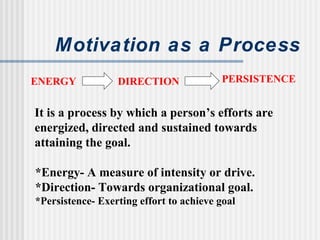
Motivation as a Process
DIRECTION PERSISTENCEENERGY
It is a process by which a person’s efforts are
energized, directed and sustained towards
attaining the goal.
*Energy- A measure of intensity or drive.
*Direction- Towards organizational goal.
*Persistence- Exerting effort to achieve goal
Basic Model of Motivation
Needs or
Expectation
s
Drive force
(Behavior or
Action)
Result in
To Achieve
Desired Goals
Which Providesfulfillments
Feedback
Positive Motivation
 Positive motivation is
a
response which includes
enjoyment and optimism
about the tasks you are
involved in.
Negative Motivation
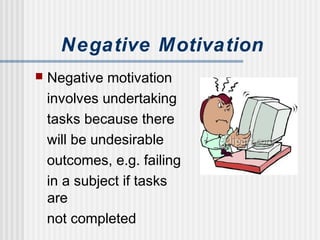
 Negative motivation
involves undertaking
tasks because there
will be undesirable
outcomes, e.g. failing
in a subject if tasks
are
not completed
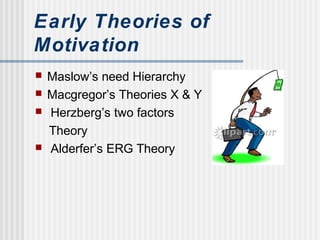
Early Theories of
Motivation
 Maslow’s need Hierarchy
 Macgregor’s Theories X & Y
 Herzberg’s two factors
Theory
 Alderfer’s ERG Theory
Maslow’s Need Theory
 Maslow’s Need TheoryMaslow’s Need Theory
• Motivation is a function
of five basic needs-
physiological safety,
love, esteem, and self-
actualization.
Maslow’s Theory
 Maslow’s theory assumes that a person
tries to satisfy the more basic needs
before directing behavior towards
satisfying the upper level needs.
 Lower level needs must be
satisfied
before a higher order need begins
to
Maslow’s Theory
 A satisfied need is
no more a motivator
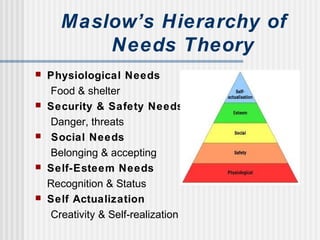
Maslow’s Hierarchy of
Needs Theory
 Physiological Needs
Food & shelter
 Security & Safety Needs
Danger, threats
 Social Needs
Belonging & accepting
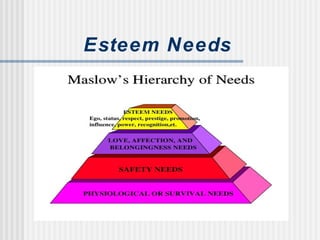
 Self-Esteem Needs
Recognition & Status
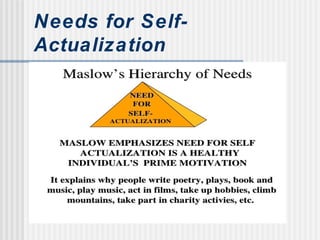
 Self Actualization
Creativity & Self-realization
Physiological or Survival
Needs
Physiological Needs
 Physiological needs are those required
to sustain life. Examples:
 Air
 Water
 Food
 Sleep
Physiological Needs
 Food, when hungry.
 Job for a jobless person
 Working conditions
 Physical comforts.
 Lunch & Rest breaks
 Bath room facilities
Safety Needs
Safety Needs
 Job Security
 Seniority
 Money
 Retirement Benefits
Social Needs
Social Needs
 Relationship with co-workers & Boss
 Teams
 Social Events
 Fun.
Esteem Needs
Esteem/ Ego Needs
 Opportunities for Growth & Advancement
 Promotions
 Job Titles
 Recognition
 Perks
 Positive feed-back on performance
 Training & Develpoment
Needs for Self-
Actualization
Need for Self-Actualzation
Self-Actualization
 Meaningful work
 Self Improvement
 Accomplishment
 Improving others & Society
 To become “All that you can be”
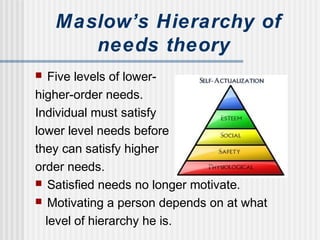
Maslow’s Hierarchy of
needs theory
 Five levels of lower-
higher-order needs.
Individual must satisfy
lower level needs before
they can satisfy higher
order needs.
 Satisfied needs no longer motivate.
 Motivating a person depends on at what
level of hierarchy he is.
Needs Hierarchy
 1. It is based on needs and not wants.
 2. When one need is fulfilled, the next
higher(ascending) need is uncovered.
 3. One can revert back(people operating
in level 4 & 5 will revert back to level
2, if a feeling of insecurity takes over.)
Needs Hierarchy
 4. Needs, which are not met are
demonstrated in behaviour.
 Managers should be able to pick-
up
the signals & take suitable
action at
the right time.
McGregor’s Theory X & Y
Theory X
 Assumes that workers have little
ambition, dislike work, avoid responsibility
and require close supervision.
Theory Y
 Assumes that workers can exercise self-
direction, desire, responsibility and like to
work.
McGregor’s Theory X & Y
Theory X assumptions:
 Most people dislike work.
 They need to be directed,
controlled and sometimes
threatened with punishment
Theory Y
Theory Y assumptions:
 They will exercise self-direction and
self-control in achievement of
organizational goal.
 People are innovative & creative of
solving organizational problems.
 Minimize the role of supervision.
Motivational Theories X &
Y
* Theory Y- a set of
assumptions of how to
manage individuals
motivated by higher
order needs.
 Theory X- a set of
assumptions of how to
manage individuals motivated by lower order
needs.
McClelland’s Theory
 McClelland’s NeedMcClelland’s Need
TheoryTheory
• The needs for
achievement,
affiliation, and power
affect behavior.
McClelland’s Need Theory:
Need for Achievement
Need for
Achievement
 The desire to excel
and succeed
McClelland’s Need Theory:
Need for Power
Need for Power
 The need to influence
the behaviour of
others.
McClelland’s Need
Theory:
Need for Affiliation
Need for
Affiliation
 The desire for
interpersonal
relationship.
Fredrick Herzberg’s
Theory
Herzberg’s Two Factors
Theory
 Dr. Herzberg developed his
theory that there are two
factors at work in determining
job satisfaction:
Hygiene Factors:
 Pay, working condition
 Inter-personal relation.
 Job security, Supervision, Company policy
 Status.
Satisfaction Vs
Dissatisfaction
 Motivators
 Achievement,
 Growth, Recognition
 Responsibility
 Hygiene
 Compensation
 Supervision
 Work Conditions
 Fringes
Recognition & Motivation
Each member values the recognition
and reward of their performance
Herzberg’s Theory
Motivators
 Responsibility
 Sense of achievement
 Challenging work
 Self-improvement
 Recognition
 Advancement
Provide Reward &
Recognition
Herzberg’s Motivator-
Hygiene
Model
 No Satisfaction
Satisfaction
Jobs that do not Jobs offering
offer achievement achievement
recognition, recognition,
 stimulating work, stimulating work,
responsibility, responsibility,
and advancement. and advancement.
Herzberg’s Motivators-
Hygiene
Model

 Dissatisfaction No Dissatisfaction
Jobs with poor Jobs with good
company policies, company policies,
and administration, & administration,
 technical supervision technical supervision,
salary, interpersonal salary, interpersonal
relationships with relationships with
supervisors, and supervisors, and
working conditions. working conditions.
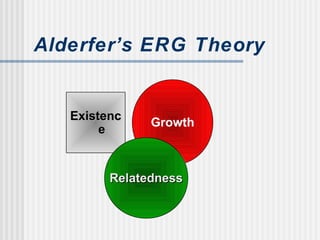
Alderfer’s ERG Theory
Physiological
Safety & Security
Love (Social)
Esteem
SA
Growth
Relatedness
Existence
ERG Theory
 Existence Needs
 Related Needs
 Growth Needs
Alderfer’s ERG Theory
ExistencExistenc
ee
ExistencExistenc
ee
GrowthGrowth
RelatednessRelatednessRelatednessRelatedness
Contemporary
Motivational
Strategies
 1. Motivation through job design
Job rotation
Job enlargement
Job enrichment
 2. Motivation through incentives
 3. Training & education
 4. Motivation through
empowerment
Provide productive and
challenging work
Positive Reinforcement &
Recognition
 Praise
 Positive Written
Communication
 Orientation & Training
 Active Listening
 Courtesy
Self Motivation Strategies
 Take control of your expectations
 Fight the urge to under-achieve
 Learn to love the job, which you hate
 Build immunity to cynicism
 Strive to excell
Self Motivation
Self Motivation
Creates a momentum to help you and
your team achieve success
A Case Study
 The manager of A.B.C.Ltd. Realized that the
level of moral and motivation of their employees
was very low and there was dissatisfaction among
the employees. Labor productivity was also found
to be very low. After investigating the causes of
dissatisfaction, the managers decided that if
employees were to be motivated, there was a need
to establish and maintain good interpersonal
relation, over and above good salary, job security,
proper working conditions and supervision.
A Case Study
So, they put in sincere efforts to improve all
these factors during one year. Yet,
surprisingly, they came to know that in
spite of reduction in the degree of
dissatisfaction, the level of morale and
motivation was low and there was no
significant increase in their productivity.
Therefore, the managers were worried.
What managerial problem is involved in
the above case? Suggest a solution.
Sail smoothly with Motivation
Questions
Thank you
By –
N.G.Palit
Benefits of motivating
your team
At the End
 If you liked this presentation, please
feel free to send your valuable feed-back
to me at:
nandapalit@yahoo.co.in
or call me at: 09949118910 (India)

Motivation (2)

  • 1.
  • 2.
    What is Motivation? Motivation is derived from the word’motive’ which means needs, desires, wants or the drives within the individuals.  It is the process of stimulating people to actions to accomplish the goals.
  • 3.
    What is Motivation? Motivation is a psychological drive that directs a person towards an objective.  Motives are the ”whys” of behaviour.
  • 4.
    What is Motivation? Motivation is the internal drive to accomplish a particular goal. In a work setting motivation is what makes people want to work.
  • 5.
    Motivation  One canpurchase a man’s time, his physical presence, but can’t buy his willingness to work.  This can be achieved only through ”motivation”.  We must remember that ability to work is quite different from ”the will to work”.
  • 6.
    Then what isMotivation?  Motivation is ’encouraging people to want to do, what you want them to do’.  ” Motivation is the act or process of stimulating to action, providing an incentive or motive, especially for an act”.
  • 7.
    Motivation as aProcess DIRECTION PERSISTENCEENERGY It is a process by which a person’s efforts are energized, directed and sustained towards attaining the goal. *Energy- A measure of intensity or drive. *Direction- Towards organizational goal. *Persistence- Exerting effort to achieve goal
  • 8.
    Basic Model ofMotivation Needs or Expectation s Drive force (Behavior or Action) Result in To Achieve Desired Goals Which Providesfulfillments Feedback
  • 9.
    Positive Motivation  Positivemotivation is a response which includes enjoyment and optimism about the tasks you are involved in.
  • 10.
    Negative Motivation  Negativemotivation involves undertaking tasks because there will be undesirable outcomes, e.g. failing in a subject if tasks are not completed
  • 11.
    Early Theories of Motivation Maslow’s need Hierarchy  Macgregor’s Theories X & Y  Herzberg’s two factors Theory  Alderfer’s ERG Theory
  • 12.
    Maslow’s Need Theory Maslow’s Need TheoryMaslow’s Need Theory • Motivation is a function of five basic needs- physiological safety, love, esteem, and self- actualization.
  • 13.
    Maslow’s Theory  Maslow’stheory assumes that a person tries to satisfy the more basic needs before directing behavior towards satisfying the upper level needs.  Lower level needs must be satisfied before a higher order need begins to
  • 14.
    Maslow’s Theory  Asatisfied need is no more a motivator
  • 15.
    Maslow’s Hierarchy of NeedsTheory  Physiological Needs Food & shelter  Security & Safety Needs Danger, threats  Social Needs Belonging & accepting  Self-Esteem Needs Recognition & Status  Self Actualization Creativity & Self-realization
  • 16.
  • 17.
    Physiological Needs  Physiologicalneeds are those required to sustain life. Examples:  Air  Water  Food  Sleep
  • 18.
    Physiological Needs  Food,when hungry.  Job for a jobless person  Working conditions  Physical comforts.  Lunch & Rest breaks  Bath room facilities
  • 19.
  • 20.
    Safety Needs  JobSecurity  Seniority  Money  Retirement Benefits
  • 21.
  • 22.
    Social Needs  Relationshipwith co-workers & Boss  Teams  Social Events  Fun.
  • 23.
  • 24.
    Esteem/ Ego Needs Opportunities for Growth & Advancement  Promotions  Job Titles  Recognition  Perks  Positive feed-back on performance  Training & Develpoment
  • 25.
  • 26.
  • 27.
    Self-Actualization  Meaningful work Self Improvement  Accomplishment  Improving others & Society  To become “All that you can be”
  • 28.
    Maslow’s Hierarchy of needstheory  Five levels of lower- higher-order needs. Individual must satisfy lower level needs before they can satisfy higher order needs.  Satisfied needs no longer motivate.  Motivating a person depends on at what level of hierarchy he is.
  • 29.
    Needs Hierarchy  1.It is based on needs and not wants.  2. When one need is fulfilled, the next higher(ascending) need is uncovered.  3. One can revert back(people operating in level 4 & 5 will revert back to level 2, if a feeling of insecurity takes over.)
  • 30.
    Needs Hierarchy  4.Needs, which are not met are demonstrated in behaviour.  Managers should be able to pick- up the signals & take suitable action at the right time.
  • 32.
    McGregor’s Theory X& Y Theory X  Assumes that workers have little ambition, dislike work, avoid responsibility and require close supervision. Theory Y  Assumes that workers can exercise self- direction, desire, responsibility and like to work.
  • 33.
    McGregor’s Theory X& Y Theory X assumptions:  Most people dislike work.  They need to be directed, controlled and sometimes threatened with punishment
  • 34.
    Theory Y Theory Yassumptions:  They will exercise self-direction and self-control in achievement of organizational goal.  People are innovative & creative of solving organizational problems.  Minimize the role of supervision.
  • 35.
    Motivational Theories X& Y * Theory Y- a set of assumptions of how to manage individuals motivated by higher order needs.  Theory X- a set of assumptions of how to manage individuals motivated by lower order needs.
  • 36.
    McClelland’s Theory  McClelland’sNeedMcClelland’s Need TheoryTheory • The needs for achievement, affiliation, and power affect behavior.
  • 37.
    McClelland’s Need Theory: Needfor Achievement Need for Achievement  The desire to excel and succeed
  • 38.
    McClelland’s Need Theory: Needfor Power Need for Power  The need to influence the behaviour of others.
  • 39.
    McClelland’s Need Theory: Need forAffiliation Need for Affiliation  The desire for interpersonal relationship.
  • 40.
  • 41.
    Herzberg’s Two Factors Theory Dr. Herzberg developed his theory that there are two factors at work in determining job satisfaction: Hygiene Factors:  Pay, working condition  Inter-personal relation.  Job security, Supervision, Company policy  Status.
  • 42.
    Satisfaction Vs Dissatisfaction  Motivators Achievement,  Growth, Recognition  Responsibility  Hygiene  Compensation  Supervision  Work Conditions  Fringes
  • 43.
    Recognition & Motivation Eachmember values the recognition and reward of their performance
  • 44.
    Herzberg’s Theory Motivators  Responsibility Sense of achievement  Challenging work  Self-improvement  Recognition  Advancement
  • 45.
  • 46.
    Herzberg’s Motivator- Hygiene Model  NoSatisfaction Satisfaction Jobs that do not Jobs offering offer achievement achievement recognition, recognition,  stimulating work, stimulating work, responsibility, responsibility, and advancement. and advancement.
  • 47.
    Herzberg’s Motivators- Hygiene Model   DissatisfactionNo Dissatisfaction Jobs with poor Jobs with good company policies, company policies, and administration, & administration,  technical supervision technical supervision, salary, interpersonal salary, interpersonal relationships with relationships with supervisors, and supervisors, and working conditions. working conditions.
  • 48.
    Alderfer’s ERG Theory Physiological Safety& Security Love (Social) Esteem SA Growth Relatedness Existence
  • 49.
    ERG Theory  ExistenceNeeds  Related Needs  Growth Needs
  • 50.
  • 51.
    Contemporary Motivational Strategies  1. Motivationthrough job design Job rotation Job enlargement Job enrichment  2. Motivation through incentives  3. Training & education  4. Motivation through empowerment
  • 52.
  • 53.
    Positive Reinforcement & Recognition Praise  Positive Written Communication  Orientation & Training  Active Listening  Courtesy
  • 54.
    Self Motivation Strategies Take control of your expectations  Fight the urge to under-achieve  Learn to love the job, which you hate  Build immunity to cynicism  Strive to excell
  • 55.
  • 56.
    Self Motivation Creates amomentum to help you and your team achieve success
  • 57.
    A Case Study The manager of A.B.C.Ltd. Realized that the level of moral and motivation of their employees was very low and there was dissatisfaction among the employees. Labor productivity was also found to be very low. After investigating the causes of dissatisfaction, the managers decided that if employees were to be motivated, there was a need to establish and maintain good interpersonal relation, over and above good salary, job security, proper working conditions and supervision.
  • 58.
    A Case Study So,they put in sincere efforts to improve all these factors during one year. Yet, surprisingly, they came to know that in spite of reduction in the degree of dissatisfaction, the level of morale and motivation was low and there was no significant increase in their productivity. Therefore, the managers were worried. What managerial problem is involved in the above case? Suggest a solution.
  • 59.
  • 60.
  • 61.
    Thank you By – N.G.Palit Benefitsof motivating your team
  • 62.
    At the End If you liked this presentation, please feel free to send your valuable feed-back to me at: nandapalit@yahoo.co.in or call me at: 09949118910 (India)