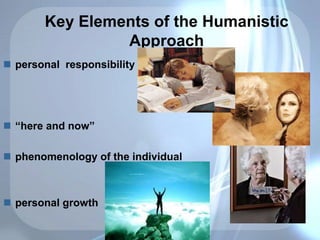
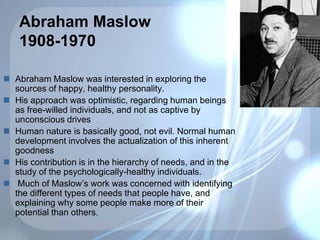
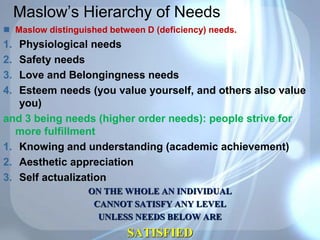
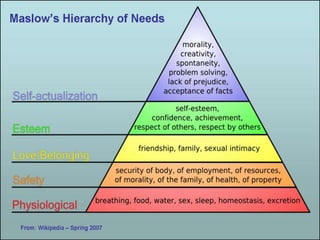
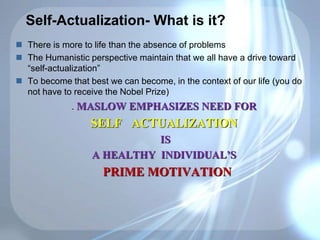
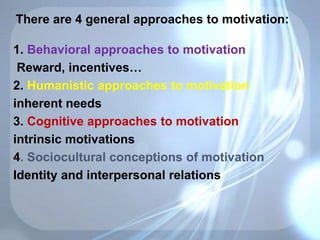
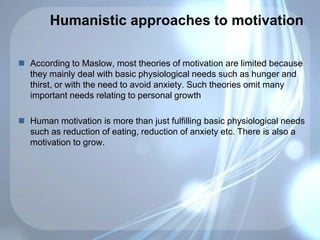
The humanistic approach emerged in the 1960s in reaction to Freudian and behavioral perspectives. It focuses on personal responsibility, the present moment, individual phenomenology, and personal growth. Abraham Maslow studied psychologically healthy individuals and developed a hierarchy of needs consisting of basic physiological needs, safety needs, love/belonging needs, esteem needs, and self-actualization as the highest need involving fulfilling one's potential. Maslow's theories emphasize an inherent drive toward self-actualization and that human nature is basically good. His hierarchy has been applied to understanding motivation and job satisfaction but also has limitations as his studies were subjective and not empirically based.