+

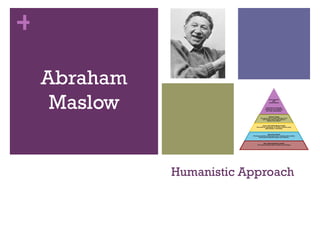
    Abraham
     Maslow


              Humanistic Approach
+
 Maslow

 •   Believed humans are interested in growing rather than simply
     restoring balance or avoiding frustration.

 •   Described humans as ‘wanting animals’ who are almost
     always wanting something.

 •    Key goal is to reach self-actualisation – to fulfill one’s potential
     - moving forward towards growth, happiness and satisfaction.

 •   Distinguished between motivation and metamotivation.
+
 MOTIVATION

    Motivation: reducing tension by satisfying deficit states.
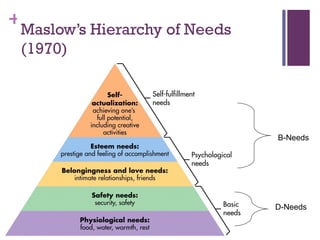
    Involves deficiency needs (D-needs) – physiological survival
     and safety, and motivate the individual to reduce these
     drives.
    Motivation and D-needs = powerful determinants of
     behaviour
+
 METAMOTIVATION

    Metamotivation: growth tendencies.
    Involves being needs (B-needs) – drive to self-actualisation.
    Goal is to enhance life by enriching it.
    Rather than reduce tension, they frequently heighten it in
     their quest for ever-increasing stimuli that will bring a life
     lived to the fullest.
+
 MOTIVATION VS
 METAMOTIVATION
  Motivationand D-needs take precedence
  over metamotivation and B-needs because
  they dominate the organism when both
  needs are thwarted.
  E.g. when an individual is desperate for
  food, they are unlikely to be concerned
  with spiritual goals like truth or beauty.
  Within the D-needs, physiological needs
  are stronger than safety needs.
+
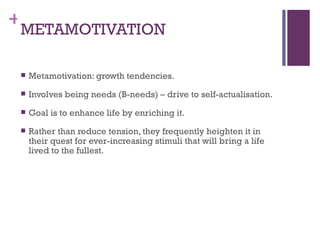
 Maslow’s Hierarchy of Needs
 (1970)


                               B-Needs


                               D-Needs
+
 Maslow’s Stats

    According to Maslow, the average American meets 85%
     physiological, 70% safety/security, 50% love and
     belongingness, 40% self-esteem and 10% self-actualisation.

    The extent to which our lower needs remain unsatisfied
     determines how strongly those needs will dominate our
     behaviour.

    Maslow at one point claimed that only two percent of the
     human population are truly, predominantly self-actualised.
+
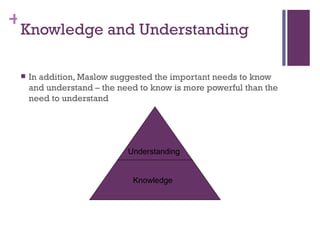
 Knowledge and Understanding

    In addition, Maslow suggested the important needs to know
     and understand – the need to know is more powerful than the
     need to understand


                            Understanding


                             Knowledge
+
 Aesthetic Needs

  Clinical
          studies also convinced Maslow that
  in some individuals, aesthetic needs are
  very important:
  “they get sick [in special ways] from
  ugliness, and are cured by beautiful
  surroundings; they crave actively, and their
  cravings can be satisfied only by beauty”


  These needs overlap with the hierarchy
  and are interrelated.
+
 Exceptions to hierarchy

  Maslow recognised that some creative
  people have pursued the development and
  expression of their special talents despite
  serious hardships and social ridicule.
  Also, stronglyvalued and idealistic people
  willing to die or go on hunger strike.
  Maslow  speculated some might scramble
  their hierarchies due to unusual factors in
  their personal history.
+
 Criticism

    Cross cultural research suggests that the order of needs does
     not always hold true for other cultures.

    E.g. in Greece and Japan, security needs are much stronger
     than self-actualisation needs in determining motivation
     (Hofstede, 1980; Hofstede et al. 2002)

    In these cultures, job security > job satisfaction.

    In Sweden and Norway, quality of life > what a person
     produces – therefore, social needs > self-actualisation.
+
 Self-Actualisation

    “fulfilling themselves and doing the best that they are
     capable of doing”
+
 Why it is rarely achieved

  Jonahcomplex – tendency to doubt and
  even fear own abilities. Characterised by a
  fear of success that prevents a person from
  aspiring to greatness and self-fulfillment.
  Socialand cultural environments imposing
  certain norms (e.g. what is masculine and
  what is not).
  Strongnegative influence exerted by safety
  needs. Growth needs courage – most
  continue specific habits as > fear = >
  regression towards safety and security
+
 Peak experiences

  According to Maslow, the self-actualised
  person frequently experiences peak
  experiences
  During  a peak experience, the individual
  experiences not only an expansion of self
  but also a sense of unity and
  meaningfulness in life. The world appears
  to be complete and the person is at one
  with it.
+
 Who is among the self-actualised?

    Maslow identified: Albert Einstein, Benjamin Franklin,
     William James, Thomas Jefferson, Abraham Lincoln, Eleanor
     Roosevelt.

    Not everyone agrees; Roosevelt was born into a wealthy
     family destroyed by alcoholism, Lincoln suffered from
     depression.
+
 Maslow’s Methods

    Began by selecting people who appeared to be
     psychologically healthy and completely satisfied their need
     for self-actualisation.

    Rather than statistical or quantitative, Maslow used holistic
     analyses – general impressions.

abraham maslow

  • 1.
    + Abraham Maslow Humanistic Approach
  • 2.
    + Maslow • Believed humans are interested in growing rather than simply restoring balance or avoiding frustration. • Described humans as ‘wanting animals’ who are almost always wanting something. • Key goal is to reach self-actualisation – to fulfill one’s potential - moving forward towards growth, happiness and satisfaction. • Distinguished between motivation and metamotivation.
  • 3.
    + MOTIVATION  Motivation: reducing tension by satisfying deficit states.  Involves deficiency needs (D-needs) – physiological survival and safety, and motivate the individual to reduce these drives.  Motivation and D-needs = powerful determinants of behaviour
  • 4.
    + METAMOTIVATION  Metamotivation: growth tendencies.  Involves being needs (B-needs) – drive to self-actualisation.  Goal is to enhance life by enriching it.  Rather than reduce tension, they frequently heighten it in their quest for ever-increasing stimuli that will bring a life lived to the fullest.
  • 5.
    + MOTIVATION VS METAMOTIVATION  Motivationand D-needs take precedence over metamotivation and B-needs because they dominate the organism when both needs are thwarted.  E.g. when an individual is desperate for food, they are unlikely to be concerned with spiritual goals like truth or beauty.  Within the D-needs, physiological needs are stronger than safety needs.
  • 6.
    + Maslow’s Hierarchyof Needs (1970) B-Needs D-Needs
  • 7.
    + Maslow’s Stats  According to Maslow, the average American meets 85% physiological, 70% safety/security, 50% love and belongingness, 40% self-esteem and 10% self-actualisation.  The extent to which our lower needs remain unsatisfied determines how strongly those needs will dominate our behaviour.  Maslow at one point claimed that only two percent of the human population are truly, predominantly self-actualised.
  • 8.
    + Knowledge andUnderstanding  In addition, Maslow suggested the important needs to know and understand – the need to know is more powerful than the need to understand Understanding Knowledge
  • 9.
    + Aesthetic Needs  Clinical studies also convinced Maslow that in some individuals, aesthetic needs are very important: “they get sick [in special ways] from ugliness, and are cured by beautiful surroundings; they crave actively, and their cravings can be satisfied only by beauty” These needs overlap with the hierarchy and are interrelated.
  • 10.
    + Exceptions tohierarchy  Maslow recognised that some creative people have pursued the development and expression of their special talents despite serious hardships and social ridicule.  Also, stronglyvalued and idealistic people willing to die or go on hunger strike.  Maslow speculated some might scramble their hierarchies due to unusual factors in their personal history.
  • 11.
    + Criticism  Cross cultural research suggests that the order of needs does not always hold true for other cultures.  E.g. in Greece and Japan, security needs are much stronger than self-actualisation needs in determining motivation (Hofstede, 1980; Hofstede et al. 2002)  In these cultures, job security > job satisfaction.  In Sweden and Norway, quality of life > what a person produces – therefore, social needs > self-actualisation.
  • 12.
    + Self-Actualisation  “fulfilling themselves and doing the best that they are capable of doing”
  • 13.
    + Why itis rarely achieved  Jonahcomplex – tendency to doubt and even fear own abilities. Characterised by a fear of success that prevents a person from aspiring to greatness and self-fulfillment.  Socialand cultural environments imposing certain norms (e.g. what is masculine and what is not).  Strongnegative influence exerted by safety needs. Growth needs courage – most continue specific habits as > fear = > regression towards safety and security
  • 14.
    + Peak experiences  According to Maslow, the self-actualised person frequently experiences peak experiences  During a peak experience, the individual experiences not only an expansion of self but also a sense of unity and meaningfulness in life. The world appears to be complete and the person is at one with it.
  • 15.
    + Who isamong the self-actualised?  Maslow identified: Albert Einstein, Benjamin Franklin, William James, Thomas Jefferson, Abraham Lincoln, Eleanor Roosevelt.  Not everyone agrees; Roosevelt was born into a wealthy family destroyed by alcoholism, Lincoln suffered from depression.
  • 16.
    + Maslow’s Methods  Began by selecting people who appeared to be psychologically healthy and completely satisfied their need for self-actualisation.  Rather than statistical or quantitative, Maslow used holistic analyses – general impressions.