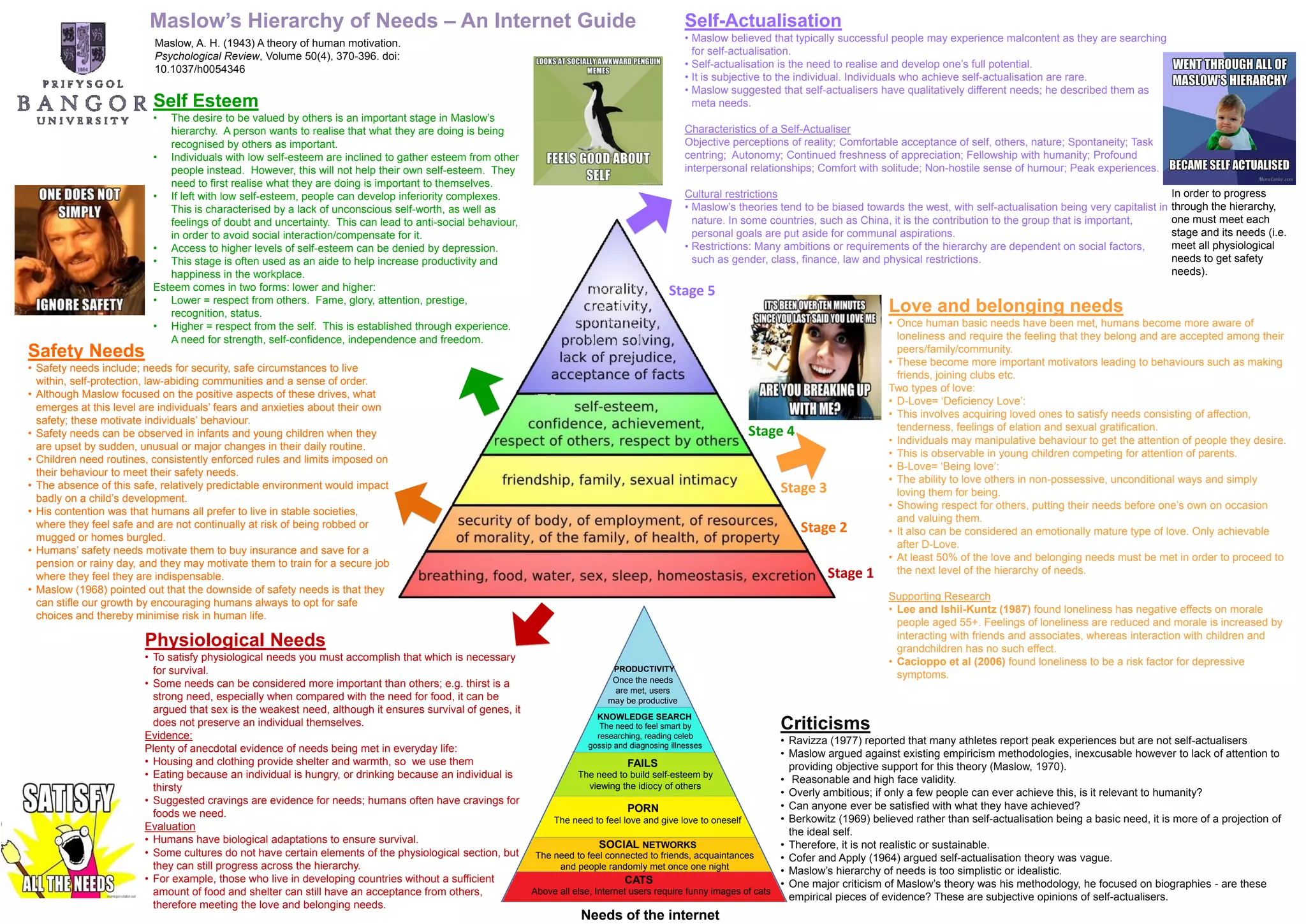
Maslow’s Hierarchy of Needs – An Internet Guide                                                                         Self-Actualisation
                          Maslow, A. H. (1943) A theory of human motivation.                                                                     • Maslow believed that typically successful people may experience malcontent as they are searching
                          Psychological Review, Volume 50(4), 370-396. doi:                                                                        for self-actualisation.
                          10.1037/h0054346                                                                                                       • Self-actualisation is the need to realise and develop one’s full potential.
                                                                                                                                                 • It is subjective to the individual. Individuals who achieve self-actualisation are rare.
                                                                                                                                                 • Maslow suggested that self-actualisers have qualitatively different needs; he described them as
                          Self Esteem                                                                                                              meta needs.
                          •  The desire to be valued by others is an important stage in Maslow’s
                             hierarchy. A person wants to realise that what they are doing is being                                              Characteristics of a Self-Actualiser
                             recognised by others as important.                                                                                  Objective perceptions of reality; Comfortable acceptance of self, others, nature; Spontaneity; Task
                          • Individuals with low self-esteem are inclined to gather esteem from other                                            centring; Autonomy; Continued freshness of appreciation; Fellowship with humanity; Profound
                             people instead. However, this will not help their own self-esteem. They                                             interpersonal relationships; Comfort with solitude; Non-hostile sense of humour; Peak experiences.
                             need to first realise what they are doing is important to themselves.
                          • If left with low self-esteem, people can develop inferiority complexes.                                              Cultural restrictions                                                                                      In order to progress
                             This is characterised by a lack of unconscious self-worth, as well as                                               • Maslow’s theories tend to be biased towards the west, with self-actualisation being very capitalist in   through the hierarchy,
                             feelings of doubt and uncertainty. This can lead to anti-social behaviour,                                            nature. In some countries, such as China, it is the contribution to the group that is important,         one must meet each
                             in order to avoid social interaction/compensate for it.                                                               personal goals are put aside for communal aspirations.                                                   stage and its needs (i.e.
                          • Access to higher levels of self-esteem can be denied by depression.                                                  • Restrictions: Many ambitions or requirements of the hierarchy are dependent on social factors,           meet all physiological
                          • This stage is often used as an aide to help increase productivity and                                                  such as gender, class, finance, law and physical restrictions.                                           needs to get safety
                             happiness in the workplace.                                                                                                                                                                                                    needs).
                          Esteem comes in two forms: lower and higher:                                                                      Stage 5
                          • Lower = respect from others. Fame, glory, attention, prestige,
                             recognition, status.                                                                                                                                           Love and belonging needs
                          • Higher = respect from the self. This is established through experience.                                                                                         • Once human basic needs have been met, humans become more aware of
                             A need for strength, self-confidence, independence and freedom.                                                                                                  loneliness and require the feeling that they belong and are accepted among their
Safety Needs                                                                                                                                                                                  peers/family/community.
                                                                                                                                                                                            • These become more important motivators leading to behaviours such as making
• Safety needs include; needs for security, safe circumstances to live
                                                                                                                                                                                              friends, joining clubs etc.
  within, self-protection, law-abiding communities and a sense of order.
                                                                                                                                                                                            Two types of love:
• Although Maslow focused on the positive aspects of these drives, what
                                                                                                                                                                                            • D-Love= ‘Deficiency Love’:
  emerges at this level are individuals’ fears and anxieties about their own
                                                                                                                                                                                            • This involves acquiring loved ones to satisfy needs consisting of affection,
  safety; these motivate individuals’ behaviour.
                                                                                                                                                              Stage 4                         tenderness, feelings of elation and sexual gratification.
• Safety needs can be observed in infants and young children when they
                                                                                                                                                                                            • Individuals may manipulative behaviour to get the attention of people they desire.
  are upset by sudden, unusual or major changes in their daily routine.
                                                                                                                                                                                            • This is observable in young children competing for attention of parents.
• Children need routines, consistently enforced rules and limits imposed on
                                                                                                                                                                                            • B-Love= ‘Being love’:
  their behaviour to meet their safety needs.
                                                                                                                                                                                            • The ability to love others in non-possessive, unconditional ways and simply
• The absence of this safe, relatively predictable environment would impact                                                                                          Stage 3                  loving them for being.
  badly on a child’s development.
                                                                                                                                                                                            • Showing respect for others, putting their needs before one’s own on occasion
• His contention was that humans all prefer to live in stable societies,
                                                                                                                                                                                              and valuing them.
  where they feel safe and are not continually at risk of being robbed or                                                                                                 Stage 2           • It also can be considered an emotionally mature type of love. Only achievable
  mugged or homes burgled.
                                                                                                                                                                                              after D-Love.
• Humans’ safety needs motivate them to buy insurance and save for a
                                                                                                                                                                                            • At least 50% of the love and belonging needs must be met in order to proceed to
  pension or rainy day, and they may motivate them to train for a secure job
  where they feel they are indispensable.                                                                                                                                      Stage 1        the next level of the hierarchy of needs.
• Maslow (1968) pointed out that the downside of safety needs is that they
                                                                                                                                                                                            Supporting Research
  can stifle our growth by encouraging humans always to opt for safe
                                                                                                                                                                                            • Lee and Ishii-Kuntz (1987) found loneliness has negative effects on morale
  choices and thereby minimise risk in human life.
                                                                                                                                                                                              people aged 55+. Feelings of loneliness are reduced and morale is increased by
                                                                                                                                                                                              interacting with friends and associates, whereas interaction with children and
                        Physiological Needs                                                                                                                                                   grandchildren has no such effect.
                        • To satisfy physiological needs you must accomplish that which is necessary                                                                                        • Cacioppo et al (2006) found loneliness to be a risk factor for depressive
                          for survival.                                                                                      PRODUCTIVITY
                                                                                                                             Once the needs
                                                                                                                                                                                              symptoms.
                        • Some needs can be considered more important than others; e.g. thirst is a
                                                                                                                             are met, users
                          strong need, especially when compared with the need for food, it can be                           may be productive
                          argued that sex is the weakest need, although it ensures survival of genes, it
                                                                                                                         KNOWLEDGE SEARCH
                          does not preserve an individual themselves.                                                     The need to feel smart by                  Criticisms
                        Evidence:                                                                                        researching, reading celeb
                                                                                                                                                                       • Ravizza (1977) reported that many athletes report peak experiences but are not self-actualisers
                        Plenty of anecdotal evidence of needs being met in everyday life:                              gossip and diagnosing illnesses
                                                                                                                                                                       • Maslow argued against existing empiricism methodologies, inexcusable however to lack of attention to
                        • Housing and clothing provide shelter and warmth, so we use them                                           FAILS                                providing objective support for this theory (Maslow, 1970).
                        • Eating because an individual is hungry, or drinking because an individual is                The need to build self-esteem by
                                                                                                                                                                       • Reasonable and high face validity.
                          thirsty                                                                                        viewing the idiocy of others
                                                                                                                                                                       • Overly ambitious; if only a few people can ever achieve this, is it relevant to humanity?
                        • Suggested cravings are evidence for needs; humans often have cravings for                                                                    • Can anyone ever be satisfied with what they have achieved?
                          foods we need.                                                                                            PORN
                                                                                                                The need to feel love and give love to oneself         • Berkowitz (1969) believed rather than self-actualisation being a basic need, it is more of a projection of
                        Evaluation                                                                                                                                       the ideal self.
                        • Humans have biological adaptations to ensure survival.                                            SOCIAL NETWORKS                            • Therefore, it is not realistic or sustainable.
                        • Some cultures do not have certain elements of the physiological section, but      The need to feel connected to friends, acquaintances       • Cofer and Apply (1964) argued self-actualisation theory was vague.
                          they can still progress across the hierarchy.                                          and people randomly met once one night                • Maslow’s hierarchy of needs is too simplistic or idealistic.
                        • For example, those who live in developing countries without a sufficient                                CATS                                 • One major criticism of Maslow’s theory was his methodology, he focused on biographies - are these
                          amount of food and shelter can still have an acceptance from others,             Above all else, Internet users require funny images of cats
                                                                                                                                                                         empirical pieces of evidence? These are subjective opinions of self-actualisers.
                          therefore meeting the love and belonging needs.
                                                                                                                      Needs of the internet

Maslow's Hierarchy of Needs

  • 1.
    Maslow’s Hierarchy ofNeeds – An Internet Guide Self-Actualisation Maslow, A. H. (1943) A theory of human motivation. • Maslow believed that typically successful people may experience malcontent as they are searching Psychological Review, Volume 50(4), 370-396. doi: for self-actualisation. 10.1037/h0054346 • Self-actualisation is the need to realise and develop one’s full potential. • It is subjective to the individual. Individuals who achieve self-actualisation are rare. • Maslow suggested that self-actualisers have qualitatively different needs; he described them as Self Esteem meta needs. • The desire to be valued by others is an important stage in Maslow’s hierarchy. A person wants to realise that what they are doing is being Characteristics of a Self-Actualiser recognised by others as important. Objective perceptions of reality; Comfortable acceptance of self, others, nature; Spontaneity; Task • Individuals with low self-esteem are inclined to gather esteem from other centring; Autonomy; Continued freshness of appreciation; Fellowship with humanity; Profound people instead. However, this will not help their own self-esteem. They interpersonal relationships; Comfort with solitude; Non-hostile sense of humour; Peak experiences. need to first realise what they are doing is important to themselves. • If left with low self-esteem, people can develop inferiority complexes. Cultural restrictions In order to progress This is characterised by a lack of unconscious self-worth, as well as • Maslow’s theories tend to be biased towards the west, with self-actualisation being very capitalist in through the hierarchy, feelings of doubt and uncertainty. This can lead to anti-social behaviour, nature. In some countries, such as China, it is the contribution to the group that is important, one must meet each in order to avoid social interaction/compensate for it. personal goals are put aside for communal aspirations. stage and its needs (i.e. • Access to higher levels of self-esteem can be denied by depression. • Restrictions: Many ambitions or requirements of the hierarchy are dependent on social factors, meet all physiological • This stage is often used as an aide to help increase productivity and such as gender, class, finance, law and physical restrictions. needs to get safety happiness in the workplace. needs). Esteem comes in two forms: lower and higher: Stage 5 • Lower = respect from others. Fame, glory, attention, prestige, recognition, status. Love and belonging needs • Higher = respect from the self. This is established through experience. • Once human basic needs have been met, humans become more aware of A need for strength, self-confidence, independence and freedom. loneliness and require the feeling that they belong and are accepted among their Safety Needs peers/family/community. • These become more important motivators leading to behaviours such as making • Safety needs include; needs for security, safe circumstances to live friends, joining clubs etc. within, self-protection, law-abiding communities and a sense of order. Two types of love: • Although Maslow focused on the positive aspects of these drives, what • D-Love= ‘Deficiency Love’: emerges at this level are individuals’ fears and anxieties about their own • This involves acquiring loved ones to satisfy needs consisting of affection, safety; these motivate individuals’ behaviour. Stage 4 tenderness, feelings of elation and sexual gratification. • Safety needs can be observed in infants and young children when they • Individuals may manipulative behaviour to get the attention of people they desire. are upset by sudden, unusual or major changes in their daily routine. • This is observable in young children competing for attention of parents. • Children need routines, consistently enforced rules and limits imposed on • B-Love= ‘Being love’: their behaviour to meet their safety needs. • The ability to love others in non-possessive, unconditional ways and simply • The absence of this safe, relatively predictable environment would impact Stage 3 loving them for being. badly on a child’s development. • Showing respect for others, putting their needs before one’s own on occasion • His contention was that humans all prefer to live in stable societies, and valuing them. where they feel safe and are not continually at risk of being robbed or Stage 2 • It also can be considered an emotionally mature type of love. Only achievable mugged or homes burgled. after D-Love. • Humans’ safety needs motivate them to buy insurance and save for a • At least 50% of the love and belonging needs must be met in order to proceed to pension or rainy day, and they may motivate them to train for a secure job where they feel they are indispensable. Stage 1 the next level of the hierarchy of needs. • Maslow (1968) pointed out that the downside of safety needs is that they Supporting Research can stifle our growth by encouraging humans always to opt for safe • Lee and Ishii-Kuntz (1987) found loneliness has negative effects on morale choices and thereby minimise risk in human life. people aged 55+. Feelings of loneliness are reduced and morale is increased by interacting with friends and associates, whereas interaction with children and Physiological Needs grandchildren has no such effect. • To satisfy physiological needs you must accomplish that which is necessary • Cacioppo et al (2006) found loneliness to be a risk factor for depressive for survival. PRODUCTIVITY Once the needs symptoms. • Some needs can be considered more important than others; e.g. thirst is a are met, users strong need, especially when compared with the need for food, it can be may be productive argued that sex is the weakest need, although it ensures survival of genes, it KNOWLEDGE SEARCH does not preserve an individual themselves. The need to feel smart by Criticisms Evidence: researching, reading celeb • Ravizza (1977) reported that many athletes report peak experiences but are not self-actualisers Plenty of anecdotal evidence of needs being met in everyday life: gossip and diagnosing illnesses • Maslow argued against existing empiricism methodologies, inexcusable however to lack of attention to • Housing and clothing provide shelter and warmth, so we use them FAILS providing objective support for this theory (Maslow, 1970). • Eating because an individual is hungry, or drinking because an individual is The need to build self-esteem by • Reasonable and high face validity. thirsty viewing the idiocy of others • Overly ambitious; if only a few people can ever achieve this, is it relevant to humanity? • Suggested cravings are evidence for needs; humans often have cravings for • Can anyone ever be satisfied with what they have achieved? foods we need. PORN The need to feel love and give love to oneself • Berkowitz (1969) believed rather than self-actualisation being a basic need, it is more of a projection of Evaluation the ideal self. • Humans have biological adaptations to ensure survival. SOCIAL NETWORKS • Therefore, it is not realistic or sustainable. • Some cultures do not have certain elements of the physiological section, but The need to feel connected to friends, acquaintances • Cofer and Apply (1964) argued self-actualisation theory was vague. they can still progress across the hierarchy. and people randomly met once one night • Maslow’s hierarchy of needs is too simplistic or idealistic. • For example, those who live in developing countries without a sufficient CATS • One major criticism of Maslow’s theory was his methodology, he focused on biographies - are these amount of food and shelter can still have an acceptance from others, Above all else, Internet users require funny images of cats empirical pieces of evidence? These are subjective opinions of self-actualisers. therefore meeting the love and belonging needs. Needs of the internet